供需双弱

Search documents
供需双弱,成本支撑区间震荡
Yin He Qi Huo· 2025-11-15 15:25
供需双弱 成本支撑区间震荡 银河期货研究所 周涛 期货从业证号:F03134259 投资咨询证号:Z0021009 目录 181/181/181 87/87/87 文 字 色 基 础 色 辅 助 色 137/137/137 246/206/207 第二章 核心逻辑分析 4 第一章 综合分析与交易策略 2 第三章 周度数据追踪 6 1 资料来源:Wind Bloomberg Mysteel GALAXY FUTURES 227/82/4 228/210/172 68/84/105 210/10/16 221/221/221 208/218/234 综合分析与交易策略 【综合分析】 硅铁方面,供应端样本企业开工率与产量双双下降,关注价格来到低位后是否形成减产趋势。需求方面,本周钢联样本钢材表需与 产量继续双双下降,唐山阶段性限产结束后,本周铁水产量出现反弹,但目前钢材利润仍然不佳,原料需求端始终存在下行预期。 成本端方面,枯水期叠加煤炭现货价格强势,各产区铁合金电价总体稳中偏强。总体来看,基本面供需双弱,成本端有所抬升,预 计延续底部震荡走势。 锰硅方面,供应端同样出现小幅下滑,关注后续是否形成减产趋势。需求方面 ...
原木期货日报-20251114
Guang Fa Qi Huo· 2025-11-14 03:10
1. Report Industry Investment Rating - No relevant information provided 2. Core View of the Report - In the context of weak supply and demand, the log futures market is expected to continue its weak and volatile operation. Although the spot price is weak and the supply is expected to increase, the current low futures price and the price inversion between the domestic and foreign markets provide some support for the futures price, limiting its downward space [3][4] 3. Summary According to Relevant Catalogs 3.1 Futures and Spot Prices - Futures prices: On November 13, the price of log2511 remained unchanged at 740.0; log2601 rose to 783.5, up 5.0 (0.64%); log2603 rose to 793.5, up 1.0 (0.13%); log2605 fell to 810.0, down 2.0 (-0.25%) [2] - Spot prices: The spot prices of various types of logs in ports such as Rizhao and Taicang remained unchanged on November 13 compared to November 12 [2] - Spread and basis: The 11 - 01 spread decreased by 5.0 to -43.5; the 11 - 03 spread decreased by 1.0 to -53.5; the 11 - contract basis remained unchanged at 10.0; the 01 - contract basis decreased by 5.0 to -33.5 [2] - Foreign quotes: On November 14, the CFR prices of 4 - meter medium - A radiata pine and 11.8 - meter spruce remained unchanged compared to November 7 [2] - Import cost: The RMB/USD exchange rate decreased to 7.102 on November 13, and the import theoretical cost decreased to 809.77 yuan [2] 3.2 Supply - Monthly supply: In October, the port shipping volume was 201.3 million cubic meters, up 13.99% from September; the number of departing ships from New Zealand to China, Japan, and South Korea increased by 8.0 (17.39%) [2] - Expected supply (November 10 - 16, 2025): The number of pre - arriving New Zealand log ships at 13 Chinese ports was 12, a week - on - week decrease of 25%; the total arrival volume was about 39.5 million cubic meters, a week - on - week decrease of 26% [3] 3.3 Inventory - Weekly inventory of major ports: As of November 7, the total inventory in Chinese ports increased by 5.0 (1.74%) to 288.0 million cubic meters; in Shandong, it increased by 3.2 (1.70%) to 191.5 million cubic meters; in Jiangsu, it increased by 0.2 (0.24%) to 82.45 million cubic meters [2][3] 3.4 Demand - Weekly demand: As of November 7, the daily average outbound volume in China increased by 0.35 (6%) to 6.63 million cubic meters; in Shandong, it increased by 0.60 (19%) to 3.79 million cubic meters; in Jiangsu, it decreased by 0.15 (-6%) to 2.28 million cubic meters [3]
工业硅&多晶硅日评20251114:上方承压-20251114
Hong Yuan Qi Huo· 2025-11-14 02:25
Report Industry Investment Rating No information provided in the content. Core Viewpoints - The silicon market has weak supply and demand, with limited improvement in demand. The industrial silicon market remains in an oversupply situation, which may put pressure on the upper limit of the market. Attention should be paid to the pressure level of 9,300 - 9,500 yuan/ton. [1] - The downstream replenishment willingness of polysilicon is limited, and there is significant pressure for further price increases in the spot market, which restricts the upward space of the market. Investors with existing long positions should protect their profits. [1] Summary by Related Catalogs Industrial Silicon - **Price Information**: The average price of non-oxygenated 553 (East China) remained flat at 9,350 yuan/ton, and the average price of 421 (East China) remained flat at 9,750 yuan/ton. The closing price of the futures main contract decreased by 0.54% to 9,145 yuan/ton. [1] - **Supply and Demand**: In October, the southwest production area entered the high-cost dry season, and some silicon enterprises shut down their furnaces. In November, the industrial silicon production is expected to drop below 400,000 tons. Downstream demand is weak, with polysilicon enterprises reducing production, organic silicon enterprises operating at reduced capacity or under maintenance, and silicon-aluminum alloy enterprises purchasing on demand. [1] - **Investment Strategy**: Adopt an interval trading strategy. Pay attention to the pressure level of 9,300 - 9,500 yuan/ton and monitor industrial policy changes and silicon enterprise production dynamics. [1] Polysilicon - **Price Information**: The prices of N-type dense material, N-type re-feeding material, N-type mixed material, and N-type granular silicon remained unchanged. The closing price of the futures main contract increased by 1.37% to 54,195 yuan/ton. [1] - **Supply and Demand**: Silicon material enterprises are reducing production, but some new production capacities may be put into operation. In November, production is expected to decline. The polysilicon market has light trading, and downstream resistance to high-priced resources is strong. [1] - **Investment Strategy**: Before the implementation of supply-side reform policies, investors can try to go long on dips with a light position. Monitor the launch of the polysilicon platform and macro sentiment changes. [1] Other Information - **Silicon Coal Price**: In Gansu, the silicon coal price increased slightly by 30 yuan/ton, with the average price of silicon mixed coal reaching 930 yuan/ton and the average price of granular coal reaching 1,050 yuan/ton. [1] - **Italian Agricultural Photovoltaic Project**: Italy's first-round agricultural photovoltaic plan has selected 747 projects, with a total installed capacity of 2 GW, supported by 1.7 billion euros (1.9 billion US dollars) from the European Recovery Fund. [1]
20号胶短期弱势难改
Qi Huo Ri Bao· 2025-11-13 01:54
(文章来源:期货日报) 库存持续累积 宏观预期减弱 尽管欧盟"零毁林法规"(EUDR)实施前引发部分泰国橡胶分流至欧洲市场,导致我国到港量短暂下 降,但整体供应增长趋势明确。我国橡胶进口依赖度维持在90%左右,国内供给宽松的格局难以改变。 海关总署公布的数据显示,2025年9月我国天然橡胶进口量为59.59万吨,环比增加14.41%,同比增加 20.92%,2025年1—9月累计进口471.72万吨,同比增加19.65%。 下游需求复苏不及预期导致库存去化速度放缓。数据显示,2025年9月ANRPC成员国合计消费量为 92.11万吨,环比略微增加0.15万吨,较去年同期的93.12万吨小幅减少1.01万吨。2025年1—9月ANRPC 成员国合计消费量为818.33万吨,较去年同期的837.39万吨减少19.06万吨,降幅为2.28%。在需求转弱 的背景下,供应压力正在库存端凸显。值得关注的是,近期青岛保税区结束此前的去库周期,开始进入 累库周期。数据显示,截至11月2日当周,青岛地区天胶保税和一般贸易合计库存量为44.77万吨,环比 小幅增加1.54万吨,增幅为3.57%,这反映出国内到港量增加而下游需求不 ...
中辉期货:螺纹钢早报-20251110
Zhong Hui Qi Huo· 2025-11-10 02:58
1. Report Industry Investment Ratings - **Steel products (Rebar and Hot-rolled coil)**: Cautiously bullish [1][4][5] - **Iron ore**: Cautiously bearish [1][6][7] - **Coke**: Cautiously bullish [1][9][10] - **Coking coal**: Cautiously bullish [1][12][13] - **Ferroalloys (Silicomanganese and Ferrosilicon)**: Cautiously bullish for silicomanganese; Cautiously bearish for ferrosilicon [1][16][17] 2. Core Views of the Report - **Steel products**: Rebar shows a supply-demand weakness in the off - season with production and apparent demand decreasing. Hot - rolled coil has falling production and demand, and a slight inverse - seasonal increase in inventory. Both are under pressure from the falling hot metal production [1][4][5] - **Iron ore**: This week, hot metal production decreased significantly due to environmental control and steel mill maintenance. With steel mills reducing inventory and ports accumulating inventory, and large - scale arrival of foreign ores, the short - term ore price is expected to fluctuate weakly [1][6][7] - **Coke**: The third round of price increase has been implemented, and the fourth round has started. Although coke enterprises' profits have slightly improved, they are still mostly in the loss state. The short - term replenishment enthusiasm is okay, and it runs in a range following the coking coal price [1][9][10] - **Coking coal**: Affected by safety inspections and environmental protection, the coal mine operating rate has decreased. With low inventory, sufficient pre - orders, and good sales, the short - term supply - demand pattern is healthy, and the price is expected to maintain a range [1][12][13] - **Ferroalloys**: For silicomanganese, supply is slightly down but still high, and demand is weakening with increasing inventory. For ferrosilicon, production area operating rate is increasing, demand is weakening, and inventory is increasing significantly [1][16][17] 3. Summaries According to Related Catalogs Steel Products - **Rebar**: Production and apparent demand decreased month - on - month, inventory decreased with a weaker - than - seasonal decline. It is testing the support at 3000 and may fluctuate at low levels [1][4][5] - **Hot - rolled coil**: Production and apparent demand declined, inventory increased slightly against the season, showing inventory pressure. It runs in a medium - term range and may have short - term rebounds after continuous declines [1][4][5] Iron Ore - The hot metal production decreased significantly this week. Steel mills are reducing inventory, ports are accumulating inventory, and foreign ore arrivals have increased. The short - term price is expected to be weakly volatile [1][6][7] Coke - The third - round price increase has been completed, and the fourth round has started. Coke enterprises' profits have slightly improved but are still mostly in losses. The short - term replenishment enthusiasm is okay, and it follows the coking coal price [1][9][10] Coking Coal - Affected by safety inspections and environmental protection, the coal mine operating rate decreased. With low inventory, sufficient pre - orders, and good sales, the short - term price is expected to be range - bound [1][12][13] Ferroalloys - **Silicomanganese**: Supply in the production area decreased slightly but is still at a high level. Demand is weakening, inventory is increasing with a slower growth rate. The short - term cost has some support [1][16][17] - **Ferrosilicon**: The production area operating rate is increasing, demand is weakening, and inventory is increasing significantly. Although the cost has some support, the fundamental situation is loose, and it is advisable to short on rallies [1][16][17]
顺丁橡胶:对标上一轮行情低点,探求价格止跌机会
Sou Hu Cai Jing· 2025-11-10 02:25
Core Viewpoint - The market for butadiene rubber is experiencing a downward trend, with prices hitting a new low since its listing, primarily due to declining costs and macroeconomic issues affecting demand [1][2]. Price Movement - As of November 5, 2025, the price of BR9000 in the North China market was approximately 9900 CNY/ton, down 600 CNY/ton from October 31, with a low point of around 9700 CNY/ton, marking a return to the price levels of the second quarter of 2023 [2][4]. Macro Environment - The macroeconomic outlook for 2025 is characterized by a transition from rapid growth to high-quality development, with expected demand growth slowing down. The impact of overseas tariff issues is overshadowing optimistic domestic expectations [4][6]. Supply and Demand Dynamics - The butadiene market is facing increased supply, leading to a downward price trend. As of November 5, 2025, the price of butadiene in the Jiangsu-Zhejiang region was 6825 CNY/ton, with a price difference from rubber prices at 2975 CNY/ton, indicating a significant supply-demand imbalance [4][6]. Inventory Levels - The overall supply of butadiene rubber is expected to grow more than demand, with inventory levels increasing by approximately 36% compared to the previous low price point. This high inventory level is likely to exert downward pressure on prices [6][7]. Future Expectations - The current market conditions suggest a lack of clear support for price stabilization, with expectations of further declines in raw material prices and a slowdown in downstream demand, particularly in the fourth quarter of 2025 [6][7].

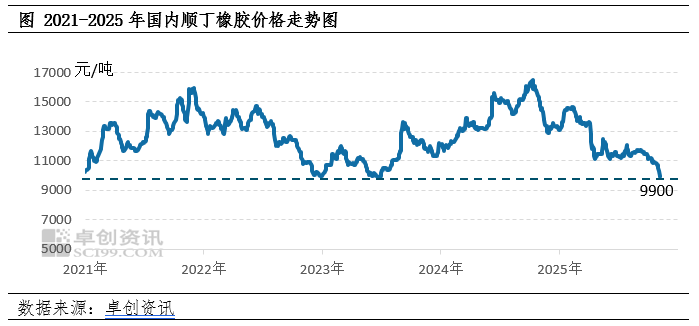
冠通期货研究报告:供需双弱,铜价盘整
Guan Tong Qi Huo· 2025-11-07 09:55
供需双弱,铜价盘整 发布日期:2025 年 11 月 7 日 【行情分析】 今日沪铜高开高走,日内下行。供给方面,据 SMM 数据显示,2025 年 10 月 SMM 中 国阳极铜企业的开工率为 53.05%,环比上升 3.99 个百分点,其中矿产阳极铜开工率环 比下降 5.45%,再生铜开工环比上升 8.48%。冶炼端加工费依旧负值且维持平稳,显现铜 矿资源偏紧,印尼铜矿端事故预计将影响全球铜供应至明年,本周铜精矿库存有回升, 但依然大幅偏低于去年同期,目前长协订单价格依然在谈判中,就目前铜精矿紧张格局 之下,市场预计此次长协定价将位于零或出现负值的水平。据 SMM 统计 11 月份市场预计 依然有 5 家冶炼厂有检修计划,预计后续废铜供应将有所增加,补充铜矿端偏紧的缺 口。据海关总署数据显示,10 月份未锻轧铜及铜材进口量从上月的 48.5 万吨下滑至 43.8 万吨,降幅达 9.7%。需求方面,随着近日铜价的上涨,下游需求受到一定的抑制, 开工多有小幅的下移,沪铜近几日温和小幅累库。综合来看,铜基本呈现供需双弱的格 局,目前铜价盘整中,等待市场新的驱动。 资料来源:同花顺期货通(日线图表) 【冠通期货研 ...
螺纹钢周度数据(20251107)-20251107
Bao Cheng Qi Huo· 2025-11-07 02:41
Report Summary 1) Report Industry Investment Rating - Not provided in the given content 2) Report's Core View - The supply and demand of rebar have both weakened. The supply has contracted but remains at a relatively high level this year with high inventory and unrelieved supply pressure. The demand has also declined, with weekly apparent demand dropping and speculative demand being weak. In the situation of weak supply - demand, the industrial contradiction remains unsolved, inventory reduction is limited, and steel prices continue to be under pressure. However, the cost provides some support, and the subsequent trend is expected to continue the shock - bottoming pattern [3]. 3) Summary by Related Categories Supply - The weekly output of rebar is 208.54 tons, a week - on - week decrease of 4.05 tons. The blast furnace capacity utilization rate is 87.81%, a week - on - week decrease of 0.80 percentage points. The supply has contracted again but is still at a relatively high level this year [1]. Demand - The weekly apparent demand for rebar is 218.52 tons, a week - on - week decrease of 13.66 tons. The speculative demand is weak under the weak steel price, and both the apparent demand and speculative demand are at low levels in recent years. With the approaching off - season and no improvement in downstream, the demand is likely to continue to weaken [1][3]. Inventory - The total inventory of rebar is 592.54 tons, a week - on - week decrease of 9.98 tons. The in - plant inventory is 166.84 tons, a week - on - week decrease of 4.87 tons, and the social inventory is 425.70 tons, a week - on - week decrease of 5.11 tons. The inventory level is high, and the supply pressure is not relieved [1].
市场情绪回暖,钢矿震荡企稳:钢材&铁矿石日报-20251106
Bao Cheng Qi Huo· 2025-11-06 10:04
1. Report Industry Investment Rating No relevant content provided. 2. Core Views of the Report - The main contract price of rebar fluctuated and stabilized, with a daily increase of 0.40%. Currently, rebar supply has declined, but demand has also decreased. In the situation of weak supply and demand, industrial contradictions remain unresolved, inventory reduction is limited, and steel prices continue to be under pressure. The relative positive factor is cost support. It is expected that the subsequent trend will continue to fluctuate and find the bottom. Pay attention to the production situation of steel mills [5]. - The main contract price of hot - rolled coil fluctuated, with a daily increase of 0.22%. Currently, the supply of hot - rolled coil has declined from a high level, but demand is also poor. In the situation of weak supply and demand, industrial contradictions continue to accumulate, and hot - rolled coil prices continue to be under pressure. Given the cost support, the subsequent trend will show a pattern of fluctuating and finding the bottom, and the trend will be weaker than that of building materials. Breaking the deadlock depends on steel mills increasing production cuts [5]. - The main contract price of iron ore fluctuated and stabilized, with a daily increase of 0.65%. Currently, iron ore supply remains high, while demand continues to decline. In the situation of increasing supply and weak demand, industrial contradictions in the ore industry lead to accelerated inventory accumulation, and ore prices continue to be under pressure. The relative positive factor is the short - term market recovery. The subsequent trend will continue to be weakly fluctuating. Pay attention to the performance of steel products [5]. 3. Summary by Relevant Catalogs 3.1 Industry Dynamics - In October 2025, the average monthly working hours of major construction machinery products in China was 80.9 hours, a year - on - year decrease of 9.03% and a month - on - month increase of 3.62%. The monthly average working hours of excavators was 68.6 hours. The monthly start - up rate of major construction machinery products was 55%, a year - on - year decrease of 10.1 percentage points and a month - on - month decrease of 0.16 percentage points. The start - up rate of excavators was 55.1% [7]. - In October 2025, the total bond financing of the real estate industry was 51.24 billion yuan, a year - on - year increase of 76.9%. Affected by the low base in the same period last year, the total bond financing of real estate enterprises increased significantly. From the perspective of financing structure, the credit bond financing of the real estate industry was 32.7 billion yuan, a year - on - year increase of 50.7%, accounting for 63.8%; overseas bond financing was 2.85 billion yuan, accounting for 5.6%; ABS financing was 15.7 billion yuan, a year - on - year increase of 115.8%, accounting for 30.6%. The average bond financing interest rate was 2.56%, a year - on - year decrease of 0.42 percentage points and a month - on - month decrease of 0.13 percentage points. In the first 10 months of this year, the total bond financing of real estate enterprises was 488.24 billion yuan, a year - on - year increase of 8.6% [8]. - In the third quarter of 2025, the iron ore production of Canadian mining company IOC was 4.41 million tons, a year - on - year increase of 15% and a month - on - month decrease of 1%. The year - on - year significant increase was mainly due to the impact of a 11 - day shutdown after forest fires in the third quarter of 2024. The salable iron ore production (concentrate + pellets) was 4 million tons, a year - on - year increase of 11% and a month - on - month decrease of 6% [9]. 3.2 Spot Market - The spot prices of rebar in Shanghai, Tianjin, and the national average were 3,160 yuan, 3,190 yuan, and 3,220 yuan respectively; the spot prices of hot - rolled coil in Shanghai, Tianjin, and the national average were 3,270 yuan, 3,190 yuan, and 3,318 yuan respectively; the price of Tangshan billet was 2,930 yuan; the price of Zhangjiagang heavy scrap was 2,170 yuan; the coil - rebar price difference was 110 yuan; the rebar - scrap price difference was 990 yuan [10]. - The price of 61.5% PB powder at Shandong ports was 785 yuan; the price of Tangshan iron concentrate was 803 yuan; the sea freight from Australia was 9.63 yuan, and from Brazil was 23.15 yuan; the SGX swap (current month) was 104.33 yuan; the Platts Index (CFR, 62%) was 104.90 yuan [10]. 3.3 Futures Market | Variety | Active Contract | Closing Price | Daily Increase (%) | Highest Price | Lowest Price | Trading Volume | Volume Difference | Open Interest | Open Interest Difference | | --- | --- | --- | --- | --- | --- | --- | --- | --- | --- | | Rebar | - | 3,037 | 0.40 | 3,042 | 3,017 | 884,740 | - 264,825 | 2,020,353 | - 11,428 | | Hot - rolled Coil | - | 3,256 | 0.22 | 3,271 | 3,241 | 462,037 | 14,203 | 1,365,348 | - 7,743 | | Iron Ore | - | 777.5 | 0.65 | 779.5 | 771.0 | 259,605 | - 22,010 | 537,495 | - 7,164 | [14] 3.4 Related Charts - **Steel Inventory**: There are charts showing the weekly changes and total inventory (steel mill + social inventory) of rebar and hot - rolled coil [17][23]. - **Iron Ore Inventory**: There are charts showing the inventory of 45 ports in China, including inventory changes, seasonal inventory, and the inventory of 247 steel mills [22][25]. - **Steel Mill Production Situation**: There are charts showing the blast furnace start - up rate, capacity utilization rate, independent electric furnace start - up rate, profitability of steel mills, and the inventory of domestic mine iron concentrate [31][32][35]. 3.5后市研判(Translated as Future Market Judgment) - **Rebar**: Both supply and demand have weakened. The weekly output of rebar decreased by 40,500 tons month - on - month, and the supply has shrunk again but is still at a relatively high level this year, with high inventory levels and supply pressure not relieved. At the same time, rebar demand has weakened as expected, with the weekly apparent demand decreasing by 136,600 tons month - on - month. Speculative demand is weak due to weak steel prices. Both are at low levels in recent years, and downstream conditions have not improved. As the off - season approaches, demand is likely to continue to weaken, putting pressure on steel prices. It is expected that the subsequent trend will continue to fluctuate and find the bottom, and attention should be paid to the production situation of steel mills [38]. - **Hot - rolled Coil**: Both supply and demand are weakening. Affected by production restrictions, the weekly output of hot - rolled coil decreased by 54,000 tons month - on - month, with a limited decline, and it is still at a relatively high level this year. High inventory levels and unrelieved supply pressure continue to suppress hot - rolled coil prices. At the same time, hot - rolled coil demand has begun to weaken, with the weekly apparent demand decreasing by 175,900 tons month - on - month, and high - frequency transactions remaining sluggish. The production of the main downstream cold - rolled products has continued to decline, and industrial contradictions have not been alleviated, continuing to drag down hot - rolled coils. In addition, the improvement in external demand is limited, and the resilience of hot - rolled coil demand is weakening. It is expected that the subsequent trend will show a pattern of fluctuating and finding the bottom, and the trend will be weaker than that of building materials. Breaking the deadlock depends on steel mills increasing production cuts [39]. - **Iron Ore**: The supply - demand pattern continues to weaken. Affected by production restrictions, the terminal demand for ore has continued to decline. Last week, the average daily hot metal output and imported ore consumption of sample steel mills decreased month - on - month, and the decline continued to expand, indicating an obvious trend of weakening demand. Considering that the industrial contradictions in the steel market have not been alleviated, coupled with frequent seasonal production - restriction disturbances, ore demand is expected to continue to decline, and weak demand is likely to drag down ore prices. At the same time, the arrival of goods at domestic ports has rebounded as expected, while the shipments of overseas miners have declined. Both are at relatively high levels, and domestic ore supply has increased, increasing the supply pressure of ore. It is expected that the subsequent trend will continue to be weakly fluctuating, and attention should be paid to the performance of steel products [40].
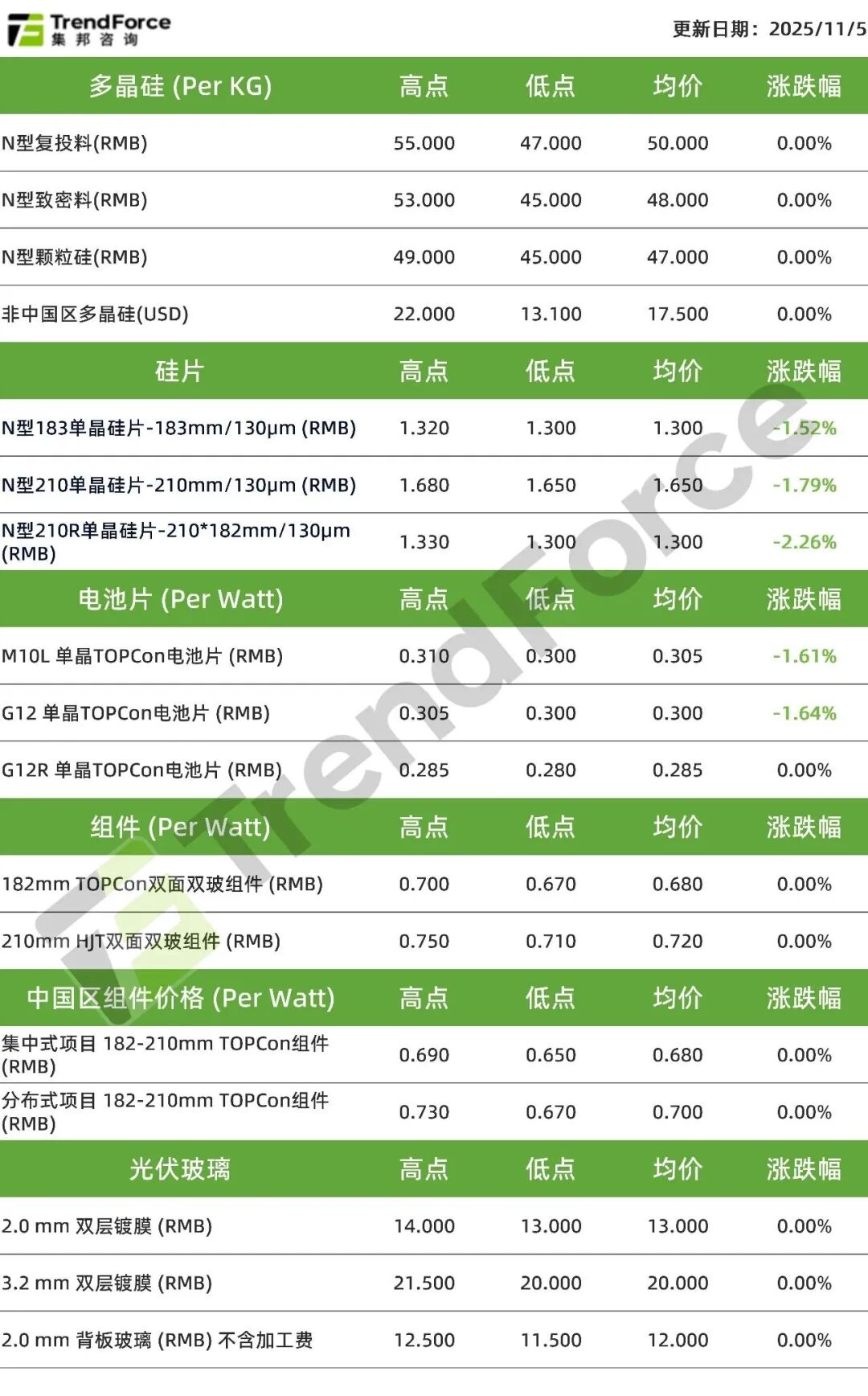
TrendForce集邦咨询:硅料价格弱势维稳 硅片、电池承压下行
Zhi Tong Cai Jing· 2025-11-06 05:51
Core Viewpoint - The silicon material prices are under pressure due to high inventory levels, but supply contraction in November and expectations for a "stockpiling" policy may provide some price support, leading to a forecast of weak stability in prices [1][2]. Group 1: Polysilicon - Current industry inventory remains above 420,000 tons, primarily due to increased polysilicon output in October and cautious procurement by downstream manufacturers [2]. - The overall polysilicon production is expected to decrease by approximately 0.8 thousand tons to around 12.7 thousand tons in November due to mixed operational adjustments among manufacturers [2]. - The market is facing a "double weakness" in supply and demand, with downstream production also showing a downward trend [2]. Group 2: Silicon Wafers - Silicon wafer inventory has risen to over 21 GW, with low procurement willingness from downstream markets due to bearish price expectations [3]. - Some silicon wafer manufacturers have begun to reduce production in response to high inventory levels and declining prices, with an increasing consensus on "production cuts to support prices" [3]. - The overall transaction prices for silicon wafers continue to decline, with significant price drops observed in second and third-tier companies [3]. Group 3: Battery Cells - Current battery inventory levels are maintained at around 5-7 days, but structural differentiation persists, particularly with rising inventory pressures on the 210RN size [4]. - Demand is structurally weak, with declining interest in 210RN and 183N sizes, influenced by reduced procurement from downstream component manufacturers [4]. - The overall battery prices face significant downward risks, with prices for 183N gradually approaching 0.3 RMB/W and 210RN stabilizing at low levels [4]. Group 4: Photovoltaic Modules - As winter approaches, outdoor projects are winding down, leading to reduced orders for module manufacturers and a decline in both domestic and overseas demand [5]. - The market is primarily supported by domestic centralized projects, but demand for 210 version modules is expected to drop sharply next month [5]. - Conventional module prices remain around 0.65 RMB/W, with overall demand weakening and insufficient order reserves for manufacturers [5]. Group 5: Price Data - Polysilicon prices remain stable with no significant changes reported [6][7]. - Silicon wafer prices for N-type 183mm and 210mm sizes have seen slight declines of 1.52% and 1.79%, respectively [6][7]. - Battery cell prices are also under pressure, with M10L and G12 sizes showing declines of 1.61% and 1.64% [6][7].