
跨年行情

Search documents
宏观与资产论(20251228):春季躁动将至?
Western Securities· 2025-12-28 12:01
Market Trends - The US stock market has initiated a "Christmas rally," with the Shanghai Composite Index achieving an eight-day winning streak and a weekly increase of 1.88%[10] - The discussion around "year-end rally" and "spring surge" is intensifying, driven primarily by liquidity and risk appetite rather than macroeconomic fundamentals[1] Liquidity and Monetary Policy - Liquidity is not a concern for the upcoming spring surge, with expectations of policy rate cuts and reserve requirement ratio reductions in the first half of 2026, although urgency is low[2] - The People's Bank of China (PBOC) has continued to signal stable liquidity through medium-term lending facility (MLF) operations, with a net injection of 1,000 billion yuan in December[56] Currency and Asset Performance - The Chinese yuan has shown orderly appreciation, with the offshore yuan briefly surpassing the 7.0 mark against the US dollar, indicating a return of correlation between stock and currency movements[17] - The A-share sentiment index rose to approximately 45 on December 26, up nearly 13 percentage points from the previous week, reflecting improved market confidence[19] Industry Insights - Silver and lithium carbonate prices have continued to perform strongly, while industrial production remains weakly differentiated, particularly in the petroleum sector[47] - The automotive sales growth has improved on a month-on-month basis, alongside rising wholesale prices for agricultural products and fruits[47] Risk Factors - Potential risks include unexpected changes in the global economic landscape, geopolitical disturbances, and policy implementations falling short of expectations[3]
机构资金买入力量有望增强
Xinda Securities· 2025-12-28 02:12
Group 1 - The core conclusion indicates that the buying power of institutional funds is expected to strengthen, with the Shanghai Composite Index achieving an "eight consecutive days of gains" and market trading volume recovering [2][8] - Positive factors catalyzing the year-end market rally include the rebound of US tech stocks, appreciation of the RMB, rising prices of non-ferrous metals (gold, silver, copper), and various themes in commercial aerospace [2][8] - The report emphasizes that the key factor driving the index to break through the upper range of the consolidation zone is the influx of incremental funds, particularly the gradual increase in institutional buying power [2][8] Group 2 - The appreciation of the RMB is beneficial for the return of overseas funds, with the RMB appreciating nearly 4% against the USD in 2025, and the offshore RMB/USD exchange rate breaking the "7" mark [9] - The report notes that the recent acceleration of inflows into stock ETFs indicates a significant increase in the net inflow scale of ETFs related to the CSI A500, suggesting that institutional funds are accelerating their layout [12][14] - The private equity fund management scale increased significantly by 1.04 trillion RMB in October 2025, reaching 7.0076 trillion RMB, and continued to rise to 7.0383 trillion RMB in November, indicating a potential important source of incremental funds for the market [14][15] Group 3 - The report highlights that there are currently no signs of accelerated inflows from resident incremental funds, but there is optimism for a seasonal surge in Q1, particularly in years when the Spring Festival is later [17][25] - The report suggests that the tactical foundation of the bull market remains solid, with the potential for a resonance between profit improvement and fund inflows [30][31] - The report recommends increasing allocations to value sectors and suggests that the technology sector typically shows significant excess returns during the spring market [36][37]
看懂这些,把握跨年行情
私募排排网· 2025-12-28 00:00
Group 1 - The core viewpoint of the article emphasizes that the "cross-year market" period is characterized by significant industry rotation and style switching rather than a straightforward market trend, with historical patterns indicating mixed performance across indices [2][4]. - Over the past decade, major broad-based indices have shown an average decline during the cross-year period, with the average returns for the CSI 500, CSI 1000, and National 2000 indices in January being -4.71%, -6.67%, and -6.68% respectively, indicating a win rate below 50% [2][4]. - The Shanghai Composite 50 and CSI 300 indices have shown average returns of -0.72% and -1.54% in January, with a win rate of 50% over the last ten years, suggesting a relatively stronger performance compared to smaller indices [2][4]. Group 2 - The article highlights that the characteristics of the cross-year market are not indicative of a general beta market trend, but rather a "defensive December and strong differentiation in January" structure, with defensive sectors performing better in December [7][12]. - In January, the banking sector has consistently outperformed other sectors, maintaining a position among the top five in terms of monthly returns, except for 2020 and 2023 [7][12]. - The average returns for most sectors in January have been negative, with many sectors showing win rates of only 30-40%, indicating a lack of broad-based gains and a tendency for performance differentiation [7][12]. Group 3 - Historical statistics suggest that the cross-year phase is not a favorable period for quantitative long strategies to achieve excess returns, but rather exposes differences in strategy concentration, drawdown control, and volatility adaptation [12]. - For investors holding quantitative long private equity funds, the focus during the cross-year period should be on assessing the ability of their products to maintain net value stability in a volatile and differentiated environment [12]. - From an asset allocation perspective, it is advisable to consider complementary configurations of styles and assets to smooth out portfolio volatility, particularly given the banking sector's relative strength in January [12].


中金研究 | 本周精选:宏观、策略、电力电气设备、科技硬件
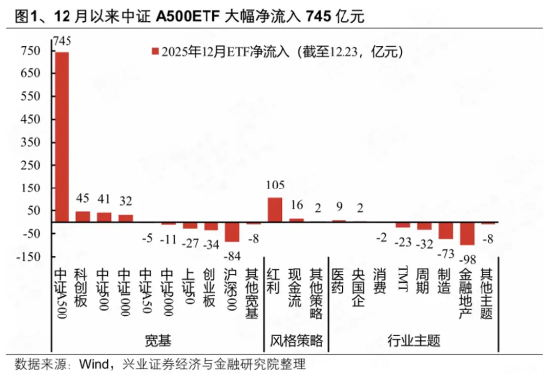
中金点睛· 2025-12-27 01:07
Strategy - The recent surge in gold prices is supported by the Federal Reserve's resumption of a loose monetary policy, declining credibility of the US dollar, and escalating geopolitical risks. The current economic environment in the US is facing stagflation pressures, indicating that the gold bull market may continue. The long-term price target for gold is projected to be between $3,300 and $5,000 per ounce, although current prices may reflect some bubble characteristics. It is advised to focus on asset trend changes rather than specific price predictions. In early 2026, rising inflation and marginal economic improvement may lead the Fed to slow down its easing, potentially putting pressure on gold prices. However, a new Fed chair and declining inflation in the latter half of the year could accelerate rate cuts, providing renewed support for gold. The asset allocation strategy suggests maintaining an overweight position in gold, adjusting commodities to benchmark, and maintaining an overweight in Chinese stocks while underweighting Chinese bonds and benchmarking US stocks and bonds [5][6]. Market Analysis - The recent divergence between stock and currency markets is attributed to different driving factors, and whether they will converge depends on the duration of the short-term factors causing the divergence and the direction of fundamental factors affecting both markets [7]. - The A-share market is experiencing fluctuations, with investor expectations showing divergence during the "cross-year" phase, influenced by both internal and external factors. The fundamental drivers of the recent market rally are rooted in the reversal of international order and industrial innovation narratives, which have not changed. The current liquidity environment remains relatively loose, and the trend of "deposit migration" among residents is expected to continue, providing a good opportunity for investors to position themselves for the "cross-year" market [9]. Industry Insights - The global energy storage market is expected to see high growth in 2026, particularly in non-US overseas markets. The demand in Europe, Asia, Africa, and Latin America is anticipated to rise, with AIDC contributing to new growth opportunities. Investment opportunities in both front-of-the-meter and behind-the-meter storage are recommended [11]. - AI is reshaping the demand structure for optical fibers, leading to a new supply-demand cycle in the industry. A supply shortage is expected to emerge within the next two years, resulting in price increases. The price of G.652.D fiber has risen by over 20% since early 2025, driven by AI's impact on multi-mode fibers and other models, which are occupying production capacity and tightening supply. This trend is likely to continue, benefiting existing manufacturers [14]. Macroeconomic Policy - Compared to previous years, the focus on supply-side measures to promote consumption has increased in the second half of 2025. The Central Economic Work Conference in December emphasized expanding the supply of quality goods and services and removing unreasonable restrictions in the consumption sector. This approach aims to release consumption potential by addressing entry barriers, optimizing regulation, and enhancing infrastructure for quality consumption. Preliminary estimates suggest that policy adjustments could impact a consumption market size of approximately 3.9 trillion yuan, about 3% of GDP, with a potential 10% increase in these areas possibly boosting overall consumption growth by 0.5 percentage points [16].

沪指八连阳成交放大 融资余额创历史新高
Zheng Quan Shi Bao· 2025-12-26 22:49
Group 1 - The A-share market continues to strengthen, with the Shanghai Composite Index rising for eight consecutive days, marking a significant trend similar to the one observed in April near the 3000-point level [1] - The total trading volume for the week reached 9.83 trillion yuan, the highest in nearly six weeks, with a daily trading volume surpassing 2 trillion yuan on Friday [1] - Margin financing saw a significant increase, with a net purchase of over 41.3 billion yuan, the highest in 11 weeks, bringing the financing balance to a historical high of 2.53 trillion yuan [1] Group 2 - The electronics sector received over 10.7 billion yuan in net financing, while the communication sector saw over 7.1 billion yuan, and the power equipment sector gained over 6.7 billion yuan in net financing [1] - Major sectors such as defense, machinery, and basic chemicals also experienced substantial net inflows, with power equipment receiving over 49.2 billion yuan and electronics over 47.1 billion yuan [1] - Only the banking and coal sectors experienced slight net outflows, indicating a strong preference for growth sectors [1] Group 3 - Looking ahead, the market is expected to follow a "cross-year market" pattern, with large-cap stocks leading the way, followed by small-cap stocks, as historical trends suggest [2] - The technology sector is anticipated to remain a key focus, with expectations of significant returns, while commodities are showing signs of a bullish trend [2] - The aerospace equipment sector has seen a remarkable increase, with the index rising 18.25% this week and 83.85% year-to-date, indicating strong investor interest [2] Group 4 - Recent developments in the aerospace sector include the launch of the Commercial Space Industry Alliance Innovation Fund and the successful launch of the Long March 8 rocket, which is expected to drive rapid expansion in the industry [3] - The upcoming measures to support the G60 Science and Technology Corridor in the Yangtze River Delta are set to take effect from January 1, 2026, further boosting the aerospace sector [3] - The commercial rocket sector is projected to undergo a transformation by 2026, marking a significant shift towards reusable rockets in China [3]
如何布局跨年行情?
Xin Lang Cai Jing· 2025-12-26 08:06
Core Viewpoint - The A-share market sentiment has recently improved, leading to increased discussions about the year-end market rally, with historical trends indicating a pattern of upward movement during this period since 2008 [1][13]. Market Trends - Historically, the A-share market has shown a "value-driven, growth-focused" characteristic during year-end rallies, with a balanced market style favoring large-cap, low-valuation, and cyclical stocks, influenced by expectations of stable growth policies [1][13]. - As the Spring Festival approaches, market liquidity is expected to remain ample, and risk appetite is likely to rise, shifting the market style towards small-cap and technology growth stocks [1][13]. Investment Opportunities - The current market conditions, including reduced overseas disturbances and increased global liquidity expectations, provide a solid foundation for the year-end rally, with the Central Economic Work Conference offering clearer guidance on economic and industrial development for the coming year [1][13]. - Investors are encouraged to consider a balanced investment portfolio that includes large-cap, small-cap, cyclical, and technology growth stocks, with the CSI A500 ETF (159338) being highlighted as a strong option [1][13]. CSI A500 ETF Insights - The CSI A500 ETF has seen significant inflows, with a total net inflow of 74.5 billion yuan and an average daily net inflow of nearly 5 billion yuan since December [1][13]. - The index's competitive edge lies in its rigorous selection mechanism and balanced constituent stock structure, which enhances its performance across structure, quality, and adaptability [2][16]. Index Structure and Methodology - The CSI A500 index features a balanced and forward-looking structure that aligns with economic transformation and the development of "new productive forces," covering all secondary industries and most tertiary industries [3][17]. - As of November 30, the average market capitalization of constituent stocks was 129.015 billion yuan, with 67.77% of the weight in companies with market caps exceeding 100 billion yuan, indicating strong liquidity and quality [4][18]. Risk Management and Performance - The index covers 35 secondary industries and accounts for nearly 56% of the total market capitalization and 68% of net profit attributable to shareholders, showcasing its representation of the A-share market [6][18]. - The top ten constituent stocks account for only about 20% of the index, allowing for effective risk diversification and resilience against individual stock shocks [6][18]. Selection Criteria for A500 ETF - When selecting products tracking the CSI A500 index, investors should consider tracking error metrics, holder structure, and fund profitability to assess management capabilities and long-term stability [19][20]. Investment Strategies - The CSI A500 ETF is recommended for long-term core allocation, as it represents the overall trend of China's economic development and A-share market [21]. - Grid trading and dollar-cost averaging strategies are suggested for investors looking to manage market volatility and accumulate shares over time [22][23].
国泰海通首席分析师方奕最新判断:跨年攻势开启,明确看好12月至次年2月的跨年行情
Xin Lang Cai Jing· 2025-12-26 03:56
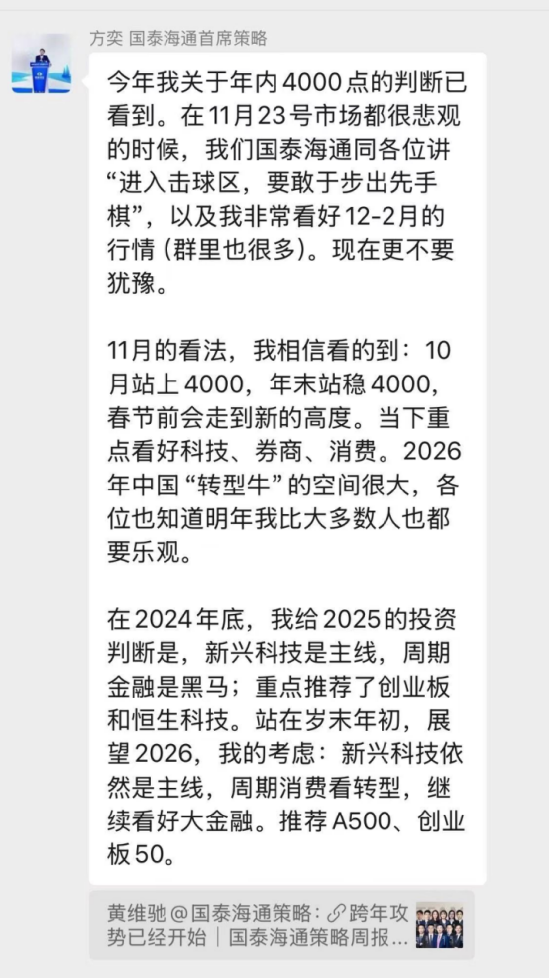
Core Viewpoint - The chief analyst Fang Yi from Guotai Junan has indicated that his previous prediction of the A-share market reaching and stabilizing at 4000 points by the end of the year is gradually being realized, with a positive outlook for the cross-year market trend from December to February [1][7]. Market Sentiment and Predictions - Fang Yi noted that the market sentiment was pessimistic on November 23, but Guotai Junan encouraged investors to take proactive steps, suggesting that the market is on track to validate the path of reaching 4000 points in October, stabilizing by year-end, and potentially rising further before the Spring Festival [1][7]. Sector Focus - Fang Yi emphasized a positive outlook on the technology, brokerage, and consumer sectors, reiterating a long-term optimistic view on China's "transformation bull market" potential by 2026 [3][9]. Asset Allocation Recommendations - In terms of asset allocation, Fang Yi revisited his 2024-end forecast for 2025, highlighting "emerging technology as the main line and cyclical finance as a dark horse," with a strong recommendation for the ChiNext and Hang Seng Technology indices. Looking ahead to 2026, he believes the logic of emerging technology will continue, with a focus on transformation opportunities in cyclical and consumer sectors, while large financial institutions still hold investment value, specifically recommending the A500 and ChiNext 50 indices [4][10].

英大证券晨会纪要-20251226
British Securities· 2025-12-26 01:56
Market Overview - The A-share market showed a mixed performance with the Shanghai Composite Index supported by heavyweight sectors, while the ChiNext Index faced a pullback due to corrections in some high-valuation stocks [1][9] - The market sentiment improved as the three major indices collectively turned positive, with the Shanghai Composite Index achieving a seven-day winning streak, indicating rising expectations for the year-end market [1][9] - The upward trend in the market is attributed to favorable policies and improvements in the exchange rate, with the central bank signaling a commitment to maintaining market stability and the RMB appreciating against the USD [1][9] Policy and Economic Outlook - The central bank's fourth-quarter meeting emphasized maintaining capital market stability and proposed measures such as stock repurchase loans and exploring regular institutional arrangements [1][9] - Despite marginal improvements in macroeconomic data, a clear recovery point has not yet been established, and corporate earnings recovery requires further observation [2][10] - Incremental policy support is expected to be concentrated around the Lunar New Year, limiting short-term market upside potential [2][10] Sector Analysis - The military industry has shown significant growth, with a 25.27% increase in the sector's overall performance since the second half of 2020, and a 25.46% increase in the first half of 2025 [6][8] - The commercial aerospace sector is experiencing heightened activity due to clear top-level policies and the establishment of dedicated regulatory bodies, providing a stable development environment [7][8] - The robotics industry has seen substantial gains, with the humanoid robot sector increasing by approximately 80% since early January 2025, driven by strong internal growth and supportive government policies [8][9] Investment Strategy - Investors are advised to focus on sectors with strong earnings support, including technology growth areas (semiconductors, AI themes, robotics), cyclical industries (solar, batteries, chemicals), and dividend stocks (banks, utilities) [2][10] - Caution is recommended against high-valuation speculative stocks lacking earnings support, as the market may experience differentiation among individual stocks [2][10]
A股罕见七连阳 短线关注5日线
Xin Lang Cai Jing· 2025-12-25 16:21
Group 1 - The A-share market indices experienced a slight rise on Thursday, with the Shanghai Composite Index achieving a seven-day winning streak, closing up 0.47% at 3959.62 points, the Shenzhen Component Index up 0.33% at 13531.41 points, and the ChiNext Index up 0.30% at 3239.34 points [1] - The total trading volume in the Shanghai and Shenzhen markets reached 1.9245 trillion yuan, an increase of 44.3 billion yuan compared to the previous trading day, with nearly 3,800 stocks rising and close to 100 stocks hitting the daily limit [1] - The market's upward trend is supported by favorable policies and improvements in the exchange rate, with the central bank signaling a commitment to maintaining market stability and providing liquidity support through various monetary tools [1] Group 2 - Historical trends indicate that a seven-day winning streak is rare in the A-share market and often suggests a continuation of the upward trend, typically accompanied by increased trading volume and a broadening profit effect [2] - However, caution is advised as historical data shows that after a seven-day winning streak, the market may experience differentiation or short-term pullbacks due to profit-taking and differing expectations for future positive developments [2] - The market's rebound is characterized by a moderate pace, lacking a clear core theme, and rapid rotation of hotspots, indicating that market participants remain cautious [3]
债市日报:12月25日
Xin Hua Cai Jing· 2025-12-25 08:50
Core Viewpoint - The bond market is experiencing fluctuations with a general downward trend, particularly in government bond futures, while short-term bonds continue to show strength. The overall liquidity remains manageable under the central bank's guidance, despite rising funding demands as the year-end approaches [1][4]. Market Performance - Government bond futures closed lower across the board, with the 30-year contract down 0.24% to 112.51, the 10-year contract down 0.02% to 108.195, and the 5-year contract down 0.03% to 105.99. The 2-year contract also fell by 0.02% to 102.51 [2]. - The yield on the 30-year government bond rose by 0.9 basis points to 2.2275%, while the 10-year bond yield increased by 1 basis point to 1.8980%. Conversely, the 1-year bond yield decreased by 2 basis points to 1.32% [2]. Overseas Bond Market - U.S. Treasury yields fell across the board, with the 2-year yield down 2.45 basis points to 3.506% and the 10-year yield down 2.73 basis points to 4.136%. In the Eurozone, the 10-year French bond yield decreased by 5.1 basis points to 3.559% [3]. Funding Conditions - The central bank conducted a reverse repurchase operation of 1,771 billion yuan at a fixed rate of 1.40%, resulting in a net injection of 888 billion yuan for the day. The central bank is also set to conduct a 4,000 billion yuan operation for 1-year MLF [4]. - Shibor rates showed mixed performance, with the overnight rate falling to 1.262%, the lowest since August 2023, while the 7-day rate rose to 1.4% [4]. Institutional Insights - CITIC Securities noted an improvement in bond market sentiment, with the 10-year government bond yield stabilizing below 1.85%. There is renewed market interest in the "cross-year market" as long-term bonds begin to recover [5]. - Huatai Fixed Income highlighted that post-2020, there has been an increase in precautionary savings among households, leading to a significant rise in long-term deposits in the banking system. The upcoming maturity of these deposits poses a re-pricing challenge [5]. - China International Capital Corporation (CICC) indicated that while there may be short-term pressure on wealth management products, demand for credit bonds is expected to remain stable due to ongoing needs for credit debt amidst fluctuating interest rates [6].