
反内卷

Search documents
2025年12月CPI和PPI点评:工业消费品带动物价温和修复
Changjiang Securities· 2026-01-11 10:44
Group 1: Report Title and General Information - The report is titled "Industrial Consumer Goods Drive Moderate Price Recovery - December 2025 CPI and PPI Review" [1] - The report was published on January 11, 2026 [10] Group 2: Report Highlights and Core Views - In December 2025, domestic prices improved unexpectedly supported by imported factors and pre - holiday consumption. Core CPI year - on - year growth remained at 1.2%, and the year - on - year decline of PPI narrowed [2] - In 2026, food CPI may still be dragged down by pig prices in the first half of the year, but the service sector is resilient, and the industrial consumer goods sector is supported by the "anti - involution" policy and the international metal price increase cycle. With the low - base effect, prices may continue a moderate recovery. It is neutrally expected that the year - on - year growth rate of PPI will turn positive in the fourth quarter [2] - This year, the bond market may operate in an environment of moderate price recovery. The long - term bond is expected to fluctuate weakly, with the 10 - year Treasury yield expected to fluctuate between 1.8% - 1.9%. The bond market's periodic recovery opportunity may come in the second half of the first quarter [2] Group 3: December 2025 Price Data - In December 2025, CPI rose 0.2% month - on - month and 0.8% year - on - year, with the year - on - year increase expanding by 0.1 percentage points compared with the previous month. Core CPI rose 1.2% year - on - year [7] - In December 2025, PPI rose 0.2% month - on - month and fell 1.9% year - on - year, with the year - on - year decline narrowing by 0.3 percentage points compared with the previous month [7] Group 4: Factors Affecting CPI Core CPI - Industrial consumer goods are the main support for core CPI, while service prices are stable. In December 2025, the year - on - year growth rate of core CPI remained at 1.2% for three consecutive months [11] - The year - on - year growth rate of industrial consumer goods (excluding energy) prices increased to 2.5% for six consecutive months, driving the year - on - year increase of CPI by about 0.63 percentage points. Gold jewelry prices rose 5.6% month - on - month due to rising international gold prices; copper and memory price increases drove household appliances and communication tools to rise 1.4% and 3% month - on - month respectively; the price decline of fuel cars and new - energy cars narrowed to 2.4% and 2.2% year - on - year respectively [11] - Service prices improved steadily, with the year - on - year growth rate slightly falling 0.1 percentage points to 0.6%. Among them, the month - on - month prices of household services and medical services were still stronger than the seasonal average [11] Overall CPI - The increase in food prices drove CPI to continue rising, while energy prices still dragged down CPI. In December 2025, CPI was stronger than the seasonal average month - on - month, and the year - on - year increase expanded by 0.1 percentage points to 0.8%, reaching the highest level since March 2023 [11] - Food prices rose 1.1% year - on - year, with the increase expanding by 0.9 percentage points compared with the previous month, driving the year - on - year increase of CPI by about 0.21 percentage points. Pre - holiday consumption demand pushed up the prices of fresh fruits and shrimps and crabs by 2.6% and 2.5% respectively. The drag of pork and egg prices on the year - on - year CPI decreased, but pig prices may remain low in the first half of this year [11] - Energy prices fell 3.8% year - on - year, with the decline expanding by 0.4 percentage points compared with the previous month. Affected by international oil price changes, domestic gasoline prices fell 1.2% month - on - month, and the year - on - year decline expanded to 8.4% [11] Group 5: Factors Affecting PPI - The continuous implementation of the "anti - involution" policy and the increase in international non - ferrous metal prices drove the month - on - month increase of PPI for three consecutive months, and the year - on - year decline narrowed. In December 2025, the month - on - month growth rate of PPI rebounded for three consecutive months, with the increase expanding by 0.1 percentage points to 0.2%. The year - on - year decline of PPI also narrowed by 0.3 percentage points to - 1.9% [11] - The year - on - year declines of both living materials and production materials narrowed. Production materials rose 0.3% month - on - month, while living materials remained flat month - on - month [11] - With the implementation of the "anti - involution" measures, the supply - demand structure of some industries improved, and the year - on - year price declines of the coal mining and washing, lithium - ion battery manufacturing, and photovoltaic industries narrowed [11] - The increase in international non - ferrous metal prices drove the prices of non - ferrous metal mining and dressing and non - ferrous metal smelting and rolling processing industries to rise 3.7% and 2.8% month - on - month respectively, with the increases expanding by 1.1 and 0.7 percentage points compared with the previous month [11] Group 6: Upstream and Downstream Price Trends - The prices of upstream mining industries continued to rise, while the prices of mid - and downstream industries were stable. The price game may have been transmitted to the downstream. The substantial implementation of the "anti - involution" policy drove the continuous price recovery of industries such as coal and photovoltaic, but some key industries for capacity management did not improve significantly [11] - Among upstream industries, the prices of coal mining and washing and non - ferrous metal mining and dressing increased for many months, while the year - on - year price growth rates of industries such as petroleum, coal and other fuel processing (- 7.9%) and non - metallic mineral products (- 6.8%) were still declining [11] - The month - on - month price growth rates of industries such as general equipment manufacturing, automobile manufacturing, and computer, communication and other electronic equipment manufacturing were basically flat or fluctuated slightly, and the upstream prices of most industries had not been smoothly transmitted to the mid - and downstream raw material processing and manufacturing industries [11] Group 7: Future Outlook - In 2026, food CPI may still be dragged down by pig prices in the first half of the year, but the service sector is resilient, and the industrial consumer goods sector is supported by the "anti - involution" policy and the international metal price increase cycle. With the low - base effect, prices may continue a moderate recovery. It is neutrally expected that the year - on - year growth rate of PPI will turn positive in the fourth quarter [11] - This year, the bond market may operate in an environment of moderate price recovery. The long - term bond is expected to fluctuate weakly, with the 10 - year and 30 - year Treasury yields expected to adjust to around 1.9% and 2.4% respectively. The bond market's periodic recovery opportunity may come in the second half of the first quarter [11]
李立峰、张海燕:把握做多窗口,牛市行情或将继续推进
Xin Lang Cai Jing· 2026-01-11 10:40
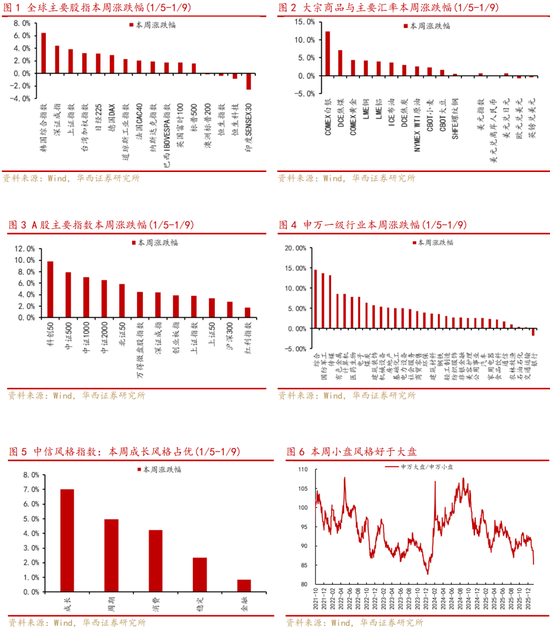
Market Overview - The A-share market achieved a "good start" in 2026, with the Shanghai Composite Index recording 16 consecutive days of gains, setting a historical record for consecutive positive trading days. Major broad-based indices experienced widespread increases, indicating a recovery in market risk appetite, with growth and small-cap styles prevailing [1][21]. - Weekly trading volume in the A-share market surpassed 30 trillion yuan, with financing transactions becoming active and the financing balance exceeding 2.6 trillion yuan, marking a historical high. Key sectors such as commercial aerospace, satellite navigation, brain-computer interfaces, and nuclear fusion continued to attract attention, while related commodities also performed well [1][21]. Market Outlook - The current market conditions suggest a continuation of the bull market, with expectations for a spring trading window. Positive economic indicators, such as better-than-expected PMI and inflation data for December, provide fundamental support for the spring market. Additionally, there is a notable increase in the willingness of external funds to enter the market, with expectations for further inflows from insurance and resident funds [1][21][23]. Key Focus Areas - The increase in market volume has facilitated the index's breakthrough of previous highs. Since 2025, the A-share market has seen three instances of trading volume exceeding 30 trillion yuan, with the latest occurring on January 9, 2026. Following these volume spikes, the indices have consistently confirmed higher trading ranges, indicating a sustained upward trend [2][21]. - The influx of financing and foreign capital reflects a significant increase in market risk appetite. The financing balance reached a historical high of 2.6 trillion yuan, with financing transactions accounting for over 11.5% of total A-share trading volume, the highest level since November 2025. Notably, foreign capital transactions also surged, with northbound capital reaching 369.6 billion yuan, the highest since October 2025 [3][22]. Economic and Policy Environment - The economic fundamentals remain supportive, with both manufacturing and non-manufacturing PMIs returning to expansion territory in December. The CPI rose by 0.8% year-on-year, while the PPI decreased by 1.9%, both better than market expectations. The macroeconomic policy environment is favorable, with coordinated fiscal and monetary policies being implemented to support market liquidity [4][23]. - The industry configuration suggests a focus on technology themes such as AI applications, commercial aerospace, robotics, and domestic substitution, as well as sectors benefiting from price increases, such as chemicals and non-ferrous metals [4][23].

黑色金属周报合集-20260111
Guo Tai Jun An Qi Huo· 2026-01-11 10:19
1. Report Industry Investment Rating No relevant information provided. 2. Core Views of the Report - The raw materials are stronger than the finished products, and the steel mill profits continue to be compressed. The iron ore pricing is detached from supply - demand, with strong macro - support. The coal - coke supply - demand is subtly repaired, but contradictions are still accumulating. The ferroalloy market is affected by long - short sentiment, and the futures trading may return to the fundamentals [8][77][136][228]. - The macro - environment is generally favorable. The Central Economic Work Conference mentioned "anti - involution", and the special commentator of Qiushi magazine proposed to improve and stabilize the real estate market expectations [10][13]. - For iron ore, although the overseas supply is marginally weakening and the domestic demand is rebounding, the pricing is mainly affected by the upward macro - risk preference, and the ore price may continue to fluctuate at a high level in the short term [79]. - For coal - coke, due to event - driven and valuation repair, the supply - demand structure has subtle changes, and it will maintain a high - level oscillation pattern. The contradictions between supply and demand are still accumulating [139]. - For ferroalloys, the alloy prices first rose and then fell this week, with a slight decline in the price center. The cost side may be supported by ore and coal prices, and the futures may maintain an oscillating trend [230]. 3. Summary by Relevant Catalogs 3.1 Steel Products - **Supply - demand and profit**: The supply - demand pattern of steel products is loose, but the cost supports the futures price rebound. The strong raw materials and weak finished products lead to the continuous compression of steel mill profits. The iron water production is expected to stop falling and then oscillate upwards, and attention should be paid to the hot - rolled coil inventory [10][14]. - **Rebar**: The basis and spread of rebar show a pattern of weak reality and strong expectation. The new - house sales remain at a low level, and the market confidence is still sluggish. The supply and demand are both weak, and the inventory is healthy. The steel mill's resumption of production and restocking expectations lead to a narrowing of the futures profit [21][26][32][37]. - **Hot - rolled coil**: The basis and spread of hot - rolled coil also show a pattern of weak reality and strong expectation. The demand is flat, and the export order receipt decreases month - on - month. The inventory is high, and production reduction is needed to reduce inventory. The steel mill's resumption of production and restocking expectations lead to a narrowing of the futures profit [42][48][49][53][55]. - **Variety spread and regional difference**: Analyzed the price spreads between different steel products (such as cold - hot spread, coil - rebar spread) and regional price differences [59][66]. 3.2 Iron Ore - **Supply**: The overseas iron ore shipments have declined from the high level at the beginning of the year, and there are also disturbances in the acceptance of Jinbuba and the pricing index of Rio Tinto and Fortescue. The supply of non - mainstream mines has some changes, and the domestic mines in the southwest region have significantly increased their production after the New Year [79][90][102]. - **Demand**: The downstream may show a restocking drive before the Spring Festival, and the iron water production has rebounded month - on - month. The substitution effect of scrap steel on iron ore is weakening [79][108]. - **Inventory**: The port inventory of iron ore remains at a high level [112][115]. - **Price performance**: The main 05 - contract price of iron ore is still strong. The medium - grade iron ore prices are strong in the spot market [83][84]. 3.3 Coal - Coke - **Supply**: The domestic coal production has rapidly recovered, and the Mongolian coal imports are expected to decline in January due to the high port inventory [136]. - **Demand**: The iron water production has increased, and the downstream raw material procurement enthusiasm has improved, but the blast furnace resumption rhythm of steel mills still needs to be observed [137]. - **Inventory**: The total inventory of coking coal at all levels has increased month - on - month, mainly in independent coking plants and ports [138]. - **Viewpoint**: The coal - coke market will maintain a high - level oscillation pattern. The contradictions between supply and demand are still accumulating, and investors are advised to try to go long at low prices [139]. 3.4 Ferroalloys (Silicon Iron and Manganese Silicon) - **Market trend**: The prices of ferroalloys first rose and then fell this week, with a slight decline in the price center. The cost side may be supported by ore and coal prices, and the futures may maintain an oscillating trend [230]. - **Manganese silicon**: The production has decreased slightly month - on - month. The new round of steel procurement is about to start, and the steel mills may start the restocking rhythm. The manganese ore supply - demand is in a weak balance, and the port prices are firm [237][244][261]. - **Silicon iron**: The production has increased month - on - month. The steel procurement volume of a large factory in Hebei has increased month - on - month, and the raw material restocking rhythm may start. The non - steel demand has some changes, and the inventory has increased [274][279][287][289].
国泰君安期货螺纹钢、热轧卷板周度报告-20260111
Guo Tai Jun An Qi Huo· 2026-01-11 10:07
1. Report Industry Investment Rating - No relevant content provided 2. Core View of the Report - The raw materials are stronger than the finished products, and the profit of steel mills continues to be compressed [3] - The macro - environment is generally favorable, and the supply - demand pattern of steel is loose, but the cost supports the rebound of the disk price. The strong raw materials and weak finished products lead to the continuous compression of steel mill profits. Technically, the black chain index, rebar, hot - rolled coil, and coke contracts face the pressure of previous highs, and chasing the rise may need to wait for the price to break through [5] - It is expected that the molten iron output will stop falling and then fluctuate and rise, and attention should be paid to the hot - rolled coil inventory [9][11] 3. Summary According to Relevant Catalogs 3.1 Threaded Steel Fundamental Data - **Threaded Steel Basis Spread**: There is a weak reality and strong expectation, and the basis spread is in a reverse spread [14] - **Threaded Steel Demand**: New home sales remain at a low level, and market confidence is still weak. Second - hand home sales remain high, indicating the existence of rigid demand. Land transaction area remains at a low level. It is the traditional off - season, and demand declines [19][22][23] - **MS Weekly Data**: The supply and demand are both weak, and the inventory is healthy. The supply and inventory of long - and short - process steel are also analyzed [24][26] - **Threaded Steel Production Profit**: With the expectation of steel mill resumption of production and inventory replenishment, the disk profit shrinks [28] 3.2 Hot - Rolled Coil Fundamental Data - **Hot - Rolled Coil Basis Spread**: There is a weak reality and strong expectation, and the basis spread is in a reverse spread [34] - **Hot - Rolled Coil Demand**: The demand is flat, with poor production schedules in the home appliance and automobile industries. The implementation of standards has led to a decrease in export orders on a month - on - month basis [38][39] - **MS Weekly Data**: The hot - rolled coil inventory is high, and production cuts are needed to reduce inventory [41][42] - **Hot - Rolled Coil Production Profit**: With the expectation of steel mill resumption of production and inventory replenishment, the disk profit shrinks [43] 3.3 Variety Regional Difference - Analyzes the regional price differences of rebar, cold - rolled coil, hot - rolled coil, and medium - thick plate [52] 3.4 Cold - Rolled Coil and Medium - Thick Plate Supply - Demand - Inventory Data - Presents the seasonal data of supply, demand, and inventory of cold - rolled coil and medium - thick plate [60]
中信证券:短期市场热度偏高,情绪没有转弱迹象
Xin Lang Cai Jing· 2026-01-11 09:43
Group 1 - The market's early-year excitement is driven by a concentration of funds that missed out on the previous year, with a backdrop of "people's desire for growth" [1][2] - The current market movement is primarily seen in thematic sectors and small-cap stocks, rather than in the direction of allocation-type funds [3][4] - Short-term market heat is high, but sentiment indicators have not shown signs of weakening, suggesting that the upward trend in thematic and small-cap stocks may continue until after the Two Sessions [4][15] Group 2 - The performance of small and mid-cap growth styles has significantly outperformed large-cap value styles, with the CSI 500 index rising by 7.9% and the CSI 2000 by 7.2%, compared to the CSI 300's 2.8% [3][13] - The commercial aerospace sector has seen a notable increase, with a trading volume of 729.1 billion yuan on January 9, accounting for 23.1% of total A-share trading [3][13] - The current market environment is characterized by abundant allocation and quantitative funds, while individual stock pricing funds are scarce, indicating a need for a shift back to fundamental-driven trends [15][16] Group 3 - For the year, allocation-type funds are increasingly focused on reducing volatility in their equity positions, as long-term interest rates continue to decline [17][18] - Recommended sectors for investment include resources and traditional manufacturing, with an emphasis on enhancing pricing power, as well as increasing allocations to non-bank financials [7][18] - The market's current excitement may not be the right time for allocation-type funds to chase hot sectors, with a more strategic approach suggested for the critical structural adjustment window in late March to April [15][16]

政策刺激短期电池抢出口,锂盐需求淡季不淡
Dong Zheng Qi Huo· 2026-01-11 09:14
Group 1: Investment Rating - The走势 rating for lithium carbonate is "oscillation" [1] Group 2: Core Views - Last week (1/5 - 1/9), lithium salt prices continued to rise. LC2601's closing price increased by 15.6% week - on - week to 139,000 yuan/ton, and LC2605's closing price rose by 18% to 143,000 yuan/ton. SMM's average spot prices of battery - grade and industrial - grade lithium carbonate increased by 18.1% and 18.2% respectively [2][12] - On January 9th, two departments announced a reduction in the VAT export tax - rebate rate for battery products from 9% to 6% from April 1st, 2026, to December 31st, 2026, and the cancellation of the VAT export tax rebate from January 1st, 2027. This will lead to a short - term rush to export batteries, increasing battery production and benefiting lithium carbonate. In the long run, it reflects the country's "anti - involution" policy. Lithium salt prices are expected to remain strong [3][13] - The second "anti - involution" meeting in the terminal battery industry aims to rectify irrational behaviors such as blind capacity construction and low - price competition. Cell prices may be more likely to rise than fall, facilitating the price - passing mechanism in the lithium - battery industry chain [3][13] - Inventory data shows off - season accumulation, but the production schedules of cathode factories have been revised upwards by multiple third - party institutions, indicating that the feature of non - weak demand in the off - season is becoming stronger [3][13][14] - Currently, high market sentiment and the rush to export strengthen the expectation of non - weak demand in the off - season. Lithium salt prices may continue to rise, showing a tendency to be more likely to rise than fall. Existing long positions can be held, while new long positions need to be carefully protected [3][14] Group 3: Summary by Directory 1. Policy Stimulates Short - term Battery Export Rush, Lithium Salt Demand Not Weak in Off - season - Lithium salt prices continued to rise last week. LC2601 and LC2605 closing prices, as well as SMM's average spot prices of battery - grade and industrial - grade lithium carbonate and lithium hydroxide, all increased significantly. The electric - industrial price difference widened, and the price discount of battery - grade lithium hydroxide to battery - grade lithium carbonate narrowed [2][12][13] 2. Weekly Industry News Review - Zhongkuang Resources' 30,000 - ton high - purity lithium salt technical renovation project was ignited for trial operation on January 2nd, 2026. After the project is put into production, the company will have a total annual production capacity of 71,000 tons of battery - grade lithium salt [15] - Two lithium iron phosphate listed companies confirmed price increases of 1,500 - 2,000 yuan/ton [15] - The first batch of price negotiations for lithium iron phosphate in the new year has landed. Most customers have accepted a processing fee increase of 1,000 yuan/ton, and there are two options for lithium carbonate settlement [16] - On January 9th, 2026, the Ministry of Finance and the State Taxation Administration announced adjustments to the VAT export tax - rebate policy for battery products [13][16] 3. Key High - frequency Data Monitoring of the Industry Chain 3.1 Resource End: Lithium Concentrate Prices Rise with the Market - Lithium concentrate prices follow the upward trend of the market [17] 3.2 Lithium Salt: Slight Increase in Production, Marginal Inventory Accumulation under Off - season Pressure - Lithium salt production increased slightly, and inventory accumulated marginally during the off - season [19] 3.3 Downstream Intermediates: Cathode Material Prices Expected to Rise Continuously - Cathode material prices are expected to continue rising [45] 3.4 Terminal: Anti - involution in the Battery Industry, Focus on the Upward Momentum of Cell Prices - The battery industry's anti - involution efforts may drive up cell prices [59]
【广发宏观团队】五年规划首年名义增长易出现反弹?
郭磊宏观茶座· 2026-01-11 09:12
Group 1 - The article discusses the potential for nominal growth rebound in the first year of the five-year plan, highlighting historical patterns where such rebounds occurred in 2006, 2010, 2016, and 2021, with specific internal and external demand influences noted [1][2] - It suggests that the first year of a new five-year plan often sees concentrated investment in key projects, leading to increased fixed asset investment growth [2][3] - The article estimates that 2026 could be a moderate recovery phase for nominal growth, driven by low fixed asset investment in the previous year and clear targets for consumption rate improvement [3][4] Group 2 - Global stock markets, including A-shares, are experiencing broad gains, with traditional sectors showing valuation recovery and growth themes like commercial aerospace and AI technology leading the charge [5][10] - The article notes a significant increase in market sentiment, with the S&P 500 fear and greed index rising to 104.5, indicating a shift towards risk-on sentiment [6] - Commodity prices are influenced by geopolitical risks, with oil and precious metals seeing price increases, while copper prices have shown volatility [7][8] Group 3 - The U.S. labor market shows signs of stabilization, with non-farm payrolls slightly below expectations but a decrease in the unemployment rate, which may affect Federal Reserve interest rate decisions [14][15] - The article highlights the potential for a significant reduction in effective tariff rates if the U.S. Supreme Court rules against the current administration's tariff powers [16][17] - The article discusses the ongoing adjustments in the domestic market, including the impact of seasonal factors on CPI and PPI, with expectations for a slight increase in CPI and a decrease in PPI [19][20] Group 4 - The article emphasizes the importance of coordinated fiscal and financial policies to stimulate domestic demand, with specific measures aimed at enhancing consumer spending and supporting private investment [30][31] - It mentions the cancellation of VAT export rebates for solar products, indicating a shift in policy that may impact the solar industry [31] - The article also addresses the need for regulatory measures in the battery industry to prevent irrational competition and ensure sustainable development [32][27]

投资策略周报:把握做多窗口,牛市行情或将继续推进-20260111
HUAXI Securities· 2026-01-11 09:07
Market Review - The A-share market started strong in 2026, with the Shanghai Composite Index achieving a record 16 consecutive days of gains, reflecting a rising market risk appetite, with growth and small-cap styles outperforming [2][3] - Daily trading volume in the A-share market exceeded 3 trillion yuan, with margin trading activity also high, as the margin balance surpassed 2.6 trillion yuan, setting a new historical high [2][4] - Key sectors such as commercial aerospace, satellite navigation, brain-computer interfaces, and nuclear fusion have shown significant performance, alongside rising prices in related commodities like non-ferrous metals [2][3] Market Outlook - The report suggests that the bull market may continue, with the A-share market entering a spring buying window, supported by better-than-expected PMI and inflation data from December [3][5] - The influx of external funds and increased willingness of market participants to invest are expected to sustain market momentum, with notable inflows from financing and foreign capital [4][5] - The report highlights the importance of upcoming events in the tech sector, particularly around the Spring Festival, which could further enhance market risk appetite [3][5] Sector Allocation - Focus on the expansion of themes in the technology sector, including AI applications, commercial aerospace, robotics, domestic substitution, and nuclear fusion [5] - Beneficiaries of the "anti-involution" trend and price increases, such as chemicals and non-ferrous metals, are also highlighted as areas of interest [5]
2025年物价回顾与2026年展望:回升的迹象增多
GOLDEN SUN SECURITIES· 2026-01-11 07:20
Macroeconomic Overview - In 2025, the CPI remained flat year-on-year at 0%, the lowest level since 2009, while the PPI decreased by 2.6%[3] - December 2025 CPI increased by 0.8% year-on-year, matching expectations, while core CPI also rose by 1.2%[1] - The PPI for December 2025 showed a year-on-year decline of 1.9%, slightly better than the expected 2.0%[1] Core Insights - CPI has risen for four consecutive months, reaching the highest level since March 2023, with core CPI also maintaining above 1% for four months[2] - The PPI has increased month-on-month for three consecutive months, driven by the non-involution sectors, while oil and petrochemical prices continue to decline[2] - For 2026, CPI is projected to rise to around 0.7%, supported by policies like trade-in programs and a narrowing decline in rental prices[2][5] Price Trends - In 2025, food prices fell by 1.5% year-on-year, marking a 25-year low, with energy prices down by 3.9%[3] - Core CPI saw a modest increase of 0.7% in 2025, with significant contributions from household appliances and communication tools, which rose by 1.8% and 0.6% respectively[3] - The international gold price surge led to a more than 40% increase in jewelry prices, significantly impacting the CPI[3] PPI Analysis - The PPI for 2025 averaged -2.6%, the second-lowest since 2016, with both production and living materials prices declining[3] - The decline in PPI was exacerbated by weak demand and excess capacity in sectors like real estate and infrastructure[3] - In 2026, PPI is expected to stabilize around -0.4%, influenced by rising prices in coal, steel, and lithium due to increased demand[5]
2026.01.05-2026.01.09日策略周报:宏观短周期略拐头,A股实现开门红-20260111
Xiangcai Securities· 2026-01-11 06:33
Group 1 - The A-share market achieved a "good start" in the first week of 2026, with major indices showing significant upward movement: Shanghai Composite Index rose by 3.82%, Shenzhen Component Index by 4.40%, and ChiNext Index by 3.89% [2][3][9] - The rise in A-shares is attributed to several factors, including proactive measures by the National Development and Reform Commission in the "two new" sectors, the positive trends in December's PMI, PPI, and CPI, and the recovery of previously adjusted technology sectors [3][13] - The report anticipates that the Shanghai Composite Index breaking through the mid-November 2025 high indicates an early onset of the spring market, with expectations of a recovery in the upward trend seen in the second half of 2025 [3][13] Group 2 - Among the 31 first-level industries, most have seen gains since the beginning of 2026, with the top performers being comprehensive, national defense and military industry, and media, which have increased by 14.55%, 13.63%, and 13.10% respectively [4][25] - In the second-level industries, aerospace equipment II and wind power equipment have led the gains with increases of 24.49% and 20.01% respectively, while state-owned large banks II and joint-stock banks II have seen declines of -2.94% and -1.92% [4][26] - The third-level industries show marketing agency and aerospace equipment III as the top gainers with increases of 26.63% and 24.49%, while state-owned large banks III and home textiles have the largest declines at -2.94% and -2.56% [4][28] Group 3 - Recent macroeconomic data indicates a slight improvement, with December's PPI showing a year-on-year decline of -1.90%, an improvement from November's -2.20%, and CPI at 0.80%, marking the third consecutive month in positive territory [5][29][30] - The macro short-cycle composite index is in a slightly turning state, suggesting that the current cycle's bottoming process is still under observation [5][30] Group 4 - The investment outlook for 2026 is optimistic, as it marks the beginning of the "14th Five-Year Plan," with a supportive policy environment for industrial upgrades and a favorable macroeconomic cycle expected to benefit upstream cyclical industries [6][7][32] - The report highlights continued interest in sectors related to "anti-involution," insurance, securities, aerospace, and strong technology sectors like artificial intelligence [7][32]