
中央经济工作会议召开

Search documents
新华述评·聚焦中央经济工作会议|必须做到既“放得活”又“管得好”——学习领会“五个必须”做好明年经济工作
Xin Hua She· 2025-12-17 14:48
Group 1 - The core idea emphasizes the need for a balance between "letting go" and "managing well" in economic work, highlighting the importance of breaking down institutional barriers while ensuring a rule-based economy [1][10] - The "Five Musts" outlined by Xi Jinping provide a framework for addressing development challenges, stimulating internal dynamics, and mitigating risks [1][10] - The focus on creating a fair and competitive market environment is essential for promoting high-quality development, as indicated by the increase in the bidding success rate of private enterprises in Hunan from 73.65% to 82.9% [2] Group 2 - The establishment of a high-standard market system is crucial for maximizing resource allocation efficiency, as stated by experts [3] - Recent measures, such as the approval of the Administrative Law Enforcement Supervision Regulations, aim to clarify responsibilities and enhance market vitality through reduced administrative approvals [4] - The importance of market rules and a conducive environment for fair competition is emphasized, ensuring equal access to production factors for all business entities [5] Group 3 - The government's role is essential in regulating market order, with recent policies focusing on risk prevention and maintaining economic stability [12] - The ongoing reforms aim to enhance the efficiency of resource allocation and reduce institutional costs, as seen in various regional initiatives [16] - The need for continuous improvement in the relationship between an effective market and a proactive government is highlighted as a key focus for future reforms [15]
新华述评·聚焦中央经济工作会议丨必须做到既“放得活”又“管得好”——学习领会“五个必须”做好明年经济工作
Xin Hua Wang· 2025-12-17 14:40
Group 1 - The core idea emphasizes the need for a balance between "letting go" and "managing well" in economic work, as highlighted by Xi Jinping during the Central Economic Work Conference [1] - The goal of "letting go" is to eliminate institutional barriers that hinder productivity, while "managing" focuses on building a rule-of-law economy [1] - The combination of an effective market and a proactive government is essential for stimulating economic vitality and ensuring sustainable growth [1] Group 2 - In Hunan, the implementation of machine-based bidding processes has increased the winning rate of private enterprises from 73.65% to 82.9% [2] - The "14th Five-Year Plan" suggests fully leveraging the market's decisive role in resource allocation while enhancing government functions to create a unified, open, competitive, and orderly market system [2][3] - The establishment of a legal framework to ensure fair competition and equal access to resources is crucial for achieving the goal of "letting go" [5] Group 3 - The recent approval of the Administrative Law Enforcement Supervision Regulations aims to clarify responsibilities and enhance market order by holding officials accountable for abuse of power [4] - The government is focused on reducing administrative approvals to boost market vitality, indicating a shift towards a more efficient regulatory environment [4][5] - The emphasis on a well-regulated market is seen as a necessary condition for the effective functioning of the economy [9] Group 4 - The Central Economic Work Conference has outlined measures to stabilize the real estate market and manage local government debt risks, emphasizing the importance of risk prevention [11] - The introduction of various reforms, such as the Fair Competition Review Regulations, aims to eliminate barriers to the free flow of resources and enhance market efficiency [10][11] - The government is committed to improving the legal and institutional framework to support the development of a fair and competitive market environment [9][10] Group 5 - The establishment of a high-standard market system is crucial for maximizing resource allocation efficiency and effectiveness [3][15] - The ongoing reforms aim to address the challenges of an underdeveloped market system, including inefficient resource allocation and barriers to factor mobility [14][15] - The focus on deepening reforms and enhancing governance capabilities is essential for building a mature and well-defined socialist market economy [15][16]
固定收益点评报告:中长期关注内需改善
Huaxin Securities· 2025-12-17 14:34
Report Overview - The report focuses on the economic data of November 2025 and provides asset allocation views, suggesting long - term attention to the improvement of domestic demand [1][4] Key Economic Data in November 2025 Production - The value - added of industrial enterprises above the designated size increased by 4.8% in November 2025, with the previous value being 4.9%. High - tech manufacturing was the main driving force. The growth rate of export delivery value was - 0.1%, significantly improved from the previous value of - 2.1%. The national service production index increased by 4.2% year - on - year, declining for 6 consecutive months, and optional consumption needed policy stimulus [1] Consumption - The total retail sales of consumer goods increased by 1.3% year - on - year in November, dropping for the 6th consecutive month and down 1.6 percentage points from the previous value. Rural areas were significantly better than urban areas. Catering revenue increased by 3.2%, maintaining a relatively high level since the second half of last year. The retail sales growth rates of communication equipment, cultural and office supplies, gold and silver jewelry, cosmetics, and grain and oil foods were above 6%. However, the sales of home appliances and building materials in the real - estate post - cycle declined sharply, and the decline of automobiles and petroleum products widened [2] Fixed - Asset Investment - The growth rate of national fixed - asset investment declined further in November, with a year - on - year decrease of 2.6% (previous value: - 1.7%). The growth rate of manufacturing investment was 1.9%, down 0.8 pct from the previous value. The transportation equipment such as railway, ship, and aerospace, automobile manufacturing, and agricultural and sideline food processing had relatively high growth rates. The growth rate of narrow - sense infrastructure investment was - 1.1% (previous value: - 0.1%), and the real - estate fixed - asset investment growth rate continued to decline to - 15.9% (previous value: - 14.7%). The year - on - year growth rate of private investment was - 5.3% (previous value: - 4.5%) [3] Asset Allocation Views - In November, production was stable, optional consumption and investment were under pressure, external demand improved, and high - tech industries were local highlights. The Central Economic Work Conference made "expanding domestic demand" the top priority for economic work in 2026. In the stage of development transformation, long - term attention should be paid to the endogenous repair of domestic demand areas such as consumption and investment, as well as price data [4]
1-11月财政数据点评:明年财政政策增量仍然值得期待
Bank of China Securities· 2025-12-17 14:11
Fiscal Revenue and Expenditure - In November, public fiscal revenue was CNY 14,026.0 billion, remaining flat year-on-year, with tax revenue at CNY 11,450.0 billion, a 2.8% increase, but the growth rate slowed by 5.8 percentage points compared to October[2] - Non-tax revenue fell to CNY 2,576.0 billion, down 10.8% year-on-year, with the decline narrowing by 22.1 percentage points from the previous month[2] - Public fiscal expenditure in November was CNY 22,713.0 billion, a decrease of 3.7% year-on-year, although the decline rate improved by 6.1 percentage points from October[3] Government Fund Performance - From January to November, government fund budget revenue totaled CNY 40,274.0 billion, down 4.9% year-on-year, with a worsening decline rate of 2.1 percentage points compared to the previous month[17] - In November, central government fund revenue was CNY 320.0 billion, down 9.1%, while local government fund revenue was CNY 5,481.0 billion, down 16.1%, with the decline rate improving by 4.3 percentage points from October[5] - The revenue from state-owned land use rights fell to CNY 4,137.0 billion, a 26.8% decrease year-on-year, with the decline rate slightly narrowing by 0.4 percentage points from October[5] Fiscal Policy Outlook - The central economic work conference emphasized the continuation of a more proactive fiscal policy, aiming to maintain necessary fiscal deficits and total expenditure levels[4] - The actual deficit rate for this year has exceeded 5.0%, and fiscal spending and financing are expected to maintain necessary strength in the coming year[4] - Broad fiscal expenditure from January to November reached CNY 340,662 billion, a 4.5% increase year-on-year, with central fiscal expenditure at CNY 47,310.0 billion, growing by 21.0%[22]
国泰海通|机械:国内政策细则出台助推太空算力发展,再提能源强国指引核聚变进程
国泰海通证券研究· 2025-12-17 14:07
Group 1 - The mechanical equipment index increased by 1.80% during the week of December 8-12, 2025, driven by domestic policy details that support the development of space computing capabilities [1] - The National Space Administration issued a plan to promote high-quality and safe development of commercial aerospace from 2025 to 2027, focusing on satellite data security and efficient utilization [1] - The Central Economic Work Conference reiterated the goal of building an "Energy Power" and provided strategic guidance for the development of controllable nuclear fusion, aiming to create a multi-layered solution for energy transition and security [2] Group 2 - In Q3 2025, global semiconductor equipment shipments increased by 11% year-on-year, reaching $33.66 billion, with strong investments in advanced technologies supporting AI computing [3] - China's semiconductor equipment sales in Q3 2025 amounted to $14.56 billion, a 13% year-on-year increase, maintaining its position as the largest market [3] - The establishment of a multi-crystalline silicon capacity integration and acquisition platform was officially announced, aimed at addressing the issue of excessive competition in the photovoltaic industry [3]


年末车市上演政策“窗口期”博弈:消费者观望,经销商鼓励先锁单
Sou Hu Cai Jing· 2025-12-17 13:42
Core Viewpoint - The central economic work conference emphasizes the continuation of the "Two New" policy (large-scale equipment updates and vehicle trade-in) for 2026, indicating a focus on domestic demand and market optimization, despite the recent suspension of local trade-in subsidies [1][5]. Group 1: Policy Changes and Market Impact - The suspension of Beijing's vehicle trade-in subsidy has led to a temporary decline in consumer enthusiasm, but interest is recovering as consumers aim to take advantage of the remaining tax exemptions for new energy vehicles [2][3]. - The upcoming reduction in new energy vehicle purchase tax from full exemption to a 50% rate is expected to increase consumer costs, influencing purchasing decisions [1][3]. - The "Two New" policy is anticipated to continue in 2026, but specific implementation details and potential adjustments remain unclear, leading to a cautious market outlook [1][8]. Group 2: Consumer Behavior and Market Trends - Two main groups of consumers are currently in a wait-and-see mode: those interested in models with tax guarantees and those waiting for the official announcement of trade-in subsidies [4][5]. - The expectation of reduced subsidy strength in 2026 may prompt consumers to make purchases before the end of the year, potentially boosting December sales [5][9]. - Recent data shows a significant decline in vehicle sales in November, marking the first year-on-year drop in nearly three years, attributed to the withdrawal of local subsidies and consumer hesitance [7][8]. Group 3: Future Market Projections - Analysts predict that while the overall vehicle market may see positive growth in 2026, challenges remain due to policy adjustments and consumer sensitivity to subsidy changes [8][10]. - The continuation of the "Two New" policy is expected to mitigate the impact of tax changes, with some analysts forecasting stable sales in early 2026 due to strong pre-holiday consumer activity [9][10]. - The automotive industry is preparing for a new phase of market dynamics, with expectations of a "survival of the fittest" scenario as policies evolve [8][10].
李迅雷专栏 | 中央经济工作会议将如何优化“存量”与“增量”
中泰证券资管· 2025-12-17 11:33
Core Viewpoint - China's economy has entered an era dominated by stock economy, facing higher demands for optimizing stock and seeking incremental growth due to its large economic scale and accumulated debt [2][4]. Group 1: Economic Environment and Policy Direction - The recent Central Economic Work Conference highlighted the deepening impact of external environmental changes, indicating increased confidence in responding to external pressures such as tariffs and technology blockades [4][5]. - The conference emphasized the need to practice internal strength to tackle external challenges, maintaining the principle of "seeking progress while ensuring stability" and better coordinating domestic economic work with international trade struggles [4][5]. - The "14th Five-Year Plan" outlines that major country relations significantly influence international situations, which in turn deeply affect domestic development, necessitating consideration of international trade dynamics in future economic work [5][6]. Group 2: Consumption and Investment Strategies - Expanding domestic demand is a strategic measure to effectively respond to external shocks, with a focus on boosting consumption through actions like implementing urban and rural resident income increase plans [6][7]. - The Central Economic Work Conference called for stabilizing investment and increasing the scale of central budget investments, aligning with major project initiations in the first year of the "14th Five-Year Plan" [6][9]. - The manufacturing sector, which accounts for about 30% of global value added, faces challenges due to external demand pressures, necessitating a focus on global capacity layout and trade protectionism concerns [6][9]. Group 3: Fiscal and Monetary Policy Adjustments - The economic work for the coming year will focus on "stability and quality improvement," with a continuation of proactive fiscal policies and moderately loose monetary policies [9][10]. - Fiscal policies will maintain necessary deficits and total debt levels, with an expected slight increase in the fiscal deficit rate from around 4% to 4.2-4.5% to support economic growth [9][10]. - Monetary policy will utilize various tools flexibly, with expectations of a 25-50 basis point reduction in reserve requirements and a 10-20 basis point interest rate cut, emphasizing the importance of reasonable price recovery [10][11]. Group 4: Innovation and Structural Reforms - The focus on innovation-driven growth is critical, with plans to establish international technology innovation centers and promote high-quality development of key industrial chains [14][15]. - The conference reiterated the importance of addressing "involution" as part of the unified national market construction, emphasizing the need for tailored approaches based on local conditions [14][15]. - Local governments are encouraged to promote new industries and models while enhancing traditional industries through new technologies, aiming for a balanced development of manufacturing and service sectors [15][17]. Group 5: Real Estate and Risk Management - The conference aimed to stabilize the real estate market through city-specific policies, inventory reduction, and promoting the construction of quality housing [17][18]. - Measures to address local government debt risks were emphasized, including proactive debt management and improving the local tax system to enhance fiscal autonomy [18].

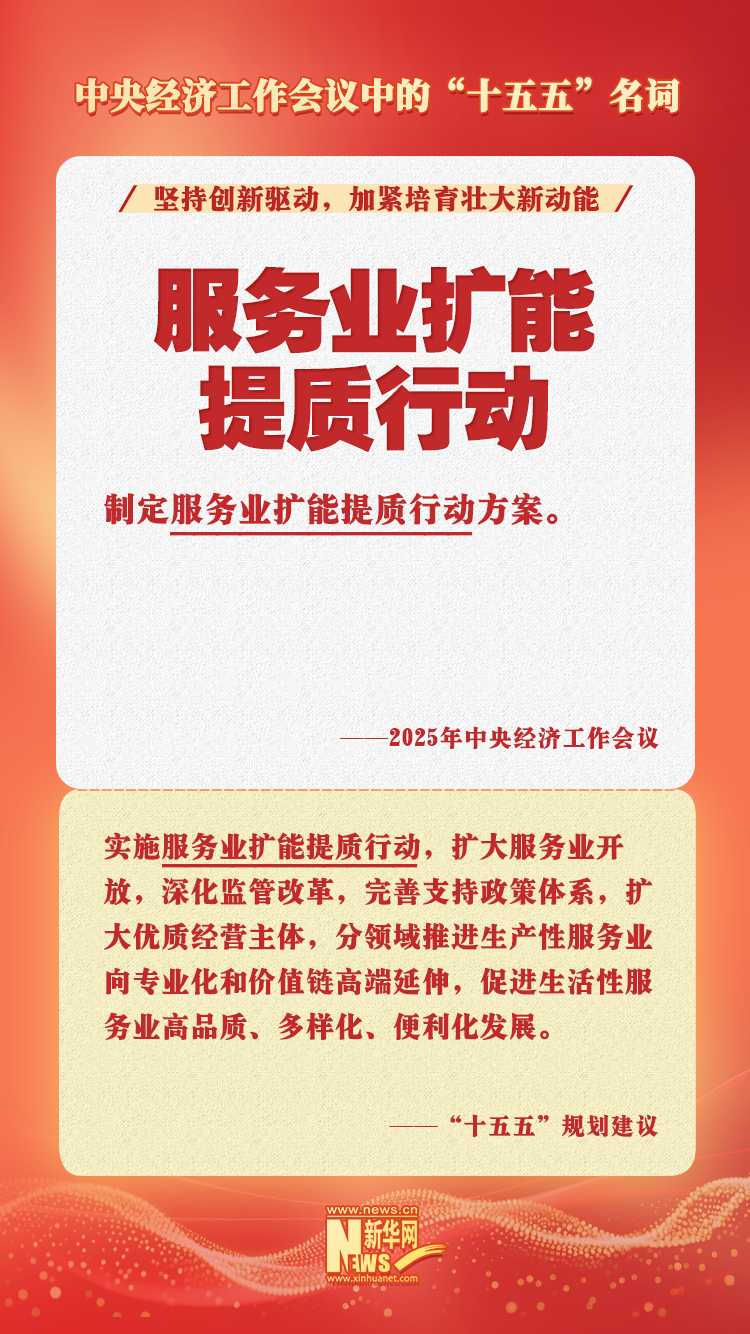
中央经济工作会议中的“十五五”名词:服务业扩能提质行动
Xin Hua Wang· 2025-12-17 09:05
Group 1 - The core viewpoint of the article emphasizes the importance of the "15th Five-Year Plan" and the economic work outlined in the recent Central Economic Work Conference, which aims to enhance the service industry's capacity and quality [1][4]. - The implementation of the service industry capacity expansion and quality improvement action is a crucial measure for promoting high-quality and efficient development in the service sector [4][5]. - The action plan focuses on addressing prominent contradictions and issues faced by the service industry, aiming to deepen reforms, expand openness, strengthen regulation, and promote innovation [4][6]. Group 2 - The action plan aims to balance effective supply expansion with quality improvement, emphasizing a target-oriented and problem-oriented approach [5][6]. - Key tasks include expanding service industry openness, aligning with international high-standard trade rules, and enhancing market access [6][7]. - The plan also highlights the need for a robust policy framework to support service industry development, including financial support and attracting social capital [6][9].
中央经济工作会议定调积极,深化投融资综合改革
East Money Securities· 2025-12-17 08:22
Investment Rating - The report maintains a "stronger than the market" investment rating for the non-bank financial sector [2] Core Insights - The Central Economic Work Conference has set a positive tone for macroeconomic policies and capital market reforms, emphasizing the importance of internal demand and the release of supportive policy signals for 2026 [6][13] - The report highlights the acceleration of mergers and acquisitions in the securities industry, which is expected to reshape the industry landscape towards a model of "leading firms excelling" and "small firms developing unique characteristics" [6][14] - The introduction of the first commercial health insurance innovation drug directory is anticipated to enhance the attractiveness of health insurance products and promote a shift from homogeneous compensation to precise protection [34][35] Summary by Sections Securities Business Overview - The report notes that the major indices have shown mixed performance, with the Shanghai Composite Index at 3,889.35 points, down 0.34% from the previous week, while the ChiNext Index rose by 2.74% [15] - The average daily trading volume in A-shares increased by 13.97% week-on-week, reaching 1.90 trillion yuan [15][21] - The report indicates that the total IPO underwriting scale for the year reached 113.97 billion yuan, with refinancing underwriting at 1,038.5 billion yuan [16] Insurance Business Overview - The report discusses the urgent need for capital replenishment among insurance companies due to the end of the transitional period for the second phase of the solvency regulatory framework, with the overall solvency adequacy ratio at 186.3%, down 11.1 percentage points year-on-year [35] - The newly implemented commercial health insurance innovation drug directory is expected to include 19 key innovative drugs, enhancing the health insurance ecosystem [34] - The report highlights that insurance companies have been actively seeking capital through various channels, with significant approvals for capital increases and bond issuances [35] Market Liquidity Tracking - The report notes that the central bank conducted a net injection of 4.7 billion yuan in the open market, with reverse repos totaling 668.5 billion yuan [38][40] - The issuance of local government bonds amounted to 106.9 billion yuan, with a net injection of 62.2 billion yuan [38][40] Industry News - The report mentions that the Shanghai Stock Exchange has revised its bond trading guidelines to enhance market efficiency and transparency [50] - The Central Economic Work Conference has reiterated the commitment to deepening capital market reforms and addressing "involution" competition [50]
博时宏观观点:岁末年初,大盘风格或相对占优
Xin Lang Cai Jing· 2025-12-17 07:53
Group 1: Monetary Policy and Economic Outlook - The Federal Open Market Committee (FOMC) has lowered interest rates by 25 basis points and announced a technical expansion of the balance sheet to prevent liquidity risks, indicating a potential slowdown in the pace of future rate cuts [1][11] - The central economic work conference in China has set a tone for moderate expansion, focusing on high-quality development and detailed policies in fiscal, monetary, domestic demand, real estate, and industrial policies, including necessary fiscal deficits and interest rate cuts [1][11] Group 2: Market Performance and Strategies - In the bond market, yields have slightly decreased during the week of December 8-12, with concerns about the ability to absorb long-term bonds and expectations of rising prices affecting market sentiment [1][11] - A-shares are experiencing weak corporate earnings and negative liquidity and risk appetite, suggesting that a rebound may take time [2][12] - The Hong Kong stock market may face volatility due to the FOMC's easing expectations and weak employment conditions [2][12] Group 3: Commodity Market Insights - Global oil demand remains weak, with ongoing supply releases and inventory accumulation putting pressure on prices [3][13] - Following the FOMC's actions, gold may experience short-term volatility but is expected to have a positive long-term development trend [3][13]