
债券

Search documents
新《证券法》实施5周年专辑|法治之光点亮债券市场新征程——纪念新《证券法》实施5周年
Xin Lang Cai Jing· 2025-11-10 23:03
Core Viewpoint - The implementation of the new Securities Law over the past five years has significantly advanced the legal framework of the bond market in China, focusing on registration system reform and zero-tolerance regulation, thereby enhancing the bond market's ability to support national strategies and manage risks [1][2]. Group 1: Legal Foundation - The new Securities Law has unified the regulation of corporate credit bonds, eliminating regulatory arbitrage and establishing a solid legal foundation for the bond market [3]. - The transition from administrative approval to a market-based registration system has streamlined the bond issuance process, significantly reducing the time required for bond registration [4][5]. Group 2: Trading Mechanism - The breaking of rigid repayment guarantees has led to the establishment of a risk pricing mechanism, enhancing market efficiency and accountability [6][7][8]. - The bond market has seen a reduction in the rolling default rate from 0.88% in 2019 to 0.05% in 2023, indicating a shift towards rational pricing and maturity in the market [8]. Group 3: Regulatory Environment - The new Securities Law has increased penalties for securities violations, enhancing the deterrent effect against illegal activities and improving market integrity [9]. - The regulatory framework has been strengthened to ensure that securities service institutions are held accountable for the accuracy and completeness of their reports [9]. Group 4: Economic Support - The bond market has played a crucial role in stabilizing the economy during crises, such as the issuance of 1 trillion yuan in special bonds to counter the economic impact of the COVID-19 pandemic [11]. - The rise of green bonds has supported the transition to a low-carbon economy, with issuance growing from 201.8 billion yuan in 2016 to 683.3 billion yuan by 2024 [12][13]. Group 5: Market Structure and Innovation - The bond market has diversified its product offerings, including the introduction of innovative instruments like tech innovation bonds and real estate investment trusts (REITs) [14][15]. - Technological advancements, such as blockchain, are being integrated into the bond market to enhance efficiency and transparency [15]. Group 6: Internationalization - The bond market has accelerated its internationalization, with the issuance of panda bonds and the establishment of cross-border investment mechanisms [16][17]. - The international influence of Chinese bonds has grown, with Chinese government bonds being included in major global bond indices [17]. Group 7: Future Outlook - The bond market must focus on risk prevention, regulatory openness, and technological empowerment to address challenges posed by global economic fluctuations and local debt pressures [19][20]. - Establishing a unified rating system and enhancing local government debt management are critical for maintaining market stability [20][21][22].
减持美债后,我国大量购买美国大豆和黄金!剩下万亿美债会将全抛吗?
Sou Hu Cai Jing· 2025-11-10 17:50
Core Insights - China has significantly reduced its holdings of U.S. Treasury bonds, dropping to $856 billion as of July 2025, a decrease of approximately $112 billion or 11.6% year-over-year [1][3] - Concurrently, China has increased its imports of U.S. soybeans and gold, with soybean imports rising by 28.6% to 21.8 million tons and gold imports increasing by 36.2% to 707 tons in the first half of 2025 [1][3] Group 1: U.S. Treasury Bonds - China has been the largest holder of U.S. Treasury bonds, with holdings peaking over $1.3 trillion around 2013, but has seen a gradual decline of about 35% since then [3][4] - The reduction in U.S. Treasury holdings began in 2018, with a total decrease of approximately $3.5 trillion from 2018 to 2024 [3][4] - The motivations for reducing U.S. Treasury holdings include the need for diversified asset allocation, managing risks associated with potential U.S. dollar depreciation, and seeking higher investment returns [4][8] Group 2: Soybean and Gold Imports - The increase in soybean imports is driven by domestic demand and price competitiveness, with a projected demand of 120 million tons against a domestic production of only 18 million tons [4][5] - The rise in gold imports reflects a strategic asset allocation adjustment, as gold serves as a hedge against inflation and geopolitical risks [7][8] - China's central bank has actively participated in gold purchases, adding approximately 105 tons in the first half of 2025, amidst a global trend of increasing gold demand [7][10] Group 3: Economic Implications - The adjustments in China's foreign exchange reserves, including the reduction of U.S. Treasury bonds and the increase in gold and soybean imports, align with a broader global trend of diversifying reserve currencies [10][11] - The gradual approach to reducing U.S. Treasury holdings suggests a focus on maintaining market stability and avoiding significant disruptions in the financial markets [8][10] - The overall strategy indicates a long-term perspective on asset allocation, emphasizing the importance of risk management and diversification in investment decisions [11][12]

【笔记20251110— 债市已成“路人甲”?】
债券笔记· 2025-11-10 11:31
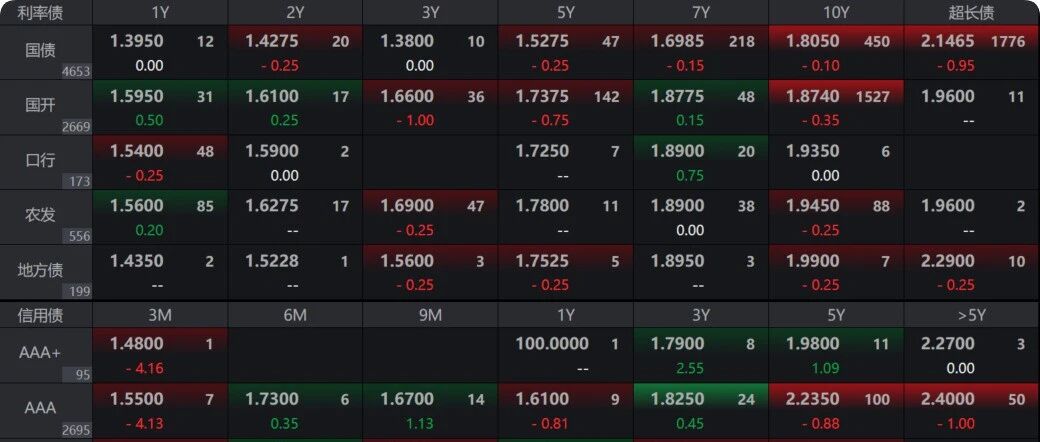
Core Viewpoint - The article discusses the current state of the bond market, highlighting its perceived decline in importance compared to the stock market, especially in light of recent economic data and market reactions [3][5][6]. Group 1: Market Overview - The bond market is experiencing a slight decline in yields, with the 10-year government bond yield fluctuating around 1.805% after opening at 1.81% [5][6]. - Recent inflation data for October was slightly above expectations, contributing to a cautious sentiment in the bond market [5][6]. - The stock market showed mixed reactions, initially declining but later recovering as news of a potential end to the government shutdown emerged [5][6]. Group 2: Monetary Policy and Liquidity - The central bank conducted a 7-day reverse repurchase operation of 119.9 billion yuan, with a net injection of 41.6 billion yuan after 78.3 billion yuan matured [3]. - The liquidity in the market is tightening, with the DR001 and DR007 rates hovering around 1.48% and 1.50%, respectively [3][4]. Group 3: Interest Rate Trends - The weighted average rates for various repo codes indicate a slight increase, with R001 at 1.52% and R007 at 1.50%, reflecting a mixed trend in the short-term funding market [4][9]. - The article notes a divergence in expectations for the 10-year government bond yield, with forecasts ranging from a lower bound of 1.2% to an upper bound of 2.1% [6].
【公募基金】央行购债落地,债市震荡调整——公募基金泛固收指数跟踪周报(2025.11.03-2025.11.07)
华宝财富魔方· 2025-11-10 09:13

Market Overview - The bond market experienced fluctuations during the week of November 3 to November 7, 2025, with the 1-year government bond yield rising by 2.19 basis points to 1.40%, the 10-year yield increasing by 1.88 basis points to 1.81%, and the 30-year yield up by 1.50 basis points to 2.16% [3][15] - The central bank announced a resumption of bond purchases amounting to 20 billion yuan in October, which fell short of market expectations, contributing to a slight decline in bond market sentiment amid a strong stock market [15] - The U.S. Treasury yields showed a downward trend, with the 1-year yield decreasing by 7 basis points to 3.63% and the 2-year yield down by 5 basis points to 3.55% [15] Public Fund Market Dynamics - The scale of bond ETFs surpassed 700 billion yuan, reaching 700.44 billion yuan as of October 31, 2025, marking a significant increase from less than 180 billion yuan at the beginning of the year [4][18] - Among the 53 bond ETFs in the market, 50 have surpassed 1 billion yuan in scale, with 30 exceeding 10 billion yuan [18] Fund Index Performance Tracking - The Money Market Enhanced Index rose by 0.03% last week, with a cumulative return of 4.27% since inception [19][20] - The Short-term Bond Fund Index increased by 0.02%, achieving a cumulative return of 4.45% since inception [20] - The Long-term Bond Fund Index saw a slight increase of 0.01%, with a cumulative return of 6.75% since inception [20] - The Low Volatility Fixed Income + Fund Index rose by 0.12%, with a cumulative return of 4.71% since inception [20] - The High Volatility Fixed Income + Fund Index increased by 0.24%, achieving a cumulative return of 8.17% since inception [20] - The Convertible Bond Fund Index rose by 0.46%, with a cumulative return of 23.51% since inception [20] - The QDII Bond Fund Index decreased by 0.17%, with a cumulative return of 10.27% since inception [20] - The REITs Fund Index fell by 1.21%, with a cumulative return of 31.61% since inception [20]

债市日报:11月10日
Xin Hua Cai Jing· 2025-11-10 07:43
Core Viewpoint - The bond market showed signs of recovery on November 10, with government bond futures increasing and interbank bond yields slightly declining, indicating a supportive liquidity stance from the central bank [1][6]. Market Performance - Government bond futures closed mostly higher, with the 30-year main contract rising by 0.22% to 116.28, and the 10-year main contract increasing by 0.01% to 108.485 [2]. - The interbank major interest rate bond yields mostly decreased, with the 30-year government bond yield down by 0.9 basis points to 2.147% [2]. Overseas Market Trends - In North America, U.S. Treasury yields collectively rose, with the 10-year yield increasing by 1.54 basis points to 4.097% [3]. - In Asia, Japanese bond yields increased, with the 10-year yield rising by 2 basis points to 2.592% [4]. Primary Market Activity - Agricultural Development Bank's financial bonds had bidding yields of 1.4118%, 1.6604%, and 1.7536% for 1.074-year, 3-year, and 5-year terms, respectively, with bid-to-cover ratios of 3.72, 2.68, and 2.64 [5]. - Chongqing's local bonds showed strong demand, with bid-to-cover ratios exceeding 21 times for all maturities [5]. Liquidity Conditions - The central bank conducted a 7-day reverse repurchase operation of 119.9 billion yuan at a rate of 1.40%, resulting in a net injection of 41.6 billion yuan for the day [6]. - Short-term Shibor rates mostly increased, with the overnight rate rising by 15.2 basis points to 1.479% [6]. Institutional Insights - Institutions suggest that the bond market is experiencing fluctuations, emphasizing the need to balance credit bond yields with liquidity [7]. - Expectations for core inflation to weaken may lead to further declines in nominal interest rates, with a potential downward trend in bond yields anticipated by year-end [8].
10月外贸不及预期,物价有所修复:利率周报(2025.11.3-2025.11.9)-20251110
Hua Yuan Zheng Quan· 2025-11-10 05:44
1. Report Industry Investment Rating No industry investment rating is provided in the report. 2. Report's Core View - In October, foreign trade fell short of expectations, while prices showed some improvement. The economic downward pressure in Q4 may increase. The year - on - year growth of economic data in Q3 slowed down compared to Q1 and Q2, with cumulative year - on - year negative growth in fixed investment, indicating that the traditional investment - driven economic model may face challenges. Consumption and exports may face pressure. Consumer willingness remains weak, and the slow price recovery in October reflects weak domestic economic recovery momentum. Exports may face year - on - year growth pressure in Q4 2025 due to good performance in Q4 2024. The year - on - year foreign trade data in October dropped significantly compared to September. However, the cancellation of fentanyl tariffs and the extension of the reciprocal tariff suspension period between China and the US on October 30 may support foreign trade in November and December. With the start of the Fed's interest - rate cut cycle, the inverted Sino - US interest rate spread has significantly eased, and the cost rate of banks' interest - bearing liabilities has steadily declined, suggesting that the conditions for a further reduction in policy interest rates may be initially met [2][76]. 3. Summary by Relevant Catalogs 3.1 Macro News - **Price Index**: In October, the price index improved. CPI increased by 0.2% year - on - year, up 0.5 percentage points from the previous month. PPI's year - on - year decline narrowed to 2.1%, up 0.2 percentage points from the previous month, and its month - on - month change turned positive. Looking ahead, food prices in Q4 may see a slower decline due to the low base last year, service prices may maintain steady growth, and the prices of daily necessities and services may continue to perform well. PPI's year - on - year decline has narrowed for three consecutive months. From a breakdown perspective, the year - on - year decline in production materials remained flat at - 2.4%, while that in living materials narrowed to - 1.4%, up 0.3 percentage points from September [10][11][16]. - **Foreign Trade**: In October, the year - on - year growth of imports and exports decreased significantly compared to the previous month, falling short of market expectations. In the first ten months of 2025, China's total goods trade value reached 37.3 trillion yuan, a year - on - year increase of 3.6%. In October, the total value of goods trade was 3.7 trillion yuan, a year - on - year increase of 0.1%. Exports were 2.17 trillion yuan, a year - on - year decrease of 0.8%, and imports were 1.53 trillion yuan, a year - on - year increase of 1.4%, marking the fifth consecutive month of growth [20]. 3.2 Meso - level High - frequency Data - **Consumption**: As of October 31, the daily average retail volume of passenger vehicle manufacturers was 155,000 units, a year - on - year increase of 47.2%, and the daily average wholesale volume was 210,000 units, a year - on - year increase of 23.9%. As of November 7, the total box office revenue of national movies in the past 7 days was 207.183 million yuan, a year - on - year decrease of 52.5%. As of October 17, the total retail volume of three major household appliances was 1.724 million units, a year - on - year decrease of 32.4%, and the total retail sales were 4.79 billion yuan, a year - on - year decrease of 35.9% [23][28]. - **Transportation**: As of November 2, the weekly container throughput at ports was 6.718 million twenty - foot equivalent units, a year - on - year increase of 18.4%. As of November 6, the average daily subway passenger volume in first - tier cities in the past 7 days was 4.0606 million person - times, a year - on - year increase of 5.5%. As of November 2, the weekly postal express pick - up volume was 4.28 billion pieces, a year - on - year increase of 8.2%, and the delivery volume was 4.31 billion pieces, a year - on - year increase of 10.0%. The weekly railway freight volume was 78.562 million tons, a year - on - year decrease of 2.7%, and the number of highway truck passages was 57.572 million vehicles, a year - on - year increase of 4.4% [33][36]. - **Industrial Operating Rates**: As of November 5, the operating rate of blast furnaces in major steel enterprises was 77.8%, a year - on - year increase of 1.4 percentage points. As of November 6, the average operating rate of asphalt was 22.0%, a year - on - year decrease of 3.0 percentage points. The operating rate of soda ash was 85.5%, a year - on - year decrease of 0.2 percentage points, and the operating rate of PVC was 80.6%, a year - on - year increase of 4.0 percentage points. As of November 7, the average operating rate of PX was 90.2%, and that of PTA was 77.0% [39][41]. - **Real Estate**: As of November 7, the total commercial housing transaction area in 30 large - and medium - sized cities in the past 7 days was 1.527 million square meters, a year - on - year decrease of 37.9%. As of October 31, the transaction area of second - hand housing in 9 sample cities was 1.599 million square meters, a year - on - year decrease of 27.3% [46][48]. - **Prices**: As of November 7, the average weekly pork wholesale price was 18.1 yuan/kg, a year - on - year decrease of 25.7% and a 4.6% decrease from 4 weeks ago. The average vegetable wholesale price was 5.8 yuan/kg, a year - on - year increase of 9.9% and a 16.6% increase from 4 weeks ago. The average wholesale price of 6 key fruits was 7.1 yuan/kg, a year - on - year decrease of 1.8% and a 0.6% increase from 4 weeks ago. The average weekly price of thermal coal at northern ports was 778 yuan/ton, a year - on - year decrease of 8.8% and an 11.1% increase from 4 weeks ago. The average weekly spot price of WTI crude oil was 60.3 US dollars/barrel, a year - on - year decrease of 15.5% and a 4.1% decrease from 4 weeks ago. The average weekly spot price of rebar was 3149.9 yuan/ton, a year - on - year decrease of 9.2% and a 0.9% decrease from 4 weeks ago. The average weekly spot price of iron ore was 799 yuan/ton, a year - on - year increase of 1.2% and a 0.1% increase from 4 weeks ago [52][56]. 3.3 Bond and Foreign Exchange Markets - Most bond yields increased. On November 7, the overnight Shibor was 1.33%, up 1.40 BP from November 3. R001 was 1.39%, up 2.54 BP; R007 was 1.47%, up 0.73 BP. DR001 was 1.33%, up 1.73 BP; DR007 was 1.41%, down 0.57 BP. IBO001 was 1.38%, up 2.10 BP; IBO007 was 1.46%, down 0.22 BP. The yields of 1 - year/5 - year/10 - year/30 - year treasury bonds were 1.40%/1.59%/1.82%/2.16% respectively, up 1.8 BP/1.9 BP/1.9 BP/1.6 BP compared to October 31. The yields of 1 - year/5 - year/10 - year local government bonds were 1.48%/1.76%/2.00% respectively, down 0.7 BP/1.3 BP/3.8 BP compared to October 31. The yields of AAA 1 - month/1 - year and AA+ 1 - month/1 - year inter - bank certificates of deposit were 1.47%/1.64%/1.49%/1.67% respectively, up 6.1 BP/0.5 BP/6.1 BP/0.5 BP compared to October 31. As of November 7, the 10 - year treasury bond yields of the US, Japan, the UK, and Germany were 4.1%, 1.7%, 4.5%, and 2.8% respectively, unchanged/+2 BP/+5 BP/+4 BP compared to October 31. The central parity rate and spot exchange rate of the US dollar against the RMB were 7.08/7.12 respectively, down 44/+90 pips compared to October 31 [58][62][71]. 3.4 Institutional Behavior - Since the beginning of 2025, the duration of medium - and long - term pure bond funds for interest - rate bonds has shown a trend of first decreasing, then increasing, and then decreasing. It has been decreasing overall in the past two months and increased this week. On November 7, 2025, the estimated average duration was around 5.0 years, and the estimated median duration was around 4.4 years, an increase of about 0.01 years compared to October 31. The duration of medium - and long - term pure bond funds for credit bonds has shown a volatile trend. It increased and then rapidly decreased in the past month and continued to decline rapidly this week. On November 7, 2025, the estimated average and median durations were around 2.1 years, a decrease of about 0.1 years compared to October [73][75]. 3.5 Investment Suggestion - The bond market trend may deviate from the fundamentals in the short term but cannot do so in the long term. Currently, the bond market has significant allocation value, and bond yields may decline fluctuantly. According to seasonal patterns, treasury bond yields usually decline significantly in November and December. Due to weak domestic consumption willingness and the start of the Fed's interest - rate cut cycle, the policy interest rate may be cut by 20 BP in the next six months. The central bank's resumption of treasury bond trading may have set the upper limit for bond yields, and future pricing may reflect the expected policy - rate cut. The report continues to be bullish on the bond market, predicting that the yield of 10Y treasury bonds will return to around 1.65%, the yield of 30Y treasury bonds will reach 1.9%, and the yield of 5Y secondary capital bonds of large banks will reach 1.9% (all referring to bonds without VAT) by the end of the year [76][79].
海外利率周报20251110:短端美债利率再度下行-20251110
Minsheng Securities· 2025-11-10 03:36
1. Report Industry Investment Rating No information provided regarding the industry investment rating. 2. Core Viewpoints of the Report - The short - end US Treasury yields declined again. Amid the federal government shutdown and labor data divergence, the market identified more recession signs and increased bets on interest rate cuts. If the federal government resumes operation before the December meeting, it may provide sufficient evidence for rate cuts [3][13]. - Global major asset classes showed different trends. Global stock indices generally pulled back, energy and black commodities were adjusted, precious metals fluctuated downwards, and the US dollar weakened due to weak labor data [5][18][19][20]. 3. Summary by Relevant Catalogs 3.1 This Week's Overseas Macroeconomic Interest Rate Review 3.1.1 Macroeconomic Indicator Review - Employment: In October, the ADP employment number turned positive but remained weak. The private - sector added about 42,000 jobs, higher than the expected 32,000 and reversing the decline in September. However, the increase was still small compared to previous years. New jobs were mainly concentrated in education, healthcare, trade, transportation, and public utilities, while several industries such as professional business services, information technology, and leisure and entertainment saw continuous net job losses for the third month [1][11]. - Business indices: The US Markit services PMI growth in October slowed, the ISM non - manufacturing PMI increased, the Markit manufacturing PMI rose, and the ISM manufacturing PMI fell short of expectations. The labor market in the service and manufacturing industries remained weak [2][12]. 3.1.2 Main Overseas Market Interest Rate Review - US: From October 31 to November 7, 2025, the short - end US Treasury yields declined again. The yield curve steepened with short - and medium - term yields down and ultra - long - term yields slightly up. The market strengthened bets on rate cuts, and the probability of a December rate cut increased by 4 percentage points to 67%. With the two - party attitude softening on Friday, the market expected the government shutdown to end soon [3][13]. - Europe and Japan: Japanese government bond yields had a slight overall increase, with short - end yields down and medium - and long - end yields up. German government bond yields across all maturities increased, with long - end yields leading the rise and the weekly amplitude reaching a phased high [4][17]. 3.2 Other Major Asset Reviews - Equities: Global major stock indices generally pulled back, affected by both fundamentals and policy expectations. The Russian MOEX index rose 1.63%, the Hong Kong Hang Seng Index rebounded 1.29%, while the US Nasdaq index fell 3.04%, and the Japanese Nikkei 225 index fell 4.07% [5][18]. - Commodities: Energy and black commodities were generally adjusted, and precious metals fluctuated downwards. US hog futures rose 0.93%, CBOT soybeans rose 0.16%, while Brent crude oil fell 2.21%, and Bitcoin fell 5.73% [5][19]. - Foreign exchange: Due to weak US labor data, the US dollar weakened. The Japanese yen rose 0.53%, the Vietnamese dong rose 0.20%, and the South Korean won depreciated 1.59% [5][20]. 3.3 Market Tracking - The report presents multiple charts, including the auction panel of US Treasury bonds, the latest target interest rate expectations of FED WATCH, the simulated trends of the US dollar, US stocks, US Treasury bonds, gold, and Bitcoin, the trends of global major stock indices, the yield curves of US, Japanese, and German government bonds, and the latest economic data panels of the US, Japan, and the Eurozone [15][16][23].
固收观察-关键是赔率
2025-11-10 03:34
Summary of Conference Call Notes Industry Overview - The current fixed income market is characterized by low risk but also low returns, suggesting a "barbell strategy" that involves investing in medium to short-term government bonds and low-rated credit bonds while maintaining liquidity to wait for regulatory changes or a decrease in bank funding costs to improve the return environment [1][2][4]. Key Points and Arguments 1. **Market Conditions**: - The credit bond market showed strong performance in October, driven by liquidity and risk-averse sentiment, with a preference for short-duration, high-yield products. Institutions leveraged short-term assets, and U.S.-China tariff tensions contributed to risk aversion, benefiting the bond market [1][8]. - The overall credit bond market is currently facing low return potential, with existing bonds having reached a lower limit of 1.75% and new bonds still having some room for growth, but overall returns remain below acceptable mid-range levels [2]. 2. **Investment Strategy**: - A "barbell strategy" is recommended, focusing on flexible or high-yield products, such as medium to short-term government bonds and low-rated credit bonds, to balance risk and return [2][4]. - Future credit bond investment strategies should focus on controlling duration, seizing yield opportunities, and selectively investing in mid to high-grade credit bonds with a duration of around three years, as well as strong regional municipal bonds [3][11]. 3. **Market Dynamics**: - The credit bond market has shown structural differentiation, with supply and demand mismatches leading to narrowing spreads in the short end while the long end still has some spread potential. Regional differences are notable, with significant spread variations in municipal bonds from different regions [9][10]. - The supply of credit bonds in October was initially high but decreased towards the end of the month, with net financing for industrial bonds reaching a six-month high of over 140 billion yuan, while municipal bonds saw a positive month-on-month change [6]. 4. **Policy Impact**: - Recent policies aimed at alleviating local government hidden debt pressures have eased some high-interest debt burdens. The upcoming changes in public fund redemption fees have made institutions cautious about long-duration products [10]. - The central bank's commitment to maintaining liquidity supports a favorable funding environment for the bond market [10]. 5. **Future Outlook**: - The convertible bond market is expected to continue experiencing high volatility, with structural trends in the A-share market supported by technology innovation and domestic demand expansion policies. A balanced approach is recommended, focusing on both equity-linked convertible bonds and low-priced bonds to mitigate market fluctuations [12][13]. Additional Important Insights - The liquidity management aspect is crucial in a low-return environment, emphasizing the need to avoid illiquid assets with unstable liabilities. Historical data suggests that in such environments, the market tends to exhibit a "no progress means regression" scenario, necessitating cautious operations [5]. - The key indicator of deposit rates is critical; a clear downward trend in deposit rates would indicate further support for lowering bond yields. However, significant reductions in deposit rates by year-end are unlikely due to uncertain supply scales [5]. This comprehensive analysis highlights the current state of the fixed income market, investment strategies, and the impact of policy changes, providing a detailed overview for stakeholders in the industry.
【债市观察】月初资金相对宽松 利率债收益率上行
Xin Hua Cai Jing· 2025-11-10 01:00
Market Overview - The overall funding environment was loose last week, with slight increases in bond yields and a decline in government bond futures [1][5] - As of November 7, the 10-year government bond yield rose to 1.81%, up 0.42 basis points from the previous Thursday and up 1.45 basis points from the previous week [1][2] - The market's expectation for bond purchases by the central bank was somewhat overstated, leading to a weaker bond market after the actual implementation [1][2] Bond Market Performance - The bond market experienced fluctuations, with the 10-year government bond yield showing mixed performance throughout the week, ending at 1.81% [2][5] - The China Convertible Bond Index rose by 0.86% over the week, with significant trading volume of 3,426 billion yuan [4] - The issuance of local bonds decreased significantly, with a total of 916.07 billion yuan issued, down 1,790.75 billion yuan from the previous week [8] Central Bank Operations - The central bank conducted a total of 4,958 billion yuan in 7-day reverse repos last week, with a net withdrawal of funds [12][14] - The central bank resumed government bond trading, injecting 200 billion yuan into the banking system, which was lower than market expectations but still significant [13][20] Credit Market Activity - A total of 448 credit bonds were issued last week, with a total scale of 5,079.87 billion yuan, reflecting an increase of 1,377.19 billion yuan from the previous week [9] - The issuance of financial bonds amounted to 1,270.70 billion yuan, while corporate bonds and medium-term notes also saw significant issuance [9] International Market Insights - In the U.S., the consumer confidence index fell to 50.3, indicating economic concerns, while the labor market showed mixed signals with job growth slightly above expectations [15][26] - European bond yields generally increased, with the 10-year German bond yield rising by 4.6 basis points over the week [17] - Japanese investors reduced their holdings of overseas bonds while increasing their investments in domestic bonds [19]
研判2025!中国可持续债券行业相关政策、市场现状及发展趋势分析:中国累计发行规模位居全球前列,绿色债券为主要发行类型[图]
Chan Ye Xin Xi Wang· 2025-11-10 00:54
Core Insights - The article discusses the growth and classification of sustainable bonds, emphasizing their role in promoting sustainable development and aligning with sustainability goals [1][2]. Group 1: Overview of Sustainable Bonds - Sustainable bonds are defined by the International Capital Market Association (ICMA) as bonds that finance projects beneficial to sustainable development or are linked to sustainability goals [2]. - ICMA categorizes sustainable bonds into green bonds, social responsibility bonds, sustainable development bonds, and sustainability-linked bonds [2]. Group 2: Global Market Status - As of mid-2025, the cumulative issuance of GSS+ bonds globally reached $6.2 trillion, with sovereign issuers leading at $926.1 billion, followed by the US ($859.8 billion), France ($628.6 billion), and China ($611.4 billion) [6]. - In the first half of 2025, the total issuance of GSS+ bonds was $555.8 billion, reflecting a 3.6% year-on-year decline [6]. Group 3: China's Sustainable Bond Market - In 2024, China's GSS+ bond issuance was $84.6 billion, a 3.8% decrease from $87.9 billion in 2023, with a cumulative total surpassing $500 billion by the end of 2024 [6][8]. - Green bonds accounted for over 80% of the issuance, with $68.9 billion issued in 2024, down 18.2% year-on-year [8]. - Social responsibility bonds saw a significant increase, with issuance rising by 312.5% to $13.2 billion in 2024 [8]. Group 4: Investment Focus Areas - In 2024, the majority of funds raised through green bonds were directed towards clean energy projects, including wind, solar, and hydropower, which accounted for 52.2% of the total [8]. - The transportation sector received 30.4% of the funding, indicating a strong focus on decarbonizing the energy system and upgrading transportation infrastructure [8]. Group 5: Future Trends - The sustainable bond market is expected to continue focusing on key economic and social development tasks, driven by policy guidance and market demand [10]. - The support capacity for low-carbon development through sustainable bonds is anticipated to strengthen, particularly for green bonds, as central policies are implemented [10]. - Enhanced information disclosure standards are expected to improve transparency and investment efficiency in the sustainable bond market [11].
