
钢铁

Search documents
大宗商品ETF(510170)大幅拉升上涨2.49%,强势冲击四连涨+四连阳!
Xin Lang Cai Jing· 2026-02-11 03:19
Group 1 - The core viewpoint of the news is the strong performance of the Commodity ETF (510170), which has seen a 2.49% increase, marking four consecutive days of gains and a significant trading volume of 15.73 million yuan [1] - The Commodity ETF (510170) is the only ETF tracking the Shanghai Stock Exchange Commodity Stock Index, known for its long-term strong performance and early establishment among similar products [1] - The ETF closely tracks the Shanghai Commodity Stock Index, which includes large-cap, liquid commodity production companies listed on the Shanghai Stock Exchange, reflecting the overall performance of commodity stocks [1] Group 2 - In January 2026, international non-ferrous metal prices increased, leading to a 5.7% and 5.2% month-on-month rise in domestic non-ferrous metal mining and smelting industries, with specific increases in silver, copper, gold, and aluminum smelting prices of 38.2%, 8.4%, 4.8%, and 2.3% respectively [2] - The global macroeconomic uncertainty is rising, with the IMF projecting a slowdown in global economic growth to 3.1% in 2026, while developed economies are expected to grow at about 1.6% and emerging markets slightly above 4% [2] - Under tight supply and steady demand conditions, many commodities with fundamental shortages or uneven geographical distribution are likely to rise, supported by geopolitical disturbances and inflation expectations [2]
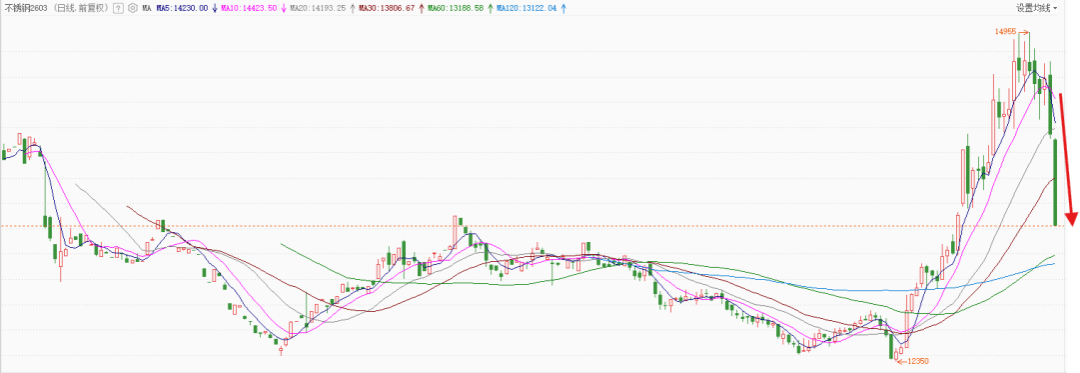
跌停潮突袭!不锈钢单日血洗7%,钢厂挺价能否扛住?
Sou Hu Cai Jing· 2026-02-11 03:18
Group 1: Market Trends - Gold and other non-ferrous metals experienced significant declines, with main futures contracts hitting their daily limit down, including stainless steel at 13,420 CNY/ton (-7.03%), gold at 1,005 CNY/gram (-16%), and nickel at 129,650 CNY/ton (-11%) [1] - The stainless steel market has shown a one-sided downward trend, with the main contract breaking below the 13,500 CNY mark, erasing all gains from late January [1] - Total positions in the market decreased by 18,490 contracts, indicating a significant reduction in long positions as panic selling intensified [1] Group 2: Macroeconomic Factors - The nomination of Kevin Warsh as the next Federal Reserve Chair by President Trump has raised hawkish expectations, contributing to a record drop in international precious metal prices [3] - Current probabilities for Federal Reserve interest rate changes indicate a 15.3% chance of a 25 basis point cut by March and a 49.5% chance of a cumulative 25 basis point cut by June [3] Group 3: Steel Prices and Production - Major steel producers like Qingshan Group and Delong have maintained stable prices for 304 cold-rolled steel, with prices around 14,550 CNY/ton [4] - Recent surveys indicate that steel plant maintenance and production cuts have affected output by approximately 630,000 tons, with the 300 series being the most impacted [5] - Despite the downward pressure on futures prices, the physical market remains resilient due to production cuts and high costs, suggesting potential for a rebound if macroeconomic conditions stabilize [5]

成材:市场低迷,钢价弱势整理
Hua Bao Qi Huo· 2026-02-11 03:09
1. Report Industry Investment Rating - Not provided in the text 2. Core Viewpoints of the Report - The steel market is sluggish, and steel prices are weakly consolidating. The low downstream demand remains the key factor dragging down steel prices. As the Spring Festival holiday approaches, the spot market is gradually entering the holiday rhythm. There may still be capital outflows before the festival, leading to a decline in market trading volume. The macro - environment is calm and has little impact on prices [1][2] - The raw materials market is expected to fluctuate weakly, and attention should be paid to the 3000 support level for rebar [2] 3. Summary by Relevant Catalogs 成材 - The market is in a downturn, and steel prices are weakly consolidating. On February 10, the average cost of 76 independent electric arc furnace construction steel mills was 3296 yuan/ton, a decrease of 62 yuan/ton compared to the previous day. The average profit was a loss of 52 yuan/ton, and the profit during off - peak electricity hours was 14 yuan/ton [1][2] - The finished products fluctuated slightly yesterday. Low downstream demand is the key factor dragging down steel prices. With the Spring Festival approaching, the spot market is entering the holiday rhythm, and there may be capital outflows before the festival, reducing market trading. The macro - environment has little impact on prices [2] Raw Materials - The raw materials market is expected to fluctuate weakly, and attention should be paid to the 3000 support level for rebar. Later, attention should be paid to macro - policies and downstream demand conditions [2]
华宝期货晨报铝锭-20260211
Hua Bao Qi Huo· 2026-02-11 03:08
Report Summary 1. Report Industry Investment Rating No information provided. 2. Core Views -成材预计震荡整理运行,价格重心下移且偏弱运行,市场情绪悲观,今年冬储低迷对价格支撑不强,需关注宏观政策和下游需求情况 [2][4] -铝锭预计价格短期震荡运行,春节假期临近下游需求走弱,库存开始累库,需关注宏观情绪、宏观预期变动、地缘政治危机发展、矿端复产情况和消费释放情况 [2][4][5] 3. Summary by Relevant Catalogs **成材方面** -云贵区域短流程建筑钢材生产企业春节停产检修预计影响总产量74.1万吨,复产时间预计在正月初十一至十六左右 [3] -安徽省6家短流程钢厂,1家1月5日停产,大部分1月中旬左右停产,个别1月20日后停产,停产期间日度影响产量1.62万吨左右 [4] -2024年12月30日 - 2025年1月5日,10个重点城市新建商品房成交面积总计223.4万平方米,环比下降40.3%,同比增长43.2% [4] -成材昨日震荡下行价格再创近期新低,在供需双弱格局下市场情绪悲观,价格重心持续下移 [4] **铝锭方面** -宏观上美联储洛根表示政策立场恰到好处,接近中性水平 [3] -国内外新投电解铝项目爬产推升日均产量,春节临近下游加工企业放假开工率下滑,需求走弱 [4] -上周铝加工综合开工率57.9%,较上周环比下降1.5个百分点,板块分化显著:铝板带龙头企业开工率回升至66.0%,下周将回调;铝箔龙头企业开工率升至71.4%,维持高位运行;铝线缆开工率降至58%,下周进一步下行;铝型材开工率骤降至36.0%,光伏型材需求坚挺 [4] -截至2月9日,铝锭社会库存达85.7万吨,环比上周一累库4万吨,春节前期下游难有明显好转 [4] **有色金属方面** -短期市场情绪缓和,贵金属和有色板块联动性强,市场交易情绪偏谨慎,预计短期价格区间整理 [5]
综合晨报-20260211
Guo Tou Qi Huo· 2026-02-11 03:03
Report Industry Investment Rating No relevant information provided. Core Viewpoints - The report analyzes the market trends of various commodities, including energy, metals, chemicals, and agricultural products, under the influence of geopolitical situations, supply - demand relationships, and seasonal factors [2][4][5] - It also provides insights into the stock market (A - shares, H - shares) and the bond market, suggesting potential trends and investment opportunities [47][48] Summary by Commodity Categories Energy - **Crude Oil**: Tensions between the US and Iran keep the Brent crude price volatile in the range of $68 - 70, with high geopolitical risk premiums expected [2] - **Fuel Oil & Low - Sulfur Fuel Oil**: Geopolitical situations drive the market. High - sulfur fuel oil may face pressure if geopolitical risks ease, while low - sulfur fuel oil is affected by overseas refinery supply and European heating demand [22] - **Asphalt**: The market shows a supply - demand dual - weak pattern, and its price is mainly influenced by crude oil trends, with potential support for the cracking spread [23] Metals - **Precious Metals**: Overnight, precious metals fluctuated. With the US retail sales data and focus on non - farm payrolls, short - term volatility is decreasing, and a wait - and - see approach before the festival is recommended [3] - **Base Metals**: - **Copper**: Overnight, copper prices oscillated narrowly. Before the festival, the position and trading volume are expected to shrink, and post - festival prices may first be pressured by inventory accumulation and then rebound based on demand expectations [4] - **Aluminum and Related Products**: Aluminum and its related products like casting aluminum alloy, alumina, etc., face different situations. For example, aluminum has inventory increase and adjustment pressure, while alumina has a supply - surplus outlook [5][6][7] - **Zinc**: In a downward - volatility adjustment, with weakening consumption and supply - demand imbalance, the overall rebound is under pressure, but short - term high - level oscillation is expected [8] - **Lead**: With mixed signals of supply and demand, it is expected to oscillate at a low level around the cost line [9] - **Nickel & Stainless Steel**: Nickel rebounds with dull trading, and stainless steel has increasing inventory and weak market confidence [10] - **Tin**: Overnight, tin prices showed a positive - line oscillation. Attention is on the post - festival supply - demand changes during the peak season [11] Chemicals - **Carbonate Lithium**: It has a weak rebound with dull trading. The inventory structure is complex, and short - term uncertainty is high [12] - **Polysilicon**: Futures oscillate downward with light trading. The market is expected to maintain an oscillatory trend due to factors such as supply - demand and the approaching festival [13] - **Industrial Silicon**: Prices fall below 8400 yuan/ton. Supply may increase after the holiday, and demand is expected to be weak, so short - term prices may remain weak [14] - **Other Chemicals**: Various chemicals like polypropylene, plastic, PVC, etc., have different market trends based on supply - demand relationships, production capacity, and seasonal factors [27][28][29] Agricultural Products - **Grains and Oilseeds**: - **Soybean & Related Products**: The USDA report is neutral - slightly bearish, but with export expectations, the US soybean may maintain a relatively high - level oscillation [36] - **Corn**: The national sales progress is 61%. Before the festival, the market is quiet, and after the festival, prices may oscillate weakly [39] - **Livestock and Poultry Products**: - **Pig**: Spot prices continue to decline. There is a risk of post - festival supply pressure, and long - term prices may have a low point next year [40] - **Egg**: Some futures contracts hit new lows. There is upward repair power in the first half of 2026, and a long - position strategy can be considered after the holiday [41] - **Other Agricultural Products**: - **Cotton**: The US cotton report is slightly bearish, and the pre - festival Zheng cotton is expected to oscillate. Attention is on post - festival inventory changes [42] - **Sugar**: International and domestic production situations vary, and short - term sugar prices face pressure [43] - **Apple**: Futures prices oscillate. The market focus is on demand, and attention is on the de - stocking speed [44] Financial Markets - **Stock Index**: A - shares had a narrow - range consolidation. The market may continue to repair this week, with potential structural rotation [47] - **Treasury Bonds**: Futures oscillated narrowly, with limited upward and downward space. A short - term strong trend may continue until the festival, and curve - related trading opportunities are recommended [48]
多资产周报:恒生科技遭遇倒春寒-20260211
Guoxin Securities· 2026-02-11 02:43
Market Overview - The Hang Seng Tech Index has fallen below the 5400-point mark, indicating a significant pullback after previous gains in sectors like internet platforms and semiconductors[1] - The market is experiencing a "cold spring" with reduced trading volumes and profit-taking behavior observed across various sectors[1] Economic Indicators - Fixed asset investment has decreased by 3.80% year-on-year[5] - Retail sales have shown a modest increase of 0.90% year-on-year[5] - Exports have risen by 6.60% year-on-year[5] - M2 money supply growth stands at 8.54%[5] External Factors - Recent U.S. economic data, including non-farm payrolls and service sector PPI, exceeded expectations, leading to a cooling of interest rate cut expectations from the Federal Reserve[1] - Domestic institutions are showing a strong demand for profit-taking to manage uncertainties post-holiday[1] Asset Allocation Trends - Southbound capital has shifted from high-growth tech stocks to high-dividend assets like telecommunications and banking[1] - The short-term support level for the market is projected to be between 5100-5250 points, coinciding with the 250-day moving average[1] Commodity and Currency Movements - The latest crude oil inventory is reported at 44,684 million tons, an increase of 44,935 million tons from the previous week[3] - The dollar long position has decreased to 16,610 contracts, down by 1,335 contracts[3]
新钢股份涨2.05%,成交额1.20亿元,主力资金净流入482.61万元
Xin Lang Cai Jing· 2026-02-11 02:36
Core Viewpoint - New Steel Co., Ltd. has shown a mixed performance in stock price and financial results, with a recent increase in stock price but a decline in revenue year-on-year while net profit has significantly increased [1][2]. Group 1: Stock Performance - On February 11, New Steel's stock price increased by 2.05%, reaching 3.99 CNY per share, with a trading volume of 1.20 billion CNY and a turnover rate of 0.96%, resulting in a total market capitalization of 12.704 billion CNY [1]. - Year-to-date, New Steel's stock price has risen by 2.84%, with a 0.76% increase over the last five trading days, a 3.91% increase over the last 20 days, but a 6.99% decrease over the last 60 days [1]. Group 2: Financial Performance - For the period from January to September 2025, New Steel reported operating revenue of 27.225 billion CNY, a year-on-year decrease of 12.68%, while net profit attributable to shareholders reached 360 million CNY, reflecting a year-on-year increase of 162.21% [2]. Group 3: Shareholder Information - As of October 31, New Steel had 38,200 shareholders, with an average of 82,368 circulating shares per shareholder, both figures remaining unchanged from the previous period [2]. - The company has distributed a total of 5.584 billion CNY in dividends since its A-share listing, with 816 million CNY distributed over the past three years [3]. - Notable changes in institutional holdings include Hong Kong Central Clearing Limited becoming the second-largest circulating shareholder, increasing its holdings by 49.8782 million shares, and several new institutional investors entering the top ten shareholders list [3].

国泰君安期货商品研究晨报-黑色系列-20260211
Guo Tai Jun An Qi Huo· 2026-02-11 02:05
Report Industry Investment Rating No relevant content provided. Core Viewpoints - The report provides investment outlooks for various commodities in the black series, including iron ore, rebar, hot-rolled coils, ferrosilicon, silicomanganese, coke, coking coal, and logs. The outlooks range from range-bound oscillations to wide-range fluctuations and weakening trends [2]. Summary by Commodity Iron Ore - **Market Outlook**: Expected to trade in a range [2]. - **Fundamental Data**: Futures price remained unchanged at 761.5 yuan/ton with no change in price and a 0.00% change in price. Open interest increased by 556 to 513,940 lots. Spot prices of various iron ore types also remained unchanged. The basis and spreads showed minimal changes [4]. - **Trend Strength**: -1, indicating a slightly bearish outlook [5]. Rebar and Hot-Rolled Coils - **Market Outlook**: Both are expected to experience wide-range fluctuations [2]. - **Fundamental Data**: Rebar futures (RB2605) closed at 3,052 yuan/ton, down 17 yuan or 0.55%. Hot-rolled coil futures (HC2605) closed at 3,220 yuan/ton, down 21 yuan or 0.65%. Open interest for both increased. Spot prices remained stable. The basis and spreads showed some changes [7]. - **Trend Strength**: 0 for both, indicating a neutral outlook [9]. Ferrosilicon and Silicomanganese - **Market Outlook**: Ferrosilicon is expected to experience wide-range fluctuations due to sector sentiment resonance, while silicomanganese is expected to fluctuate widely as South African manganese ore shipments may tighten after the Spring Festival [2]. - **Fundamental Data**: Futures prices of ferrosilicon and silicomanganese showed some changes. Spot prices of related products and raw materials were provided. The basis, spreads, and cross-variety spreads also showed changes [11]. - **Trend Strength**: 0 for both, indicating a neutral outlook [14]. Coke and Coking Coal - **Market Outlook**: Both are expected to weaken with a bearish trend as long positions take profits [2]. - **Fundamental Data**: Futures prices of coke and coking coal decreased. Spot prices of related products remained mostly stable. The basis and spreads showed some changes [16]. - **Trend Strength**: -1 for both, indicating a slightly bearish outlook [19]. Logs - **Market Outlook**: Expected to trade in a range [2]. - **Fundamental Data**: Futures prices, trading volumes, and open interest of different log contracts showed various changes. Spot prices of different types of logs remained mostly stable [20]. - **Trend Strength**: 0, indicating a neutral outlook [23]. Macro and Industry News - China's January RatingDog Manufacturing PMI was 50.3, in line with expectations and up from the previous value of 50.1 [4][22]. - Multiple real estate developers no longer need to report the "three red lines" indicators monthly, but some troubled developers are required to report financial indicators to the special team in their headquarters city regularly [4][22]. - In late January 2026, major steel enterprises' average daily production of crude steel decreased by 2.2%, pig iron decreased by 3.0%, and steel increased by 3.2%. Steel inventories decreased by 8.8% compared to the previous ten-day period [8][9]. - BHP Billiton's first-half iron ore production reached a record high, and it accepted price cuts for some iron ore in annual contract negotiations with China [9]. - In December 2025, China's steel imports increased by 4.2% month-on-month, and the average price increased by 11.0%. The cumulative imports from January to December decreased by 11.1% year-on-year [9]. - The Ministry of Commerce and the General Administration of Customs implemented export license management for some steel products [9]. - An Inner Mongolia silicon-manganese plant's new production capacity is expected to start producing iron by the end of February. Jupiter will not supply or quote manganese ore to China in March and will release April's offer after the Spring Festival [11]. - On February 10, the prices of ferrosilicon and silicomanganese in different regions were reported, and a Jiangsu steel mill set the silicon-manganese price for early February at 5,850 yuan/ton, up 20 yuan/ton from mid-to-late January [12][13]. - On February 10, the CCI metallurgical coal index showed price changes, and the coking coal online auction had a lower failure rate and an average premium of 11.17 yuan/ton. The market activity declined, and most prices fell [16].
国泰君安期货商品研究晨报-20260211
Guo Tai Jun An Qi Huo· 2026-02-11 02:03
国泰君安期货商品研究晨报 2026年02月11日 商 品 研 究 | 期货研究 | | | --- | --- | | 纯碱:现货市场变化不大 | 48 | | LPG:地缘扰动仍存,基本面驱动向下 | 49 | | 丙烯:现货持稳,基差收敛 | 49 | | PVC:偏弱震荡 | 52 | | 燃料油:窄幅震荡,短期波动缩小 | 53 | | 低硫燃料油:夜盘短线转强,外盘现货高低硫价差仍处低位 | 53 | | 集运指数(欧线):震荡市 | 54 | | 短纤:短期震荡市20260211 | 57 | | 瓶片:短期震荡市20260211 | 57 | | 胶版印刷纸:节前观望 | 58 | | 纯苯:偏强震荡 | 60 | | 棕榈油:基本面驱动有限,震荡调整 | 61 | | 豆油:报告缺乏亮点,区间震荡 | 61 | | 豆粕:隔夜美豆收涨,连粕或跟随反弹震荡 | 63 | | 豆一:现货稳定,盘面震荡 | 63 | | 玉米:震荡偏强 | 65 | | 白糖:关注低基差机会 | 66 | | 棉花:节前预计维持震荡走势20260211 | 67 | | 鸡蛋:震荡调整 | 69 | | 生猪:旺季 ...
首席点评:非农数据临阵预警
Shen Yin Wan Guo Qi Huo· 2026-02-11 01:50
Report Industry Investment Rating - The report provides a cautious view on various commodities, with some marked as "cautiously bearish" and others as "cautiously bullish". For example, crude oil, methanol, etc., are marked as "cautiously bearish", while gold, silver, etc., are marked as "cautiously bullish" [4]. Core Viewpoints - The report analyzes multiple aspects including economic data, geopolitical events, and market trends. It mentions that the US is at a critical stage of its economic cycle, and the global market is affected by various factors such as US employment data, geopolitical negotiations, and supply - demand changes in different industries [1][5]. - In the commodity market, different commodities have different trends. For example, precious metals are expected to return to an upward trend in the long - term, while the short - term is affected by data announcements; the crude oil market is influenced by geopolitical negotiations and supply changes [2][3]. Summary by Directory 1. Chief Comment - US API crude oil inventory increased by 13.4 million barrels last week. US soybean export inspection volume decreased by 14% week - on - week but increased by 3% year - on - year. As of February 5, 2026, the weekly US soybean export inspection volume was 1,136,099 tons. The total US soybean export inspection volume in the 2025/26 season reached 23,136,299 tons, a year - on - year decrease of 34.4%. The US non - farm employment data to be released this Wednesday is expected to show an increase of 69,000 in non - farm employment in January, with the unemployment rate remaining at 4.4%. Futures markets mostly rose at night, with propylene up over 2% and glass down over 1% [1]. 2. Key Varieties Precious Metals - Precious metals are in a consolidation phase. The market is waiting for US employment and inflation data, which may affect subsequent interest rate cut expectations. After a sharp rise in January, precious metals had a significant shock. In the long - term, factors such as de - dollarization, geopolitical risks, and central bank gold purchases still support the upward trend of gold. The central bank of China has increased its gold holdings for 15 consecutive months. It is recommended to wait and see for silver due to its high volatility and relatively low gold - silver ratio [2]. Crude Oil - SC crude oil rose 0.21% at night. Iran and the US held indirect negotiations in Muscat. The negotiation started well, and both sides agreed to continue. Kazakhstan's oil export volume in February may drop by up to 35% due to the slow recovery of the Tengiz oil field [3]. Stock Index - US stock indexes were mixed. The stock index rose slightly the previous trading day, with the media sector leading the rise and the real estate sector leading the fall. The market turnover was 2.12 trillion yuan. The margin trading balance increased by 523 million yuan on February 9. In February, the market is expected to continue the phased upward trend, but the potential impact of overseas market fluctuations during the Spring Festival should be noted [3]. 3. Main News of the Day International News - Ray Dalio warned that the US is at the "fifth stage" of the imperial cycle, on the verge of order collapse and conflict. He suggested that gold should account for 5% - 15% of the investment portfolio [5]. Domestic News - The People's Bank of China will continue to implement a moderately loose monetary policy, use various policy tools such as reserve requirement ratio cuts and interest rate cuts, and carry out regular treasury bond trading operations [6]. Industry News - An article in Qiushi emphasized the importance of cultivating future industries for high - quality development [7]. 4. Daily Returns of Overseas Markets - The report provides the daily returns of various overseas markets on February 9 and 10, including the S&P 500, European STOXX50, etc. Some indexes and commodities rose, while others fell [8]. 5. Morning Comments on Main Varieties Financial - **Stock Index**: The stock index is expected to continue the phased upward trend in February, but the potential impact of overseas market fluctuations during the Spring Festival should be noted [9]. - **Treasury Bonds**: Treasury bonds fluctuated narrowly. The central bank will continue to implement a moderately loose monetary policy. The market expects the new Fed chairman's policy to be a combination of interest rate cuts and balance - sheet reduction. The bond futures price is expected to stabilize, and cautious operation is recommended before the Spring Festival [10][11]. Energy and Chemicals - **Crude Oil**: SC crude oil rose 0.21% at night. Iran - US negotiations started well, and Kazakhstan's oil export volume may decline [12]. - **Methanol**: Methanol fell 0.09% at night. The operating rate of coal - to - olefin plants increased, and the methanol inventory in coastal areas decreased [13]. - **Natural Rubber**: Natural rubber rebounded slightly. The domestic production area is in the off - season, and the supply elasticity is weak. The demand side supports the stable operation of all - steel tire production. It is expected to fluctuate and adjust before the Spring Festival [14]. - **Polyolefins**: Polyolefin futures rebounded slightly. The market focuses on supply improvement and macro factors. It is recommended to control positions before the Spring Festival [15]. - **Glass and Soda Ash**: Glass futures declined, and soda ash futures also fell. The glass supply - demand situation is gradually improving, and the supply of soda ash is slightly shrinking. It is recommended to control positions before the Spring Festival [16]. - **Precious Metals**: Precious metals are in a consolidation phase. They are affected by US data announcements. In the long - term, gold is expected to rise, and it is recommended to wait and see for silver [17]. - **Copper**: Copper prices rose 0.17% at night. The concentrate supply is tight, and the copper price may enter an adjustment phase [18]. - **Zinc**: Zinc prices rose 0.08% at night. The zinc concentrate processing fee decreased, and the zinc price may follow the overall trend of non - ferrous metals [19]. - **Aluminum**: The Shanghai aluminum market was flat at night. The aluminum production rate is high, but the downstream demand is weakening, and the inventory is accumulating. In the long - term, low inventory and stable demand support the price [20]. - **Lithium Carbonate**: The production and production plan of lithium carbonate decreased, and the inventory decreased. The market sentiment is weak, and it is recommended to pay attention to trading opportunities after volatility reduction [21]. Black Metals - **Coking Coal and Coke**: The prices of coking coal and coke rebounded at night. The supply of coking coal decreased slightly, and the demand growth is limited. After the Spring Festival, factors such as iron - making production, mine operation, and import policies should be noted [22]. - **Steel**: Steel production decreased slightly, and the inventory increased. The construction downstream demand is weakening. The steel market is in a situation of weak supply and demand, and the price is expected to be weak and volatile [23]. - **Iron Ore**: The global iron ore shipment increased slightly, and the port inventory continued to rise. The steel mill's demand for iron ore is expected to be based on on - demand replenishment, and the iron ore price is expected to be weak and volatile [24]. Agricultural Products - **Protein Meal**: The prices of soybean meal and rapeseed meal rose at night. The Brazilian soybean harvest is progressing, and the US soybean price is under pressure. The domestic soybean meal price is also affected by high inventory and sufficient supply expectations [25]. - **Oils and Fats**: Oils and fats were weak at night. The palm oil inventory in Malaysia decreased, and the production decreased. The palm oil price is supported by inventory reduction but restricted by crude oil prices. It is expected to fluctuate in the short - term [26][27]. - **Sugar**: The sugar price continued to fluctuate. The global sugar supply is in an oversupply situation, and the domestic sugar supply is increasing seasonally. The sugar price is expected to fluctuate in the short - term [28]. - **Cotton**: The cotton price maintained a range - bound trend. The textile factory's restocking is coming to an end, and the cotton price is expected to fluctuate. Attention should be paid to the implementation of direct subsidy policies [29]. - **Hogs**: The hog futures market continued to be weak. The supply in the spot market exceeds demand, and the price is expected to be under pressure in the short - term [30]. Shipping Index - **Container Shipping to Europe**: The EC index fell 4.57%. The spot freight rate in February is relatively stable, and the market is expected to be volatile before the Spring Festival. After the Spring Festival, the impact of export demand and price increase letters should be noted [31].