
有色金属

Search documents
深度学习因子1月超额0.98%,本周热度变化最大行业为有石油石化、有色金属:市场情绪监控周报(20260126-20260130)-20260202
Huachuang Securities· 2026-02-02 11:31
- The DecompGRU model was used to construct a weekly long-only stock selection portfolio, holding the top 200 stocks with the highest integrated scores equally weighted The portfolio is rebalanced weekly based on the updated factor values from the previous Friday's closing prices Stocks with price limits or suspension are excluded, and transaction costs are not considered The benchmark is the CSI All Share Equal Weight Index[8][10] - The DecompGRU model's individual stock scores were aggregated to construct an ETF rotation portfolio The ETF pool is limited to industry and thematic ETFs, retaining only the ETF with the highest average daily trading volume over the past five days if multiple ETFs track the same index The portfolio is rebalanced weekly, holding 2-6 ETFs per period, with a benchmark of the Wind Thematic ETF Index[11][13] - A sentiment factor was constructed using user behavior data from Tonghuashun, aggregating stock-level heat indicators (browsing, watchlist, and click counts) normalized as a percentage of the total market and scaled by 10,000 This aggregated heat indicator serves as a proxy for "sentiment heat" at the broad-based index, industry, and concept levels[15][19][28] - A simple rotation strategy was built based on the weekly heat change rate (MA2) of broad-based indices, buying the index with the highest heat change rate on the last trading day of each week If the "Others" group has the highest change rate, the strategy remains in cash The strategy achieved an annualized return of 8.74% since 2017, with a maximum drawdown of 23.5%[21][24] - A concept-level sentiment strategy was constructed by selecting the top 5 concepts with the highest weekly heat change rates, excluding the bottom 20% of stocks by market capitalization within each concept From each concept, the top 10 stocks by total heat were equally weighted to form the "TOP" portfolio, while the bottom 10 stocks formed the "BOTTOM" portfolio The BOTTOM portfolio achieved an annualized return of 15.71% with a maximum drawdown of 28.89%[39][41][42] - The DecompGRU TOP200 portfolio achieved a cumulative absolute return of 74.91% and an excess return of 38.96% relative to the CSI All Share Equal Weight Index since its inception on March 31, 2025 The portfolio's maximum drawdown was 10.08%, with a weekly win rate of 68.18% and a monthly win rate of 100% In January 2026, the portfolio's absolute return was 8.99%, with an excess return of 0.98%[10] - The ETF rotation portfolio achieved a cumulative absolute return of 40.08% and an excess return of 5.93% relative to the Wind Thematic ETF Index since its inception on March 18, 2025 The portfolio's maximum drawdown was 7.82%, with a weekly win rate of 64.44% and a monthly win rate of 70% In January 2026, the portfolio's absolute return was 10.98%, with an excess return of 3.37%[13][14] - The broad-based index heat momentum strategy achieved a cumulative return of 6.6% in 2026[24] - The concept-level sentiment BOTTOM portfolio achieved a cumulative return of 3.7% in 2026[42]
看涨率跌破5成
第一财经· 2026-02-02 11:27
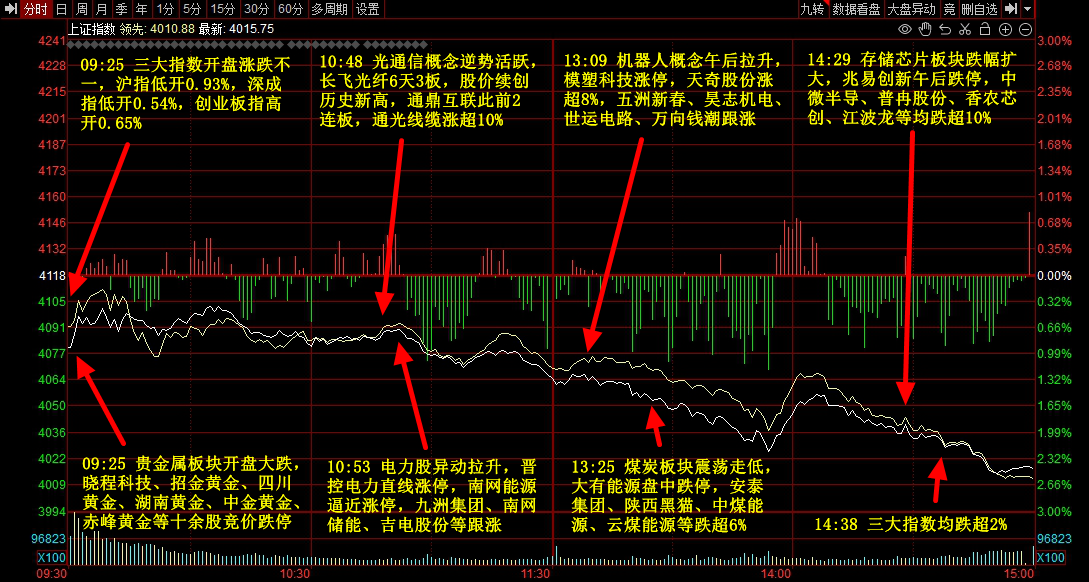
Market Overview - The A-share market has experienced a significant adjustment, with the Shanghai Composite Index falling below the 4100-point mark, primarily due to the decline of resource cyclical stocks [3] - The Shenzhen Component Index has seen a substantial drop influenced by both technology and cyclical sectors, while the ChiNext Index is under pressure from high-valuation stocks [3] Sector Performance - The market is characterized by a broad decline, although some sectors remain active, such as the strong performance of ultra-high voltage concept stocks and the resilience of liquor stocks [3] - Other sectors like cultural media AI applications and film industry themes are also showing activity, while gold, non-ferrous metals, oil and gas, coal, steel, and chemical sectors are experiencing significant downturns [3] Trading Volume and Sentiment - The total trading volume in the two markets has decreased by 8.8%, indicating a reduction in trading activity as the Spring Festival approaches, leading to increased risk aversion and a strong wait-and-see sentiment among investors [5] - There is an adjustment demand within the market, with previously popular sectors facing profit-taking pressure, prompting a shift in funds from high-risk, cyclical sectors to more defensive and stable sectors [5] Fund Flow Dynamics - There has been a net outflow of 19.98 billion from institutional funds, while retail investors have seen a net inflow [6] - Institutions are reallocating funds away from sectors like electronics, semiconductors, and non-ferrous metals, directing them towards defensive sectors such as electric grid equipment, liquor, and food and beverage [7] Retail Investor Behavior - Retail investor sentiment is reported at 75.85%, indicating a relatively high level of engagement despite market volatility [8] - The current positioning shows 28.19% of retail investors increasing their holdings, while 19.85% are reducing their positions, with 51.96% choosing to hold their positions steady [10]


A股大跌,原因来了!公募最新研判
Zhong Guo Ji Jin Bao· 2026-02-02 11:13
Core Viewpoint - The recent adjustment in A-shares is attributed to a combination of technical corrections and emotional releases, rather than systemic risks, with a continued positive outlook for the spring market driven by economic recovery and liquidity easing [1][2][4]. Market Adjustment Reasons - The primary disturbance in the market is linked to the nomination of Kevin Warsh as the next Federal Reserve Chairman by President Trump, which is interpreted as a hawkish stance advocating for "rate cuts + balance sheet reduction," leading to a stronger dollar and impacting commodity prices [2][3]. - The direct trigger for the adjustment was the significant drop in international precious metals markets, particularly gold and silver, which negatively affected the A-share market, especially in the non-ferrous metals sector [2][3]. Market Structure and Performance - Despite the overall market decline, certain sectors such as electric grid equipment, liquor, and banking showed resilience and strength, indicating a structural differentiation rather than a complete market downturn [2][4]. - The market is expected to enter a phase of consolidation, with a focus on verifying corporate earnings and fundamental performance as the Chinese New Year approaches [4][5]. Future Market Outlook - The spring market rally is anticipated to continue, supported by domestic policies aimed at stabilizing expectations and expanding domestic demand, with a focus on sectors like consumption and technology [4][6]. - The market is likely to experience a balanced structural feature, with opportunities in previously lagging sectors such as consumption and finance, as well as in technology growth stocks that are supported by industry trends [6][7]. Investment Focus Areas - Investment strategies should consider sectors with clear industry trends and low macroeconomic dependence, such as computing power and energy storage, as well as undervalued high-beta index sectors like non-bank financials [6][7]. - Post-earnings announcement, the market may focus on themes such as commercial aerospace, AI applications, and sectors experiencing price increases like petrochemicals and construction materials [7].
A股五张图:2月目标,回本!
Xuan Gu Bao· 2026-02-02 10:35
Market Overview - The market experienced significant losses on the first trading day of February, with the Shanghai Composite Index, Shenzhen Component Index, and ChiNext Index closing down by 2.48%, 2.69%, and 2.46% respectively, with over 4,600 stocks declining and trading volume shrinking to 2.6 trillion yuan [4][3]. Sector Performance - The non-ferrous metals sector faced a collective downturn, with major stocks like Tongling Nonferrous Metals and Huayou Cobalt hitting the daily limit down, reflecting a broader trend of heavy losses across various non-ferrous commodities [5][15]. - The precious metals market saw silver prices drop significantly, with a decline of over 25% in New York silver futures, indicating a severe sell-off triggered by market dynamics [9][10]. Specific Stock Movements - Wenta Technology faced a dramatic decline, with its net profit projected to drop by 376.52% to 217.68%, leading to a trading halt at the daily limit down. This was attributed to asset impairment related to disputes with Anshi Semiconductor [31]. ETF Market - The ETF market also reflected the bearish sentiment, with major ETFs like the SSE 50 ETF and CSI 500 ETF experiencing sharp declines, particularly the CSI 500 which saw a drop of 6.5% in the afternoon session [27].


金融工程定期:券商金股解析月报(2026年02月)
KAIYUAN SECURITIES· 2026-02-02 10:35
Investment Rating - The report does not explicitly provide an investment rating for the industry or specific stocks [36]. Core Insights - In February, the top recommended stocks included Zijin Mining, Zhongji Xuchuang, Haiguang Information, Wanhua Chemical, Guizhou Moutai, Foster, and Shandong Gold, with a total of 291 unique stocks recommended by 38 brokerage firms [2][13]. - The sectors with the highest representation in recommended stocks were Electronics (13.0%), Non-ferrous Metals (8.5%), Basic Chemicals (8.0%), and Machinery Equipment (8.0%) [3][17]. - The market capitalization and valuation levels of recommended stocks decreased in February, indicating a potential shift towards value investing [3][18]. Summary by Sections February Stock Characteristics - The report highlights that the most frequently recommended stocks in February were Zijin Mining (7 times), Zhongji Xuchuang (7 times), Haiguang Information (7 times), Wanhua Chemical (7 times), and China Ping An (6 times) among repeat recommendations. New recommendations included Guizhou Moutai (6 times), Foster (4 times), and Shandong Gold (3 times) [2][14]. - The report categorizes stocks into new and repeat recommendations, with a total of 291 stocks identified [13]. January Stock Performance Review - The overall return of the stock portfolio in January was 7.2%, with a historical annualized return of 14.7%, outperforming the CSI 300 and CSI 500 indices. New recommendations performed better than repeat ones, with returns of 8.0% for new stocks compared to 6.4% for repeat stocks [4][21]. - Top-performing stocks in January included Zhuoyi Information (96.5%), Maiwei Shares (59.0%), and Hongjing Technology (55.4%) [4][22]. Preferred Stock Portfolio - The preferred stock portfolio achieved a return of 11.1% in January, with a historical annualized return of 24.2%, outperforming the overall stock portfolio [5][26]. - The February preferred stock portfolio included stocks such as Caibai Co., Runze Technology, and Cangge Mining, with a focus on sectors like power equipment, electronics, and machinery [5][27].





互联网巨头打响AI红包大战
摩尔投研精选· 2026-02-02 10:24
01丨 如何看待有色金属的高波动? 本周贵金属价格出现大幅波动,核心原因为 "美元信用松动+流动性宽松预期"的叙事因为美联储主席提名人选的确定出现了逆转 。 短期来看,国金策略梳理2001年以来铜、铝、黄金在创新高并下跌后的行情,发现铜、金在下跌后的10个、20个、60个交易日胜率均 超过50%(区间涨幅高于0),其中铜甚至能够超过70%。 | | | 2001年以来 | | | | --- | --- | --- | --- | --- | | 新高下跌后表现 | 諾 | 铜 | 金 | | | 10个交易日涨跌幅 | -1 | 0.45 | 2.33 - | 1.09 | | 20个交易日涨跌幅 | F | 0.51 | 0.70 - | 0.64 | | 60个交易日涨跌幅 | 1 | -0.89 -1 | 9.44 - | 4.82 | | 新高下跌后胜率 | | | | | | 10个交易日胜率 | | 58.3% | 67.4% | 61.9% | | 20个交易日胜率 | | 51.3% | 70.3% | 63.6% | | 60个交易日胜率 | | 49.6% | 67.9% | 71 0% ...

6.53亿资金逆势抢筹兴业银锡,湖南黄金龙虎榜现机构与游资博弈
摩尔投研精选· 2026-02-02 10:24
沪深股通今日合计成交3583.1亿,其中紫金矿业和中际旭创分居沪股通和深股通个股成交额首位。 二、板块个股主力大单资金 从板块表现来看,白酒、电网设备等板块涨幅居前,有色金属、油气、化工、煤炭、半导体等板块跌幅居前。 板块主力资金方面, 电网设备板块主力资金净流入居首 。ETF成交方面,多只化工相关ETF份额大幅增加,其中化工ETF(1 59870) 连续三周份额大增,上周份额增长43 . 16亿份位居首位,近三周份额共计增加超130亿份。沪深3 00ETF易方达(510310)上周份额减 少16 3.845亿份位居首位,近两周该ETF共计减少近300亿份。 龙虎榜方面, 中超控股今日逆势涨停,获一家一线游资(国泰海通证券成都北一环路)买入1.0 2亿,同时获两家量化(开源证券西安 太华路、中信证券上海漕溪北路)合计买入1.7亿,深股通买入1.27亿。 一、沪深股通前十大成交 今日沪股通总成交金额为1737. 74亿,深股通总成交金额为1845 .36亿。 | | 沪股通 ( | 2月2日 | ) | | | --- | --- | --- | --- | --- | | 排名 | 股票代码 | 股票名称 | ...


市场分析:电网酿酒行业领涨,A股宽幅震荡
Zhongyuan Securities· 2026-02-02 09:54
Investment Rating - The industry is rated as "stronger than the market," indicating an expected increase of over 10% in the industry index relative to the CSI 300 index over the next six months [16]. Core Insights - The A-share market experienced a low opening and wide fluctuations, with notable performance in the electric grid equipment, liquor, banking, and photovoltaic equipment sectors, while precious metals, fertilizers, mining, and non-ferrous metals lagged behind [2][3]. - The average price-to-earnings (P/E) ratios for the Shanghai Composite Index and the ChiNext Index are 16.90 times and 52.86 times, respectively, which are above the median levels of the past three years, suggesting a favorable environment for medium to long-term investments [3][15]. - The total trading volume on the two exchanges was 26,069 billion, which is above the median of the past three years, indicating robust market activity [3][15]. - The manufacturing PMI for January showed a slight decline, but the equipment manufacturing and high-tech manufacturing PMIs remain in the expansion zone, reflecting ongoing structural optimization in the industry [3][15]. - The report suggests a balanced investment strategy, focusing on AI and high-end manufacturing while also considering opportunities in certain consumer sectors [3][15]. Summary by Sections A-share Market Overview - On February 2, the A-share market opened low and experienced wide fluctuations, with the Shanghai Composite Index facing resistance around 4,103 points before retreating [7]. - The Shanghai Composite Index closed at 4,015.75 points, down 2.48%, while the Shenzhen Component Index closed at 13,824.35 points, down 2.69% [8]. - Over 80% of stocks declined, with only the electric grid equipment and liquor sectors showing slight increases [7]. Future Market Outlook and Investment Recommendations - The report anticipates that the Shanghai Composite Index will likely maintain a slight fluctuation, advising investors to closely monitor macroeconomic data, changes in overseas liquidity, and policy developments [3][15]. - Short-term investment opportunities are highlighted in the electric grid equipment, liquor, banking, and photovoltaic equipment sectors [3][15].
香港恒生指数下跌2.23% 科指跌3.36%
Xin Lang Cai Jing· 2026-02-02 09:51
转自:新华财经 当日恒指低开289.77点,开报27097.34点,开盘震荡向下,午后继续下行,尾市稍有回升,最终恒指跌 611.54点,主板成交超3478亿港元。截至午间收盘,上涨股票489只,下跌1854只,收平811只。当日, 港股通(南向)净流入超过19亿港元。 整体来看,多数板块下跌,博彩、啤酒等股多为上涨,银行、奶制品等股有涨有跌,黄金、有色金属、 铜矿股、商业航天、芯片、生物医药、新能源车企、券商、港口运输、石油与天然气等股多有下跌。 成交额前三的个股中,腾讯控股跌1.24%,成交超166亿港元;阿里巴巴跌3.49%,成交超164亿港元; 紫金矿业跌5.58%,成交72亿港元。 编辑:王媛媛 新华财经香港2月2日电(记者林迎楠)2月2日港股主要指数低开低走,截至收盘,恒生指数下跌2.23% 至26775.57点,恒生科技指数下跌3.36%至5526.31点,国企指数下跌2.54%至9080.19点。 ...
懒人财知道:2月2日交易复盘笔记 非理性恐慌下的机会
Xin Lang Cai Jing· 2026-02-02 09:47
Group 1 - The overall market sentiment is cautious due to high volatility, with a focus on avoiding risky trades and maintaining discipline in trading strategies [3][4][21] - The commodity market is experiencing a significant downturn, with a broad decline observed in various sectors, particularly in precious metals and energy [5][21][22] - The strongest sector identified is the chemical sector, specifically in caustic soda and PVC, while the weakest sectors include precious metals, non-ferrous metals, and crude oil [6][22] Group 2 - The core strategy involves going long on the strongest sectors and shorting the weakest ones, with a focus on maintaining a light position in weak commodities to avoid potential losses [7][24] - Specific strategies executed include automatic exit from PVC positions upon market decline and avoiding deep losses in precious metals and crude oil [9][10][25][26] - Risk management has been emphasized through systematic market analysis and strict stop-loss measures, successfully avoiding significant losses in weak sectors [11][27][28] Group 3 - Market drivers include geopolitical tensions and changes in U.S. monetary policy expectations, which have led to a bearish sentiment in the market [13][29] - The analysis framework used has effectively captured signals of market weakness, although there is a need for improved strategies for strong sectors to adapt to sudden market changes [14][30] - Continuous monitoring of U.S. Federal Reserve policies and global geopolitical developments is necessary for dynamic adjustment of trading strategies [15][31]
