
钢铁

Search documents
钢材早报-20260126
Yong An Qi Huo· 2026-01-26 03:18
Report Summary 1. Report Industry Investment Rating - No information provided 2. Core Viewpoints - No information provided 3. Summaries by Related Catalogs Price and Profit - The report presents the spot prices of various steel products in different regions from January 19 to January 23, 2026, including Beijing, Shanghai, Chengdu, Xi'an, Guangzhou, and Wuhan for rebar, and Tianjin, Shanghai, and Lecong for hot-rolled and cold-rolled coils. For example, the price of Beijing rebar was 3130 on January 19 and remained the same on January 20, then dropped to 3110 on January 21 and stayed at that level until January 22. The price changes of hot-rolled and cold-rolled coils are also detailed, such as the Shanghai hot-rolled coil price increasing from 3260 on January 19 to 3310 on January 23 [1] Output and Inventory - No information provided Basis and Spread - No information provided
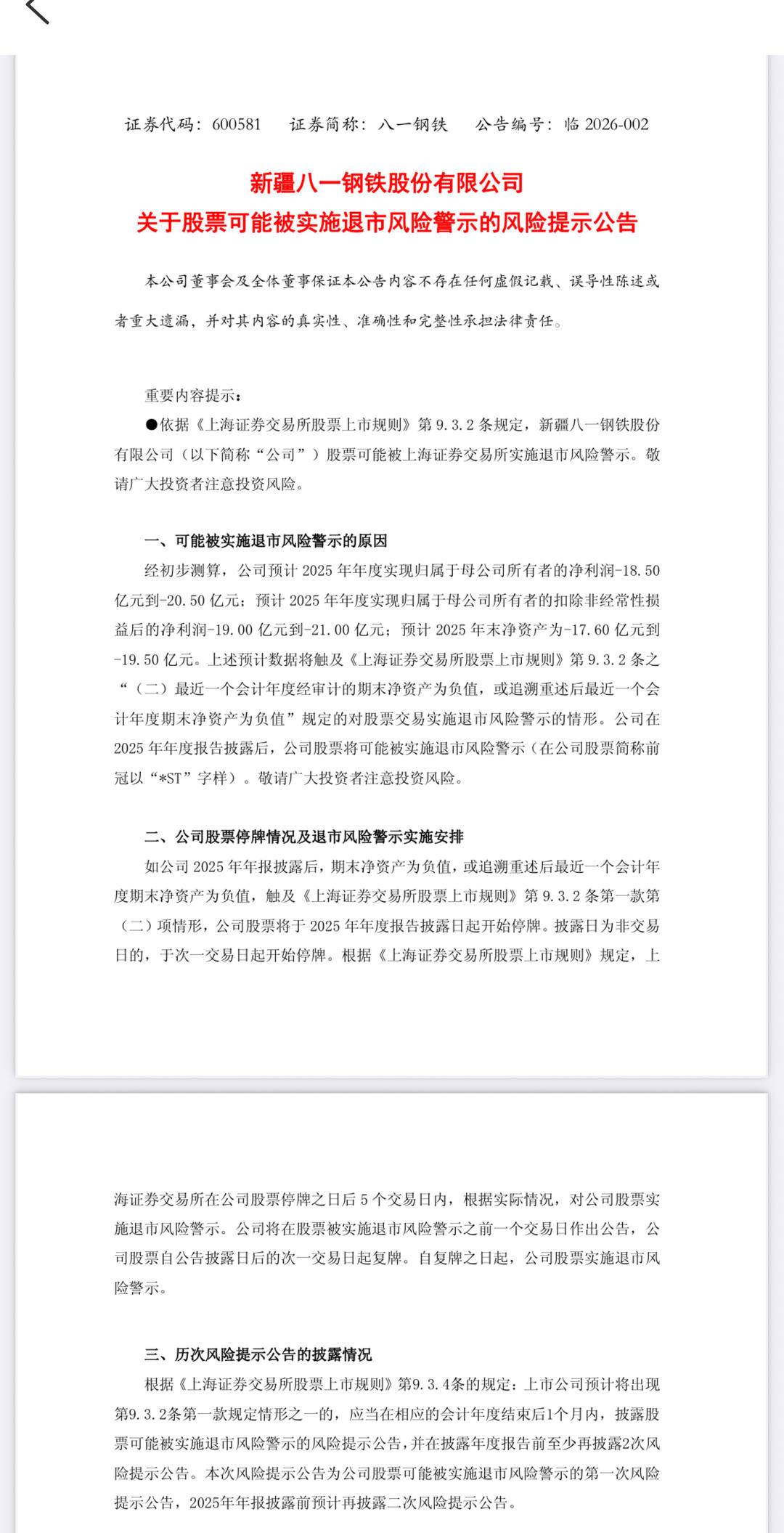
你没看错!这家公司去年预亏超18亿元
Yang Zi Wan Bao Wang· 2026-01-26 03:17
Core Viewpoint - The company Xinjiang Bayi Iron and Steel Co., Ltd. is at risk of being delisted due to projected negative net profits and net assets for the fiscal year 2025, which may trigger a warning for delisting risk according to the Shanghai Stock Exchange regulations [2][3][11] Group 1: Financial Projections - The company expects a net profit attributable to shareholders of the parent company for 2025 to be between -1.85 billion to -2.05 billion yuan [3][6] - The projected net profit after deducting non-recurring gains and losses is estimated to be between -1.9 billion to -2.1 billion yuan [3][6] - The expected net assets at the end of 2025 are projected to be between -1.76 billion to -1.95 billion yuan [3][6] Group 2: Delisting Risk Warning - The anticipated financial results will likely meet the criteria for a delisting risk warning as per the Shanghai Stock Exchange's regulations, specifically regarding negative net assets [3][11] - If the company's net assets are negative as reported in the 2025 annual report, the stock will be suspended from trading starting from the disclosure date [4][11] Group 3: Market Conditions and Company Strategy - The steel industry is currently undergoing a period of "reduction in quantity and optimization of stock," with weak supply and demand, tightening environmental policies, and price discrepancies affecting profitability [10] - The company is focusing on a strategy of "cost reduction, quality improvement, market expansion, and transformation" to address current challenges and improve operational performance [10] - The company is actively adjusting its product structure and sales regions in response to recent fluctuations in raw material prices and seasonal demand impacts [9][10]


钢铁ETF(515210)近20日资金净流入超10亿元,资金积极布局,产业集中度提升
Mei Ri Jing Ji Xin Wen· 2026-01-26 03:16
Group 1 - The long-term trend in the steel industry is expected to be an increase in industry concentration and promotion of high-quality development [1] - Demand for steel is anticipated to gradually bottom out, with limited downward pressure; the negative impact of the real estate sector on steel demand has significantly weakened [1] - Steel demand from infrastructure and manufacturing sectors is expected to grow steadily [1] Group 2 - Approximately 60% of steel companies are currently operating at a loss, indicating a prolonged period of micro-profitability in the industry [1] - Market-driven supply adjustments are beginning to occur, suggesting a gradual recovery in the steel industry's fundamentals [1] - If supply policies are implemented, the contraction of industry supply may accelerate, leading to quicker progress in industry recovery [1] Group 3 - Under stricter environmental regulations and the context of ultra-low emissions and carbon neutrality, leading companies are expected to demonstrate enhanced competitive advantages and profitability [1] - The steel ETF (515210) tracks the CSI Steel Index (930606), which reflects the overall performance of listed companies in the steel industry [1] - The index covers various sub-sectors, including general steel and special steel, capturing the cyclical characteristics and market dynamics of the steel industry [1]
自由现金流策略韧性凸显,聚焦自由现金流ETF(159201)、现金流500ETF(560120)配置价值
Mei Ri Jing Ji Xin Wen· 2026-01-26 03:14
Group 1 - The A-share market showed a mixed performance on January 26, with the free cash flow strategy demonstrating resilience, leading to an increase in related indices, with the cash flow index rising over 1.6% and the free cash flow index up over 1.3% [1] - The largest free cash flow ETF (159201) attracted significant capital, with a total net inflow of 1.402 billion yuan over the past six days, while the cash flow 500 ETF (560120) saw over 55.66 million yuan in inflows in the last ten days [1] - Despite short-term external policy disturbances, the domestic equity market pricing remains self-driven, supported by a relatively loose liquidity environment, which continues to favor the spring market trend [1] Group 2 - The free cash flow ETF (159201) and its linked funds focus on the domestic growth potential, emphasizing financial health and sustainability, which aligns with the long-term growth and capital appreciation needs of investors [2] - The cash flow 500 ETF (560120) closely tracks the CSI 500 free cash flow index, selecting 50 stocks with positive and high free cash flow, characterized by small to mid-cap market value, lower valuations, and higher ROE [2] - The industry distribution of the index is balanced, primarily featuring non-financial sectors such as metals, basic chemicals, steel, pharmaceuticals, and machinery, with no allocation to the financial and real estate sectors [2]
黑色:市场氛围偏好黑色震荡延续
Chang Jiang Qi Huo· 2026-01-26 03:13
Report Summary 1. Report Industry Investment Rating No information provided. 2. Core Viewpoints - Last week, the black sector first declined and then rose, showing overall weak performance. In terms of index fluctuations, the strength order of varieties was coke > hot-rolled coil > rebar > coking coal > iron ore. In the entire futures market, non-ferrous metals remained strong, chemicals strengthened collectively, while the black sector showed mediocre performance [4]. - Macro policy: Global uncertainty has intensified as the US imposed a new round of sanctions on Iran. Domestically, a package of policies on fiscal and financial coordination to promote domestic demand has been introduced. Industry pattern: Last week, steel demand declined month-on-month, and inventory accumulated seasonally. However, the absolute inventory is currently low. On the raw material side, downstream enterprises replenished their stocks before the festival, and inventory shifted to the middle and lower reaches [4]. 3. Summary by Relevant Catalogs 01 Black Sector Trend Comparison - The black sector first declined and then rose last week, showing overall weak performance [4][6]. 02 Futures Market Rise and Fall Comparison - Non-ferrous metals remained strong, and chemicals strengthened. The black sector showed mediocre performance [4][8]. 03 Spot Prices - Spot prices were stable with a weak trend, and iron ore had the largest decline [10]. 04 Profit and Valuation - The profitability rate of steel mills increased slightly, and the valuation of rebar futures was low. Rebar futures prices were slightly higher than the valley electricity cost of electric furnaces and lower than the flat electricity cost, with a low static valuation [5][13]. 05 Steel Supply and Demand - Steel demand declined month-on-month, and inventory accumulated seasonally. Currently, the absolute inventory is low, and the supply-demand contradiction is not significant [4][5][15]. 06 Iron Ore Supply and Demand - Iron ore output remained stable. Steel mills started to replenish their stocks before the festival, and the inventory at steel mills and ports both increased. Iron ore shipments continued to decline, but based on previous shipment data, recent arrivals are still at a high level. It is expected to remain in an inventory accumulation pattern in the short term, with the support being the large discount of iron ore futures [5][24]. 07 Coking Coal Supply and Demand - Raw coal output increased, and coking coal inventory continued to accumulate. Although coking plants started to replenish their stocks before the festival, mines had difficulty in destocking and still had a slight inventory increase [5][27]. 08 Coke Supply and Demand - Coke output remained flat, and inventory shifted to the middle and lower reaches. Currently, the profit of coking plants is low. Recently, some coking plants proposed the first round of price increases, but coke futures have a premium over the spot [5][29]. 09 Variety Spreads - The rebar-iron ore ratio increased, and the hot-rolled coil-rebar spread widened [31]. 10 Key Data/Policy/News - In 2025, China's GDP increased by 5.0% year-on-year, exceeding 140 trillion yuan for the first time, reaching 140.19 trillion yuan. - The central bank governor said that in 2026, the People's Bank of China will continue to implement a moderately loose monetary policy, with promoting stable economic growth and reasonable price recovery as important considerations for monetary policy. There is still room for reserve requirement ratio cuts and interest rate cuts this year. - A package of policies on fiscal and financial coordination to promote domestic demand has been introduced, including the establishment of a 500 billion yuan special guarantee plan for private investment for the first time, guiding banks to newly issue 500 billion yuan in loans for private investment in small and medium-sized enterprises. - Recently, five departments including the Ministry of Industry and Information Technology jointly issued the "Guiding Opinions on Carrying out the Construction of Zero-Carbon Factories", aiming to gradually expand zero-carbon factory construction to industries such as steel, non-ferrous metals, petrochemicals, building materials, and textiles by 2030, exploring new paths for carbon reduction in traditional high-energy-consuming industries. - In 2025, China's crude steel output was 960.81 million tons, a year-on-year decrease of 4.4%; pig iron output was 836.04 million tons, a year-on-year decrease of 3.0%; steel output was 1.44612 billion tons, a year-on-year increase of 3.1%. - On January 23 local time, the US Treasury Department's Office of Foreign Assets Control announced a new round of sanctions on multiple entities and vessels related to Iran's energy and shipping systems, targeting the shipping and management network assisting Iran's oil, energy, and derivatives exports. - On January 21, Trump posted on social media that he had formulated a framework for an agreement on Greenland with NATO Secretary-General Rutte, so he would not implement the tariff increase measures on 8 European countries originally scheduled to take effect on February 1. - The final annualized quarterly growth rate of the US GDP in the third quarter of 2025 was 4.4%, higher than the initial value of 4.3%, hitting the fastest growth rate in nearly two years. - The global bond market has experienced large-scale selling, and concerns about fiscal spending, new tariff threats, and doubts about the safe-haven status of US Treasuries have jointly triggered market volatility [38].
《黑色》日报-20260126
Guang Fa Qi Huo· 2026-01-26 03:04
1. Report Industry Investment Ratings - No industry investment ratings are provided in the given reports. 2. Core Views Steel - Steel prices maintain a sideways trend, with rebar slightly stronger than hot - rolled coils, and the spread between coils and rebar has converged to 160 yuan per ton. The steel industry has weak supply and demand. Rebar demand declines seasonally, with a large supply - demand gap and obvious inventory accumulation; hot - rolled coil demand declines slightly and inventory continues to be depleted. The market sentiment has improved in the second half, and steel is expected to fluctuate towards the upper limit of the range. The 5 - month contract of rebar is expected to fluctuate between 3050 - 3250 yuan, and hot - rolled coils between 3200 - 3350 yuan [1]. Iron Ore - Iron ore is facing a pattern of weak supply and demand. With the possible easing of the negotiation deadlock, lower - than - expected hot - metal production resumption, and the gradual realization of steel - mill restocking, prices are under pressure. Be cautious of macro - level fluctuations [3]. Coke - The coke futures showed a trend of first falling and then rising last week. The spot market is currently stable. Supply - side price adjustments lag behind coking coal, and coking profits are under pressure. Demand - side steel - mill production has resumed slightly after the New Year's Day. Inventory has increased slightly. After the fourth round of spot price cuts, some coke enterprises are resisting price cuts and starting to raise prices, which is expected to be implemented. The market is expected to be loose again, and prices are expected to fluctuate within the range of 1600 - 1800 yuan [5]. Coking Coal - Coking coal futures also showed a trend of first falling and then rising last week. The spot auction prices in Shanxi mostly increased, and the Mongolian coal quotation followed the futures down. The supply side has resumed production, and the demand side has low - level hot - metal production and weakening coking profits. The overall inventory has increased slightly. Before the Spring Festival, the spot is strong due to restocking demand, but the futures have over - anticipated the rise. After the festival, the market is expected to be loose, and prices are expected to fluctuate within the range of 1000 - 1200 yuan [5]. Ferrosilicon - Ferrosilicon is in a pattern of weak supply and demand. Supply is stable, and production is at a historically low level. The non - steel demand is weakening. The overall inventory is moderately high. The cost is affected by the manganese ore restocking. In the short term, the price is expected to fluctuate widely within the range of 5500 - 5900 yuan [6]. Silicomanganese - Silicomanganese supply is relatively stable with a low absolute value. The demand is affected by the slow resumption of hot - metal production. The manganese ore supply and port inventory have an impact on the cost. The price is expected to fluctuate widely within the range of 5600 - 6000 yuan [6]. 3. Summary by Directory Steel Steel Prices and Spreads - Rebar and hot - rolled coil prices in different regions have different changes, with some rising and some remaining stable. The basis and spreads of different contracts also vary [1]. Cost and Profit - Steel billet and slab prices have different changes. The costs of electric - furnace and converter rebar in different regions also change, and the profits of rebar and hot - rolled coils in different regions decline to varying degrees [1]. Production - The daily average hot - metal output and the output of five major steel products are basically stable. Rebar production increases by 4.9%, with converter production increasing by 6.3% and electric - furnace production decreasing by 2.0%. Hot - rolled coil production decreases by 1.0% [1]. Inventory - The inventory of five major steel products increases by 0.8%, with rebar inventory increasing by 3.2% and hot - rolled coil inventory decreasing by 1.3% [1]. Transaction and Demand - Building material transactions increase by 8.9%, while the apparent demand for five major steel products, rebar, and hot - rolled coils decreases [1]. Iron Ore Iron Ore - Related Prices and Spreads - The warehouse - receipt costs of various iron ore powders increase by about 0.9%, and the basis of the 05 - contract for different powders decreases slightly. The 5 - 9 spread increases by 2.9%, and the 1 - 5 spread decreases by 3.4% [3]. Spot Prices and Price Indexes - The spot prices of various iron ore powders at Rizhao Port increase by about 0.8% - 0.9%, and the Singapore Exchange 62% Fe swap price increases slightly [3]. Supply - The 45 - port arrival volume and global shipment volume decline, while the national monthly import volume increases by 8.2% [3]. Demand - The daily average hot - metal output of 247 steel mills is basically stable, the 45 - port daily average desulfurization volume decreases by 2.9%, and the national monthly pig - iron and crude - steel production decline [3]. Inventory Changes - The 45 - port inventory and the imported - ore inventory of 247 steel mills increase, and the inventory - available days of 64 steel mills increase by 9.5% [3]. Coke Coke - Related Prices and Spreads - The prices of Shanxi and Rizhao Port quasi - first - grade wet - quenched coke remain stable, while the 05 and 09 - contract prices increase. The coking profit (weekly) of the Steel Union declines [5]. Upstream Coking Coal Prices and Spreads - The price of Shanxi coking coal (warehouse - receipt) remains stable, and the price of Mongolian coking coal (warehouse - receipt) increases by 0.4%. The overseas coal prices of some varieties increase [5]. Supply - The daily average output of all - sample coking plants decreases slightly, and the daily average output of 247 steel mills increases slightly [5]. Demand - The hot - metal output of 247 steel mills increases slightly [5]. Inventory Changes - The total coke inventory increases by 2.1%, with the inventory of coking plants decreasing and the inventory of steel mills and ports increasing [5]. Coke Supply - Demand Gap Changes - The coke supply - demand gap remains basically unchanged [5]. Coking Coal Coking Coal - Related Prices and Spreads - The price of Shanxi medium - sulfur primary coking coal (warehouse - receipt) remains stable, and the 05 and 09 - contract prices increase. The sample coal - mine profit (weekly) increases [5]. Supply - The raw - coal output of Fenwei sample coal mines decreases slightly, and the coking - coal product output decreases slightly [5]. Demand - The coke output of all - sample coking plants decreases slightly, and the coke output of 247 steel mills increases slightly [5]. Inventory Changes - The coking - coal inventory of Fenwei coal mines decreases, while the inventory of all - sample coking plants, 247 steel mills, and ports changes in different directions [5]. Ferrosilicon Ferrosilicon Spot Prices and Spreads - The closing price of the ferrosilicon main contract increases, and the spot prices of some regions increase slightly [6]. Cost and Profit - The production cost in some regions changes slightly, and the production profit in some regions improves [6]. Supply - The ferrosilicon product output (weekly) decreases slightly, and the operating rate of production enterprises decreases slightly [6]. Demand - The ferrosilicon demand (weekly) calculated by the Steel Union increases slightly [6]. Inventory Changes - The ferrosilicon inventory of 60 sample enterprises increases by 5.4%, and the average available days of downstream ferrosilicon decrease [6]. Silicomanganese Silicomanganese Spot Prices and Spreads - The closing price of the silicomanganese main contract increases, and the spot prices in most regions remain stable [6]. Cost and Profit - The manganese - ore prices of some varieties at Tianjin Port remain stable [6]. Supply - The silicomanganese weekly output increases slightly, and the operating rate increases slightly [6]. Demand - The silicomanganese demand calculated by the Steel Union increases slightly [6]. Inventory Changes - The inventory of 63 sample enterprises remains basically unchanged, and the average available days of inventory decrease [6].
中泰期货晨会纪要-20260126
Zhong Tai Qi Huo· 2026-01-26 03:03
1. Report Industry Investment Ratings No relevant information provided. 2. Core Views of the Report - The A - share market showed a differentiated trend on Friday, with small - and medium - cap indexes rising and large - cap blue - chip indexes falling. The market sentiment was affected by news such as the possible visit of US President Trump to China and the release of the first fine by the CSRC in 2026 [15]. - The long - end bonds may continue to rebound, and the interest rate curve may continue to flatten. The central bank's monetary policy is turning to be more accommodative, but the cost of funds remains relatively high [16]. - The black market as a whole maintains a volatile trend. Steel products may fluctuate and consolidate in the short term, and iron ore is relatively weak and should be shorted on rallies [18]. - The prices of coking coal and coke may fluctuate and consolidate in the short term, and the supply - demand contradiction may improve during the Spring Festival [19][21]. - The medium - term price fluctuation center of ferrosilicon and silicomanganese is rising slightly. It is recommended to go long on ferrosilicon on dips and hold short positions in silicomanganese [22]. - For soda ash and glass, it is advisable to wait and see currently. Pay attention to the supply changes of leading enterprises and the implementation of production line changes [23]. - For non - ferrous metals, it is recommended to wait and see for zinc and lead, and hold short positions in lead. Lithium carbonate is expected to fluctuate strongly in the short term [25][26][28]. - Industrial silicon is under pressure at the upper limit and should wait for opportunities to sell out - of - the - money call options after a rebound. Polysilicon should wait for guidance on anti -内卷 and anti - monopoly rectification plans [29]. - For agricultural products, cotton prices may be affected by supply and demand and policies. Sugar prices are under pressure, and eggs may weaken before the Spring Festival. Apples may fluctuate strongly, and corn prices are affected by inventory and policy. Jujubes may fluctuate weakly, and pork prices are affected by supply and demand [31][34][36][38][39][40][41]. - For energy and chemical products, crude oil prices are affected by geopolitical factors and supply - demand contradictions. Fuel oil prices follow crude oil. Plastics may have a short - term rebound but with limited space. Rubber can sell out - of - the - money put options on dips. Methanol is recommended to be long - configured. Caustic soda has different views for near - term and far - term contracts. Asphalt prices follow crude oil. The polyester industry chain may maintain a high - level operation. LPG may be strong in the short term but with limited upside. Pulp and logs may fluctuate strongly, and urea is expected to be strongly volatile [43][46][48][50][52][53][54][55][56][57][58]. 3. Summaries According to Relevant Catalogs 3.1 Macro Information - The CSRC officially released the guidelines for the performance comparison benchmarks of public funds, and the Asset Management Association of China released the operating rules, which will come into effect on March 1, 2026. The new rules target industry pain points such as "vague benchmarks", "style drift", and "fund blind boxes" [8]. - The CSRC issued its first fine in 2026, imposing a penalty on Yu Han for manipulating the stock price of "Doctor Glasses" [8]. - The market operation and consumption promotion work conference emphasized promoting the expansion and upgrading of commodity consumption and cultivating new growth points in service consumption [8]. - The CSRC is intensively investigating illegal activities in the private fund sector and will urge private institutions to rectify non - standard behaviors [9]. - The "Beijing Rocket Street" launched six platforms, aiming to form a full - chain "thousand - satellite production and launch" capacity [9]. - US President Trump said that the US is deploying troops to Iran and will impose a 25% tariff on countries trading with Iran. The US also imposed a new round of sanctions on entities and vessels related to Iran's energy and shipping systems [9]. - Representatives from Russia, the US, and Ukraine held their first meeting in Abu Dhabi to discuss security issues [9]. - The preliminary values of the US manufacturing, service, and composite PMIs in January were slightly lower than expected. The eurozone's manufacturing PMI rebounded slightly but remained in the contraction range, while the service PMI declined [10]. - The CSRC approved the registration of 20 - rubber options, low - sulfur fuel oil options, and international copper options and included 14 futures and options varieties in the scope of expanding the opening of the futures market [10]. - The Bank of Japan maintained its benchmark interest rate at 0.75% and raised its economic growth and inflation expectations for the 2026 fiscal year [10]. - A German lawmaker proposed that Germany should repatriate its gold reserves from the US due to the "unpredictable" policies of US President Trump [11]. - Silver prices reached a new high, with a year - to - date increase of over 40%, outperforming gold. Gold prices continued to approach $5000 per ounce [11]. 3.2 Macro - Finance 3.2.1 Stock Index Futures - The A - share market showed a differentiated trend on Friday, with small - and medium - cap indexes rising and large - cap blue - chip indexes falling. The market sentiment was affected by news such as the possible visit of US President Trump to China and the release of the first fine by the CSRC in 2026 [15]. 3.2.2 Treasury Bond Futures - The long - end bonds may continue to rebound, and the interest rate curve may continue to flatten. The central bank's monetary policy is turning to be more accommodative, but the cost of funds remains relatively high [16]. 3.3 Black 3.3.1 Steel and Iron Ore - The macro - policy meets market expectations, and the possibility of policy interference in the steel production end is low. The fundamentals of steel are acceptable, with small inventory increases and good order - taking. However, downstream demand is weak, especially in the building materials sector. Iron ore supply is abundant, and its inventory is accumulating [16][17]. - The black market as a whole maintains a volatile trend. Steel products may fluctuate and consolidate in the short term, and iron ore is relatively weak and should be shorted on rallies [18]. 3.3.2 Coking Coal and Coke - The prices of coking coal and coke may fluctuate and consolidate in the short term. The supply - demand contradiction may improve during the Spring Festival, which may support spot prices [19][21]. 3.3.3 Ferrosilicon and Silicomanganese - The medium - term price fluctuation center of ferrosilicon and silicomanganese is rising slightly. It is recommended to go long on ferrosilicon on dips and hold short positions in silicomanganese [22]. 3.3.4 Soda Ash and Glass - For soda ash and glass, it is advisable to wait and see currently. Pay attention to the supply changes of leading enterprises and the implementation of production line changes [23]. 3.4 Non - Ferrous Metals and New Materials 3.4.1 Zinc - As of January 22, the domestic zinc inventory decreased. It is recommended to wait and see or short on rallies due to the repeated inventory data [25]. 3.4.2 Lead - As of January 22, the lead inventory reached a two - month high. It is recommended to wait and see and hold short positions. Be cautious of the risk of lead price decline before the Spring Festival [26][27]. 3.4.3 Lithium Carbonate - Lithium carbonate is expected to fluctuate strongly in the short term, with good demand and supply - side disturbances. The market expects a narrowing of the supply surplus or even a shortage in 2026 [28]. 3.4.4 Industrial Silicon and Polysilicon - Industrial silicon is under pressure at the upper limit and should wait for opportunities to sell out - of - the money call options after a rebound. Polysilicon should wait for guidance on anti -内卷 and anti - monopoly rectification plans [29]. 3.5 Agricultural Products 3.5.1 Cotton - The global cotton supply and demand situation is favorable, with a decrease in production and inventory. The domestic cotton supply is temporarily abundant, and attention should be paid to the impact of pre - Spring Festival restocking and policy implementation [31][33]. 3.5.2 Sugar - Global sugar supply is expected to be in surplus in the 2025/26 season. Domestic sugar is under supply pressure, and it is recommended to trade in the low - level range [34]. 3.5.3 Eggs - Eggs may weaken before the Spring Festival. The futures of the 03 contract have limited upside space, and a bearish view is recommended. However, the egg - laying hen inventory is expected to decline, which may limit the downside space of futures [36][37]. 3.5.4 Apples - Apple prices may fluctuate strongly in the short term, with the supply side providing support and the demand side constraining the upside. Attention should be paid to the terminal consumption during the Spring Festival [38][39]. 3.5.5 Corn - Corn prices are expected to be stable in the short term, supported by pre - Spring Festival restocking demand. However, the upside space is limited, and attention should be paid to the selling pressure in March [39]. 3.5.6 Jujubes - Jujubes are expected to fluctuate weakly in the short term. Attention should be paid to the market performance during the consumption peak season [40]. 3.5.7 Pigs - The pig market has both supply and demand increases, and the spot market is in a fierce game. It is recommended to pay attention to the impact of weight reduction before the Spring Festival on prices and consider shorting near - term contracts on rallies [41]. 3.6 Energy and Chemical Products 3.6.1 Crude Oil - Crude oil prices are affected by geopolitical factors and supply - demand contradictions. Geopolitical factors have pushed up prices, but the supply - demand situation remains weak [43]. 3.6.2 Fuel Oil - Fuel oil prices follow crude oil, and the current supply - demand situation has a marginal improvement. The focus is on the geopolitical situation in Iran [46]. 3.6.3 Plastics - Plastics have a large supply pressure and weak downstream demand. They may have a short - term rebound but with limited space [46][47]. 3.6.4 Rubber - Rubber can sell out - of - the money put options on dips before the Spring Festival, supported by downstream restocking and the approaching off - season in overseas production areas [48]. 3.6.5 Synthetic Rubber - Synthetic rubber is expected to fluctuate upward in the first half of the year, and it is recommended to go long on pullbacks [49]. 3.6.6 Methanol - Methanol's supply - demand situation has improved, and it is recommended to be long - configured. However, there may be a short - term callback risk [50]. 3.6.7 Caustic Soda - Caustic soda has different views for near - term and far - term contracts. The near - term contract is bearish, while the far - term contract is bullish [52]. 3.6.8 Asphalt - Asphalt prices follow crude oil, and attention should be paid to the change in raw material discounts [53]. 3.6.9 Polyester Industry Chain - The polyester industry chain may maintain a high - level operation, and it is recommended to consider low - buying and 5 - 9 positive spreads for PX and PTA [54]. 3.6.10 LPG - LPG may be strong in the short term but with limited upside. Attention should be paid to the negative feedback from the demand side [55]. 3.6.11 Pulp - Pulp prices may fluctuate strongly. The spot market is weak, but there is support from the expected price increase of overseas pulp [56]. 3.6.12 Logs - Logs may fluctuate strongly, with the domestic spot market remaining stable and the supply - demand situation expected to be balanced [57]. 3.6.13 Urea - Urea is expected to be strongly volatile, and attention should be paid to the improvement of spot market liquidity [58].
银河期货每日早盘观察-20260126
Yin He Qi Huo· 2026-01-26 02:54
1. Report Industry Investment Rating No investment rating information is provided in the report. 2. Core Viewpoints of the Report - The market is currently in a state of high activity with a strong upward trend, especially for the CSI 500 and CSI 1000 indices. The market成交 remains high, and the upward momentum is expected to continue. However, there are also potential risks, such as a reversal in market liquidity, a burst of the US AI bubble, and lower - than - expected economic growth [20]. - In different commodity sectors: - Agricultural products: Overall, the supply and demand situation varies. For example, protein meal faces supply pressure, while sugar has supply - side issues both domestically and internationally. Oils and fats are in a state of wide - range oscillation [25][28][31]. - Metals: Precious metals like gold and silver are strongly influenced by geopolitical factors and are expected to maintain a strong upward trend. Base metals have different trends, such as copper being in a high - level consolidation phase, and iron ore having a weakening fundamental outlook [70][77][65]. - Energy and chemicals: Crude oil is affected by geopolitical risks and is expected to be volatile and slightly bullish. Other products like asphalt, fuel oil, and LPG also have their own supply - demand and price characteristics [120][122][127]. 3. Summary by Relevant Categories Financial Derivatives - **Stock Index Futures**: The IC and IM indices are accelerating upwards. The market enthusiasm is high, and the upward trend is expected to continue. The CSI 500 and CSI 1000 indices are favored. Trading strategies include going long on IM and IC in the medium - to - long term, and using grid trading for IF and IH in the short term [18][20]. - **Treasury Bond Futures**: Economic data is mixed, and the central bank's attitude towards liquidity is positive. It is recommended to partially take profits on long positions in TL and consider short - selling the basis of 30Y active bonds [22][23]. Agricultural Products - **Protein Meal**: Supply pressure is increasing, and the overall market is declining. The US soybean market is under pressure due to a generally loose supply - demand situation, while the domestic market may have some support in the short - term but still faces long - term pressure [25][27]. - **Sugar**: The international sugar price is falling, while the Zhengzhou sugar price is relatively strong. The international sugar market is affected by the expected increase in production in the Northern Hemisphere, while the domestic market is under supply pressure but has some support at low prices [28][30]. - **Oils and Fats**: The sector is expected to continue wide - range oscillations. Domestic soybean supply is sufficient, and the inventory of various oils is in different states. The Malaysian palm oil is expected to continue to reduce production and inventory [31][35]. - **Corn/Corn Starch**: The northern port spot price is rising, and the market is in a strong - side oscillation. The US corn market is affected by export sales and weather, while the domestic market has a stable spot price in the short - term but still faces pressure [35][37]. - **Hogs**: The slaughter pressure is improving, and the spot price is gradually rising. However, the overall supply pressure still exists, and the price is still under pressure [38][40]. - **Peanuts**: The spot price is stable, and the market is oscillating at the bottom. The import volume is decreasing, and the oil mill has a profit. The 05 contract is recommended to go long at low prices [41][43]. - **Eggs**: As the Spring Festival approaches, the egg price is rising. The supply is gradually reducing production, but the 03 contract may have limited upward space due to the weak demand after the Spring Festival [44][48]. - **Apples**: The pre - festival sales are good, and the price is firm. The inventory is low, the cost of warehouse receipts is high, and the 5 - month contract price is expected to be easy to rise and difficult to fall [50][55]. - **Cotton - Cotton Yarn**: The sentiment is optimistic, and the cotton price is supported. The sales progress is fast, and the improvement in Sino - US relations and the expected expansion of Xinjiang textile factories' production capacity support the market. The short - term market is expected to oscillate within a range [56][57]. Black Metals - **Steel**: The demand is marginally weakening, and the steel price continues to oscillate. The steel production and inventory are in a complex state, and the cost is supported. The market is expected to remain oscillating before the Spring Festival [59][60]. - **Coking Coal and Coke**: The fundamentals are lackluster, and attention should be paid to capital disturbances. The supply of coking coal is not tight, and the downstream replenishment is not strong. The market is expected to oscillate widely, and it is recommended to wait and see or go long at low prices [61][64]. - **Iron Ore**: The terminal demand is at a low level, and the iron ore price is oscillating. The supply is increasing, the demand is weak, and the high - valuation situation is expected to be difficult to sustain. The market is expected to oscillate in the short - term [65][67]. - **Ferroalloys**: The valuation is low and there is a need for restoration, and the short - term market is oscillating strongly. The supply and demand of silicon - iron and manganese - silicon are improving marginally, and the cost is supported [67][69]. Non - ferrous Metals - **Gold and Silver**: Gold has broken through the $5000 mark, and silver has entered the "three - digit" era. Geopolitical factors are the main drivers, and the prices are expected to remain strong in the short - term [70][73]. - **Platinum and Palladium**: Geopolitical events have led to a rift in trust between Europe and the United States, and the precious metals are strongly rising. Platinum has a stronger upward drive than palladium [74][76]. - **Copper**: The copper price is in a high - level consolidation phase. The increase in inventory and the uncertainty of tariffs have an impact on the short - term price, but the long - term supply shortage and strong financial attributes support the price [77][79]. - **Alumina**: The market is mainly oscillating at a low level. The supply has short - term maintenance and production reduction, and the fundamentals are still weak [80][83]. - **Electrolytic Aluminum**: The aluminum price is oscillating and rebounding. The global shortage is more prominent overseas, and the downstream has replenishment sentiment, supporting the price [84]. - **Cast Aluminum Alloy**: Driven by risk appetite, the alloy is oscillating and rebounding with the sector. The supply of scrap aluminum is tight, and the cost supports the price [85][86]. - **Zinc**: Attention should be paid to the change in domestic social inventory. The supply of zinc concentrate is still in short supply, and the supply of refined zinc is increasing. The market is expected to oscillate and rebound [87][93]. - **Lead**: There may be support at the bottom. The supply of primary lead is stable, and the production of recycled lead may decline. The demand is weakening, and the price is in a range - bound oscillation [93][97]. - **Nickel**: The long - term expectation is leading the nickel price to rise. The short - term reality is weak, but the long - term expectation is optimistic. The price is expected to have upward space after high - level consolidation [98][101]. - **Stainless Steel**: The supply and demand are tight, and the price is firm. The supply of raw materials is short, the inventory is decreasing, and the price is expected to remain high [102]. - **Industrial Silicon**: The news of production reduction is fermenting, but the coking coal is dragging down the market. The short - term market is oscillating strongly. If the production reduction is implemented, the price may rise [104]. - **Polysilicon**: The spot price is declining, and the short - term futures are under pressure. The high inventory and weak demand may lead to a decline in the spot price, and the futures should be treated with a short - term bearish view [105][106]. - **Lithium Carbonate**: The price is at a high level, and cautious operation is recommended. The supply may be affected by policies and maintenance, and the demand is supported by pre - holiday stocking. The price may continue to rise, but there are also regulatory risks [110][112]. - **Tin**: The tin price has increased in volume and broken through. The inventory is increasing, the production is decreasing, and the demand is in the off - season. The price is expected to oscillate widely at a high level [114][116]. Shipping - **Container Shipping**: The spot freight rate is continuing to decline, and attention should be paid to geopolitical dynamics. The freight rate is in the off - season decline process, and the impact of export tax rebates and geopolitical factors on the market needs to be observed [117][118]. Energy and Chemicals - **Crude Oil**: Driven by risk appetite, geopolitical sentiment still exists. Geopolitical factors and cold snaps in Europe and the United States are boosting the price, and the market is expected to be volatile and slightly bullish [120][121]. - **Asphalt**: Low inventory and low production support the spot price. The market is following the high - level oscillation of crude oil, and the demand is weakening as the Spring Festival approaches [122][125]. - **Fuel Oil**: The fundamentals remain weak, and geopolitical factors are the main bullish drivers. The high - sulfur fuel oil fundamentals are expected to be stable and weak in the first quarter, while the low - sulfur fuel oil supply is increasing [127][128]. - **LPG**: International propane is in short supply, and chemical demand is declining. The international market is tight, the supply of domestic liquefied gas is increasing slightly, and the demand for downstream chemicals is decreasing [130]. - **Natural Gas**: It is expected that the upward space of LNG price is limited, and attention should be paid to the market risk of US HH near the delivery date. The short - term price is supported by cold weather, but the long - term demand growth is slow, and the price is expected to decline [132][134]. - **PX & PTA**: The capital attention is increasing, and the aromatics sector is in a strong atmosphere. The PX supply is at a high level, and the PTA is affected by cost and capital sentiment [136][138]. - **BZ & EB**: There are frequent unexpected device problems, and the export transactions are good. The supply of pure benzene is expected to tighten, and the supply of styrene is affected by device problems. The market is expected to be volatile and slightly bullish [140][142]. - **Ethylene Glycol**: Saudi Arabia's maintenance is expected to reduce imports, and the Lianyungang device is switching production. The supply is expected to decrease, and the price is expected to be volatile and slightly bullish [143][145]. - **Short - fiber**: The supply is sufficient, and the terminal demand is weakening. The load is expected to decrease, and the price is following the cost side [146][148]. - **Bottle - grade PET**: The maintenance is accelerating in late January, and the price is following the cost side. The start - up rate is expected to decrease, and the price is expected to be volatile and slightly bullish [149]. - **Propylene**: The load continues to decline. The supply is affected by device maintenance, and the market supply and demand are supported [150][152]. - **Plastics (L & PP)**: The operation of the rubber and plastics industry is continuously improving. The prices of L and PP are rising, and the industry's profitability is improving [153][154]. - **Caustic Soda**: The price of caustic soda is weakening. The supply is strong, the demand is weak, and the inventory is accumulating. The price and the futures market are expected to be weak [155][158]. - **PVC**: The price continues to rise. The start - up rate is expected to decrease, the export is expected to be strong, and the price is expected to continue to be strong [159][161]. - **Soda Ash**: The price is oscillating and repairing. The supply is stable, the demand is good, and the price decline is expected to slow down [161][163]. - **Glass**: The futures price is oscillating. The market is affected by the real - estate situation, and the price is expected to decline with a narrowing range [164][166]. - **Methanol**: The market is running strongly. The international device start - up rate is declining, and the domestic supply is relatively loose. The market is supported by the overall strength of chemical products [166][168]. - **Urea**: The market is mainly oscillating. The domestic production is at a high level, the international market has an impact on sentiment, and the market is expected to continue to oscillate [169][171]. - **Pulp**: The pulp price is oscillating widely. Attention should be paid to the impact of the Chilean fire on the pulp supply. The supply is greater than the demand, and the price is expected to be bullish, but the impact of the fire needs to be observed [172][175]. - **Logs**: Due to natural disasters in New Zealand, the supply is tightening, and the spot price is slightly strong. The price is affected by supply and demand in different regions, and the long - position should be held [176][180]. - **Offset Printing Paper**: The inventory is high, and the cultural paper spot price has weak rebound momentum. The supply is still sufficient, the demand is weak, and the price is expected to be weak [180][182]. - **Natural Rubber and 20 - grade Rubber**: The NR warehouse receipts are reducing inventory, and the tire inventory is increasing. The inventory of different types of rubber is in different states, and the short - position is recommended for RU and NR [183][186]. - **Butadiene Rubber**: The warehouse receipts are increasing inventory, and the tire inventory is increasing. The inventory is increasing, and the market should be observed [186][189].
宏观金融类:文字早评2026/01/26星期一-20260126
Wu Kuang Qi Huo· 2026-01-26 02:50
文字早评 2026/01/26 星期一 宏观金融类 股指 【策略观点】 近期政策更多是担心市场短期过热,慢牛才是政策的长期导向。中长期看政策支持资本市场的态度未变, 短期关注市场的节奏,策略上以逢低做多的思路为主。 【行情资讯】 国债 1、银河航天徐鸣:太空新基建迎万亿市场 2035 年全球太空经济将达 1.8 万亿美元; 2、星河动力总工李君:液体回收火箭智神星二号预计今年首飞; 3、AI:元宝官宣 2 月 1 号开启新春 10 亿红包活动;百度文心助手将发放 5 亿现金; 4、马斯克:星舰今年目标完全复用 进入太空成本将降至目前的 1%; 5、报道称三星电子将一季度 NAND 价格上调 100%。 期指基差比例: IF 当月/下月/当季/隔季:0.03%/0.14%/-0.32%/-1.18%; IC 当月/下月/当季/隔季:0.77%/0.79%/-0.13%/-1.15%; IM 当月/下月/当季/隔季:0.72%/0.54%/-1.23%/-2.97%; IH 当月/下月/当季/隔季:0.01%/0.19%/0.13%/-0.86%。 基本面看,12 月经济数据显示生产端有所回暖,外需方面出口数据超 ...
宏观周周谈-当前的核心矛盾是什么
2026-01-26 02:49
Summary of Key Points from Conference Call Records Industry and Company Overview - The discussion primarily revolves around macroeconomic trends, inflation expectations, and the performance of various industries in the context of the Chinese and U.S. markets. [1][2][3] Core Insights and Arguments Market Sentiment - Market sentiment has improved, particularly in second and third-tier cities, indicating a recovery in market activity to about 50-66% of previous levels. [2] Inflation Expectations - A "pork-oil resonance" phenomenon is anticipated in 2026, signaling the end of deflation and a return to inflation, with a CPI central tendency expected to reach 0.5% and PPI likely turning positive in Q3. [1][3][4] Industry Focus - Industries that may benefit from the positive PPI include resource-related sectors and raw materials, while the technology sector's valuations are no longer seen as advantageous. [1][4] U.S. Stock Market Outlook - The U.S. stock market is expected to experience a rally from May to August 2026, potentially boosting related sectors such as computing power. However, the main focus remains on the implications of PPI turning positive. [1][6] PPI Impact on Industries - Positive PPI is expected to favor industries such as construction materials, non-ferrous metals, steel, and basic chemicals, while sectors like machinery, automotive, electronics, pharmaceuticals, and home appliances show strong alpha correlation but weak beta correlation. [1][7][8] Currency Exchange Rate - The Chinese yuan is projected to appreciate significantly, with the effective exchange rate expected to return to levels seen at the end of 2024. This appreciation will benefit yuan-denominated assets, including Hong Kong stocks. [1][9] Geopolitical Risks - Geopolitical risks are increasing due to the disintegration of the old international order, U.S. strategic adjustments, and rising global political uncertainties. Key areas of concern include the Russia-Ukraine conflict, the situation in Iran, and developments in U.S.-China relations. [1][10][11] Other Important but Potentially Overlooked Content Specific Industry Dynamics - The relationship between PPI and various industries has shifted, with some sectors like real estate losing their previous correlation with PPI, while others have become more competitive due to changes in consumer behavior and market dynamics. [1][7][8] Recent Developments in Geopolitical Situations - The situation in Greenland has shown signs of easing, with diplomatic negotiations taking precedence over military threats. However, tensions remain in the Middle East, particularly regarding Iran and the ongoing Russia-Ukraine conflict. [10][11][12][14] U.S.-China Relations - Recent developments indicate a potential stabilization in U.S.-China relations, with high-level diplomatic engagements expected to continue throughout the year. [15][16]