建材

Search documents
行业周报:雅江下游水电工程顺利开工,关注建材投资机会-20250727
KAIYUAN SECURITIES· 2025-07-27 09:29
Investment Rating - The investment rating for the construction materials industry is "Positive" (maintained) [1] Core Views - The construction materials index increased by 8.20% in the week from July 21 to July 25, 2025, outperforming the CSI 300 index by 6.51 percentage points [4][13] - The construction materials sector has shown strong performance over the past three months, with an increase of 16.12%, and over the past year, it has risen by 28.09%, both outperforming the CSI 300 index [4][13] - The report highlights significant investment opportunities in the construction materials sector, particularly due to the commencement of major projects like the Yarlung Tsangpo River downstream hydropower project, which is expected to boost demand for related construction materials [3] Summary by Sections Market Overview - The construction materials index has outperformed the CSI 300 index by 6.51 percentage points this week, with a year-to-date increase of 28.09% compared to the CSI 300's 21.06% [4][13] - The average PE ratio for the construction materials sector is 29.88 times, ranking it 17th lowest among all A-share industries, while the PB ratio is 1.28 times, ranking it 7th lowest [20][23] Cement Sector - As of July 25, 2025, the average price of P.O 42.5 bulk cement is 275.19 RMB per ton, reflecting a 2.02% decrease from the previous period [25][27] - The clinker inventory ratio has increased to 69.07%, up by 1.83 percentage points [26] Glass Sector - The spot price of float glass has risen to 1255.79 RMB per ton, an increase of 3.41% [78] - The inventory of float glass has decreased by 4.05%, with a total of 53.34 million weight boxes as of July 25, 2025 [80][81] - The price of photovoltaic glass has slightly decreased to 115.63 RMB per weight box, down by 0.34% [85]





重估“安全资产”系列报告(二十):“反内卷”掩映下的商品超级周期
Western Securities· 2025-07-27 07:44
Group 1 - The report highlights that the pulse market driven by exchange rates continues, with a focus on the upcoming issuance schedule of US Treasury bonds, indicating a potential liquidity disturbance due to the need to replenish over 500 billion USD in the TGA account by the end of September [1][18] - The "anti-involution" movement is seen as a superficial phenomenon, with the real driving force behind the rise in commodity prices being the beginning of a new super cycle in commodities, influenced by de-globalization and de-dollarization [2][29] - The report suggests that "anti-involution" is merely the first step in a debt-clearing cycle, emphasizing the need to pay attention to demand-side policies following the supply-side changes [3][34] Group 2 - ROIC-WACC is identified as a key indicator for measuring the degree of "involution," with current negative values concentrated in the midstream materials and manufacturing sectors, indicating deeper involution compared to previous years [4][42] - The report notes that the current super cycle in commodities is just beginning, driven by factors such as the restructuring of global interest distribution and the weakening of the dollar, which shifts pricing from demand to supply [2][29] - The analysis indicates that industries like coking coal, photovoltaic equipment, and wind power equipment are still in a state of "true involution," suggesting potential for further price increases [4][51] Group 3 - The report emphasizes the importance of "hard currency" and "hard technology" investments, recommending a focus on gold, banks, resources, and public utilities as safe assets, alongside domestic AI computing capabilities as a growth area [5][66] - It is noted that the current economic environment is characterized by significant deflationary pressures, with historical parallels drawn to previous debt-clearing cycles [3][34] - The report suggests that the upcoming political bureau meeting will be a critical observation point for future demand-side policies, which are essential for sustaining economic recovery [3][36]
港股三大指数周线三连涨,多个热点快速轮动
Yin He Zheng Quan· 2025-07-27 07:27
Group 1 - The Hong Kong stock market indices experienced a three-week consecutive rise, with the Hang Seng Index increasing by 2.27% to 25,388.35 points, the Hang Seng Tech Index rising by 2.51%, and the Hang Seng China Enterprises Index up by 1.83% [2][4]. - Among the ten sectors in the Hong Kong stock market, all but the telecommunications services sector saw gains, with materials, industrials, and energy sectors leading the way with increases of 8.16%, 5.89%, and 5.13% respectively [7][11]. - The average daily trading volume on the Hong Kong Stock Exchange rose to HKD 287.94 billion, an increase of HKD 41.215 billion from the previous week, while the average short-selling amount also increased [13][19]. Group 2 - As of July 25, the price-to-earnings (PE) and price-to-book (PB) ratios for the Hang Seng Index were 11.32 times and 1.19 times, respectively, both at the 84th percentile since 2019 [17][24]. - The risk premium for the Hang Seng Index was calculated at 4.44%, which is significantly below the three-year rolling average [19][24]. - The investment sentiment towards the Hong Kong market is expected to remain positive, with a focus on sectors benefiting from favorable policies, such as stablecoin concept stocks, innovative pharmaceuticals, AI industry chains, and sectors showing better-than-expected mid-year performance [39][36].
2025年8月宏观及大类资产月报:临近筹码密集区,关注中央政治局会议-20250727
Chengtong Securities· 2025-07-27 06:51
Group 1: Macro and Market Overview - The A-share market showed positive performance in July, with the Shanghai Composite Index, CSI 300, and ChiNext Index rising by 4.3%, 4.9%, and 8.7% respectively [1][10] - The bond market weakened, with an overall decline of 0.6%, and government bond yields increased, with 1-year, 5-year, and 10-year yields rising by 4.3bp, 10.3bp, and 8.3bp respectively [1][10] - The external markets also performed well, with the Hang Seng Index rising by 5.5% and major US indices, including the Dow Jones, Nasdaq, and S&P 500, increasing by 1.8%, 3.6%, and 3.0% respectively [1][10] Group 2: A-share Market Analysis - The A-share market is approaching a critical trading zone, with the Shanghai Index nearing the October 2024 trading volume of 3 trillion, indicating potential resistance to breaking through this level [2][22] - External risks are increasing, particularly regarding US-China tariff negotiations and potential sanctions from the EU against Chinese financial institutions [2][22] Group 3: Sector Focus and Investment Strategy - Investment strategies should focus on technology and anti-involution sectors, with particular attention to humanoid robotics and the broader AI industry [3][23] - The anti-involution strategy is expected to drive demand policies, suggesting investments in undervalued chemical blue-chip stocks, vitamins, phosphorus chemicals, TDI, and coking coal sectors [3][25] - The technology sector is highlighted for potential growth, especially with upcoming IPOs in humanoid robotics and increased capital expenditure in AI services [3][24] Group 4: Bond Market Strategy - The upcoming Central Political Bureau meeting is expected to address the current economic situation and may reinforce anti-involution policies, which could lead to rising inflation expectations and government bond yields [3][27] - The 10-year government bond yield has been on an upward trend, reaching approximately 1.73% as of late July, with expectations of continued increases [3][27][30]

A股市场运行周报第51期:攻势延伸行情升级,耐心持、择机增-20250726
ZHESHANG SECURITIES· 2025-07-26 13:00
Core Insights - The market is experiencing a strong upward trend, with the offshore RMB showing signs of breaking out against the USD. This is expected to create a bullish mid-term outlook for A-shares, with the Shanghai Composite Index potentially aiming beyond the previous high of 3674 points set on October 8, 2024 [1][4][54] - Short-term fluctuations are anticipated due to profit-taking, but key support levels such as recent short-term gaps and the 20-day moving average are expected to provide stability [1][4][54] Weekly Market Overview - Major indices collectively rose, with the STAR 50 leading the gains. The Shanghai Composite Index, Shanghai 50, and CSI 300 increased by 1.67%, 1.12%, and 1.69% respectively, while the STAR 50 surged by 4.63% [2][12] - The cyclical sector showed strong performance, with coal, steel, non-ferrous metals, building materials, and construction leading the gains, rising by 8.00%, 7.55%, 7.10%, 6.44%, and 6.21% respectively [2][13][53] - Market sentiment improved significantly, with average daily trading volume rising to 1.83 trillion RMB, indicating increased investor activity [2][19] Fund Flow Analysis - The margin trading balance increased significantly to 1.94 trillion RMB, with the proportion of financing purchases rising to 10.56% [2][28] - Stock ETFs saw a net inflow of 4.04 billion RMB, with infrastructure ETFs attracting the most inflow while securities ETFs experienced the largest outflow [2][28] Sector Configuration Recommendations - The report suggests maintaining a balanced allocation strategy of "1+1+X," focusing on large financial institutions (banks and brokerages) alongside sectors like military, computing, media, electronics, and new energy [5][56] - In light of increased market risk appetite, a shift from large banks to smaller banks is recommended to enhance portfolio flexibility [5][56] - Continuous investment in brokerage firms is advised to mitigate upward risks, while switching from high-performing stocks to those near their annual moving averages is suggested [5][56]
价格法修正草案公布,强调“反内卷”,这些ETF机会值得关注!
Mei Ri Jing Ji Xin Wen· 2025-07-25 10:10
Group 1 - The core viewpoint of the news is the introduction of the "anti-involution" policy through the draft amendment to the Price Law, which aims to establish standards for identifying unfair pricing behaviors and to regulate "involution-style" competition [1] - The new policy is expected to promote healthy industry development and orderly competition, allowing industries to return to normal profit levels and emphasizing product quality and service for high-quality development [1] - The Ministry of Industry and Information Technology will implement a new round of growth stabilization plans for ten key industries, including steel, non-ferrous metals, petrochemicals, and building materials, focusing on structural adjustments and eliminating outdated production capacity [1] Group 2 - The coal ETF (515220) is the only coal ETF in the market, with a scale exceeding 7 billion yuan, tracking the China Securities Coal Index, which includes thermal coal, coking coal, and coal chemicals [3] - The steel ETF (515210) is the only steel ETF in the market, with a scale exceeding 3 billion yuan, tracking the China Securities Steel Index, which includes steel plates, special steel, and metal products [3] - The building materials ETF (159745) is the largest building materials ETF in the market, tracking the China Securities All-Index Building Materials Index, which includes cement, glass, and consumer building materials [3] - The photovoltaic 50 ETF (159864) has seen a net inflow of over 200 million yuan for five consecutive days, tracking the China Securities Photovoltaic Industry Index, which encompasses the entire photovoltaic industry chain, including silicon materials, silicon wafers, components, equipment, and power stations [3]

金工ETF点评:宽基ETF单日净流入20.54亿元,有色、钢铁、建材拥挤依旧高位
Tai Ping Yang Zheng Quan· 2025-07-25 09:21
Quantitative Models and Construction Methods 1. Model Name: Industry Crowding Monitoring Model - **Model Construction Idea**: This model is designed to monitor the crowding levels of Shenwan First-Level Industry Indices on a daily basis, identifying industries with high or low crowding levels[4] - **Model Construction Process**: The model calculates the crowding levels of various industries based on specific metrics (not detailed in the report) and ranks them accordingly. For the previous trading day, industries such as steel, building materials, and non-ferrous metals had high crowding levels, while media, home appliances, and automobiles had lower levels[4] - **Model Evaluation**: The model provides a useful tool for identifying industry crowding trends and potential investment opportunities or risks[4] 2. Model Name: Premium Rate Z-Score Model - **Model Construction Idea**: This model identifies potential arbitrage opportunities in ETF products by calculating the Z-score of premium rates over a rolling window[5] - **Model Construction Process**: The Z-score is calculated as follows: $ Z = \frac{(P - \mu)}{\sigma} $ where: - $ P $ represents the premium rate of the ETF - $ \mu $ is the mean premium rate over the rolling window - $ \sigma $ is the standard deviation of the premium rate over the rolling window The model flags ETFs with significant deviations from their historical premium rates, indicating potential arbitrage opportunities[5] - **Model Evaluation**: The model is effective in identifying ETFs with potential mispricing but requires caution due to the risk of price corrections[5] --- Backtesting Results of Models 1. Industry Crowding Monitoring Model - No specific numerical backtesting results were provided for this model[4] 2. Premium Rate Z-Score Model - No specific numerical backtesting results were provided for this model[5] --- Quantitative Factors and Construction Methods No specific quantitative factors were detailed in the report. --- Backtesting Results of Factors No specific quantitative factor backtesting results were provided in the report.
ETF市场周报 | 上证指数创年内收盘新高!建材、稀有金属领涨, ETF资金流向出现分化
Sou Hu Cai Jing· 2025-07-25 09:10
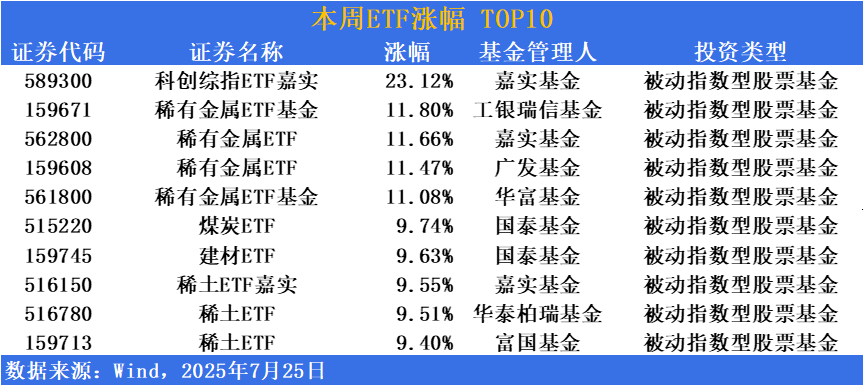
Market Overview - A-share market continued to show an upward trend with major indices rising, with the Shanghai Composite Index reaching a new closing high for the year, marking four consecutive weeks of gains [1] - The total trading volume exceeded 9 trillion yuan, with an average daily trading volume of over 1.7 trillion yuan [1] - Major indices saw increases of 1.67%, 2.33%, and 2.76% for the Shanghai Composite Index, Shenzhen Component Index, and ChiNext Index respectively [1] ETF Performance - The average increase of ETFs across the market was 2.39%, driven by strong performances in sectors such as building materials and rare metals [2] - Notable top-performing ETFs included the Sci-Tech Innovation Index ETF with a 23.12% increase and several rare metal ETFs with increases exceeding 11% [2] Future Outlook - Market optimism is driven by liquidity and policy deployment, with a focus on international trade and domestic economic policies for potential positive impacts [3] - The small metals market is experiencing heightened interest, with upward price trends due to limited resource availability and increasing demand from sectors like new energy and semiconductors [3] Fund Flow Trends - The ETF market saw continued inflows, with a net inflow of 2.378 billion yuan during the period, maintaining high activity levels [6] - Bond ETFs, cross-border ETFs, and stock ETFs were the top recipients of inflows, with bond ETFs being particularly favored by large funds [8] ETF Trading Volume - The Hong Kong Securities ETF achieved a weekly trading volume exceeding 100 billion yuan, reaching 101.805 billion yuan, leading the market [9] Upcoming ETF Listings - Four new ETFs are set to launch next week, including the Huatai-PineBridge National General Aviation Industry ETF, which focuses on low-altitude economy stocks [10] - The Penghua Sci-Tech Innovation Board Chip ETF will track semiconductor-related companies, reflecting strong interest in technology sectors [11]
中国股票策略 -多重积极进展推动 A 股市场情绪回升China Equity Strategy-A-Share Sentiment Rose on Several Positive Developments
2025-07-25 07:15
Summary of Key Points from the Conference Call Industry Overview - The focus is on the **A-share market** in China, with a particular emphasis on investor sentiment and regulatory developments impacting the market [1][4]. Core Insights and Arguments - **Improved Investor Sentiment**: A-share investor sentiment has improved significantly, with the weighted Morgan Stanley A-share Sentiment Indicator (MSASI) rising by **10 percentage points** to **90%**, and the simple MSASI increasing by **13 percentage points** to **83%** compared to the previous cutoff date [2][6]. - **Increased Market Activity**: Average daily turnover (ADT) for ChiNext and A-shares increased by **11%** and **5%**, respectively, indicating heightened trading activity [2]. - **Net Inflows**: Southbound trading recorded net inflows of **US$2.1 billion** from July 17-23, contributing to year-to-date net inflows of **US$101.4 billion** [3]. - **Regulatory Developments**: The Chinese government's anti-involution campaign has positively influenced market sentiment, with various regulatory bodies taking steps to manage excessive competition in key industries, including the NEV sector and online food delivery platforms [4]. - **US-China Trade Relations**: Progress in US-China trade negotiations has further bolstered market sentiment, with upcoming economic talks scheduled [4]. Additional Important Insights - **Earnings Guidance**: Despite a challenging macroeconomic backdrop, earnings guidance for Q2 2025 has shown resilience, with A-share pre-announcements improving to **-4.8%** and MSCI China rising by **6.8%** [14]. - **Caution on Overheating**: There is a warning against overestimating the potential for earnings growth recovery, suggesting that a rapid surge in consensus earnings estimates could indicate overly optimistic market expectations [16]. - **Consumer Sentiment**: The MS Consumer Pulse Survey indicates a continued lackluster consumer appetite, with concerns around job and income growth deepening in Q2 [13]. - **Long-term Outlook**: The anti-involution initiative is viewed as a constructive signal for enhancing earnings growth and improving return on equity (ROE) over the next **12-24 months**, although real change may require significant adjustments in local incentives and fiscal policies [15]. Conclusion - The A-share market is experiencing a positive shift in sentiment driven by regulatory support and improving trade relations, although caution is advised regarding the sustainability of this momentum and the underlying consumer sentiment challenges.
大规模设备更新首批1730亿落地,哪些仪器/领域收益了?
仪器信息网· 2025-07-25 03:02
Core Viewpoint - The new large-scale equipment update and consumer goods replacement policy in China, initiated in 2024, is set to significantly boost economic development by expanding funding support and coverage areas, aiming for a 25% increase in equipment investment across seven major sectors by 2027 [1][5]. Group 1: Policy Dynamics and Key Points - The funding scale for equipment updates has been expanded to 200 billion yuan, with the first batch of approximately 173 billion yuan allocated to 7,500 projects across 16 sectors [2][5]. - The second batch of funding, amounting to 81 billion yuan, is being reviewed for projects focusing on consumer goods replacement and equipment updates [5]. - The 2025 policy introduces new support areas such as electronic information and safety production, creating a "16+N" coverage system [5][8]. Group 2: Implementation Mechanism Optimization - The policy has removed the previous investment threshold of 100 million yuan for projects, lowering the entry barrier for small and medium-sized enterprises [5][7]. - A dual review mechanism of "local audit + national review" has been established to streamline the approval process [5][7]. - New upgrade directions in the energy and power sector include ten specific areas, enhancing the efficiency and safety of energy facilities [8][9]. Group 3: Comparison of 2024 and 2025 Policies - The 2024 policy focused on seven key sectors, while the 2025 policy expands to 16 sectors with a dynamic expansion mechanism [7]. - The funding intensity has increased with an additional 81 billion yuan and a 1.5% interest subsidy on loans [7]. - The 2025 policy introduces 294 new national standards, enhancing the regulatory framework for project applications [7]. Group 4: Key Supported Areas and Renovation Focus - Major industrial sectors targeted for equipment updates include petrochemicals, steel, non-ferrous metals, and machinery, focusing on replacing outdated equipment and upgrading production lines [8][10]. - Energy facilities will see upgrades in areas such as high-efficiency energy motors and waste heat recovery systems, aimed at reducing energy consumption [8][10]. - Transportation infrastructure will undergo significant updates, including intelligent systems for railways and urban transit, enhancing operational efficiency [10][11].