
房地产

Search documents
2026年中国宏观展望:不靠强刺激,通胀也能稳住
Xinda Securities· 2025-12-25 06:03
Policy Insights - The GDP target for 2026 is expected to remain around 5%, with macro policies not being strong stimulus but rather supportive measures[5][9]. - Monetary policy is projected to see a 10 basis point rate cut and a 50 basis point reserve requirement ratio cut, consistent with 2025[5][24]. - The fiscal deficit rate is anticipated to stay at 4%, with total debt slightly increasing, maintaining fiscal efforts similar to 2025[5][24]. Economic Outlook - Economic growth is expected to be stable, but structural differentiation may occur, with real housing demand declining due to slowed urbanization[5][36]. - Real estate sales are projected to decrease by 10% in 2026, continuing the downward trend from 2025[5][37]. - Manufacturing investment is likely to remain low, with a growth rate of 3-4% anticipated due to ongoing capacity surplus issues[5][47]. Price Trends - CPI is expected to rise slightly to around 0.5% in 2026, driven by reduced drag from pork and energy prices[5][79]. - Core CPI is projected to maintain resilience, supporting overall CPI growth, with a historical average around 0.8%[5][88]. Market Dynamics - The A-share market is expected to experience a slow bull market, driven by technology and cyclical sectors, with institutional funds poised to enter the market[5][5]. - The total balance of institutional funds is over 100 trillion yuan, with an estimated 1.5-5 trillion yuan ready to enter the equity market[5][5]. Risk Factors - Key risks include geopolitical tensions, domestic policy implementation falling short of expectations, and potential underperformance in infrastructure investment[5][5].
股市“四辩”——一家知名投资机构展望2026年资本市场
李迅雷金融与投资· 2025-12-25 05:18
Core Viewpoint - The Chinese stock market is expected to rebound strongly in 2025, with the Shanghai Composite Index reaching a ten-year high, while the market structure remains highly differentiated. The article discusses how to seize new opportunities in 2026 from four perspectives: future debate, allocation debate, current debate, and strategy debate [3]. Future Debate - China is unlikely to repeat Japan's lost decades due to its superior innovation capabilities and irreplaceability in the global market. The Chinese economy's rise has diminished Japan's industrial advantages, and the market has shifted from being viewed as "uninvestable" to having "strategic allocation value" [3][9][10]. - The historical context of Japan's economic stagnation post-1990s is contrasted with China's current trajectory, emphasizing that China's innovation in technology and manufacturing is advancing rapidly [7][8]. Allocation Debate - The influx of new capital into the stock market is driven by asset reallocation from residents and financial institutions in a low-interest-rate environment. The real estate market's downturn has transformed it from a source of capital diversion to a driver of stock market growth [4][12]. - High-net-worth individuals and insurance funds are leading this asset reallocation, which is characterized as rational and gradual rather than speculative [12][14]. Current Debate - The article raises concerns about whether AI capital expenditure expectations can be met, highlighting the potential for AI to be a significant technological revolution. However, the high profit margins in the industry may limit the overall economic growth associated with AI [5][19]. - The article discusses the challenges of achieving the necessary revenue growth to support the anticipated capital expenditures in the AI sector, suggesting that the required income increments are substantial compared to the current GDP [20][21]. Strategy Debate - The outlook for 2026 remains positive, but investors should temper their return expectations. The ongoing asset reallocation process is expected to sustain market resilience, with a focus on defensive strategies and identifying opportunities in technology and advanced manufacturing sectors [26][27]. - Specific sectors to watch include: - **Technology**: Continued investment in AI applications and companies that can leverage AI for efficiency [29]. - **Advanced Manufacturing**: Growth in sectors related to AI and robotics, with a focus on domestic cycles and equipment upgrades [30]. - **Consumer**: Identifying resilient companies in traditional sectors that can maintain performance despite broader economic challenges [31]. - **Military**: Anticipated recovery in the military sector as procurement cycles normalize [31]. - **Real Estate**: Looking for structural opportunities in real estate services and resilient developers amid ongoing market adjustments [31].


陕西最豪高奢酒店业主,在敦煌投了我国第二家隐世
3 6 Ke· 2025-12-25 02:57
Core Insights - The article discusses the signing of a luxury hotel project, the Ritz-Carlton Reserve in Dunhuang, by Marriott and Shaanxi Wanzhong Holding Group, marking the first privately-owned Ritz-Carlton Reserve in Greater China and Wanzhong's first luxury hotel project outside Shaanxi [1][5][16]. Group 1: Project Details - The Ritz-Carlton Reserve will be located near the Mingsha Mountain and Crescent Spring scenic area, approximately 15 kilometers from the Mogao Caves, a UNESCO World Heritage site [2]. - The hotel will cover around 200 acres with a total construction area of approximately 30,000 square meters, featuring 69 luxury villas, each with a private courtyard, and three distinct dining venues [4]. - The first Ritz-Carlton Reserve in China is located near Jiuzhaigou, with starting room rates at 10,600 yuan [5]. Group 2: Company Background - Wanzhong Group is a real estate company based in Xi'an, known for its high-end hotel projects, including the Westin Hotel in Xi'an, which has 385 rooms and opened in 2018 [6][7]. - The group has plans to expand its luxury hotel portfolio, having recently signed agreements for a Mandarin Oriental hotel in Xi'an and a self-owned brand hotel called "Songjian" in Tongguan County [8][9]. Group 3: Market Trends - The luxury hotel sector is experiencing a shift, with state-owned and central enterprises becoming the main players in new high-end hotel projects, contrasting with the previous dominance of real estate companies [27][30]. - The investment focus in luxury hotels is transitioning from real estate-driven projects to cultural tourism and destination cities, reflecting changing market demands [31]. Group 4: Strategic Implications - Wanzhong Group's investment in the Dunhuang luxury hotel project signifies a strategic move to explore opportunities in the northwest region of China, indicating a proactive approach by Shaanxi capital [16][21]. - The group's commitment to high-end hotel development aligns with a broader trend of significant capital investment in luxury hospitality, which is seen as a stable long-term investment [20][22].

房地产2026年展望:调结构待转型,提质量新发展
2025-12-25 02:43
Summary of Real Estate Industry Conference Call Industry Overview - The conference call focuses on the **real estate industry** in China, particularly the outlook for 2026 and the trends observed in 2025 [1][2]. Key Points and Arguments Market Trends - In early 2025, the de-stocking cycle in the real estate market decreased, but began to rise again in April due to a cooling market, indicating inventory pressure [1][3]. - The proportion of land investment in real estate has increased since 2020, reflecting a contraction in construction investments by real estate companies [1][3]. - The sales price of residential properties is highly correlated with the land price from eight months prior, suggesting that future new home sales prices may rise due to increased land acquisition costs [1][4]. Sales and Inventory Projections - For 2026, both broad and narrow inventory levels are expected to decline, although the absolute value of narrow inventory remains high due to reduced construction activity [1][6]. - The forecast for national commodity housing sales area in 2026 is projected to be below **870 million square meters**, representing a year-on-year decline of **4%-5%** [1][6]. - New construction is expected to decline by **14%-15%** year-on-year, with overall real estate investment anticipated to drop by over **10%** [1][6]. Urbanization and Economic Impact - China's urbanization rate has surpassed **65%**, and its impact on the real estate market is diminishing as the country approaches a more mature stage of urbanization [1][7][8]. - Since 2018, the contribution of real estate to GDP has been declining, which aligns with a decrease in land transfer fees contributing to local government finances [1][10]. Credit Policy and Market Recovery - The real estate industry is heavily reliant on credit policies, and the current phase in China is transitioning from credit easing to real estate recovery, which may take time [2][12]. - The expectation is that industry valuations may recover as stable real estate market policies are implemented, which could boost investor confidence [2][13]. Additional Important Insights - The relationship between urbanization and real estate market growth is changing, with the need to meet improvement, renewal, and investment demands becoming more critical for sustainable development [1][7]. - The historical context shows that during economic slowdowns, real estate can still contribute positively to economic growth due to factors like low-interest rates and increased disposable income [1][11]. This summary encapsulates the essential insights from the conference call regarding the real estate industry's current state and future outlook, highlighting the challenges and potential recovery paths.
对话2026年关键词:金融地产篇
2025-12-25 02:43
Summary of Conference Call Records Industry Overview - The non-bank financial sector, particularly online insurance and brokerage firms, is expected to have greater growth potential compared to banks in the coming year. Online insurance benefits from an increase in equity positions, which could enhance investment returns if the stock market performs well. Additionally, adjustments in household asset allocation favor stable income products from insurance [1][2][3]. Key Insights on Insurance and Brokerage - Insurance companies listed in H-shares have shown significant recovery, while A-shares lag behind. It is anticipated that the fundamentals of insurance will further improve in 2026. The optimization of insurance product structures, including new products like commercial insurance and dividend-type critical illness insurance, is expected to contribute to growth [1][2]. - Brokerages have performed well during year-end market conditions, particularly in the spring season, where historical data shows a high success rate. Despite underperformance in A-share brokerages this year, ongoing performance releases and increased market activity suggest potential for excess returns in the coming year [1][3]. Banking Sector Strategy - The banking sector's strategy for 2026 will focus on interest margins and asset growth. The balance between volume and price is expected to stabilize under real estate policy impacts, with interest margins becoming a key revenue growth driver. Loan pricing is projected to bottom out and recover, while deposit rates are expected to decline, supporting a gradual recovery in interest margins [4][5]. - Credit growth is expected to remain flat or slightly lower than in 2025, with a continued divergence between social financing growth and credit growth. The overall credit expansion is anticipated to slow down, maintaining a tight balance between deposits and loans [5]. Capital Supplementation in Banking - In 2025, the Ministry of Finance added four state-owned banks, with plans to complete additional capital increases for two more major state-owned banks in 2026. Due to a constrained external financing environment, smaller banks are expected to rely on convertible bonds for growth. Long-term funds from insurance capital, bank shareholders, and asset management companies are becoming primary sources of funding for bank stocks [6]. Macroeconomic Outlook - A positive macroeconomic trend is expected to support the banking sector's fundamentals, although rapid profit growth is unlikely. The public fund reform may lead to a shift in asset allocation towards performance benchmark indices, potentially alleviating revenue pressures in the banking industry in 2026 [7]. Real Estate Sector Predictions - The real estate industry is expected to rely on economic recovery for resolution of its issues. Predictions indicate a decline of approximately 10% in sales amounts and areas, with new construction and actual completions expected to drop by about 15% [9]. - Developers face significant risks in land acquisition, including accurately assessing customer demand and high-risk investments. The stability of the asset side is increasingly uncertain, with high leverage posing additional risks [11]. Investment Recommendations in Real Estate - Investors should focus on real estate companies with high accuracy in land acquisition, low valuations with potential for marginal improvement, and those with strong competitive advantages in shopping center operations. Companies like Greentown China and China Resources Land are highlighted for their high acquisition accuracy rates [12][13]. - The second-hand housing intermediary sector, exemplified by Beike, is noted for its potential growth and should be considered as part of the investment strategy [14].
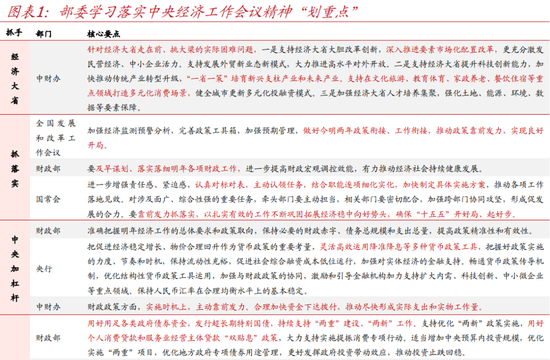
国盛宏观熊园:各部委各地学习中央经济工作会议“划重点”
Xin Lang Cai Jing· 2025-12-25 02:28
Core Viewpoint - The recent learning and communication of the Central Economic Work Conference's spirit by various departments and regions is an important window for tracking the implementation of the conference's spirit, revealing more details and actionable measures [2] Group 1: Policy Implementation - Various departments are focusing on the "stability while seeking progress, improving quality and efficiency" principle, with clear directions and highlighted priorities such as expanding domestic demand, strengthening technology, promoting reform, and stabilizing real estate [3][5] - The central government is expected to continue "leveraging" with specific scales to be determined at the 2026 National Two Sessions, emphasizing proactive measures and reasonable acceleration of fund disbursement [4][6] - Departments are prioritizing support for expanding domestic demand, utilizing various funds, and continuing to support "two new" and "two heavy" initiatives, including fostering trillion-level new consumption growth points [6][7] Group 2: Financial and Monetary Policies - The Ministry of Finance and the central bank are maintaining a "more proactive fiscal policy" and "moderately loose monetary policy," with a focus on maintaining necessary fiscal deficits and debt levels [6][8] - The central bank may consider lowering reserve requirements and interest rates in the first quarter of 2026, along with introducing more structural tools [2][4] - There is an emphasis on accelerating fiscal spending and issuing special bonds to support consumption and investment [6][7] Group 3: Industry and Innovation - There is a strong focus on industrial transformation, self-control, and innovation leadership, with initiatives to promote technology finance and the construction of international technology innovation centers in key regions [7][8] - The government is pushing for reforms to create a unified market, enhance the development of the private economy, and deepen state-owned enterprise reforms [8][9] Group 4: Risk Management - The financial system is focused on preventing risks, particularly in the real estate sector, while ensuring support for both residents and real estate companies [9][10] - Measures are being taken to stabilize the stock market and promote long-term investments, including accelerating reforms in the Sci-Tech Innovation Board and piloting commercial real estate REITs [10][11] Group 5: Local Implementation - Various regions are adapting the central economic work conference's spirit to their local contexts, emphasizing proactive measures and specific actionable tasks, with a focus on ensuring a good start for the 14th Five-Year Plan [13][14] - Local governments are expected to detail their plans and measures in the upcoming local two sessions in January 2026, with a strong emphasis on innovation and openness [13][14]
“反内卷”破局传统赛道,高端化打开成长空间 | 投研报告
Zhong Guo Neng Yuan Wang· 2025-12-25 02:05
Core Viewpoint - The construction materials industry is expected to see improved profitability and demand in 2025, driven by "anti-involution" policies and a gradual recovery in key product demand [1][2]. Fundamental Analysis - In the first three quarters of 2025, demand for major construction materials showed slight improvement, while "anti-involution" policies positively impacted supply-side dynamics, leading to improved profitability across various sub-sectors [2]. - The construction materials index rose by 20.8% from January 2 to December 23, 2025, ranking 11th among all sectors, while the CSI 300 index increased by 17.43% during the same period [1][2]. Real Estate and Infrastructure - The real estate market continues to stabilize, with a downward trend in sales and completion rates, alongside declining housing prices; however, inventory reduction is evident as the area of unsold commercial housing has been decreasing since early 2025 [2]. - Infrastructure investment growth is declining despite an increase in the scale of special bonds directed towards land reserves [2]. Investment Recommendations - Focus on two main lines: 1. "Anti-involution" policies are expected to alleviate overcapacity issues in the construction materials sector, with an emphasis on traditional materials [2]. 2. The demand for high-end fiberglass products is anticipated to enhance industry profitability [2]. Sector-Specific Insights - **Cement**: The ongoing "anti-involution" policies are expected to ease overcapacity in the cement industry, with a long-term improvement in supply-demand dynamics anticipated to boost profitability, particularly for leading companies like Conch Cement [3]. - **Float Glass**: Demand remains weak, but supply-side changes from "anti-involution" policies may improve the supply-demand balance; companies like Xinyi Glass are recommended for attention [3]. - **Photovoltaic Glass**: The industry is currently facing overcapacity, but leading companies with cost advantages are likely to benefit from improved supply-demand conditions as "anti-involution" policies are implemented [3]. - **Consumer Building Materials**: The increasing proportion of aging housing is expected to drive demand for renovation-related building materials, with companies like Skshu Paint and Beixin Building Materials highlighted for potential investment [3]. Fiberglass Sector - The "anti-involution" policies are expected to prevent redundant capacity and curb vicious price competition in the fiberglass sector, with rising demand for mid-to-high-end fiberglass products likely to enhance profitability; companies such as China Jushi and Zhongcai Technology are recommended for investment [4].
金融暴雷叠加实控人涉案,祥源系再陷迷雾
Xin Lang Cai Jing· 2025-12-25 01:55
Core Viewpoint - The financial crisis surrounding the "Xiangyuan system" continues to escalate, with the actual controller Yu Faxiang facing criminal charges, negatively impacting the stock prices of Xiangyuan Cultural Tourism, Jiaojian Co., and Haichang Ocean Park [2][11]. Stock Price Movements - On December 22, the three companies announced that Yu Faxiang was taken into criminal custody, leading to significant stock declines on December 23: Xiangyuan Cultural Tourism down 2.80%, Jiaojian down 4.89%, and Haichang down 7.29% [12]. - In December, the stock prices of the three companies experienced substantial declines: Haichang down 35.71%, Xiangyuan Cultural Tourism down 19.89%, and Jiaojian down 37.09% [4][12]. - On December 24, there was a slight recovery in stock prices, with Xiangyuan Cultural Tourism closing at 5.92 yuan (up 0.17%), Jiaojian at 7.65 yuan (up 0.92%), and Haichang at 0.450 HKD (up 1.12%) [4][13]. Financial Product Defaults - Since November 28, multiple financial products guaranteed by Xiangyuan Holdings and Yu Faxiang have faced payment defaults, involving over 200 products and a total outstanding amount exceeding 200 billion yuan, affecting nearly 10,000 investors [3][12]. - The underlying assets of the defaulted financial products are primarily accounts receivable from real estate and cultural tourism projects within the Xiangyuan Holdings system [14]. Ongoing Investigations and Risks - A support team was established by the Shaoxing government on December 12 to assist Xiangyuan Holdings, indicating a direct link between the financial product defaults and Yu Faxiang's criminal charges [14]. - Legal experts suggest that Yu Faxiang's legal responsibilities are closely tied to the payment crisis, as he is both the chairman of Xiangyuan Holdings and responsible for the payment obligations of the financial products [14]. Project Status and Concerns - Several projects under the Xiangyuan system have been reported as halted or under construction, raising concerns about the company's operational stability [15]. - Past issues of non-disclosure regarding non-operational fund usage have increased investor anxiety, with Xiangyuan Cultural Tourism previously fined for failing to disclose 410 million yuan in such funds [17]. Risk Assessment - The core risks facing the three listed companies include the implications of the actual controller's legal issues, potential stock freezes, price volatility, and investor rights protection [18].



北京优化调整房地产相关政策,枧下窝锂矿预计春节前后复产
Dong Zheng Qi Huo· 2025-12-25 00:46
Report Industry Investment Ratings No relevant content found. Core Views of the Report - The stock market may start a cross - year rally, with the Shanghai Composite Index potentially hitting 4000 points again, and it is recommended to evenly allocate long positions in various stock index futures [1][19]. - The U.S. dollar is expected to remain weak, and it is recommended to be bearish on the U.S. dollar [2][14][15]. - U.S. stocks are expected to fluctuate strongly, and it is recommended to hold a positive view on the short - term trend of U.S. stocks [16][17]. - The long - term bond market is building a bottom and is expected to strengthen in the short - to - medium term, while the short - term bond interest rate has limited downward space [24]. - Palm oil is expected to enter a consolidation phase, and it is recommended to wait for the opportunity to go long on the 05 contract; for rapeseed oil, it is recommended to focus on short - term positive spreads between near - and far - term contracts [26]. - Steel prices are expected to fluctuate, and it is recommended to adopt a range - trading approach [28][29]. - Coal prices are expected to continue to decline in the short term [30][32]. - Iron ore prices are expected to remain range - bound [33]. - Lead prices are expected to fluctuate, and it is recommended to wait and see both in single - side trading and arbitrage [34][35]. - Zinc prices are volatile in the short term, and it is recommended to reduce positions or establish hedging positions; in the medium term, it is recommended to look for opportunities to buy on dips [37]. - Lithium carbonate prices may pull back in the short term, but the long - term strategy is to buy on dips [38]. - Nickel prices are expected to return to a range - bound state [40]. - Copper prices may experience short - term corrections, and it is not recommended to chase the high. Instead, it is recommended to wait for opportunities to buy on dips for mid - term long positions [44][45]. - Tin prices are expected to adjust at a high level in the short term, and investors should be vigilant against price drops when the capital enthusiasm fades [51]. - Oil prices are weakly fluctuating. During the overseas holiday period, trading is light, and attention should be paid to the progress of Russia - Ukraine negotiations [51]. - Asphalt prices are expected to remain weak [53]. - Urea's 01 contract is expected to fluctuate within a range, and the 05 contract should focus on post - holiday spring plowing demand and new export quota policies [55][56]. - LLDPE prices are expected to rebound, and it is recommended to wait for opportunities to establish short positions after the rebound [57][58]. - Methanol prices are expected to remain strong, and it is recommended to take a bullish approach, targeting the 2200 - 2250 range [59]. Summaries According to Related Catalogs 1. Financial News and Reviews 1.1 Macro Strategy (Gold) - The initial jobless claims in the U.S. last week were 214,000, lower than the expected 224,000. The employment market shows no rapid deterioration, but the cooling trend remains. During the Christmas and New Year holidays, the risk of market volatility increases, and it is not recommended to chase the high in precious metals [10][11]. 1.2 Macro Strategy (Foreign Exchange Futures - U.S. Dollar Index) - A U.S. federal judge ruled that the Trump administration's new rule of a $100,000 H - 1B visa application fee is legal, which is a blow to U.S. technology companies. A U.S. official downplayed the possibility of further military action against Venezuela. The U.S. initial jobless claims decreased to 214,000. The labor market is short - term stable, market risk appetite rises, and the U.S. dollar remains weak [12][13][14]. 1.3 Macro Strategy (U.S. Stock Index Futures) - The U.S. employment market shows signs of improvement. With the GDP data exceeding expectations and the unemployment claims data decreasing, the market is optimistic about future interest rate cuts and a soft landing. The S&P 500 has reached a new high, and U.S. stocks are expected to fluctuate upward [16][17]. 1.4 Macro Strategy (Stock Index Futures) - The Shanghai Composite Index has achieved six consecutive positive days. Beijing has optimized real - estate policies, and with continuous high trading volume, a cross - year rally may start, and the index may hit 4000 points again. It is recommended to evenly allocate long positions in various stock index futures [1][18][19]. 1.5 Macro Strategy (Treasury Bond Futures) - The central bank will conduct a 400 - billion - yuan MLF operation. The long - term bond market is building a bottom. It is expected to strengthen in the short - to - medium term, with the curve mainly dominated by long - term bonds. It is recommended that allocation investors buy on interest rate increases, and trading investors buy on dips and exit quickly [24][25]. 2. Commodity News and Reviews 2.1 Agricultural Products (Soybean Oil/Rapeseed Oil/Palm Oil) - The MPOA data shows that palm oil production in Malaysia from December 1 - 20 decreased by 7.44% month - on - month, verifying the production cut expectation. The supply pressure of palm oil is expected to ease. The supply of rapeseed oil in the near - term is tight, and inventories are declining. It is recommended to wait for the opportunity to go long on palm oil's 05 contract and focus on short - term positive spreads of rapeseed oil [26]. 2.2 Black Metals (Rebar/Hot - Rolled Coil) - South Africa launched an anti - dumping investigation on Chinese color - coated steel. The total new contracts signed by five major construction central enterprises in the first 11 months exceeded 6.5 trillion yuan. Steel prices are slightly rebounding, but the increase is limited. The supply - demand contradiction may accumulate in the future, and it is recommended to trade within a range [27][28][29]. 2.3 Black Metals (Steam Coal) - The total social power consumption in November increased by 6.2% year - on - year. Coal prices continue to decline, and due to warm winter weather, the demand growth rate is expected to be negative. With high port inventories, coal prices are expected to continue to fall in the short term [30][32]. 2.4 Black Metals (Iron Ore) - The National Housing and Urban - Rural Construction Work Conference was held, emphasizing key tasks for 2026. The iron ore market is seasonally weak, with expected decline in iron - making water this week. Considering the off - season demand, ore prices are expected to remain range - bound [33]. 2.5 Non - ferrous Metals (Lead) - The LME 0 - 3 lead is at a discount of $42.3 per ton. LME inventories decreased, and the cash spread fluctuated. Domestic social inventories are declining. Due to environmental protection, the production of recycled lead is affected, and the demand is weak. Lead prices are expected to fluctuate, and it is recommended to wait and see [34][35]. 2.6 Non - ferrous Metals (Zinc) - The LME 0 - 3 zinc is at a discount of $29.14 per ton. LME inventories increased, and the cash spread fluctuated. Domestic social inventories are increasing. Zinc prices are volatile in the short term and may rise in the medium term. It is recommended to reduce positions or hedge in the short term and buy on dips in the medium term [36][37]. 2.7 Non - ferrous Metals (Lithium Carbonate) - Ningde Times' Yichun Jixiawo lithium mine is expected to resume production around the Spring Festival. Short - term prices may pull back, but long - term strategy is to buy on dips [38]. 2.8 Non - ferrous Metals (Nickel) - LME nickel inventories increased. Indonesia plans to set a lower nickel ore production quota in 2026. The market is skeptical about this plan. The cost of nickel smelting may increase. Nickel prices are expected to return to a range - bound state [39][40]. 2.9 Non - ferrous Metals (Copper) - Multiple copper - related projects are in progress. Short - term copper prices are supported by macro factors but may be affected by changes in macro expectations and inventory accumulation. It is recommended not to chase the high and wait for opportunities to buy on dips for mid - term long positions [44][45]. 2.10 Non - ferrous Metals (Tin) - Turkey imposed anti - dumping duties on Chinese tin - plated steel. The inventories of SHFE and LME tin increased. The supply shortage has eased in the short term, and demand is weak. Tin prices are expected to adjust at a high level in the short term [51]. 2.11 Energy Chemicals (Crude Oil) - The loading volume of the CPC pipeline in December decreased. Oil prices are weakly fluctuating. Overseas trading is light during the holiday period. Attention should be paid to the progress of Russia - Ukraine negotiations [51]. 2.12 Energy Chemicals (Asphalt) - The capacity utilization rate of domestic heavy - traffic asphalt increased. Asphalt prices are declining, and due to the off - season demand, prices are expected to remain weak [52][53]. 2.13 Energy Chemicals (Urea) - Urea enterprise inventories decreased. The 01 contract is expected to fluctuate within a range, and the 05 contract should focus on post - holiday spring plowing demand and new export quota policies [55][56]. 2.14 Energy Chemicals (LLDPE) - The inventory of Chinese polyethylene production enterprises decreased. LLDPE prices rebounded, but it is not a reversal. It is recommended to wait for opportunities to establish short positions after the rebound [57][58]. 2.15 Energy Chemicals (Methanol) - Chinese methanol port inventories increased, but the actual increase may be less. With the overall rebound of the chemical industry, methanol prices are expected to remain strong. It is recommended to take a bullish approach, targeting the 2200 - 2250 range [58][59].

四大证券报头版头条内容精华摘要_2025年12月25日_财经新闻
Xin Lang Cai Jing· 2025-12-25 00:37
Group 1 - The People's Bank of China (PBOC) proposed to continue implementing a moderately loose monetary policy and enhance counter-cyclical and cross-cyclical adjustments to promote stable economic growth and reasonable price recovery [1][11][34] - The PBOC emphasized the dual function of monetary policy tools in terms of both quantity and structure, and the need for better coordination between monetary and fiscal policies [1][11][34] Group 2 - The National Development and Reform Commission (NDRC) and the Ministry of Commerce released the "Encouragement Directory for Foreign Investment Industries (2025 Edition)" to attract more foreign investment into advanced manufacturing, modern services, high-tech, and energy-saving and environmental protection sectors [2][20][25] - The new directory will take effect on February 1, 2026, and aims to optimize the regional layout of foreign investment, particularly in the central and western regions and Northeast China [2][20][25] Group 3 - Beijing has implemented adjustments to its housing purchase policies, including relaxing purchase conditions for non-Beijing residents and supporting housing needs for families with multiple children [3][21][32] - The adjustments are part of efforts to stabilize the real estate market and are expected to release housing demand [3][21][32] Group 4 - The A-share market is experiencing increased volatility and stock differentiation, with certain thematic sectors like commercial aerospace, controllable nuclear fusion, and new retail showing significant growth [4][22] - This trend of "stock differentiation and thematic peaks" is becoming a prominent feature of the market as the year ends [4][22] Group 5 - As of December 24, 1866 companies in the Shanghai Stock Exchange held performance briefings, representing over 99% of scheduled companies and more than 80% of the total number of companies listed [5][23] Group 6 - The precious metals market saw unprecedented growth in 2025, with gold outperforming most asset classes, silver surpassing $72 per ounce, and platinum achieving significant gains [6][24] Group 7 - Eight departments, including the PBOC and NDRC, released 21 financial support measures to enhance the financial service system for the Western Land-Sea New Corridor [9][26][30] - The measures include increasing financial resource coordination, optimizing fund settlement systems, and expanding the use of the Renminbi in cross-border transactions [9][26][30] Group 8 - The State-owned Assets Supervision and Administration Commission (SASAC) outlined five key tasks for central enterprises in 2026, focusing on strategic restructuring, professional integration, and high-quality mergers and acquisitions [10][27][33] - The meeting emphasized the importance of stabilizing operations, improving quality and efficiency, and ensuring a good start for the 14th Five-Year Plan [10][27][33]