
有色金属

Search documents
成立超10年,年化超6%,回撤控制在5%以内的稳健型基金 | 1分钟了解一只吾股好基(七十五)
市值风云· 2026-03-23 10:13
Core Viewpoint - The article highlights the performance and management strategy of the Dongfanghong Strategy Selected Mixed A Fund, which has consistently delivered positive returns over the years, making it a suitable investment option for risk-averse investors seeking alternatives to bank deposits [3][20]. Fund Performance - The Dongfanghong Strategy Selected Mixed A Fund has been established for over 10 years, with an annualized return exceeding 6% and a total return of 77.95% since the current manager, Kong Lingchao, took over in August 2016 [3][4]. - The fund has only experienced a slight decline of 0.94% in 2022, while achieving positive returns in all other years, outperforming the CSI 300 index during bear markets and significantly beating performance benchmarks during bull markets [9][10]. Fund Management - Kong Lingchao manages a total of 9 funds, with the Dongfanghong Strategy Selected Mixed A being the best performer among them, currently holding assets of 13.35 billion [4][6]. - The fund maintains a conservative stock allocation of below 25% and a bond allocation of over 70%, with a focus on managing drawdowns effectively, keeping the maximum dynamic drawdown under 5% [11][14]. Asset Allocation - As of the end of 2025, the fund's asset allocation includes 58.6% in financial bonds, with medium-term notes, corporate bonds, and corporate short-term financing bonds making up 22.2%, 10.36%, and 7.46% respectively [15]. - The equity allocation is diversified, with the largest sector being media at 9.18%, followed by electronics, pharmaceuticals, basic chemicals, textiles, non-ferrous metals, and others, all within the 5%-9% range [15][16]. Institutional Interest - The fund has attracted significant institutional interest, with institutional holdings reaching nearly 90% during the weak market of 2022, and still maintaining a 56% share as of mid-2025 [12]. Investment Strategy - The fund's strategy includes a balanced approach to equity investments, with a focus on sectors that may recover from pessimistic earnings expectations, particularly in AI and traditional industries [20].


有色期权早报-20260323
Wu Kuang Qi Huo· 2026-03-23 08:33
1. Report Industry Investment Rating - No information provided in the report 2. Core Viewpoints - The report provides a comprehensive analysis of various有色金属 options, including market data, option factors, and strategy recommendations. It offers insights into price trends, volatility, and market sentiment for each option type, guiding investors in formulating trading strategies. 3. Summary by Directory 3.1 Aluminum Alloy (AD) - **Market Data**: The ad2604 contract closed at 22,810 yuan yesterday, down 485 yuan or 2.08% from the previous day. The trading volume was 8,397 lots, a decrease of 983 lots, and the open interest was 4,781 lots, a decrease of 294 lots [3][6]. - **Option Factors**: The implied volatility of AD (aluminum alloy options) fluctuates above the mean of 0.1321. The option's open interest PCR is 0.9613, at the 16.30% level in the past year. The pressure level is 23,800, and the support level is 22,000 [5][6]. - **Strategy Recommendations**: No directional strategy. For volatility strategy, construct a short call + short put option combination strategy to obtain option time - value income, and dynamically adjust positions to keep the delta neutral, such as S_AD2605P22400, S_AD2605C23800 [7]. 3.2 Aluminum (AL) - **Market Data**: The al2605 contract closed at 24,020 yuan yesterday, down 530 yuan or 2.15% from the previous day. The trading volume was 561,560 lots, an increase of 101,192 lots, and the open interest was 280,023 lots, a decrease of 12,381 lots [15][18]. - **Option Factors**: The implied volatility of AL (aluminum options) fluctuates above the mean of 0.1646. The option's open interest PCR is 0.5788, at the 12.24% level in the past year. The pressure level is 29,000, and the support level is 23,000 [17][18]. - **Strategy Recommendations**: No directional strategy. For volatility strategy, construct a short call + short put option combination strategy to obtain option time - value income, and dynamically adjust positions to keep the delta neutral, such as S_AL2605P23000, S_AL2605P23400, S_AL2605C25000, S_AL2605C26000 [19]. 3.3 Alumina (AO) - **Market Data**: The ao2605 contract closed at 3,041 yuan yesterday, down 35 yuan or 1.13% from the previous day. The trading volume was 707,158 lots, a decrease of 273,561 lots, and the open interest was 245,836 lots, a decrease of 22,397 lots [27][30]. - **Option Factors**: The implied volatility of AO (alumina options) fluctuates above the mean of 0.3257. The option's open interest PCR is 0.4564, at the 71.84% level in the past year. The pressure level is 3,400, and the support level is 2,800 [29][30]. - **Strategy Recommendations**: For directional strategy, construct a bull call spread strategy to obtain directional income. For volatility strategy, construct a short call + short put option combination strategy to obtain option time - value income, and dynamically adjust positions to keep the delta neutral, such as S_AO2605P2800, S_AO2605C3200 [31]. 3.4 Copper (CU) - **Market Data**: The cu2605 contract closed at 94,740 yuan yesterday, down 1,050 yuan or 1.09% from the previous day. The trading volume was 243,335 lots, an increase of 37,372 lots, and the open interest was 201,181 lots, a decrease of 2,147 lots [39][42]. - **Option Factors**: The implied volatility of CU (copper options) fluctuates above the mean of 0.2292. The option's open interest PCR is 0.8336, at the 65.31% level in the past year. The pressure level is 116,000, and the support level is 90,000 [41][42]. - **Strategy Recommendations**: For directional strategy, construct a bear put spread strategy to obtain directional income, such as B_CU2605P104000, S_CU2605P90000. No volatility strategy [43]. 3.5 Nickel (NI) - **Market Data**: The ni2605 contract closed at 133,160 yuan yesterday, up 370 yuan or 0.27% from the previous day. The trading volume was 537,401 lots, an increase of 139,049 lots, and the open interest was 173,136 lots, a decrease of 13,621 lots [51][54]. - **Option Factors**: The implied volatility of NI (nickel options) fluctuates above the mean of 0.3080. The option's open interest PCR is 0.5821, at the 55.92% level in the past year. The pressure level is 150,000, and the support level is 130,000 [53][54]. - **Strategy Recommendations**: No directional strategy. For volatility strategy, construct a short - biased short call + short put option combination strategy to obtain option time - value income, and dynamically adjust positions to keep the delta short, such as S_NI2605P126000, S_NI2605P130000, S_NI2605C146000, S_NI2605C150000 [55]. 3.6 Lead (PB) - **Market Data**: The pb2605 contract closed at 16,290 yuan yesterday, down 265 yuan or 1.60% from the previous day. The trading volume was 76,606 lots, an increase of 7,762 lots, and the open interest was 93,141 lots, an increase of 8,210 lots [63][67]. - **Option Factors**: The implied volatility of PB (lead options) fluctuates above the mean of 0.1822. The option's open interest PCR is 0.5988, at the 41.63% level in the past year. The pressure level is 17,000, and the support level is 16,000 [65][67]. - **Strategy Recommendations**: No directional strategy. For volatility strategy, construct a short call + short put option combination strategy to obtain option time - value income, and dynamically adjust positions to keep the delta neutral, such as S_PB2605P15800, S_PB2605P16200, S_PB2605C17200, S_PB2605C17600 [67]. 3.7 Tin (SN) - **Market Data**: The sn2604 contract closed at 342,480 yuan yesterday, down 11,520 yuan or 3.25% from the previous day. The trading volume was 304,523 lots, an increase of 70,520 lots, and the open interest was 27,184 lots, a decrease of 2,617 lots [76][79]. - **Option Factors**: The implied volatility of SN (tin options) fluctuates above the mean of 0.3759. The option's open interest PCR is 0.5214, at the 11.84% level in the past year. The pressure level is 450,000, and the support level is 280,000 [78][79]. - **Strategy Recommendations**: For directional strategy, construct a bear put spread strategy to obtain directional income, such as B_SN2605P350000, S_SN2605P330000. No volatility strategy [80]. 3.8 Zinc (ZN) - **Market Data**: The zn2605 contract closed at 22,935 yuan yesterday, up 15 yuan or 0.06% from the previous day. The trading volume was 159,743 lots, an increase of 159,743 lots, and the open interest was 106,130 lots, an increase of 1,518 lots [88][91]. - **Option Factors**: The implied volatility of ZN (zinc options) fluctuates above the mean of 0.1771. The option's open interest PCR is 0.5515, at the 2.04% level in the past year. The pressure level is 25,000, and the support level is 23,000 [90][91]. - **Strategy Recommendations**: For directional strategy, construct a bear put spread strategy to obtain directional income, such as B_ZN2605P24200, S_ZN2605P23000. No volatility strategy [92].
金属周期品高频数据周报(2026.3.16-2026.3.22):伦敦金现价格本周环比-10.49%,SPDR黄金持仓本周环比-1.36%-20260323
EBSCN· 2026-03-23 07:29
Investment Rating - The report maintains an "Overweight" rating for the steel and non-ferrous metals sectors [5] Core Insights - The London gold spot price has dropped significantly by 10.49% week-on-week, marking the largest weekly decline in six years, with the current price at $4,492 per ounce [10] - The financing environment index for small and medium enterprises (SMEs) is at 48.66 for February 2026, reflecting a month-on-month decrease of 3.20% [15] - The cumulative year-on-year sales area of commercial housing in China for January-February 2026 is down by 13.50% [18] Liquidity - The total liabilities of the Federal Reserve are reported at $6.61 trillion, with a week-on-week increase of 0.15% [10] - The M1 and M2 growth rate difference in February 2026 is -3.1 percentage points, showing a month-on-month increase of 1.0 percentage points [15] Infrastructure and Real Estate Chain - The cumulative year-on-year new construction area of commercial housing for January-February 2026 is down by 23.10% [18] - The national average price index for cement has increased by 1.58% week-on-week, with a current operating rate of 46.95% [59] Industrial Chain - The operating rate for semi-steel tires is at a five-year high of 78.25%, with a week-on-week increase of 0.54 percentage points [2] - The price of electrolytic aluminum is reported at 24,030 yuan per ton, reflecting a week-on-week decrease of 4.26% [9] Price Relationships - The price ratio of rebar to iron ore is currently at 3.94, indicating a significant price relationship [3] - The price difference between hot-rolled and rebar steel is 90 yuan per ton, with a week-on-week increase of 40 yuan [3] Export Chain - The new export orders PMI for China in February 2026 is at 45.00%, down by 2.8 percentage points month-on-month [3] - The CCFI composite index for container shipping rates is at 1,120.61 points, reflecting a week-on-week increase of 4.52% [3] Valuation Levels - The CSI 300 index has decreased by 2.19%, with the steel and industrial metals sectors showing a PB ratio of 30.19% and 63.67% relative to the CSI 300 [4] - The current PB ratio for the steel sector is 0.49, which is near its historical high of 0.82 [4] Investment Recommendations - The report suggests a long-term positive outlook for the non-ferrous metals and steel sectors, while short-term observations should focus on oil price performance and steel production policies [4]
有色金属行业报告(2026.3.16-2026.3.21):流动性及衰退预期过度扰动,关注贵金属、铝中长期布局机会
China Post Securities· 2026-03-23 07:26
Investment Rating - The industry investment rating is "Outperform the Market" and is maintained [2] Core Views - The report emphasizes that the long-term logic for precious metals is strengthening despite short-term volatility, driven by ongoing geopolitical conflicts and inflationary pressures [5] - Copper prices are under pressure due to recession expectations, although there is a rise in downstream purchasing interest as prices decline [6] - Aluminum has long-term upward potential despite recent price declines, with supply disruptions expected from geopolitical tensions [7] - Tungsten prices are stabilizing at high levels, with supply shortages dominating the market [8] - Lithium prices are adjusting, but there is a rebound in purchasing interest from downstream sectors [9] Summary by Sections Industry Overview - The closing index for the industry is at 8452.57, with a 52-week high of 11180.33 and a low of 4295.55 [2] Price Movements - LME copper decreased by 8.39%, aluminum by 5.90%, zinc by 6.80%, lead by 1.87%, and tin by 10.40% this week [21] - COMEX gold fell by 10.36% and silver by 16.28% [21] Inventory Changes - Global visible copper inventory decreased by 5454 tons, while aluminum inventory increased by 2679 tons [32][34]
中国宏桥(01378):业绩符合预期,经营性净现金流尤为亮眼
Western Securities· 2026-03-23 06:32
Investment Rating - The report maintains a "Buy" rating for the company, indicating that the expected investment return over the next 6-12 months will exceed the market benchmark by more than 20% [5][10]. Core Insights - The company reported a revenue of 162.35 billion yuan for 2025, representing a year-on-year growth of 3.96%. The net profit attributable to shareholders was 22.64 billion yuan, up 1.18% year-on-year. The proposed dividend is 1.65 HKD per share [5][6]. - The operating cash flow was particularly strong, amounting to 38.99 billion yuan, which is a 14.75% increase compared to the previous year. This suggests improved cash generation capabilities [5][6]. - The company’s gross margin for 2025 was 25.56%, a decrease of 1.44 percentage points year-on-year, while the net margin was 14.88%, down 0.84 percentage points year-on-year. The average ROE was 18.83%, reflecting a decline of 3.54 percentage points [5][6]. Business Segment Performance 1) **Aluminum Alloy**: - Sales volume remained stable at 5.824 million tons, with an average selling price of 18,216 yuan/ton, up 3.8%. Revenue from this segment was 106.10 billion yuan, a growth of 3.6%, with a gross margin of 28.5%, an increase of 3.9 percentage points [2]. 2) **Alumina**: - Sales volume increased by 22.7% to 13.397 million tons, with an average selling price of 2,899 yuan/ton, down 15.2%. Revenue reached 38.83 billion yuan, a growth of 4.0%, but the gross margin fell by 13.2 percentage points to 22.2% [2]. 3) **Aluminum Processing**: - Sales volume for deep processing products was stable at 716,000 tons, with an average selling price of 20,874 yuan/ton, up 3.1%. Revenue was 14.96 billion yuan, a growth of 4.0%, with a gross margin of 19.2%, down 6.7 percentage points [2]. Financial Forecast - The company is projected to have EPS of 3.24, 3.50, and 3.78 yuan for 2026, 2027, and 2028 respectively, with corresponding P/E ratios of 9, 9, and 8 [2][3].
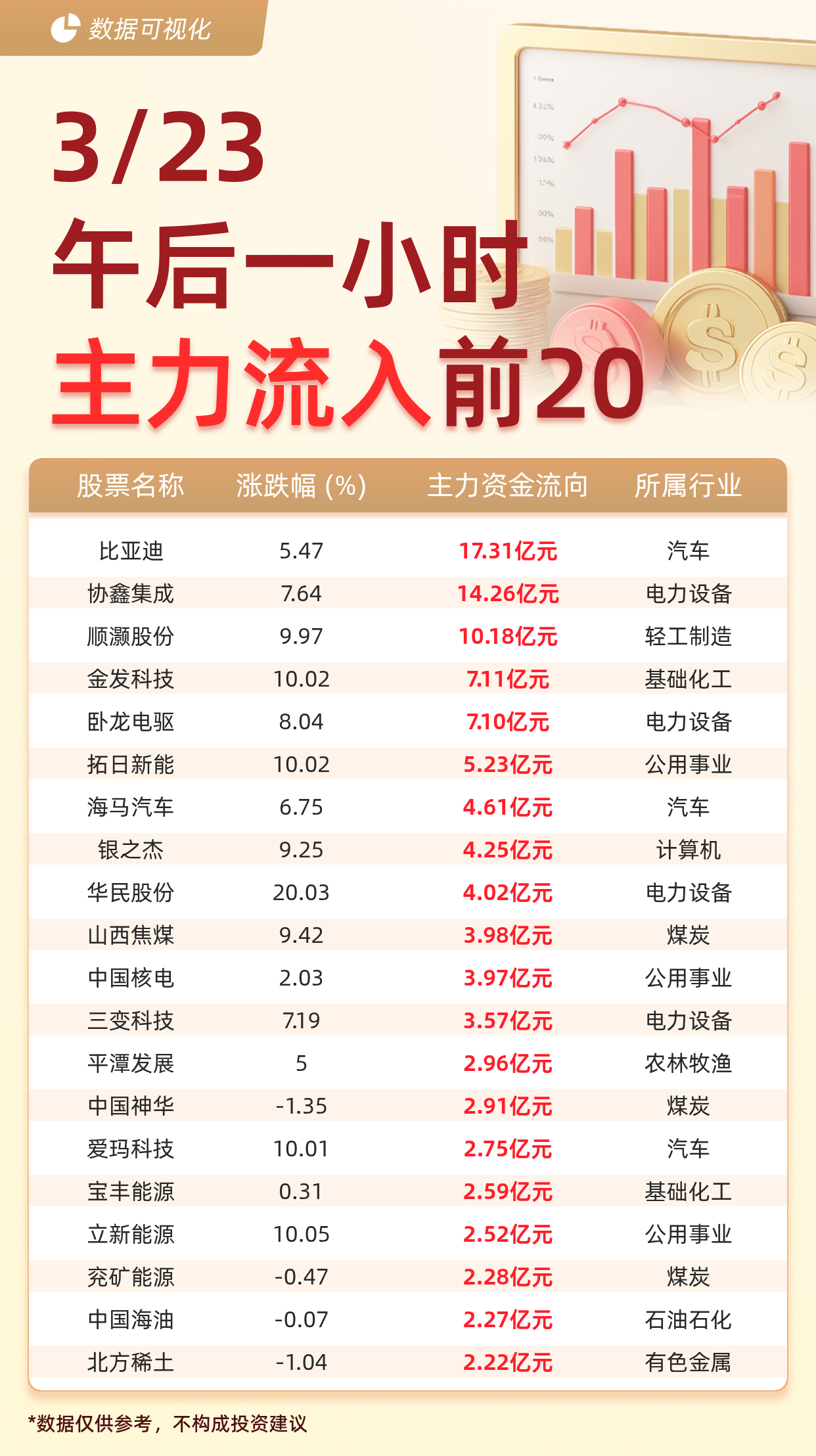
主力资金流入前20:比亚迪流入17.31亿元、协鑫集成流入14.26亿元
Jin Rong Jie· 2026-03-23 06:29
Core Insights - The main focus of the news is the significant inflow of capital into various stocks, highlighting the top 20 stocks by capital inflow as of March 23, with notable performances in sectors such as automotive, power equipment, and coal [1][2][3] Group 1: Stock Performance - BYD saw a capital inflow of 1.731 billion, with a price increase of 5.47% [2] - GCL-Poly Energy experienced a capital inflow of 1.426 billion, with a price increase of 7.64% [2] - Shunhao Co. reported a capital inflow of 1.018 billion, with a price increase of 9.97% [2] - Jinfat Technology had a capital inflow of 711 million, with a price increase of 10.02% [2] - Wolong Electric Drive received a capital inflow of 710 million, with a price increase of 8.04% [2] Group 2: Sector Analysis - The automotive sector, represented by BYD and Haima Automobile, showed strong capital inflows, indicating investor confidence [1][2] - The power equipment sector, including GCL-Poly Energy and Wolong Electric Drive, also attracted significant capital, reflecting growth potential [1][2] - The coal sector, represented by Shanxi Coal and China Shenhua, displayed mixed performance with varying capital inflows and stock price changes [1][3]




海外因素冲击,股指大幅调整
Guo Mao Qi Huo· 2026-03-23 05:47
1. Report Industry Investment Rating - Not provided in the content 2. Core Viewpoints of the Report - Currently, considering both internal and external factors, it is expected that the stock index will continue its weak oscillation pattern. In the future, as the overall economic tone meets expectations, multiple policies continue to work together to promote economic growth, macro - liquidity remains abundant, and capital market policies aim to nurture a "slow - bull" market, the stock index is expected to have room for an upward trend. With the easing of external geopolitical situations and the recovery of market risk appetite, the stock index is expected to consolidate and resume its upward movement. The investment view is to go long in the medium - to - long term, and the trading strategy is to choose the right time to go long in the medium - to - long term, with overseas geopolitical factors being the risk to watch [3]. 3. Summary by Relevant Catalogs 3.1 Main Views and Strategy Overview - **Economic and Corporate Profits**: The economic indicators from January to February continued the pattern of "mixed hot and cold". The production side was strong, with the added value of industrial enterprises above designated size increasing by 6.3% year - on - year, higher than the market expectation of 5.0%. The demand side was generally weak. The total retail sales of consumer goods from January to February was 75,815 billion yuan, with a year - on - year increase of 2.5%, in line with market expectations. The investment growth rate turned slightly positive, with national fixed - asset investment (excluding rural households) reaching 52,721 billion yuan, a year - on - year increase of 1.8%. Infrastructure investment was the core driver, with a year - on - year increase of 11.4%, while real estate investment was still in the adjustment period, with a 11.1% decline in real estate development investment from January to February [3]. - **Policy**: The probability of "bottom - support" policies in the capital market has increased. The A - share capital market remains well - funded, providing strong support for the stock index. After the sharp adjustment of the stock index last week, the probability of policy - level support has increased [3]. - **Overseas Factors**: The uncertainty of the Middle East conflict persists, impacting the equity market. The tightening of the global geopolitical situation has pushed up oil prices, increased global inflationary pressure, and restricted the interest - rate cut space of major overseas central banks, leading to a risk of tightening global liquidity. The upstream energy price increase has squeezed the profit margins of domestic mid - and downstream high - end manufacturing industries [3]. - **Liquidity**: Market sentiment cooled significantly last week, and A - share trading volume shrank sharply. The average daily trading volume decreased by 244.62 billion yuan compared with the previous week [3]. 3.2 Stock Index Market Review - **Index Performance**: Last week, the Shanghai - Shenzhen 300 Index fell 2.19% to 4,567; the Shanghai 50 Index fell 2.47% to 2,883.9; the CSI 500 Index fell 5.82% to 7,760; the CSI 1000 Index fell 5.25% to 7,783.4 [5]. - **Industry Index Performance**: Most Shenwan primary industry indices declined. Only the communication (2.1%) and banking (0.4%) sectors rose, while non - ferrous metals (- 11.8%), basic chemicals (- 10.5%), steel (- 10.3%), comprehensive (- 8%), and building materials (- 7.9%) sectors led the decline [7]. - **Futures Volume and Open Interest**: The trading volume of CSI 300 futures, Shanghai 50 futures, CSI 500 futures, and CSI 1000 futures increased by 34.03%, 44.45%, 20.74%, and 26.76% respectively. The open interest of CSI 300 futures, Shanghai 50 futures, and CSI 500 futures decreased by 3.86%, 4.31%, and 2.05% respectively, while the open interest of CSI 1000 futures increased by 2.77% [11]. - **Futures Premium and Discount**: As of March 20, the monthly contracts expired. The annualized discounts of the next - month contracts IF2604, IH2604, IC2604, and IM2604 were 7.71%, 1.11%, 10.66%, and 9.32% respectively; the annualized discounts of the current - quarter contracts IF2606, IH2606, IC2606, and IM2606 were 7.08%, 2.51%, 10.37%, and 11.51% respectively; the annualized discounts of the next - quarter contracts IF2609, IH2609, IC2609, and IM2609 were 7.04%, 3.57%, 9.75%, and 11.32% respectively [12]. - **Cross - Variety Spread Performance**: The spread between the Shanghai - Shenzhen 300 and the Shanghai 50 was 1,683.2, at the 97.5% historical quantile level; the spread between the CSI 1000 and the CSI 500 was 23.4, at the 23.9% historical quantile level; the ratio of the Shanghai - Shenzhen 300 to the CSI 1000 was 0.6, at the 26.9% historical quantile level; the ratio of the Shanghai 50 to the CSI 1000 was 0.6, at the 20.3% historical quantile level [17]. 3.3 Stock Index Influencing Factors - Liquidity - **Central Bank Operations**: The central bank conducted 242.3 billion yuan of reverse repurchase operations this week, with 176.5 billion yuan of reverse repurchases maturing, resulting in a net injection of 65.8 billion yuan. Next week, 242.3 billion yuan of reverse repurchases will mature, and 450 billion yuan of MLF will mature on Wednesday [23]. - **Market Volume and Margin Trading**: As of March 19, the margin trading balance of A - shares was 2,641.71 billion yuan, a decrease of 1.57 billion yuan from the previous week. The proportion of margin trading purchases in the total market trading volume was 9%, at the 63.7% quantile level in the past ten years. The average daily trading volume of A - shares last week decreased by 244.62 billion yuan compared with the previous week. As of March 20, the risk premium rate of the Shanghai - Shenzhen 300 was 5.3, at the 53.4% quantile level in the past ten years [29]. 3.4 Stock Index Influencing Factors - Economic Fundamentals and Corporate Profits - **Macroeconomic Indicators**: In February 2026, the industrial added value increased by 6.3% year - on - year; fixed - asset investment increased by 1.8% year - on - year; real estate investment decreased by 11.1% year - on - year; infrastructure investment increased by 11.4% year - on - year; social consumer goods retail increased by 2.8% year - on - year; the urban surveyed unemployment rate was 5.3%; CPI was 1.3%; PPI was - 0.9%; the increment of social financing was 23,855 billion yuan; the growth rate of social financing stock was 8.2%; the new RMB loans were 8,458 billion yuan; M1 was 5.9%; M2 was 9.0%; exports increased by 39.6% year - on - year; imports increased by 13.8% year - on - year; the manufacturing PMI was 49.0%; the non - manufacturing PMI was 49.5% [32]. - **Corporate Profit Indicators**: The year - on - year growth rates of net profit attributable to shareholders of the Shanghai - Shenzhen 300, Shanghai 50, CSI 500, and other major broad - based indices, as well as the ROE (TTM) of these indices, are presented in the report [43]. The profitability of Shenwan primary industry indices, including the year - on - year growth rate of net profit attributable to shareholders and ROE (TTM), is also provided [44]. 3.5 Stock Index Influencing Factors - Policy Driven - **Recent Macro - Policy Trends**: A series of policies have been introduced, including setting economic growth targets, fiscal policies such as deficit ratios, special bond issuance, and measures to expand domestic demand. In the real estate sector, policies aim to maintain stability and adjust housing purchase restrictions. In the capital market, policies focus on improving the market mechanism and increasing support [48][49][50]. 3.6 Stock Index Influencing Factors - Overseas Factors - **US Economic Data**: In February, the US manufacturing PMI was 52.4%, a 0.2 - percentage - point decrease from the previous value; the non - manufacturing PMI was 56.1%, a 2.3 - percentage - point increase from the previous value. The consumer confidence index in March was 55.5, a 1.1 increase from the previous value. The seasonally - adjusted unemployment rate in February was 4.4%, and the number of new non - farm payrolls was - 92,000. In January, the year - on - year increase in PCE was 2.83%, and the year - on - year increase in core PCE was 3.06%. The year - on - year increase in CPI was 2.4%, and the year - on - year increase in core CPI was 2.5% [61][63][68]. 3.7 Stock Index Influencing Factors - Valuation - **Index Valuation**: As of March 20, 2026, the rolling price - to - earnings ratios of the Shanghai - Shenzhen 300, Shanghai 50, CSI 500, and CSI 1000 were 14, 11.4, 35.1, and 47.2 respectively, at the 77.7%, 77.3%, 76.7%, and 67% quantile levels since October 2014 [70].
金属周报 | 贵金属暴跌避险逻辑失效?COMEX铜库存顶部初现
对冲研投· 2026-03-23 05:11
Core Viewpoint - The macroeconomic pressure has escalated significantly, driven by geopolitical tensions and hawkish signals from the Federal Reserve [3][4]. Group 1: Macroeconomic Impact - The Federal Reserve's March meeting revealed a more hawkish stance than expected, with the dot plot indicating a reduction in rate cut expectations to less than 50 basis points by 2026, and Powell stating that rates are at the high end of the neutral range [4]. - The escalation of the US-Iran conflict, including attacks on energy facilities, has heightened global inflation expectations, leading the market to price in "stagflation" and even rate hikes, which has put systemic pressure on metals [4]. Group 2: Copper Market Analysis - Copper concentrate treatment charges (TC) have further declined to -67.32 USD/ton, with smelting losses exceeding 1,000 CNY/ton, indicating a worsening situation for domestic smelters [6][14]. - Domestic social copper inventory has decreased for two consecutive weeks, down by 50,800 tons to 523,100 tons, suggesting marginal improvement in the fundamentals, but macroeconomic factors continue to dominate, leading to a significant drop in copper prices [10][19]. Group 3: Precious Metals Market Analysis - The precious metals market experienced unprecedented selling pressure, with the trading focus shifting from geopolitical risk to pricing in "stagflation and tightening" [8][26]. - Gold prices fell sharply, with London gold dropping 10.5% to close at 4,492 USD/oz, marking the largest weekly decline in nearly three years, while silver fell 15.7% to 67.9 USD/oz [8][26]. Group 4: Market Trends and Inventory - COMEX gold inventory decreased by approximately 600,000 ounces to 33.32 million ounces, while COMEX silver inventory fell by about 5.92 million ounces to 36.033 million ounces [41]. - The SPDR gold ETF holdings increased by 23 tons to 1,101 tons, while SLV silver ETF holdings rose by 475 tons to 15,992 tons, indicating a shift in market positioning [44].

华宝期货碳酸锂晨报-20260323
Hua Bao Qi Huo· 2026-03-23 04:21
Group 1: Investment Rating - There is no information about the report's industry investment rating provided in the content. Group 2: Core View - The price of lithium carbonate is mainly influenced by macro - sentiment and is expected to run weakly within a certain range [1][4] Group 3: Summary by Related Catalogs Market Performance - Last week, the main contract of lithium carbonate closed at 143,860 yuan/ton, with trading volume and open interest shrinking, and the warehouse receipt volume of the Guangzhou Futures Exchange continued to decline. The average spot price of SMM battery - grade lithium carbonate was 149,000 yuan/ton. The procurement rhythm slowed down significantly, and the overall trading activity decreased compared with the previous day. The conflict between the US and Iran pushed up the crude oil price, causing capital to flow out of assets outside the energy and chemical sectors. The non - ferrous metal sector was in a weekly - level correction cycle, and lithium carbonate declined synchronously due to the sector linkage effect. There was an obvious outflow of funds, and the open interest decreased significantly [2] Fundamental Analysis - **Supply**: Last week, the raw material price weakened with the salt price. The SMM operating rate continued to rise to 55.14%, and the total output increased to 24,186 tons, strengthening the medium - term supply relaxation expectation [3] - **Demand**: In March, the production schedule was differentiated, and downstream buyers had a low acceptance of high prices. Ternary lithium iron continued the trend of increasing production and inventory. The production and sales of energy - storage cells were booming, and the inventory was at a low level, which was a structural highlight. Overall, the short - term fundamentals showed a marginal weakening trend, and there was a tug - of - war between downstream buyers' low - price restocking and upstream price support [3] - **Inventory**: Last week, the SMM four - place social inventory decreased to 40,700 tons (- 1,820 tons), the sample weekly inventory decreased to 98,900 tons, which was at a relatively low level. The total inventory days decreased to 27.7 days, continuing the tight - balance pattern. Structurally, downstream inventory increased, and the restocking willingness weakened [3] Macro - policy Analysis - **International**: The 15% temporary tariff policy of the US White House is still within the window period, which is a phased positive for demand. The escalation of the US - Iran situation has strengthened the crude oil price, suppressing the non - ferrous metal sector and causing capital to flee for safety [3] - **Domestic**: The subsidy for car trade - ins and the battery export tax rebate (officially implemented on April 1) stimulate terminal consumption. The comprehensive utilization management method for new - energy vehicle power batteries optimizes the domestic supply structure in the long term and raises the cost support center. The development of Qinghai Salt Lake, the 14th Five - Year Plan for energy storage, and the Central Economic Work Conference support the long - term supply - demand balance. The 2026 government work report mentioned zero - carbon parks/factories, which is expected to become the second growth curve for energy storage [3]
国泰海通晨报-20260323
国泰海通· 2026-03-23 03:04
Macroeconomic Research - Geopolitical factors are driving stronger imported inflation, with external demand showing resilience while internal demand remains to be boosted, leading to a persistent divergence [1][2] - The policy focus is on long-term special government bond issuance and the construction of a unified national market to promote high-quality economic recovery through precise investment and institutional optimization [2][18] Strategy Research - The mid-level economic landscape shows differentiation, with increased disruptions in oil supply leading to a continuous rise in prices along the oil and chemical chain; emerging technologies are seeing an upward shift in their economic center [1][4] - The first quarter saw bright growth in travel and consumer goods consumption, indicating a potential recovery in these sectors [4][24] Banking Research - The commercial banking sector is exhibiting a clear trend of "leading banks," with state-owned banks acting as a credit stabilizer; regional city commercial banks are achieving differentiated breakthroughs, particularly in economically strong provinces like Jiangsu, Zhejiang, Sichuan, and Shandong [1][7] - The market share of state-owned banks is expected to increase, with their asset proportion rising to 43.3% by the end of 2025, while city commercial banks are also gaining market share due to regional economic resilience [8][10] Transportation Research - The demand for highway passage is resilient, with stable dividends and cash flow expected; the revision of the highway management regulations is anticipated to optimize policies [1][12] - The highway sector is expected to see steady growth in traffic volume in 2026, supported by favorable location advantages and ongoing expansion projects [12][25]