石油石化

Search documents
002155,一字涨停!
中国基金报· 2026-01-26 05:09
Market Overview - The A-share market opened higher but experienced a "W" shaped fluctuation, with the Shanghai Composite Index closing at 4141.01 points, a slight increase of 0.12% [1] - The Shenzhen Component Index fell by 0.74%, and the ChiNext Index dropped by 0.86% [1] Individual Stock Performance - A total of 3756 stocks declined, while 1606 stocks rose, with 50 stocks hitting the daily limit up [2] - The total trading volume in the Shanghai and Shenzhen markets reached 2.24 trillion yuan, an increase of 347.8 billion yuan compared to the previous trading day [2] Sector Performance Precious Metals - The precious metals sector saw significant gains, with individual stocks like Hunan Gold and Jin Hui shares hitting the daily limit up [5] - Gold prices reached a new high, with spot gold surpassing $5000 per ounce, and Goldman Sachs raised its 2026 gold price forecast to $5400 per ounce from $4900 [8] Oil and Gas - The oil and gas sector experienced a rally, with major companies like China National Petroleum, China National Offshore Oil, and Sinopec all seeing gains of over 4% [10] - The rise in oil prices was attributed to geopolitical tensions, with WTI and ICE Brent crude both increasing by over 3% [10] Financial Sector - The financial sector showed upward movement, with securities stocks rising significantly; for instance, Caitong Securities and Industrial Securities increased by over 4% [14] - Insurance stocks also performed well, with New China Life and China Pacific Insurance rising by over 3% [16] Alcoholic Beverages - The liquor sector faced a downturn, dropping over 1%, with stocks like Yanghe and Kweichow Moutai experiencing notable declines [20] - Yanghe's forecast indicated a potential net profit drop of 62.18% to 68.30% for the fiscal year 2025, leading to a projected loss of 1.451 billion to 1.859 billion yuan in Q4 2025 [21]








今日50只A股封板 有色金属行业涨幅最大
Zheng Quan Shi Bao Wang· 2026-01-26 05:06
Market Overview - The Shanghai Composite Index increased by 0.12% with a trading volume of 1,312.82 million shares and a transaction value of 22,631.30 billion yuan, representing an 18.63% increase compared to the previous trading day [1] Industry Performance - The top-performing industries included: - Non-ferrous metals: increased by 4.43% with a transaction value of 2,125.42 billion yuan, up 53.12% from the previous day, led by Xinweiling with a rise of 18.77% [1] - Oil and petrochemicals: increased by 4.34% with a transaction value of 249.22 billion yuan, up 31.70%, led by Tongyuan Petroleum with a rise of 13.42% [1] - Coal: increased by 2.37% with a transaction value of 111.32 billion yuan, up 60.37%, led by Huaibei Mining with a rise of 4.23% [1] Declining Industries - The worst-performing industries included: - National defense and military industry: decreased by 3.68% with a transaction value of 1,230.16 billion yuan, down 7.63%, led by Yaguang Technology with a decline of 12.24% [2] - Media: decreased by 2.21% with a transaction value of 751.18 billion yuan, down 9.68%, led by Giant Network with a decline of 8.63% [2] - Automotive: decreased by 2.11% with a transaction value of 937.05 billion yuan, down 17.57%, led by Kaizhong Co. with a decline of 10.02% [2]
坚守“科技 + 资源品”双主线,石化ETF(159731)连续13日合计“吸金”6.1亿元
Sou Hu Cai Jing· 2026-01-26 04:12
Core Viewpoint - The petrochemical ETF (159731) is experiencing a significant increase, with a net inflow of 610 million yuan over the past 13 days, indicating strong investor interest in the sector [1] Group 1: ETF Performance - The petrochemical ETF has reached a new high with a total share of 887 million and a total scale of 910 million yuan [1] - Major stocks such as China National Offshore Oil Corporation, China Petroleum, and Yanchang Petroleum are leading the gains within the ETF [1] Group 2: Market Environment - The current macroeconomic environment is characterized by stronger production than demand, with external demand outperforming internal demand, and a loose monetary policy similar to the investment peak period of 2020-2021 [1] - In the last two weeks, stock ETFs have seen an outflow of approximately 450 billion yuan, while broad-based ETFs have experienced an outflow of over 570 billion yuan, contrasting with an inflow of about 110 billion yuan into thematic industry ETFs [1] Group 3: Investment Strategy - The current bull market is supported by a positive policy tone, with a focus on "technology + resource products" as the main investment themes [1] - The technology sector should focus on AI and semiconductors, while the resource sector should pay attention to non-ferrous metals, with potential benefits expected to extend to energy and machinery sectors [1] Group 4: Index Composition - The petrochemical ETF closely tracks the CSI Petrochemical Industry Index, which is primarily composed of basic chemicals and petroleum and petrochemical industries, accounting for over 91% of the index [1] - The top ten holdings include the "Big Three" oil companies—China Petroleum, China Petrochemical, and China National Offshore Oil Corporation—collectively representing over 20% of the index weight [1]
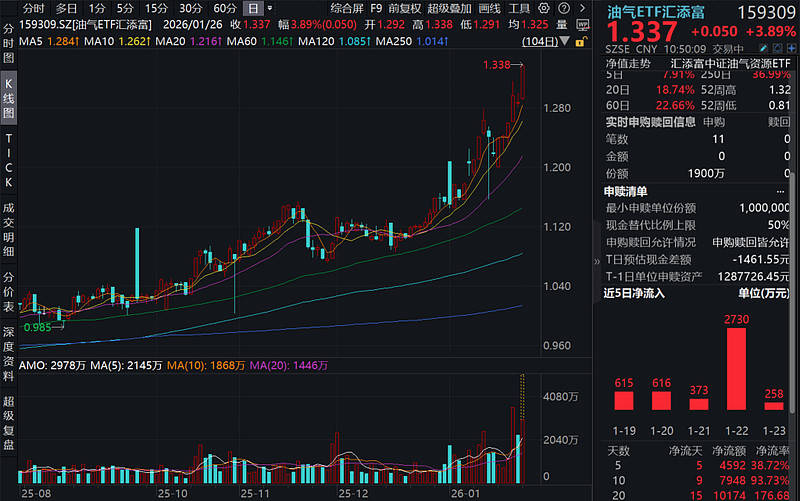
地缘风险升温,资源品超级周期爆发!中国海油罕见飙涨6%创新高,油气ETF汇添富(159309)涨超3%,盘中强势吸金超1000万元!
Sou Hu Cai Jing· 2026-01-26 03:11
Group 1 - The resource sector is leading the market surge, with the oil and gas sector experiencing fluctuations, as evidenced by the oil and gas ETF Huatai (159309) rising over 3.8% and reaching a historical high, attracting over 25 million yuan in funds during the day [1] - The oil and gas ETF Huatai has seen continuous inflows, accumulating over 1 billion yuan in the past 10 days [1] - Major stocks in the oil and gas sector, such as China National Offshore Oil Corporation (CNOOC) and Sinopec, have shown significant price increases, with CNOOC rising 6.34% and Sinopec increasing 4.07% [2][5] Group 2 - Geopolitical tensions, particularly between the US and Iran, may threaten Middle Eastern oil exports, increasing regional risks [3] - Supply disruptions in Kazakhstan due to power distribution issues at major oil fields are expected to reduce oil exports through the Caspian Pipeline Consortium (CPC), which may support oil prices [4] - The current cold weather in the US is causing significant fluctuations in natural gas prices, with potential implications for other energy prices if the cold spell persists [4] Group 3 - The oil and gas sector is highlighted as a focus area due to the ongoing commodity supercycle, with energy prices expected to rise following other commodities [4] - The oil and gas ETF Huatai is designed to focus on the oil and gas industry chain, including exploration, equipment, refining, and transportation, emphasizing companies with quality reserves and low-cost advantages [9] - The index of the oil and gas ETF Huatai has shown strong performance over the past six months, one year, and three years, leading among similar indices [10]
【盘中播报】53只A股封板 有色金属行业涨幅最大
Zheng Quan Shi Bao Wang· 2026-01-26 03:11
证券时报·数据宝统计,截至上午10:28,今日沪指涨0.39%,A股成交量980.00亿股,成交金额16999.36 亿元,比上一个交易日增加21.19%。个股方面,1390只个股上涨,其中涨停53只,3998只个股下跌, 其中跌停22只。从申万行业来看,有色金属、石油石化、非银金融等涨幅最大,涨幅分别为5.02%、 3.79%、2.04%;国防军工、传媒、计算机等跌幅最大,跌幅分别为3.43%、2.74%、1.95%。(数据宝) | 房地产 | | | | 万通发展 | | | --- | --- | --- | --- | --- | --- | | 计算机 | -1.95 | 1186.13 | 30.39 | 浩瀚深度 | -9.56 | | 传媒 | -2.74 | 587.64 | 28.52 | 天龙集团 | -8.86 | | 国防军工 | -3.43 | 926.12 | 4.22 | 亚光科技 | -12.82 | (文章来源:证券时报网) 今日各行业表现(截至上午10:28) | 申万行业 | 行业涨跌(%) | 成交额(亿元) | 比上日(%) | 领涨(跌)股 | 涨跌幅(%) | ...
本轮债市回暖中的新规律
2026-01-26 02:50
Summary of Conference Call Records Industry Overview - The conference primarily discusses the bond market, focusing on the recovery trends observed since mid-January 2026, with specific attention to government bonds and credit bonds [1][2]. Key Points and Arguments Recovery of the Bond Market - The bond market has shown signs of recovery due to three main factors: 1. **Stability of Government and Local Bonds**: The stability of interest rates for government bonds and local bonds has been crucial. The 10-year government bond has remained stable, not exceeding 1.9%, while local bonds have stayed below 2.5% [2]. 2. **Banking Sector Participation**: There has been an increase in bank allocations to bonds, particularly after the clarity of KPIs for banks in 2026. This has led to a stronger demand for bonds, especially those with shorter durations [3][4]. 3. **External Support Factors**: External factors such as the stagnation of equity markets and expectations of monetary easing have contributed to the bond market's recovery. The MLF (Medium-term Lending Facility) has also seen increased volumes, indicating a supportive monetary environment [4][5]. Future Market Outlook - The outlook for the bond market remains cautious but optimistic. Short-duration bonds are expected to perform well, while long-duration bonds may face more volatility. The market anticipates that the recovery could serve as a precedent for future bond market trends in 2026 [5][6]. - The potential for downward movement in interest rates exists, particularly for 10-year government bonds, if deposit rates continue to decline [5][6]. Risks and Challenges - The bond market may face challenges related to supply and demand mismatches, especially in the first and second quarters of 2026. The issuance of local bonds is expected to be high, which could lead to increased pressure on the market [9][10]. - The risk indicators for banks remain a concern, particularly for smaller banks, which may face stricter regulations and slower adjustments to their risk profiles [9][10]. Investment Recommendations - Analysts recommend focusing on 10-year government bonds and certain credit bonds, particularly those with favorable yield spreads. The expectation is that these assets will provide stability and potential for appreciation in the current market environment [11][12]. - The discussion also highlights the potential for industry-specific perpetual bonds, particularly those issued by state-owned enterprises, which are seen as having a favorable risk-return profile [17][18]. Market Dynamics - The dynamics of the bond market are influenced by the behavior of institutional investors, with a noted shift towards increasing allocations in response to market conditions. The performance of convertible bonds is also highlighted, with expectations of continued demand despite some volatility [26][27]. Conclusion - The bond market is currently in a recovery phase, supported by stable interest rates, increased bank participation, and favorable external conditions. However, potential risks related to supply-demand mismatches and regulatory pressures on banks warrant careful monitoring. Investment strategies should focus on stable, shorter-duration bonds and select credit instruments to navigate the evolving landscape [36].
廖市无双-如何应对当下指数分化格局
2026-01-26 02:49
Summary of Conference Call Records Industry Overview - The current market is experiencing a bull market that has lasted for 24 months, entering its mid-to-late stage, benefiting from a downturn in the real estate and trust industries, leading to capital inflow into the securities market. The outlook for the next decade remains positive, but the spring offensive in 2026 should be viewed as a mid-game break [1][4]. Market Performance - The Shanghai Composite Index has shown slight upward movement, while the Shanghai 50 and CSI 300 have entered a correction phase, indicating a consolidation of heavyweight indices. Conversely, small and mid-cap growth stocks have performed strongly, with the CSI 500, CSI 1000, and National CSI 2000 reaching new highs since September 2024 [1][5][6]. - In the recent week, 17 out of 24 sectors in the Shenwan primary industry index saw gains, with small and mid-cap sectors showing significant excess returns [7]. Sector Analysis - Underperforming sectors include construction materials, oil and petrochemicals, steel, real estate, environmental protection, and textiles, while sectors such as non-ferrous metals, defense, and basic chemicals have shown strong performance [8]. - The recent rebound in underperforming sectors is attributed to the market entering a mid-to-late stage, with a rotation and broad-based rally emerging. Stocks that had been stagnant are beginning to rise, particularly in construction materials and oil and petrochemicals [9]. Investment Strategy - A dual strategy is recommended: 1. Invest in indices like CSI 500, CSI 1000, and National CSI 2000 for relative returns. 2. Focus on sectors with high growth potential and reasonable valuations, such as electronics, semiconductor storage, and renewable energy [3][14]. - Investors are advised to avoid panic selling due to corrections in heavyweight indices, as adjustments are not expected to be severe. Short-term strategies should avoid blind chasing of high prices [12][13]. Future Market Outlook - The heavyweight indices may continue to adjust, while growth indices like CSI 500 and CSI 1000 are expected to maintain upward momentum. The Shanghai Composite Index is currently above the 20-day moving average, indicating potential for upward movement, but caution is advised as the slope has flattened [11]. Regulatory Impact - New regulations set to take effect on March 1 will require disclosure of deviations and gradually increase external monitoring, leading to a decrease in investment freedom. Prior to this, optimizing portfolios for maximum returns is essential, while post-regulation, a focus on balanced allocation will be necessary [22][25]. Key Focus Areas - Attention should be given to the banking and non-banking financial sectors, which have seen significant declines. The telecommunications sector also requires close monitoring due to signs of weakness in leading stocks [10]. Conclusion - The market is characterized by structural differentiation, with small-cap stocks showing superior performance. Investors should remain vigilant and adjust strategies according to market conditions, particularly during the spring rally period [21][23].
宏观周周谈-当前的核心矛盾是什么
2026-01-26 02:49
Summary of Key Points from Conference Call Records Industry and Company Overview - The discussion primarily revolves around macroeconomic trends, inflation expectations, and the performance of various industries in the context of the Chinese and U.S. markets. [1][2][3] Core Insights and Arguments Market Sentiment - Market sentiment has improved, particularly in second and third-tier cities, indicating a recovery in market activity to about 50-66% of previous levels. [2] Inflation Expectations - A "pork-oil resonance" phenomenon is anticipated in 2026, signaling the end of deflation and a return to inflation, with a CPI central tendency expected to reach 0.5% and PPI likely turning positive in Q3. [1][3][4] Industry Focus - Industries that may benefit from the positive PPI include resource-related sectors and raw materials, while the technology sector's valuations are no longer seen as advantageous. [1][4] U.S. Stock Market Outlook - The U.S. stock market is expected to experience a rally from May to August 2026, potentially boosting related sectors such as computing power. However, the main focus remains on the implications of PPI turning positive. [1][6] PPI Impact on Industries - Positive PPI is expected to favor industries such as construction materials, non-ferrous metals, steel, and basic chemicals, while sectors like machinery, automotive, electronics, pharmaceuticals, and home appliances show strong alpha correlation but weak beta correlation. [1][7][8] Currency Exchange Rate - The Chinese yuan is projected to appreciate significantly, with the effective exchange rate expected to return to levels seen at the end of 2024. This appreciation will benefit yuan-denominated assets, including Hong Kong stocks. [1][9] Geopolitical Risks - Geopolitical risks are increasing due to the disintegration of the old international order, U.S. strategic adjustments, and rising global political uncertainties. Key areas of concern include the Russia-Ukraine conflict, the situation in Iran, and developments in U.S.-China relations. [1][10][11] Other Important but Potentially Overlooked Content Specific Industry Dynamics - The relationship between PPI and various industries has shifted, with some sectors like real estate losing their previous correlation with PPI, while others have become more competitive due to changes in consumer behavior and market dynamics. [1][7][8] Recent Developments in Geopolitical Situations - The situation in Greenland has shown signs of easing, with diplomatic negotiations taking precedence over military threats. However, tensions remain in the Middle East, particularly regarding Iran and the ongoing Russia-Ukraine conflict. [10][11][12][14] U.S.-China Relations - Recent developments indicate a potential stabilization in U.S.-China relations, with high-level diplomatic engagements expected to continue throughout the year. [15][16]
【申万宏源策略】人民币升值期间大类资产复盘
申万宏源证券上海北京西路营业部· 2026-01-26 02:10
人民币升值期间大类资产复盘 ——全球资产配置每周聚焦 (20260116-20260123) 本期投资提示: 全球资本市场回顾: 本周 (20260116-20260123)全球地缘政治冲突加剧,贵金属继续上 行。1)固收方面, 10Y美债收益率维持在4.2%的水平,美元指数下行1.88%; 2)权益 方面, 本周上证指数整体上行,中证1000和科创50涨幅靠前,上证50跌幅较大;全球市 场中巴西、阿根廷股价涨幅较大,其中A股行业中建筑材料,石油石化、钢铁涨幅靠前, 银行跌幅较大,港股耐用消费品领涨; 3)商品方面, 本周黄金上涨8.3%,主要是因为 地缘政治冲突集中爆发。 聚焦热点:人民币升值期间大类资产表现复盘 :2000年以来,人民币汇率共经历了6轮升 值与4轮贬值,人民币汇率变化主要受到汇率制度改革、全球贸易周期以及中美货币政策 周期变化的影响。 国内大类资产方面,人民币升值期间,股票稳定的胜率更高,债券和 商品表现规律并不统一。 股票方面 ,创业板整体跑赢沪深300(除2017年),小盘整体 跑赢大盘(除2017年)。 债券方面, 2017、2023、2025年升值期间,国债指数录得负收 益,其他几 ...
原油周报:美伊局势紧张,支撑国际油价
Soochow Securities· 2026-01-26 00:24
Investment Rating - The industry investment rating is "Overweight," indicating an expected outperformance of the industry index relative to the benchmark by more than 5% over the next six months [173]. Core Insights - The report highlights that the geopolitical tensions between the U.S. and Iran are supporting international oil prices, with Brent and WTI crude oil futures averaging $64.8 and $60.1 per barrel, respectively, showing a slight increase of $0.1 and a decrease of $0.1 from the previous week [2]. - U.S. crude oil production is reported at 13.73 million barrels per day, with a slight decrease of 20,000 barrels per day week-on-week, while active oil rigs increased by 1 to 411 [2]. - The report recommends several companies for investment, including China National Offshore Oil Corporation (CNOOC), China Petroleum & Chemical Corporation (Sinopec), and China National Petroleum Corporation (PetroChina) [3]. Summary by Sections 1. Weekly Oil Data Brief - The report provides a comprehensive overview of weekly oil data, including price trends, inventory levels, production rates, and import/export statistics [5][7][8]. 2. Oil and Petrochemical Sector Performance - The oil and petrochemical sector has shown varied performance, with specific companies experiencing significant fluctuations in stock prices over the past week, month, and year [21][22]. 3. Crude Oil Data Tracking - Crude oil prices have been tracked, showing fluctuations in both Brent and WTI prices, alongside inventory levels and production data [25][26][37]. - U.S. crude oil inventories have increased, with total inventories reported at 840 million barrels, reflecting a week-on-week increase of 441,000 barrels [2][44]. 4. Refined Oil Data Tracking - The report details refined oil prices, inventory levels, production, and consumption trends, indicating a decrease in refinery throughput to 16.6 million barrels per day, down by 350,000 barrels per day [4][74]. - Refined oil inventories have also seen changes, with gasoline and diesel inventories increasing by 598,000 and 335,000 barrels, respectively [2][108]. 5. Oil Service Sector Data Tracking - The oil service sector is analyzed, focusing on the average day rates for drilling rigs and the overall performance of service companies [158][161].