
个护

Search documents
研报掘金|中金:国庆出游景气度按年提升 消费有望延续回暖趋势
Ge Long Hui· 2025-09-29 05:25
Core Insights - The report from CICC indicates that the 2025 National Day and Mid-Autumn Festival holiday will span 8 days, coupled with more flexible leave arrangements, which is expected to stimulate a more active consumption window [1] - The Ministry of Culture and Tourism has announced that over 480 million yuan in consumption subsidies will be distributed during the consumption month, which is anticipated to further enhance residents' willingness to spend and boost holiday consumption [1] Group 1: Consumer Trends - The extended holiday peak is expected to improve travel sentiment year-on-year [1] - The report emphasizes a long-term focus on self-consumption, recommending sectors such as trendy toys and e-cigarettes, with specific companies like Pop Mart, Blokus, and Smoore International highlighted [1] Group 2: Domestic Brands and Policy Impact - The report suggests a trend towards the rise of domestic brands, recommending beauty and personal care sectors, including companies like Mao Geping, Juzhibio, Shanghai Jahwa, and Shanghai Jahwa [1] - Attention is drawn to sectors benefiting from policy catalysts, particularly retail, supported by domestic demand policies and seasonal boosts [1]



申万宏源:美容护理业绩分化 新消费逆势双击
智通财经网· 2025-09-24 06:17
Group 1 - The core viewpoint is that in H1 2025, the cosmetics retail sales growth has reversed its decline, achieving a growth rate of 2.9% due to consumption-boosting policies and improved income expectations [1][2] - The demand for cosmetics is expected to remain strong in H2 2025, with the off-peak season in July and August showing increased growth, indicating positive demand expectations [1][2] - The competitive landscape is improving, with domestic brands making significant progress, and leading domestic brands are now sharing market share equally with international brands [2] Group 2 - In the cosmetics sector, the revenue growth rate for key covered companies in H1 2025 is around 8%, with net profit growth slightly lower than revenue growth [2] - Specific companies in the cosmetics sector include: - Shiseido: H1 2025 revenue of 4.11 billion yuan, up 17.3%, net profit of 520 million yuan, up 30.6% [2] - Proya: H1 2025 revenue of 5.36 billion yuan, up 7.2%, net profit of 800 million yuan, up 13.8% [2] - Water Sheep: H1 2025 revenue of 2.5 billion yuan, up 9.0%, net profit of 123 million yuan, up 16.5% [2] - Marubi: H1 2025 revenue of 1.77 billion yuan, up 30.8%, net profit of 190 million yuan, up 5.2% [2] Group 3 - The second category of companies is capitalizing on consumer trends, with notable performances including: - Mao Geping: H1 2025 revenue of 2.59 billion yuan, up 31.3%, net profit of 670 million yuan, up 36.1% [3] - Juzi Biotechnology: H1 2025 revenue of 3.11 billion yuan, up 22.5%, net profit of 1.18 billion yuan, up 20.2% [3] - The third category includes companies showing marginal improvements or initial signs of strategic transformation, such as Shanghai Jahwa, Huaxi Biological, and Betaini [3] Group 4 - In the personal care sector, two companies reported revenue and net profit growth, indicating a strong market potential: - RuYuchen: H1 2025 revenue of 1.32 billion yuan, up 67.6%, net profit of 70 million yuan, up 85.6% [3] - Runben: H1 2025 revenue of 900 million yuan, up 20.3%, net profit of 190 million yuan, up 4.2% [3] Group 5 - In the medical beauty sector, the performance is mixed, with some companies experiencing declines: - Aimeike: H1 2025 revenue of 1.3 billion yuan, down 21.6%, net profit of 790 million yuan, down 29.6% [4] - Langzi: H1 2025 revenue of 2.79 billion yuan, down 4.3%, net profit of 270 million yuan, up 64.1% [4] - Overall, the medical beauty sector reported a revenue of 1.333 billion yuan, down 6.1%, with a gross margin of 54.54% [4]

轻工制造行业2025年中报业绩综述:景气度分化关注细分赛道投资机会
GUOTAI HAITONG SECURITIES· 2025-09-05 05:46
Investment Rating - The report rates the industry as "Overweight" [4] Core Insights - The report highlights a significant divergence in sector performance, suggesting investors focus on sectors with improving conditions [2] - The furniture sector is experiencing a slight decline in revenue, with a year-on-year decrease of 4.4% in Q2 2025, although soft furniture shows relatively better performance [7][8] - The personal care sector demonstrates resilience with a year-on-year revenue increase of 14% in Q2 2025, indicating strong demand [6] - The toy sector shows short-term revenue differentiation but has substantial long-term growth potential, with a year-on-year revenue decrease of 2% in Q2 2025 [6] - The export chain is facing performance differentiation, with companies having overseas production capabilities showing better revenue growth [6] - The two-wheeler sector is benefiting from trade-in incentives, leading to significant revenue growth [6] - The smart glasses market is experiencing explosive growth, with sales of Ray-Ban Meta smart glasses increasing by over 200% year-on-year in the first half of 2025 [6] - The paper industry is expected to see price increases as raw material prices recover, with integrated pulp and paper companies performing better [6] - The packaging sector is witnessing improved revenue growth, driven by an optimized domestic market structure and rising raw material prices [6] Summary by Sections Furniture Sector - The furniture sector's revenue in Q2 2025 decreased by 4.4% year-on-year, with soft furniture showing better growth [7][8] - Contract liabilities and advance payments in the furniture sector increased by 42.8% year-on-year, indicating potential future revenue growth [9] - The sector's net profit after deducting non-recurring items decreased by 7.8% year-on-year in Q2 2025, with slight fluctuations in profitability [10][13] Personal Care Sector - The personal care sector's revenue increased by 14% year-on-year in Q2 2025, reflecting strong demand and resilience [6] - The focus on product quality is becoming increasingly important to consumers [6] Toy Sector - The toy sector is experiencing short-term revenue differentiation, with a 2% year-on-year revenue decline in Q2 2025, but has significant long-term growth potential [6] Export Chain - The export chain is facing performance differentiation, with companies that have overseas production capabilities achieving better revenue performance [6] Two-Wheeler Sector - The two-wheeler sector is benefiting from trade-in incentives, leading to significant revenue growth in Q2 2025 [6] Smart Glasses - The smart glasses market is experiencing explosive growth, with sales of Ray-Ban Meta smart glasses increasing by over 200% year-on-year in the first half of 2025 [6] Paper Industry - The paper industry is expected to see price increases as raw material prices recover, with integrated pulp and paper companies performing better [6] Packaging Sector - The packaging sector is witnessing improved revenue growth, driven by an optimized domestic market structure and rising raw material prices [6]



农银汇理基金廖凌:内外积极因素共振 基本面投资胜率或提升
Zhong Zheng Wang· 2025-09-04 12:44
Group 1 - The A-share market is experiencing a positive trend driven by both domestic and external factors, leading to a broader range of investment opportunities [1] - The coordination of domestic supply and demand policies is a key variable that maintains high risk appetite, resulting in an upward trend in market indices [1] - The expectation of a Federal Reserve interest rate cut and a weaker dollar is likely to attract global funds towards non-US assets, providing room for valuation recovery in A-share equities [1] Group 2 - Two core investment themes identified are: new consumption and new services, focusing on high-income groups, the elderly, and consumers in lower-tier cities, as well as self-sufficiency sectors like semiconductors and AI computing chips [2] - The investment strategy for the new fund will involve a balanced approach, gradually increasing equity positions while controlling for volatility, aiming to capture opportunities from industry trends and fundamental improvements [2] - The market is expected to show greater breadth and depth in the second half of the year, with a focus on high-quality stocks that have clear fundamental improvements and reasonable valuations [2]
业绩拐点出现,优趣汇(02177)正积累增长后势
智通财经网· 2025-09-03 03:37
Core Viewpoint - The financial results of Youquhui (02177) for the first half of 2025 show a revenue of 580 million yuan and a net profit of 11.2 million yuan, indicating a "zero growth" situation. However, excluding non-recurring items and terminated brand collaborations, revenue increased by 2.5% year-on-year, and net profit remained stable. The gross margin improved by 4.6 percentage points to 34.6% [1] Group 1: "Subtraction" Strategy - Youquhui has been actively divesting low-margin brands and channels, which has led to a continuous improvement in profitability. The gross margin has shown a significant upward trend, increasing from 23.9% in 2022 to 34.6% in the first half of 2025 [2] - The company terminated collaborations with low-margin brands in the personal care and beauty sectors, as well as ceased operations in stagnant e-commerce businesses, indicating a strategic shift towards higher-margin products [2] - The rising gross margin trend is a key indicator of potential future improvements in other performance metrics, despite short-term fluctuations in revenue and net profit [2] Group 2: "Addition" Strategy in Health Sector - Youquhui has identified the health sector as a primary area for diversification, capitalizing on the growing demand for functional health foods. The health segment's revenue grew by 42.9% in the first half of 2025, driven by the strong performance of its proprietary brand Vanpearl, which generated 14 million yuan in revenue [3][4] - The successful launch of the ERGO-VITALIS™ capsule, which utilizes ergothioneine as a key ingredient, has validated the company's health product development model [3] - Youquhui is expanding its partnerships with established health brands, enhancing its market presence and brand influence in the health sector [3] Group 3: Future Growth Potential - The company's mid-year report reflects a strategic investment phase, with a clear long-term growth trajectory despite the absence of immediate steep growth in core financial metrics [5] - Youquhui plans to prioritize overseas expansion, particularly in Southeast Asia and North America, utilizing localized compliance and collaboration with local KOLs to enhance brand visibility and market penetration [6] - The company has shifted its funding strategy from seeking investments in technology companies to focusing on acquisitions and strategic partnerships in the health and beauty sectors, indicating a proactive approach to seizing growth opportunities [6]
别问做不做大促,要问怎么把大促做深做透
3 6 Ke· 2025-08-28 12:28
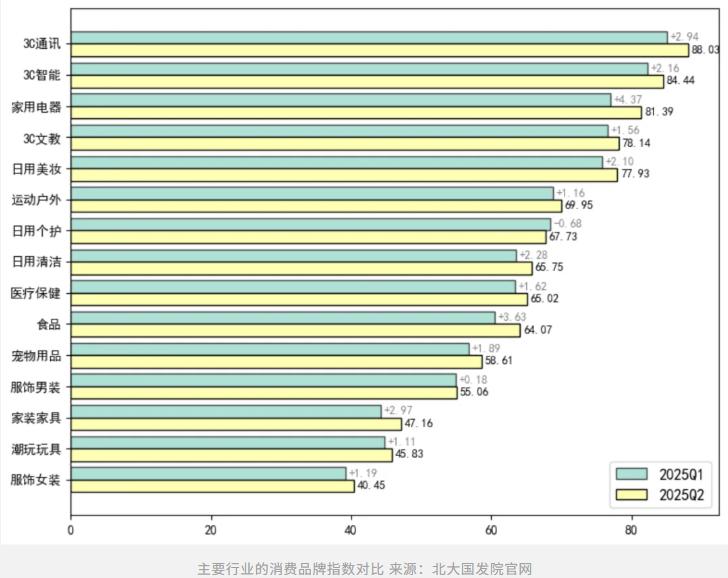
Core Insights - The current consumer industry is experiencing collective anxiety regarding the reliance on low prices as the only solution, with concerns that brand, quality, and innovation are losing importance [1] - There is also anxiety about the diminishing significance of major promotional events as consumer stockpiling mentality fades, leading brands to question the effectiveness of high marketing costs during these events [1] - The recent release of the "China Online Consumption Brand Index" (CBI) and "Global Brand China Online Top 500" lists by Peking University indicates that consumer emphasis on brand and quality is actually increasing, and major promotions remain a key strategy for enhancing brand value and customer loyalty [1][2] Group 1: CBI Index and Methodology - The CBI index is the first brand value assessment system based entirely on actual consumer purchasing behavior, filling a gap left by traditional macro indicators [1] - The index is developed by Peking University and supported by Alibaba, updated quarterly, and utilizes a comprehensive data set from 6,000 brands on Taobao and Tmall [3][5] - The methodology employs machine learning algorithms to identify key indicators that distinguish "high-quality brands" from ordinary ones, ensuring the index is both comprehensive and dynamic [6][5] Group 2: Trends and Consumer Behavior - The CBI index shows an upward trend, with a notable increase in consumer preference for quality brands during major promotional events like 618 and Double 11 [7][10] - The data indicates that during these promotional periods, consumers not only increase their total spending but also show a stronger inclination towards selecting quality brands over low-priced alternatives [7][9] - The seasonal fluctuations in the CBI index reflect the impact of major promotions on brand rankings, with brands like Midea and Haier significantly improving their positions during the 618 event [10][11] Group 3: New Brands and Market Dynamics - The research highlights that major promotions serve as critical growth accelerators for emerging brands, allowing them to establish a foothold in competitive markets [12] - For categories like beauty and personal care, promotions help brands create a closed loop from demand generation to brand recognition, enhancing consumer loyalty [13] - In the mother and baby category, promotions facilitate trust-building and market penetration, while personal care brands leverage differentiation and innovative channels to stand out [14][15] Group 4: Strategic Implications for Brands - The core conclusion from the CBI findings is that the challenge for brands is not whether to participate in promotions, but how to effectively leverage them for deeper engagement and growth [17] - Each promotional event represents an opportunity for brands to either capture market share or risk being left behind, emphasizing the need for strategic planning and execution [17]

曝无人机企业在试用期结束和年终奖发放前集中裁员;个护公司品牌总监被投资人点名走人;某硬件公司内部斗争严重丨鲸犀情报局Vol.18
雷峰网· 2025-08-22 10:39
Group 1 - A certain drone company is experiencing a decline in reputation due to concentrated layoffs before year-end bonuses, with severance packages significantly lower than bonuses or regular salaries [2] - The company has seen high turnover in its management team, with frequent changes in key positions such as product and sales heads, leading to instability and difficulty in retaining employees [2] - The company's aggressive investment in AI lacks a clear business model, resulting in financial concerns and a perception of wasted resources [2] - A major home appliance giant has conducted large-scale layoffs in response to e-commerce pressures and competitive challenges, with significant restructuring affecting multiple departments [3] - Middle management has faced demands for either demotion or salary cuts, leading to dissatisfaction among high-earning employees [3] Group 2 - A personal care company hired a new senior brand director with a background from Huawei, who overspent on brand innovation, leading to significant financial losses [4] - The company incurred over 200 million yuan in losses in 2022 due to high marketing expenditures and low product pricing [4] - A laser radar manufacturer sought to partner with a traditional lawn mower company, proposing investment and technical support, but the latter declined large-scale adoption due to cost concerns [5] - Internal conflicts within a hardware company have escalated, with key personnel engaging in power struggles and some using family members to hold shares [6] - A lawn mower company claimed it was not bankrupt despite rumors, stating it had over 10 million yuan in cash and had halted projects due to misalignment with market needs [7] Group 3 - A storage manufacturer faced setbacks in its lawn mower business, spending around 300 million yuan without achieving significant market impact, leading to a shift in focus towards cost reduction [8] - A drone company's new product has been marked by Amazon as having a high return rate, raising concerns about its cash flow and operational stability [9] - A lawn mower company has achieved a high return on investment (ROI) in overseas markets, with advertising expenditures yielding significant sales returns [10] - A humanoid robot manufacturer has paused advertising for its lawn mower product due to high pricing and insufficient product quality, highlighting challenges in market entry [10]

泉果基金调研百亚股份,聚焦投入重点资源,电商业务逐渐恢复常态
Xin Lang Cai Jing· 2025-08-20 07:39
Core Viewpoint - The company has shown a positive performance in the first half of 2025, with revenue growth driven by its product lines, despite challenges in the e-commerce channel due to public sentiment issues [1][3]. Financial Performance - In the first half of 2025, the company achieved operating revenue of 1.764 billion, a year-on-year increase of 15.1%, and a net profit attributable to shareholders of 188 million, up 4.6% [2][3]. Product Performance - The company's sanitary napkin product line generated revenue of 1.688 billion, reflecting a year-on-year growth of 20.5%. The health product series, represented by probiotics and organic cotton products, has seen faster revenue growth and an increasing revenue share [3]. Channel Performance - E-commerce revenue faced a decline of 9.4% year-on-year due to public sentiment impacts, while offline sales reached 1.133 billion, growing by 39.8% year-on-year. The company plans to increase resource investment in peripheral provinces to enhance national market expansion [3][4]. Sales and Marketing Expenses - Sales expenses amounted to 642 million, up 18.8%, with a sales expense ratio of 36.4%. The increase in expenses was primarily due to additional budget allocations for brand and online platform marketing in response to public sentiment [3]. Strategic Initiatives - The company is actively embracing the rise of instant retail channels and has established a dedicated department for channel development. It aims to adapt product offerings and focus resources on capturing growth opportunities in this area [4][6]. E-commerce Channel Recovery - The return on investment (ROI) for the online channel has largely recovered to the previous year's levels, with competition dynamics shifting. The company maintains a strong competitive edge through innovative marketing and product iteration [5][7]. Future Product Development - The company is increasing resource allocation for its organic cotton product line, anticipating better performance in the second half of the year due to strong consumer demand [6][9]. Regional Expansion - The company is accelerating its expansion in non-core provinces, with a more aggressive pace than initially planned. The overall market share is on an upward trend across different regions [8][10].
孩子王2025年中报简析:营收净利润同比双双增长
Zheng Quan Zhi Xing· 2025-08-19 23:21
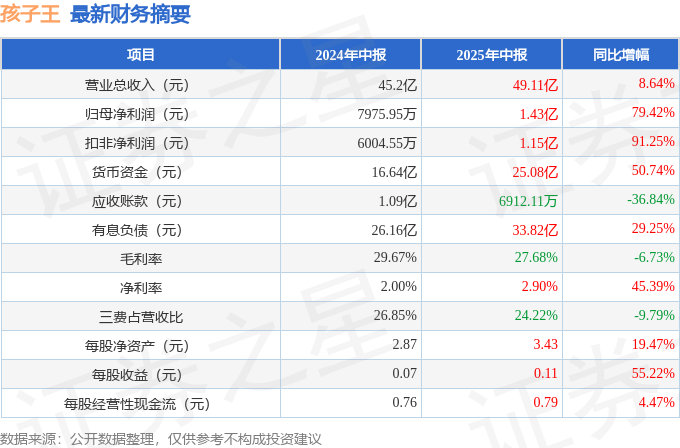
Financial Performance - The company reported a total revenue of 4.911 billion yuan for the first half of 2025, an increase of 8.64% year-on-year [1] - The net profit attributable to shareholders reached 143 million yuan, showing a significant growth of 79.42% compared to the previous year [1] - The gross profit margin was 27.68%, a decrease of 6.73% year-on-year, while the net profit margin improved to 2.9%, an increase of 45.39% [1] - The total of selling, administrative, and financial expenses was 1.189 billion yuan, accounting for 24.22% of revenue, down 9.79% year-on-year [1] - Earnings per share increased by 55.22% to 0.11 yuan [1] Financial Position - Cash and cash equivalents increased by 50.74% to 2.508 billion yuan, attributed to the receipt of acquisition loans [1][2] - Interest-bearing liabilities rose by 29.25% to 3.382 billion yuan, primarily due to new acquisition loans [2] - Accounts receivable decreased by 36.84% to 691.211 million yuan [1] - The company's net asset per share increased by 19.47% to 3.43 yuan [1] Business Model and Strategy - The company's performance is primarily driven by marketing efforts, indicating a need for careful analysis of the underlying drivers [4] - The company has a history of fluctuating returns on invested capital (ROIC), with a median ROIC of 4.22% since its listing [5] - The company has faced challenges in maintaining a strong business model, with three years of losses since its IPO [5] Market Outlook - Analysts expect the company's performance in 2025 to reach 364 million yuan, with an average earnings per share forecast of 0.29 yuan [5] - The company operates in a growing market, with the hair care market in China projected to reach 81.25 billion yuan by 2028, indicating significant growth potential [8]
孩子王上半年多数据持续增长 全年预期增强
Zheng Quan Shi Bao Wang· 2025-08-18 10:55
Core Insights - The company, Kid King, reported a resilient half-year performance with revenue, net profit, and cash flow growth under its "three expansions" strategy [1] - Revenue reached 4.911 billion yuan, an increase of 8.64% year-on-year, while net profit rose by 79.42% to 143 million yuan [1] - The net cash flow amounted to 999.8 million yuan, reflecting a significant increase of 18.28% [1] Business Strategy - Kid King is diversifying its business through industry incubation and mergers and acquisitions, focusing on maternal and child products and services, while expanding into personal care, skincare, and AI-driven innovations [1][2] - The company launched 54 new brands in its short-chain direct procurement strategy, covering 59 subcategories and 441 SKUs, with 11 brands achieving over 1 million yuan in sales [1][2] Market Expansion - The company continues to penetrate the market through its franchise business model, having opened 61 new stores and planning over 200 more [2] - The digital transformation of its app aims to enhance user experience by integrating instant retail, social sharing, local services, and parenting platforms [2] Technological Advancements - Kid King introduced AI-driven tools to automate marketing processes, enhancing operational efficiency across various functions [2] - The first AI product, "A Beibei," launched in June, sold over 30,000 units in its first month, with daily interactions exceeding 2.5 million [2] Mergers and Acquisitions - The acquisition of a 65% stake in Siyi Industrial marks Kid King's entry into the personal care sector, aiming to enhance service offerings and operational synergies [3] - By June 2025, the company plans to expand its store count to 1,165 nationwide, with a total membership base of 97 million [3] Industry Positioning - Analysts view Kid King's strategy as clear, focusing on acquiring leading players in niche markets and collaborating with tech firms to enhance efficiency in content production, user service, and operational management [3] - The company's deep engagement in the supply chain and AI technology application is expected to strengthen its competitive edge in the maternal and child retail market [3]