原油

Search documents
碳酸锂飙涨7%,原油却大跌?
Xin Lang Cai Jing· 2026-01-05 10:16
Group 1: Market Reactions to Geopolitical Events - The domestic futures market experienced significant volatility, with palladium, lithium carbonate, and platinum rising over 6%, while crude oil, coking coal, and soda ash fell over 2% due to a geopolitical event involving Venezuela [1][10] - A sudden military action by the U.S. against Venezuela led to a surge in safe-haven buying in the precious metals market, with palladium futures rising over 8% and platinum futures increasing over 6% [3][15] - Analysts noted that the rebound in platinum and palladium was primarily driven by geopolitical risks rather than significant changes in their fundamental demand [3][15] Group 2: Lithium Carbonate Market Dynamics - Lithium carbonate futures surged over 7%, driven by clear domestic policy support and tightening supply conditions [5][18] - The Chinese government extended the subsidy for replacing old cars with new ones, enhancing demand expectations for the lithium battery industry [6][18] - The average price of battery-grade lithium carbonate reached 119,500 yuan per ton, indicating a strong bullish sentiment due to supply constraints [6][18] Group 3: Crude Oil Market Analysis - Despite the geopolitical event involving Venezuela, domestic crude oil futures fell over 3%, highlighting complex market dynamics [5][17] - Concerns about global economic growth and risk appetite were cited as primary factors suppressing crude oil demand expectations [5][17] - The long-term supply-demand outlook for crude oil remains unchanged, with no significant supply disruptions expected [5][17] Group 4: Macro Economic Indicators - China's official manufacturing PMI rose to 50.1 in December, indicating a return to expansion and providing fundamental support for the market [7][19] - The positive macroeconomic sentiment contributed to a strong performance in stock index futures, with the CSI 500 index rising 3.11% [7][19] - Improved macroeconomic conditions also positively impacted basic metals, with aluminum, copper, and zinc futures all rising over 2% [7][20] Group 5: Future Market Outlook - The market is expected to continue operating under the dual themes of external risk disturbances and internal industrial transformations in 2026 [10][21] - Investors are advised to focus on structural opportunities amidst market differentiation and competition, with ongoing volatility in precious metals and the need for further data to validate the performance of the new energy sector [10][22]


战术性资产配置周度点评(20260105):地缘政治突变,建议超配黄金-20260105
国泰海通· 2026-01-05 02:51
Group 1 - The report suggests tactical overweighting in A/H shares, US stocks, and gold, while recommending standard allocation in government bonds and underweighting in oil due to rising global risk aversion driven by geopolitical changes in South America [2][3][18] - Multiple factors support the performance of Chinese equities, including expectations of expanded fiscal deficits and more proactive economic policies as the 14th Five-Year Plan begins [16][17] - The US stock market is expected to perform well, supported by resilient corporate earnings and a cautious monetary policy direction from the Federal Reserve, despite marginal economic cooling [16][17] Group 2 - The report highlights the importance of gold as a safe-haven asset amid rising geopolitical uncertainties, with central banks continuing to purchase gold, which supports long-term price stability [18][19] - The oil market is anticipated to face short-term volatility, with consistent supply-demand expectations and geopolitical events potentially increasing US influence on global oil prices, leading to continued pressure on oil prices [18][19] - The tactical asset allocation model indicates a strategic weight of 45% in equities, 45% in bonds, and 10% in commodities, with specific allocations detailed for various asset classes [20][26]
亚太股市集体高开,A股军工股全线走强,黄金涨破4400美元
21世纪经济报道· 2026-01-05 02:07
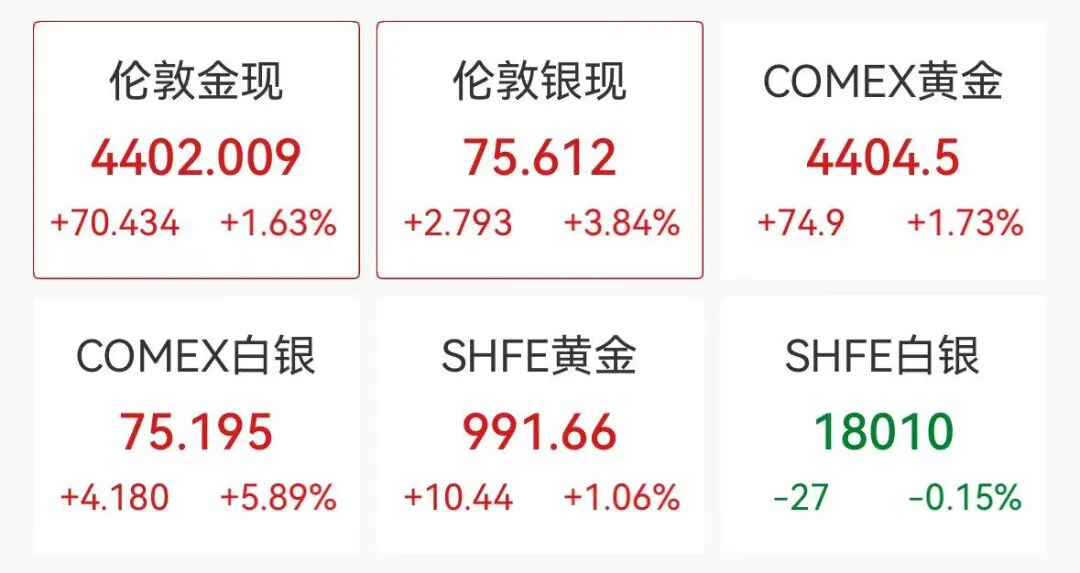
Core Viewpoint - The article highlights the significant rise in gold and silver prices due to escalating geopolitical tensions, with gold surpassing the $4,400 mark and silver nearing $75 [1][2]. Market Performance - As of the morning of the 5th, spot gold increased by 1.63% to $4,402.009, while COMEX gold futures rose by 1.73% to $4,404.5 [1][2]. - Spot silver surged nearly 4% to $75.612, with COMEX silver up by 5.89% to $75.195 [2]. - International oil prices showed volatility, reversing from a decline to an increase [3]. Stock Market Reaction - The Asia-Pacific stock markets opened higher, with Japan's Nikkei 225 index rising over 2.6% and South Korea's composite index increasing by more than 2% [4]. - In the Chinese stock market, the three major indices opened positively, with the Shanghai Composite Index up by 0.46%, the Shenzhen Component up by 0.80%, and the ChiNext Index up by 0.84% [4][5]. Geopolitical Context - The article mentions that Venezuelan President Maduro is facing legal challenges in the U.S., which could impact oil production due to sanctions [7]. - Analysts suggest that the geopolitical tensions may lead to increased risk premiums in oil prices, potentially pushing WTI and Brent crude oil prices to around $60 and $63 per barrel, respectively [7].

亚太股市集体高开,A股军工股全线走强,黄金涨破4400美元
2 1 Shi Ji Jing Ji Bao Dao· 2026-01-05 02:00
Group 1: Gold and Silver Market - Gold prices surged by 1.63%, surpassing the $1,400 mark, while COMEX gold futures increased by 1.73% [1] - Spot silver rose nearly 4%, breaking the $75 threshold [1] Group 2: Oil Market - International oil prices experienced significant volatility, shifting from decline to increase [3] - Venezuela, a key oil-producing country and OPEC member, faces production cuts due to U.S. sanctions, which may lead to a further decline in its oil output [6] - Analysts suggest that escalating geopolitical tensions could raise risk premiums and drive oil prices upward, with WTI and Brent crude potentially reaching $60 and $63 per barrel, respectively [6] Group 3: Asian Stock Markets - Asian stock markets opened higher, with Japan's Nikkei 225 rising over 2.6% and South Korea's Composite Index increasing by more than 2% [4] - The A-share market also saw gains, with the Shanghai Composite Index up by 0.46%, the Shenzhen Component up by 0.80%, and the ChiNext Index up by 0.84% [4] - Notable sectors included commercial aerospace, military stocks, brain-computer interface concepts, and oil and gas stocks showing strong performance [4]
宏观金融类:文字早评2026/01/05-20260105
Wu Kuang Qi Huo· 2026-01-05 01:42
Report Industry Investment Rating No relevant information provided. Core Viewpoints of the Report - For the stock index, the re - inflow of institutional allocation funds at the beginning of the year and policy support suggest a long - term strategy of buying on dips [4]. - For treasury bonds, the improvement in economic expectations may put pressure on the bond market, but with uncertain economic recovery momentum, the bond market is expected to be weak and volatile in the first quarter [7]. - For precious metals, they may experience a short - term correction, but the long - term upward cycle may not end. It's recommended to stay on the sidelines [9]. - For non - ferrous metals, most metals are expected to be in a high - level or upward - trending state, but some may face short - term adjustments [12][14]. - For black building materials, steel prices are expected to oscillate at the bottom, and iron ore prices are expected to oscillate due to supply and demand factors [30][33]. - For energy and chemicals, different products have different outlooks, such as rubber being neutral, crude oil having an upward potential for heavy oil products, etc. [52][54]. - For agricultural products, the price trends of different products are diverse. For example, pig prices may weaken in the medium - term, while egg prices may rise first and then fall [77][78]. Summary by Relevant Catalogs Stock Index - **Market Information**: Events include the US raid on Venezuela, a nuclear fusion conference, a company's IPO application, and changes in shareholding ratios [2]. - **Strategy**: Long - term strategy of buying on dips due to institutional funds and policy support [4]. Treasury Bonds - **Market Information**: Contract prices of TL, T, TF, and TS decreased. PMI data improved, and there were regulations on fund sales fees. The central bank had a net injection of funds [5][6]. - **Strategy**: The bond market may face pressure due to economic improvement expectations, but with uncertain economic recovery, it's expected to be weak and volatile in Q1 [7]. Precious Metals - **Market Information**: Domestic and foreign prices of gold and silver decreased. The Fed's policy may turn tight, and silver's lease rate is high [8]. - **Strategy**: A short - term correction may occur, but the long - term upward cycle may not end. It's recommended to stay on the sidelines [9]. Non - Ferrous Metals Copper - **Market Information**: Peripheral copper prices fluctuated, LME and domestic inventories changed, and Chile's copper production decreased [11]. - **Strategy**: Copper prices are expected to remain high with a slowdown in the upward trend, supported by supply and geopolitical factors [12]. Aluminum - **Market Information**: LME aluminum prices were strong, and domestic inventories and spot prices changed [13]. - **Strategy**: Aluminum prices are expected to rise due to external factors and supply - side support [14]. Zinc - **Market Information**: Domestic and foreign zinc prices changed, and inventories and basis data were provided [15]. - **Strategy**: Zinc prices may correct in the short - term but will maintain a wide - range oscillation in the medium - term [16]. Lead - **Market Information**: Domestic and foreign lead prices decreased, and inventories and basis data were provided [17]. - **Strategy**: Lead prices are expected to be weak in the short - term [17]. Nickel - **Market Information**: Nickel prices oscillated, and cost and supply - related data were provided [18]. - **Strategy**: The bottom of nickel prices may have appeared, and it's recommended to stay on the sidelines [18]. Tin - **Market Information**: Tin prices decreased, and supply, demand, and inventory data were provided [19]. - **Strategy**: Tin prices are expected to fluctuate with market sentiment, and it's recommended to stay on the sidelines [20]. Carbonate Lithium - **Market Information**: Spot and futures prices of carbonate lithium changed, and import prices of lithium concentrate increased [21]. - **Strategy**: Although the first - quarter demand is weak, the future supply - demand is expected to improve. It's recommended to stay on the sidelines or take a light position [21]. Alumina - **Market Information**: Alumina index prices increased, and basis, inventory, and ore prices were provided [22]. - **Strategy**: It's recommended to stay on the sidelines and wait for opportunities to short if there are no production cuts [23]. Stainless Steel - **Market Information**: Stainless steel futures prices increased, and spot prices and inventory data were provided [24]. - **Strategy**: It's recommended to go long on dips and pay attention to policy implementation [25]. Casting Aluminum Alloy - **Market Information**: Casting aluminum alloy prices increased, and inventory and trading volume data were provided [26]. - **Strategy**: Prices are expected to be strong and oscillate due to cost and supply factors [27]. Black Building Materials Steel - **Market Information**: Futures prices of rebar and hot - rolled coils decreased, and inventory and spot price data were provided [29]. - **Strategy**: Steel prices are expected to oscillate at the bottom, and the winter storage willingness is weak [30]. Iron Ore - **Market Information**: Iron ore futures prices increased slightly, and spot prices and basis data were provided [31]. - **Strategy**: Iron ore prices are expected to oscillate due to supply, demand, and inventory factors [32][33]. Glass and Soda Ash - **Market Information**: Glass futures prices were flat, and soda ash futures prices decreased. Inventory and trading data were provided [34][36]. - **Strategy**: Glass prices may rise in the short - term, and it's recommended to short soda ash at high prices in the 1200 - 1250 yuan/ton range [35][36]. Manganese Silicon and Ferrosilicon - **Market Information**: Futures prices of manganese silicon and ferrosilicon decreased. Spot prices and basis data were provided [37]. - **Strategy**: The market sentiment may continue to be bullish, but attention should be paid to risks. The future market is affected by overall sentiment and cost factors [39][40]. Industrial Silicon and Polysilicon - **Market Information**: Industrial silicon prices decreased, and polysilicon prices increased slightly. Supply, demand, and inventory data were provided [41][44]. - **Strategy**: Industrial silicon prices are expected to oscillate, and polysilicon prices are expected to be weak and oscillate. It's recommended to stay on the sidelines [43][45]. Energy and Chemicals Rubber - **Market Information**: Rubber prices oscillated, and supply, demand, and inventory data were provided [47][50]. - **Strategy**: It's recommended to stay on the sidelines and partially close the hedging position [52]. Crude Oil - **Market Information**: Crude oil and refined oil futures prices decreased, and inventory data were provided [53]. - **Strategy**: The value of heavy oil products is expected to rise, and the crack spread of asphalt or fuel oil may increase [54]. Methanol - **Market Information**: Regional spot prices of methanol changed [55]. - **Strategy**: It's recommended to go long on dips due to low valuation and improved future outlook [56]. Urea - **Market Information**: Regional spot and futures prices of urea changed [57]. - **Strategy**: It's recommended to take profit at high prices due to expected fundamental negatives [58]. Pure Benzene and Styrene - **Market Information**: Prices, basis, and supply - demand data of pure benzene and styrene were provided [59]. - **Strategy**: It's recommended to go long on the non - integrated profit of styrene before Q1 [60]. PVC - **Market Information**: PVC futures prices decreased, and cost, supply - demand, and inventory data were provided [61]. - **Strategy**: It's recommended to short on rallies due to the supply - demand imbalance [62]. Ethylene Glycol - **Market Information**: Ethylene glycol futures prices decreased, and supply - demand, inventory, and cost data were provided [63]. - **Strategy**: The supply - demand situation needs improvement, and it's expected to compress valuation without further production cuts [64]. PTA - **Market Information**: PTA futures prices decreased, and supply - demand, inventory, and cost data were provided [65]. - **Strategy**: PTA may enter a inventory accumulation period after the Spring Festival. It's recommended to pay attention to short - term callback risks and mid - term long - buying opportunities [66][67]. p - Xylene - **Market Information**: p - Xylene futures prices decreased, and supply - demand, inventory, and cost data were provided [68]. - **Strategy**: p - Xylene is expected to accumulate a small amount of inventory before the maintenance season. It's recommended to pay attention to short - term callback risks and mid - term long - buying opportunities [69]. Polyethylene (PE) - **Market Information**: PE futures and spot prices increased, and supply - demand and inventory data were provided [70]. - **Strategy**: It's recommended to go long on the LL5 - 9 spread on dips [71]. Polypropylene (PP) - **Market Information**: PP futures prices increased, and supply - demand and inventory data were provided [72]. - **Strategy**: The PP price may bottom out after the supply - surplus pattern changes in Q1 [74]. Agricultural Products Live Pigs - **Market Information**: Pig prices decreased in most areas, and demand varied in the north and south [76]. - **Strategy**: Short - term pig prices may be strong, but they may weaken in the medium - term. It's recommended to short on rallies and pay attention to far - month contract support [77]. Eggs - **Market Information**: Egg prices were stable in most areas, and the price is expected to rise first and then fall [78]. - **Strategy**: It's recommended to short on rallies due to limited price increase and decrease space [79]. Soybean Meal and Rapeseed Meal - **Market Information**: Futures prices of soybean meal and rapeseed meal decreased, and supply - demand and inventory data were provided [80]. - **Strategy**: Prices are expected to oscillate due to supply - demand factors [81]. Oils - **Market Information**: Futures prices of three major oils were weak and oscillated, and supply - demand and inventory data were provided [82]. - **Strategy**: Oil prices are close to the bottom range due to weak current fundamentals but optimistic expectations [83]. Sugar - **Market Information**: Sugar futures prices oscillated, and production data of India and Thailand were provided [84][85]. - **Strategy**: International sugar prices may rebound after February, and domestic sugar prices may continue to rebound in the short - term [86]. Cotton - **Market Information**: Cotton futures prices increased slightly, and supply - demand, inventory, and export data were provided [87]. - **Strategy**: It's recommended to wait for a correction and then go long on cotton [88].
能源化工日报-20260105
Wu Kuang Qi Huo· 2026-01-05 01:35
Report Industry Investment Rating No relevant information provided. Core Viewpoints - Methanol: Current valuation is low, and the pattern will improve marginally next year. Although short - term downside risks remain, due to geopolitical instability in Iran, there is a feasibility of going long on dips [3]. - Urea: The current domestic - foreign price difference has opened the import window, and with the expected increase in production at the end of January, bearish fundamentals are coming, so take profits on rallies [6]. - Rubber: The current situation calls for a neutral approach and temporary observation. Partially close the hedging position of buying RU2605 and selling RU2609 [14]. - PVC: Fundamentally, the comprehensive corporate profit is at a historically low level, with short - term valuation pressure being small. However, supply reduction is limited, production is at a historical high, and domestic demand is in the off - season. In the short - term, strong sentiment drives a rebound, but in the medium - term, the strategy is to go short on rallies before significant industry production cuts [16]. - Pure Benzene & Styrene: Currently, the non - integrated profit of styrene is moderately low, with a large upward repair space for valuation. Before the first quarter of next year, it is advisable to go long on the non - integrated profit of styrene [19]. - Polyethylene: OPEC+ plans to suspend production growth in Q1 2026, and the crude oil price may have bottomed. The long - term contradiction has shifted from cost - induced decline to production mismatch. Go long on the LL5 - 9 spread on dips [22]. - Polypropylene: In the context of weak supply and demand, the overall inventory pressure is high. There is no prominent short - term contradiction. The futures price may bottom out when the supply - surplus pattern changes in Q1 next year [25]. - PX: Currently, the PX load remains high, and downstream PTA has many maintenance activities. Before the maintenance season, PX is expected to maintain a slight inventory build - up pattern. In the short - term, there is a large expected component in the market, so beware of correction risks. In the medium - term, look for opportunities to go long on dips [27]. - PTA: In the short - term, supply will maintain high - level maintenance. Demand for polyester and chemical fibers is under pressure, and due to the off - season, the load will gradually decline. After short - term inventory depletion, PTA will enter the Spring Festival inventory build - up stage. In the short - term, beware of corrections due to over - expectation, and in the medium - term, look for opportunities to go long on dips [30]. - Ethylene Glycol: The overall load is still relatively high. The port inventory build - up cycle will continue, and in the medium - term, there is an expectation of further profit compression and load reduction under the pressure of new device commissioning. Valuation needs to be compressed without further domestic production cuts [32]. Detailed Summaries by Commodity Crude Oil - Futures Prices: As of the last trading day of the holidays, the INE main crude oil futures closed down 6.40 yuan/barrel, a 1.46% decline, at 432.20 yuan/barrel. Related refined oil main futures, high - sulfur fuel oil closed down 37.00 yuan/ton (1.49%) at 2447.00 yuan/ton, and low - sulfur fuel oil closed down 65.00 yuan/ton (2.17%) at 2935.00 yuan/ton [1]. - European ARA Data: Gasoline inventory increased by 1.38 million barrels to 10.52 million barrels (15.07% MoM), diesel inventory decreased by 0.12 million barrels to 14.61 million barrels (0.81% MoM), fuel oil inventory increased by 0.37 million barrels to 7.06 million barrels (5.60% MoM), naphtha inventory decreased by 0.83 million barrels to 4.63 million barrels (15.18% MoM), aviation kerosene inventory decreased by 0.36 million barrels to 7.82 million barrels (4.43% MoM), and the total refined oil inventory increased by 0.44 million barrels to 44.64 million barrels (1.00% MoM) [1]. Methanol - Spot Price Changes: Jiangsu changed by 5 yuan/ton, Lunan by - 15 yuan/ton, Henan by 10 yuan/ton, Hebei by 0 yuan/ton, and Inner Mongolia by - 20 yuan/ton [2]. Urea - Spot Price Changes: Shandong changed by 0 yuan/ton, Henan by - 10 yuan/ton, Hebei by 0 yuan/ton, Hubei by 0 yuan/ton, Jiangsu by 0 yuan/ton, Shanxi by 10 yuan/ton, and Northeast by 0 yuan/ton. The overall basis was reported at - 59 yuan/ton [5]. - Futures Price: The main contract changed by 6 yuan/ton, reported at 1749 yuan/ton [5]. Rubber - Price Movement: Rubber prices were in a sideways consolidation. Bulls expect price increases due to seasonal factors and demand expectations, while bears expect price decreases due to weak demand [10][11]. - Tire Industry: As of December 25, 2025, the operating load of all - steel tires in Shandong was 62.20%, down 2.46 ppts from last week and 0.02 ppts from the same period last year. The operating load of semi - steel tires was 73.74%, up 0.98 ppts from last week but down 5.05 ppts from the same period last year. Tire inventories were under high pressure [12]. - Inventory: As of December 21, 2025, China's natural rubber social inventory was 118.2 million tons, a 2.5% increase MoM. The total inventory of dark - colored rubber was 77.4 million tons (3.4% increase), and that of light - colored rubber was 40.8 million tons (1% increase). The inventory in Qingdao was 50.92 (+1.5) million tons [12]. - Spot Prices: Thai standard mixed rubber was 14650 (0) yuan, STR20 was reported at 1855 (- 5) dollars, STR20 mixed was 1860 (0) dollars, Jiangsu and Zhejiang butadiene was 8350 (0) yuan, and North China butadiene rubber was 11000 (0) yuan [13]. PVC - Futures and Spot Prices: The PVC05 contract fell 5 yuan to 4805 yuan. The spot price of Changzhou SG - 5 was 4500 (0) yuan/ton, and the basis was - 305 (+5) yuan/ton. The 5 - 9 spread was - 134 (- 1) yuan/ton [15]. - Cost and Supply: The cost of calcium carbide in Wuhai was 2325 (0) yuan/ton, the price of semi - coke was 820 (0) yuan/ton, ethylene was 745 (0) dollars/ton, and caustic soda was 703 (0) yuan/ton. The overall PVC operating rate was 78.6%, a 1.4% increase MoM; the calcium carbide method was 78.4% (0.1% decrease), and the ethylene method was 79.3% (5% increase) [15]. - Demand and Inventory: The overall downstream operating rate was 44.5%, a 0.9% decrease MoM. Factory inventory was 30.9 million tons (+0.3), and social inventory was 106.3 million tons (+0.3) [15]. Pure Benzene & Styrene - Price and Basis: The spot price of pure benzene in East China was 5340 yuan/ton (unchanged), the closing price of the active contract was 5463 yuan/ton (unchanged), and the basis was - 123 yuan/ton (24 - yuan expansion). The spot price of styrene rose 50 yuan/ton to 6900 yuan/ton, the closing price of the active contract rose 10 yuan/ton to 6791 yuan/ton, and the basis was 109 yuan/ton (40 - yuan strengthening) [18]. - Supply and Demand: The upstream operating rate was 70.7%, a 1.57% increase. The inventory in Jiangsu ports decreased by 0.05 million tons to 13.88 million tons. The weighted operating rate of three S products was 42.24%, a 1.77% increase. The operating rate of PS was 59.40% (4.90% increase), EPS was 52.56% (0.76% increase), and ABS was 69.40% (0.70% decrease) [18]. - Profit: The BZN spread was 133.37 yuan/ton (4 - yuan decrease), and the non - integrated device profit of EB was - 76.1 yuan/ton (40 - yuan increase) [18]. Polyethylene - Price and Basis: The closing price of the main contract rose 11 yuan/ton to 6472 yuan/ton, the spot price rose 10 yuan/ton to 6375 yuan/ton, and the basis was - 97 yuan/ton (1 - yuan weakening) [21]. - Supply and Demand: The upstream operating rate was 82.27%, a 0.82% decrease MoM. The production enterprise inventory decreased by 8.79 million tons to 37.07 million tons, and the trader inventory decreased by 0.49 million tons to 2.76 million tons. The downstream average operating rate was 41.15%, a 0.68% decrease MoM. The LL5 - 9 spread was - 37 yuan/ton (2 - yuan narrowing) [21]. Polypropylene - Price and Basis: The closing price of the main contract rose 27 yuan/ton to 6348 yuan/ton, the spot price was unchanged at 6275 yuan/ton, and the basis was - 73 yuan/ton (27 - yuan weakening) [23]. - Supply and Demand: The upstream operating rate was 75.65%, a 1.76% decrease MoM. The production enterprise inventory decreased by 0.45 million tons to 53.33 million tons, the trader inventory decreased by 1.11 million tons to 18.72 million tons, and the port inventory increased by 0.12 million tons to 6.87 million tons. The downstream average operating rate was 53.24%, a 0.56% decrease MoM. The LL - PP spread was 124 yuan/ton (16 - yuan narrowing) [23][24]. PX - Futures and Spot Prices: The PX03 contract fell 56 yuan to 7260 yuan, PX CFR fell 1 dollar to 893 dollars, and the basis was - 25 yuan (+42). The 3 - 5 spread was - 6 yuan (+10) [26]. - Load and Inventory: China's PX load was 88.2%, a 0.1% increase; the Asian load was 79.5%, a 0.6% increase. In December, South Korea exported 28.3 million tons of PX to China, a 0.8 - million - ton increase YoY. The inventory at the end of November was 402 million tons, a 5 - million - ton decrease MoM [26]. - Valuation and Cost: PXN was 355 dollars (- 1), South Korea's PX - MX was 143 dollars (- 7), and the naphtha crack spread was 89 dollars (+3) [26]. PTA - Futures and Spot Prices: The PTA05 contract fell 34 yuan to 5110 yuan, the East China spot price fell 5 yuan to 5095 yuan, the basis was - 46 yuan (+4), and the 5 - 9 spread was 100 yuan (- 18) [29]. - Load and Inventory: The PTA load was 72.5%, a 0.7% decrease. The downstream load was 90.4%, a 0.7% decrease. On December 26, the social inventory (excluding credit warehouse receipts) was 205.5 million tons, a 5.2 - million - ton decrease [29]. - Valuation and Cost: The spot processing fee of PTA rose 4 yuan to 349 yuan, and the futures processing fee rose 2 yuan to 347 yuan [29]. Ethylene Glycol - Futures and Spot Prices: The EG05 contract fell 44 yuan to 3803 yuan, the East China spot price fell 13 yuan to 3681 yuan, the basis was - 141 yuan (- 2), and the 5 - 9 spread was - 93 yuan (- 9) [31]. - Supply and Demand: The ethylene glycol load was 73.3%, a 1.4% increase. The downstream load was 90.4%, a 0.7% decrease. The import arrival forecast was 10.7 million tons, and the East China departure on December 30 was 1.1 million tons. The port inventory was 73 million tons, a 1.4 - million - ton increase [31]. - Valuation and Cost: The naphtha - based profit was - 829 yuan, the domestic ethylene - based profit was - 925 yuan, and the coal - based profit was 188 yuan. The cost of ethylene was flat at 745 dollars, and the price of Yulin pit - mouth bituminous coal fines fell to 540 yuan [31].
原油月报:油价大幅波动,地缘成为主要锚点
Xin Lang Cai Jing· 2026-01-04 23:13
Core Viewpoint - The oil market experienced significant volatility in December 2025, primarily driven by geopolitical tensions and an oversupply of crude oil, with WTI and Brent crude prices declining by 1.93% and 3.72% respectively by the end of the month [5][32]. Group 1: Market Review - As of December 31, WTI crude futures closed at $57.42 per barrel, Brent at $60.85 per barrel, and INE crude at 436.5 yuan per barrel, reflecting monthly declines of 1.93%, 3.72%, and 3.19% respectively [5][32]. - The oil prices initially rose due to geopolitical tensions but fell sharply after news of potential ceasefire agreements between Russia and Ukraine, alongside bearish EIA data [6][33]. - The market saw a rebound after hitting a low of $60.16 per barrel for Brent, but the overall recovery was limited due to persistent oversupply [6][33]. Group 2: Global Supply Dynamics - Global crude oil supply remains significantly oversupplied, with U.S. crude production reaching 13.827 million barrels per day, the highest seasonal level in five years [11][38]. - U.S. crude oil demand decreased by 3.34% month-over-month, while commercial inventories stood at 422.888 million barrels, indicating a slight draw but still at a moderate seasonal level [11][38]. - The low oil prices have not substantially impacted the operational costs of U.S. shale oil production, which are estimated at around $45 per barrel [11][38]. Group 3: Geopolitical Factors - Geopolitical conflicts have become a major trading anchor, with significant events such as attacks on energy facilities by both Ukraine and Russia influencing market sentiment [23][50]. - The U.S. has intensified its blockade on Venezuela, impacting its oil exports, although the overall effect on global supply remains manageable [24][51]. - The ongoing tensions in the Middle East, particularly between Iran and Israel, are also contributing to market volatility and uncertainty [32].
向上动能仍存,新年或有新气象
Datong Securities· 2026-01-04 11:25
Group 1 - The overall performance of major assets shows that the equity, bond, and commodity markets are stabilizing with narrow fluctuations [2][9] - The A-share market is experiencing a high-level narrow fluctuation, with the Shanghai Composite Index maintaining a continuous upward trend, although affected by pre-holiday risk aversion [3][11] - The domestic macroeconomic data continues to improve, with PMI rising and remaining in the expansion zone, while the RMB continues to appreciate against the USD, providing support for the market [3][12] Group 2 - The bond market is expected to remain in a state of fluctuation, with liquidity easing providing a support base while upward movement is capped by the equity market [6][36] - The bond market configuration suggests that it may continue to experience a period of oscillation, with short-term bonds likely to perform better due to their flexibility [6][36] Group 3 - The commodity market is stabilizing after a slight decline, with precious metals like gold and silver experiencing adjustments after significant gains [7][44] - The outlook for precious metals remains positive in the medium to long term, with expectations of upward movement due to ongoing geopolitical conflicts and a declining status of the US dollar [7][44] - The recommendation for commodity allocation suggests maintaining positions in gold [7][47] Group 4 - The report suggests an "barbell strategy" for A-share allocation, focusing on offensive sectors like telecommunications and commercial aviation while retaining cash for potential post-holiday volatility [5][13] - The focus on technology innovation sectors is emphasized as a key driver for market performance in the medium to long term, particularly in the context of national competition and industrial transformation [11][13]
行业比较周跟踪:A股估值及行业中观景气跟踪周报-20260104
Shenwan Hongyuan Securities· 2026-01-04 11:04
Valuation Summary - The overall valuation of the A-share market as of December 31, 2025, shows the CSI All Share (excluding ST stocks) with a PE of 21.6x and a PB of 1.8x, positioned at the 81st and 42nd historical percentiles respectively [2] - The Shanghai Stock Exchange 50 Index has a PE of 11.8x and a PB of 1.3x, at the 63rd and 43rd historical percentiles [2] - The CSI 300 Index has a PE of 14.2x and a PB of 1.5x, at the 65th and 39th historical percentiles [2] - The CSI 500 Index shows a PE of 33.8x and a PB of 2.3x, at the 64th and 51st historical percentiles [2] - The ChiNext Index has a PE of 40.8x and a PB of 5.5x, at the 35th and 63rd historical percentiles [2] Industry Valuation Comparison - Industries with PE valuations above the 85th historical percentile include Real Estate, Retail, and IT Services [2] - Industries with PB valuations above the 85th historical percentile include Electronics (Semiconductors) and Communications [2] - Industries with both PE and PB valuations below the 15th historical percentile include Medical Services and White Goods [2] Industry Sentiment Tracking New Energy - In the photovoltaic sector, the average price of silicon wafers increased by 10.8%, while battery cell prices rose by 11.8% [2] - The price of cobalt increased by 6.8% and nickel by 5.5%, while lithium carbonate prices rose by 0.9% [2] Technology TMT - The Philadelphia Semiconductor Index rose by 2.2%, and the Taiwan Semiconductor Index increased by 5.1% [3] - The DXI Index (DRAM output value) increased by 7.2%, driven by strong demand for high-performance products related to AI computing [3] Real Estate Chain - The price of rebar increased by 0.1%, while iron ore prices rose by 1.5% [3] - The national cement price index decreased by 0.3% [3] Consumption - The average price of live pigs increased by 10.4%, while wholesale pork prices rose by 1.4% [3] - The price of Moutai liquor decreased by 3.5% to 1505 CNY [3] Cyclical Industries - The price of copper increased by 2.7%, while aluminum rose by 2.2% [3] - Brent crude oil futures closed at 60.8 USD per barrel, down 2.4% [3]
下周外盘看点丨美国非农紧绷投资者神经 贵金属波动何时休?
Di Yi Cai Jing· 2026-01-04 04:55
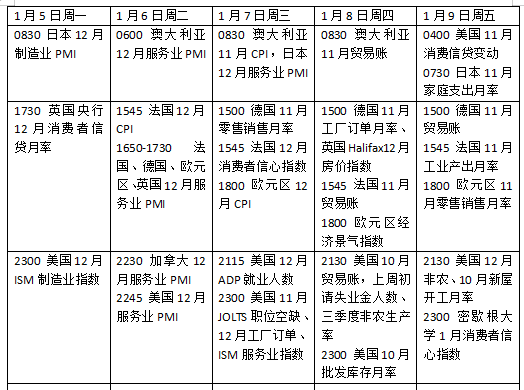
Market Overview - The US stock market experienced a decline, with the Dow Jones down 0.67%, Nasdaq down 1.52%, and S&P 500 down 1.03% for the week. In contrast, European indices saw gains, with the UK FTSE 100 up 0.86%, Germany's DAX 30 up 0.77%, and France's CAC 40 up 1.03% [1]. Economic Indicators - Upcoming US employment data and ISM manufacturing and services activity data will be critical for assessing the health of the US economy and the potential timing of the next Federal Reserve interest rate cut. The market anticipates an 85% probability that the Fed will maintain rates at the January 28 meeting, with expectations for a 25 basis point cut by June [2]. - The Eurozone inflation data will also be closely watched, with expectations that it will not alter the European Central Bank's current monetary policy stance [7]. Geopolitical Factors - Geopolitical tensions have escalated, particularly with the US military's actions against Venezuelan President Maduro, which may impact commodity markets [1][5]. - The upcoming CES 2026 in Las Vegas will feature major tech leaders and could influence the stability of the AI sector [3]. Commodity Markets - Oil prices saw a slight increase, with WTI crude up 1.02% to $57.32 per barrel and Brent crude up 0.85% to $60.75 per barrel. However, both benchmarks have experienced nearly a 20% decline in 2025, marking the largest annual drop since 2020 [4]. - The precious metals market faced significant volatility, with gold futures down 4.40% to $4,332.01 per ounce and silver futures down 7.93% to $70.55 per ounce due to profit-taking and increased margin requirements [5][6]. Upcoming Events - Key economic data releases are scheduled for the upcoming week, including Japan's manufacturing PMI, Australia's service PMI, and various US employment figures, which will provide insights into economic conditions [9].