
金融期货

Search documents
股指期货日度数据跟踪-20251127
Guang Da Qi Huo· 2025-11-27 05:07
股指期货日度数据跟踪 2025-11-27 一、指数走势 11 月 26 日,上证综指涨跌幅-0.15%,收于 3864.18 点,成交额 7010.2 亿元,深成指数涨跌幅 1.02%,收于 12907.83 点,成交额 10823.27 亿元。 中证 1000 指数涨跌幅-0.02%,成交额 3769.64 亿元,其中开盘价 7236.66,收盘价 7248.45,当日最高价 7307.2,最低价 7225.09; 中证 500 指数涨跌幅 0.15%,成交额 2748.58 亿元,其中开盘价 6946.08,收盘价 6965.05,当日最高价 7024.88,最低价 6936.88; 沪深 300 指数涨跌幅 0.61%,成交额 4273.61 亿元,其中开盘价 4490.2,收盘价 4517.63,当日最高价 4538.14,最低价 4485.7; 上证 50 指数涨跌幅 0.12%,成交额 972.58 亿元,其中开盘价 2969.78,收盘价 2971.8,当日最高价 2979.98,最低价 2968.02。 数据来源:Wind,光期研究所 数据来源:Wind,光期研究所 二、板块涨跌对指数影响 ...
综合晨报-20251125
Guo Tou Qi Huo· 2025-11-25 03:37
Group 1: Energy and Metals - International oil prices rebounded overnight, with the Brent 01 contract up 1.41%. The Russia-Ukraine geopolitical risk is entangled between sanctions and peace talks. There is a greater expectation of inventory accumulation in Q4 and Q1 next year, and the downward drive for oil prices remains [1]. - Precious metals rose overnight. With multiple Fed officials advocating a December rate cut, the implied probability of a rate cut in the interest rate market rose to 80%. The market is uncertain, and precious metals are oscillating at high levels [2]. - Copper prices oscillated overnight. The domestic spot market shows a certain bullish sentiment, and the SMM social inventory decreased by 1.39 million tons to 18.06 million tons [3]. - Shanghai aluminum fluctuated narrowly overnight. The inventory decreased, and the demand has resilience but lacks highlights. The price adjustment may continue, with support at around 21,100 yuan [4]. - Alumina supply is in an oversupply pattern, and it will mainly operate weakly before large-scale production cuts [5]. - Cast aluminum alloy continues to follow the aluminum price, and the spread with AL may narrow [6]. - Zinc prices found support at the 60 - day moving average. The LME zinc 0 - 3 month spot premium remains high. The rebound height of Shanghai zinc is limited, and it is expected to oscillate in the range of 22,200 - 23,000 yuan/ton [7]. - Lead prices are looking for support at the annual line. The export of lead - acid batteries is expected to remain under pressure. Shanghai lead is expected to oscillate in the range of 17,000 - 17,500 yuan/ton [8]. - Shanghai nickel rebounded, and the stainless - steel cost support continues to move down [9]. - Tin prices are mainly considered for short - selling, and call options can be used to hedge risks [10]. - Lithium carbonate futures prices oscillated sharply at high levels, and risk control should be prioritized [11]. - Polysilicon futures prices maintain an oscillating pattern due to weak supply and demand [12]. - Industrial silicon futures maintain an oscillating operation, and attention should be paid to the dynamics of silicone prices [13]. - Steel prices oscillated narrowly at night. Supply pressure is gradually easing, and demand is still weak. Steel prices are expected to oscillate in a range [14]. - Iron ore fundamentals are becoming more relaxed, and the price is expected to oscillate [15]. - Coke prices may oscillate weakly [16]. - Coking coal prices may oscillate weakly [17]. - Silicomanganese prices oscillated. The bottom support expectation has moved down [18]. - Ferrosilicon prices oscillated. The bottom support will be tested [19]. - The SCFIS European route index rose significantly. The 02 contract may maintain a discount, and the price of the 12 contract has limited up - and - down space [20]. - Both high - and low - sulfur fuel oils face pressure from abundant supply and weak demand [21]. - Asphalt prices are expected to oscillate weakly under pressure [22]. Group 2: Chemicals - Urea supply is sufficient, and the market may return to a stalemate [23]. - Methanol futures rose sharply. You can try to go long on the 5 - 9 spread at low prices, but beware of weak reality [24]. - Pure benzene continues the idea of short - selling on rebounds, and options can be considered for allocation [25]. - Styrene supply and demand are in a tight balance, but the sustainability of support is questionable, and the rebound height is limited [26]. - Polypropylene, polyethylene, and propylene prices have certain low - level support, but the supply pressure of polyethylene increases, and the demand of polypropylene and polyethylene is weak [27]. - PVC may follow the cost, and caustic soda runs weakly [28]. - PX is still strong before new capacity is put into production, and PTA is mainly driven by cost [29]. - Ethylene glycol prices have a short - term rebound expectation, but the rebound space is limited [30]. - Short - fiber prices fluctuate with raw materials, and bottle - chip prices are mainly driven by cost [31]. Group 3: Agricultural Products - Soybean meal futures rebounded. Pay attention to the impact of La Nina on South American soybean production and wait for the Sino - US trade agreement [35]. - Soybean oil and palm oil prices are expected to oscillate in a range. Palm oil supply is increasing while demand is weak [36]. - Rapeseed meal and rapeseed oil prices are supported by supply shortages. It is recommended to wait and see in the short term [37]. - Domestic soybeans rebounded strongly. Pay attention to the spot market and policy guidance [38]. - Corn futures oscillated at a high level. There are still differences in the new - season corn output. Pay attention to the sales progress of new corn in the Northeast [39]. - Live hog futures had a large increase in the far - month contract. The price may have a second bottoming next year [40]. - Egg prices: Pay attention to the spot price performance and the convergence of the basis [41]. - Cotton prices are expected to oscillate in a range. It is recommended to wait and see [42]. - Sugar prices: International supply is sufficient, and domestic production expectations are good. Pay attention to production progress [43]. - Apple prices oscillated at a high level. Pay attention to the inventory reduction situation [44]. - Wood prices oscillated. Low inventory supports prices, and it is recommended to wait and see [45]. - Pulp prices fell slightly. Supply is loose, demand is weak, and it is recommended to wait and see [46]. Group 4: Financial Instruments - A - shares rose in a narrow range with shrinking volume. The short - term macro - liquidity uncertainty restricts the market. It is recommended to wait and see [47]. - Treasury bond futures oscillated upward. The yield curve may flatten slightly, but there may be phased adjustments [48].
外汇期货周度报告:非农数据超预期,美元短期回升-20251123
Dong Zheng Qi Huo· 2025-11-23 10:11
1. Report Industry Investment Rating - The rating for the US dollar is "oscillating" [5] 2. Core View of the Report - The release of the September non - farm payroll data in the US after the government ended the shutdown showed that the job market continued to cool but without significant deterioration. The data did not strengthen the Fed's rate - cut expectation, and the stock market was significantly suppressed. The Fed's stance on a December rate cut is uncertain, and the market's expectation of liquidity tightening has changed, with the probability of a December rate cut exceeding 50% [2][33] 3. Summary by Directory 3.1 Global Market Overview This Week - Market risk appetite declined, most stocks fell, bond yields mostly decreased, and the US bond yield dropped to 4.06%. The US dollar index rose 0.89% to 100.2, non - US currencies depreciated, gold fell 0.5% to $4065 per ounce, the VIX index rose to 23.4, and the spot commodity index declined, with Brent crude oil dropping 2.2% to $62.33 per barrel [1][5][9] 3.2 Market Trading Logic and Asset Performance 3.2.1 Stock Market - Global stock markets mostly declined, with significant drops in US and A - shares. The September non - farm payroll report did not strengthen the Fed's rate - cut expectation, and the Fed's internal differences intensified. The stock market was suppressed, and it is expected that the stock market will continue to oscillate weakly [10][11][13] 3.2.2 Bond Market - Global bond yields mostly declined, with the 10 - year US bond yield dropping to 4.06%. The decline was driven by the inflow of funds from the falling stock market. However, the Fed's hawkish stance limited the downward space of long - term bond yields. The domestic bond market in China oscillated weakly [14][17][20] 3.2.3 Foreign Exchange Market - The US dollar index rose 0.89% to 100.2, and all non - US currencies depreciated. The offshore RMB gained 0.08%, the euro fell 0.94%, the pound fell 0.55%, the yen fell 1.2%, and others also declined [23][24][26] 3.2.4 Commodity Market - Gold fell 0.5% to $4065 per ounce, and it is in an oscillating pattern with a risk of decline. Brent crude oil fell 2.2% to $62.33 per barrel, and the commodity spot index declined due to the weak supply - demand pattern of oil and the strong US dollar [27][29][32] 3.3 Hotspot Tracking - The September US non - farm payroll data exceeded expectations, with the number of new jobs being 119,000, higher than the expected 50,000. The unemployment rate rose to 4.4%, and the wage growth rate remained high at 3.8% year - on - year [2][31][33] 3.4 Next Week's Important Event Tips - Monday: US November Dallas Fed Business Activity Index - Tuesday: US September retail sales, PPI, housing price index; US November Conference Board Consumer Confidence Index - Wednesday: US weekly initial jobless claims, September durable goods orders and new home sales; US November Chicago PMI - Thursday: Eurozone November economic sentiment index; Fed releases the Beige Book; ECB October interest rate meeting minutes - Friday: France and Germany October CPI [35]
黄金早参|失业数据超预期,12月降息升温,金价震荡加剧
Mei Ri Jing Ji Xin Wen· 2025-11-21 02:14
Core Viewpoint - Gold prices experienced significant fluctuations, reaching $4,100 during the day but ultimately closing at $4,076.7 per ounce, reflecting market reactions to a strong dollar and tempered expectations for interest rate cuts by the Federal Reserve [1] Group 1: Market Reactions - Gold prices dropped by 0.15% to close at $4,076.7 per ounce on the COMEX [1] - The China Gold ETF (518850) fell by 0.53%, while the Gold Stock ETF (159562) decreased by 0.76% [1] Group 2: Employment Data - The U.S. added 119,000 jobs in September, significantly exceeding expectations [1] - The unemployment rate unexpectedly rose to 4.4%, the highest level since October 2021 [1] - Initial jobless claims decreased by 8,000 to 220,000, while continuing claims reached a four-year high [1] Group 3: Federal Reserve Insights - The October meeting minutes of the Federal Reserve revealed significant divisions among members, with a lack of guiding data contributing to this discord [1] - The U.S. Bureau of Labor Statistics will not release the October non-farm payroll report, incorporating the data into the November report set for release on December 16, after the Fed's final meeting of the year [1] - Market expectations for a rate cut in December have diminished, with only a 27% probability priced in, which has negatively impacted precious metals [1]
光大期货金融期货日报-20251119
Guang Da Qi Huo· 2025-11-19 05:15
Report Industry Investment Rating - The investment rating for stock index futures is "sideways", and for government bond futures is "relatively strong" [1] Core Viewpoints - The A-share market oscillated and closed lower yesterday, with TMT performing well and coal and power equipment sectors correcting. The overall market is expected to be range - bound in the short term as the liquidity-driven market since June ended and the focus returns to fundamentals. Traditional economic sectors are in a slow recovery, and overseas tech stocks also face expectation divergence [1]. - Government bond futures closed higher yesterday. The central bank's actions and economic expectations have a positive impact on the bond market, but the "stock - bond seesaw" effect causes some disturbances. The bond market is expected to continue its oscillating pattern [1][2] Summary by Directory 1. Research Views Stock Index Futures - Yesterday, the A - share market closed down with Wind All - A dropping 0.93% and a trading volume of 1.95 trillion yuan. The CSI 1000, CSI 500, SSE 50, and CSI 300 indices all declined. New - quality productivity themes led by AI have optimistic growth expectations, especially in the upstream hardware manufacturing of the tech sector, but they lack catalysts and have entered a sideways trend since November. Traditional economic sectors are in a slow recovery and are unlikely to enter a fundamental bull market in the short term. Overseas tech stocks also face expectation divergence [1]. Government Bond Futures - Yesterday, government bond futures closed higher, with the 30 - year, 10 - year, 5 - year, and 2 - year main contracts rising. The central bank conducted 4075 billion yuan of 7 - day reverse repurchases, with a net injection of 37 billion yuan. DR001 rose 2BP to 1.53%, and DR007 remained flat at 1.52%. The central bank's actions strengthen the expectation of reasonable and sufficient funds, which is positive for the bond market. However, the "stock - bond seesaw" effect causes some disturbances, and the bond market is expected to oscillate [1][2] 2. Daily Price Changes Stock Index Futures - On November 18, 2025, IH dropped 0.39% to 2,997.6, IF dropped 0.58% to 4,555.0, IC dropped 0.89% to 7,079.8, and IM dropped 0.58% to 7,351.8 compared to November 17 [3]. Stock Indices - The SSE 50 dropped 0.30% to 3,003.0, the CSI 300 dropped 0.65% to 4,568.2, the CSI 500 dropped 1.17% to 7,151.0, and the CSI 1000 dropped 1.00% to 7,448.1 on November 18, 2025, compared to November 17 [3]. Government Bond Futures - On November 18, 2025, TS rose 0.01% to 102.49, TF rose 0.01% to 105.92, T rose 0.01% to 108.50, and TL rose 0.07% to 116.53 compared to November 17 [3] 3. Market News - As of the week ending October 18, the number of initial jobless claims in the US was 232,000, and the number of continuing jobless claims was 1,957,000, up from 1,947,000 the previous week. The US Federal government shutdown led to a lack of regular weekly data [4]. - China's Foreign Ministry held consultations with Japan's officials. China sternly protested against Japanese Prime Minister Kaochi Sanae's wrong remarks on China, urging Japan to retract the remarks and stop causing trouble on China - related issues [4] 4. Chart Analysis Stock Index Futures - The report provides charts of the trends of IH, IF, IM, IC main contracts, and their respective basis trends [6][7][9] Government Bond Futures - The report includes charts of the trends of government bond futures main contracts, bond yields, basis, inter - period spreads, cross - variety spreads, and fund rates [13][14][19] Exchange Rates - The report presents charts of the central parity rates of the US dollar, euro against the RMB, forward exchange rates, the US dollar index, and exchange rates between major currencies [22][23][26]
多元金融板块11月14日跌0.22%,瑞达期货领跌,主力资金净流入1008.41万元
Zheng Xing Xing Ye Ri Bao· 2025-11-14 08:58
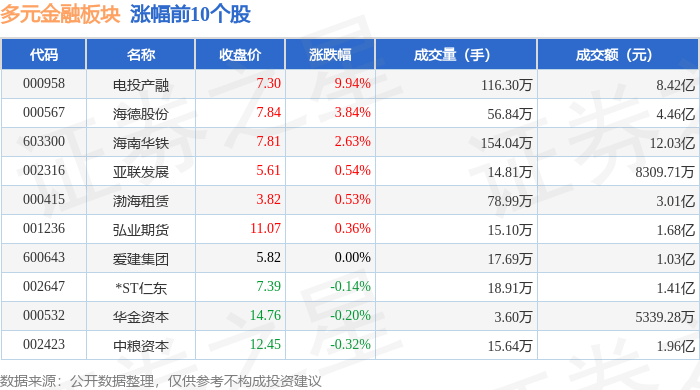
证券之星消息,11月14日多元金融板块较上一交易日下跌0.22%,瑞达期货领跌。当日上证指数报收于 3990.49,下跌0.97%。深证成指报收于13216.03,下跌1.93%。多元金融板块个股涨跌见下表: 从资金流向上来看,当日多元金融板块主力资金净流入1008.41万元,游资资金净流出8657.8万元,散户 资金净流入7649.4万元。多元金融板块个股资金流向见下表: | 代码 | 名称 | 主力净流入(元) | 主力净占比 游资净流入 (元) | | 游资净占比 散户净流入 (元) | | 散户净占比 | | --- | --- | --- | --- | --- | --- | --- | --- | | 000958 | 电投产融 | 2.70 Z | 32.10% | -1.32 Z | -15.73% | -1.38 Z | -16.37% | | 603300 | 海南华铁 | 8595.07万 | 7.14% | 1295.77万 | 1.08% | -9890.84万 | -8.22% | | 000415 | 渤海租赁 | 3471.63万 | 11.53% | -2990.74万 | ...


多元金融板块11月13日涨0.92%,瑞达期货领涨,主力资金净流入589.43万元
Zheng Xing Xing Ye Ri Bao· 2025-11-13 08:45
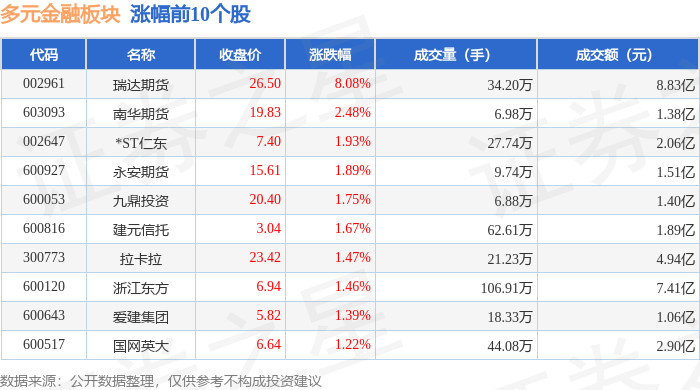
证券之星消息,11月13日多元金融板块较上一交易日上涨0.92%,瑞达期货领涨。当日上证指数报收于 4029.5,上涨0.73%。深证成指报收于13476.52,上涨1.78%。多元金融板块个股涨跌见下表: | 代码 | 名称 | 收盘价 | 涨跌幅 | 成交量(手) | 成交额(元) | | --- | --- | --- | --- | --- | --- | | 002961 | 瑞达期货 | 26.50 | 8.08% | 34.20万 | 8.83亿 | | 603093 | 南大朗器 | 19.83 | 2.48% | 6.98万 | · 1.38亿 | | 002647 | *ST仁东 | 7.40 | 1.93% | 27.74万 | 2.06亿 | | 600927 | 永安期货 | 15.61 | 1.89% | 9.74万 | 1.51亿 | | 600053 | 九鼎投资 | 20.40 | 1.75% | 6.88万 | 1.40亿 | | 600816 | 建元信托 | 3.04 | 1.67% | 62.61万 | 1.89亿 | | 300773 | 拉卡拉 | 23.42 | ...
股指期货日度数据跟踪2025-11-12-20251112
Guang Da Qi Huo· 2025-11-12 05:57
Report Summary 1. Report Industry Investment Rating No industry investment rating is provided in the report. 2. Core Viewpoints The report presents a daily data tracking of stock index futures on November 11, 2025, including the performance of major stock indices, the impact of sector movements on these indices, the basis and annualized opening costs of stock index futures, and the points difference in futures contract roll - over and its annualized costs. 3. Summary by Directory Index Trends - On November 11, the Shanghai Composite Index fell 0.39% to close at 4002.76 points, with a trading volume of 858.362 billion yuan; the Shenzhen Component Index fell 1.03% to 13289.0 points, with a trading volume of 1135.224 billion yuan [1]. - The CSI 1000 Index fell 0.3% with a trading volume of 404.867 billion yuan; the CSI 500 Index fell 0.71% with a trading volume of 338.598 billion yuan; the SSE 50 Index fell 0.63% with a trading volume of 118.061 billion yuan; the CSI 300 Index fell 0.91% with a trading volume of 477.629 billion yuan [1]. Impact of Sector Movements on Indices - The CSI 1000 dropped 22.46 points. Sectors such as power equipment and basic chemicals had a positive impact, while household appliances, computer, and electronics had a negative impact [2]. - The CSI 500 dropped 52.19 points, with computer and electronics sectors pulling the index down [2]. - The CSI 300 dropped 42.88 points, affected negatively by non - bank finance, communication, and electronics sectors [2]. - The SSE 50 dropped 19.23 points. The banking sector had a positive impact, while non - bank finance, non - ferrous metals, and electronics had a negative impact [2]. Stock Index Futures Basis and Annualized Opening Costs - For IM contracts, IM00 had an average daily basis of - 55.58, IM01 of - 140.81, IM02 of - 363.76, and IM03 of - 586.08 [13]. - For IC contracts, IC00 had an average daily basis of - 43.5, IC01 of - 109.76, IC02 of - 283.12, and IC03 of - 476.92 [13]. - For IF contracts, IF00 had an average daily basis of - 10.23, IF01 of - 25.19, IF02 of - 53.14, and IF03 of - 95.85 [13]. - For IH contracts, IH00 had an average daily basis of - 1.09, IH01 of - 3.3, IH02 of - 5.94, and IH03 of - 12.74 [13]. Stock Index Futures Contract Roll - over Points Difference and Annualized Costs - Data on the roll - over points difference and its annualized costs for IM, IC, IF, and IH contracts are presented in the form of 15 - minute average values and corresponding annualized cost graphs [22][23][24].
股指期货日度数据跟踪-20251111
Guang Da Qi Huo· 2025-11-11 05:11
1. Index Trends - On November 10, the Shanghai Composite Index rose 0.53% to close at 4018.6 points, with a trading volume of 960.589 billion yuan; the Shenzhen Component Index rose 0.18% to close at 13427.61 points, with a trading volume of 1213.865 billion yuan [1]. - The CSI 1000 Index rose 0.28%, with a trading volume of 433.798 billion yuan. Its opening price was 7568.75, closing price was 7563.25, the highest price was 7592.76, and the lowest price was 7515.68 [1]. - The CSI 500 Index rose 0.22%, with a trading volume of 371.311 billion yuan. Its opening price was 7357.34, closing price was 7343.8, the highest price was 7384.79, and the lowest price was 7289.77 [1]. - The SSE 300 Index rose 0.35%, with a trading volume of 593.977 billion yuan. Its opening price was 4688.12, closing price was 4695.05, the highest price was 4695.18, and the lowest price was 4654.21 [1]. - The SSE 50 Index rose 0.51%, with a trading volume of 139.907 billion yuan. Its opening price was 3043.51, closing price was 3053.86, the highest price was 3054.55, and the lowest price was 3030.23 [1]. 2. Impact of Sector Movements on Indexes - The CSI 1000 rose 21.37 points from the previous closing price. Sectors such as household appliances, pharmaceuticals and biotech, and basic chemicals significantly pulled the index up, while sectors like machinery, automobiles, and power equipment pulled it down [2]. - The CSI 500 rose 15.89 points from the previous closing price. Sectors such as pharmaceuticals and biotech, non - bank finance, and non - ferrous metals significantly pulled the index up, while sectors like machinery, electronics, and power equipment pulled it down [2]. - The SSE 300 rose 16.26 points from the previous closing price. Sectors such as food and beverage, non - bank finance, and banks significantly pulled the index up, while sectors like machinery, power equipment, and electronics pulled it down [2]. - The SSE 50 rose 15.51 points from the previous closing price. Sectors such as food and beverage, non - bank finance, and banks significantly pulled the index up, while sectors like machinery and electronics pulled it down [2]. 3. Stock Index Futures Basis and Annualized Opening Costs - For IM contracts, IM00 had an average daily basis of - 57.03, IM01 had - 142.23, IM02 had - 361.89, and IM03 had - 580.67 [12]. - For IC contracts, IC00 had an average daily basis of - 43.2, IC01 had - 107.51, IC02 had - 277.1, and IC03 had - 467.73 [12]. - For IF contracts, IF00 had an average daily basis of - 9.52, IF01 had - 25.0, IF02 had - 54.69, and IF03 had - 98.5 [12]. - For IH contracts, IH00 had an average daily basis of - 0.02, IH01 had - 1.49, IH02 had - 5.36, and IH03 had - 11.46 [12]. 4. Stock Index Futures Roll - over Point Differences and Annualized Costs - Data on IM, IC, IF, and IH roll - over point differences and their annualized costs are presented in the report, including detailed values at different time points [20][21][22]
综合晨报-20251111
Guo Tou Qi Huo· 2025-11-11 02:49
Report Industry Investment Ratings No relevant content provided. Core Views of the Report - The crude oil market has short - term support, but there are still supply - demand surplus pressures in Q4 and Q1 of next year. Consider short - side strategies after the oil price rebounds again [2]. - Precious metals may continue to build a high - level shock platform due to the lack of strong drivers [3]. - The upward momentum of the copper market in the short - term is decreasing. Consider buying put at - the - money/one - strike out - of - the - money options and selling call options with an execution price of 90,000 to reduce costs [4]. - The aluminum market is mainly driven by macro sentiment, with limited fundamental resonance. Be vigilant of capital turning [5]. - Other commodities such as zinc, lead, nickel, tin, etc. also have their own market characteristics and investment suggestions based on supply - demand, inventory, and other factors [8][9][10]. Summary by Catalog Energy Commodities - **Crude Oil**: OPEC+ suspending production increase in Q1 of next year boosts market confidence. US government shutdown negotiation progress and geopolitical factors also affect the market. There is short - term support, but supply - demand surplus pressure remains [2]. - **Fuel Oil & Low - Sulfur Fuel Oil**: High - sulfur fuel oil supply tends to be loose, while low - sulfur fuel oil has short - term positive sentiment but weak medium - term upward support [22]. - **Asphalt**: Demand is weaker than expected, and social inventory has turned from lower to higher year - on - year. The market is bearish, and the price continues to decline [23]. - **Liquefied Petroleum Gas (LPG)**: Fundamental conditions have improved marginally, providing support for the LPG price [24]. Metal Commodities - **Precious Metals**: Temporarily lack strong drivers and may continue high - level shock [3]. - **Base Metals**: - **Copper**: The upward momentum is decreasing, and inventory has decreased. Consider short - term trading strategies [4]. - **Aluminum**: Narrow - range fluctuation, with macro - led strong sentiment and limited fundamental resonance [5]. - **Zinc**: The export window is open, and low inventory supports the external market. The domestic market is expected to follow the external market to rise [8]. - **Lead**: High - level shock, with the far - month contract's center of gravity expected to move up [9]. - **Nickel & Stainless Steel**: The nickel market is weak, and the stainless - steel market is sluggish [10]. - **Tin**: Supply is constrained, but demand is weak. Consider short - selling in the medium - to - long - term [11]. - **Alumina**: Supply surplus persists, and the price is weak with limited rebound space [7]. - **Cast Aluminum Alloy**: Follows the aluminum price and has no independent market for now [6]. Chemical Commodities - **Carbonate Lithium**: The price has risen significantly, and the market sentiment has improved. It is expected to be strong in the short - term [12]. - **Industrial Silicon**: The supply is expected to shrink more than demand, and the inventory may decrease. The futures price is expected to be strong in the short - term [13]. - **Polysilicon**: The price will continue to fluctuate due to the synchronous contraction of supply and demand [14]. - **Urea**: The upward momentum is insufficient, and the market will continue to fluctuate within a range with a slightly upward price center [25]. - **Methanol**: It may continue to be weak in the short - term, but is easily affected by positive news due to low valuation [26]. - **Pure Benzene**: The price is in a narrow - range shock at a low level. Pay attention to the port inventory build - up rhythm [27]. - **Styrene**: The supply - demand balance is tight, but the market is worried about the long - term situation, and the price is under pressure [28]. - **Polypropylene, Plastic & Propylene**: The demand has improved temporarily, but the overall supply is loose, and the price is under pressure [29]. - **PVC & Caustic Soda**: PVC has high supply and weak demand, and may run at a low level. Caustic soda is in a weak operation [30]. - **PX & PTA**: PX supply has recovered, and PTA has improved slightly. There is uncertainty in the short - to - medium - term, so it is advisable to wait and see [31]. - **Ethylene Glycol**: The supply growth pressure is large, and the demand is expected to weaken in the medium - term. Adopt a bearish view [32]. - **Short - Fiber & Bottle - Chip**: Short - fiber has a good spot pattern but is affected by raw material price increases. Bottle - chip demand is weakening [33]. Building Materials Commodities - **Glass**: The price is falling, and the cost has increased. The profit has narrowed, and the daily melting has decreased. Pay attention to the end - of - year rush - work situation [34]. - **Soda Ash**: The price is in a strong shock in the short - term, but a short - selling strategy is recommended in the long - term due to high supply pressure [36]. Agricultural Commodities - **Soybean & Soybean Meal**: Soybean supply is basically sufficient in Q4, and there may be inventory reduction in Q1 of next year. Pay attention to long - buying opportunities after Sino - US trade eases [37]. - **Soybean Oil & Palm Oil**: Soybean oil is stronger than palm oil. Palm oil has high - inventory pressure in the short - term [38]. - **Rapeseed Meal & Rapeseed Oil**: The demand for rapeseed meal is expected to be poor. Adopt a wait - and - see strategy for domestic rapeseed products [39]. - **Soybean No.1**: The price is in a high - level shock. Pay attention to domestic soybean policies and market sentiment [40]. - **Corn**: The futures price is rebounding at the bottom, but the supply is still loose in the future [41]. - **Pork**: The price may have a seasonal rebound in the short - term, but there is a high probability of a second bottom - probing in H1 of next year [42]. - **Egg**: Try short - selling at high prices and observe the spot market [43]. - **Cotton**: The US cotton price has risen. The Zhengzhou cotton price is in a shock. Pay attention to the US cotton export data [44]. - **Sugar**: The international sugar supply is sufficient, and pay attention to the sugar production forecast in Guangxi for the new season [45]. - **Apple**: The price is in a wide - range shock. Adopt a bearish strategy due to inventory concerns [46]. - **Timber**: The price is in a weak operation. Low inventory provides support, and adopt a wait - and - see strategy [47]. - **Pulp**: The price has risen. The inventory has decreased, and the valuation is low. Consider buying at low prices [48]. Financial Futures - **Stock Index**: A - share indexes are differentiated, and futures contracts have all risen. Pay attention to the RMB exchange rate and domestic policies [49]. - **Treasury Bond**: The futures price is rising in a shock. The yield curve steepening may come to an end [50].