农产品

Search documents
外媒爆料:中国在加下大单
Xin Lang Cai Jing· 2026-01-27 16:55
Core Viewpoint - Chinese importers have finalized agreements to purchase up to 10 ships of Canadian canola, which will help alleviate market supply tensions [2] Group 1: Trade Agreements - During Canadian Prime Minister Mark Carney's visit to China, a preliminary trade agreement was reached where China will lower tariffs on Canadian canola, while Canada will reduce tariffs on Chinese electric vehicles [2] - The canola shipment is expected to occur between February and April, with each ship carrying approximately 65,000 tons, totaling around 650,000 tons, which represents over 10% of China's total canola imports for 2024 [2] Group 2: Market Impact - The ease of importing Canadian canola into the Chinese market has been noted, with crushing companies already pre-booking these shipments [2] - Canola, also known as rapeseed, is processed to produce edible oil, and the remaining high-protein meal is widely used as livestock feed [2] Group 3: Government Statements - The Chinese Ministry of Commerce indicated that it will fully consider Canada's reasonable requests within the framework of rules and will make final decisions based on facts and evidence regarding the canola trade agreement [2]


敢和中国合作就毁灭?美咬死加拿大,加征100%关税,中方把话说透
Sou Hu Cai Jing· 2026-01-27 15:14
Core Viewpoint - The relationship between the United States and Canada has soured, with President Trump threatening to impose a 100% tariff on Canadian goods if Canada reaches a trade agreement with China, reflecting a strategy to pressure Canada into abandoning its cooperation with China [1][8][12]. Group 1: U.S.-Canada Relations - Trump's threats are seen as an attempt to assert U.S. dominance over Canada, which has historically relied heavily on the U.S. economy [5][12]. - The U.S. imports significant amounts of oil from Canada and relies on Canadian automotive parts, indicating a deep economic interdependence [12][14]. - Trump's rhetoric includes calling Canada a "state" of the U.S., emphasizing his view that Canada should not engage independently with China [8][10]. Group 2: Canada's Response - Canadian Prime Minister Trudeau responded calmly to Trump's threats, promoting a "buy Canadian" campaign without directly confronting the U.S. [17][19]. - Trudeau's approach signals a commitment to diversifying Canada's trade partnerships and reducing reliance on the U.S. market [21][23]. - The Canadian government has been actively seeking new trade partners, as evidenced by Trudeau's recent visits to China and Qatar [23][25]. Group 3: China-Canada Relations - Canada and China signed a trade cooperation roadmap earlier this year, which has angered the U.S. [3][34]. - China's stance emphasizes mutual benefit and cooperation, rejecting the notion that its relationship with Canada is a threat to the U.S. [34][36]. - The trade relationship between China and Canada is characterized by mutual advantages, with Canada exporting agricultural products to China and importing Chinese goods [38][40]. Group 4: Global Implications - The escalating tensions between the U.S. and Canada, influenced by China's involvement, have drawn global attention [32][44]. - The article suggests that the U.S. is struggling to maintain its hegemonic position as more countries seek independent trade relationships [42][46]. - The narrative indicates a shift towards a multipolar world where countries are increasingly choosing their own paths for economic cooperation [42][48].

油粕日报:美国 45Z 生物燃料政策加快落地-20260127
Guan Tong Qi Huo· 2026-01-27 10:01
【冠通期货研究报告】 油粕日报:美国 45Z 生物燃料政策加快落地 发布日期:2026 年 1 月 27 日 豆粕:AgRural 公司:截至上周四,巴西 2025/26 年度大豆收割进度已达种 植面积的 4.9%。将巴西 2025/26 年度大豆产量预期上调至 1.81 亿吨,此前预估 为 1.804 亿吨。主要作物产量预期继续小幅上调,若后期天气配合,全球谷物与 油籽供应前景将更为宽松。初期收割与种植进度符合季节性规律,未来市场关注 点将转向单产确认及产区天气变化。USDA 出口检验:截至 2026 年 1 月 22 日的 一周,美国大豆出口检验量为 1,324,408 吨,去年同期为 738,028 吨。2025/26 年度迄今美国大豆出口检验总量达到 20,668,363 吨,同比减少 37.5%。2025/26 年度迄今美国大豆出口达到全年出口目标的 48.2%。 据 Mysteel 对国内主要油厂调查数据显示:2026 年第 4 周,全国主要油厂 大豆库存下降,豆粕库存下降,未执行合同下降。 其中大豆库存 658.99 万吨, 较上周减少 28.34 万吨,减幅 4.12%,同比去年增加 207. ...
银河期货苹果日报-20260127
Yin He Qi Huo· 2026-01-27 09:44
Group 1: Report Overview - The report is an apple daily report in the agricultural product research report, dated January 27, 2024 [1] Group 2: Market Information Spot Prices - The Fuji apple price index was 108.44, down 0.09 from the previous trading day. The average wholesale price of 6 kinds of fruits was 7.84, down 0.04 [2] - The price of Qixia first and second - grade paper - bagged 80 apples was 4.00, down 0.10; the price of Penglai first and second - grade paper - bagged 80 apples was 4.10, down 0.15; the price of Luochuan semi - commercial paper - bagged 70 apples was 4.20, unchanged; the price of Yiyuan paper - bagged 70 apples was 2.50, unchanged [2] Futures Prices - AP01 was 8239, up 23 from the previous close; AP05 was 9466, down 69; AP10 was 8330, down 14 [2] - The spread AP01 - AP05 was - 1227, up 92; AP05 - AP10 was 1136, down 55; AP10 - AP01 was 91, down 37 [2] Other Price Differences - The difference between Qixia first and second - grade 80 apples and AP01 was - 239, down 223; the difference between Qixia first and second - grade 80 apples and AP10 was - 330.0, down 186; the difference between Qixia first and second - grade 80 apples and AP05 was - 1466, down 131 [2] Group 3: Market News and Views Apple Market News - As of January 21, 2026, the apple cold - storage inventory in the main producing areas of China was 682.78 million tons, a decrease of 21.88 million tons from the previous week. The inventory removal speed continued to accelerate but was lower than the same period last year [7] - In December 2025, the export volume of fresh apples was about 15.65 million tons, a month - on - month increase of 28.63% and a year - on - year increase of 26.76%. The import volume was 0.31 million tons, a month - on - month increase of 21.31% and a year - on - year increase of 20.02%. The cumulative import volume in 2025 was 11.68 million tons, a year - on - year increase of 19.72% [7] - On January 26, the mainstream price of apples in the producing areas was stable. During the weekend, the number of traders packing and shipping in the cold storage in the producing areas increased significantly, and the enthusiasm for Spring Festival stocking increased [7] - In Shandong, the price of high - quality late - maturing paper - bagged Fuji apples in stock was stable. In Qixia, the mainstream price of 80 and above first, second, and third - grade fruit was 3.0 - 3.5 yuan per catty. In Shaanxi, the mainstream price was stable. In Luochuan, the mainstream price of 70 and above semi - commercial fruit was 3.8 - 4.2 yuan per catty, and high - quality fruit was 4.5 - 5.0 yuan per catty [7] Trading Logic - This year, the apple cold - storage inventory is low and the quality is poor. The pre - Spring Festival stocking enthusiasm has increased recently, and the inventory removal speed has accelerated. The apple cold - storage inventory cost is high, about 9700 - 10000 yuan per ton. Considering the low inventory, high downstream stocking enthusiasm, and high inventory cost, the overall trend of the apple May contract is expected to be strong [5] Trading Strategies - For the single - side strategy, hold the long position of the May contract and short the October contract on rallies [8] - For the arbitrage strategy, go long on the May contract and short the October contract [8] - For the options strategy, it is recommended to wait and see [8] Group 4: Related Attachments - The report includes 10 figures, such as the price of Qixia first and second - grade paper - bagged 80 apples, the price of Luochuan semi - commercial paper - bagged 70 apples, AP contract basis, spreads between different AP contracts, apple arrival volume in wholesale markets, 6 - fruit average price, national cold - storage apple inventory, and national cold - storage apple delivery volume [10][13][20][22][25]
SGS:预计马来西亚1月1-25日棕榈油出口量为746745吨
Xin Hua Cai Jing· 2026-01-27 08:14
(文章来源:新华财经) 据船运调查机构SGS公布数据显示,预计马来西亚1月1-25日棕榈油出口量为746745吨,较上月同期出 口的824276吨减少9.41%。 ...
2025年滨州粮油副食类价格稳定,蔬菜价格上涨,猪肉和鸡蛋价格下降
Zhong Guo Fa Zhan Wang· 2026-01-27 07:53
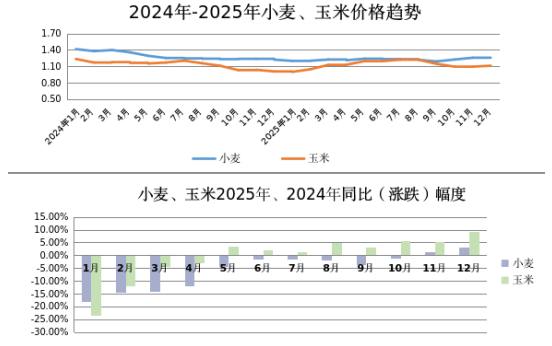
Core Insights - The average price of 60 essential consumer goods in Binzhou, Shandong Province is projected to be 12.19 yuan per jin in 2025, a decrease of 2.63% compared to the previous year [1] - Prices for grains and aquatic products remain stable, while beef and vegetable prices have increased, and prices for raw grains, pork, lamb, eggs, and fruits have decreased [1] Grain Prices - The average price of wheat for the year is expected to be 1.22 yuan per jin, down 5.51% from 2024, with a slight increase in the fourth quarter [2] - The average price of corn is projected to be 1.13 yuan per jin, remaining stable compared to 2024, with seasonal fluctuations throughout the year [2] Oil and Rice Prices - Prices for flour and rice have remained stable, with special flour at 2.38 yuan per jin and standard flour at 2.05 yuan per jin, while peanut oil and soybean oil have decreased by approximately 6% [3] Pork and Beef Prices - The average purchase price of live pigs is 7.03 yuan per jin, down 16.96% from 2024, and pork prices average 15.21 yuan per jin, a decrease of 5.35% [6] - Fresh beef prices have increased to an average of 31.42 yuan per jin, up 22.16% from the previous year, influenced by previous supply reductions and tightening import policies [6] Lamb and Egg Prices - The average price of fresh lamb is 36.38 yuan per jin, down 10.55% year-on-year, with a price trend that initially declined before rising [7] - The average price of eggs is 3.65 yuan per jin, reflecting a significant decrease of 20.66% compared to last year, with a notable drop in the second half of the year [10] Vegetable and Fruit Prices - The average price of 22 types of vegetables is 3.31 yuan per jin, down 6.88% year-on-year, showing a "V" shaped trend influenced by reduced planting areas and adverse weather conditions [12] - The average price of five types of fruits is 3.42 yuan per jin, showing a slight decrease of 3.42% compared to last year, with mixed trends among different fruit types [13]
欧盟称印度将对其降低汽车、葡萄酒和农产品关税
Xin Lang Cai Jing· 2026-01-27 07:50
Core Points - India will significantly reduce tariffs on cars imported from the EU from 110% to as low as 10%, with an annual quota of 250,000 vehicles [2][1] - Tariffs on auto parts will be completely eliminated within five to ten years [3] - Tariffs on machinery (up to 44%), chemicals (22%), and pharmaceuticals (11%) will also be largely eliminated [4] - The agreement will remove tariffs on over 90% of EU goods [5] - A proposal for zero tariffs on EU steel products has been made [6] - High tariffs on EU agricultural products will be removed or reduced [7] - Wine tariffs will be reduced to 20%-30%, spirits to 40%, and beer to 50% [8] - Overall, this will save approximately €4 billion in tariffs for European products annually [9]
揭秘商品周期轮动密码:从贵金属-有色-化工-农产品,现在是到哪个阶段了?
对冲研投· 2026-01-27 07:49
Core Viewpoint - The article discusses the cyclical nature of commodity markets, highlighting the sequential rotation of different commodities as indicators of economic phases. It emphasizes that the current market signals suggest the beginning of a new commodity cycle, characterized by differentiation and rotation rather than a broad-based rally [1][13]. Group 1: Commodity Phases - The first phase of a commodity bull market typically features precious metals like gold and silver, which shine during economic uncertainty or stagflation, as seen since March 2024 with gold prices reaching $4000 per ounce [2][3]. - The second phase involves industrial metals, such as copper, which signal economic recovery as demand for raw materials increases when economic stimulus measures take effect. This phase began in November 2025 with rising copper prices [3][4]. - The third phase is marked by a surge in energy and chemical products, driven by overheating economies where demand for oil and related products spikes, often accompanied by inflationary pressures [4][5]. - The final phase sees agricultural products gaining traction, as their demand remains relatively stable regardless of economic conditions, often influenced by production costs and weather conditions [5][6]. Group 2: Current Market Analysis - Current market conditions indicate that gold has reached a historical high, signaling strong global demand for safe-haven assets and concerns about the traditional monetary system, marking a clear first phase signal [10]. - The strong performance of industrial metals suggests that market participants are pricing in expectations of economic recovery, with significant investments flowing into this sector [10][11]. - Energy and chemical products are still in a relatively low position, indicating that the global economy has not yet reached a stage of full operational capacity, suggesting that the third phase is still developing [10][11]. - Agricultural products are influenced more by specific supply and demand factors rather than broad economic trends, indicating that they are not yet in a position to lead the cycle [11][12]. Group 3: Macro Indicators - The dollar's decline since 2025 is noted as a favorable backdrop for commodity price increases, as historically, a weakening dollar correlates with rising commodity prices [12]. - The Baltic Dry Index (BDI) has shown signs of recovery since February 2025, which typically precedes a broader rise in commodity prices by 1-3 months, indicating increased global trade activity [12]. Group 4: Investment Strategy - The article suggests that the current market environment presents structural opportunities, particularly in precious metals and select industrial metals, which have clear investment logic supported by macro indicators [13][14]. - Energy and chemical sectors require patience as their comprehensive market movements depend on confirming signals of economic overheating, while agricultural investments should focus on specific supply narratives rather than broader trends [14].

两艘巨轮将抵华,中国运回黄金,赶在特朗普访华前中美互赠厚礼
Sou Hu Cai Jing· 2026-01-27 07:30
Group 1: U.S.-China Relations - The meeting between President Trump and Chinese leaders is scheduled for late October 2025, indicating efforts to stabilize relations ahead of the elections [1] - Both sides have engaged in multiple high-level communications focusing on trade and finance, avoiding sensitive topics [1][3] - Canada's Prime Minister's visit to China in January 2026 highlights international attention on U.S.-China relations [1] Group 2: Trade Developments - China purchased over 8 million tons of U.S. soybeans in November 2025, with shipments expected to arrive in January 2026, helping alleviate pressure on U.S. farmers [5] - The U.S. approved the export of Nvidia's H200 chips to China with conditions, including third-party audits and sales limits [5][9] - U.S. soybean exports reached 12 million tons, while China's gold purchases attracted more countries, indicating a recovery in trade relations [11] Group 3: Economic Strategies - China's gold reserves increased to 7.415 million ounces by the end of December 2025, reflecting a strategy to enhance risk resilience [7] - The U.S. Department of Commerce adjusted its review process for certain products, allowing for more flexibility in trade [7] - The ongoing trade truce has led to a 30% reduction in U.S. farmers' inventory, while stabilizing prices in China [11] Group 4: Future Outlook - The potential for Trump's timely visit to China remains a focal point for international observers [13] - The normalization of soybean procurement presents new opportunities for U.S.-China economic relations [13] - The scale of H200 chip exports remains uncertain, but strong internal dynamics could expand future cooperation [13]