机械

Search documents
6年损失近万亿欧元,德国反思竞争力:解决结构性缺陷,反对“筑贸易壁垒”
Huan Qiu Shi Bao· 2026-02-09 22:53
【环球时报驻德国特约记者 青木】接连不断的危机令德国经济付出沉重代价,敦促这一欧洲最大经济 体尽快找到破局之法。德新社8日援引德国经济研究所(IW)的估算数据报道称,自2020年以来,疫 情、俄乌冲突、关税争端等危机给德国造成的经济损失已累计近1万亿欧元。虽然德国经济在2025年微 弱增长约0.2%,结束了此前连续两年的衰退,但出口前景不明、劳动力市场停滞以及投资环境未改善 等问题为经济复苏蒙上阴影。在国际经贸格局愈发复杂的背景下,德国经济和能源部长赖歇上周六对欧 盟引导公共采购偏向欧洲企业的计划提出反对,警告竞争力无法通过孤立手段建立。 1/4 由关税政策导致 IW的估算数据显示,自2020年以来的6年间,德国经价格调整后的国内生产总值(GDP)因为各种危机 损失高达9400亿欧元。仅在新冠疫情暴发的第一年,即2020年,德国的产值损失就达约1850亿欧元。 从2022年开始,俄乌冲突带来的能源价格冲击和持续高企的地缘政治不确定性严重拖累德国经济增长, 2022年经济损失约为850亿欧元。随后两年间,德国经济产值分别减少约1400亿欧元和2000亿欧元。 值得注意的是,近万亿损失的1/4归因于过去一年。在德 ...
专访田轩:A股三大主线浮现 如何“擒牛”又“防坑”?
2 1 Shi Ji Jing Ji Bao Dao· 2026-02-09 11:16
Group 1 - The core consensus in the A-share market includes the recovery of cyclical sectors, rapid development of new productive forces, and the increased value of low-valuation high-dividend asset allocation [1] - Cyclical sectors such as non-ferrous metals and chemicals, as well as midstream manufacturing sectors like machinery and building materials, benefit from supply-demand restructuring and policy support, becoming the main line for capital allocation [1] - Hard technology fields like semiconductors, high-end manufacturing, and AI computing power are recognized as long-term growth engines for new productive forces, continuously attracting market interest [1] Group 2 - Low-valuation high-dividend assets are gaining attention due to dual support from policies and capital, with long-term funds accelerating entry into the market since early 2026, reinforcing their valuation support [1] - Investors are advised to rationally assess the sustainability of profits in cyclical sectors, the warming demand trend, the timeliness of policy implementation, and industry prosperity turning points to avoid simplistic extrapolation of short-term data into long-term trends [2] - Within the new productive forces sector, significant differentiation exists, necessitating careful identification of companies' technological breakthroughs and commercialization capabilities, while being cautious of the disconnect between speculative concepts and performance realization [2]
周期板块景气预期开启扩张
GOLDEN SUN SECURITIES· 2026-02-09 09:01
Quantitative Models and Construction Methods 1. Model Name: Industry Mainline Model (Relative Strength Index, RSI) - **Model Construction Idea**: This model identifies leading industries by calculating their relative strength (RS) based on historical price performance. Industries with RS > 90% are considered potential market leaders [13] - **Model Construction Process**: 1. Use 31 first-level industry indices as the configuration targets [13] 2. Calculate the price change percentages over the past 20, 40, and 60 trading days for each industry [13] 3. Rank the industries based on their price changes for each period and normalize the rankings to obtain RS_20, RS_40, and RS_60 [13] 4. Compute the average of the three rankings to derive the final RS index: $ RS = (RS_{20} + RS_{40} + RS_{60}) / 3 $ [13] 5. Industries with RS > 90% before the end of April are identified as potential leaders for the year [13] - **Model Evaluation**: The model effectively identified leading industries in 2024, such as coal, utilities, home appliances, banks, oil and gas, telecommunications, non-ferrous metals, agriculture, and automobiles. These industries aligned with the market's main themes, including high dividends, resources, exports, and AI [13] 2. Model Name: Industry Sentiment-Trend-Crowding Framework - **Model Construction Idea**: This framework provides two right-side industry rotation strategies based on market sentiment, trend, and crowding levels [17] 1. High Sentiment + Strong Trend, avoiding high crowding (aggressive and synchronized with the market) [17] 2. Strong Trend + Low Crowding, avoiding low sentiment (trend-following and user-friendly) [17] - **Model Construction Process**: 1. Use sentiment as the core metric, combined with trend and crowding levels, to identify industries with strong potential [17] 2. Historical backtesting results show the model's annualized return and risk metrics [17] - **Model Evaluation**: The model demonstrates strong performance, with an annualized return of 22.0%, an annualized excess return of 13.4%, an IR of 1.5, and a maximum drawdown of -8.0%. The monthly win rate is 67% [17] 3. Model Name: Left-Side Inventory Reversal Model - **Model Construction Idea**: This model identifies industries in a recovery phase from distress or inventory pressure, aiming to capture turnaround opportunities during restocking cycles [27] - **Model Construction Process**: 1. Focus on industries with current or past distress but showing signs of recovery [27] 2. Evaluate long-term analyst sentiment and inventory pressure to identify industries with restocking potential [27] 3. Historical backtesting results show the model's performance metrics [27] - **Model Evaluation**: The model has shown strong historical performance, with absolute returns of 13.4% in 2023, 26.5% in 2024, and 28.7% in 2025. The excess returns relative to equal-weighted industry benchmarks were 17.0%, 15.4%, and 5.6%, respectively [27] --- Model Backtesting Results 1. Industry Mainline Model (RSI) - **2024**: Industries with RS > 90% included coal, utilities, home appliances, banks, oil and gas, telecommunications, non-ferrous metals, agriculture, and automobiles. These industries aligned with the year's main themes [13] - **2025**: 17 industries showed RS > 90%, including TMT, banks, manufacturing, and some consumer sectors [13] - **2026 (up to February 6)**: 7 industries showed RS > 90%, including media, building materials, oil and gas, non-ferrous metals, basic chemicals, defense, and telecommunications [14] 2. Industry Sentiment-Trend-Crowding Framework - **Annualized Return**: 22.0% [17] - **Annualized Excess Return**: 13.4% [17] - **IR**: 1.5 [17] - **Maximum Drawdown**: -8.0% [17] - **Monthly Win Rate**: 67% [17] - **January 2026 Performance**: Absolute return of 6.5%, excess return of 0.7% [17] 3. Left-Side Inventory Reversal Model - **2023**: Absolute return of 13.4%, excess return of 17.0% [27] - **2024**: Absolute return of 26.5%, excess return of 15.4% [27] - **2025**: Absolute return of 28.7%, excess return of 5.6% [27] - **January 2026**: Absolute return of 10.4%, excess return of 4.8% [27]
A股风格之辩:成长不只科创!
Hua Er Jie Jian Wen· 2026-02-09 08:27
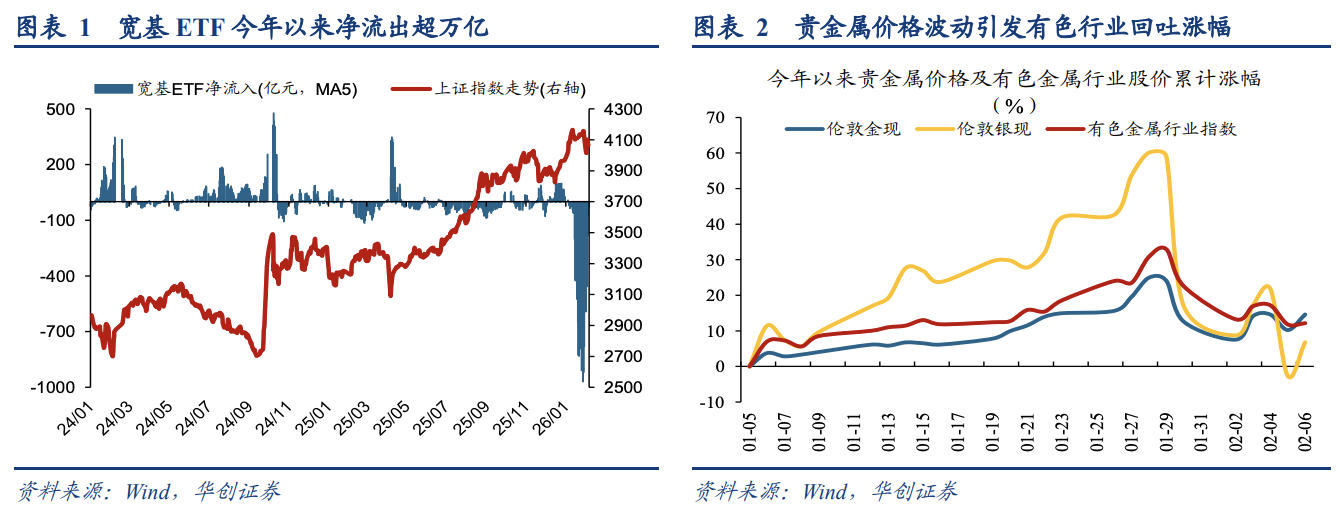
剩余流动性趋缓背景下,大盘股将跑赢小盘股;全年维度看,科技+顺周期仍是配置主线。对投资者而言,当前时点应把握中长线配置机会,重新审视"成 长"的定义边界。 调整到位信号明确,微观流动性冲击快速出清 市场经历了一轮猛烈但短暂的调整。据华创数据,宽基ETF今年以来累计净流出1.02万亿元,杠杆资金过去5个交易日净流出582亿元,创下去年4月以来新 高。贵金属价格暴跌引发有色金属板块回吐涨幅,叠加监管层上调融资保证金比例释放降温信号,市场风险偏好受到明显抑制。 市场短期剧烈调整后,配置窗口已经打开。在牛市背景下,微观流动性冲击已出清,关注顺周期与地产链的困境反转。 据追风交易台,华创证券2月8日发布的策略周报显示,本轮回撤或已到位——2月2日跌停公司达130家创新高,杠杆资金5日净流出582亿元,市场温度回落 至去年11月水平。 更关键的是投资风格正在发生深刻变化:成长股将优于价值股,但成长机会不再局限于科创板块,顺周期和地产链的困境反转同样值得关注; 但多个指标显示调整已经充分。从投资者情绪看,上证指数在4000点附近的市场温度已接近去年11月的3800点水平;2月2日跌停公司达130家,超过去年11 月21日的 ...

每日报告精选(2026-02-06 09:00——2026-02-09 15:00)-20260209
GUOTAI HAITONG SECURITIES· 2026-02-09 08:23
目 录 | | 每日报告精选(2026-02-06 09:00——2026-02-09 15:00) 3 | | | --- | --- | --- | | | 宏观周报:《春节效应延续》2026-02-08 3 | | | | 宏观周报:《美国:制造业景气度超季节回升》2026-02-08 3 | | | | 策略周报:《坚定信心,持股过节》2026-02-08 3 | | | | 策略专题报告:《地方两会聚焦扩内需与强科技》2026-02-08 4 | | | | 策略观察:《成交活跃度下降,万得全 估值微跌》2026-02-08 5 A | | | | 行业跟踪报告:餐饮《千问加码外卖补贴,行业价格战趋缓》2026-02-09 6 | | | | 行业跟踪报告:钢铁《淡季维持累库趋势,但库存处于历史低位》2026-02-09 7 | | | | 行业跟踪报告:有色金属《关注企稳后的布局机会》2026-02-09 7 | | | | 行业跟踪报告:钢铁《钢铁行业周报数据库 20260208》2026-02-09 8 | | | | 行业周报:金融《建议左侧增持非银板 ...
针对重点行业专题解读稳增长系列政策
Xin Lang Cai Jing· 2026-02-08 22:43
转自:辽宁日报 (来源:辽宁日报) 会议邀请了工业和信息化部相关司局及事业单位负责同志,围绕稳增长系列政策,结合辽宁产业结构特 点与现实困境,就政策内涵、落实路径、行业预期及企业纾困等方面进行深度讲解与现场指导。同时深 化政银企协同,发挥金融支撑作用,精准把握政策导向,力求为行业、企业提供金融支持。 以汽车行业为例,会议对国家稳增长工作方案中着力扩大国内消费、提升供给质量、优化发展环境、深 化国际合作等举措进行深入解读,并结合我省产业实际提出具体发展建议。与会专家认为,辽宁应统筹 优化全省产能,强化整车与零部件企业协同发展,推动整车企业持续上规模、增效益;依托我省资源优 势,加强低温环境下的动力电池、固态电池等技术攻关,拓展公交、物流等领域新能源汽车应用场景, 推动产业数字化转型,完善充电基础设施建设。 本报讯 记者韩宇浩报道 2月4日,由省工业和信息化厅、中国工商银行辽宁省分行举办的重点行业稳增 长实施方案专题解读会在沈阳举行。会议围绕国家出台的稳增长系列政策,重点解读汽车、机械、电力 装备、电子信息、石油化工、钢铁、轻工等行业政策。 ...
景气叠加周期双轮驱动 挖掘转债市场超额收益
Xin Lang Cai Jing· 2026-02-08 18:31
证券时报记者 安仲文 对于"高弹性+高集中度"组合模式的核心护城河,刘文良总结为三大方面:一是勤奋,投入大量时间和精力在研究 和组合管理上;二是研究创造价值,特别是投研团队的深度研究能力,南方基金成立跨部门转债投研小组,对重 点个券进行深度挖掘,研究的深度决定了波动时能否拿住关键标的;三是数智化平台的工具支持,转债模块提供 的择时、板块流动、量化择券信号,已融入日常投资决策。 转债市场科技+周期的高弹性,正成为放大可转债基金收益空间的引擎。 南方基金基金经理刘文良管理的南方昌元可转债基金和南方广利在2025年斩获亮眼收益,其中南方昌元可转债基 金2026年开年收益率更是一度突破18%,大幅跑赢中证转债指数。在近日的采访中,刘文良详细拆解了产品业绩 背后的配置逻辑、产业周期研判框架,同时分享了2026年转债基金的投资思路,其以产业周期为核心,结合数智 化工具与多元资产配置的投资体系,也成为把握转债赛道投资机遇的关键。 业绩突围来自认知迭代 谈及旗下产品的业绩驱动,刘文良表示,转债基金的核心收益来自科技成长与周期板块的双重加持,其中产业周 期级别驱动的科技成长是长期布局重点。从过往产品定期报告来看,AI(人工智能 ...

调整或已到位,把握配置区间。风格之辩:成长优于价值,大盘优于小盘,科技+顺周期仍是主线。:风格之辩——策略周聚焦
Huachuang Securities· 2026-02-08 09:41
策略研究 证 券 研 究 报 告 【策略周报】 风格之辩——策略周聚焦 ❖ 调整或已到位,把握配置区间。 市场三大关注点:行业轮动渐近尾声,风险偏好抑制明显,春节前市场进入存 量博弈。经过短期快速的调整,当前机构普遍关注三大方向,具体来看:1、 春季躁动以来的行业轮动或接近尾声;2、市场风险偏好受到明显抑制;3、春 节前或将进入存量博弈。短期看市场情绪难有大幅提升,结构上轮动可能出现 最后一波加速,关注高股息的稳定红利品种,以及有业绩支撑的确定性板块。 我们在 26/2/3《调整或已到位,把握配置区间》指出,因外部突发事件产生的 风险偏好冲击或已到位。历史上由微观流动性引发的牛市中回撤通常呈现进二 退一。从投交情绪看,当前上证 4000 点左右的市场温度已经接近 25/11 的 3800 点,2/2 跌停公司 130 家,超去年 11/21 的 107 家,创近半年新低;杠杆资金 过去 5 个交易日净流出 582 亿元,超过 25/11 高点的 400 亿元。本轮 ETF 和 杠杆资金流出,以及贵金属价格的大幅波动,更类似微观流动性和突发事件引 发的风险偏好抑制,此类回撤往往在短时间内快速完成下跌,不必过分担 ...
华金证券:春季行情未完 持股过节
Xin Lang Cai Jing· 2026-02-08 07:05
炒股就看金麒麟分析师研报,权威,专业,及时,全面,助您挖掘潜力主题机会! 来源:华金证券 炒股就看金麒麟分析师研报,权威,专业,及时,全面,助您挖掘潜力主题机会! 来源:华金证券 春节前A 股短期走势对节后行情可能有一定影响。2010 年以来的16 年中,有9次春节前5 个交易日内上 证综指走强(弱)而节后1 个交易日上证综指下跌(上涨);有12 次节前5 个交易日内上证综指涨跌与 节后5 个交易日内涨跌同向。 春季行情未完,春节期间风险可能有限,可持股过节。(1)今年春节期间经济和盈利预期可能改善。 一是春节出行、消费数据可能偏好。二是今年春节地产销售可能有所回暖:首先,低基数效应下今年春 节期间地产销售同比增速可能有所回升;其次,各地刺激地产销售的政策预期较强,春节假期期间地产 销售可能延续回暖趋势。(2)春节期间流动性可能维持宽松。一是春节期间宏观流动性可能维持宽 松:首先,海外方面,2 月11 日美国1 月CPI 数据将公布,2 月17 日美国零售数据将披露,预计美元指 数可能继续维持低位震荡,海外对国内流动性宽松的掣肘有限;其次,国内方面,春节前流动性季节性 紧张下央行可能加大净投放力度。二是春节前 ...
上海高级金融学院:2025上海市涉外企业ESG发展报告
Sou Hu Cai Jing· 2026-02-08 04:41
今天分享的是:上海高级金融学院:2025上海市涉外企业ESG发展报告 报告共计:56页 《2025上海市涉外企业ESG发展报告》以上海325家上市涉外企业和1140家非上市涉外企业为样本,系统剖析了 上海涉外企业ESG发展的现状、特征与挑战,为当地相关三年行动计划落地提供实证支撑。报告显示,上海涉外 企业呈现多元共生的结构特征,上市企业以民营企业为主,非上市企业则外资主体占优,浦东新区为核心集聚区 域,信息技术与工业是核心产业,高新技术与先进制造业集聚效应显著。 在ESG能力建设上,上海涉外上市企业ESG报告披露率大幅提升且优于A股整体水平,国有企业在ESG评分上领 跑,外资企业披露机制成熟,民营企业治理领域提升显著。企业在技术创新和绿色转型上活力充沛,专利成果丰 富,多数企业涉足节能降碳、清洁能源等绿色低碳领域,形成多层次发展格局。同时,企业在就业吸纳上表现突 出,形成上市板块由国有和民营主导、非上市板块由外资驱动的就业结构。 上海涉外企业当前面临国际与国内ESG标准"双轨披露"的核心挑战,指标口径、披露逻辑的差异,加之标准更新 频繁,让中小企业陷入能力陷阱,头部企业也承受着持续的管理压力。在服务生态建设方 ...