能源

Search documents
海外观察:美国2025年11月CPI数据:美国11月通胀意外放缓,但参考性降低
Donghai Securities· 2025-12-19 06:54
Inflation Data Summary - The U.S. November CPI year-on-year increased by 2.7%, lower than the expected 3.1% and down from 3.0% in September[2] - Core CPI year-on-year rose by 2.6%, below the expected 3.0% and unchanged from September[2] - The unexpected slowdown in CPI was primarily driven by significant declines in household food and core services prices[2] Key Influences on CPI - Food prices decreased from 3.1% in September to 2.6% in November, with household food prices dropping from 2.7% to 1.9%[2] - Energy prices increased from 2.8% in September to 4.2% in November, influenced by low base effects and winter demand[2] - Core goods prices showed resilience, with clothing prices rising from -0.1% to 0.2% and new car prices slightly declining from 0.8% to 0.6%[2] Housing Market Insights - Housing prices fell sharply to 3.0% in November from 3.6% in September, contradicting other indicators of a recovering housing market[2] - Rent and owners' equivalent rent both decreased by 0.4 percentage points from September, indicating a significant cooling in the housing market[2] Market Reactions and Future Outlook - Following the CPI release, U.S. stock markets rose, while gold initially surged before declining, and the dollar index experienced volatility[2] - The probability of the Federal Reserve lowering interest rates in January 2026 is estimated at 27.7%[4] - The report suggests that the weak reference nature of the November inflation data may lead to a higher likelihood of the Fed adopting a wait-and-see approach rather than cutting rates[2]
美国11月能源价格同比涨幅为4.2%
Xin Hua She· 2025-12-19 03:31
Core Insights - The Consumer Price Index (CPI) in the U.S. increased by 2.7% year-on-year in November, down from 3% in September [1][2] - Food prices rose by 2.6% year-on-year, while energy prices saw a 4.2% increase [2] - The core CPI, excluding volatile food and energy prices, increased by 2.6% year-on-year in November [2] Data Context - The October CPI data was not published due to the federal government shutdown, which resumed operations on November 13 [2] - Analysts caution that the new inflation and employment data may contain inaccuracies due to the impact of the government shutdown, suggesting a need for careful interpretation [2]
报告:2025年大宗商品价格指数呈现前低后高、企稳回升态势
Xin Hua Cai Jing· 2025-12-19 03:10
Group 1 - The core viewpoint of the report indicates that the overall price index for bulk commodities in China is expected to show a trend of low first and high later, stabilizing and recovering, reflecting a healthier and more sustainable economic structure [1] - The average price index for bulk commodities in China for 2025 is projected to be 112.1 points, a slight decrease of 0.1% compared to the previous year [1] - Among the 50 monitored bulk commodities, 10 are expected to see price increases, with notable rises in neodymium oxide (43.4%), refined tin (20.6%), and corrugated paper (18.5%) [1] Group 2 - The non-ferrous price index is expected to stand out with an average of 131 points, an increase of 4.2% year-on-year, driven by high growth in high-tech manufacturing and equipment sectors, alongside supply disruptions from incidents like the mudslide at Indonesia's Grasberg copper mine [1] - The black, energy, chemical, and mineral indices are projected to decline, with average values of 78.8 points, 99.1 points, 102.7 points, and 73.9 points respectively, reflecting decreases of 7.5%, 9.9%, 10.2%, and 10.6% [2] - The agricultural product price index is expected to fluctuate downwards, averaging 96.7 points, a slight decrease of 0.4%, attributed to effective implementation of national food security strategies and balanced supply and demand for key agricultural products [2] Group 3 - The overall stability of the bulk commodity market is highlighted, with a clear transition between old and new growth drivers, supported by government policies aimed at promoting consumption and stabilizing growth [3] - The resilience of the Chinese economy and its substantial domestic demand potential are seen as the strongest foundation for the global bulk commodity market moving forward into 2026 [3] - The conference focused on enhancing international influence and building credible trade rules, discussing future trends, challenges, and opportunities in global bulk commodity trade [3]
冠通期货早盘速递-20251219
Guan Tong Qi Huo· 2025-12-19 02:45
Report Summary 1. Hot News - On Thursday, the main palladium futures contract on the Guangzhou Futures Exchange hit the daily limit again, and the main platinum futures contract nearly hit the limit. Starting from the trading session on December 23, 2025, non - futures company members or clients are restricted to a maximum daily opening position of 500 lots for platinum and palladium futures contracts respectively. Also, from the trading session on December 22, the minimum opening order quantity for polysilicon futures contracts is adjusted from 1 lot to 5 lots [3] - China has re - implemented export license management for steel after 16 years, aiming to strengthen monitoring, statistical analysis, and quality tracking of steel product exports. Meanwhile, the Ministry of Commerce has approved some general export license applications for rare earths. China strongly opposes the EU's recent investigations under the Foreign Subsidies Regulation (FSR) and will take necessary measures [3] - A giant undersea gold mine, the only one in China and the largest in Asia, has been discovered in the northern waters of Sanshandao, Laizhou, Shandong. The city's total proven gold reserves exceed 3,900 tons, accounting for about 26% of the country's total, ranking first in both reserves and production nationwide [3] - At the "2025 Annual Conference of the Photovoltaic Industry", Yang Xudong, Director of the Department of Electronic Information of the Ministry of Industry and Information Technology, stated that the photovoltaic industry governance will enter a critical stage in 2026, with further capacity regulation to achieve dynamic balance. The China Photovoltaic Industry Association did not predict the next - year's new installed capacity [3] - The US core CPI in November 2025 rose 2.6% year - on - year, the slowest pace since early 2021 and lower than the market expectation of 3%. The overall CPI rose 2.7% year - on - year, lower than the expected 3.1%. However, the reliability of this inflation report is questioned due to the serious interference of the federal government shutdown in data collection [4] 2. Key Focus - The key commodities to focus on are urea, Shanghai copper, palladium, plastic, and asphalt [5] 3. Night - session Performance - The night - session price changes of different commodity futures sectors are as follows: non - metallic building materials 2.42%, precious metals 33.32%, oilseeds and oils 8.49%, soft commodities 3.33%, non - ferrous metals 23.90%, coal, coke, and steel ore 10.87%, energy 2.51%, chemicals 10.29%, grains 1.27%, and agricultural and sideline products 3.60% [5] 4. Major Asset Performance - **Equity**: The daily, monthly, and annual percentage changes for various stock indices are provided. For example, the Shanghai Composite Index had a daily increase of 0.16%, a monthly decrease of 0.31%, and an annual increase of 15.65%. Other indices like S&P 500, Hang Seng Index, etc., also have their respective performance data [7] - **Fixed - income**: The performance of 10 - year, 5 - year, and 2 - year treasury bond futures is presented, including daily, monthly, and annual percentage changes [7] - **Commodity**: The performance of CRB commodity index, WTI crude oil, London spot gold, LME copper, and Wind commodity index is shown, with daily, monthly, and annual percentage changes [7] - **Other**: The performance of the US dollar index and CBOE volatility index is given, including their daily, monthly, and annual percentage changes [7]
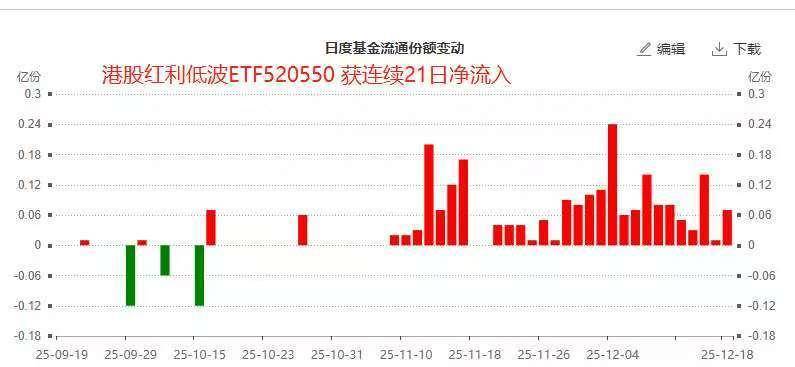
根本停不下来!港股红利低波ETF(520550)获连续21日增仓,股息率飙至近7%!
Sou Hu Cai Jing· 2025-12-19 02:45
Core Viewpoint - The Hong Kong dividend low-volatility ETF has attracted significant capital inflows, becoming a focal point for investors seeking stable returns in a volatile market environment [3][4]. Group 1: Fund Inflows - As of December 18, 2023, the Hong Kong dividend low-volatility ETF (code: 520550) has seen net inflows for 21 consecutive trading days, totaling approximately 190 million RMB [3][4]. - Year-to-date, the ETF has accumulated net inflows of nearly 1 billion RMB, indicating strong long-term investor confidence in this strategy [3][4]. Group 2: Dividend Yield and Valuation - The ETF's tracked index has a current dividend yield close to 7%, significantly higher than major mainland indices and leading among global markets [4]. - The high dividend yield is particularly attractive in the context of declining bank deposit rates and pressured returns from traditional investment products, making it a competitive option for conservative investors [4]. Group 3: Low Volatility Attributes - The low-volatility aspect of the strategy is crucial, as the ETF selects stocks with relatively low historical price volatility, resulting in an overall portfolio volatility that is significantly lower than the Hong Kong market average [5]. - In the current uncertain global economic climate, the demand for "safe" and "stable" investments has increased, making the dividend low-volatility strategy appealing to many investors [5]. Group 4: Market Outlook - The ongoing inflows into the Hong Kong dividend low-volatility ETF reflect a rational choice by market participants in light of the current macroeconomic environment, favoring assets with high growth certainty and consistent cash returns [6]. - The trend of declining risk-free interest rates enhances the attractiveness of dividend returns, suggesting a favorable outlook for dividend strategies in the medium to long term [6].

日本核心CPI连续51个月同比上升
Xin Hua Cai Jing· 2025-12-19 02:44
Core Insights - Japan's core Consumer Price Index (CPI), excluding fresh food, rose by 3.0% year-on-year to 112.5 in November, marking the 51st consecutive month of year-on-year increases [1] - The year-on-year increase in November's core CPI remained stable compared to the previous month, while the month-on-month increase was 0.3%, slightly lower than the 0.4% recorded in the prior month [1] Price Drivers - The primary driver of the price increase in November was food, with significant price hikes observed in grains, snacks, prepared foods, dining out, beverages, meat, and dairy products [1] - Coffee bean prices surged by 51.6% year-on-year, while the price of ordinary japonica rice saw a year-on-year increase of 37.0%, although this was a decrease from last year's high levels [1] - Other categories such as housing repairs, electricity, automotive-related expenses, communication fees, and hotel accommodations also experienced year-on-year price increases [1] Economic Policy Impact - Concerns have been raised by media and experts regarding Prime Minister Suga Yoshihide's commitment to an active fiscal policy, which is exacerbating the depreciation of the yen and potentially leading to further inflation in Japan [1]
关注下游消费新业态试点运行
Hua Tai Qi Huo· 2025-12-19 02:36
Report Summary 1. Industry Investment Rating No information provided regarding the report's industry investment rating. 2. Core Viewpoints - The report presents an overview of the mid - and upstream, mid - stream, and downstream industries, along with relevant policy events and price trends. In the production industry, there are updates on the export control of rare - earth related items, and in the service industry, there are new consumption pilot programs. The prices of some upstream products are falling, the operating rates of some mid - stream industries are changing, and downstream real estate is warming up while some service sectors are declining [1][2][3][4]. 3. Summary by Directory 3.1 Mid - view Event Overview - **Production Industry**: At the Ministry of Commerce's regular press conference on the 18th, the spokesperson responded to the latest progress of the export control of rare - earth related items. Some Chinese exporters have initially met the requirements for applying for general licenses, and some applications have been received and approved [1]. - **Service Industry**: The General Office of the Ministry of Commerce and the General Office of the Ministry of Finance have issued a notice to carry out pilot projects on new consumption formats, models, and scenarios in 50 cities including Beijing. On December 17, a work deployment and promotion meeting was held, emphasizing that pilot cities should improve implementation plans and ensure the effectiveness of the pilot work [1]. 3.2 Industry Overview 3.2.1 Upstream - **Non - ferrous Metals**: The prices of nickel and lead have slightly declined [2]. - **Agriculture**: The price of palm oil has slightly declined [2]. - **Energy**: The prices of international crude oil and liquefied natural gas continue to decline [2]. 3.2.2 Mid - stream - **Chemical Industry**: The operating rates of PX and PTA continue to decline [3]. - **Energy**: The coal consumption of power plants has increased [3]. - **Infrastructure**: The asphalt operating rate is at a low level [3]. 3.2.3 Downstream - **Real Estate**: The sales of commercial housing in first, second, and third - tier cities continue to pick up [4]. - **Service**: The number of domestic and international flights has declined, and movie box office has also declined [4]. 3.3 Key Industry Price Indicators Tracking - **Agriculture**: On December 18, the prices of corn, eggs, palm oil, cotton, and pork showed different trends, with palm oil down 1.15%, eggs down 0.60%, and others showing small increases or decreases [42]. - **Non - ferrous Metals**: The prices of copper, zinc, aluminum, nickel, etc. on December 18 also had different changes, such as nickel down 1.49% and zinc up 0.02% [42]. - **Energy**: The prices of WTI crude oil, Brent crude oil, liquefied natural gas, and coal on December 18 had different trends, with Brent crude oil down 4.07% and WTI crude oil up 4.53% [42]. - **Chemical Industry**: The prices of PTA, polyethylene, urea, and soda ash on December 18 showed different changes, with polyethylene down 1.46% and PTA up 0.69% [42]. - **Real Estate**: The cement price index, building materials composite index, and concrete price index on December 18 also had different trends, with the cement price index up 0.81% and the concrete price index down 0.06% [42].
新一轮财富分配启动|十五五最具潜力的就业与投资赛道前瞻
Qian Zhan Wang· 2025-12-19 02:18
Core Insights - The article discusses the transformation of China's economy as it transitions from the "14th Five-Year Plan" to the "15th Five-Year Plan," highlighting a shift from quantitative growth to qualitative changes driven by deep technology and societal needs [1][30]. Group 1: Artificial Intelligence - Artificial intelligence is shifting focus from "computational power competition" to "embodied intelligence and vertical penetration," with humanoid robots poised for large-scale deployment [2][4]. - The demand for "vertical domain + AI" talent is increasing, as industries require professionals who understand both AI technology and specific industry knowledge [6]. Group 2: Energy Transition - The energy revolution is entering a "second half," focusing on energy storage and grid stability rather than just power generation [6][7]. - By 2030, China's non-fossil energy consumption is expected to reach 25%, with a total installed capacity of wind and solar power exceeding 1.2-2.4 billion kilowatts [7]. Group 3: Low-altitude Economy - The low-altitude economy is recognized as a new pillar industry, facing challenges in manufacturing technology, market maturity, and infrastructure development [11][12]. - The space information industry is expected to grow significantly, driven by satellite networking and data empowerment, creating demand for various new professional roles [13]. Group 4: 6G Communication - 6G is anticipated to be a central driver of the digital economy, with a projected global market size exceeding 24.4 trillion yuan by 2040, and China expected to be a major market [17]. - The integration of communication, sensing, and computing capabilities in 6G will revolutionize sectors like autonomous driving and industrial internet [19]. Group 5: Quantum Computing - Quantum computing is moving towards practical applications, with a projected market size of $17.689 trillion by 2029, growing at a compound annual growth rate of 32% [20][23]. - There is a significant talent gap in the quantum computing field, particularly for interdisciplinary professionals who can bridge quantum physics and computer science [23]. Group 6: Biomanufacturing and Silver Economy - The aging population is creating a "silver economy" market projected to reach 25 trillion yuan by 2030, with biomanufacturing playing a key role in addressing health needs [24][28]. - Professions related to biomanufacturing and personalized healthcare are expected to expand significantly during the "15th Five-Year Plan" [28]. Group 7: Productive Services Industry - The productive services industry is becoming a core support for manufacturing, with its GDP share expected to rise from 28% to 35% by the end of the "15th Five-Year Plan" [29]. - Key growth areas include high-end technology services, industrial digitalization, and green consulting services, driven by the need for innovation and sustainability [29]. Conclusion and Insights - The article emphasizes the importance of understanding long-term technological and societal trends for investment and career opportunities during the "15th Five-Year Plan" [30][31].
银河期货每日早盘观察-20251219
Yin He Qi Huo· 2025-12-19 01:49
1. Report Industry Investment Ratings - Not provided in the content 2. Core Views of the Report - The overall market shows a complex and diversified trend. Different sectors, such as financial derivatives, agricultural products, black metals, non - ferrous metals, shipping, and energy chemicals, have their own characteristics and influencing factors. For example, in financial derivatives, stock index futures are expected to test 3900 again, while treasury bond futures have opportunities despite fluctuations; in agricultural products, the supply - demand situation of various varieties varies, affecting their price trends [5][20][26] 3. Summary by Relevant Catalogs Financial Derivatives - **Stock Index Futures**: Expected to test 3900 again. On Thursday, the market showed a sideways shock. The main stock index futures contracts mostly declined, and the trading volume and positions decreased. The market rebound was affected by factors such as the overnight decline of the US stock market, and it is expected to maintain a sideways consolidation trend [18][20] - **Treasury Bond Futures**: There were fluctuations, but opportunities remained. On Thursday, most treasury bond futures closed higher, and the market funds were balanced and slightly loose. The central bank's open - market operations and market rumors affected the bond market sentiment. In the short term, the central bank's loose tone remained unchanged, but the long - end repair rhythm might be repeated [22][23][24] Agricultural Products - **Protein Meal**: The production outlook was good, and US soybeans continued to be under pressure. The CBOT soybean and soybean meal indexes declined. The US soybean export sales decreased, and the Brazilian soybean production was expected to increase. The domestic soybean meal crushing profit was still in deficit, and the overall price was expected to be supported but with limited sustainability [26][27][28] - **Sugar**: International sugar prices dropped sharply. The ICE and London sugar futures prices declined. The Brazilian sugar production increase was basically realized, and the market focus shifted to the Northern Hemisphere. The domestic sugar market had increasing supply pressure, but the price had certain support near the cost line [29][30][33] - **Oilseeds and Oils**: Palm oil had a technical rebound, and the overall oils were at the bottom - level shock. The overseas palm oil and soybean oil prices had small fluctuations. The Indonesian palm oil inventory decreased, and the domestic soybean oil inventory was gradually decreasing, while the rapeseed oil inventory was expected to continue to decline [35][36] - **Corn/Corn Starch**: The spot price declined, and the futures price was at the bottom - level shock. The CBOT corn futures rebounded. The domestic corn processing enterprise inventory increased, and the starch inventory also increased. The Northeast corn price was strong, while the North China corn price was weak [37][38][39] - **Hogs**: The slaughter recovered, and the spot price fluctuated slightly. The hog price was stable in most regions. The short - term slaughter pressure decreased, but the overall supply pressure still existed [39][40][41] - **Peanuts**: The spot price declined, and the futures price had a narrow - range shock. The peanut price was stable in some regions and declined in others. The oil factory's purchase price was adjusted, and the 03 peanut futures price still had a downward space [42][43][44] - **Eggs**: The demand was average, and the egg price was stable with a slight decline. The main - producing and main - selling area prices were relatively stable. The number of laying hens decreased slightly, and the short - term supply pressure was relieved [45][46][47] - **Apples**: The demand was average, and the apple price was mainly stable. The cold - storage inventory decreased, and the import and export volume changed. The apple price was high before, which led to weak demand, and the market was concerned about the January delivery and pre - Spring Festival stocking [49][50][51] - **Cotton - Cotton Yarn**: The new cotton sales were good, and the cotton price was shock - upward. The ICE cotton futures price increased. The domestic cotton import and export volume changed, and the new cotton sales progress was fast. The market was affected by factors such as the expected reduction of cotton planting area and the expansion of textile factory capacity [52][53][54] Black Metals - **Steel**: The raw material prices stopped falling and stabilized, and the steel price rebounded from the bottom. The steel product supply decreased slightly, the inventory decreased, and the consumption decreased slightly. The steel price was affected by factors such as the raw material supply, demand, and export policy, and it was expected to show a shock - upward trend [57][58][59] - **Coking Coal and Coke**: The prices rebounded from the bottom, and the trading logic change needed attention. The Mongolian coking coal market was strong, and the prices of some domestic coking coal increased. The market "anti - involution" sentiment led to the price rebound, and the future supply - demand situation might improve slightly [59][60][61] - **Iron Ore**: The market expectations were repeated, and the ore price was in shock. The domestic crude steel and rebar production decreased, and the iron ore production increased slightly. The global iron ore supply was loose, and the domestic demand was weak. The ore price was expected to have limited upward space [62][63][64] - **Ferroalloys**: Supported by cost and the "anti - involution" expectation, the prices rebounded in the short term. The silicon - iron and manganese - silicon prices were stable with a slight increase. The supply was expected to decline slightly, and the demand was under pressure. The cost support and "anti - involution" expectation led to the price rebound [64][65][66] Non - Ferrous Metals - **Gold and Silver**: The US November CPI was better than expected, but the data was questionable, leading to market fluctuations. The international gold and silver prices fluctuated widely, and the US dollar index and US bond yields changed. The market was in a long - short tug - of - war, and the gold and silver prices were expected to maintain a high - level range [67][68][69] - **Platinum and Palladium**: The trading enthusiasm was over - high, and the risk factors were gradually accumulating. The platinum and palladium futures prices increased significantly, and the trading volume expanded. The macro - environment was favorable, and the news boosted the demand outlook. The platinum was short - term bullish, and the palladium might be affected by the macro - environment [69][70][71] - **Copper**: Buy after a full correction. The copper futures prices increased, and the inventory increased. The US inflation data affected the market, and the copper supply was expected to be tight in 2026. The long - term price trend was upward, but the short - term might be in shock [74][75][76] - **Alumina**: The price was in a weak shock. The alumina futures price declined, and the spot price decreased slightly. The overseas supply negotiation and domestic inventory situation affected the price. The price was expected to be under pressure after the "anti - involution" expectation subsided [78][79][80] - **Electrolytic Aluminum**: The overseas economic data was released this week, and the aluminum price rebounded. The electrolytic aluminum futures price increased, and the inventory decreased. The overseas economic data was better than expected, and the domestic demand was resilient. The price was supported [83][84][85] - **Cast Aluminum Alloy**: The scrap aluminum supply was still tight, and the alloy price rebounded with the sector. The cast aluminum alloy futures price increased, and the spot price increased. The scrap aluminum supply was tight, and the cost supported the price. The price was expected to maintain a high - level shock [86][87] - **Zinc**: Pay attention to the domestic social inventory today. The zinc futures price increased, and the spot price had a small change. The overseas zinc inventory increased, and the domestic smelting profit was compressed. The price was under pressure from the external market [88][89][90] - **Lead**: Pay attention to the inventory change. The lead futures price increased, and the spot price decreased slightly. The domestic lead supply and demand decreased, and the inventory became more visible. The price was expected to maintain a range shock [91][92][93] - **Nickel**: The Indonesian policy expectation stimulated the nickel price rebound, but the surplus suppressed the upward space. The LME nickel price increased, and the inventory decreased. The global nickel was in a surplus situation, but the Indonesian policy adjustment stimulated the price rebound. The price was expected to decline after the short - term rebound [93][94][95] - **Stainless Steel**: Followed the nickel price and weakened in shock. The stainless steel inventory decreased, and the terminal demand was in the off - season. The price was affected by the nickel price and demand, and it was expected to be at a low - level shock [96][97][99] - **Industrial Silicon**: Sell on rallies. The industrial silicon was in a state of inventory accumulation. The demand in the first quarter of 2026 was pessimistic, and the price was expected to decline. It was recommended to sell on rallies [99][100] - **Polysilicon**: Realize the profits of long positions and pay attention to risk management. The polysilicon futures trading rules changed. The downstream demand was relatively pessimistic, and the short - term price was expected to be strong. It was recommended to take profits on long positions and buy after a correction [100][101][103] - **Lithium Carbonate**: The inventory reduction was slower than expected, and the lithium price was under pressure to correct. The lithium carbonate price had a short - term correction, and the inventory reduction was slow. The price was expected to be at a high - level, and it was recommended to operate cautiously [104][105] - **Tin**: Pay attention to the November export data from Myanmar. The tin futures price increased, and the inventory increased. The US inflation data was questionable, and the domestic tin supply and demand were weak. The price was expected to be affected by the Myanmar export data and market fluctuations [107][108][109] Shipping - **Container Shipping**: MSK released the price of 2500/2600 for the first week, and pay attention to the January freight rate change path. The spot freight rate increased slightly. The European port congestion was serious, and the demand was expected to improve in December - January. The short - term price was expected to be at a high - level shock, and it was recommended to take partial profits on long positions [110][111][113] Energy and Chemicals - **Crude Oil**: The surplus pressure was difficult to change, and the oil price rebound was limited. The crude oil futures prices increased slightly. The US inflation and employment data changed, and the geopolitical situation was uncertain. The oil price was expected to be in a weak shock in the medium - term [114][115][116] - **Asphalt**: The short - term supply - demand was weak, and the raw material risk remained. The asphalt futures price declined, and the spot price was stable. The terminal demand decreased, and the raw material supply was uncertain. The price was expected to be in a narrow - range shock [117][118][119] - **Fuel Oil**: The short - term low - sulfur supply was continuously increasing. The fuel oil futures prices increased slightly. The low - sulfur supply was expected to increase, and the high - sulfur demand was stable and weak. The short - term price was expected to be bearish [120][121][122] - **Natural Gas**: The LNG downward trend remained unchanged. The natural gas futures prices had different changes. The weather affected the demand, and the overall supply was loose. The HH2602 contract long positions were recommended to be held [124][125][126] - **LPG**: The PDH profit continued to be in deficit. The LPG futures price increased, and the spot price was stable. The international LPG market was strong, and the PDH profit was in deficit. It was recommended to short the 03 contract on rallies [127][128][129] - **PX & PTA**: The polyester sales volume increased, and the market atmosphere was boosted. The PX and PTA futures prices increased. The PTA supply was expected to increase slowly, and the downstream polyester demand was high. The price was expected to be shock - upward [131][132] - **BZ & EB**: The pure benzene supply - demand was loose, and the styrene basis weakened. The pure benzene and styrene futures prices declined slightly. The pure benzene supply increased and demand decreased, and the styrene supply and demand were also weak. The price was expected to be in a weak shock [134][135][136] - **Ethylene Glycol**: The inventory accumulation pressure remained, and the price was in shock. The ethylene glycol futures price increased slightly. The supply and demand were weak, and the inventory had a de - stocking pressure. The short - term price was expected to be in shock and weak in the medium - term [138][139] - **Short - Fiber**: The supply - demand was weak. The short - fiber futures price increased. The short - fiber supply and demand decreased, and the processing fee was under pressure. The price was expected to be shock - upward [140][142] - **Bottle Chips**: The supply - demand was relatively loose. The bottle - chip futures price increased. The supply was expected to increase, and the demand was relatively stable. The price was expected to be shock - upward [143][144] - **Propylene**: The demand was poor, and the rebound was weak. The propylene futures price increased first and then decreased. The propylene supply was expected to be high, and the demand was weak. The short - term price was expected to be shock - upward [146][147] - **Plastic PP**: The PE production decreased month - on - month, and the PP production increased month - on - month. The L and PP futures prices declined slightly. The PE and PP supply and demand had different changes. It was recommended to wait and see for the L and PP 2605 contracts [148][150][151] - **Caustic Soda**: The price was in a shock trend. The caustic soda spot price had a small adjustment. The supply was sufficient, and the demand was weak. The price was expected to be in a weak shock [152][153][154] - **PVC**: The price continued to rebound. The PVC futures price increased, and the spot price increased slightly. The supply was expected to increase, and the demand was weak. The price was expected to continue to rebound [155][156][157] - **Soda Ash**: The futures price was in a strong trend. The soda ash futures price increased, and the spot price had a small change. The supply was expected to be under pressure in the future, and the demand was weak. The price was expected to be shock - upward next week with a risk of decline at the end of the month [157][158][159] - **Glass**: The futures price was in a strong trend. The glass futures price increased, and the spot price was stable. The supply was expected to be reduced, and the demand was weak. The price was expected to be shock - upward next week with a risk of decline at the end of the month [160][161][163] - **Methanol**: The price rose strongly. The methanol production increased, and the international device operation was affected. The price was expected to be shock - upward [165][166] - **Urea**: The price continued to rise. The urea production decreased slightly, and the international market had an impact. The short - term price was expected to be strong, and the medium - long - term supply - demand was relatively loose [167][168][169] - **Pulp**: The reality was weak, but the expectation was strong. Pay attention to the warehouse receipt registration and port inventory changes. The pulp futures price declined slightly, and the spot price had a small adjustment. The cost supported the price, but the demand was weak. It was recommended to hold the previous short positions [170][171][173] - **Logs**: The fundamentals were weak, and the futures - spot price was inverted. Pay attention to the warehouse receipt registration. The log price was stable, and the inventory and arrival volume changed. The price was expected to continue to bottom - out. It was recommended to hold the 03 long positions [173][174][175] - **Offset Printing Paper**: The supply pressure remained, and the high pulp price transmission did not meet expectations. The offset printing paper futures price declined slightly, and the spot price was stable. The production and inventory of double - offset paper and coated paper changed. The price was expected to be bearish [179][180] - **Natural Rubber**: The tire production line decreased month - on - month. The natural rubber futures prices had different changes. The Thai government took measures to stabilize the price, and the domestic tire production decreased. It was recommended to short the RU 05 contract slightly and hold the NR 02 contract long positions [182][183] - **Butadiene Rubber**: The BD & BR production decreased marginally, and the tire production decreased month - on - month. The butadiene rubber futures price increased, and the natural rubber futures prices had different changes. The domestic butadiene and tire production decreased. It was recommended to hold the BR 02 contract long positions [186][187][188]
智通港股早知道 | 国办印发《关于全链条打击涉烟违法活动的意见》 隔夜美股三大股指集体上涨
智通财经网· 2025-12-19 00:14
Group 1 - Two studies published in Nature confirm the efficacy and safety of a new diabetes drug, Masitide, developed by China's Innovent Biologics and Eli Lilly, showing superior blood sugar control and weight loss compared to placebo and Dulaglutide [1] - The studies involved Phase III clinical trials with Chinese type 2 diabetes patients, demonstrating improvements in cardiovascular, liver, and kidney-related indicators [1] - Masitide is a dual receptor agonist for glucagon-like peptide-1 and glucagon, providing high-quality evidence for overweight, obese, and diabetic patients, highlighting China's research capabilities in this field [1] Group 2 - U.S. stock indices rose collectively, with the Dow Jones up 65.88 points (0.14%), S&P 500 up 53.33 points (0.79%), and Nasdaq up 313.04 points (1.38%), driven by gains in large tech stocks [2] - Notable stock performances included Tesla rising over 3%, and Micron Technology increasing over 10% [2] - Chinese concept stocks also saw gains, with Zhihu up over 3% and XPeng Motors up over 2% [2] Group 3 - The State Council of China issued an opinion to combat illegal tobacco activities, focusing on countering counterfeit and smuggled tobacco products, and enhancing law enforcement collaboration with other countries [3] - The opinion aims to purify the tobacco market environment and protect national interests and consumer rights [3] Group 4 - BHP CEO Mike Henry emphasized the critical role of copper in the economy and its demand surge, predicting a bull market for copper due to supply constraints [4] - The annual market size for copper is estimated between $300 billion and $400 billion, with a projected 70% increase in demand by 2050, while new mining discoveries are becoming rarer and more challenging to develop [4] Group 5 - Meituan released and open-sourced a state-of-the-art virtual human video generation model, LongCat-Video-Avatar, which supports multiple tasks and has undergone significant upgrades in realism and stability [5] Group 6 - Zhihui Mining's shares rose 126.16% in dark trading, with a planned global offering of 122 million H-shares at HKD 4.51 each, focusing on zinc, lead, and copper mining in Tibet [6] Group 7 - Evergrande Auto announced a change in the registered shareholder of its subsidiary to Guangzhou Juliyi, with stock trading suspended pending further notice [7] Group 8 - Wasion Holdings' subsidiary won a contract worth over RMB 80 million for a project with CPFL, a leading power company in Brazil, and expects significant growth in AI data center revenues [8] - The company anticipates a doubling of AI data center revenue from RMB 1 billion in 2025 to RMB 2 billion in 2026, with new orders expected to grow significantly [8] Group 9 - Citigroup raised its profit forecasts for Wasion Holdings by 1% to 5% for 2025-2027, increasing the target price from HKD 15.5 to HKD 21, maintaining a "buy" rating [9]