
建筑业

Search documents
千方百计释放县域消费潜力!连平全面亮出前三季度经济增长目标
Sou Hu Cai Jing· 2025-08-04 18:05
Economic Overview - The economic analysis meeting in Heyuan highlighted that Lianping achieved a GDP of 5.356 billion, growing by 5.7%, surpassing the provincial and city averages of 4.2% [1] - Key economic indicators showed growth in agriculture, forestry, animal husbandry, and fishery with a total output value increase of 9.1% [1][10] - Industrial added value increased by 11.1%, and fixed asset investment rose by 8.0%, ranking first in the city [1][10] Agricultural Sector - Lianping's agricultural foundation is being strengthened, with a focus on increasing the output of the "Eagle Mouth Peach" to an expected 112,000 tons this season [3][4] - The county aims for a 6% growth in agricultural output value for the first three quarters, targeting 3.184 billion [3] - Livestock production is projected to increase by 18%, with specific targets for pig and poultry output [4][5] Industrial Development - The industrial sector's sustainable development relies on both existing and new enterprises, with a focus on stabilizing production in 18 companies facing reductions [6] - Lianping plans to achieve an industrial output value of over 1.45 billion, with efforts to optimize production processes in mining and other sectors [6][8] - The construction industry is expected to contribute 607 million in output value, with ongoing projects being closely monitored [7] Investment and Infrastructure - Fixed asset investment in Lianping is projected to reach 2.749 billion, with a focus on new projects to enhance investment success rates [8] - The county is actively pursuing 30 investment projects and aims to increase the number of registered enterprises [9] Consumer Market - The retail sector faced challenges due to seasonal demand fluctuations, but initiatives are being launched to boost consumption, including promotional events and partnerships with e-commerce platforms [9] - The county aims to increase the number of large-scale commercial enterprises by four by the end of the year [9] Summary of Key Economic Indicators - GDP: 5.356 billion, growth of 5.7% - Agricultural output: 1.629 billion, growth of 9.1% - Industrial added value: 1.272 billion, growth of 11.1% - Fixed asset investment: 2.749 billion, growth of 8.0% - Local public budget revenue: 361 million, growth of 3.3% - Tax revenue: 367 million, growth of 19.3% - Retail sales: 2.042 billion, growth of 2.7% [10]


泰达股份:首次回购100万股
Mei Ri Jing Ji Xin Wen· 2025-08-04 11:41
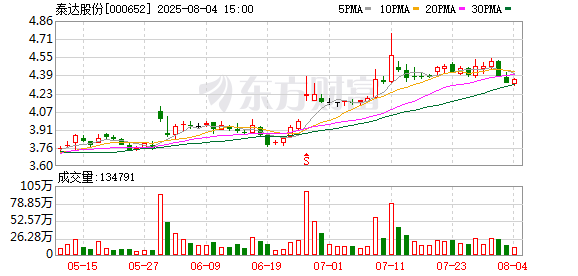
Group 1 - The company, Teda Co., Ltd. (SZ 000652), announced a share buyback on August 4, 2025, purchasing 1 million shares, which represents 0.068% of its total share capital, with a total transaction amount of approximately 4.32 million yuan [2] - The highest transaction price for the repurchased shares was 4.36 yuan per share, while the lowest was 4.30 yuan per share [2] - For the fiscal year 2024, the company's revenue composition was as follows: wholesale industry accounted for 89.33%, environmental management 6.82%, construction 2.8%, real estate 0.74%, and textile and apparel 0.29% [2]

股债跷跷板依然为主逻辑,国债震荡偏空
Ning Zheng Qi Huo· 2025-08-04 10:40
Group 1: Report Industry Investment Rating - The investment rating for the bond market is "oscillating with a bearish bias" [5] Group 2: Core Viewpoints of the Report - The stock - bond seesaw remains the main logic for the bond market recently. The short - term correction of A - shares gives impetus to the bond market's rebound. The economic sentiment declined in July, and counter - cyclical adjustment needs to be continuously strengthened. The keynote for the second half of the year is an active fiscal policy and a moderately loose monetary policy, but the incremental policies exceeding market expectations may be limited [2][4][30] Group 3: Summary by Relevant Catalogs Chapter 1: Market Review - The stock - bond seesaw logic has led the long - end bond market to effectively break below the 60 - day moving average, and this logic may continue to dominate the bond market [10] Chapter 2: Overview of Important News - The Ministry of Finance requires state - owned commercial insurance companies to improve asset - liability management. China's official manufacturing PMI in July was 49.3, a decline of 0.4 percentage points month - on - month, and the non - manufacturing PMI was 50.1, also down 0.4 percentage points month - on - month. The Politburo meeting emphasized maintaining policy continuity and stability. The China - US economic and trade talks reached a consensus on the extension of tariffs. The profit decline of industrial enterprises above designated size narrowed in June, and multiple departments planned key work for the second half of the year [14][16] Chapter 3: Analysis of Important Influencing Factors 3.1 Economic Fundamentals - China's economic data showed certain resilience in the second quarter, with GDP growth exceeding expectations. However, the economic sentiment declined in July, and counter - cyclical adjustment needs to be strengthened [17] 3.2 Policy Aspect - In June 2025, the social financing scale stock increased year - on - year, and the M2 - M1 gap narrowed, indicating that real - sector enterprises are more optimistic about the economic outlook [19] 3.3 Capital Aspect - The bond market interest rate and DR007 have decreased significantly, and the capital is already relatively loose. The probability of significant monetary easing such as reserve requirement ratio cuts and interest rate cuts in the second half of the year is low [21] 3.4 Supply - Demand Aspect - The issuance of local bonds and special bonds has accelerated recently. The issuance of special bonds and ultra - long - term special treasury bonds has basically been realized, and the market is waiting for the effects and implementation of relevant policies [24] 3.5 Sentiment Aspect - The stock - bond ratio has broken through the short - term shock range, indicating that the market's attention to the stock market is greater than that to the bond market, and the market risk appetite has increased [27] Chapter 4: Market Outlook and Investment Strategy - The themes for the second half of the year are anti - involution and maintaining stable economic recovery. The start of infrastructure projects increases the market's expectation of further fiscal and infrastructure efforts. The short - term correction of A - shares gives impetus to the bond market, and investors should pay attention to the subsequent trend of the stock market [30]
【数据发布】2025年7月中国采购经理指数运行情况
中汽协会数据· 2025-08-04 08:23
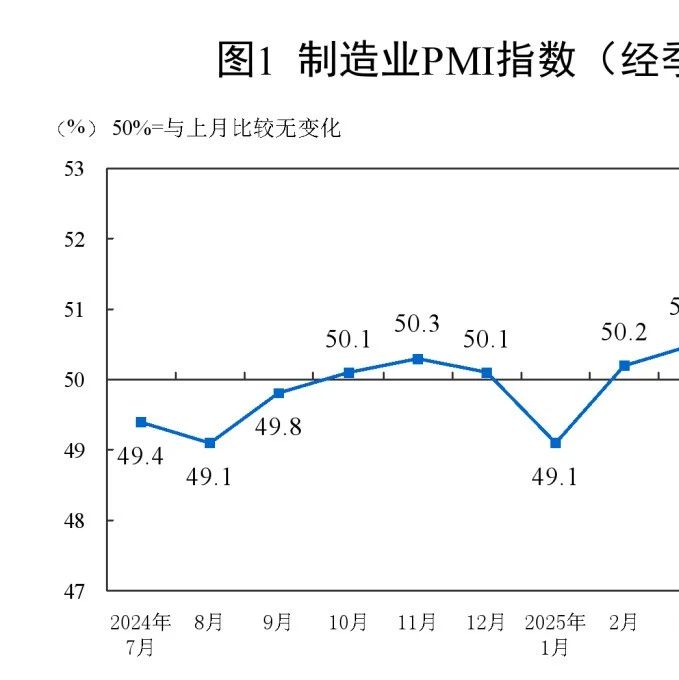
Group 1: Manufacturing PMI Overview - In July, the Manufacturing Purchasing Managers' Index (PMI) was 49.3%, a decrease of 0.4 percentage points from the previous month, indicating a decline in manufacturing activity [1][3] - Large enterprises had a PMI of 50.3%, down 0.9 percentage points, while medium-sized enterprises saw a PMI of 49.5%, up 0.9 percentage points, and small enterprises had a PMI of 46.4%, down 0.9 percentage points [3][4] - The production index was at 50.5%, a decrease of 0.5 percentage points, indicating continued expansion in manufacturing production [3][4] Group 2: Demand and Inventory Indicators - The new orders index was 49.4%, down 0.8 percentage points, suggesting a slowdown in market demand for manufacturing [4] - The raw materials inventory index was 47.7%, down 0.3 percentage points, indicating a continued reduction in major raw material inventories [4] - The employment index was 48.0%, up 0.1 percentage points, showing a slight improvement in employment conditions within the manufacturing sector [4] Group 3: Non-Manufacturing PMI Overview - In July, the Non-Manufacturing Business Activity Index was 50.1%, a decrease of 0.4 percentage points, remaining above the critical point [7] - The construction industry business activity index was 50.6%, down 2.2 percentage points, while the service industry index was 50.0%, down 0.1 percentage points [9] - The new orders index for non-manufacturing was 45.7%, down 0.9 percentage points, indicating a decline in market demand [11] Group 4: Price and Employment Trends in Non-Manufacturing - The input price index was 50.3%, up 0.4 percentage points, indicating an overall increase in input prices for non-manufacturing enterprises [11] - The sales price index was 47.9%, down 0.9 percentage points, suggesting a decrease in overall sales prices [11] - The employment index for non-manufacturing was 45.6%, up 0.1 percentage points, indicating a slight improvement in employment conditions [11] Group 5: Composite PMI Overview - The Composite PMI Output Index was 50.2%, a decrease of 0.5 percentage points, but still above the critical point, indicating overall expansion in production and business activities [15]
“反内卷”驱动量价再平衡,关注价格修复的可持续性
China Post Securities· 2025-08-04 03:09
Group 1: Economic Indicators - The manufacturing PMI for July is at 49.3%, a decrease of 0.4 percentage points from the previous month, indicating a marginal decline in manufacturing sentiment[9] - The new orders index for manufacturing PMI is at 49.4%, down 0.8 percentage points, indicating a return to contraction territory[12] - The production index for manufacturing PMI is at 50.5%, a decrease of 0.5 percentage points, but still within the expansion range[15] Group 2: Supply and Demand Dynamics - Both supply and demand have weakened, with the supply-demand gap widening in July[9] - The new export orders index is at 47.1%, down 0.6 percentage points, reflecting a decline in external demand[12] - The marginal consumption propensity of residents is at 65.52%, a decrease of 0.08 percentage points year-on-year, indicating cautious consumer spending[13] Group 3: Policy Impact and Market Outlook - The "anti-involution" policy is expected to marginally improve PPI growth, supporting corporate profit expectations[2] - The BCI profit forecast index for July is at 44.26, an increase of 0.48 points, indicating improved profit expectations[18] - If inflation recovery is sustainable in Q3, the capital market may stabilize and trend positively in August[26] Group 4: Risks and Challenges - Risks include potential escalation of global trade tensions and geopolitical conflicts[27] - The impact of extreme weather on construction and service sectors has been significant, leading to a slowdown in expansion momentum[21][22]
2025年7月美国非农数据点评:为什么美国非农就业大幅下修?
EBSCN· 2025-08-02 12:01
Employment Data Summary - In July 2025, the U.S. non-farm payrolls increased by 73,000, significantly below the expected 110,000, and the previous value was revised down from 147,000 to 14,000[1][11]. - The unemployment rate in July 2025 was 4.2%, matching expectations but up from the previous 4.1%[1][14]. - Average hourly earnings rose by 3.9% year-on-year, exceeding the expected 3.8% and revised from a previous increase of 3.7%[1][14]. Data Revision Insights - The June non-farm payrolls were revised down by a total of 258,000, with significant downward adjustments in government, leisure, and construction sectors, accounting for 90,000 of the total revision[2][12]. - The downward revision reflects the impact of tariffs on the U.S. economy, indicating a decline in the accuracy of the "birth-death model" used for employment predictions[2][5]. Sector Performance - In July, the financial activities, education, and healthcare sectors added 15,000, 79,000, and 16,000 jobs respectively, showing stability in service sector demand[3][27]. - The goods-producing sector continued to show negative job growth for three consecutive months, indicating weak production intentions among businesses[3][28]. Labor Market Dynamics - The labor force participation rate fell to 62.2% in July, down from 62.3% in June, with a notable decline in employment willingness among younger demographics[4][35]. - The number of unemployed individuals increased by 221,000 in July, contributing to the rise in the U3 unemployment rate to 4.2%[4][35]. Economic Outlook - The Federal Reserve is expected to initiate rate cuts, with market predictions indicating three rate cuts in 2025, starting in September with an 83.4% probability[5][26]. - The overall economic environment remains challenging, with the second quarter GDP growth at 3.0%, driven by a "import rush" effect, but core GDP growth showing signs of decline[5][23].
格林大华期货中国宏观经济7月报:观察变化、相机决策-20250802
Ge Lin Qi Huo· 2025-08-02 08:17
Report Industry Investment Rating No relevant content provided. Core Viewpoints of the Report - The GDP growth in Q2 2025 met market expectations, but the fixed - asset investment, social consumption, and real estate sectors faced challenges. The export and industrial added - value in June exceeded expectations. The domestic real estate market continued to decline, and the Chinese economy may face challenges in maintaining rapid growth in the second half of the year, requiring continuous efforts to expand domestic demand. The "anti - involution" policies may have a more moderate and long - term impact. Policy decisions may be made based on economic changes, and new policies may be introduced at the end of the third quarter or the beginning of the fourth quarter [84]. Summary by Related Content GDP and Industry Contribution - In Q2 2025, China's GDP grew 5.2% year - on - year, meeting market expectations. The GDP grew 5.3% year - on - year in the first half of the year. The primary, secondary, and tertiary industries grew 3.8%, 4.8%, and 5.7% year - on - year respectively in Q2. The contributions of the three industries to GDP in Q2 were 4.6%, 34.2%, and 61.2% respectively [4][6]. GDP Growth Contribution Factors - In Q2 2025, the contributions of final consumption expenditure, capital formation, and net exports of goods and services to GDP growth were 52.3%, 24.7%, and 23.0% respectively [9]. GDP Deflator - The GDP deflator in Q2 2025 decreased 1.20% year - on - year, showing a negative growth for nine consecutive quarters since Q2 2023 [12]. Fixed - Asset Investment - In the first half of 2025, the national fixed - asset investment grew 2.8% year - on - year, lower than the market expectation of 3.7%. General infrastructure investment (including power) grew 8.9% year - on - year, while narrow infrastructure investment (excluding power) grew 4.6% year - on - year. Manufacturing investment grew 7.5% year - on - year, and real estate development investment decreased 11.2% year - on - year [15]. Real Estate Market - In the first half of 2025, the sales area of new commercial housing decreased 3.5% year - on - year, and the sales volume decreased 5.5% year - on - year. In June, the second - hand housing prices in first - tier cities decreased 0.7% month - on - month, and those in second - and third - tier cities decreased 0.6% month - on - month. In July, the decline rate of national new housing sales area accelerated [18][21][23]. Social Consumption - In June 2025, the total retail sales of consumer goods grew 4.8% year - on - year, lower than the market expectation of 5.6%. The growth rates of most categories of consumer goods in units above the designated size decreased compared with May [26][28]. Service Industry - In June 2025, the service industry production index grew 6.0% year - on - year. The growth rates of information transmission, software and information technology services, leasing and business services, and wholesale and retail industries were relatively high [30]. Foreign Trade - In June 2025, China's exports in US dollars grew 5.8% year - on - year, and imports grew 1.1% year - on - year. Exports to ASEAN and the EU increased, while exports to the US decreased. In July, the China Containerized Freight Index (CCFI) declined slightly, and the decline of the US - West route was faster [33][36][38]. Industrial Sector - In June 2025, the added - value of industrial enterprises above the designated size grew 6.8% year - on - year, exceeding the market expectation. The product sales rate was 94.3%, and the industrial capacity utilization rate in Q2 was 74.0% [41][43][45]. Employment and Prices - In June 2025, the national urban surveyed unemployment rate was 5.0%. The CPI increased 0.1% year - on - year, and the PPI decreased 3.6% year - on - year. In July, agricultural product prices hovered at a low level, and the average domestic gasoline price was higher than that in June [47][49][57]. Manufacturing and Non - Manufacturing PMI - In July 2025, the official manufacturing PMI was 49.3%, remaining below the boom - bust line for four consecutive months. The non - manufacturing business activity index was 50.1%. The manufacturing production continued to expand, while the demand re - entered the contraction range. The service industry activity expectation index increased slightly [68][71][81].
政府就业被高估——7月美国非农数据解读【陈兴团队•财通宏观】
陈兴宏观研究· 2025-08-02 05:56
Core Viewpoint - The July non-farm employment data shows a significant downward revision in previous months, indicating an overestimation of employment levels, particularly in government sectors. The overall labor market is cooling down, with rising unemployment rates and declining labor participation rates [2][3][5]. Employment Data Revision - The July non-farm employment recorded an increase of 73,000 jobs, but previous months' data were heavily revised downwards. June's employment was adjusted from 147,000 to 14,000, and May's from 144,000 to 19,000, totaling a downward revision of 258,000 jobs [3][2]. Unemployment Rate Trends - The unemployment rate rose slightly by 0.1 percentage points to 4.2% in July, while the U6 unemployment rate increased by 0.2 percentage points to 7.9%. This indicates a broad cooling of the job market, with a decrease in labor participation rate to 62.2%, the lowest since the beginning of 2023 [5][6]. Sector-Specific Employment Changes - Job growth in July was concentrated in the education and healthcare sectors, with retail, education, and financial activities seeing the most significant increases. However, government employment decreased by 10,000 jobs, marking the third negative month this year, with substantial downward revisions in previous months [6][2]. Labor Market Supply and Demand - As of June, job vacancies in the U.S. fell to 7.44 million, with a vacancy rate of 4.4%. The labor supply-demand gap recorded 422,000, indicating a return to pre-pandemic levels and suggesting a balance in the labor market [8]. Wage Growth Trends - Average hourly earnings in July increased by 0.3% month-over-month, with a year-over-year growth of 3.9%. However, long-term trends show a slowdown in wage growth since November 2024 [9][10]. Real Wage Growth - The real wage growth, adjusted for inflation, showed a year-over-year increase of 1% in June, down by 0.4 percentage points from the previous month. This indicates stable wage income growth [10]. Sectoral Wage Changes - In July, the highest year-over-year wage growth was observed in the retail and business services sectors, at 5.2% and 5.1%, respectively. Conversely, the slowest growth was in public utilities and construction, with declines of approximately 0.7 and 0.2 percentage points [12]. Interest Rate Expectations - Following the release of weak employment data, expectations for interest rate cuts in September have increased, with the probability rising from 40% to 80%. The anticipated number of rate cuts for the year has also increased from 1.3 to 2.2 [16].

7月PMI:反内卷的“悖论”?
赵伟宏观探索· 2025-08-01 16:03
Core Viewpoints - The "anti-involution" policy has boosted prices, but supply and demand performance appears counterintuitive [3][8] - The manufacturing PMI decreased by 0.4 percentage points to 49.3%, exceeding the average decline since 2017 [3][8] - The increase in commodity prices is reflected in the raw material purchase price index (+3.1 percentage points to 51.5%) and the factory price index (+2.1 percentage points to 48.3%) [3][8] Manufacturing Sector - The manufacturing PMI has marginally declined, with production and new order indices both decreasing [5][34] - The production index fell by 0.5 percentage points to 50.5%, while the new order index dropped by 0.8 percentage points to 49.4% [5][34] - The new export order index decreased by 0.6 percentage points to 47.1%, indicating a slowdown in market demand [5][38] Non-Manufacturing Sector - The non-manufacturing PMI fell by 0.4 percentage points to 50.1%, primarily due to a significant decline in the construction PMI [45] - The construction PMI decreased by 2.2 percentage points to 50.6%, with the new order index dropping sharply by 2.2 percentage points to 42.7% [6][61] - The service sector PMI showed a slight decline, with the new order index remaining weak at 46.3% [49] Key Industries - High-energy-consuming industries have shown production strength despite price increases, with the steel industry PMI rising by 4.6 percentage points [4][21] - The equipment manufacturing and consumer goods industries experienced declines in PMI, falling by 1.1 and 0.9 percentage points to 50.3% and 49.5%, respectively [4][21] - Investment demand has weakened significantly, contrasting with the strong production performance in high-energy-consuming sectors [24][72] Future Outlook - The political bureau meeting in July emphasized the need for further implementation of the "anti-involution" policy, particularly focusing on the downstream effects and marginal changes in domestic demand [30][72] - The current situation indicates that the "anti-involution" policy in the upstream sectors still requires further advancement [30][72]
海合会非油经济持续发力 GDP突破5878亿美元
Shang Wu Bu Wang Zhan· 2025-08-01 15:42
Core Insights - The GDP of Gulf Cooperation Council (GCC) countries is projected to reach $587.8 billion in 2024, reflecting a year-on-year growth of 1.5% [1] - Non-oil economic activities account for 77.9% of the GDP, indicating significant progress in economic diversification within the region [1] Sector Contributions - The manufacturing sector is the largest contributor to the non-oil economy, accounting for 12.5% [1] - Wholesale and retail trade follows with a contribution of 9.9%, while the construction sector contributes 8.3% [1] - Other significant sectors include public administration and defense (7.5%), financial and insurance services (7%), and real estate (5.7%) [1]