通信

Search documents
光大策略:关注业绩,持股过节,春节后A股或迎来新一轮的上涨行情
Xin Lang Cai Jing· 2026-02-01 11:42
Group 1 - The A-share market experienced a volatile upward trend in January 2026, with major indices showing gains, particularly the ChiNext 50 and CSI 500, while the Shanghai Composite Index rose by 3.8% [6][12][22] - The market is expected to enter a short-term correction phase before the Spring Festival, influenced by tightening liquidity and reduced trading enthusiasm among investors [4][38] - Historical data indicates that the A-share market typically performs better in the 20 trading days following the Spring Festival, with a 75% probability of gains compared to less than 45% before the holiday [38][40] Group 2 - In the upcoming spring market, small-cap stocks are anticipated to outperform, driven by increased risk appetite and the influx of retail investor capital [52][54] - The focus should be on growth and cyclical sectors, with industries such as electronics, power equipment, machinery, non-ferrous metals, and communications expected to perform well in February [2][54] - The Hong Kong market is advised to adopt a "growth + value" strategy, benefiting from earnings recovery, improved liquidity, and supportive policies [2][65] Group 3 - The spring market is characterized by a dual focus on growth and cyclical sectors, with historical trends showing that both categories often perform well during this period [54][61] - The technology sector, particularly AI and commercial aerospace, is highlighted as a key area for investment, with potential catalysts expected to drive performance [61][64] - The overall sentiment in the market is shifting from being driven by capital to being driven by earnings, indicating a transition towards long-term value investing [2][65]

一周要闻|全球市场1月30日当周回顾与下周展望
Sou Hu Cai Jing· 2026-02-01 11:26
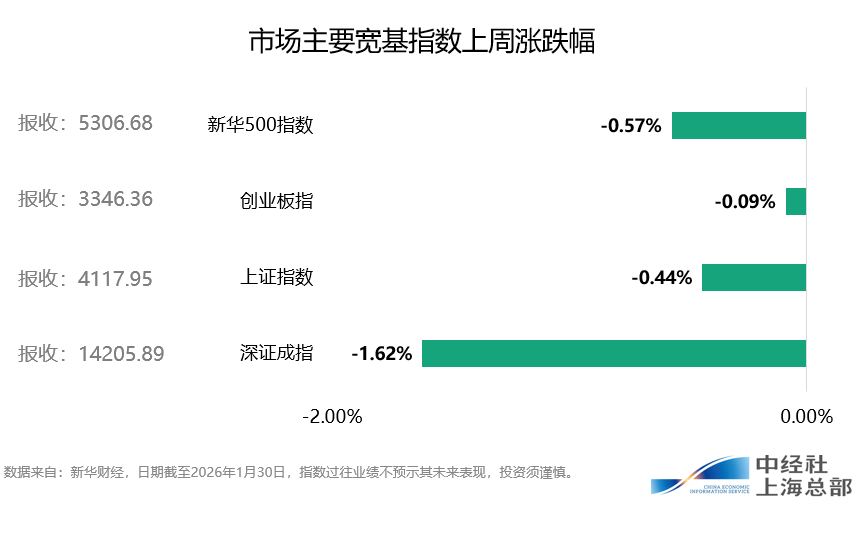
Stock Market Overview - The A-share market indices experienced declines during the week from January 26 to January 30, with the Shanghai Composite Index down by 0.44%, the Shenzhen Component down by 1.62%, the ChiNext Index down by 0.09%, and the Xinhua 500 Index down by 0.57% [1] - The Xinhua 500 Index showed increased volatility, opening at 5354.57 points and closing at 5306.68 points, with a weekly fluctuation of 3.01% and a total trading volume of 5.11 trillion yuan [1] Industry Performance - Most industry indices in the Shenwan first-level sectors declined, with the petroleum and petrochemical, telecommunications, coal, and non-ferrous metals sectors showing the largest gains, while the defense, electric equipment, automotive, and computer sectors experienced significant declines [4] US Stock Market - The US stock indices showed a mixed performance, with the S&P 500 Index rising by 0.34% for the week and 1.32% for January, marking its best monthly performance since October of the previous year [6] - The Dow Jones Industrial Average fell by 0.42% for the week but gained 1.73% in January, while the Nasdaq Composite Index decreased by 0.17% for the week and rose by 0.95% for January [6][7] Commodity Market - In the last trading week of January, precious metals experienced extreme volatility, with gold prices nearing $5600 per ounce before a significant reversal, closing down by 9.6% to around $4860 per ounce [8] - Silver prices also saw a dramatic drop, falling over 30% during the week but closing at approximately $85 per ounce [8] - Despite the weekly declines, COMEX gold futures recorded a 13% increase for January, while COMEX silver saw a monthly rise of over 20% [8][9] - International oil prices rose for four consecutive trading days, with Brent crude oil reaching $70 per barrel at one point, and WTI crude oil increasing by 7.65% for the week and 14.49% for January [8][9] Foreign Exchange Market - The US dollar index rebounded following the nomination of Kevin Warsh as the next Federal Reserve Chair, although it still fell by 0.4% for the week and 1.17% for January [10] - The euro and pound against the dollar rose for the second consecutive week, with the euro increasing by 0.2% for the week and 0.9% for January, and the pound rising by 0.29% for the week and 1.57% for January [10] Economic Indicators - The manufacturing Purchasing Managers' Index (PMI) for January was reported at 49.3%, a decrease of 0.8 percentage points from the previous month, indicating a slight contraction in the manufacturing sector [11] - The production index was above the critical point at 50.6%, while the new orders index fell to 49.2%, suggesting a decline in market demand [11]
长江研究2026年2月金股推荐
Changjiang Securities· 2026-02-01 11:23
Market Outlook - The market is expected to maintain a fluctuating upward trend around the Spring Festival in February 2026, with a focus on the "Technology + Resources" mainline market[3] - Key attention should be given to the earnings reports of US tech stocks and the potential validation of AI industry trends[3] Investment Strategy - Focus on three main lines: - Technology sector, including optical modules, storage, semiconductor equipment, and energy storage, addressing the issues of electricity shortages in the US, chip shortages domestically, and global storage shortages[3] - Non-ferrous metals, with increased volatility expected after January, particularly in industrial metals and chemicals[3] - Hot topics such as robots participating in the Spring Festival Gala and updates on AI large models[3] Recommended Stocks - **Metals**: Shandong Gold (EPS: 1.78, PE: 30.6 in 2026E)[20] - **Chemicals**: Juhua Co. (EPS: 2.51, PE: 15.7 in 2026E)[20] - **New Energy**: Junda Co. (EPS: 1.67, PE: 60.5 in 2026E)[20] - **Machinery**: Dier Laser (EPS: 2.87, PE: 30.6 in 2026E)[20] - **Military Industry**: Aero Engine Corporation (EPS: 0.35, PE: 132.9 in 2026E)[20] - **Non-Banking**: New China Life (EPS: 10.68, PE: 7.8 in 2026E)[20] - **Automotive**: Top Group (EPS: 1.92, PE: 37.7 in 2026E)[20] - **Electronics**: Jingce Electronics (EPS: 1.15, PE: 115.3 in 2026E)[20] - **Communication**: Zhongji Xuchuang (EPS: 17.40, PE: 37.3 in 2026E)[20] - **Media**: Giant Network (EPS: 2.12, PE: 20.8 in 2026E)[20] Risk Factors - Economic recovery may fall short of expectations, leading to slow growth or stagnation due to factors like slow job growth and reduced market demand[22] - Significant changes in individual stock fundamentals could lead to substantial declines in revenue or net profit[22]






投资策略周报:政策保驾护航,中长线资金入市仍是大趋势-20260201
HUAXI Securities· 2026-02-01 11:12
Market Review - The A-share market showed divergence this week, with the Dividend Index and Shanghai 50 leading in gains, while the North China 50, CSI 2000, and STAR 50 lagged behind. The average daily trading volume remained around 3 trillion yuan, indicating a high risk appetite among investors. The petroleum, telecommunications, and coal sectors led the gains, while defense, power equipment, and automotive sectors lagged. Low-position sectors like real estate and liquor also saw a strong rebound at one point. In the commodity market, precious metals prices plummeted, with silver and gold dropping by 26.42% and 9.25% respectively. The geopolitical tensions between the US and Iran drove international oil prices up, with WTI crude and ICE Brent rising by 7.65% and 7.32% respectively. The US dollar index exhibited a V-shaped trend, with the offshore yuan depreciating slightly against the dollar [1][2]. Market Outlook - The report emphasizes that policy support will continue to drive medium- to long-term capital inflows into the market. Despite signs of a temporary market adjustment amid increasing external disturbances, there remains ample space and opportunities for the current market trend from a mid-term perspective. The net outflow of stock ETFs has adjusted trading rhythms, but overall trading volume remains high, reflecting strong investor interest in high-growth sectors. The regulatory focus is on cultivating "patient capital" and increasing the participation of insurance and pension funds in the market, aiming to solidify the foundation for a slow bull market. The domestic demand showed marginal decline in January, but the recovery in price indices and sustained high growth in high-tech manufacturing create conditions for corporate profit recovery. With the narrowing decline in PPI, corporate profits are expected to enter a mild recovery phase in 2026 [2][4]. Economic Fundamentals - In January, the manufacturing PMI fell to 49.3%, and the non-manufacturing PMI dropped to 49.4%, both below the expansion threshold, indicating a marginal decline in domestic demand. However, improvements in prices and sustained high growth in new economic drivers were noted. The purchasing price index and the factory price index rose to 56.1% and 50.6% respectively, indicating overall price improvement in the manufacturing market, which is expected to narrow the PPI decline further. The high-tech manufacturing PMI remained above 52.0% for two consecutive months, reflecting sustained high growth in new economic drivers, while traditional sectors like consumer goods and high-energy industries showed marginal declines [3][4]. Capital Market Policies - The China Securities Regulatory Commission (CSRC) is committed to consolidating the positive momentum in the capital market and is intensifying efforts to cultivate patient capital and promote medium- to long-term capital inflows. On January 30, CSRC Chairman Wu Qing held a meeting to discuss enhancing the adaptability of regulatory frameworks, improving the quality and investment value of listed companies, and increasing the efficiency of refinancing. As of the end of 2025, various types of medium- to long-term capital held A-share circulating market value reached 23 trillion yuan, a 36% increase from the beginning of the year. Looking ahead to 2026, under the policy framework focused on stability, the regulatory authorities will continue to promote the increase in the scale of medium- to long-term capital entering the market [4][5]. Micro Liquidity - Since the beginning of the year, there has been a large-scale redemption of stock ETFs, with a cumulative net redemption of 792.2 billion yuan, primarily concentrated in broad-based ETFs like CSI 300 and Shanghai 50. Despite this, the A-share market remains active, with trading volumes around 3 trillion yuan. Financing funds saw a net inflow of 16.1 billion yuan this week, indicating strong support for high-growth sectors. Although the A-share market has shown signs of temporary adjustment, there is still ample space and opportunities compared to previous bull markets. The report suggests focusing on high-growth technology sectors such as AI, robotics, and energy storage, as well as cyclical commodities related to price increases [5][4].
重回震荡,风格摇摆
Guotou Securities· 2026-02-01 11:11
- The report mentions a **cycle analysis model**, which is used to track market trends and identify potential stabilization signals. The model suggests that the market may have reached a small-scale stabilization point, indicating a shift into a short-term oscillation phase with a clearer oscillation range[2][7] - A **trend model** is also referenced, which remains in a bullish zone on a larger scale. This model supports the inference that the market's short-term movements are constrained within a two-way oscillation pattern[2][7] - The **industry rotation model** is highlighted, showing dispersed signals across various sectors. It identifies opportunities in low-valuation sectors like banking, adjusted sectors like media, and sectors that have been consolidating, such as communication and growth-oriented industries. This model suggests a balanced allocation strategy for the current market environment[7] - The **four-wheel drive industry model** is presented, which provides specific signals for sector opportunities. For example, it identifies potential opportunities in sectors like photovoltaic leaders, communication, and banking, as well as trading opportunities in growth-oriented sectors and media. The model uses signal types such as "potential opportunity" and "trading opportunity" to guide sector allocation[13]
融资客一周扫货名单出炉!下周两大板块获投资者看好
Sou Hu Cai Jing· 2026-02-01 09:53
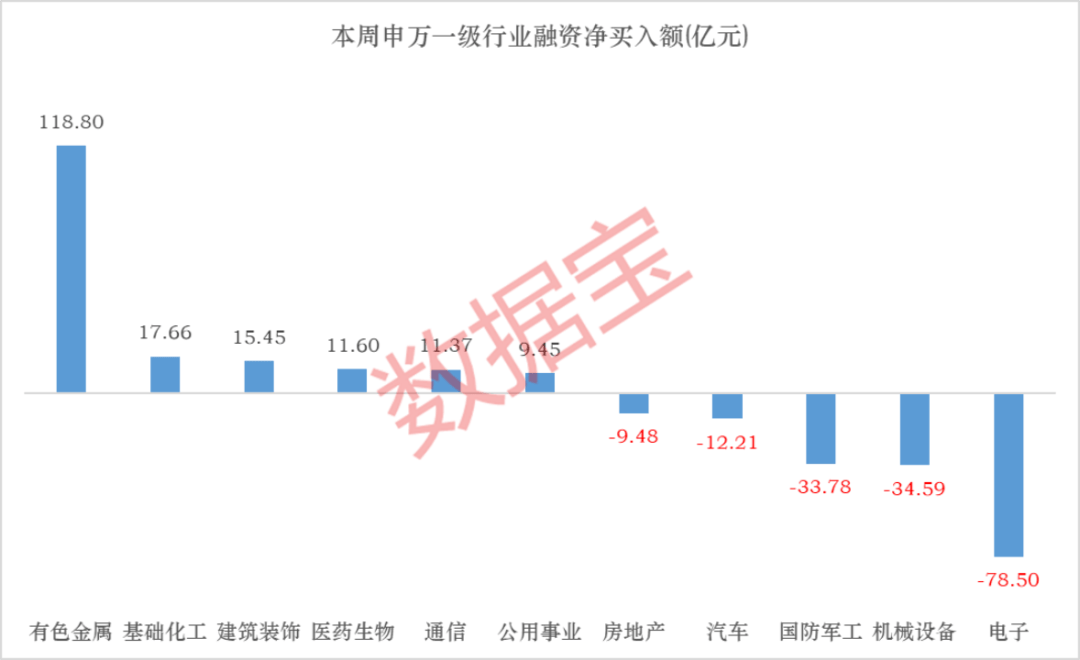
Group 1 - The core point of the article highlights that the A-share financing balance remains high at 27,222.32 billion yuan, with a net financing inflow of 5.279 billion yuan for the week [1] - In terms of industry performance, non-ferrous metals lead with a net financing inflow of 11.88 billion yuan, while sectors like basic chemicals, construction decoration, pharmaceuticals, and communications also saw inflows exceeding 1 billion yuan [1] - The electronics sector experienced significant net repayments amounting to 7.85 billion yuan, followed by machinery and defense industries with repayments over 3 billion yuan each [1] Group 2 - Individual stocks saw substantial net inflows, with Zijin Mining, Tianfu Communication, and China Ping An leading at 2.873 billion yuan, 2.559 billion yuan, and 1.254 billion yuan respectively [3] - Zijin Mining announced a strategic acquisition of all issued shares of a gold mining company, which includes significant assets in Mali and Ivory Coast, expected to enhance its position in the global gold market [3] - The non-ferrous metals sector includes multiple stocks with net inflows over 4 billion yuan, indicating strong demand driven by global energy and supply chain dynamics [4] Group 3 - The electric equipment sector, including stocks like Maiwei Co., Mingyang Smart Energy, and CATL, also attracted significant financing interest [5] - A total of 131 stocks experienced net repayments exceeding 1 billion yuan, with Industrial Fulian and China Satellite leading the repayments at 1.701 billion yuan and 1.475 billion yuan respectively [10] - The commercial aerospace sector, previously popular, faced large net repayments, indicating a shift in investor sentiment despite ongoing government support and technological advancements [8] Group 4 - The A-share market showed mixed performance, with the Shanghai Composite Index slightly down by 0.44%, closing at 4,117.95 points [11] - Investor sentiment remains neutral, with 54% expecting the market to oscillate between 4,100 and 4,200 points in the coming week [11] - The technology sector is favored for the upcoming week, with 54% of surveyed investors expressing optimism, while the enthusiasm for non-ferrous metals has decreased [13]




通信行业研究:头部光模块厂商发布业绩预告,阿里资本开支有望再上修
SINOLINK SECURITIES· 2026-02-01 09:28
Investment Rating - The report suggests a positive outlook for the AI-driven sectors, particularly in servers and IDC, driven by domestic and international AI developments [4]. Core Insights - Major companies like Industrial Fulian, Meta, and Microsoft are showing strong growth in their earnings, driven by AI investments and demand for high-performance computing [1][53]. - The report highlights a significant increase in capital expenditures by tech giants, indicating a robust investment trend in AI infrastructure [1][61]. - The demand for optical modules and servers is expected to rise due to the ongoing expansion of AI capabilities and infrastructure [2][35]. Summary by Sections Industry Overview - The telecommunications sector is experiencing steady growth, with a reported revenue of 16,096 billion yuan, reflecting a 0.9% year-on-year increase [3][14]. - The optical module exports have seen a decline, with a 24% drop in November, attributed to domestic companies establishing overseas factories [3][35]. Company Performance - Industrial Fulian anticipates a net profit of 351-357 billion yuan for 2025, marking a 51%-54% increase year-on-year, driven by strong growth in cloud services and AI servers [1][53]. - Meta's revenue for Q4 reached $59.893 billion, a 24% increase year-on-year, supported by recovering advertising business and AI investments [1][53]. - NewEase is expected to achieve a net profit of 94-99 billion yuan in 2025, reflecting a growth of 231.24%-248.86% due to increasing demand for high-speed products [1][55]. Market Trends - The server index decreased by 5.70% this week but has increased by 1.20% for the month, indicating volatility in the market [2][6]. - The optical module index rose by 10.07% this week, reflecting strong demand for high-speed optical devices [2][6]. - The IDC index increased by 3.50% this week, with a notable 11.04% rise for the month, driven by advancements in AI models [2][9]. Future Projections - Companies are expected to continue investing heavily in AI infrastructure, with Alibaba planning to increase its investment in AI and cloud computing from 380 billion yuan to 480 billion yuan over the next three years [1][12]. - The report anticipates that the demand for AI-related services and products will continue to grow, leading to further investment opportunities in the sector [4][35].





2026年2月份投资策略报告:春季行情有望延续-20260201
Dongguan Securities· 2026-02-01 09:04
2026 年 2 月 1 日 春季行情有望延续 投 资 2026 年 2 月份投资策略报告 投资要点: S0340523110001 电话:0769-22119276 邮箱:zenghao@dgzq.com.cn | 邮箱:zenghao@dgzq.com.cn 上证指数 4117.95 深证成指 14205.89 | 涨跌幅 3.76% 5.03% 证 券 研 究 | | --- | --- | | 收盘点位 | | | 沪深 300 4706.34 | 1.65% | | 创业板指 3346.36 | 4.47% | | 北证 50 1531.55 | 6.33% | | 科创 50 1509.40 | 12.29% | | 资料来源:东莞证券研究所,iFinD 上证指数月线走势 | 报 | | 告 | | | 资料来源:东莞证券研究所,Wind | | 上证指数月线走势 本报告的风险等级为中风险。 本报告的信息均来自已公开信息,关于信息的准确性与完整性,建议投资者谨慎判断,据此入市,风险自担。 请务必阅读末页声明。 月度策略/A 股市场 分析师:费小平 资料来源:东莞证券研究所,Wind SAC 执业证 ...
投资组合报告:2026年二月策略金股报告
ZHESHANG SECURITIES· 2026-02-01 08:51
Group 1 - February macro outlook indicates a favorable macro environment for equity markets, with expectations of strong economic and credit data at the beginning of the year [7][9] - The strategy outlook suggests a transition in market styles, with a focus on growth "rest" and a continued bullish stance while adjusting portfolio structures [9][10] - The quantitative strategy emphasizes investing in small-cap stocks and taking long positions before the Spring Festival [10] Group 2 - The February gold stock selection includes companies from various sectors: - Electronics: Shiyun Circuit, Shengkong Co. - Consumer Electronics: Baiwei Storage - Computing: Yunsai Zhiliang - Communication: Kexin Innovation Source - Non-ferrous Metals: Shengtun Mining, Luoyang Molybdenum - Machinery: Zhonglian Heavy Industry - Coal: Huaibei Mining - Non-bank Financials: Dongfang Securities [12][14] - The rationale for selected stocks includes: - Shiyun Circuit is expected to benefit from emerging fields such as commercial aerospace and intelligent driving, potentially leading to significant growth [13] - Shengkong Co. is positioned to gain from the semiconductor cycle, with demand driven by AI and storage needs [17] - Baiwei Storage is set to capitalize on the AI infrastructure boom, with a focus on domestic market share growth [20] - Yunsai Zhiliang is anticipated to see increased demand for cloud services and IDC, driven by AI advancements [22] - Kexin Innovation Source is expected to achieve breakthroughs in the AI liquid cooling market, enhancing revenue and profitability [26] - Shengtun Mining is projected to improve profitability through copper price increases and strategic acquisitions [31] - Luoyang Molybdenum is expected to benefit from increased copper and cobalt production, alongside new gold mining projects [35] - Zhonglian Heavy Industry is positioned for growth through diversification in machinery sectors and global expansion [40] - Huaibei Mining is highlighted for its high elasticity in coking coal, with price improvements expected in 2026 [46] - Dongfang Securities is set to benefit from regulatory support and potential mergers, enhancing its market position [49]






周末影响市场重要资讯回顾:白银史诗级暴跌 黄金创40年最大跌幅
Xin Lang Cai Jing· 2026-02-01 08:35
Group 1: Market and Economic Indicators - The manufacturing PMI for January is reported at 49.3, a decrease of 0.8 percentage points from the previous month, indicating a decline in economic activity [4][58] - The Ministry of Finance announced that the securities transaction stamp duty is expected to reach 203.5 billion yuan in 2025, reflecting a growth of 57.8% [3][57] - The national general public budget revenue for 2025 is projected to be 21.6 trillion yuan, a decrease of 1.7% compared to 2024, with tax revenue expected to grow by 0.8% [8][61] Group 2: Regulatory Developments - The China Securities Regulatory Commission (CSRC) is proposing to expand the types of strategic investors and clarify minimum shareholding requirements, aiming to enhance the stability of capital markets [15][54] - The CSRC is also focusing on improving the regulatory framework to support high-quality development in the capital market [14] Group 3: Commodity Market Movements - Silver prices experienced a historic drop of 36%, while gold prices fell over 12%, marking the largest single-day declines in 40 years [23][54] - The Chicago Mercantile Exchange has raised margin requirements for precious metal futures in response to the volatility in the market [54] Group 4: Energy Sector Developments - The National Development and Reform Commission and the National Energy Administration have issued a notice to improve the pricing mechanism for power generation capacity, allowing for flexible pricing based on market supply and demand [5][59][10] - The notice encourages the signing of flexible pricing mechanisms in medium to long-term contracts to better reflect real-time supply and demand [11][59] Group 5: Corporate Earnings Forecasts - New Yi Sheng expects a net profit of 9.4 billion to 9.9 billion yuan for 2025, representing a year-on-year increase of 231.24% to 248.86% [27] - Zhongji Xuchuang forecasts a net profit of 9.8 billion to 11.8 billion yuan for 2025, with a growth rate of 89.50% to 128.17% [28] - Wan Ke A anticipates a net loss of approximately 82 billion yuan for 2025, primarily due to a significant decrease in project settlement scale [32][33]