
医药

Search documents
突然“崩了”,20cm跌停!股民:离谱……
Zhong Guo Ji Jin Bao· 2025-12-15 03:04
Market Overview - On December 15, A-shares opened lower with the Shanghai Composite Index down 0.62%, Shenzhen Component down 0.81%, and ChiNext down 1.16% [1] - By the time of reporting, the market's decline had narrowed significantly [1] Consumer Sector Performance - The consumer sector showed signs of recovery on December 15, with strong performances in the food and beverage sector, particularly in dairy and liquor stocks [3] - Notable stocks included: - Huanlejia reached a 20% limit up - Huangtai Liquor, Huangshi Group, Yangguang Dairy, and Junyao Health also hit the limit up - Anji Food and several others saw significant gains [3][4] Retail Sector Strength - The retail sector also performed well, with Baida Group achieving three consecutive limit ups and Dongbai Group hitting the limit up [5] - Other rising stocks included: - Haizhi Wang and Aiying Room with increases of 7.56% and 5.85% respectively [5] Policy Support for Consumption - The Ministry of Commerce, the People's Bank of China, and the Financial Regulatory Bureau proposed 11 policy measures to boost consumption, focusing on key areas [5] - Measures include enhancing the consumer goods exchange service platform and encouraging businesses to issue consumption vouchers [5] CPO Sector Weakness - The CPO sector continued to weaken, with Changfei Fiber hitting the limit down on December 15 [7] - Other stocks in the sector, such as Shijia Photon, also experienced declines exceeding 9% [10] One-Pin Red Stock Performance - One-Pin Red opened significantly lower and quickly hit the 20% limit down, closing at 37.32 CNY per share, with a total market value dropping to 16.9 billion CNY [11][14] - The decline was attributed to the perceived inadequacy of the acquisition price for its stake in the U.S. company Arthrosi, which was announced to be acquired for 950 million USD (approximately 6.713 billion CNY) [14]



中央经济工作会议火线解读
2025-12-15 01:55
Summary of Key Points from the Central Economic Work Conference Industry and Company Involvement - The conference focuses on the overall economic landscape of China, emphasizing various sectors including real estate, healthcare, technology, and consumer services. Core Insights and Arguments 1. **Economic Potential and Reform**: The conference emphasizes the need to tap into economic potential by leveraging institutional, market, industrial, and talent advantages to drive reform and opening up [3][2] 2. **Macroeconomic Policies**: Fiscal policy is expected to maintain necessary expenditure levels with a deficit rate around 4%. Monetary policy will be flexibly applied, with a significant likelihood of a 10 basis point interest rate cut and a 50 basis point reserve requirement ratio cut in the first quarter [6][14] 3. **Domestic Demand Initiatives**: Plans to increase urban and rural residents' income to boost consumption and stabilize investment, particularly in infrastructure and real estate, are highlighted [7][17] 4. **Reform and Innovation Focus**: Emphasis on developing new productive forces and establishing international technology innovation centers in key regions like Beijing-Tianjin-Hebei and the Greater Bay Area [8][3] 5. **Quality Growth**: The conference shifts focus from merely stabilizing growth to enhancing quality, indicating a prioritization of qualitative improvements over quantitative growth [5][13] 6. **Risk Prevention**: Attention is drawn to risks in the real estate market and local government financing platforms, with a continued focus on the "housing is for living, not speculation" framework [9][20] Additional Important Content 1. **Investment Focus Areas for 2026**: Key investment areas include: - "Two重" investments focusing on infrastructure and major projects - National unified market initiatives - New productive forces such as quantum technology and AI [21][22] 2. **Healthcare Sector Directives**: The conference outlines support for innovative drugs, optimization of drug procurement policies, and reforms in medical insurance payment methods [36] 3. **Technology and AI Emphasis**: The importance of AI in driving economic growth is reiterated, with a focus on integrating AI with the real economy and supporting major tech innovation centers [37][38] 4. **Real Estate Market Strategies**: Strategies to stabilize the real estate market include converting unsold inventory into affordable housing and maintaining a cautious approach to policy changes [28][20] 5. **Consumer Services Outlook**: The focus on enhancing service consumption and addressing unreasonable restrictions in sectors like housing and automotive is noted, with an emphasis on long-term sustainable growth rather than short-term stimulus [34][31] This summary encapsulates the key points from the Central Economic Work Conference, highlighting the strategic directions and policy measures that will shape China's economic landscape in the coming years.
中泰国际每日晨讯-20251215
ZHONGTAI INTERNATIONAL SECURITIES· 2025-12-15 01:50
Market Overview - On December 12, the Central Economic Work Conference emphasized the need for internal strengthening to address external challenges and to continue implementing a moderately loose monetary policy[1] - The Hang Seng Index rose by 446 points (1.8%) to close at 25,976 points, with a peak increase of 475 points during the day[1] - The Hang Seng Technology Index increased by 103 points (1.9%) to close at 5,638 points, with total market turnover expanding to HKD 242.7 billion[1] - Southbound capital experienced a net outflow of HKD 5.29 billion[1] Sector Performance - Gold prices increased, with Zijin Mining (2899 HK) rising by 3.6%, Shandong Gold (1787 HK) and Zhaojin Mining (1818 HK) both up by 3.4%[1] - Consumer stocks performed well, with Mengniu Dairy (2319 HK) up 2.7%, Nongfu Spring (9633 HK) up 2.2%, and Haidilao (6862 HK) up 2.9%[1] - Technology stocks also saw gains, with Alibaba (9988 HK) and Tencent (700 HK) rising by 2.3% and 2.4%, respectively[1] U.S. Market Dynamics - Despite interest rate cuts, U.S. tech stocks continued to decline, with the Nasdaq Composite falling by 245 points (0.5%) to close at 48,458 points[2] - The S&P 500 index dropped by 73 points, closing at 6,827 points, while long-term bond yields rose to 4.189%[2] Macroeconomic Indicators - As of the end of November, China's broad money supply (M2) stood at CNY 336.99 trillion, growing by 8% year-on-year, slightly below the market expectation of 8.2%[3] - Narrow money supply (M1) reached CNY 112.89 trillion, with a year-on-year growth of 4.9%, also below the expected 5.7%[3] - The loan balance grew by 6.4% year-on-year, down from the previous 6.5%[3] Industry Insights - In the automotive sector, stocks related to smart driving performed well, with Xiaoma Zhixing (2026 HK) up 4.9% and Horizon Robotics (9660 HK) up 3.8%[4] - The energy/utilities sector saw traditional power equipment stocks rise, with Dongfang Electric (1072 HK) increasing by 16.8% over the week[4] - The pharmaceutical sector remained stable, with WuXi AppTec (2359 HK) and WuXi Biologics (2269 HK) showing solid performance despite potential regulatory challenges[5]
华泰 港股策略:左侧布局市场“预期差”
Jin Rong Jie· 2025-12-15 00:47
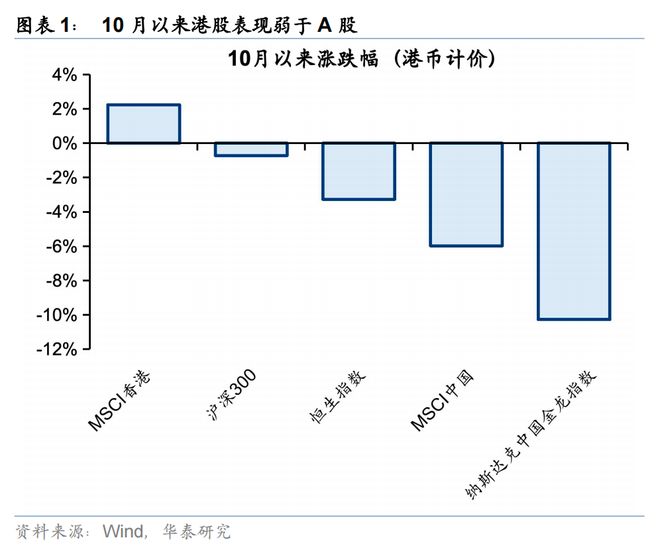
Market Overview - The current market has limited downside potential, but the upside remains uncertain. The sentiment indicator for Hong Kong stocks is still in a pessimistic range, indicating a bottoming phase similar to November 2024. After entering a panic zone, the market saw a significant rebound in early 2025, catalyzed by DeepSeek before the Lunar New Year [1]. - The expected catalysts for future market movements may arise from three key areas: 1) Renminbi appreciation, which could lead to significant changes in capital flows once consensus forms; 2) Companies expanding overseas, with expectations of resilience in exports despite concerns over exchange rate appreciation; 3) Breakthroughs in domestic technology and independent paths [1]. Performance Comparison - Hong Kong stocks have underperformed compared to A-shares, with the MSCI Hong Kong index declining by 3.3% and the Hang Seng index by 10.3% since October, while the MSCI China index rose by 2.2% [2][3]. - The AH premium index has shown minimal change, indicating that the differences in sentiment and liquidity between the two markets are not the core reasons for the underperformance [2]. Sector Analysis - Since October, sectors such as electronics, pharmaceuticals, and retail (including e-commerce and new consumption companies) in the Hong Kong stock market have experienced declines exceeding 10% [2][6]. - The market sentiment has been particularly affected by the performance of unique assets in Hong Kong, with southbound funds focusing on these sectors [2]. Capital Flow and Sentiment - Southbound capital inflows have significantly decreased, with net buying intensity dropping from around 90 at the end of September to nearly zero currently [2][9]. - The overall liquidity environment is expected to improve, which may lead to a rebound in certain sectors, particularly technology and pharmaceuticals in the short term [1]. Economic Policy Insights - The Central Economic Work Conference emphasized structural adjustments, focusing on quality and efficiency improvements, with a moderate fiscal policy stance and a commitment to appropriate monetary easing [12]. - Key tasks include boosting domestic demand, promoting technological innovation, and addressing real estate risks, which may influence market dynamics moving forward [12].
早报(12.15)| 持续5小时!美乌柏林会谈取得“重大进展”;美军被袭击,特朗普扬言报复;SpaceX筹划“史上最大IPO”
Ge Long Hui· 2025-12-15 00:40
Group 1 - The US and Ukraine delegations held talks in Germany, achieving "significant progress" on key issues such as territory, security guarantees, and the €210 billion in frozen Russian central bank assets [1] - Ukraine's President Zelensky stated that Ukraine has abandoned its long-term goal of joining NATO as a compromise to secure Western security guarantees to end the conflict with Russia [1] - The South Korean government held an emergency meeting to address the depreciation of the Korean won, which has fallen over 4% this quarter due to high interest rate differentials with the US and capital outflows [4] Group 2 - The A-share market saw the Shanghai Composite Index decline by 0.34%, while the Shenzhen Component Index and the ChiNext Index increased by 0.84% and 2.74%, respectively [2] - In the US stock market, the Dow Jones rose by 10.5%, while the Nasdaq and S&P 500 fell by 1.62% and 0.63%, respectively, with major tech stocks experiencing declines [2] - Over 90% of private equity products reported positive returns, with an average return of 22.61%, and quantitative long strategies leading with a return of 36.24% [10] Group 3 - SpaceX confirmed a potential IPO plan for 2026, with a valuation of $800 billion, doubling from $400 billion in July [12] - The Chinese liquor market is stabilizing, with prices for premium brands like Moutai and Wuliangye showing signs of recovery after new production control policies were introduced [13] - The introduction of a humanoid robot App Store by Yushu Technology allows users to deploy cloud algorithms without programming, marking a shift towards software ecosystem competition in the robotics industry [14]

上证早知道|《阿凡达3》有望推升电影票房;脑虎科技助植入者实现无线自由;芯片巨头重大资产重组终止
Shang Hai Zheng Quan Bao· 2025-12-14 23:01
Group 1 - The People's Bank of China will conduct a 600 billion yuan reverse repurchase operation on December 15, with a term of 6 months [1] - The 2025 China Automotive Software Conference will be held in Shanghai from December 15 to 16 [1] - The World Tourism Economic Forum 2025 Summit will take place in Harbin from December 15 to 17 [1] Group 2 - As of the end of November, the total social financing scale was 440.07 trillion yuan, a year-on-year increase of 8.5% [2] - The seventh United Nations Environment Assembly concluded on December 12, passing 11 resolutions and 3 decisions to promote sustainable practices in various sectors [2] - A mandatory national standard for electronic product information clearing will be implemented starting January 1, 2027 [2] Group 3 - The population of Xiong'an has reached approximately 1.4 million, indicating significant growth and the initial emergence of new urbanization [3] Group 4 - In November, global physical gold ETF inflows reached 5.2 billion USD, marking six consecutive months of inflows [4] Group 5 - As of December 13, 2025, China's film box office has surpassed 50 billion yuan, an increase of nearly 7.5 billion yuan compared to the entire year of 2024 [5] - The film "Nezha: The Devil Child Is Coming" leads the box office with 15.446 billion yuan [5] Group 6 - A new brain-computer interface product has completed its first clinical trial, allowing a paralyzed patient to browse the web and play games wirelessly [9] - The global brain-computer interface market is projected to reach 2.94 billion USD by 2025, with a compound annual growth rate of 17.35% [9] Group 7 - CIMC Raffles has signed a contract for eight methanol dual-fuel container ships with a total investment exceeding 500 million USD [11] - The global shipbuilding market is expected to recover as issues related to capacity and financing are resolved by 2026 [12] Group 8 - Kweichow Moutai has launched a quantity control measure to stabilize channel expectations and optimize product structure [13] - The price of the 25-year Flying Moutai has increased by 70 yuan to 1,570 yuan per bottle [13] Group 9 - Huazhong Technology has received FDA pre-market notification for its flu and COVID-19 test kits, allowing for normal sales in the U.S. market [14] - A court ruling has ordered a compensation payment of 3.029 billion yuan to Huaying Technology, which is expected to positively impact the company's operations [14]
新起点、新动能、新机遇——国际人士瞩目中央经济工作会议为世界注入确定性
Jing Ji Ri Bao· 2025-12-14 22:30
Core Viewpoint - The recent Central Economic Work Conference in Beijing has set the direction for China's economy, aiming to provide stability and opportunities for the global economy amidst uncertainties [1][2]. Economic Outlook - The conference highlighted that the main economic and social development goals for 2025 will be successfully completed, marking a strong start for the new "15th Five-Year Plan" [2]. - International organizations have raised China's economic growth forecasts for 2025 by 0.4, 0.2, 0.1, and 0.1 percentage points respectively, reflecting growing confidence in China's economic resilience [3]. Policy Focus - The conference emphasized the need to fully tap into economic potential, combining policy support with reform and innovation, and focusing on both material and human investment [3]. - Key tasks for the upcoming year include innovation-driven development, expanding domestic demand, and enhancing the quality of life for citizens [4][9]. New Growth Drivers - The conference underscored the importance of innovation and the establishment of international technology innovation centers in major regions like Beijing, Shanghai, and the Guangdong-Hong Kong-Macau Greater Bay Area [7]. - A strong domestic market is identified as a strategic foundation for modernization, with specific actions to boost consumption and stabilize investment [9]. Global Cooperation - The launch of the Hainan Free Trade Port is a significant step towards high-level opening up and promoting an open world economy [10]. - The conference outlined eight key tasks for the next year, with a strong emphasis on expanding international cooperation and optimizing free trade zones [10][11]. Market Potential - China's expanding market access in various sectors, including finance, automotive, and digital services, is creating a more predictable and transparent environment for foreign investment [11]. - The growth of e-commerce and logistics in China is facilitating easier access for international products, enhancing opportunities for global businesses [11][12].
局部人气聚集推升新股板块交投意愿,但活跃周期开启可能仍待观察
Huajin Securities· 2025-12-14 10:30
Group 1 - The new stock sector is experiencing increased trading willingness due to localized popularity, but the overall active cycle may still require observation [1][12] - The average increase of new stocks listed since 2024 is approximately 1.5%, with about 54.2% of stocks achieving positive returns [1][12] - The recent performance of specific new stocks, such as Moer Thread, has significantly boosted trading activity, indicating a potential rise in investor interest [1][12] Group 2 - The average issuance price-earnings ratio for new stocks in December has slightly increased, with the main board's average at 27.1X, up from 24.3X the previous month [13][19] - The first-day average closing price-earnings ratio for new stocks on the main board in December is 102.8X, significantly higher than the previous month's average of 63.1X [16][19] - The first-day trading enthusiasm for new stocks has cooled, with an average first-day increase of only 146.6%, compared to 350% in the previous week [24][25] Group 3 - Upcoming new stocks include Angrui Micro and Muxi Co., with average issuance price-earnings ratios of 33.7X for the new stocks expected to be listed [3][31] - The new stocks set to be issued this week include 7 stocks across various boards, maintaining a good subscription profit effect [31][32] - Specific companies like Jianxin Superconducting and Shuangxin Environmental Protection are highlighted for their potential, with significant expected revenue growth [32][35]
2025 年全国医疗保障工作会议点评:优化集采,支持医药产业创新发展
GUOTAI HAITONG SECURITIES· 2025-12-14 07:29
Investment Rating - The report assigns an "Accumulate" rating for the industry [1] Core Insights - The National Medical Security Work Conference emphasizes the continuation of optimizing centralized procurement policies in 2026, promoting the development of maternity insurance and long-term care insurance, and leveraging strategic purchasing to support the innovative drug industry [3] - The report highlights the importance of commercial health insurance in complementing basic medical insurance and encourages investment in innovative drug development [5] Summary by Sections National Medical Security Work Conference - The conference held on December 13, 2025, summarized the work during the "14th Five-Year Plan" period and outlined the tasks for 2026, including support for commercial health insurance and the establishment of a multi-tiered medical security system [5] - The National Medical Security Bureau will promote the inclusion of flexible employment workers and migrant workers in maternity insurance coverage, aiming for "no out-of-pocket" expenses for childbirth within policy limits [5] Support for Innovative Drug Development - The report discusses the strategic role of medical insurance in fostering healthy competition and differentiated innovation within the pharmaceutical industry [5] - It mentions the implementation of new rounds of national centralized procurement for drugs and high-value medical consumables, aiming to enhance the efficiency of company receivables [5]
浙商证券:市场分化之下A股冲高回落 多看少动、耐心等待
Xin Lang Cai Jing· 2025-12-14 06:58
来源:浙商证券股份有限公司 核心观点 本周市场明显分化、呈现"沪弱深强"格局,多数宽基指数冲高回落。展望后市,由于以上证为代表的权 重指数勉强站上5 周均线,但还未收复前期上升趋势线;而在算力链"强势吸金"的背后,市场出现明显 分化格局。我们预计,在"权重不够强、行业大分化"的局面下,市场或继续维持区间震荡格局。配置方 面,基于"市场分化震荡继续,多看少动守株待兔"的判断:择时方面,建议持仓等待,切勿追涨杀跌、 垫高自身成本,同时根据不同宽基指数的"左脚"分类设定目标,伺机出击、分批介入。行业配置,建议 关注明显滞涨且份额扩张的券商板块、走势顺畅且历史上在12 月胜率较高的家电,以及近期利好频出 的机械设备。个股方面,留意医药、消费、AI 应用板块中相对低位的标的,同时关注年线上方低位滞 涨个股。 本周(2025-12-08 至2025-12-12)行情概况(1)主要指数:市场呈现"沪弱深强"格局,多数宽基指数冲 高回落。(2)板块观察:算力携硬科技领涨,大周期和消费走弱。(3)市场情绪:沪深成交环比上 升,IC 股指期货合约升水。(4)资金流向:两融余额小幅上升,有色金属ETF 净流入最多。(5)量 化"黑 ...
