
Hua Er Jie Jian Wen

Search documents
在美国“医药春晚”,中国药企从“可选消费”变成“必选消费”
Hua Er Jie Jian Wen· 2026-01-14 06:45
Core Insights - The recent J.P. Morgan Global Healthcare Conference highlighted an increased focus on mergers and external licensing among multinational pharmaceutical companies, particularly regarding innovative drug assets from China [1][2] - J.P. Morgan's analysis indicates that Chinese innovative drugs have evolved from being optional assets to a category that multinational companies must systematically evaluate during asset selection, although this change is highly dependent on clinical data and global development capabilities [1][2][5] Group 1: Mergers and Acquisitions - Mergers and acquisitions are becoming essential survival tools for pharmaceutical companies due to expiring core patents, declining internal R&D returns, and intensified competition in key therapeutic areas [2] - The criteria for selecting external assets have shifted from merely technical concepts to the ability to enter late-stage clinical or registration phases within a controllable timeframe [2][5] Group 2: Clinical Progress and Cost Considerations - The attention on Chinese innovative drugs is primarily driven by clinical progress rather than cost advantages, with R&D costs being a secondary factor compared to time and certainty [3] - Some Chinese pharmaceutical projects have advanced to compete globally in certain indications, not due to innovative mechanisms but due to clinical execution efficiency and patient enrollment speed [3][5] Group 3: External Licensing as a Risk Management Tool - External licensing is increasingly viewed as a risk management strategy rather than a passive monetization approach, helping Chinese companies reduce uncertainty in global development [4] - For external licensing to enhance long-term value, the assets must have clear clinical positioning and scalability; otherwise, such transactions may only serve as one-time financial arrangements [4] Group 4: Industry Dynamics and Investment Focus - The current changes reflect an upgrade in the asset selection mechanism rather than an overall revaluation of the industry, with some Chinese innovative projects entering the evaluative scope due to their progress and data quality [5][6] - The differentiation within the Chinese pharmaceutical sector is expected to intensify, with projects that can meet global evaluation criteria likely to attract more capital attention [6] Group 5: Ongoing Risks - Despite the positive trends, inherent risks in the pharmaceutical industry remain, including clinical failures, competitive landscape changes, and regulatory uncertainties, which can significantly impact asset valuations [7] - The assessment of the global potential of Chinese innovative drugs should be based on verifiable data and pathways rather than merely on trend narratives [7]
交付即正义!高盛:高龄的美国电网,正为中国电力供应商提供历史性机遇
Hua Er Jie Jian Wen· 2026-01-14 06:03
Core Insights - The core contradiction in AI infrastructure construction is shifting from merely pursuing GPU quantities to competing for power supply speed, with "Time-to-Power" becoming the most severe bottleneck in AI development [1] - Chinese power solution providers, capable of rapid delivery and large-scale production, are experiencing a historic revaluation opportunity due to this shift [1] Group 1: Power Supply Challenges - The average lifespan of power grids in the US and EU has reached 35 to 40 years, and the infrastructure is increasingly fragile in the face of explosive energy demands from AI data centers [1] - Currently, US domestic power equipment capacity meets only about 40% of local demand, with interconnection waiting times extending to nearly five years [1] - Goldman Sachs projects that by 2030, electricity consumption in US data centers will increase by approximately 175% compared to 2023, contributing about 120 basis points to overall electricity demand [3] Group 2: Market Dynamics - The structural shortage in power supply is reshaping the pricing power within the supply chain, with qualified Chinese suppliers gaining a competitive edge through shorter delivery times rather than just lower costs [1][8] - Chinese suppliers can command significant price premiums in overseas markets, ranging from 10% to 80% compared to domestic sales, providing high visibility for profits [9] Group 3: Product Growth and Opportunities - The overall addressable market for AI data center power products is expected to expand at a compound annual growth rate (CAGR) of approximately 39% from 2025 to 2030, driven by capacity construction, increasing power density, and a shift from AC to DC architecture [5] - The 800V DC distribution architecture is becoming the standard for most AI data center projects, with potential energy savings of 5-15% compared to traditional AC structures [5] Group 4: Key Product Preferences - Goldman Sachs ranks the preference for power supply-related products as follows: gas turbine blades > power transformers > electrical components > uninterruptible power supply systems > liquid cooling systems > server power [11] - Gas turbine blades are prioritized due to high material science and manufacturing barriers, while power transformers follow due to labor-intensive manufacturing and lengthy certification processes [11] Group 5: Company Performance and Projections - Companies like Siyi Electric and Ingeteam are expected to benefit from the supply shortages in gas turbine blades and power transformers, with Siyi Electric's US market revenue projected to increase from 26% in 2026 to 28% in 2028 [8][10] - Goldman Sachs estimates that the average sales CAGR for Chinese companies in the US market will reach 23% from 2025 to 2030, with overseas AI data center market contributions expected to average 23% by 2030 [10]

拼多多杀入商超零售赛道?
Hua Er Jie Jian Wen· 2026-01-14 05:52
Core Viewpoint - Pinduoduo is quietly testing a new business called "Billion Supermarket" within its app, focusing on essential consumer goods, while major competitors like Alibaba and Meituan are heavily investing in instant retail and AI technologies [2][4]. Group 1: Business Development - The "Billion Supermarket" initiative leverages Pinduoduo's established "Billion Subsidy" system, offering limited-time coupons and low-price subsidies, currently available to a select group of users [2][4]. - The service is integrated into the existing "Billion Subsidy" channel on the app, without a separate entry point, which may hinder user recognition of the supermarket as a distinct offering [9]. Group 2: Competitive Landscape - Pinduoduo's entry into the supermarket sector is seen as a strategic move to enhance user engagement and retention, especially in the fast-moving consumer goods (FMCG) market, where competition is intensifying [4][5]. - Competitors like Alibaba's Tmall Supermarket and Meituan are aggressively expanding their instant retail capabilities, with Tmall aiming to dominate the market by enhancing its delivery services [6][8]. Group 3: Market Challenges - The supermarket sector is crowded with established players, making it challenging for Pinduoduo to gain a foothold, especially as the focus shifts from simple traffic subsidies to supply chain efficiency and service quality [9][10]. - Pinduoduo's current offering lacks the depth of product variety and delivery speed compared to competitors, which could impede its ability to compete effectively in the supermarket space [9][10]. Group 4: Strategic Advantages - Pinduoduo's strengths lie in its cost control capabilities and a strong foundation in lower-tier markets, which could provide a competitive edge in the supermarket sector [10]. - The company has a skilled team experienced in community group buying, which may enhance its supply chain capabilities as it ventures into supermarket retail [10].



从80%提高至100%,沪深北交易所上调融资保证金最低比例!
Hua Er Jie Jian Wen· 2026-01-14 04:50
Core Viewpoint - The China Securities Regulatory Commission has approved an adjustment to the financing margin ratio for the Shanghai and Shenzhen North Exchanges, increasing the minimum financing margin ratio from 80% to 100% for new financing contracts, aimed at reducing leverage and protecting investors' rights [1] Group 1 - The financing margin ratio was previously lowered from 100% to 80% in August 2023, which led to a steady increase in financing scale and trading volume [1] - Recent trends show a significant increase in financing transactions and relatively ample market liquidity, prompting the adjustment to return the margin ratio to 100% [1] - The adjustment applies only to new financing contracts, while existing contracts will continue to follow the previous regulations [1]
CES上的“物理AI”拐点:Robotaxi走向规模化,人形机器人供应链悄然形成
Hua Er Jie Jian Wen· 2026-01-14 04:09
Core Insights - The report from Deutsche Bank predicts that 2026 will mark a significant transition for AI in the physical world, particularly in the fields of autonomous vehicles and humanoid robots, moving from testing to scaling [1] Group 1: Humanoid Robots - The supply chain for humanoid robots is forming, with suppliers transitioning to provide integrated solutions and core components [1] - Schaeffler aims to be a key player in humanoid robotics by offering integrated planetary gear actuators, showcasing a compact unit with a torque range of 60–250 Nm [4] - Companies like NEURA and Hyundai Mobis are collaborating to leverage automotive supply chains for humanoid robot manufacturing [4] Group 2: Autonomous Vehicles - The deployment of Robotaxis is gaining momentum, with significant commercial activity expected in 2026, particularly with Tesla's planned launch [10] - Waymo has provided over 10 million paid rides and is expanding its services to international markets, indicating a shift from concept to operational data [15] - Mobileye plans to launch L4 Robotaxi services in Los Angeles this year, showcasing the industry's movement towards real-world applications [15] Group 3: Technology and Innovation - Nvidia remains the dominant player in onboard processors for humanoid robots, with companies like Boston Dynamics utilizing its technology for advanced capabilities [3] - The shift from scripted actions to visual-language-action (VLA) models allows robots to reason and adapt to new environments [3] - The competition in training methods is evolving, focusing on efficient closed-loop systems that integrate real-world data with simulations [7] Group 4: Cost Reduction and Scalability - The cost reduction formula for humanoid robots is driven by increased production volume and improved supplier negotiations [9] - Companies are targeting significant cost reductions, with projections indicating that manufacturing costs could drop from $200,000 to $50,000 as production scales [10] - Visteon is introducing modular solutions to help automakers integrate AI capabilities without overhauling existing architectures, enhancing cost competitiveness [13] Group 5: Market Dynamics - The CES 2026 event highlighted a shift in focus from feasibility to scalability and cost reduction in both autonomous vehicles and humanoid robots [14] - The industry's future will depend on tracking supply chain integration, production capacity, and unit cost curves rather than just innovative demonstrations [14]

AI数据中心电力供应链,高盛最偏好“燃气轮机叶片和变压器”,对这类中国企业是大机遇
Hua Er Jie Jian Wen· 2026-01-14 04:09
Core Insights - The global AI data center construction is facing a significant "power bottleneck," particularly in the U.S. market, creating historic opportunities for Chinese power supply chain companies with advantages in technology, cost, and delivery speed [1][2]. Group 1: Market Dynamics - Global AI data center capacity is expected to increase by approximately 73 gigawatts (GW) from 2025 to 2030, primarily concentrated in the U.S. and China [2]. - The U.S. is experiencing a more severe power supply bottleneck compared to other countries, with local power equipment capacity only meeting about 40% of domestic demand [4]. - The average power reserve capacity in the U.S. is projected to be around 100 GW from 2025 to 2030, while China's average reserve capacity is expected to reach 300 GW, indicating a more robust system [4]. Group 2: Supply Chain Challenges - Power generation equipment, particularly gas turbines and transformers, is identified as the most critical supply chain bottleneck, with shortages expected to persist until 2028-2030 [3]. - The production of gas turbine blades and transformers faces significant technical barriers and customization requirements, leading to slow capacity expansion [5]. Group 3: Competitive Advantages of Chinese Suppliers - Chinese suppliers are positioned to capture overflow demand due to their shorter delivery times compared to the 3-5 year wait for key components in the U.S. [7]. - The core competitive advantages of Chinese suppliers include not only cost but also faster delivery times and competitive products, particularly in high-voltage direct current (HVDC) technology and high-density power conversion [8][10]. - Chinese companies are expected to achieve an average sales compound annual growth rate of 23% from 2025 to 2030, with overseas AI data center markets contributing an average of 23% to their revenue by 2030 [1]. Group 4: Financial Implications - The pricing premium for Chinese suppliers in overseas markets can reach 10% to 80%, leading to significant gross margin expansion despite additional tariffs and logistics costs [9]. - The transition to 800V direct current architecture is anticipated to save 5-15% in energy consumption, benefiting suppliers with expertise in this area [6][12].
冰火两重天:美国电价要爆了,中国电价开跌了
Hua Er Jie Jian Wen· 2026-01-14 03:38
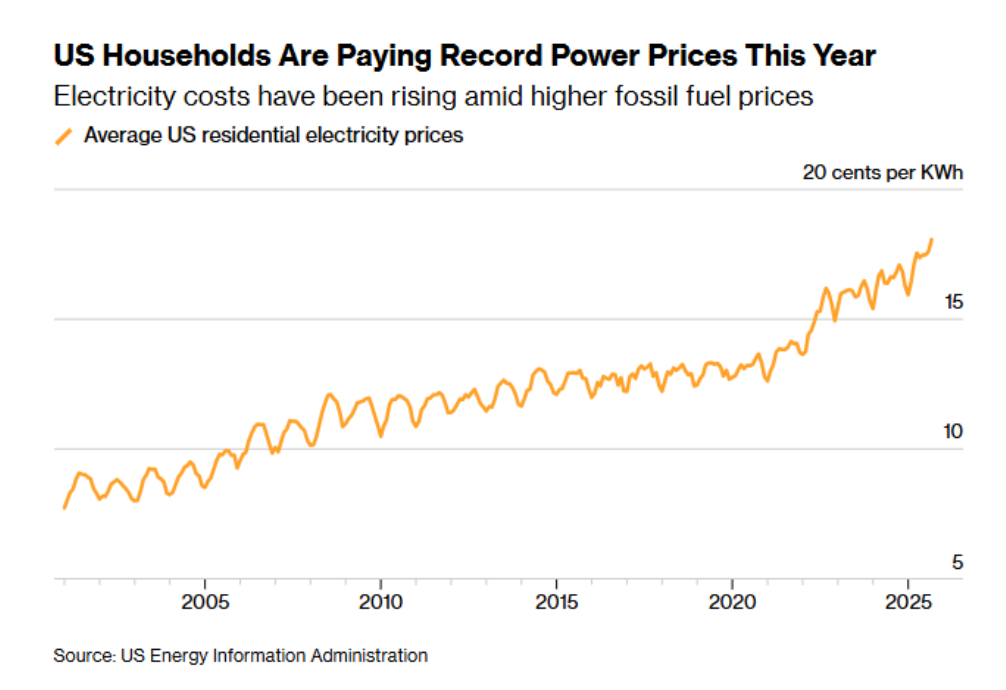
全球电力市场正经历剧烈分化。 在美国,人工智能(AI)与数据中心的爆发式增长将电网推向极限,容量价格触及监管上限,迫使监管层介入干预成本分担;而在中国,随着 可再生能源装机的快速扩张,电价正进入显著的下行通道,工业与商业用电成本面临重估。 近期市场数据显示,美国最大的电网运营商PJM的最新拍卖价格已触及历史高位,若无价格管制,数据中心需求本将令电价再涨60%。对此, 美国当选总统特朗普已明确施压,要求科技巨头为激增的电力需求"自行买单"。这一政治博弈直接加剧了市场对公用事业板块及科技公司运营 成本的担忧。 与此同时,大洋彼岸的中国市场则呈现出截然不同的图景。据美银美林(BofA Global Research)最新发布的研报显示,中国电力价格的下降趋 势正在加剧。2026年1月的代理购电价格同比大幅下跌10%,广东、江苏等核心经济大省的年度电力合约价格均出现明显回落。 美国:AI逼爆电网,特朗普施压科技巨头 美国电力市场的供需矛盾已达到临界点。 华尔街见闻写道,美国最大的电网运营商PJM Interconnection在针对2027/2028年的基础剩余拍卖中,发电容量价格攀升至333.40美元/兆瓦日 (M ...
美国CPI降温,市场为何无动于衷?数据失真,关键要看下周的PCE
Hua Er Jie Jian Wen· 2026-01-14 03:07
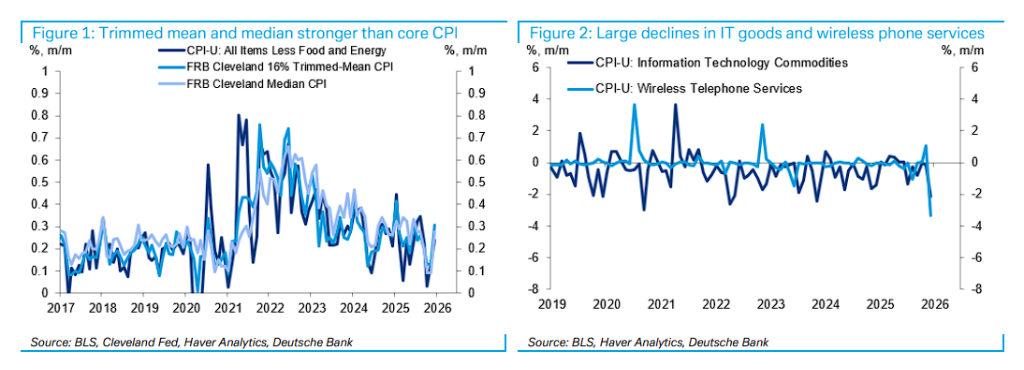
Core Viewpoint - The December CPI data appears mild but is filled with unsustainable noise and statistical distortions, according to Deutsche Bank and Morgan Stanley. The true test will be the upcoming PCE data [1][3]. CPI Analysis - The December CPI data showed a year-over-year core CPI increase of 2.6%, the lowest since March 2021, and a month-over-month increase of 0.2%, both below expectations [1]. - Deutsche Bank highlighted that the CPI data is distorted, with significant downward pressure from abnormal declines in information technology goods and wireless phone services, which together lowered the core CPI by about 6 basis points [4][6]. - The trimmed mean CPI and median CPI, which exclude extreme values, were reported at 0.31% and 0.28% respectively, indicating stronger underlying inflation pressures [1][6]. PCE Forecast - Morgan Stanley warned that despite the lower-than-expected core CPI, their forecast for the December PCE price index suggests a month-over-month increase of 0.46%, significantly higher than the CPI performance [2][9]. - The divergence between CPI and PCE is attributed to the differing weightings of goods and services in the two indices, with PCE showing stronger price increases in categories that have higher weights [9][11]. Market Implications - The market is awaiting the PCE data to confirm the true inflation trend. If the PCE rebounds as expected, it will limit the Federal Reserve's ability to continue lowering interest rates [3]. - Deutsche Bank noted that the CPI data reflects a mix of distorted November data recovery and genuine weakness, suggesting the Fed will likely wait for more data before signaling further rate cuts [14]. Tariff Effects - Both Deutsche Bank and Morgan Stanley observed signs of tariff impacts on inflation data, with prices of tariff-sensitive goods rising again in December, indicating potential future consumer price increases [12].


现货白银史上首次站上90美元/盎司关口
Hua Er Jie Jian Wen· 2026-01-14 03:07
市场有风险,投资需谨慎。本文不构成个人投资建议,也未考虑到个别用户特殊的投资目标、财务状况或需要。用户应考虑本文中的任何 意见、观点或结论是否符合其特定状况。据此投资,责任自负。 现货白银史上首次站上90美元/盎司关口。 风险提示及免责条款 ...
“预见”关税退税?抢在高院裁决前,亚马逊与供应商谈“降价”
Hua Er Jie Jian Wen· 2026-01-14 02:52
Group 1 - Amazon is negotiating with suppliers for price reductions ranging from single digits to as much as 30% to recover concessions made last year in response to Trump tariffs [1][2] - The negotiations are being expedited to finalize agreements before the Supreme Court's ruling on the legality of U.S. trade tariffs [2] - Amazon's statement claims that its annual supplier negotiation cycle remains unchanged, denying any strict deadlines for negotiations [1] Group 2 - Suppliers are concerned that Amazon's latest negotiation stance threatens product line profitability, as it does not adequately consider rising costs from supply chain disruptions and increased raw material and labor costs [3] - Amazon operates its vast e-commerce business through direct sales and third-party retailers, with third-party seller sales accounting for over 60% of total sales on the platform [3] - Amazon has not joined lawsuits filed by businesses and interest groups against tariff measures, including a collective lawsuit by over 1,000 retailers seeking to recover paid tariffs [3]
