
Qi Huo Ri Bao

Search documents
聚酯期货板块国际化获批,实现产业链协同开放
Qi Huo Ri Bao· 2026-01-23 13:53
Core Viewpoint - The China Securities Regulatory Commission (CSRC) has announced the inclusion of specific futures and options related to the polyester industry for foreign traders, aiming to enhance risk management and internationalization of the polyester sector [1][2]. Group 1: Regulatory Developments - The CSRC has determined that the Zhengzhou Commodity Exchange (ZCE) will allow foreign participation in futures and options for paraxylene (PX), bottle chips, short fibers, and purified terephthalic acid (PTA) [1]. - The ZCE has been gradually opening up the polyester sector, with PTA futures being the first chemical futures introduced to foreign traders since 2018, which has stabilized market operations and established PTA prices as a global reference for polyester trade [2]. Group 2: Industry Insights - China's polyester industry is the largest globally, with a projected capacity of 89.035 million tons by 2025, accounting for 60% to 70% of global production [1]. - The demand for diversified risk management strategies has increased due to price volatility in polyester products and accelerated overseas capacity expansion [1]. Group 3: Market Participation and Internationalization - Nearly 800 foreign clients from 33 countries and regions have opened accounts at the ZCE, and the exchange has signed memorandums of understanding with 12 foreign exchanges to facilitate the internationalization of the polyester sector [3]. - The internationalization of the polyester sector is expected to enhance the pricing mechanism and reduce harmful competition among domestic enterprises in international trade [3].
业内首家!天齐锂业成注册品牌,酸锂期货定价效率或将进一步提升
Qi Huo Ri Bao· 2026-01-23 07:37
Core Viewpoint - The inclusion of Tianqi Lithium's brand as a registered brand for lithium carbonate futures at the Guangzhou Futures Exchange signifies a strategic advantage, enhancing the company's market credibility and operational efficiency [1][2]. Group 1: Brand Registration Impact - Tianqi Lithium's brand will be officially recognized as a registered brand for lithium carbonate futures starting February 2, 2026, marking a transition from "deliverable" to "brand deliverable" status [1]. - The registration allows for direct delivery of products without the need for repeated quality inspections, saving approximately 20 yuan per ton in inspection fees and reducing time costs by 3-5 days, thus significantly improving delivery efficiency and customer acceptance [1]. Group 2: Competitive Advantage - With the registration, Tianqi Lithium becomes the only lithium company in China with both designated delivery warehouse and registered brand status for lithium carbonate futures, enhancing its control over the entire production, storage, delivery, and pricing chain [2]. - The company's production facilities in Sichuan and Jiangsu are noted as the lowest-cost lithium carbonate production bases globally, with production costs around 70,000 yuan per ton, significantly lower than the industry average of 110,000 yuan per ton [2]. - The brand registration is expected to amplify Tianqi Lithium's cost advantages, allowing for higher pricing power and the potential for simultaneous increases in both volume and price as market conditions improve [2].

智链实体·数驱未来——华金期货的AI战略与实践
Qi Huo Ri Bao· 2026-01-23 00:47
金融与科技的融合正以前所未有的深度与速度展开。在这场席卷全球的人工智能浪潮中,华金期货敏锐 地捕捉时代脉搏,坚定地踏上了"AI+期货"的探索之路。 华金期货的战略转型并非一蹴而就。 "我们从2024年下半年开始就有一些转型方面的构思。"华金期货总裁表示,期货行业的特殊性以及基础 模型的迭代进程,让构建真正有用的智能化平台成为一大挑战。华金期货的目标是从数据、算力、模 型、应用等方面立体化重塑期货的研究、服务、营销与合规体系。 2025年是华金期货推动科技主线变革的关键一年。以"智链实体·数驱未来"为核心理念,华金期货运用 深度学习、大语言模型及多模态数据融合等技术,完成了综合性智能平台的基础架构。 "两方面因素支撑起了公司以科技为主线的改革。一方面,我国将人工智能作为发展新质生产力的重要 引擎,通过一系列顶层设计和政策部署,构建起系统完备、科学规范、运行有效的政策体系。另一方 面,人工智能基础理论取得突破,人工智能理论框架体系基本形成。自然语言、通用视觉、多模态交互 大模型等形成完整的技术路线,特别是AI的逻辑推理能力不断提升,例如OpenAI发布的推理模型o1和 o3版本,在数学、编程、博士级科学问答等复杂 ...
供应预期偏紧 碳酸锂高位震荡
Qi Huo Ri Bao· 2026-01-23 00:43
Group 1 - The core viewpoint of the article highlights the increasing volatility in the lithium carbonate market, with the main contract experiencing a significant rise of over 30% year-to-date as of January 22, 2026, and total market funds exceeding 30 billion yuan [1] Group 2 - Supply-side uncertainties are driving the pricing logic in the lithium carbonate market, particularly due to tightening environmental regulations affecting lithium mica mining in Jiangxi province. The recent solid waste management action plan from the State Council restricts the approval of mining projects without self-built mines and tailings disposal facilities, raising concerns about future supply stability [2] - The price of lithium spodumene concentrate (CIF China) has reached 2,130 USD/ton as of January 22, 2026, reflecting an increase of 582 USD/ton since the beginning of the year, indicating strong cost support for lithium carbonate futures amid tight supply expectations [2] Group 3 - Demand for lithium carbonate remains robust despite the traditional off-season, driven by preemptive consumption expectations due to policy changes. The announcement regarding the adjustment of export tax rebate policies for photovoltaic and battery products has led to increased orders from battery companies and overseas clients in the first quarter to secure existing tax benefits [3] - Positive signals from overseas electric vehicle markets, such as Canada's quota and tariff reductions on Chinese electric vehicles and Germany's plans to reinstate electric vehicle subsidies, are expected to bolster demand in the lithium battery supply chain [3] Group 4 - The rapid increase in lithium prices has disrupted price transmission within the supply chain, intensifying operational pressures on upstream and downstream companies. New regulatory measures implemented by the exchange aim to curb market overheating and speculation, including increased transaction fees and limits on daily opening positions for certain contracts [4] - The inability to pass on high costs to the battery cell segment has led to a general reluctance among downstream cathode material manufacturers to accept current high lithium carbonate prices, resulting in a cautious market with low actual transaction volumes [4]
IEA发出石油供应过剩警告
Qi Huo Ri Bao· 2026-01-23 00:35
Group 1 - The U.S. Energy Secretary called for a doubling of global oil production to meet rising demand and prevent energy poverty, highlighting significant challenges in global energy supply and access [1] - As a result of this announcement, international oil prices fell, with light crude oil futures dropping by $1.26 to $59.36 per barrel, a decrease of 2.08%, and Brent crude oil futures down by $1.18 to $64.06 per barrel, a decline of 1.81% [1] Group 2 - The American Petroleum Institute reported a 3 million barrel increase in U.S. crude oil inventories, following a previous increase of 5.278 million barrels [2] - The International Energy Agency warned of a significant oversupply in the global oil market by the first quarter of 2026 unless major supply disruptions occur [2] - Analysts noted that the current oil price is influenced by various factors, with oversupply becoming a clear concern, and that the market is expected to return to fundamental trading after the end of the European cold wave [2] Group 3 - Geopolitical tensions have been a core factor influencing oil prices, with recent incidents in Libya and Kazakhstan causing declines in oil exports [3] - The market is currently characterized by mixed factors, with potential geopolitical pressures from the U.S. and Israel on Iran possibly increasing risk premiums, although the likelihood of a full-scale ground war remains low [3] - The key variable for the oil market remains the expectation of production cuts, as further declines in oil prices could lead to reduced U.S. shale oil production and prompt OPEC+ to adjust output quotas [3] Group 4 - Analysts suggest that a de-escalation of geopolitical tensions could lead to oil prices hitting cyclical lows, as conflicts have restricted oil production and exports from Russia and Iran [4] - OPEC+'s production policy is a critical variable for future market conditions, with the group expected to maintain stable production increases in the first quarter [4] - The geopolitical situation and U.S. tariffs are also seen as significant factors affecting global economic conditions and oil demand growth [4]
刚刚 金价突破4900美元/盎司 银价暴涨!特朗普警告欧洲!俄乌 大消息
Qi Huo Ri Bao· 2026-01-23 00:33
早上好,原油市场传来利空,金价再创新高! 22日晚,美国能源部长赖特在世界经济论坛上呼吁将全球石油产量提高1倍以上,以满足不断增长的需 求并防止能源贫困。他强调了全球能源供应和获取方面面临的重大挑战。 谈及美伊关系时,特朗普称,伊朗方面有意与美国接触,并暗示双方可能恢复外交沟通。特朗普在出席 所谓"和平委员会"相关活动时称:"伊朗确实想谈,我们也会谈。"但他未就对话的具体形式、时间或议 题作出进一步说明。 俄乌局势方面,乌克兰总统泽连斯基表示,乌克兰、美国和俄罗斯的三方会谈将于23日在阿联酋举行, 他表示这是技术层面的会谈。据悉,此次三方会谈将持续两天。 据悉,美国总统特使威特科夫和特朗普女婿库什纳与俄罗斯总统普京的会晤将于23日进行。 此外,威特科夫表示,俄乌和平进程已取得重大进展,如今已到了最后阶段,他保持乐观态度。在访问 俄罗斯之后,他将前往阿联酋,参加美、俄、乌三方工作组会议。 受此影响,国际油价下跌。 截至今晨收盘,WTI原油期货主力合约下跌1.57%,布伦特原油期货主力合约下跌1.23%。 贵金属方面,伦敦金现货价格收涨3.31%,报4935.75美元/盎司;伦敦银现货价格大涨近6%。沪金、沪 银 ...
山东齐盛期货:焦煤下行空间有限
Qi Huo Ri Bao· 2026-01-23 00:31
Group 1 - The core viewpoint indicates that coking coal futures are experiencing a weak and volatile trend, with prices under pressure due to seasonal factors, but further declines are limited [1] - The macroeconomic environment is supportive, with the central bank lowering rates and promoting a more active fiscal policy, which may provide some support to the market [1] - The supply side is recovering as previously shut-down coal mines resume production, with the capacity utilization rate increasing from 79.6% to 88.5% [2] Group 2 - Demand for coking coal shows a mix of short-term support from winter stockpiling and expectations of weakening demand thereafter, with independent coking plants increasing their coal inventories [3] - The recent extreme weather conditions may boost heating demand, potentially providing support for coking coal prices [4] - The overall market situation for coking coal remains stable, with limited downside risk for prices, although demand may weaken as stockpiling concludes and steel production remains inconsistent [4]
沪铜短期波动难改中期上行趋势 关注回调布局机会
Qi Huo Ri Bao· 2026-01-23 00:02
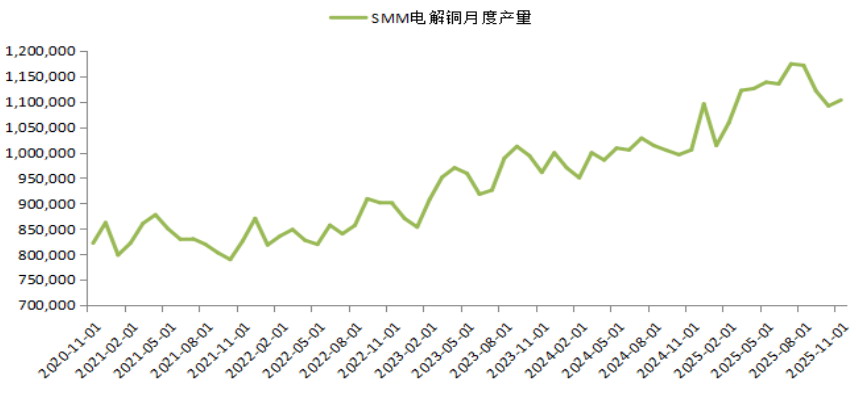
Core Viewpoint - Copper prices are expected to rise significantly and reach historical highs by 2026 due to supply concerns stemming from project delays and labor strikes, alongside geopolitical risks affecting resource supply chains [1] Supply Side Summary - The import concentrate treatment charge (TC) has decreased to -45.41 USD/ton, indicating ongoing tightness in copper supply [2] - Domestic copper smelting fees remain high, with southern and northern processing fees at 2000 CNY/ton and 1200 CNY/ton respectively, leading to increased recycled copper supply [2] - The production of electrolytic copper saw a month-on-month increase of 75,000 tons in December 2025, but is expected to decrease by 14,500 tons in January due to fewer statistical days [2] - The delay of the Mirador copper mine phase II is expected to reduce global copper mine output by 100,000 tons in 2026, exacerbating supply concerns [2] - The U.S. is considering imposing tariffs on refined copper, which could lead to structural shortages in non-U.S. regions [2] Demand Side Summary - The price difference between refined and scrap copper has surged past 6000 CNY/ton, indicating a significant substitution effect [3] - High copper prices have led to a decrease in operating rates for downstream industries such as scrap copper rods and electrical cables, reflecting weak demand [3] - Despite short-term demand pressures, long-term demand for copper is expected to grow due to its role in electrification and strategic reserves amid rising geopolitical risks [3] Inventory and Macro Environment Summary - Since January, China's social inventory has increased by 54,500 tons, while global total inventory rose by 67,000 tons to 981,000 tons [5] - The LME inventory continues to decline, providing strong support for copper prices, while the price difference between COMEX and LME has narrowed significantly [5] - Geopolitical risks are expected to drive demand for strategic metals, while the short-term strength of the U.S. dollar may limit copper price increases [5] - The current market dynamics reflect a conflict between short-term pressures and mid-term bullish trends, with high prices suppressing demand and leading to inventory accumulation [7]

今年首批超长期特别国债支持设备更新资金已下达
Qi Huo Ri Bao· 2026-01-22 23:35
今年以来,国家发展改革委会同各有关方面优化实施"两新"政策,在前期扎实开展设备更新项目谋划储 备的基础上,抓紧组织项目申报,严格做好审核把关,加快推动设备更新政策落地见效。 据新华社电 记者22日从国家发展改革委获悉,近日,2026年第一批936亿元超长期特别国债支持设备更 新资金已经下达,支持工业、能源电力、教育、医疗、住宅老旧电梯等领域约4500个项目,带动总投资 超过4600亿元;同时,采取直接向地方下达资金的方式,继续支持老旧营运货车报废更新、新能源城市 公交车更新、老旧农机报废更新。 ...
股债“跷跷板”效应料回归
Qi Huo Ri Bao· 2026-01-22 07:26
Group 1 - The core viewpoint of the articles indicates that the bond market is experiencing relatively small fluctuations compared to the equity market, with a notable "teeter-totter" effect between stocks and bonds becoming less pronounced [1] - The People's Bank of China (PBOC) has announced a reduction in structural monetary policy tool rates and an increase in re-lending quotas, indicating a focus on structural tools rather than broad monetary policy [2] - The fiscal policy for 2026 is set to be more proactive, with a commitment to maintain necessary levels of fiscal deficit, debt, and expenditure, ensuring that overall spending increases while key areas remain robust [3] Group 2 - Recent movements in overseas long-term yields, particularly in the US and Japan, have had limited direct impact on China's bond market, although they reflect broader economic concerns [4] - The reversal of yen carry trades may continue to disrupt markets, potentially benefiting safe-haven assets like gold, while the direct influence on China's bond market remains limited [5] - The overall macroeconomic environment remains unchanged, with the bond market under pressure and the "teeter-totter" effect between stocks and bonds expected to return, although short-term drivers for the bond market are limited [6]