TENCENT(00700)

Search documents
知名基金经理调仓路线图揭晓 科技成布局焦点
Zheng Quan Ri Bao· 2026-01-23 16:10
Group 1 - The core focus of several prominent fund managers, including Xie Zhiyu and Fu Pengbo, has shifted towards the technology sector, with increased allocations in semiconductor and AI-related companies [1][2] - Xie Zhiyu's fund, Xingquan Helun Mixed Fund, significantly increased its holdings in technology stocks, particularly in the semiconductor industry, with companies like Zhongji Xuchuang and Ningde Times among the top ten holdings [1] - Fu Pengbo's Ruiyuan Growth Value Mixed Fund raised its stock position and concentrated its top ten holdings, increasing the proportion of assets from 66.04% at the end of Q3 2025 to 70.38% at the end of Q4 2025 [2] Group 2 - The Ruiyuan Growth Value Mixed Fund has prepared for 2026 by reducing positions in companies with weak fundamentals and increasing investments in data center cooling and computing power-related firms [2] - The top ten holdings of the E Fund Blue Chip Selected Mixed Fund remained consistent with Q3 2025, with notable adjustments in share quantities, including increased holdings in Alibaba and reduced positions in JD Health and Focus Media [2] - Morgan Stanley's Digital Economy Mixed Fund, managed by Lei Zhiyong, focused on the digital economy sector, particularly the AI computing power industry, with new additions to its top ten holdings including Xunwei Communication and Dongshan Precision [3] Group 3 - Lei Zhiyong expressed optimism about the ongoing A-share bull market, citing sustained investor confidence and a favorable market environment [3] - The fund manager highlighted continued interest in AI, military industry, nuclear power, wind power, and energy storage sectors, as well as traditional industry leaders leveraging AI for transformation [3]


大模型卷价格没意义,AI竞争关键是“卖场景”!腾讯云高管发声
券商中国· 2026-01-23 14:48
Core Viewpoint - The article discusses the shift in the competitive logic of the domestic cloud computing market as artificial intelligence (AI) moves from technical demonstrations to practical applications within industries, emphasizing the importance of integrating AI into business processes to create measurable commercial value by 2026 [2]. Group 1: Competitive Logic Shift - The initial phase of AI competition focused on selling resources, particularly GPU computing power, but many clients did not fully understand how AI could reduce costs and improve efficiency [3]. - By 2025, the market's focus shifted from survival to seizing new AI opportunities, with competition now centered on application rather than underlying resources [3]. - Tencent Cloud's revenue structure shows a significant shift, with approximately 25% of revenue coming from SaaS, contrasting with other cloud providers that primarily focus on infrastructure services [3]. Group 2: Ecosystem Partner Transformation - Tencent Cloud estimates that 30%-40% of its ecosystem partners have begun exploring AI business opportunities, but transitioning from resource resellers to value service providers presents challenges [4]. - Partners face two main pain points: internal consensus and execution issues, and the need to shift from price-based sales to value-based sales, requiring a deep understanding of customer business scenarios [4]. - Tencent Cloud's strategy has evolved from merely opening technology capabilities to integrating technology with business through collaborative exploration of vertical industry scenarios [4]. Group 3: International Expansion and Value Competition - In addition to the competitive domestic market, "going global" has become a common strategy for cloud providers and partners seeking growth, with Tencent Cloud's international business growing by 30% year-on-year [5]. - Key factors for winning overseas clients include advanced audio and video technology, competitive pricing, and professional localized service support [5]. - Tencent Cloud's executives reject the notion of engaging in price wars, emphasizing that the focus should be on delivering core value to customers rather than competing on price [5].


兴业证券基金四季报点评:主动权益管理规模下降 存量赎回压力仍在出清
Zhi Tong Cai Jing· 2026-01-23 13:48
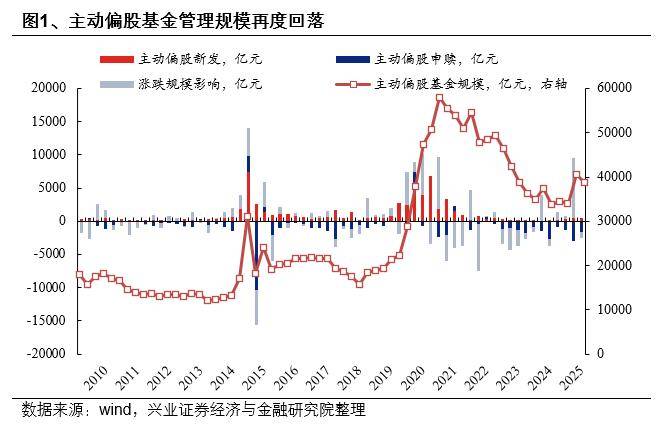
Core Viewpoint - The report from Industrial Securities indicates a slight decline in the management scale of active equity funds in Q4 2025, primarily due to significant redemption pressure from existing funds, which has hindered the continuation of growth seen in Q3 2025 [1][2]. Group 1: Fund Management Scale - In Q4 2025, the management scale of three types of active equity funds (ordinary stock, mixed equity, and flexible allocation) decreased by 189.8 billion yuan, with new active equity fund issuance at 56.2 billion yuan and net redemptions from existing funds at 165.6 billion yuan, alongside a decline of 80.4 billion yuan due to market fluctuations [1][2]. - The equity position of active equity funds decreased by 0.83 percentage points to 86.62% in Q4 2025, remaining at the second-highest historical level, just behind Q3 2025 [2]. Group 2: Sector Allocation Changes - In terms of sector allocation, the proportion of investment in the ChiNext board increased to 24.98%, up by 1.24 percentage points from Q3 2025, while the allocation to the Sci-Tech Innovation board decreased to 16.55%, down by 0.90 percentage points [3]. - The allocation to the main board fell to 58.21%, down by 0.30 percentage points, indicating a further increase in underweight positions [3][4]. Group 3: Style and Sector Adjustments - Active equity funds increased their positions in cyclical and financial real estate sectors while reducing exposure to technology growth and pharmaceuticals. The allocation percentages for technology growth, financial real estate, consumption, pharmaceuticals, and cyclical sectors were 52.27%, 4.47%, 14.28%, 8.18%, and 20.67%, respectively, with notable changes from the previous quarter [5]. - The funds increased their positions in non-ferrous metals, communications, and non-bank financial sectors, with increases of 2.26 percentage points, 1.85 percentage points, and 0.87 percentage points, respectively, while reducing positions in electronics and pharmaceuticals [6][7]. Group 4: TMT Sector Adjustments - The allocation to the TMT sector slightly decreased in Q4 2025, with the overall allocation dropping to 38.05% from a peak of 40% in Q3 2025. The internal structure showed increased positions in communication devices and components while reducing holdings in consumer electronics and semiconductors [11]. Group 5: Dividend Sector Recovery - The allocation to dividend low-volatility indices and the CSI Dividend Index showed signs of stabilization and recovery, with the allocation to the former rising by 1.7 percentage points to 4.3% and the latter increasing by 1.5 percentage points to 4.4% [12]. Group 6: Top Holdings and Changes - The top five stocks with increased holdings in active equity funds in Q4 2025 included Zhongji Xuchuang, Xinyi Sheng, Dongshan Precision, China Ping An, and Zijin Mining, with respective increases of 1.46 percentage points, 0.63 percentage points, 0.63 percentage points, 0.58 percentage points, and 0.40 percentage points [13]. - Conversely, the top five stocks with reduced holdings included Industrial Fulian, Yiwei Lithium Energy, Ningde Times, Luxshare Precision, and Focus Media, with respective decreases of 1.07 percentage points, 0.64 percentage points, 0.53 percentage points, 0.44 percentage points, and 0.33 percentage points [15].



爱优腾开“卷”分账模式,长视频主动“挤泡沫”?
3 6 Ke· 2026-01-23 12:53
Core Insights - The long video industry is facing intensified challenges in 2025, with a projected 20% decrease in effective views for the top 20 long dramas, dropping from an average of 100 million views per episode to 60 million [1] - Major platforms like iQIYI, Tencent Video, and Youku are reforming their content cooperation models to establish a profit-sharing system, indicating a shift towards a more sustainable content ecosystem [1][2][5] - The rise of profit-sharing content signifies a move away from the era of "traffic inflation," emphasizing a return to quality content as the foundation for attracting viewers [1][6] Group 1: Industry Trends - iQIYI's new profit-sharing regulations cover various content types, including dramas, variety shows, films, and animations, aiming for a unified revenue calculation based on platform income and tiered ratios [2] - Tencent Video has introduced new collaboration policies for horizontal and vertical screen dramas, enhancing incentives for both pure profit-sharing and guaranteed plus profit-sharing projects [4] - The collective shift towards profit-sharing models is a response to external pressures and aims to create a more sustainable and mutually beneficial ecosystem for platforms and content creators [7] Group 2: Content Quality and Market Dynamics - The implementation of the Effective Play Index (EPI) by platforms like Youku is designed to provide a clearer picture of content performance, linking creator income directly to viewer engagement and advertising effectiveness [5][8] - Successful examples of profit-sharing dramas, such as "Old Uncle," demonstrate the potential for high-quality content to thrive under this new model, breaking previous revenue records [10][11] - The transition to a profit-sharing model is expected to lead to a more competitive landscape, where content quality and audience engagement become the primary drivers of success, rather than reliance on star power [12][14]


见证历史!公募第一重仓股变了 积极加仓信息技术、有色等板块
Zhong Guo Ji Jin Bao· 2026-01-23 12:46
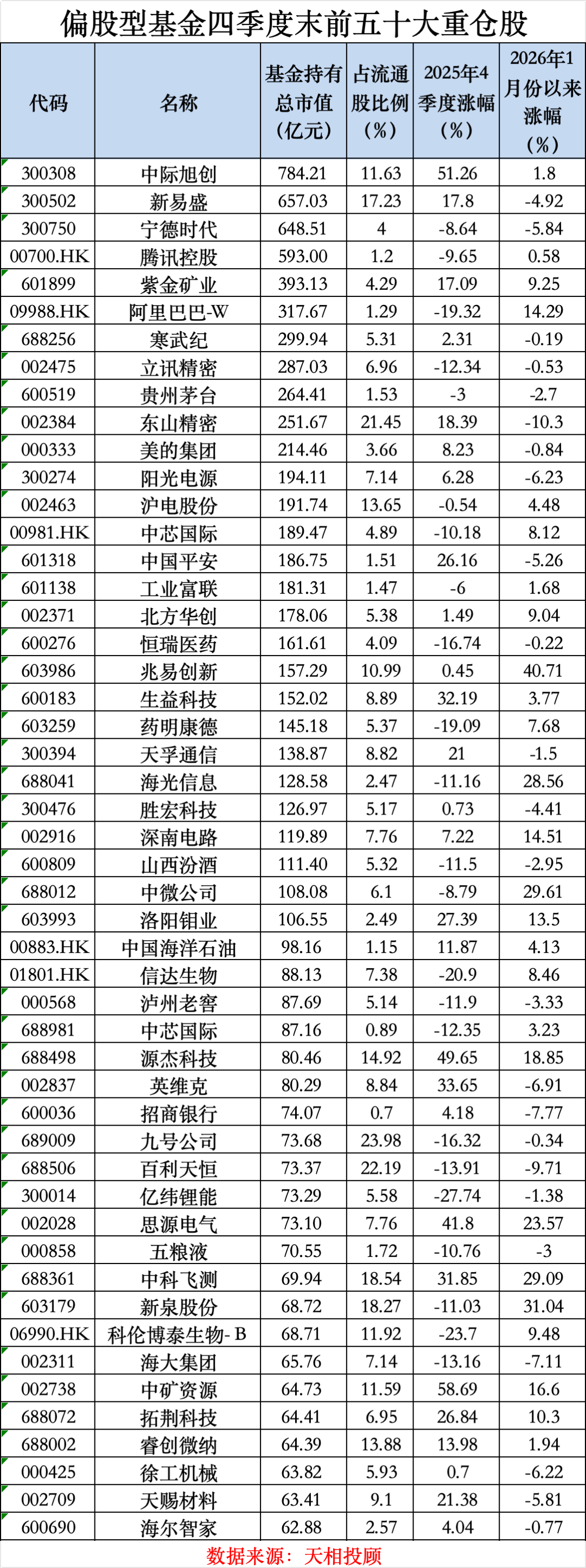
Core Insights - The public fund's top holdings have shifted, with Zhongji Xuchuang and Xinyi Sheng replacing CATL and Tencent as the first and second largest holdings respectively, reflecting a significant change in investment focus within the technology sector [1][4]. Group 1: Fund Holdings Overview - As of the end of Q4 2025, the top ten holdings of actively managed equity funds included Zhongji Xuchuang, Xinyi Sheng, CATL, Tencent, Zijin Mining, Alibaba-W, Cambricon, Luxshare Precision, Kweichow Moutai, and Dongshan Precision [1]. - Zhongji Xuchuang emerged as the largest holding with a total market value of 78.42 billion yuan, representing 11.63% of the circulating shares, and a quarterly increase of 51.26% [2][5]. - Xinyi Sheng followed with a market value of 65.70 billion yuan, accounting for 17.23% of circulating shares, and a quarterly increase of 17.8% [2][5]. Group 2: Changes in Holdings - The top five holdings experienced varying degrees of reduction in shares held by equity funds, with Zhongji Xuchuang seeing a decrease of 970.14 million shares, a 7.02% decline from the previous quarter [4]. - Despite the reduction in shares, the market value of Zhongji Xuchuang held by funds increased from 55.81 billion yuan to 78.42 billion yuan due to a significant rise in stock price [4]. - China Ping An was noted as a new entrant into the top twenty holdings, moving up from 41st to 15th place, indicating a growing interest in the insurance sector [4]. Group 3: Sector Focus - The information technology sector saw substantial increases in fund holdings, with four out of the top five increased holdings belonging to this sector, alongside significant investments in the insurance sector, particularly in China Ping An [1][4]. - The top stocks that received the most significant increases in holdings were primarily concentrated in the information technology, non-ferrous metals, and chemical sectors [4]. Group 4: Performance of Stocks - Several stocks that doubled in price during Q4 2025 received considerable increases in fund holdings, including Tianhua New Energy, which surged by 118.53%, leading to a rise in the number of funds holding the stock from 2 to 93 [7]. - Maiwei Co. also saw a significant increase in fund interest, with its stock price rising by 107.34% and the number of funds holding it increasing from 8 to 54 [7]. Group 5: Reduction in Holdings - Notable reductions in holdings were observed in several major stocks within the Hang Seng Technology Index, including Alibaba-W, Tencent, and SMIC, reflecting a broader trend of fund managers reducing exposure to these tech giants [8][9]. - The top ten stocks with the largest reductions in holdings included Alibaba-W, Industrial Fulian, CATL, and Tencent, indicating a strategic shift away from these previously favored stocks [9].


兴证策略:2025年四季度主动权益基金管理规模小幅下降 四季度存量基金的赎回压力仍然较大
Sou Hu Cai Jing· 2026-01-23 12:38
Group 1 - The active equity fund management scale decreased slightly in Q4 2025, primarily due to significant redemption pressure from existing funds, resulting in a net redemption of 165.6 billion yuan [1] - The total management scale of three types of active equity funds (ordinary stock, mixed equity, and flexible allocation) decreased by 189.8 billion yuan, with new active equity fund issuance at 56.2 billion yuan [1] - The active equity fund's position in Q4 2025 decreased by 0.83 percentage points to 86.62%, remaining at the second-highest level in history [2] Group 2 - In terms of sector allocation, the proportion of the ChiNext board increased by 1.24 percentage points to 24.98%, while the main board and Sci-Tech Innovation board saw declines [5][8] - The allocation to the main board decreased by 0.30 percentage points to 58.21%, indicating a further increase in underweight [8] - Active equity funds increased their positions in cyclical and financial real estate sectors while reducing exposure to technology growth and pharmaceuticals [11] Group 3 - The active equity funds increased their allocation in the non-ferrous metals, communication, and non-bank financial sectors, with increases of 2.26 percentage points, 1.85 percentage points, and 0.87 percentage points respectively [13] - The funds reduced their positions in electronics, pharmaceuticals, media, power equipment, and computers, with reductions of 1.72 percentage points, 1.54 percentage points, and 1.16 percentage points respectively [13] - Excluding thematic/sector funds, the active equity funds still increased their positions in non-ferrous metals, communication, and non-bank financial sectors [14] Group 4 - The allocation to the TMT sector slightly decreased in Q4 2025, with the configuration coefficient at 1.48, indicating room for further improvement [29] - Within the TMT sector, active equity funds increased their holdings in communication equipment and components while reducing positions in consumer electronics and semiconductors [32] - The dividend sector's allocation stabilized and increased, with the low-volatility dividend index rising by 1.7 percentage points to 4.3% [37] Group 5 - The top five stocks in active equity funds in Q4 2025 included Zhongji Xuchuang, Xinyi Sheng, Dongshan Precision, China Ping An, and Zijin Mining, with respective increases in holding ratios [43] - The top ten holdings accounted for 4.83%, 4.01%, and 3.97% of the total market value of the funds [46] - The concentration of individual stocks in active equity funds increased slightly, while the concentration of industries showed a mixed trend [49] Group 6 - The Hong Kong stock allocation of active equity funds decreased to 15.98%, down from 19.09%, with a total holding value of 302.9 billion yuan [51] - The funds increased their positions in the healthcare, materials, and energy sectors while reducing exposure to consumer discretionary and information technology sectors [54] - Tencent maintained its position as the largest holding in Hong Kong stocks, with a market value of 57.3 billion yuan [56]


张坤在管基金披露2025年四季报:减持白酒股 加仓阿里巴巴(09988)
Zhi Tong Cai Jing· 2026-01-23 12:24
Core Viewpoint - E Fund's Zhang Kun reported a decline in total assets under management to 48.383 billion yuan as of December 2025, with three A-share focused funds underperforming their benchmarks, while the E Fund Asia Select fund achieved positive returns, significantly exceeding its benchmark [1][2]. Group 1: Fund Performance - As of December 2025, the largest fund, E Fund Blue Chip Select, had a net asset value of 1.8623 yuan, with a report period net asset value growth rate of -8.93%, compared to a benchmark return of -2.63% [1]. - Three main A-share focused funds reported negative quarterly returns and failed to outperform their performance benchmarks [1]. Group 2: Portfolio Adjustments - Zhang Kun reduced holdings in major stocks such as Kweichow Moutai, Wuliangye, Luzhou Laojiao, and Shanxi Fenjiu, while also significantly reducing positions in Focus Media and China Merchants Bank [1]. - The top ten holdings of E Fund Blue Chip Select remained unchanged, including Tencent, Kweichow Moutai, and Alibaba, with notable reductions in Focus Media and increases in Alibaba [2]. Group 3: Market Outlook - Zhang Kun expressed a long-term optimistic view on the macro economy and market, predicting significant improvements in living standards and social security in China over the next decade [2]. - He emphasized the importance of a strong domestic demand market in promoting technological innovation, suggesting that improved consumer environments could enhance subscription revenues and model capabilities [3]. Group 4: Confidence in Business Models - Zhang Kun maintained confidence in the business models, competitive barriers, and cash flow generation capabilities of the companies in the portfolio, asserting that the market's perception of quality companies presents good opportunities for long-term investors [3].



共话全球经济破局之道,热议AI发展趋势,重磅嘉宾齐聚腾讯财经达沃斯愿景晚宴
Di Yi Cai Jing· 2026-01-23 11:33
Group 1: AI Development Trends - The World Economic Forum highlighted AI as a key topic, emphasizing its profound impact on work, life, and research, indicating that AI is evolving into a core infrastructure and productivity driver across industries [3][9] - Discussions at the event included the need for vertical AI models in education, which focus on deep data accumulation rather than merely applying general language models [9][10] - The integration of AI with cryptocurrency was noted as a significant trend, with AI agents potentially controlling assets and facilitating continuous trading once assets are tokenized [12] Group 2: Global Economic Insights - Michael Spence, a Nobel laureate, expressed optimism about globalization, stating it is evolving rather than declining, with technology driving inclusive growth and entrepreneurial vitality [6][8] - The concept of "small multilateralism" was discussed as a necessary reality in a divided world, emphasizing the importance of alliances that promote cooperation for common interests [7] - The need for a systematic approach to building industrial ecosystems was highlighted, advocating for the retention of diverse industrial systems to avoid pitfalls of over-specialization [8] Group 3: ESG and Sustainable Development - The shift towards green development in China is moving from production-led to a dual-driven model of production and consumption, with green consumption becoming a vital area for sustainable development [13][14] - ESG principles are increasingly integrated into corporate operations, with companies like Moutai focusing on sustainable practices and stakeholder interests [14]

燧原科技科创板IPO获受理,腾讯系AI芯片独角兽冲刺科创板
2 1 Shi Ji Jing Ji Bao Dao· 2026-01-23 11:10
Core Viewpoint - Shanghai Suiruan Technology Co., Ltd. has received acceptance for its IPO application on the Sci-Tech Innovation Board, marking it as another leading domestic AI chip company entering the secondary market after several others [1] Group 1: IPO Details - The company plans to publicly issue no less than 43.04 million shares and no more than 68.35 million shares, aiming to raise approximately 6 billion yuan for the development and industrialization of its AI chip series products [1] - The estimated valuation of Suiruan Technology is 18.2 billion yuan as of August 2025 [1] Group 2: Ownership Structure - Suiruan Technology has no single controlling shareholder, with co-founders Zhao Lidong and Zhang Yalin collectively controlling 28.1% of the voting rights through direct holdings and employee stock ownership platforms [2] Group 3: Strategic Partnerships - Suiruan Technology is viewed as a "Tencent system" AI chip unicorn, with Tencent being its largest shareholder, holding 20.26% of the shares [4] - The collaboration with Tencent dates back to 2020, with significant joint developments, including the first-generation training chip and the AI inference chip [4] Group 4: Revenue and Financial Performance - In the first three quarters of 2025, Suiruan Technology's revenue was 540 million yuan, with a net loss of 912 million yuan after deducting non-recurring gains and losses [7] - The company has a high dependency on Tencent, with 57.28% of its revenue coming from Tencent and 71.84% when including designated final customers [5] Group 5: Research and Development - Suiruan Technology has invested heavily in R&D, with expenses of 988 million yuan, 1.229 billion yuan, and 1.312 billion yuan from 2022 to 2024, totaling 3.529 billion yuan, which is over 316% of its revenue during the same period [6] - The company is not expected to reach profitability until at least 2026, assuming no significant changes in external conditions [7] Group 6: Technology and Market Position - Suiruan Technology emphasizes a proprietary AI accelerator system, diverging from the GPGPU technology route taken by other domestic AI chip companies [8] - The company has developed its own software platform, "Yusuan TopsRider," to reduce programming difficulties and costs associated with its hardware [8] - In 2024, the company aims to capture a 1.4% market share in China's AI accelerator card market, with a sales volume of 38,800 units [10]

JD.com Is Priced For Failure, But The Market Is Wrong
Seeking Alpha· 2026-01-23 11:03
Core Insights - Investing in China and Chinese technology and retail companies has become more favorable in recent quarters, with major companies like Tencent Holdings showing strong performance over the last two years [1] Group 1: Company Performance - Major Chinese technology companies have performed well, particularly Tencent Holdings, indicating a potential for long-term investment opportunities [1] Group 2: Investment Focus - The analysis emphasizes high-quality companies that can outperform the market due to competitive advantages and defensibility, with a focus on both European and North American companies across various market capitalizations [1]