
HLGF(600346)

Search documents
恒力石化涨2.07%,成交额1.86亿元,主力资金净流入907.40万元
Xin Lang Cai Jing· 2025-11-27 05:54
Core Viewpoint - Hengli Petrochemical's stock price has shown a year-to-date increase of 26.45%, despite a recent decline of 1.73% over the last five trading days, indicating volatility in its performance [1]. Group 1: Stock Performance - As of November 27, Hengli Petrochemical's stock price rose by 2.07% to 18.74 CNY per share, with a trading volume of 186 million CNY and a turnover rate of 0.14%, resulting in a total market capitalization of 131.91 billion CNY [1]. - The company has experienced a net inflow of 9.074 million CNY from major funds, with significant buying and selling activities recorded [1]. - Over the past 20 days, the stock has increased by 5.16%, while it has risen by 9.08% over the last 60 days [1]. Group 2: Financial Performance - For the period from January to September 2025, Hengli Petrochemical reported a revenue of 157.467 billion CNY, reflecting a year-on-year decrease of 11.46%, while the net profit attributable to shareholders was 5.023 billion CNY, down by 1.61% compared to the previous year [2]. - The company has distributed a total of 26.136 billion CNY in dividends since its A-share listing, with 7.602 billion CNY distributed over the last three years [3]. Group 3: Shareholder Information - As of September 30, 2025, the number of shareholders for Hengli Petrochemical decreased by 9.54% to 67,300, while the average number of circulating shares per shareholder increased by 10.55% to 104,566 shares [2]. - Among the top ten circulating shareholders, Hong Kong Central Clearing Limited holds 204 million shares, a decrease of 35.5818 million shares from the previous period, while Huatai-PB CSI 300 ETF is a new entrant with 35.7783 million shares [3].

2025年全球及中国聚乳酸降解塑料行业产业链全景、发展现状及未来发展趋势研判:产能布局加速落地,绿色替代空间可期[图]
Chan Ye Xin Xi Wang· 2025-11-27 01:09
Core Insights - The article emphasizes the rapid growth and potential of polylactic acid (PLA) biodegradable plastics as a sustainable alternative to traditional petroleum-based plastics, driven by global green initiatives and domestic policies in China [1][7][10]. Industry Overview - PLA is derived from renewable plant resources, such as corn and cassava, through fermentation to produce lactic acid, which is then polymerized into biodegradable polyester [2][3]. - PLA offers advantages over traditional plastics, including lower carbon emissions, good biocompatibility, and adaptability to various applications like packaging and medical devices [5][6]. Market Dynamics - The global biodegradable plastics market is projected to grow significantly, with production capacity expected to reach approximately 573 million tons by 2029, reflecting a compound annual growth rate (CAGR) of over 18% [8][10]. - In China, the biodegradable materials market is anticipated to reach 29.9 billion yuan in 2024, with a year-on-year growth of 29.59%, and is expected to exceed 48 billion yuan by 2025 [10][11]. Competitive Landscape - Leading domestic companies such as Fengyuan Group, Haizheng Biomaterials, and Jindan Technology are actively expanding their production capacities and integrating the supply chain from raw materials to PLA production [11][12]. - International players like NatureWorks and TotalCorbion are also establishing a presence in China, creating a differentiated competitive landscape [11]. Future Trends - The PLA industry is expected to focus on overcoming technical barriers, enhancing product performance, and expanding into high-value applications such as medical materials and engineering plastics [13][14]. - There is a strong emphasis on building a sustainable circular economy, utilizing non-food biomass resources, and improving recycling technologies to align with carbon neutrality goals [15].


天风证券:政策与周期共振 石化行业迎来结构性机遇
智通财经网· 2025-11-26 07:51
Core Viewpoint - The petrochemical industry is at a significant turning point driven by policies aimed at "controlling growth and reducing inventory" [1][2] Group 1: Policy Implications - The "controlling growth" strategy is central to the long-term improvement of the industry, as outlined in the "Petrochemical and Chemical Industry Stabilization Growth Work Plan," which emphasizes scientific regulation of major project construction and strict control of new refining capacity [2] - The "reducing inventory" approach focuses on addressing current contradictions, with safety, environmental protection, and energy efficiency being key policy drivers [2] Group 2: Industry Cycle and Capacity - The industry is nearing the end of its production cycle, with significant slowdowns in capacity growth expected by 2026 for most products [1][4] - Despite high operating rates, the industry has not experienced severe oversupply, with average capacity growth for various petrochemical products exceeding 10% per year from 2019 to 2025 [3] Group 3: Future Outlook - By 2026, the production growth rate of most petrochemical products is expected to decline significantly, leading to improved capacity utilization in sectors like PX, polyester filament, methanol, and acetic acid [4] - The industry is anticipated to transition from localized recovery to comprehensive improvement between 2027 and 2028, supported by high entry barriers and reduced new capacity growth [4] Group 4: Profitability and Investment Recommendations - The PX industry chain is projected to provide significant profit elasticity for refining companies in 2026, driven by supply-demand imbalances and external factors such as sanctions and refinery attacks affecting oil exports [5] - Recommended stocks include Hengli Petrochemical, Rongsheng Petrochemical, Hengyi Petrochemical, Dongfang Shenghong, and Sinopec, with a suggestion to pay attention to Huajin Co [5]



恒力石化:持续巩固成本护城河优势,加快内生式增长
Zheng Quan Shi Bao Wang· 2025-11-25 06:23
Core Viewpoint - Hengli Petrochemical is focusing on optimizing operations, reducing debt, and enhancing dividends, aiming to establish itself as a high-profit, high-dividend, low-debt growth and return-oriented listed company [3] Group 1: Company Overview - Hengli Petrochemical is one of the earliest private refining enterprises in China, with a comprehensive capacity including a 20 million tons/year integrated refining project, a 5 million tons/year modern coal chemical facility, a 1.5 million tons/year ethylene project, and a 16.6 million tons/year PTA facility [1] - The company has built a modern industrial system integrating "world-class chemical refining + modern coal chemical facilities," supporting a "big chemical" strategy that deeply integrates oil and coal [1] - Hengli Petrochemical has a well-established capacity layout in downstream chemical new materials, including differentiated fibers, functional films, engineering plastics, and biodegradable new materials [1] Group 2: Financial Performance - In the first three quarters of this year, Hengli Petrochemical achieved an operating income of 157.384 billion yuan and a net profit attributable to shareholders of 5.023 billion yuan, with an operating cash flow of 20.134 billion yuan [2] - The company reported a single-quarter profit of 1.972 billion yuan in the third quarter, representing a year-on-year increase of 81.47% and a significant improvement compared to the second quarter [2] - The overall price trend this year has stabilized, leading to a steady improvement in gross profit margins compared to the same period last year [2] Group 3: Strategic Focus - Hengli Petrochemical plans to conclude its current round of project construction and capital expenditure this year, shifting its operational focus towards refined cost control [3] - The company aims to enhance its cost moat and implement continuous cost improvements based on internal efficiency gains, while accelerating high value-added technological upgrades and boutique project construction [2][3] - Hengli Petrochemical has implemented a stable and sustainable cash dividend policy, having distributed a total of 26.1 billion yuan in cash dividends since its listing, which accounts for 40.43% of the cumulative net profit attributable to shareholders during the dividend period [3]
投资策略专题:科技周期再平衡,反内卷下化工机会凸显
KAIYUAN SECURITIES· 2025-11-24 13:12
Group 1 - The report emphasizes a dual-driven strategy where technology and cyclical sectors are rebalanced, highlighting opportunities in the chemical industry under the "anti-involution" trend [4][14][15] - The report notes that from Q3 2025, both technology and cyclical sectors have shown synchronized growth, indicating a shift in market dynamics [15][18] - The chemical industry is expected to benefit from a recovery in supply-demand dynamics, with capital expenditure nearing its end and a significant decrease in ongoing projects [4][5][25] Group 2 - The chemical sector is positioned to enter a new cycle of prosperity, driven by the "anti-involution" policy, which is expected to enhance both performance and valuation [5][31][65] - The report identifies that the chemical industry has advantages over traditional cyclical sectors like steel and coal, particularly in capacity optimization and high-end transformation paths [25][30] - The report highlights that the chemical industry is experiencing a significant reduction in capital expenditure, with a 10% year-on-year decrease in ongoing projects as of H1 2025 [25][33] Group 3 - The report suggests that the domestic demand is stabilizing, supported by government policies aimed at boosting consumption, which is expected to benefit the chemical sector [35][42] - The chemical industry has shown resilience in exports despite trade tensions, with a notable increase in export volumes to ASEAN, EU, and India [42][47] - The report indicates that the chemical industry is likely to see a dual uplift in performance and valuation, particularly when compared to the refrigerant sector, which is currently experiencing high demand [66][68]



炼化及贸易板块11月24日跌2.15%,和顺石油领跌,主力资金净流出4.49亿元
Sou Hu Cai Jing· 2025-11-24 09:19
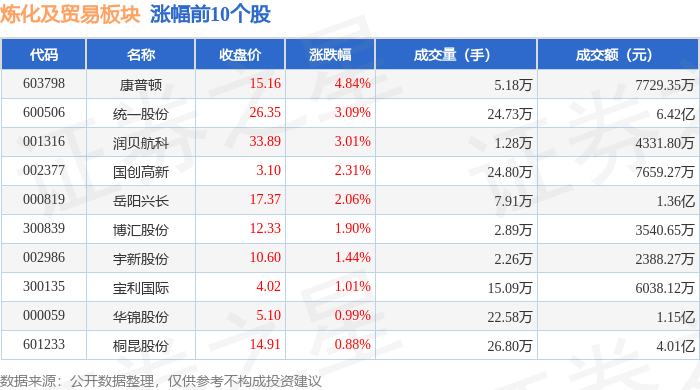
Market Overview - The refining and trading sector experienced a decline of 2.15% on November 24, with Heshun Petroleum leading the drop [1] - The Shanghai Composite Index closed at 3836.77, up 0.05%, while the Shenzhen Component Index closed at 12585.08, up 0.37% [1] Stock Performance - Notable gainers in the refining and trading sector included: - Compton (603798) with a closing price of 15.16, up 4.84% [1] - Unified Shares (600506) at 26.35, up 3.09% [1] - Runbei Aerospace (001316) at 33.89, up 3.01% [1] - Major decliners included: - Heshun Petroleum (603353) at 29.01, down 5.17% [2] - Rongsheng Petrochemical (002493) at 9.52, down 2.96% [2] - China Petroleum (601857) at 9.78, down 2.49% [2] Capital Flow - The refining and trading sector saw a net outflow of 449 million yuan from main funds, while retail funds had a net inflow of 262 million yuan [2] - The following stocks had significant capital flows: - Rongsheng Petrochemical had a main fund net inflow of 42.31 million yuan, but retail funds saw a net outflow of 22.34 million yuan [3] - Compton had a main fund net inflow of 7.05 million yuan, with retail funds experiencing a net outflow of 9.01 million yuan [3]


——基础化工行业周报:DMC、电解液、磷酸二胺价格上涨,关注反内卷和铬盐-20251123
Guohai Securities· 2025-11-23 11:02
Investment Rating - The report maintains a "Recommended" rating for the chemical industry [1] Core Views - The chemical industry is expected to benefit from the ongoing "anti-involution" measures, which may lead to a significant slowdown in global chemical capacity expansion. This shift is anticipated to enhance cash flow and dividend yields for companies in the sector, transforming them from cash-consuming entities to cash-generating ones [7][27] - The report highlights the potential for domestic substitutes for Japanese semiconductor materials due to rising tensions in Sino-Japanese relations, which could accelerate the domestic market's growth in this area [6] Summary by Sections Recent Trends - The chemical industry has shown a relative performance increase of 16.1% over the past 12 months, outperforming the CSI 300 index, which increased by 11.6% [4] Key Price Movements - DMC (Dimethyl Carbonate) prices rose to 4400 CNY/ton, up 14.29% week-on-week, driven by strong demand from the electrolyte sector [14] - Lithium battery electrolyte prices increased to 27000 CNY/ton, up 8.00% week-on-week, although profit margins for manufacturers are under pressure due to rising raw material costs [14] - Diammonium phosphate prices in East China reached 3850 CNY/ton, up 5.48% week-on-week, amid rising production costs [14] Investment Opportunities - The report identifies four key opportunities in the chemical sector: 1. Low-cost expansion, focusing on companies like Wanhua Chemical and Hualu Hengsheng [9] 2. Improved industry conditions, particularly in chromium salts and phosphate rock [10] 3. New materials with high growth potential, such as electronic chemicals and aerospace materials [11] 4. High dividend yields from state-owned enterprises in the chemical sector, including China Petroleum and China National Chemical [11] Company Tracking and Earnings Forecast - The report provides a detailed earnings forecast for key companies, indicating a positive outlook for several firms in the chemical sector, with many rated as "Buy" [28]


石油化工行业周报(2025/11/17—2025/11/23):IEA如何看待石油长期需求?-20251123
Shenwan Hongyuan Securities· 2025-11-23 09:35
Investment Rating - The report provides a positive investment outlook for the petrochemical sector, highlighting specific companies for investment opportunities [10]. Core Insights - The IEA projects that under the Current Policies Scenario (CPS), global oil demand will steadily increase, reaching 105 million barrels per day by 2035 and 113 million barrels per day by 2050, with an average annual growth of approximately 500,000 barrels per day [3][4]. - In the Established Policies Scenario (STEPS), oil demand is expected to peak around 2030, with a decline anticipated thereafter, primarily driven by the rapid growth of electric vehicles in China [6][10]. - Emerging markets, particularly India, Southeast Asia, and Africa, are expected to account for nearly all oil demand growth, while developed economies will see a decline in consumption [4][6]. Summary by Sections Oil Demand Projections - Under CPS, oil demand is projected to rise to 105 million barrels per day by 2035, with significant contributions from petrochemical, aviation, and industrial sectors [3][4]. - In STEPS, oil demand is expected to peak around 2030, with a subsequent decline influenced by the rise of electric vehicles, particularly in China [6]. Regional Demand Insights - India is projected to lead global oil demand growth, increasing from 5.5 million barrels per day in 2024 to 8 million barrels per day by 2035 [4]. - Africa's oil demand is expected to grow by one-third to approximately 6 million barrels per day by 2035, driven by road transport needs [4]. Investment Recommendations - The report recommends investing in high-quality companies in the polyester sector, such as Tongkun Co. and Wankai New Materials, due to tightening supply and improving market conditions [10]. - It also suggests focusing on major refining companies like Hengli Petrochemical and Rongsheng Petrochemical, which are expected to benefit from improved cost structures and competitive advantages [10]. Price Trends and Market Conditions - As of November 21, Brent crude oil prices were reported at $62.56 per barrel, reflecting a decrease of 2.84% from the previous week [15]. - The report notes that the overall oil price is expected to maintain a neutral level through 2026, with limited downside potential [10].
石油化工行业周报:IEA如何看待石油长期需求?-20251123
Shenwan Hongyuan Securities· 2025-11-23 08:14
Investment Rating - The report maintains a positive outlook on the oil and petrochemical industry, indicating a favorable investment environment [2][3]. Core Insights - The IEA projects that under the Current Policies Scenario (CPS), oil demand will steadily increase, reaching 105 million barrels per day by 2035 and 113 million barrels per day by 2050, with an average annual growth of approximately 500,000 barrels per day [2][3]. - In the Stated Policies Scenario (STEPS), oil demand is expected to peak around 2030, with a forecasted decline to 100 million barrels per day by 2035, averaging a decrease of about 200,000 barrels per day from 2035 to 2050 [2][7]. - The report highlights that the growth in oil demand will primarily occur in emerging markets and developing economies, with India leading the demand increase, projected to rise from 5.5 million barrels per day in 2024 to 8 million barrels per day by 2035 [4][7]. Summary by Sections Upstream Sector - As of November 21, Brent crude oil futures closed at $62.56 per barrel, a decrease of 2.84% from the previous week, while WTI futures fell by 3.38% to $58.06 per barrel [16]. - The report notes a trend of widening supply-demand dynamics in crude oil, with expectations of downward pressure on prices, although OPEC production cuts and shale oil cost support are likely to maintain prices at moderate to high levels [2][16]. Refining Sector - The report indicates that the Singapore refining margin for major products increased to $26.66 per barrel, up by $2.44 from the previous week [53]. - The domestic refining product price differentials have improved, suggesting a potential for enhanced profitability as economic recovery progresses [50][53]. Polyester Sector - The report observes a tightening supply-demand balance in the downstream polyester sector, with expectations for improved market conditions, particularly for high-quality companies in the polyester filament sector [11]. - The PTA price has shown an upward trend, with the average price in East China reaching 4626.8 yuan per ton, reflecting a 0.90% increase [11]. Investment Recommendations - The report recommends focusing on high-quality companies in the polyester filament sector, such as Tongkun Co., and bottle-grade companies like Wankai New Materials [11]. - It also suggests monitoring large refining companies like Hengli Petrochemical and Rongsheng Petrochemical due to expected improvements in cost structures and competitive advantages [11]. - For upstream exploration and development, companies like CNOOC and Haiyou Engineering are highlighted as having strong growth prospects [11].
大炼化周报:局部地区春季订单开始释放,长丝盈利仍在改善-20251123
Xinda Securities· 2025-11-23 07:03
Investment Rating - The report does not explicitly state an investment rating for the oil refining industry. Core Insights - The report highlights that spring orders are beginning to be released in certain regions, and the profitability of polyester filament continues to improve [1]. Summary by Sections Domestic and International Refining Project Price Differentials - As of November 21, 2025, the domestic key refining project price differential is 2389.69 CNY/ton, with a week-on-week increase of 52.43 CNY/ton (+2.24%). The international key refining project price differential is 1446.16 CNY/ton, with a week-on-week increase of 6.66 CNY/ton (+0.46%) [2][3]. Refining Sector - The report notes that the end of the U.S. government shutdown is expected to boost demand. Geopolitical tensions, particularly the attack on the Russian port of Novorossiysk, raise concerns about supply disruptions from Russia. The Brent and WTI crude oil prices as of November 21, 2025, are 62.56 USD/barrel and 58.06 USD/barrel, respectively, reflecting decreases of 1.83 USD and 2.03 USD from the previous week [2][15]. Chemical Sector - The chemical price differentials are showing a fluctuating trend. Polyethylene prices are stable, while polypropylene demand remains weak, leading to price declines. The report indicates that the price of pure benzene remains stable, with a slight increase in its price differential [2][57]. Polyester & Nylon Sector - Demand for polyester filament is gradually being released, with product prices and profits showing slight increases. The report mentions that two new production facilities have been commissioned, although they have not yet started production. The prices of nylon fiber products have slightly increased, while the price differential has significantly decreased [2][57]. Stock Performance of Major Refining Companies - As of November 21, 2025, the stock price changes for six major private refining companies over the past week are as follows: Rongsheng Petrochemical (-9.17%), Hengli Petrochemical (-5.29%), Dongfang Shenghong (-3.44%), Hengyi Petrochemical (-3.01%), Tongkun Co. (-6.04%), and Xin Fengming (-9.63%). Over the past month, stock price changes are: Rongsheng Petrochemical (+4.58%), Hengli Petrochemical (+14.38%), Dongfang Shenghong (+7.91%), Hengyi Petrochemical (+10.44%), Tongkun Co. (+11.55%), and Xin Fengming (+7.98%) [2].