
HLGF(600346)

Search documents
资本开支增速回落,景气拐点渐近
HTSC· 2025-07-08 09:45
Investment Rating - The report maintains an "Overweight" rating for the Basic Chemicals and Oil & Gas sectors [5]. Core Insights - The overall price spread in the industry is weak, with the CCPI-oil price spread at approximately 558, below the 30% percentile since 2012, indicating a potential turning point in the industry as supply and demand begin to recover [1][14]. - Capital expenditure growth in the chemical raw materials and products industry has significantly declined, with a year-on-year increase of only 0.4% from January to May 2025, suggesting a self-adjustment phase in the supply side [2][31]. - The domestic PMI for June 2025 is reported at 49.7, indicating a slight recovery in demand, although uncertainties remain regarding tariff policies post-July 9 [2][16]. Summary by Sections Supply Side - The industry capital expenditure growth has dropped to a low level, indicating a potential turning point for supply-side adjustments, with expectations for a recovery starting in the second half of 2025 [2][31]. - The report highlights that the competitive intensity has increased, leading to a significant decline in profitability across most sub-sectors since the second half of 2022 [2][31]. Demand Side - The report notes a recovery in domestic PMI, but uncertainties regarding tariff policies may disrupt future export orders [2][16]. - The demand for chemical products is expected to improve in the medium to long term, supported by domestic economic recovery and growth in demand from regions like Asia, Africa, and Latin America [2][16]. Investment Strategy - The report suggests that the second half of 2025 may see an upward turning point, with a focus on resilient demand and improved supply dynamics [34]. - Specific recommendations include: - Oil & Gas: Favorable long-term prospects for high-dividend companies like China Petroleum [34]. - Bulk Chemicals: Attention on refrigerants and isocyanates, with recommendations for companies like Juhua Co., Luxi Chemical, and Wanhua Chemical [34]. - Downstream Products: Recommendations for companies like Meihua Biological Technology and Xinghuo Technology, anticipating recovery in downstream demand [34]. - Export-driven chemical products: Companies like Senqilin and Sailun Tire are highlighted for their competitive advantages in exports [34]. - High-dividend assets: Companies like Hengli Petrochemical are recommended for their potential to increase dividend payouts [34].




石油化工行业2025年度中期投资策略:景气触底,结构分化
Changjiang Securities· 2025-07-07 09:11
Core Insights - The report predicts that Brent crude oil prices will fluctuate around $65-70 per barrel in the second half of 2025, driven by tight supply and slow demand growth, with potential short-term spikes due to geopolitical factors [4][9] - The petrochemical industry is expected to gradually recover from its bottoming out phase, returning to a normal capacity cycle constrained by credit boundaries, leading to a slow recovery in profitability in 2025 and beyond [4][10] - Investment opportunities are highlighted in high-quality growth stocks, coal chemical equipment investments, and high-dividend sectors, emphasizing a bottom-up investment approach [4][10] Oil Price Trends - Oil prices experienced a two-phase trend in 2025: a decline from $74.64 to $60.23 per barrel (down 19.31%) until May 3, followed by a recovery to $77.01 per barrel (up 27.86%) after May 3 due to seasonal demand and geopolitical tensions [7][25] - The report indicates that global oil supply remains tight, with non-OECD countries contributing to demand growth, which will limit the extent of price declines [9][27] Industry Performance - Global refining capacity is projected to grow by 440,000 barrels per day from 2022 to 2028, with China contributing significantly to this increase [27][33] - The report notes that domestic refined oil demand is nearing its peak, with a decline in consumption due to economic weakness and competition from electric vehicles [39][45] - The petrochemical sector is experiencing a weak recovery, with some chemical products showing improved profitability despite high raw material costs [8][45] Investment Themes - The report emphasizes four main investment themes: 1. Quality growth and leading companies in the industry experiencing volume and price increases [10] 2. Opportunities in high-end materials and technology import substitution [10] 3. Investments related to the upcoming coal chemical investment cycle [10] 4. High dividend yielding state-owned enterprises benefiting from economic recovery [10][11] Recommendations - Key investment targets include leading companies in ethylene production, coal chemical leaders, and high dividend stocks such as China National Offshore Oil Corporation and China Petroleum [11][10] - The report suggests focusing on companies that are positioned to benefit from the recovery in domestic demand and the transition to high-end materials [11][10]





大炼化周报:长丝价格继续下跌,库存增加-20250706
Soochow Securities· 2025-07-06 12:38
1. Report Investment Rating Information - The report does not explicitly mention the investment rating for the industry [158] 2. Core Viewpoints - The report provides a comprehensive analysis of the large refining and chemical industry in the current week, covering various aspects such as project spreads, polyester, refining, and chemical sectors, and presents detailed data on prices, profits, inventories, and operating rates [2] 3. Summary by Directory 3.1 Big Refining Weekly Data Briefing 3.1.1 Stock Price and Market Value - The report tracks the stock price changes of 6 major private refining companies in the past week, month, quarter, year, and from the beginning of 2025 to date, and provides profit forecasts and related financial indicators such as market value, net profit attributable to shareholders, and price - earnings ratios [8] 3.1.2 Oil Price and Refining Spreads - International crude oil prices (Brent and WTI) have declined, with Brent at $68.0/barrel (down $1.2, -1.8% week - on - week) and WTI at $66.0/barrel (down $0.5, -0.8% week - on - week) - The spread of domestic refining projects is 2,673 yuan/ton, unchanged week - on - week; the spread of foreign refining projects is 1,124 yuan/ton, down 117 yuan/ton (-9% week - on - week) [8] 3.1.3 Polyester Sector - **Product Prices and Profits**: POY, FDY, and DTY prices have decreased, with POY at 6,989 yuan/ton (down 186 yuan/ton), FDY at 7,250 yuan/ton (down 229 yuan/ton), and DTY at 8,268 yuan/ton (down 161 yuan/ton). POY and DTY profits have increased, while FDY profits have decreased - **Inventory and Operating Rates**: POY, FDY, and DTY inventories have increased, with POY at 21.7 days (up 4.5 days), FDY at 22.4 days (up 3.5 days), and DTY at 28.6 days (up 3.3 days). The filament operating rate is 90.9% (up 0.4 percentage points), the loom operating rate is 58.1% (down 0.9 percentage points), the raw material inventory of weaving enterprises is 10.4 days (down 1.1 days), and the finished product inventory is 28.0 days (up 0.8 days) [2][9] 3.1.4 Refining Sector - Domestic gasoline, diesel, and jet fuel prices have declined; in the US, gasoline prices have declined, while diesel and jet fuel prices have increased [2] 3.1.5 Chemical Sector - The average price of PX is $861.7/ton (down $13.4 week - on - week), the spread to crude oil is $365.2/ton (down $4.4 week - on - week), and the PX operating rate is 84.6% (down 1.8 percentage points) [2] 3.2 Big Refining Weekly Report 3.2.1 Big Refining Index and Project Spread Trends - The report may analyze the trends of the big refining index and the spreads of domestic and foreign refining projects, but specific data and analysis are not detailed in the provided text [12] 3.2.2 Polyester Sector - Covers various aspects such as the prices and spreads of raw materials (crude oil, PX, MEG, PTA), the prices and profits of polyester products (filaments, short fibers, bottle chips), inventory levels, and operating rates [23] 3.2.3 Refining Sector - Analyzes the prices and spreads of domestic and foreign refined oil products (gasoline, diesel, jet fuel) and their relationships with crude oil prices [80] 3.2.4 Chemical Sector - Analyzes the prices and spreads of various chemical products (polyethylene, polypropylene, EVA, etc.) and their relationships with crude oil prices [136]


石油化工行业周报:OPEC联盟8国宣布超预期增产,实际增产效果有待观察-20250706
Shenwan Hongyuan Securities· 2025-07-06 11:14
Investment Rating - The report maintains a positive outlook on the oil and petrochemical industry, indicating a "Buy" rating for specific companies within the sector [4][5]. Core Insights - OPEC has announced an unexpected production increase of 548,000 barrels per day for August, but the actual impact of this increase remains to be observed [4][5]. - The upstream sector is experiencing a downward trend in oil prices, with Brent crude oil futures closing at $68.3 per barrel, reflecting a week-on-week increase of 0.78% [4][18]. - The refining sector is seeing mixed results, with overseas refined oil crack spreads declining, while olefin price spreads show varied trends [4][47]. - The polyester sector is facing profitability challenges, but there are expectations for recovery as supply and demand improve [4][13]. Summary by Sections Upstream Sector - OPEC's actual production increase has been lower than expected, with April's total production at approximately 31.1 million barrels per day, a decrease of 210,000 barrels from the previous month [4][8]. - The U.S. oil rig count decreased to 539, down 8 from the previous week and down 46 year-on-year [31][32]. - The report anticipates a widening supply-demand trend in crude oil, with potential downward pressure on prices, but expects prices to stabilize at mid-high levels due to OPEC's production cuts and shale oil cost support [4][18]. Refining Sector - The Singapore refining margin for major products was $14.01 per barrel, down $2.46 from the previous week [51]. - The U.S. gasoline RBOB-WTI spread was $22.37 per barrel, up $0.53 from the previous week, with a historical average of $24.86 per barrel [56]. - The report suggests that refining profitability may improve as economic recovery progresses, despite current low levels [4][47]. Polyester Sector - The PTA price has seen a decline, with the average price in East China at 4,971.4 yuan per ton, down 3.26% week-on-week [4][13]. - The report highlights a potential recovery in the polyester industry, with expectations for improved profitability as supply-demand dynamics shift positively [4][13]. Investment Recommendations - The report recommends focusing on leading companies in the polyester sector such as Tongkun Co. and Wankai New Materials, as well as top refining companies like Hengli Petrochemical and Sinopec [4][13]. - It also suggests that the upstream exploration and development sector remains robust, with high capital expenditure expected to continue, particularly for offshore oil service companies [4][13].


纯苯专题:纯苯下游格局
Hua Tai Qi Huo· 2025-07-03 01:25
1. Report Industry Investment Rating No information provided in the content. 2. Core Viewpoints of the Report The report conducts a comprehensive analysis of the downstream landscape of pure benzene, including both horizontal and vertical perspectives. Horizontally, it analyzes the demand proportion, production capacity growth rate, and regional distribution of the five major downstream products of pure benzene. Vertically, it focuses on the device analysis of each of the five products, including the proportion of self - owned and externally purchased pure benzene, device characteristics, regional distribution, and enterprise group concentration [2]. 3. Summary According to the Directory 3.1 Pure Benzene Downstream Pattern Horizontal Analysis 3.1.1 Demand Proportion and Basic Introduction of Five Major Downstream Products for Pure Benzene - Based on 2024 production data, the demand proportions of benzene ethylene, caprolactam (CPL), phenol (phenol - ketone), aniline, and adipic acid for pure benzene are 42%, 21%, 17%, 12%, and 7% respectively, with other pure benzene demands accounting for 1% [9]. - Benzene ethylene is the largest downstream product of pure benzene. Its production processes mainly include ethylbenzene dehydrogenation, propylene oxide - styrene co - production (PO/SM), and C8 extraction. It is mainly used in PS, EPS, ABS, UPR, etc. [11]. - CPL is the second - largest downstream product, mainly produced by the cyclohexanone ammoximation method (HAO, 83%) and the phosphoric acid hydroxylamine method (HPO, 17%). It is mainly used to produce PA6, which is used to make nylon [15]. - Phenol (phenol - ketone) is the third - largest downstream product. Produced by the cumene method, it is co - produced with acetone. Its main downstream products are bisphenol A and phenolic resin [22]. - Aniline accounts for 12% of pure benzene demand, produced by the nitrobenzene catalytic hydrogenation method. It is mainly used to produce MDI [23]. - Adipic acid accounts for 7% of pure benzene demand, mainly produced by the cyclohexene method (81%) and the cyclohexane method (19%). It is used to produce polyester polyols and PA66 [33]. 3.1.2 Demand Proportion of Five Major Downstream Products for Pure Benzene (Weighted by the Proportion of Externally Purchased Pure Benzene) - After excluding self - owned pure benzene integrated production capacity, the demand proportions of caprolactam, benzene ethylene, phenol - ketone, aniline, and adipic acid for externally purchased pure benzene are 28%, 25%, 15%, 19%, and 12% respectively [38]. - Benzene ethylene has a higher proportion of self - owned pure benzene in integration, with externally purchased pure benzene device capacity accounting for 34%. Phenol has 51% externally purchased capacity, CPL has 76%, and aniline and adipic acid have 94% and 95% respectively [37]. 3.1.3 Production Cycle of Five Major Downstream Products - Benzene ethylene's high - speed production cycle from 2020 - 2023 has ended, and production has slowed down since 2024 [42]. - CPL's production growth rate slowed down to 10% in 2025 after reaching 16% and 21% in 2023 and 2024 respectively [42]. - Phenol's production growth rate slowed down to 13% in 2025 after an average of 23% from 2020 - 2024 [42]. - Aniline's production growth rate is 8% in 2025, with intermittent production increases in the past [42]. - Adipic acid had no production plan in 2025 after a large - scale production increase in 2023 [42]. 3.1.4 Regional Consumption Proportion of Pure Benzene and the Demand Proportion of the Five Major Downstream Products in Each Region - The main consumption area of pure benzene is East China, which is also the main trading market. Other regions have relatively small proportions [45]. - In East China (excluding Shandong), benzene ethylene accounts for 58% and phenol accounts for 23% of pure benzene demand [46]. - In Shandong, benzene ethylene accounts for 36% and CPL accounts for 22% of pure benzene demand, with a more evenly distributed downstream structure compared to East China [46]. - In North China and South China, benzene ethylene and CPL are the main downstream products [49]. 3.2 Pure Benzene Downstream Pattern Vertical Analysis 3.2.1 Benzene Ethylene Device Analysis - Self - owned pure benzene devices in benzene ethylene production mainly belong to Sinopec, CNOOC, PetroChina, and large refineries like Hengli, Zhejiang Petrochemical, etc. Externally purchased pure benzene devices are mainly private refineries in Shandong and Jiangsu - Zhejiang [50]. - Benzene ethylene devices are mainly distributed in East China (43%), South China (19%), Shandong (18%), and Northeast China (10%). Externally purchased pure benzene devices are mainly in East China (50%) and Shandong (39%) [54]. 3.2.2 CPL Device Analysis - Self - owned pure benzene devices in CPL production mainly belong to Sinopec and its joint - venture companies. Most devices are externally purchased [57]. - CPL devices are mainly distributed in Central China (28%), Shandong (27%), and South China (26%). The enterprise concentration is not high [59]. - About 44% of CPL devices have downstream PA6 devices, and 21% have downstream PA6 and nylon devices [59]. 3.2.3 Phenol Device Analysis - Self - owned pure benzene devices in phenol production mainly belong to Sinopec, PetroChina, CNOOC, and large private refineries. Externally purchased pure benzene devices are in East China, Shandong, and South China [62]. - 69% of phenol devices have downstream bisphenol A devices, and 35% of these have self - owned bisphenol A and PC devices [62]. - Phenol devices are mainly in East China (49%), Shandong (19%), and South China (13%). The enterprise concentration is not high [68]. 3.2.4 Aniline Device Analysis - Only 6% of aniline devices have self - owned pure benzene (Sinopec Nanjing Chemical). Most are externally purchased [69]. - Aniline devices are mainly in East China (37%) and Shandong (33%). Wanhua accounts for 48% of the total production capacity, with high industry concentration [71]. 3.2.5 Adipic Acid Device Analysis - Only 5% of adipic acid devices have self - owned pure benzene (PetroChina). Most are externally purchased [73]. - Adipic acid devices are mainly in Southwest China (34%) and Shandong (25%). Huafeng accounts for 34% of the total production capacity. The industry is in an over - supply and loss situation [77].


涤纶工业丝专题:供给放缓,景气上行
Changjiang Securities· 2025-07-02 02:15
Investment Rating - The report maintains a "Positive" investment rating for the polyester industrial yarn industry [12]. Core Viewpoints - The polyester industrial yarn industry is experiencing a gradual recovery in market conditions due to a slowdown in supply and steady growth in demand, with potential investment opportunities in related companies [10][54]. Demand Side Summary - Domestic demand for polyester industrial yarn is steadily increasing, with a projected apparent consumption of 1.773 million tons in 2024, representing a year-on-year growth of 14.1% and a compound annual growth rate (CAGR) of 5.3% from 2014 to 2024 [7][24]. - The export volume is expected to reach 560,000 tons in 2024, with a year-on-year increase of 7.6% and a CAGR of 4.4% from 2014 to 2024 [7][29]. - The main application areas include automotive (45% share) and non-automotive sectors (55% share), with growth driven by the automotive industry and diversification into new fields such as deep-sea technology [22][24]. Supply Side Summary - China holds over 70% of the global polyester industrial yarn production capacity, with an annual capacity of 3.34 million tons expected by the end of 2024 [8][35]. - The capacity expansion phase has ended, with no new capacity expected after 2023, and the industry concentration is increasing due to the exit of smaller players [8][37]. - The top five companies in the industry account for 65.2% of the market share, indicating a high level of concentration [8][37]. Market Conditions Summary - The market conditions for polyester industrial yarn are showing signs of recovery, with prices for ordinary yarn reaching 9,050 yuan per ton as of July 1, 2025, reflecting a 7.7% increase since the beginning of 2025 [9][46]. - The profit margins for melt-spinning and chip-spinning processes have also improved significantly, indicating a positive trend in the industry's profitability [9][46]. Investment Recommendations - The report recommends focusing on investment opportunities within the polyester industrial yarn sector, highlighting the favorable supply-demand dynamics and the potential for gradual market recovery [10][54].

中证石化产业指数上涨0.37%,前十大权重包含万华化学等
Jin Rong Jie· 2025-07-01 15:32
Group 1 - The core index of the petrochemical industry, the China Securities Petrochemical Industry Index, rose by 0.37% to 1009.79 points with a trading volume of 11.339 billion yuan on July 1 [1] - Over the past month, the index has increased by 2.08%, but it has decreased by 2.96% over the last three months and by 4.36% year-to-date [1] - The index is designed to reflect the overall performance of listed companies in key industries such as steel, shipping, petrochemicals, textiles, light industry, equipment, and logistics, with a base date of December 31, 2008, set at 1000.0 points [1] Group 2 - The top ten holdings in the China Securities Petrochemical Industry Index include Wanhua Chemical (9.98%), China Petroleum (9.61%), China Petrochemical (8.1%), and others [1] - The index's market composition shows that 70.15% of holdings are from the Shanghai Stock Exchange, while 29.85% are from the Shenzhen Stock Exchange [1] - In terms of industry composition, raw materials account for 75.54% and energy for 24.46% of the index holdings [1] Group 3 - The index sample is adjusted biannually, with changes implemented on the next trading day following the second Friday of June and December [2] - Weight factors are generally fixed until the next scheduled adjustment, with special circumstances allowing for temporary adjustments [2] - Public funds tracking the petrochemical industry include various funds from Huaxia and E Fund, such as Huaxia China Securities Petrochemical Industry Link A and E Fund China Securities Petrochemical Industry ETF [2]

趋势研判!2025年中国纺织面料行业发展现状及发展趋势分析:纺织面料的发展将更注重功能性和环保性,新型纤维和技术的应用将不断扩大[图]
Chan Ye Xin Xi Wang· 2025-06-30 01:28
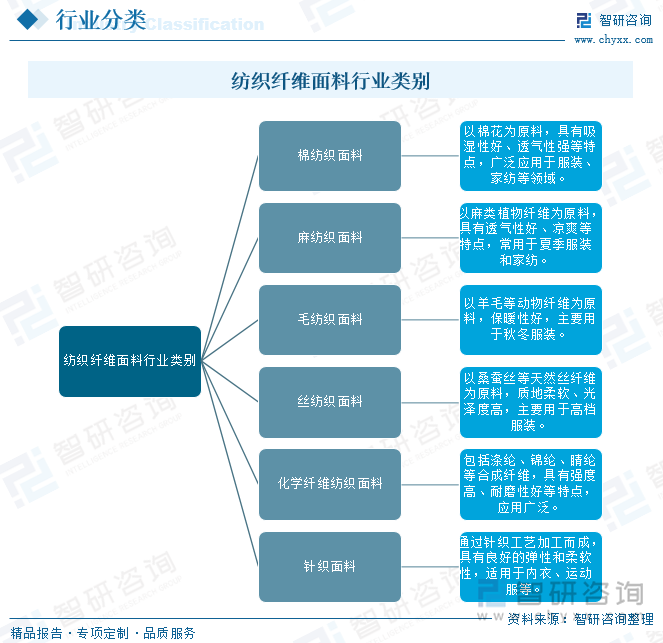
Core Insights - The textile fiber fabric industry is crucial for manufacturing fabrics and garments, divided into natural fiber fabrics and chemical fiber fabrics [3][5] - In 2024, China's cotton textile industry is projected to generate revenue of 1,141.86 billion yuan, accounting for 61.40% of the textile industry, while the chemical textile industry is expected to generate 247.88 billion yuan, representing 13.33% [6][8] - The development of the textile fabric industry is increasingly focused on functionality and environmental sustainability, with the application of new fibers and technologies expanding [22] Industry Definition and Classification - Textile fiber fabrics are elongated materials used for making fabrics and garments, categorized into natural fiber fabrics and chemical fiber fabrics [3] - Natural fibers are favored for their environmental friendliness and comfort, while chemical fibers are essential for their strength and durability [3] Current Development Status - The textile industry has evolved significantly since the Neolithic era, reflecting advancements in technology, art, culture, and economy [5] - The industrial revolution greatly enhanced production efficiency and quality, with cotton becoming a key textile raw material [5] - The 21st century presents new challenges and opportunities, emphasizing sustainable practices and the emergence of innovative materials like nanofibers and smart textiles [5] Industry Chain Structure - The textile fabric industry chain consists of upstream natural fibers (cotton, linen, silk, wool) and chemical fibers (polyester, nylon), midstream fabric production, and downstream applications in clothing, home textiles, and industrial textiles [10] Market Size and Growth - The market size for industrial textiles in China is projected to reach 332.44 billion yuan in 2024, with total industry output valued at 597.74 billion yuan [14] - The silk industry is expected to generate approximately 76.59 billion yuan in revenue in 2024, with a year-on-year growth of 5.75% [12] Competitive Landscape - The textile fabric industry in China is characterized by a diverse and fragmented competitive landscape, with key players including Zhejiang Xin'ao Textile Co., Ltd., Hengli Petrochemical Co., Ltd., and others [16] - Major companies are focusing on product innovation and sustainability, with significant investments in technology and brand development [18] Future Trends - The development of textile fabrics is increasingly influenced by new materials and technologies, emphasizing diversification, functionality, lightweight, and environmental sustainability [22] - The industry is expected to continue evolving to meet consumer demands for high-quality, eco-friendly products [22]


石油化工行业周报:中美贸易存在好转预期,涤纶长丝有望迎来修复-20250629
Shenwan Hongyuan Securities· 2025-06-29 12:57
Investment Rating - The report maintains a positive outlook on the polyester industry, particularly for polyester filament yarn, anticipating a recovery in demand due to improving Sino-US trade relations [3][4]. Core Insights - The report highlights the expectation of a recovery in polyester filament yarn demand as Sino-US trade restrictions are anticipated to ease, potentially restoring textile and apparel exports to the US [4][5]. - It notes that US apparel wholesalers have been depleting their inventories since Q4 2022, and with the overseas economy recovering, a replenishment phase is expected to begin in 2025, further boosting filament yarn demand [4][7]. - The report emphasizes that downstream inventories for polyester filament yarn are at historically low levels, which supports a stable demand outlook despite external trade pressures [11]. - The report indicates that the valuation of polyester filament yarn companies is currently at historical lows, suggesting potential for upward movement during the seasonal peak periods [14]. Summary by Sections Upstream Sector - Brent crude oil prices fell to $67.77 per barrel, a decrease of 12% week-on-week, while WTI prices dropped to $65.52 per barrel, down 11.27% [22]. - US commercial crude oil inventories decreased to 415 million barrels, down 5.84 million barrels from the previous week, and are 11% lower than the five-year average [24]. - The report anticipates a widening supply-demand trend for crude oil, with expectations of price fluctuations but overall stability due to OPEC+ production cuts [4][22]. Refining Sector - The report notes an increase in the Singapore refining margin to $16.47 per barrel, up $4.89 from the previous week, indicating improved refining profitability [56]. - The report suggests that refining product margins are still low but are expected to improve as economic recovery progresses [4][53]. Polyester Sector - PTA prices have been rising, with the average price in East China reaching 5,139 RMB per ton, up 1.08% week-on-week [4]. - The report highlights a positive outlook for leading polyester companies such as Tongkun Co. and Wankai New Materials, anticipating a recovery in profitability as supply-demand dynamics improve [18]. Investment Recommendations - The report recommends focusing on leading polyester companies, refining firms, and offshore oil service companies, citing potential for performance improvement as market conditions stabilize [18].
大炼化周报:长丝价格增加,产销明显上升-20250629
Soochow Securities· 2025-06-29 07:42
Report Summary 1. Report Industry Investment Rating No information about the industry investment rating is provided in the given content. 2. Core Viewpoints The report focuses on the weekly data of the large refining and chemical industry, including price, profit, inventory, and operating rate changes in different sectors such as refining, polyester, and chemicals, as well as the performance of relevant listed companies [2][8][9]. 3. Summary by Directory 3.1 Big Refining Weekly Data Briefing - **Price and Spread**: The domestic key large refining project spread this week was 2,673 yuan/ton, a week - on - week increase of 377 yuan/ton (16%); the foreign key large refining project spread was 1,241 yuan/ton, a week - on - week increase of 258 yuan/ton (26%). The average price of PX this week was 875.1 dollars/ton, a week - on - week decrease of 4.9 dollars/ton, and the spread to crude oil was 369.6 dollars/ton, a week - on - week increase of 41.0 dollars/ton [2]. - **Polyester Sector**: POY/FDY/DTY industry average prices were 7,193/7,496/8,446 yuan/ton respectively, with week - on - week increases of 146/179/186 yuan/ton. The weekly average profits were 74/10/44 yuan/ton, with week - on - week increases of 88/109/114 yuan/ton. The inventory was 17.2/18.9/25.3 days, with week - on - week changes of +0.9/ - 0.9/ - 0.3 days. The filament operating rate was 90.6%, a week - on - week increase of 0.3 pct. The downstream loom operating rate was 59.0%, a week - on - week decrease of 1.7 pct [2]. - **Refining Sector**: Domestic gasoline, diesel, and jet fuel prices rose this week, while in the US, gasoline, diesel, and jet fuel prices fell [2]. - **Chemical Sector**: The PX operating rate was 86.4%, a week - on - week increase of 0.1 pct [2]. - **Related Listed Companies**: Private large refining and chemical & polyester filament companies include Hengli Petrochemical, Rongsheng Petrochemical, Hengyi Petrochemical, Tongkun Co., Ltd., and Xin凤鸣 [2]. - **Stock Performance**: The oil and petrochemical index on June 27, 2025, showed a - 2.1% change in the past week, 1.5% in the past month, - 1.1% in the past three months, - 5.9% in the past year, and - 4.9% since the beginning of 2025. Among the listed companies, Rongsheng Petrochemical had a 2.5% increase in the past week, while Tongkun Co., Ltd. had a - 33.3% change in the past year [8]. - **Earnings Forecast**: For example, Hengli Petrochemical's expected net profit attributable to the parent company in 2025 is 8.024 billion yuan, with a PE of 12.5 in 2025E [8]. 3.2 Big Refining Weekly Report - **2.1 Big Refining Index and Project Spread Trends**: It may involve the trends of the big refining index, domestic and foreign big refining project spreads, and the changes in the performance of six private big refining companies [11][15][20]. - **2.2 Polyester Sector**: Covers various aspects such as the prices and spreads of crude oil, PX, PTA, and MEG; the operating rates of PX, PTA, and MEG; the prices and profits of POY, FDY, DTY, and polyester staple fiber; the inventory and operating rates of polyester filament and downstream looms [23][33][55]. - **2.3 Refining Sector**: Includes the prices and spreads of domestic, US, European, and Singaporean refined oil products (gasoline, diesel, and jet fuel) relative to crude oil [84][99][122]. - **2.4 Chemical Sector**: Focuses on the prices and spreads of various chemical products such as polyethylene, polypropylene, EVA, and styrene relative to crude oil [139][140][148].