King's Luck(603369)

Search documents
今世缘破百亿,全国化应提上日程
Sou Hu Cai Jing· 2025-07-26 17:16
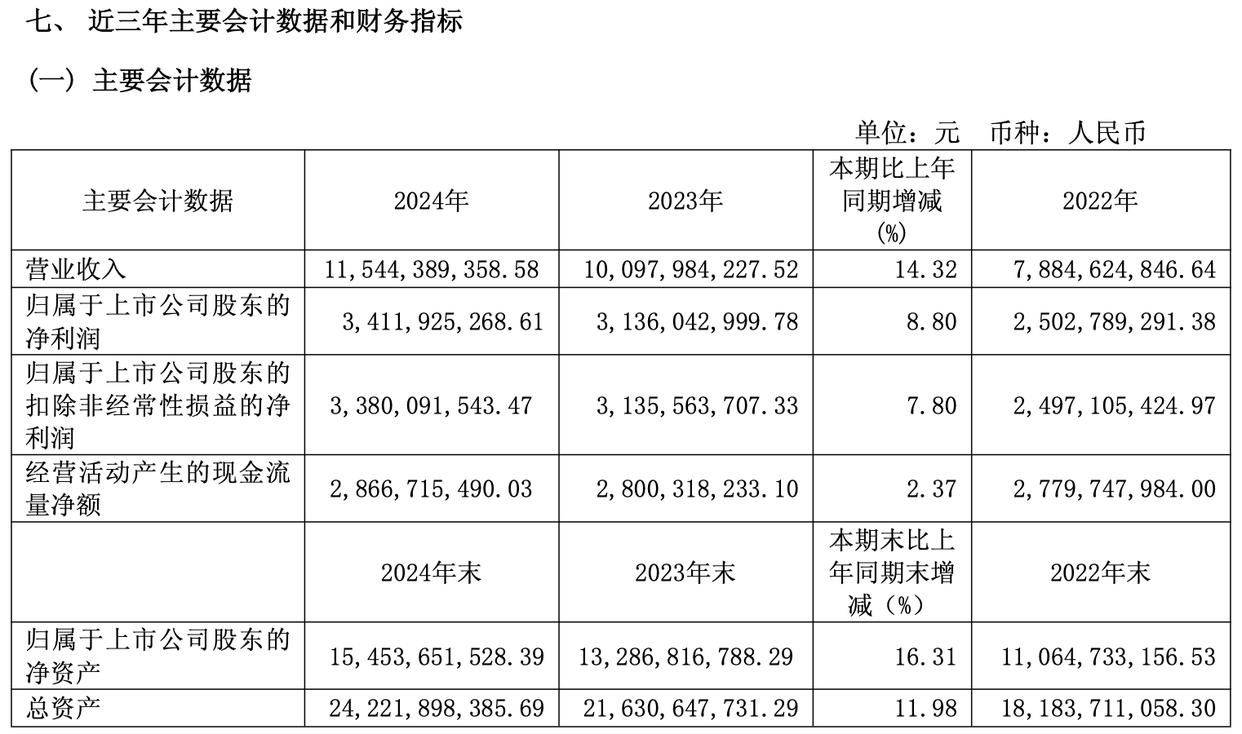
Core Viewpoint - The Chinese liquor industry is experiencing a slight decline in production but an increase in sales revenue and profit, with the company Jiuziyuan showing significant growth in revenue and profit in 2024 [1][2]. Industry Overview - In 2024, the liquor industry had a total production of 4.1447 million kiloliters, a year-on-year decrease of 1.80%, while sales revenue reached 796.384 billion yuan, an increase of 5.30%, and profits were 250.865 billion yuan, up by 7.76% [1]. - The overall market is facing pressure from major brands expanding their distribution channels, impacting regional brands significantly [3]. Company Performance - Jiuziyuan achieved a revenue of approximately 11.544 billion yuan in 2024, marking a year-on-year growth of 14.32%, and a net profit of about 3.412 billion yuan, up by 8.80% [2][3]. - The company’s quarterly revenue for 2024 was approximately 4.671 billion yuan, 2.633 billion yuan, 2.636 billion yuan, and 1.604 billion yuan, respectively, indicating a slowdown in revenue and profit growth [2][3]. Product Analysis - Jiuziyuan's revenue from premium products priced above 300 yuan grew by approximately 15.17%, while products priced between 100-300 yuan saw a growth of about 16.61% [3][4]. - Products priced above 100 yuan accounted for approximately 93.88% of total revenue, all achieving double-digit growth [3]. Market Performance - Revenue from various regions showed growth, with the Huai'an region achieving approximately 2.235 billion yuan (up 12.31%), and the Suzhou region reaching about 1.924 billion yuan (up 21.21%) [4]. - The company’s traditional wholesale and agency channels generated 112.05 billion yuan, accounting for 97.06% of total revenue, with a year-on-year growth of 14.19% [5]. Production Insights - Jiuziyuan's production volume in 2024 was 53,548.59 kiloliters, a year-on-year increase of 4.03%, while sales volume reached 55,834.30 kiloliters, up by 19.54% [6]. - The company has faced challenges in increasing its market share outside its home province, with external revenue remaining around 5% [6][7]. Strategic Goals - Jiuziyuan aims to achieve a revenue target of 15 billion yuan by 2025, focusing on expanding its presence in provincial markets and enhancing product structure [7]. - The company is investing in capacity enhancement projects, including a 12 billion yuan investment in facility upgrades [7]. Competitive Landscape - The liquor market is becoming increasingly competitive, with Jiuziyuan needing to enhance its brand recognition and product quality to meet consumer demands [8].


【开源食饮】食品饮料仓位新低,建议布局白酒与新消费潜力股——行业点评报告
Sou Hu Cai Jing· 2025-07-25 20:24
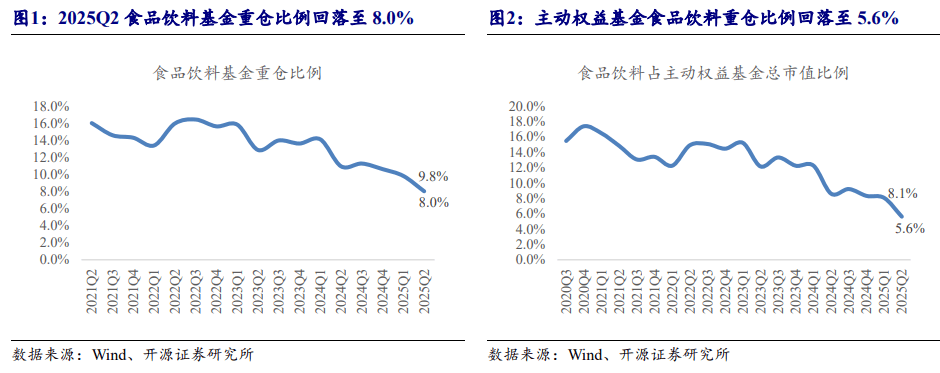
Group 1 - The core viewpoint of the articles indicates a significant decline in the allocation of food and beverage sectors by funds, reaching a new low since 2020, with the allocation ratio dropping from 9.8% in Q1 2025 to 8.0% in Q2 2025 [1][5][6] - Active equity funds have notably reduced their allocation to the food and beverage sector, with a decrease from 8.1% in Q1 2025 to 5.6% in Q2 2025, reflecting a 2.5 percentage point drop [1][5][6] - The decline in the food and beverage sector is attributed to the impact of the alcohol ban, which has further contracted consumption scenarios, particularly affecting traditional sectors like liquor [1][3][5] Group 2 - The proportion of active equity funds heavily invested in liquor has decreased from 6.57% in Q1 2025 to 3.97% in Q2 2025, a decline of 2.6 percentage points, indicating a widespread reduction in liquor holdings [2][11] - The overall market fund allocation to liquor has also fallen from 8.5% in Q1 2025 to 6.8% in Q2 2025, showing a similar trend of reduced investment in liquor [2][11] - Major liquor companies such as Luzhou Laojiao, Wuliangye, and Shanxi Fenjiu have seen significant reductions in fund holdings, while only a few companies like Kuaijishan and Shede Liquor experienced slight increases [2][11][20] Group 3 - The investment recommendation suggests strategically positioning in the liquor sector, as the current low expectations and valuations present potential opportunities for gradual accumulation [3][25][27] - The report anticipates that the liquor industry will find a bottom in the second half of the year, with expectations of a recovery in demand as the market adjusts to the impacts of the alcohol ban [3][27] - For new consumption targets, the focus should be on companies that can leverage channel expansion opportunities and emerging product categories, with recommendations including Ximai Food and Bai Run Shares [3][28]





行业点评报告:食品饮料仓位新低,建议布局白酒与新消费潜力股
KAIYUAN SECURITIES· 2025-07-24 05:43
Investment Rating - The industry investment rating is "Positive" (maintained) [1] Core Viewpoints - The food and beverage sector has seen a significant decline in fund allocation, with the configuration ratio dropping from 9.8% in Q1 2025 to 8.0% in Q2 2025, marking a new low since 2020 [3][12] - The decline in fund allocation is primarily attributed to the impact of the alcohol ban, which has further contracted consumption scenarios, particularly in the traditional liquor sector [5][6] - Despite the current pessimism, there is an expectation of a market style switch in July, which may lead to some capital returning to the sector [5][13] Summary by Sections Fund Allocation Trends - In Q2 2025, the allocation ratio for food and beverage in active equity funds decreased to 5.6%, down from 8.1% in Q1 2025, indicating a significant reduction in food and beverage investments [5][12] - The proportion of funds heavily invested in liquor dropped from 6.57% in Q1 2025 to 3.97% in Q2 2025, reflecting a broad reduction in liquor company holdings [4][20] - The overall market fund allocation for liquor also fell from 8.5% to 6.8% during the same period [20] Investment Recommendations - The report suggests a strategic focus on the liquor sector, particularly as the market is expected to find a bottom in the second half of the year [6][33] - It is recommended to gradually build positions in leading liquor companies such as Kweichow Moutai, Luzhou Laojiao, and Shanxi Fenjiu, which maintain high dividend yields [6][33] - For new consumption stocks, the report advises identifying high-quality companies that align with industry trends and holding them long-term, focusing on opportunities in new channels and product categories [6][34] Performance Metrics - The food and beverage sector's market value declined by 3.4% in Q2 2025, ranking 31 out of 32 sectors [13][18] - The sector's transaction amount ratio increased to 2.70%, indicating a slight recovery in trading activity despite the overall decline [13][18] - The report highlights that the majority of liquor companies experienced a decrease in fund holdings, while some consumer goods companies saw an increase in their market value [5][32]
食品饮料行业 2025 年中报前瞻:白酒出清探底,食品亮点频现
Huachuang Securities· 2025-07-22 09:25
Investment Rating - The report maintains a "Recommended" rating for the food and beverage industry, particularly highlighting opportunities in the liquor sector and food products [1] Core Insights - The liquor industry is undergoing extreme pressure testing, with a significant focus on inventory clearance and bottoming out of financial reports. The second quarter has shown weak demand due to seasonal factors and regulatory impacts, leading to a notable decline in sales and pricing pressures [5][10] - High-end liquor brands like Moutai are expected to maintain growth, while mid-tier brands face challenges with declining revenues and profits. The overall industry is in a deep clearance phase, with potential for recovery as regulations stabilize [5][12] - The consumer goods sector shows mixed performance, with snacks and beverages remaining strong, while other segments like frozen foods and chain restaurants face ongoing demand pressures [20][25] Summary by Sections 1. Liquor Sector - The liquor industry is experiencing extreme pressure, with weak demand in the second quarter and significant inventory levels. Major brands like Moutai and Wuliangye are expected to show modest growth, while others like Yanghe and Luzhou Laojiao are facing declines [5][11][12] - Moutai's revenue is projected to grow by 7% in Q2, while Wuliangye is expected to see a 1% increase. In contrast, brands like Yanghe and Luzhou Laojiao are forecasted to decline by 35% and 8% respectively [11][12] 2. Consumer Goods - The overall demand for consumer goods remains weak, but segments like snacks and beverages are performing well. For instance, East Peak is expected to see a 33% increase in revenue, while other snack brands are also showing positive trends [20][25] - The beverage sector is projected to see positive growth, with major brands like Qingdao Beer and Yanjing expected to report increases in revenue and profit [25][26] 3. Investment Recommendations - The report suggests focusing on high-performing stocks in the short term while considering long-term investments in liquor brands that are currently at their bottom. Brands like Moutai and Gujing are recommended for their lower risk profiles [7][8] - For consumer goods, companies like Anqi and East Peak are highlighted for their growth potential, while traditional dairy brands like Yili and Mengniu are suggested for a bundled investment approach [7][8]



白酒股午后震荡拉升,泸州老窖、山西汾酒均涨超4%
news flash· 2025-07-22 05:14
Group 1 - The core viewpoint of the article highlights the significant rise in the stock prices of Chinese liquor companies, particularly Luzhou Laojiao and Shanxi Fenjiu, which both increased by over 4% [1] - Other companies in the sector, such as Jinshiyuan and Gujing Gongjiu, also saw gains exceeding 3%, indicating a positive trend across the industry [1] - The article suggests that "smart money" is flowing into these stocks, hinting at a strategic investment interest in the liquor sector [1]

食品饮料周报:白酒情绪边际修复,关注中报确定性个股-20250721
Tai Ping Yang Zheng Quan· 2025-07-21 11:49
Investment Rating - The overall investment rating for the food and beverage industry is positive, with expectations of returns exceeding the CSI 300 index by more than 5% in the next six months [23]. Core Insights - The food and beverage sector has shown signs of stabilization and recovery, with soft drinks, liquor, and dairy products leading in growth. The sector index increased by 0.97%, ranking 14th among 31 sub-industries [4][13]. - The liquor segment is experiencing a rebound, with the SW liquor index rising by 0.88%. The sector is in a bottoming phase, with a focus on the upcoming demand during the Mid-Autumn Festival and National Day [5][17]. - The beverage market is seeing mixed short-term performances due to external events, but there is a long-term positive outlook for companies with upward momentum [6][18]. Summary by Sections Liquor Sector - The liquor sector is recommended for investment, with specific companies like Guizhou Moutai, Luzhou Laojiao, Shanxi Fenjiu, and Jianshiyuan receiving "Buy" ratings. The sector is currently at a historical low valuation, suggesting a potential recovery [3][5][21]. - The price of Moutai (bottle) is reported at 1890 RMB, showing a slight increase, while the price of Wuliangye remains stable at 870 RMB [5][17]. Beverage Sector - The beverage sector is experiencing fluctuations due to public sentiment affecting certain brands. Companies like Nongfu Spring and China Resources Beverage have shown resilience, with Nongfu Spring's market share recovering significantly [6][20]. - Recommendations include Youyou Foods, Dongpeng Beverage, and Dashi Co., with a focus on companies that can capitalize on market share recovery [6][18][21]. Food Sector - The food sector has seen some companies facing challenges due to external events, but there are still opportunities for growth in the long term. The focus remains on companies with strong mid-year performance [6][18].


酒业半年大考:八仙过海寻出路,三大趋势定格局
Sou Hu Cai Jing· 2025-07-21 07:29
Industry Overview - In 2024, the production of large-scale liquor enterprises is expected to reach 4.145 million kiloliters, a year-on-year decrease of 1.8%, while sales revenue is projected to increase to 796.38 billion yuan, a year-on-year increase of 5.3%, indicating a unique trend of "declining volume but increasing profit" [2] - By the first half of 2025, 59.7% of liquor companies reported a decline in operating profit, and 50.9% experienced a contraction in revenue, with an average inventory turnover period of 900 days, up 10% year-on-year, highlighting significant challenges in the industry [2] Key Trends - The industry is witnessing a simultaneous trend of "contraction and concentration," with smaller companies exiting the market and leading firms shifting focus from "high-speed growth" to "steady development" [3] - A "channel revolution" is underway, with major companies moving towards direct consumer engagement through new sales channels like online platforms and instant retail, indicating a shift in power from distributors to brands [4] - Consumer demand is evolving, driven by younger consumers, leading to product upgrades towards lower alcohol content and diverse flavors, with major brands launching new products to cater to these trends [5] Company Performance - **Kweichow Moutai**: Aims for a 9% revenue growth by 2025, with a first-quarter revenue of 51.443 billion yuan, up 11.07%, and a net profit of 26.847 billion yuan, up 11.56%, demonstrating strong execution of its strategic goals [6][7] - **Wuliangye**: Targets revenue growth in line with macroeconomic conditions, reporting a first-quarter revenue of 36.940 billion yuan, up 6.05%, and a net profit of 14.860 billion yuan, up 5.80%, with ongoing channel reforms [6][8] - **Luzhou Laojiao**: Focuses on low-alcohol products, with a first-quarter revenue of 9.352 billion yuan, up 1.78%, and a net profit of 4.593 billion yuan, up 0.41%, indicating a strong market position in lower alcohol segments [6][9] - **Shanxi Fenjiu**: Reports a first-quarter revenue of 16.523 billion yuan, up 7.72%, and a net profit of 6.648 billion yuan, up 6.15%, with ongoing efforts in national expansion and product innovation [6][10] - **Guojiao**: Achieves a first-quarter revenue of 5.099 billion yuan, up 9.17%, and a net profit of 1.644 billion yuan, up 7.27%, driven by a focus on the wedding market [6][12] Strategic Shifts - The industry is transitioning from "incremental expansion" to "stock optimization," with companies focusing on refining existing markets rather than pursuing aggressive growth [17] - A shift from "channel-driven" to "consumer-driven" strategies is evident, with companies prioritizing direct consumer engagement and enhancing consumer experiences [18] - The trend is moving from "high alcohol content" to "low and diverse products," with major brands launching lower alcohol options to attract younger consumers [20] - Companies are increasingly emphasizing "long-term value" over short-term performance, with a focus on cultural branding and sustainable growth strategies [21] - The shift from "national expansion" to "regional deepening" is becoming a survival strategy for many companies, focusing on local market penetration and brand recognition [22][23]

开源证券晨会纪要-20250721
KAIYUAN SECURITIES· 2025-07-20 23:30
Group 1 - The report maintains an optimistic view on the market's ability to continue breaking through, driven by strong risk appetite and multiple signals supporting market upward momentum [8][9][10] - Key sectors showing strong performance include construction materials, non-bank financials, non-ferrous metals, agriculture, and household appliances, with high-growth sectors identified as media, agriculture, construction materials, transportation, and non-bank financials [9][10] - The report highlights the importance of the TMT sector, particularly AI hardware and gaming, as significant drivers of market interest and investment [8][9] Group 2 - The report emphasizes the potential of the low-altitude economy, with significant developments in eVTOL aircraft and related infrastructure, supported by government policies and local initiatives [53][54] - Companies like Xiaopeng Heavens and Times Technology are noted for their recent financing and order achievements, indicating strong market interest and growth potential in the low-altitude sector [53][54] - The report suggests that the low-altitude economy is experiencing a comprehensive rollout from macro to micro levels, with various applications being tested and developed [53][54] Group 3 - The food and beverage sector is facing challenges with slowing retail sales growth, particularly in the restaurant and alcohol segments, due to external factors such as subsidy controls and strict regulations [56] - Despite the pressures, there are opportunities for investment in leading liquor companies as valuations have reached low points, suggesting potential for recovery in the second half of the year [56] - The report indicates that the overall consumer demand needs to be stimulated, with a focus on the clearing of livestock and new demand drivers [56]

6月社零增速环比放缓,内需消费仍待提振
KAIYUAN SECURITIES· 2025-07-16 06:16
Investment Rating - The industry investment rating is "Overweight" [1] Core Viewpoints - The report highlights that the food and beverage sector is expected to benefit from potential domestic policy adjustments and a recovery in consumer demand in the second half of the year [3][4] - The report suggests strategic positioning in leading liquor companies due to their low valuation and favorable market conditions [3][6] - The snack food segment shows strong growth potential, driven by product innovation and emerging sales channels [6] Summary by Sections Industry Overview - The food and beverage sector is currently experiencing a slowdown in retail sales growth, with June 2025 retail sales increasing by 4.8% year-on-year, a decrease of 1.6 percentage points from May [4][8] - The report notes that the decline in consumer spending on dining and discretionary items has impacted overall sales performance [4][5] Liquor Sector - The liquor industry is in a bottoming phase, with consumption scenarios limited by recent policy changes and promotional activities affecting pricing [6] - The report recommends focusing on top liquor brands such as Kweichow Moutai, Luzhou Laojiao, and Shanxi Fenjiu for potential investment opportunities [3][6] Snack Food Sector - The snack food segment, particularly products like konjac, is experiencing robust growth due to health trends and diverse flavor offerings [6] - The report emphasizes the importance of identifying quality companies in the snack food sector that align with industry development trends for long-term investment [3][6]
一瓶几十元,白酒巨头狂卷光瓶酒
Xin Lang Cai Jing· 2025-07-16 05:50
Group 1 - The core viewpoint of the article highlights the growing popularity of low-priced "light bottle" liquor in the Chinese market, as high-end liquor brands struggle with price declines and sales challenges [1][14][16] - Major liquor companies are launching new products in the light bottle segment, with notable examples including Yanghe's "Yanghe Daqu High Line Light Bottle Liquor" priced at 59 yuan, which sold over 10,000 bottles in 48 hours [1][4] - The light bottle liquor market has reached a scale of approximately 1.5 trillion yuan in 2024, with continued growth expected in 2025, making it one of the most dynamic segments in the liquor industry [3][10] Group 2 - Consumer behavior is shifting towards more rational choices, with a significant portion of consumers prioritizing cost-effectiveness and practicality in their liquor purchases [10][11] - The traditional light bottle liquor market, represented by brands like Niulanshan and Baijiu, has established a strong presence, while new entrants are emerging to capture market share amid changing consumer preferences [7][9] - The competitive landscape is intensifying as more companies enter the light bottle segment, leading to concerns about market saturation and the ability to maintain quality and differentiation [17][18] Group 3 - The high-end liquor market, particularly brands priced above 1,000 yuan, is experiencing significant price declines, with major brands like Moutai and Wuliangye seeing their market prices drop below their official guidance prices [16][17] - The shift towards light bottle liquor reflects a broader trend in the industry where companies are adapting to consumer demands and seeking new growth opportunities in a challenging market environment [15][17] - The light bottle segment is increasingly viewed as a mainstream choice, moving away from its previous perception as a low-end product, and is now seen as a potential growth engine for liquor companies [17][18]