
WLY(000858)

Search documents
五粮液业绩失速背后:华涛官场思维难适配,市值蒸发150亿
Sou Hu Cai Jing· 2025-08-30 02:06
Core Viewpoint - The financial report of Wuliangye has raised concerns among investors due to a lack of dividends and a significant decline in net profit, leading to a 2.4% drop in stock price on the day of the announcement [1][4]. Financial Performance - Wuliangye reported a revenue of 52.771 billion yuan and a net profit of 19.492 billion yuan, reflecting year-on-year growth of 4.19% and 2.28% respectively [3]. - However, the second quarter showed a revenue of 15.831 billion yuan with a negligible growth of 0.098% and a net profit of 4.632 billion yuan, down 7.58% year-on-year, marking the first negative growth in net profit in five years [3][5]. - The revenue gap between Wuliangye and its competitor Moutai has widened, with Wuliangye's revenue difference exceeding 40 billion yuan in the first half of 2025 [3][10]. Management and Strategy - The new general manager, Hua Tao, has faced criticism for his management style and the internal chaos following his appointment, which has affected the company's marketing and distribution strategies [5][6]. - Hua Tao's strategy to target the low-alcohol market has been slow to materialize, with the company struggling to adapt to changing consumer preferences [6][7]. - Wuliangye's cancellation of dividends is seen as a response to cash flow pressures, with net cash flow from operating activities declining by 12.7% year-on-year [6][9]. Market Position and Competition - The low-alcohol market is becoming increasingly competitive, with over 20 companies launching similar products, while Wuliangye's brand perception does not align with younger consumers' preferences [7][8]. - Wuliangye's low-alcohol products have not gained significant traction in online sales, indicating a lack of effective marketing and distribution strategies [8][9]. - The company's current challenges are attributed to long-standing issues such as a narrow product range, inadequate brand modernization, and rigid channel management [9][10].


白酒强势反攻涨超2%,形势看似一片大好,背后真相真有这么简单?
Sou Hu Cai Jing· 2025-08-30 02:06
Core Viewpoint - The white liquor sector has shown a remarkable upward trend, with the index rising over 2%, driven by significant stock performances from companies like Jinhui Liquor and Shede Liquor, despite underlying inventory pressures that equate to 3 to 6 months of sales [1][2][4]. Market Performance - On August 29, the white liquor stocks surged, with the Tonghuashun white liquor index surpassing a 2% increase. Jinhui Liquor led with over a 6% rise, while Shede Liquor and Gujing Gongjiu followed with increases of over 4% [2]. - Major brands like Guizhou Moutai also demonstrated resilience, with a 1.36% increase, maintaining a strong position above the 1,000 yuan mark [2]. Fund Movements - Central Huijin, representing the "national team," significantly increased its holdings in the white liquor ETF by 121 million shares in the first half of the year, raising its total to 581 million shares, making it the third-largest holder of this ETF [4]. - The overall market performance in August saw the Tonghuashun white liquor index accumulate a rise of over 13% [4]. Valuation and Policy Support - The current price-to-earnings (PE) ratio for the white liquor sector stands at 19.83, marking a near ten-year low, with individual companies like Guizhou Moutai at a dynamic PE of 24 and Wuliangye at 17, both below historical averages, indicating significant valuation appeal [6]. - Recent government policies aimed at stimulating consumption and addressing unreasonable restrictions on the liquor industry have provided positive signals for the market [6]. Fundamental Improvements and Seasonal Recovery - There are signs of marginal improvement in the fundamentals, particularly with the recovery of banquet and gift consumption since late July, especially in the sub-300 yuan price range [7]. - The upcoming Mid-Autumn Festival and National Day are expected to catalyze demand, enhancing sales momentum [7]. Changing Fund Preferences and Shareholder Returns - Fund preferences are shifting as leading liquor companies increase dividend rates and implement stock buybacks, with dividend yields for major firms exceeding 3.5%, appealing to long-term investors seeking stable returns [10]. Ongoing Challenges - Despite positive market signals, underlying issues such as weak consumer spending persist, with a reported 2.1% year-on-year growth in per capita consumption expenditure in Q1 2025, impacting sales, particularly in high-end products [11]. - Inventory levels remain a significant challenge, with some mainstream brands holding stock equivalent to 3 to 6 months of normal sales, and production figures showing a 5.8% decline year-on-year [11]. - Price discrepancies continue, with major products like Wuliangye's mainstream offerings trading at 12.5% below factory prices, affecting profit margins for distributors [12]. Institutional Perspectives and Future Outlook - Market consensus among institutions shows a belief in a gradual recovery for the white liquor industry, with improved sales and pricing indicators suggesting potential for recovery [13]. - If sales data during the Mid-Autumn Festival exceeds expectations, the mid-range liquor segment may experience a rebound [15]. - Long-term prospects remain strong due to the robust business models of leading companies, although economic stabilization and inventory reduction will take time to materialize [15].



【五粮液(000858.SZ)】25Q2收入平稳,利润短期承压——2025年中报点评(叶倩瑜/李嘉祺)
光大证券研究· 2025-08-30 00:03
Core Viewpoint - Wuliangye reported a total revenue of 52.771 billion yuan for the first half of 2025, a year-on-year increase of 4.19%, and a net profit attributable to shareholders of 19.492 billion yuan, up 2.28% year-on-year [4]. Group 1: Revenue Performance - In H1 2025, Wuliangye's revenue from its main brand and other liquor products was 40.998 billion yuan and 8.122 billion yuan, respectively, with year-on-year growth of 4.57% and 2.73% [5]. - The sales volume of Wuliangye increased by 12.75% while the average price decreased by 7.25%, indicating a volume growth but price reduction for the main brand [5]. - The sales of mid-to-low priced products showed significant improvement, with a 58.81% increase in sales volume but a 35.31% decrease in average price for other liquor products [5]. Group 2: Profitability and Costs - The gross profit margin for Q2 2025 was 74.69%, a slight decline of 0.32 percentage points year-on-year, attributed to the increase in sales of mid-to-low priced liquor [6]. - The net profit margin for Q2 2025 was 30.11%, down 2.71 percentage points year-on-year, impacted by increased promotional, storage, and logistics costs [6]. - Cash flow from operating activities showed a significant increase, with cash receipts of 31.233 billion yuan in Q2 2025, up 12.03% year-on-year, and a net cash flow of 15.288 billion yuan, an increase of 18.4% [6].

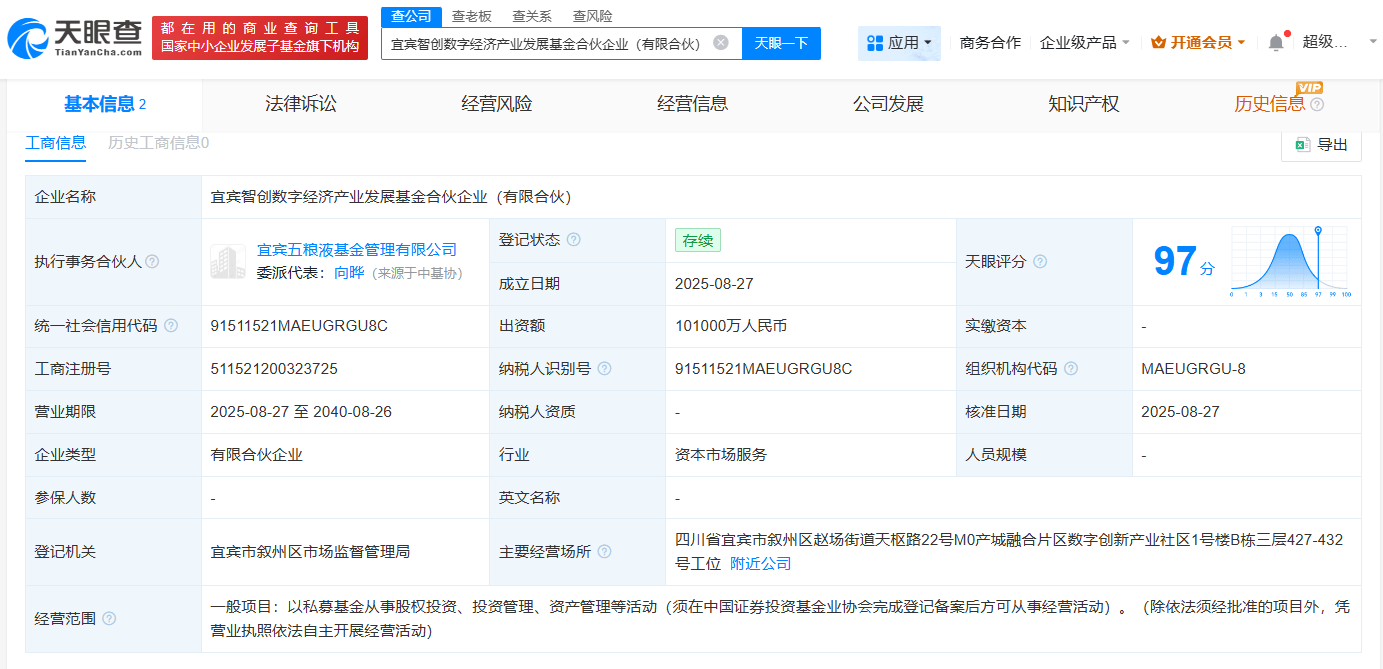
五粮液豪掷10.1亿,智创数字经济产业发展基金正式成立!
Sou Hu Cai Jing· 2025-08-29 17:31
Core Viewpoint - The establishment of Yibin Zhichuang Digital Economy Industry Development Fund Partnership (Limited Partnership) marks a significant move into the digital economy sector, backed by strong industry players and substantial capital investment [1][3]. Group 1: Fund Overview - The newly established fund has a registered capital of 1.01 billion RMB, indicating a robust financial foundation for its operations [1][2]. - The fund's operational scope includes private equity investments, investment management, and asset management, showcasing its diverse capabilities in the financial investment sector [1][2]. Group 2: Key Stakeholders - The fund is co-founded by two major shareholders: Sichuan Yibin Wuliangye Group Co., Ltd. and Yibin Wuliangye Fund Management Co., Ltd., which strengthens the fund's long-term development prospects [1][3]. - Yibin Wuliangye Fund Management Co., Ltd. will serve as the executive partner, responsible for daily operations and management decisions, leveraging its extensive experience in the financial sector [2][3]. Group 3: Strategic Importance - The involvement of Sichuan Yibin Wuliangye Group, a well-known liquor company, brings valuable industry resources and market insights, facilitating the fund's exploration of digital transformation [3]. - The fund aims to integrate traditional industry wisdom with the vitality of emerging sectors, potentially driving innovation and upgrades within the digital economy [3].
16.26亿元资金今日流入食品饮料股
Zheng Quan Shi Bao Wang· 2025-08-29 14:19
Market Overview - The Shanghai Composite Index rose by 0.37% on August 29, with 17 out of the 28 sectors experiencing gains. The top-performing sectors were diversified and electrical equipment, with increases of 3.86% and 3.12% respectively. The food and beverage sector also saw a rise of 2.42%. Conversely, the household appliances and transportation sectors faced declines of 1.82% and 1.69% respectively [1] Capital Flow Analysis - The main capital flow showed a net outflow of 69.47 billion yuan across the two markets. However, seven sectors recorded net inflows, with the electrical equipment sector leading at a net inflow of 3.13 billion yuan, followed by the food and beverage sector with a net inflow of 1.63 billion yuan [1] Food and Beverage Sector Performance - The food and beverage sector increased by 2.42%, with a total net inflow of 1.63 billion yuan. Out of 124 stocks in this sector, 78 stocks rose, including 4 that hit the daily limit. The top net inflow stocks included Kweichow Moutai with 764.23 million yuan, followed by Wuliangye and Huadiao with 475 million yuan and 271 million yuan respectively [2] Top Gainers in Food and Beverage Sector - The following stocks in the food and beverage sector had significant gains: - Kweichow Moutai: +2.34%, turnover rate 0.50%, net inflow 764.23 million yuan - Wuliangye: +3.24%, turnover rate 1.12%, net inflow 474.99 million yuan - Huadiao: +9.99%, turnover rate 5.10%, net inflow 270.68 million yuan - Other notable gainers included Shede Liquor and Jiu Gui Liquor with increases of 6.02% and 5.26% respectively [2] Top Losers in Food and Beverage Sector - The following stocks in the food and beverage sector experienced notable losses: - Yili: -3.18%, turnover rate 3.36%, net outflow -172.62 million yuan - Wancheng Group: -20.00%, turnover rate 5.34%, net outflow -86.60 million yuan - Lianhua Holdings: -2.65%, turnover rate 3.64%, net outflow -57.04 million yuan - Other significant losers included Liziyuan and Tancheng Beijian with losses of -3.22% and -0.73% respectively [4]




湾财晚报 | 梦网科技终止收购碧橙数字;五粮液10亿成立基金;韩红车展现场下订
Sou Hu Cai Jing· 2025-08-29 14:17
Group 1: DreamNet Technology and Acquisition - DreamNet Technology has terminated its plan to acquire 100% of Orange Digital for a total price of 1.28 billion yuan, which was initially announced on June 26 [2] - The acquisition was intended to be financed through a combination of issuing shares and cash, with a maximum of 830 million yuan raised for supporting funds [2] Group 2: Wuliangye and Digital Economy Fund - Wuliangye has established the Yibin Smart Innovation Digital Economy Industry Fund with a contribution of 1.01 billion yuan [4] - The fund will engage in private equity investments, investment management, and asset management activities [4] Group 3: MiHoYo and Tencent Lawsuit - MiHoYo has initiated a civil lawsuit against Tencent, which has sparked speculation among players regarding the motives behind the action [6] - The case is set to be heard on September 5 in Shenzhen [6] Group 4: China Merchants Bank Half-Year Report - China Merchants Bank reported a revenue of 169.969 billion yuan for the first half of 2025, a decrease of 1.72% year-on-year [7] - The net profit attributable to shareholders was 74.930 billion yuan, reflecting a slight increase of 0.25% [7] - The bank's total assets reached 12.66 trillion yuan, growing by 4.16% compared to the end of the previous year [7] Group 5: Guosen Securities Half-Year Report - Guosen Securities achieved a total revenue of 110.75 billion yuan in the first half of 2025, marking a year-on-year increase of 51.84% [8] - The net profit attributable to shareholders was 53.67 billion yuan, representing a growth of 71.00% [8] Group 6: Biyin Lefen's Performance - Biyin Lefen reported a revenue of 2.103 billion yuan for the first half of 2025, an increase of 8.63% year-on-year [11] - However, the net profit attributable to shareholders decreased by 13.56% to 414 million yuan [11] Group 7: Zeekr's New SUV Launch - Zeekr has launched its new flagship luxury SUV, the Zeekr 9X, with pre-sale prices starting at 479,900 yuan [13] - The model received significant interest, with over 42,000 orders placed within the first hour of the pre-sale [13]






明星基金经理二季度调仓路线图:科技医药成共识,消费现分歧
Nan Fang Du Shi Bao· 2025-08-29 13:36
Core Viewpoint - The article highlights the strategic adjustments made by prominent fund managers in response to the market's structural characteristics, focusing on sectors like AI, innovative pharmaceuticals, and consumer goods, while also indicating a clear divergence in the consumer sector's performance [2][3][4]. Group 1: Fund Manager Strategies - Prominent fund managers have collectively increased their positions in high-growth sectors such as AI and innovative pharmaceuticals while making structural adjustments within the consumer sector [2]. - The technology and pharmaceutical sectors have emerged as core allocation directions, with significant investments in companies like BYD (increased by 184.78%) and Alibaba (increased by 161.10%) [2]. - Fund managers are focusing on "hard technology" in the tech sector, with AI computing and robotics becoming key investment areas [4]. Group 2: Consumer Sector Dynamics - The consumer sector has shown significant structural differentiation, with fund managers displaying contrasting attitudes towards traditional liquor and new consumption trends [3]. - Some fund managers have increased their holdings in traditional liquor stocks like Wuliangye and Moutai, while others have reduced their positions in these stocks, indicating a shift towards new consumption opportunities [3][4]. - The performance of consumer companies has influenced fund adjustments, with companies like Yili achieving strong revenue growth while others like Yanghe experienced profit declines [4]. Group 3: Future Outlook - Looking ahead to the third quarter, there is optimism regarding the innovative pharmaceutical sector, driven by global collaborations and anticipated clinical data disclosures [5]. - The consumer healthcare sector is expected to continue benefiting from rising health awareness among residents, with demand for home medical devices projected to grow steadily due to an aging population [5]. - The overall economic environment is seen as favorable for investment, although structural pressures may persist, with policies aimed at reducing excessive competition likely to improve corporate profitability [5].



今日22只股长线走稳 站上年线
Zheng Quan Shi Bao Wang· 2025-08-29 13:04
Market Overview - The Shanghai Composite Index closed at 3857.93 points, above the annual line, with a change of 0.37% [1] - The total trading volume of A-shares reached 28,301.97 billion yuan [1] Stocks Breaking Annual Line - A total of 22 A-shares have surpassed the annual line today, with notable stocks including Guoan Co., Transsion Holdings, and ST Huawen, showing divergence rates of 6.70%, 5.14%, and 4.43% respectively [1] - Stocks with smaller divergence rates that just crossed the annual line include Changjiang Electric, ST Zhongzhuang, and Laobaigan Liquor [1] Top Divergence Rates - The top three stocks with the highest divergence rates are: - Guoan Co. (10.07% increase, 6.70% divergence) - Transsion Holdings (7.17% increase, 5.14% divergence) - ST Huawen (4.86% increase, 4.43% divergence) [1] Additional Stock Performance - Other notable stocks include: - Shenyang Machine Tool (4.49% increase, 3.75% divergence) - Shangong Shenbei (4.20% increase, 3.64% divergence) - ST Boda (4.10% increase, 3.48% divergence) [1]





五粮液(000858):2025年半年报点评:宴席带动开瓶率增长,逆周期营收韧性足
Minsheng Securities· 2025-08-29 12:17
Investment Rating - The report maintains a "Recommended" rating for the company, indicating a positive outlook for the stock price over the next 12 months [5]. Core Insights - The company reported a revenue of 52.77 billion yuan and a net profit attributable to shareholders of 19.49 billion yuan for the first half of 2025, reflecting a year-on-year increase of 4.19% and 2.28% respectively [1]. - The focus on banquet markets has led to a double-digit growth in both the number of events and bottle openings, although overall performance showed an increase in volume but a decrease in price [1]. - The company launched a new low-alcohol product aimed at younger consumers, which is expected to contribute to revenue growth in the second half of the year [1]. Revenue Breakdown - The main liquor segment achieved a revenue of 49.12 billion yuan in the first half of 2025, with a volume increase of 44.59% but a price decrease of 27.89%, resulting in a gross margin decline of 0.39 percentage points to 82.20% [1]. - The revenue from Wuliangye products was 40.99 billion yuan, with a volume increase of 12.75% and a price decrease of 7.25% [1]. - Other liquor products generated a revenue of 8.12 billion yuan, with a significant volume increase of 58.81% but a price drop of 35.31% [1]. Regional Performance - The company restructured its marketing regions into three major areas, with the Eastern region showing the best growth at 7.88% year-on-year [2]. - Revenue from the Northern and Southern regions increased by 1.82% and 1.93% respectively [2]. Channel Performance - Revenue from distribution and direct sales reached 27.93 billion yuan and 21.20 billion yuan respectively, with direct sales growing faster than the overall market [2]. - The company has been expanding its direct sales channels, increasing the number of exclusive stores to 1,768 by the end of Q2 [2]. Profitability Metrics - The gross margin for the first half of 2025 was 76.83%, down 0.53 percentage points year-on-year, while the net profit margin was 36.94% [3]. - The company expects net profits to recover in the coming years, projecting 30.40 billion yuan in 2025, a decrease of 4.6% from the previous year, followed by growth in subsequent years [5][6]. Financial Forecast - The company is projected to achieve revenues of 89.69 billion yuan in 2025, with a growth rate of 0.6% [6]. - The earnings per share are expected to be 7.83 yuan in 2025, with a price-to-earnings ratio of 17 [6].
五粮液(000858):Q2务实降速,八代普五竞争地位稳固
HUAXI Securities· 2025-08-29 11:16
Investment Rating - The investment rating for the company is "Buy" [1] Core Insights - The company reported a revenue of 52.771 billion yuan for H1 2025, a year-on-year increase of 4.19%, and a net profit attributable to shareholders of 19.492 billion yuan, up 2.28% year-on-year [2] - In Q2 2025, the company achieved a revenue of 15.831 billion yuan, a slight increase of 0.10% year-on-year, while the net profit attributable to shareholders was 4.632 billion yuan, down 7.58% year-on-year [3] - The company maintained a stable market share for its flagship product, with a focus on volume growth in the series of products [4] - The distribution model showed slight changes, with both wholesale and direct sales channels achieving revenue growth [5] - The gross margin was slightly pressured due to a decline in unit price, with a Q2 gross margin of 74.69%, down 0.32 percentage points year-on-year [6][7] - The company has adjusted its earnings forecast slightly downward for 2025-2027, with expected revenues of 92.022 billion yuan, 94.365 billion yuan, and 97.108 billion yuan respectively [8] Summary by Sections Financial Performance - For H1 2025, the company reported a revenue of 52.771 billion yuan and a net profit of 19.492 billion yuan [2] - Q2 2025 revenue was 15.831 billion yuan, with a net profit of 4.632 billion yuan [3] Market Position - The company’s flagship product maintained a stable market share, with revenue from its main product reaching 40.998 billion yuan, a year-on-year increase of 4.57% [4] - The sales volume for the flagship product increased by 12.75% year-on-year, while the average price per ton decreased by 7.25% [4] Distribution Channels - The revenue from the wholesale model was 27.925 billion yuan, up 1.20%, while direct sales revenue was 21.195 billion yuan, up 8.60% [5] - The direct sales channel accounted for 43.15% of total revenue in H1 2025 [5] Profitability - The gross margin for Q2 2025 was 74.69%, reflecting a slight decline due to lower unit prices [6] - The net profit margin decreased by 2.71 percentage points year-on-year [7] Earnings Forecast - The company has revised its revenue forecasts for 2025-2027, with expected revenues of 92.022 billion yuan, 94.365 billion yuan, and 97.108 billion yuan respectively [8]