
BYD(002594)

Search documents
比亚迪欧洲首家整车厂将投产,年规划产能30万辆
Ju Chao Zi Xun· 2025-12-22 07:30
Group 1 - BYD's first European factory in Hungary is set to begin production, with a planned annual output of 300,000 electric vehicles, marking a significant step in its overseas localization strategy [1] - In November, BYD achieved a record monthly sales high of 480,186 vehicles, with a year-to-date total of 4.18 million vehicles sold, representing an 11.3% year-on-year increase [1] - The November sales included 474,921 passenger vehicles, comprising 237,540 pure electric vehicles and 237,381 plug-in hybrid vehicles, while overseas sales surpassed 130,000 units, also a historical high [1] Group 2 - At a recent shareholder meeting, BYD's chairman Wang Chuanfu analyzed the domestic market decline, attributing it to decreased technological lead and increasing industry homogenization, along with user demand issues such as slow low-temperature charging [2] - Wang emphasized the importance of technological breakthroughs for future development and indicated that significant technology releases are forthcoming, supported by a team of 120,000 engineers [2]

年末冲刺势如破竹,比亚迪引领新能源汽车市场全速前行
Zhong Guo Qi Che Bao Wang· 2025-12-22 06:46
Core Insights - The automotive market is entering a critical year-end phase, with major car manufacturers accelerating sales efforts to deliver impressive results by year-end. BYD, as a leader in the electric vehicle sector, has achieved remarkable sales figures and is solidifying its global presence [1] Sales Performance - In November, BYD achieved a record monthly sales figure of over 480,000 units, showcasing its strong market appeal and widening the gap with competitors like Tesla and Volkswagen. BYD ranked first in both total sales and electric vehicle sales among Chinese automotive groups [2] - Cumulatively, BYD's sales reached 4.182 million units in the first eleven months of 2025, marking an 11.3% year-on-year increase, with a completion rate of over 90% of its annual sales target [6] Competitive Positioning - BYD's sales performance is supported by a comprehensive and optimized product matrix. The Dynasty and Ocean series have seen significant sales, with the Qin family selling 70,824 units in November and the Yuan family selling 47,835 units [8] - The high-end brand, Fangchengbao, achieved sales of 37,405 units in November, reflecting a staggering 339% year-on-year growth, while the Tengshi brand also showed strong performance with 13,255 units sold [9] Global Expansion - BYD's overseas sales reached 131,661 units in November, representing a 297% year-on-year increase. Cumulatively, overseas sales exceeded 910,000 units in the first eleven months of 2025, more than double the total for 2024 [10] - As of November 2025, BYD's cumulative global electric vehicle sales reached 14.7 million units, reinforcing its position as a leader in the global electric vehicle market [11]


新能源汽车指数上周涨0.14%,磷酸铁锂平均报价持平丨行业周报
2 1 Shi Ji Jing Ji Bao Dao· 2025-12-22 06:04
Market Overview - The new energy vehicle (NEV) index rose by 0.14% from December 15 to December 19, outperforming the CSI 300 index by 0.42% [1] - The best-performing sector within the automotive industry was the automotive services and others index, which increased by 2.49% [1] - In the battery-related sector, the power battery recycling index had a modest increase of 0.05% [1] Company Performance - Notable closing prices for NEV companies as of December 19 include: - BAIC Blue Valley: 8.21 CNY [3] - Changan Automobile: 11.75 CNY [3] - BYD: 94.23 CNY [3] - Great Wall Motors: 22.21 CNY [3] - Other companies in the automotive parts sector showed varied performance, with closing prices such as: - Joyson Electronics: 29.68 CNY [5] - Huayu Automotive: 19.94 CNY [5] - In the lithium battery sector, notable companies include: - Contemporary Amperex Technology Co. (CATL): 374.0 CNY [7] - Yiwei Lithium Energy: 68.56 CNY [7] Industry Data - In November, the production of new energy vehicles reached 1,880,000 units, a year-on-year increase of 20% [36] - Cumulative production for the year reached 14,907,000 units, with a year-on-year increase of 31.4% [36] - The wholesale sales of new energy vehicles in November were 1,706,000 units, reflecting an 18.7% year-on-year increase [36] - The penetration rate for wholesale sales was 56.9%, while the retail penetration rate was 59.3% [36] - The total installed capacity of power batteries in November was 93,500 MWh, a year-on-year increase of 39.2% [36] Material Prices - As of December 19, the average price of battery-grade lithium hydroxide was 94,100 CNY/ton, up by 4,500 CNY/ton from December 12 [12] - The average price of battery-grade cobalt sulfate was 92,500 CNY/ton, increasing by 1,000 CNY/ton [14] - The price of lithium hexafluorophosphate remained stable at 180,000 CNY/ton [30] Sales Performance - BYD's sales in November were 480,186 units, with a month-on-month increase of 8.71% but a year-on-year decrease of 5.25% [36] - Leap Motor's delivery volume was 70,327 units, showing a year-on-year increase of 75.08% [36] - Sales figures for other brands in November included: - NIO: 36,275 units, down 10.2% year-on-year [37] - Li Auto: 33,181 units, up 4.45% year-on-year [37]






车企在激烈厮杀中告别2025 未来竞争将更残酷
Xin Lang Cai Jing· 2025-12-22 05:13
Core Viewpoint - The competitive landscape of the Chinese automotive market is rapidly changing, with significant shifts expected by 2025, as highlighted by the comments from Xiaopeng Motors' CEO, He Xiaopeng [1] Group 1: Market Dynamics - The leading position among new energy vehicle manufacturers has shifted from Li Auto to Leap Motor, indicating a change in competitive dynamics [1] - BYD, the current leader among domestic automakers, is facing increasing competition from SAIC Group and Geely [1] Group 2: Pricing Strategies - A price war characterized by "limited-time fixed prices" intensified in the first half of 2025 but abruptly ceased in the second half, leading to a collective call from automakers to initiate a "value war" [1] - The reduction of purchase tax subsidies for new energy vehicles is expected to intensify competition among automakers [1] Group 3: Future Outlook - The chairman of Lantu Motors, Lu Fang, indicated that the automotive industry may soon witness a decisive confrontation between fuel vehicles and new energy vehicles [1]



德国铁路公司订购中国电动公交车,德财长:让我十分恼火
Guan Cha Zhe Wang· 2025-12-22 04:43
Group 1 - The German railway company (DB) announced a procurement plan for 200 electric buses from China, which has sparked criticism from German Finance Minister Lars Klingbeil, who advocates for "rational domestic protectionism" [1][2] - Klingbeil expressed his frustration over DB's decision to purchase Chinese electric buses while also procuring buses from German manufacturer MAN, emphasizing the need for a domestic focus in such orders [1][2] - DB's procurement plan includes a total of 3,300 hybrid or fully electric buses, with a total order value exceeding €1 billion, and the Chinese buses will be produced at BYD's factory in Hungary [1] Group 2 - The German railway and transport union has also criticized DB's decision, with union chairman Martin Burkert stating that the government had previously called for more "domestic patriotism," making the procurement decision seem contradictory [2] - Klingbeil acknowledged the leading position of China in the electric vehicle transition, noting that the future of transportation is undoubtedly electric, and German automakers need to catch up [3] - Recent analysis from consulting firm EY revealed that the combined EBIT of major German automakers Volkswagen, BMW, and Mercedes-Benz fell to approximately €1.7 billion in Q3 2025, a 76% year-on-year decline, marking the lowest level since 2009 [8]

AI巨浪“掀桌”,A股市值版图重塑,长三角市值首超30万亿|回望2025
Di Yi Cai Jing· 2025-12-22 03:25
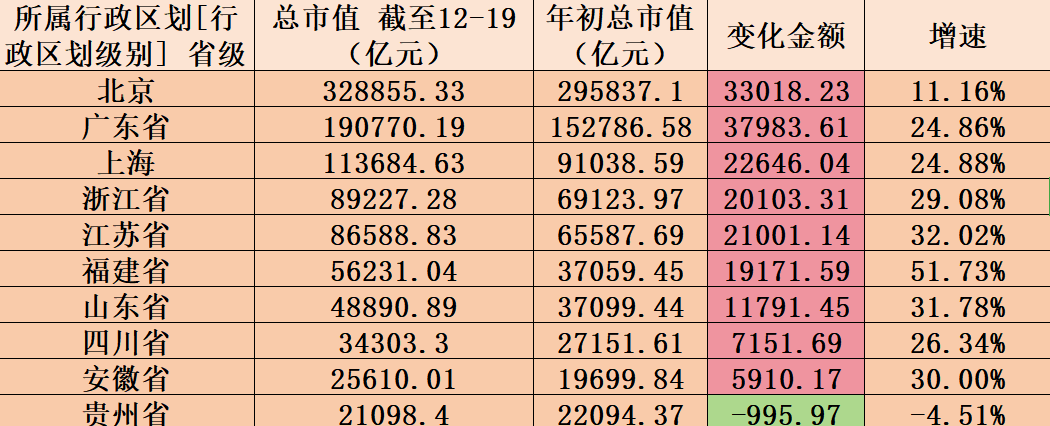
Group 1 - The core point of the article highlights the shift in market capitalization leadership in Sichuan Province from Wuliangye to the optical module leader, Xinyi Sheng, reflecting the explosive growth in the electronics industry [2][3] - The AI wave has significantly impacted the electronic and communication industries, leading to a surge in technology stocks across various sectors and driving profound changes in the market landscape [3][4] - The total market capitalization of A-shares has increased from 48.6 trillion yuan at the beginning of the year to 56.5 trillion yuan by year-end, marking a growth of nearly 8 trillion yuan [4] Group 2 - As of December 19, 2025, the total market capitalization of A-shares reached 120.31 trillion yuan, representing a year-to-date increase of 22.2% [5][6] - The top five provinces in terms of market capitalization are Beijing, Guangdong, Shanghai, Zhejiang, and Jiangsu, with a highly concentrated "pyramid" structure in market value distribution [5][6] - Fujian Province saw a remarkable market capitalization growth of 51.73%, driven by the strong performance of major companies like CATL and Zijin Mining, moving from seventh to sixth place in rankings [9] Group 3 - The Yangtze River Delta region leads with a total market capitalization of 31.51 trillion yuan, accounting for 26.2% of the A-share market, with significant contributions from semiconductor and AI hardware companies [10][11] - The market capitalization of Jiangsu and Zhejiang provinces grew by over 29%, showcasing their robust private economy and industrial upgrade momentum [11][12] - The total market capitalization of the Pearl River Delta reached 18.3 trillion yuan, benefiting from the development of electronics, automotive, and biomedicine industries [12] Group 4 - Major cities like Beijing, Shenzhen, and Shanghai continue to dominate A-share market capitalization, with Beijing's market value at 32.88 trillion yuan, supported by state-owned enterprises and tech companies [15] - Shenzhen's market capitalization increased by 23.1% to 12.23 trillion yuan, driven by key players in technology, finance, and new energy sectors [15] - The city of Suzhou experienced a significant market capitalization increase of 8839 billion yuan, with strong performances in advanced manufacturing sectors [16]






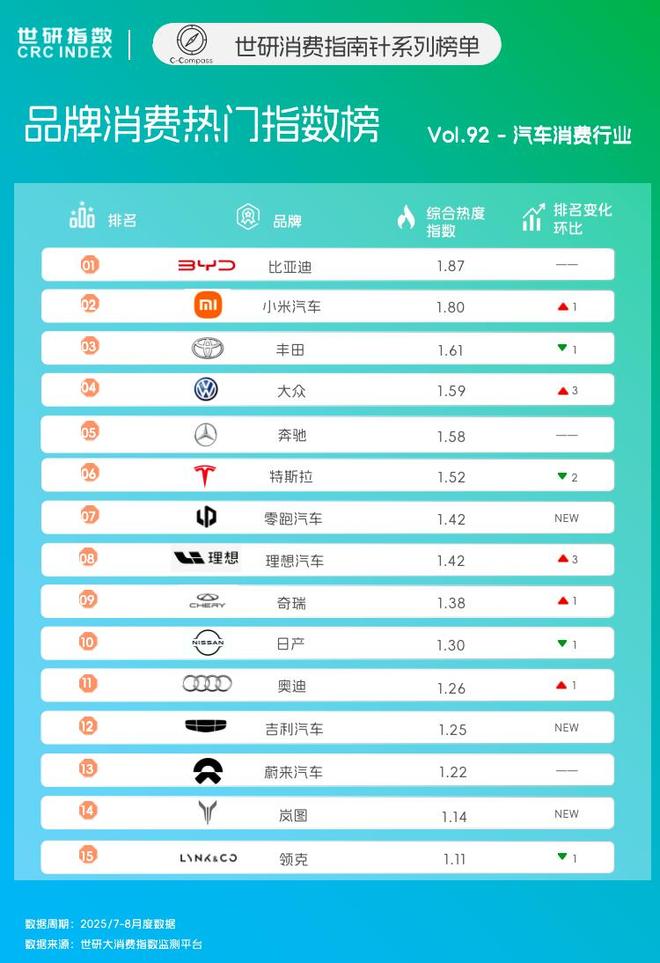
汽车市场两极竞速,智驾进入信任时代|世研消费指数品牌榜Vol.92
3 6 Ke· 2025-12-22 02:42
Core Insights - The current electric vehicle market is exhibiting a significant "dumbbell-shaped" differentiation pattern, with high-end markets leveraging ecological connectivity and advanced driving technologies to create competitive advantages, while entry-level markets are experiencing a "technology democratization" wave focused on extreme cost-performance ratios [1][3] Group 1: Market Dynamics - The high-end market (priced between 250,000 to 450,000 yuan) is characterized by leading brands focusing on differentiated strategies to build competitive moats, either through user ecosystems or advanced driving technologies [3] - Entry-level brands like Leap Motor and Geely are reshaping brand value through technology democratization, with Leap Motor's B01 model featuring standard lidar at a price of 89,800 yuan [3][4] Group 2: Competitive Landscape - The competition in intelligent driving is shifting from hardware accumulation to a dual-driven model of "AI large models + responsibility assurance," emphasizing user trust as a key competitive factor [5] - Tesla's Grok4 and BYD's "Tianshen Eye" are examples of advanced intelligent driving systems that have moved beyond basic path planning to include risk prediction and human-like decision-making [5] Group 3: Consumer Behavior - Consumers are increasingly willing to pay for either extreme experiences or extreme cost-effectiveness, while mid-range electric vehicles (priced between 150,000 to 200,000 yuan) are facing growth challenges due to a lack of distinct branding [4] - The trend indicates that brands must possess both advanced AI technology and clear accountability mechanisms to gain user trust and establish sustainable competitive barriers in the intelligent driving sector [5]


比亚迪方程豹,终于露出了“獠牙”
Xin Lang Cai Jing· 2025-12-22 02:23
Core Insights - The rise of the Equation Leopard brand has put pressure on established players in the off-road vehicle market, such as Great Wall Tank and Beijing Off-road [1] - Equation Leopard has achieved significant sales growth, particularly with its mid-range models, while its high-end strategy still faces challenges [1] Group 1: Sales Performance - Equation Leopard has become the fourth top-selling new force brand, with a record monthly sales of 37,405 units in November 2025, marking a 20.5% month-on-month increase and a 339% year-on-year surge [2] - The brand's main models include the Leopard series (Leopard 5 and Leopard 8) and the Titanium series (Titan 3 and Titan 7), with Titan 7 contributing over 64% of the brand's sales in November [2][3] - The Titan 7 model has achieved impressive sales, with over 50,000 units delivered within 80 days of its launch, and it has consistently surpassed 20,000 monthly sales [2] Group 2: Competitive Positioning - The Titan 7 is priced competitively between 179,800 to 219,800 yuan, making it an attractive option compared to competitors like Haval H9 and Tank 400, which are priced higher [5][6] - The vehicle's design and features, including DM-i super hybrid technology and advanced driving assistance, enhance its appeal and value proposition [6][10] - The brand's strategy of offering high value at lower prices has positioned it as a disruptive force in the market, challenging established brands [6][10] Group 3: Market Strategy and Future Outlook - Equation Leopard aims to penetrate the mid-range "light off-road" market, with a focus on models priced between 150,000 to 200,000 yuan [13] - The brand's sales structure indicates that growth is primarily driven by mid-range models, with high-end models contributing less than 40% to total sales [14] - Despite the current reliance on lower-priced models, Equation Leopard has the potential to build a recognized brand value and pursue a high-end strategy supported by BYD's technological resources [14]
比亚迪智驾销量破局:全民智驾时代的行业重构与价值回归
Zhong Guo Qi Che Bao Wang· 2025-12-22 02:06
Core Insights - BYD's sales of models equipped with the "Heavenly Eye" system exceeded 310,000 units in November, with cumulative sales surpassing 2.3 million, marking a significant shift in the smart driving industry from high-end gimmicks to widespread accessibility [1][4]. Group 1: Strategic Positioning - BYD's "Universal Smart Driving" strategy addresses the long-standing issue of technological stratification in the industry, offering a comprehensive product matrix across all price ranges, allowing mainstream market users to enjoy smart driving experiences comparable to luxury brands [2][4]. - The cumulative ownership of 2.3 million smart driving vehicles indicates that for every few auxiliary driving models sold in China, one is from BYD, demonstrating a market penetration that challenges the perception of smart driving as a niche demand [4][8]. Group 2: Data-Driven Differentiation - BYD adopts a differentiated approach by leveraging scale to generate data, with 150 million kilometers of real-world driving data collected daily, creating a core barrier that is difficult for competitors to replicate [4][5]. - The "Heavenly Eye" system utilizes an efficient closed-loop model that incorporates data collection, model training, and OTA iterations, allowing the system to continuously improve based on user driving experiences, thus enhancing safety and usability [4][5]. Group 3: Building Trust and Responsibility - BYD's commitment to a "no limit, no restrictions for the first owner" parking safety guarantee represents a revolutionary responsibility in the industry, addressing user concerns about smart driving safety and breaking down trust barriers [5][6]. - This proactive approach to technology responsibility has led to increased usage rates of smart driving features, creating a positive feedback loop of trust, usage, data generation, and technological evolution [5][6]. Group 4: Market Implications - The market response to the "Heavenly Eye" system indicates a significant shift in consumer demand, with smart driving evolving from a supplementary feature to a key driver in the purchasing decisions of mid-to-high-end vehicles [8]. - BYD's success illustrates that the ultimate value of technology lies in serving people rather than self-promotion, emphasizing the importance of making technology accessible, ensuring safety, and continuously improving user experience [8].

智驾概念股早盘走高 浙江世宝大涨超10% 海内外自动驾驶产业迎催化
Zhi Tong Cai Jing· 2025-12-22 01:42
消息面上,近期,海内外智能驾驶领域均迎来重大突破。12月15日,工信部正式公布首批L3级有条件 自动驾驶车型准入许可,首批获准车型为长安深蓝SL03和北汽极狐阿尔法S6,随后比亚迪 (002594)、鸿蒙智行等多家品牌也宣布获得L3级自动驾驶路测牌照并启动内测。值得关注的是,12 月20日,首块L3级自动驾驶专用正式号牌"渝AD0001Z"在重庆诞生,标志着长安汽车开启L3级自动驾 驶时代。海外方面,马斯克此前表示特斯拉正式在奥斯汀启动全无人驾驶Robotaxi测试,车内无安全监 督员及乘客。 东方证券认为,在法规政策支持、市场需求提升的驱动下,预计2026年L3级自动驾驶产业化进展有望 持续加速,相关智驾硬件及软件供应商有望受益。长城证券(002939)表示,海内外龙头厂商持续在智 驾方面取得突破行业进入高速发展期。伴随高阶智驾逐步下探至10-20万车型,智驾平权亦将逐步实 现,该行持续看好智能驾驶产业链投资机会。 智驾概念股早盘走高,截至发稿,浙江世宝(002703)(01057)涨10.02%,报5.6港元;小马智行- W(02026)涨8.26%,报124.6港元;佑驾创新(02431)涨6.25%, ...
