
洋河股份

Search documents
洋河放宽回款进度要求后渠道信心回升
Cai Jing Wang· 2025-11-05 13:50
Core Viewpoint - The relaxation of payment collection requirements by Yanghe has led to a recovery in channel confidence, suggesting that the upcoming Spring Festival may serve as a turning point for the industry [2][3]. Group 1: Company Performance - Yanghe reported a revenue of 18.09 billion yuan and a net profit of 3.975 billion yuan for the first three quarters of 2023 [3]. - The company's contract liabilities at the end of Q3 reached 6.42 billion yuan, reflecting a quarter-on-quarter increase of 5.5 billion yuan, indicating a warming trend compared to previous quarters [3][4]. - The average price of core products has slightly increased since the beginning of the year, with the gross profit margin for distributors improving compared to regional competitors [3][4]. Group 2: Industry Trends - The white liquor industry is experiencing a release of reporting pressure as companies begin to clear their inventory, with a consensus emerging around the recovery of mid-tier products [2][4]. - The industry is expected to see a turning point in demand during the upcoming Spring Festival, driven by positive sentiment around inventory replenishment [2][5]. - The overall market has shown signs of improvement since August, with some brands reporting positive sales growth during the Mid-Autumn Festival and National Day periods [6]. Group 3: Strategic Initiatives - Yanghe has implemented strict quota controls on its products to maintain price stability and has focused on enhancing its product offerings, including the launch of the seventh generation of its Hai Zhi Lan product line [3][7]. - The company has invested nearly 4 billion yuan in base liquor production capacity since 2011, which has strengthened its supply chain capabilities and product quality [7]. - Yanghe's strategy to leverage its base liquor reserves for product upgrades aims to address consumer preferences and improve channel profitability [7][8].

多家酒企Q3营利双降,四川龙头也难逃下滑
3 6 Ke· 2025-11-05 12:40
Core Insights - The announcement of salary cuts at Xuanjiu, a prominent regional liquor company, has raised eyebrows in the industry, especially given its recent strong performance in sales and profits [2][3] - The liquor industry is currently undergoing a significant adjustment period, with many companies emphasizing cost reduction and efficiency improvements [5][6] Company Summary - Xuanjiu, based in Anhui Province, reported a sales revenue of 1.8 billion yuan in 2023, a 23% increase year-on-year, and a profit of 314 million yuan, up 16% [2] - The company plans to reduce employee salaries by 10% starting October 1, 2025, which has led to mixed reactions among staff [1][3] - The chairman of Xuanjiu indicated that high-end product sales are expected to grow over 40% in 2024, with tax contributions reaching a historical high of 512 million yuan [2] Industry Summary - The liquor industry is experiencing a downturn, with a reported 18.09% decline in revenue and a 22.10% drop in net profit among 19 listed liquor companies in Q3 2025 [5][6] - Major players like Wuliangye have seen significant revenue declines, with a 52.66% drop in Q3 revenue [6] - The overall market is characterized by an oversupply, leading to reduced consumption in drinking and gifting scenarios, prompting many companies to adopt cost-cutting measures [5][7] - The industry is expected to remain in a bottoming phase, with cautious forecasts for recovery in 2026 [7][8]




预计逆势涨超10%!消费风向变了,光瓶酒成了“香饽饽”?
Nan Fang Du Shi Bao· 2025-11-05 10:29
Core Viewpoint - The overall performance of the liquor industry, particularly the baijiu sector, is declining, with only a few companies like Guizhou Moutai and Shanxi Fenjiu showing slight growth, while the majority face significant revenue drops [1][2]. Industry Overview - In the third quarter of 2025, 20 listed baijiu companies reported their earnings, with only Guizhou Moutai and Shanxi Fenjiu achieving minor increases, while 18 others experienced varying degrees of decline [1]. - The baijiu industry is undergoing a deep adjustment period due to changing consumer environments and high channel inventories [1]. Market Trends - Despite the overall downturn, the light bottle liquor segment is experiencing robust growth, with products like Shanxi Fenjiu's Guo Fen showing over 10% sales growth in the first three quarters [1][5]. - The market size of light bottle liquor has expanded from 35.2 billion yuan in 2013 to over 150 billion yuan in 2024, with projections indicating it will surpass 200 billion yuan in 2025 [1][5]. Company Performance - Shanxi Fenjiu reported a revenue of 32.924 billion yuan in the first three quarters of 2025, marking a 5% year-on-year increase, with a net profit of 11.405 billion yuan, a slight increase of 0.48% [2]. - The growth in Shanxi Fenjiu's performance is attributed to its light bottle products, particularly Guo Fen, which has shown significant sales increases [2][5]. Competitive Landscape - The rapid growth of the light bottle liquor market has prompted many liquor companies to increase their investments in this segment, with notable entries from Yanghe and other brands [6][8]. - Analysts indicate a shift in consumer preferences from luxury packaging to quality and cost-effectiveness, driving the growth of light bottle liquor [8]. Market Challenges - Despite the overall growth in the light bottle liquor market, there is increasing differentiation among brands, with traditional brands like Niulanshan facing severe challenges [10][12]. - Niulanshan's revenue dropped by 19.79% to 5.869 billion yuan in the first three quarters, with a net profit decline of 79.85% [10][12]. - The competitive landscape is intensifying, with many companies facing challenges due to changing consumer habits and market dynamics [13][16].

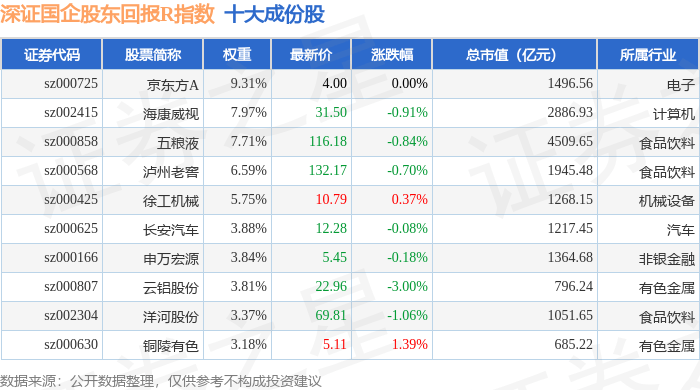
11月5日深证国企股东回报R(470064)指数跌0.32%,成份股云铝股份(000807)领跌
Sou Hu Cai Jing· 2025-11-05 10:15
Core Points - The Shenzhen State-Owned Enterprises Shareholder Return Index (470064) closed at 2257.45 points, down 0.32%, with a trading volume of 24.053 billion yuan and a turnover rate of 0.97% [1] - Among the index constituents, 27 stocks rose while 22 stocks fell, with Beixin Building Materials leading the gainers at 2.45% and Yun Aluminum leading the decliners at 3.0% [1] Index Constituents Summary - The top ten constituents of the Shenzhen State-Owned Enterprises Shareholder Return Index include: - BOE Technology Group (9.31% weight, latest price 4.00 yuan, market cap 149.656 billion yuan) in the electronics sector - Hikvision (7.97% weight, latest price 31.50 yuan, market cap 288.693 billion yuan) in the computer sector - Wuliangye Yibin (7.71% weight, latest price 116.18 yuan, market cap 450.965 billion yuan) in the food and beverage sector - Luzhou Laojiao (6.59% weight, latest price 132.17 yuan, market cap 194.548 billion yuan) in the food and beverage sector - Xugong Machinery (5.75% weight, latest price 10.79 yuan, market cap 126.815 billion yuan) in the machinery equipment sector - Changan Automobile (3.88% weight, latest price 12.28 yuan, market cap 121.745 billion yuan) in the automotive sector - Shenwan Hongyuan (3.84% weight, latest price 5.45 yuan, market cap 136.468 billion yuan) in the non-banking financial sector - Yun Aluminum (3.81% weight, latest price 22.96 yuan, market cap 79.624 billion yuan) in the non-ferrous metals sector - Yanghe Brewery (3.37% weight, latest price 69.81 yuan, market cap 105.165 billion yuan) in the food and beverage sector - Tongling Nonferrous Metals (3.18% weight, latest price 5.11 yuan, market cap 68.522 billion yuan) in the non-ferrous metals sector [1] Capital Flow Summary - The net outflow of main funds from the index constituents totaled 1.125 billion yuan, while speculative funds saw a net inflow of 243 million yuan and retail investors saw a net inflow of 882 million yuan [3] - Detailed capital flow for selected stocks includes: - Tongling Nonferrous Metals: main net inflow of 88.024 million yuan, speculative net outflow of 53.924 million yuan, retail net outflow of 34.100 million yuan - Luzhou Laojiao: main net inflow of 57.790 million yuan, speculative net outflow of 22.566 million yuan, retail net outflow of 35.224 million yuan - Beixin Building Materials: main net inflow of 56.578 million yuan, speculative net outflow of 24.593 million yuan, retail net outflow of 31.985 million yuan [3]




五粮液们的雷,彻底爆了!
商业洞察· 2025-11-05 09:23
Core Viewpoint - The article highlights the severe financial downturn of major Chinese liquor companies, particularly Wuliangye, which has experienced unprecedented revenue and profit declines, signaling a significant shift in the industry landscape [5][25]. Financial Performance Summary - Major liquor companies reported disappointing third-quarter results, with Wuliangye's revenue plummeting by 52.66% year-on-year to 81.74 billion yuan, marking its largest quarterly decline since its listing [6][8]. - Wuliangye's net profit fell by 65.62% to 20.19 billion yuan, with a net profit margin dropping from 38.2% to 24.7%, the lowest in nearly a decade [9][12]. - Other companies like Yanghe and Kweichow Moutai also reported significant declines, with Yanghe posting a loss and Kweichow Moutai's profit growth slowing to just 0.48% [5][6]. Internal and External Challenges - The decline in Wuliangye's performance is attributed to a combination of internal mismanagement and external market pressures, creating a "perfect storm" for the company [11][12]. - Wuliangye's strategy of channel inventory pressure led to excessive stock levels, with inventory reaching 5-6 months, forcing distributors to sell at a loss [12][14]. - The company's reliance on a single product line, "Pu Wu," which accounts for over 60% of its revenue, has become a vulnerability in a declining market [16][17]. Market Dynamics and Consumer Behavior - The ongoing "strict ban on alcohol" has severely impacted the consumption of high-end liquor, particularly in government and business settings, which were previously significant revenue drivers [18][22]. - Younger consumers are increasingly turning away from traditional liquor, favoring alternative beverages, which poses a long-term threat to the industry [21][22]. - Economic downturns have led to reduced discretionary spending, further diminishing the market for luxury alcohol products [22][23]. Strategic Implications - The article suggests that the era of relying on channel inventory and government consumption for growth is over, necessitating a reevaluation of business strategies within the industry [25][31]. - Wuliangye's announcement of a significant mid-term dividend aims to stabilize investor confidence, but it may not address the underlying issues of market share and brand reputation [26][27]. - The industry must adapt to changing consumer preferences and economic realities to survive, focusing on rebuilding trust and understanding new consumer demographics [31][32].

今世缘(603369):2025Q3 延续调整,净利润降幅环比扩大
Guoxin Securities· 2025-11-05 08:38
Investment Rating - The investment rating for the company is "Outperform the Market" [6][4][20] Core Views - The company continues to experience a decline in net profit, with a year-on-year decrease of 48.69% in Q3 2025, reflecting ongoing adjustments in its operations [1][4] - Revenue for Q3 2025 was reported at 19.31 billion yuan, down 26.78% year-on-year, indicating a persistent downward trend in sales [1][2] - The company is expected to focus on maintaining market share through increased marketing expenditures despite the pressure on overall sales [4][3] Summary by Sections Financial Performance - For the first three quarters of 2025, the company achieved total revenue of 88.82 billion yuan, a decrease of 10.66% year-on-year, and a net profit of 25.49 billion yuan, down 17.39% year-on-year [1] - In Q3 2025, the gross profit margin was 75.04%, a decline of 0.55 percentage points year-on-year, while the net profit margin decreased by 7.08 percentage points [3][4] Revenue Breakdown - Q3 2025 revenue from the Special A+ category was 11.23 billion yuan, down 38.04% year-on-year, while the Special A category saw revenue of 6.39 billion yuan, a slight decrease of 1.12% [2] - Direct sales channels experienced a significant increase of 65.21% year-on-year, while wholesale and agency channels saw a decline of 30.27% [2] Future Projections - The revenue forecast for 2025-2027 has been adjusted to 101.0 billion yuan, 105.5 billion yuan, and 114.1 billion yuan, reflecting a year-on-year change of -12.5%, +4.4%, and +8.1% respectively [4][5] - The expected net profit for the same period is projected to be 27.4 billion yuan, 28.0 billion yuan, and 31.1 billion yuan, with year-on-year changes of -19.8%, +2.3%, and +11.0% respectively [4][5]
研报掘金丨浙商证券:维持洋河股份“买入”评级,持续出清,静待改善
Ge Long Hui A P P· 2025-11-05 08:23
Core Viewpoint - The report from Zheshang Securities indicates that Yanghe Brewery's net profit attributable to shareholders for Q1-Q3 2025 is 3.975 billion (down 53.66% year-on-year), with Q3 showing a net loss of 369 million (compared to a profit of 631 million in Q3 2024) [1] Financial Performance - The company is experiencing a significant decline in net profit, with a 53.66% year-on-year decrease for the first three quarters of 2025 [1] - In Q3 2025, the company reported a net loss of 369 million, contrasting with a profit of 631 million in the same quarter of the previous year [1] Strategic Initiatives - Yanghe Brewery plans to leverage its over 600,000 tons of aged liquor inventory to launch a true vintage strategy in 2024 [1] - The company has introduced new products, including the seventh generation of "Hai Zhi Lan" and the three-year aged "Yanghe Daqu" [1] Management Changes - The appointment of the new chairman, Gu Yu, is expected to bring about improvements in governance and operational performance [1] Market Outlook - The company is awaiting industry recovery and the effects of its reforms, with a focus on high dividends and a strong dividend yield [1] - Despite current sales pressures on core products, there is potential for demand recovery in the liquor market due to policy catalysts [1] - The company is considered to have high elasticity in its performance, which could benefit from improvements in governance and market conditions [1]

食品饮料板块 2025 年三季报总结:成长为先,白酒探底
Haitong Securities International· 2025-11-05 07:22
Investment Rating - The report suggests a focus on growth-oriented sectors such as beverages, snacks, and food ingredients, while indicating a need to monitor the white liquor sector for potential recovery points [4]. Core Insights - The food and beverage sector experienced a decline in revenue and net profit in Q3 2025, with revenues down 6% year-on-year and net profits down 13%. The white liquor segment showed significant deceleration, while consumer staples exhibited structural growth [2][6]. - The report highlights that the white liquor sector is undergoing a deep adjustment phase, with a notable decline in both revenue and profit margins. However, there are signs of potential recovery as companies innovate and adapt to market conditions [12][15]. Summary by Sections Food and Beverage Sector Overview - In Q3 2025, the food and beverage sector reported revenues of 243 billion, a 6% decrease year-on-year, and a net profit of 44.6 billion, down 13%. The gross margin fell by 2.4 percentage points to 46.5% [6][9]. - The white liquor segment saw a revenue decline of 18% and a net profit drop of 22% in Q3 2025, indicating a significant downturn in performance [6][12]. White Liquor Segment - The white liquor sector is in a deep adjustment phase, with companies actively reducing inventory levels. The report notes that the adjustment may continue for several quarters, but the capital market might have already priced in the downturn [15][48]. - Major brands like Guizhou Moutai and Wuliangye are experiencing substantial revenue declines, with some companies reporting losses for the first time in years [13][16]. Consumer Staples and Other Segments - The report indicates that consumer staples are showing structural growth, with segments like soft drinks and snacks performing well. For instance, soft drinks reported a 15% revenue increase year-on-year in Q3 2025 [7][12]. - The beer segment showed resilience with a 1% revenue increase and an 11% profit increase, despite a weakening demand environment [7][12]. Investment Recommendations - The report recommends focusing on growth stocks in beverages, snacks, and food ingredients while keeping an eye on the white liquor sector for signs of recovery. Specific companies to watch include Dongpeng Beverage, Nongfu Spring, and Kweichow Moutai [4][6].
年轻人不买账,中年人喝不起,茅台跌破 1600 元,终于承认自己只是瓶酒?
3 6 Ke· 2025-11-05 07:21
Core Viewpoint - The decline in the price of Moutai reflects a significant shift in consumer behavior and market dynamics, moving from a status symbol to a regular product, influenced by younger generations' preferences for casual drinking experiences over traditional high-end brands [1][11][19] Group 1: Price Decline and Market Dynamics - The wholesale price of 53-degree Moutai has dropped below 1600 yuan, marking a historical low, down from a peak of around 3000 yuan in late 2021, indicating a nearly 50% decrease in just four years [1][6][10] - Moutai's price decline is attributed to a combination of increased production capacity, changing consumption scenarios, and the impact of e-commerce platforms reshaping pricing structures [4][12][15] - The once high demand for Moutai as a "social currency" has diminished, with younger consumers favoring a more relaxed drinking culture, leading to a significant drop in sales and a shift in market perception [11][19] Group 2: Inventory and Production Challenges - Moutai's production capacity has expanded significantly, with 2023 output reaching 57,200 tons and projections for 2025 to reach 67,200 tons, resulting in an oversupply situation with approximately 700 million bottles available in the market [12][14][15] - The high inventory levels have created a vicious cycle of price drops, as distributors rush to sell off stock, further driving down prices [14][15] - The traditional consumption scenarios for Moutai, heavily reliant on government and high-end business banquets, have been negatively impacted by new regulations and changing corporate spending habits [12][15][18] Group 3: Industry-Wide Implications - The entire Chinese liquor industry is experiencing a downturn, with significant inventory levels across various companies, indicating a broader market challenge beyond just Moutai [16][18] - Moutai's attempts to pivot towards more casual consumption and younger demographics have faced difficulties, as younger consumers show a preference for lower-alcohol beverages and different drinking experiences [18][19] - The shift in consumer behavior emphasizes the need for liquor companies to adapt to changing market demands, focusing on genuine consumption rather than speculative investment [19]
洋河放宽回款进度要求后渠道信心回升,明年春节或成行业好转拐点
Cai Jing Wang· 2025-11-05 07:09
Core Viewpoint - The white liquor industry is experiencing a recovery in channel confidence, with Yanghe showing signs of channel repair and a positive trend in contract liabilities, indicating a potential turnaround for the company and the industry as a whole [1][2]. Company Summary - Yanghe's revenue for the first three quarters of 2023 reached 18.09 billion yuan, with a net profit of 3.975 billion yuan [2]. - As of the end of Q3, Yanghe's contract liabilities amounted to 6.42 billion yuan, reflecting a quarter-on-quarter increase of 5.5 billion yuan, indicating a recovery in channel confidence [2]. - The company has implemented a strategy to control inventory and stabilize prices, leading to a slight increase in the prices of core products compared to the beginning of the year [2][6]. - Yanghe's focus on quality has led to significant investments in production capacity, totaling nearly 4 billion yuan since 2011, resulting in a robust supply chain and a strong foundation for product quality [6]. Industry Summary - The white liquor industry is expected to see a shift in demand dynamics, with a consensus emerging around the recovery of mid-tier products and positive sentiment for the upcoming Spring Festival [1][4]. - The industry has faced significant pressure in recent years, but the third quarter of 2023 marks a turning point as companies begin to release reporting pressures and adjust their strategies [3][4]. - There is a notable improvement in sales performance for mid-tier products, with some brands reporting positive growth in sales volume compared to last year [5]. - The industry is anticipated to experience a recovery in sales during the 2026 Spring Festival, with the end-of-year reporting and subsequent sales growth serving as critical indicators of the industry's bottoming out [6].