蜜雪冰城

Search documents
链博会观察|一杯茶的沉浮 健康理念让传统文化“沏”出新味道
Bei Ke Cai Jing· 2025-07-19 01:38
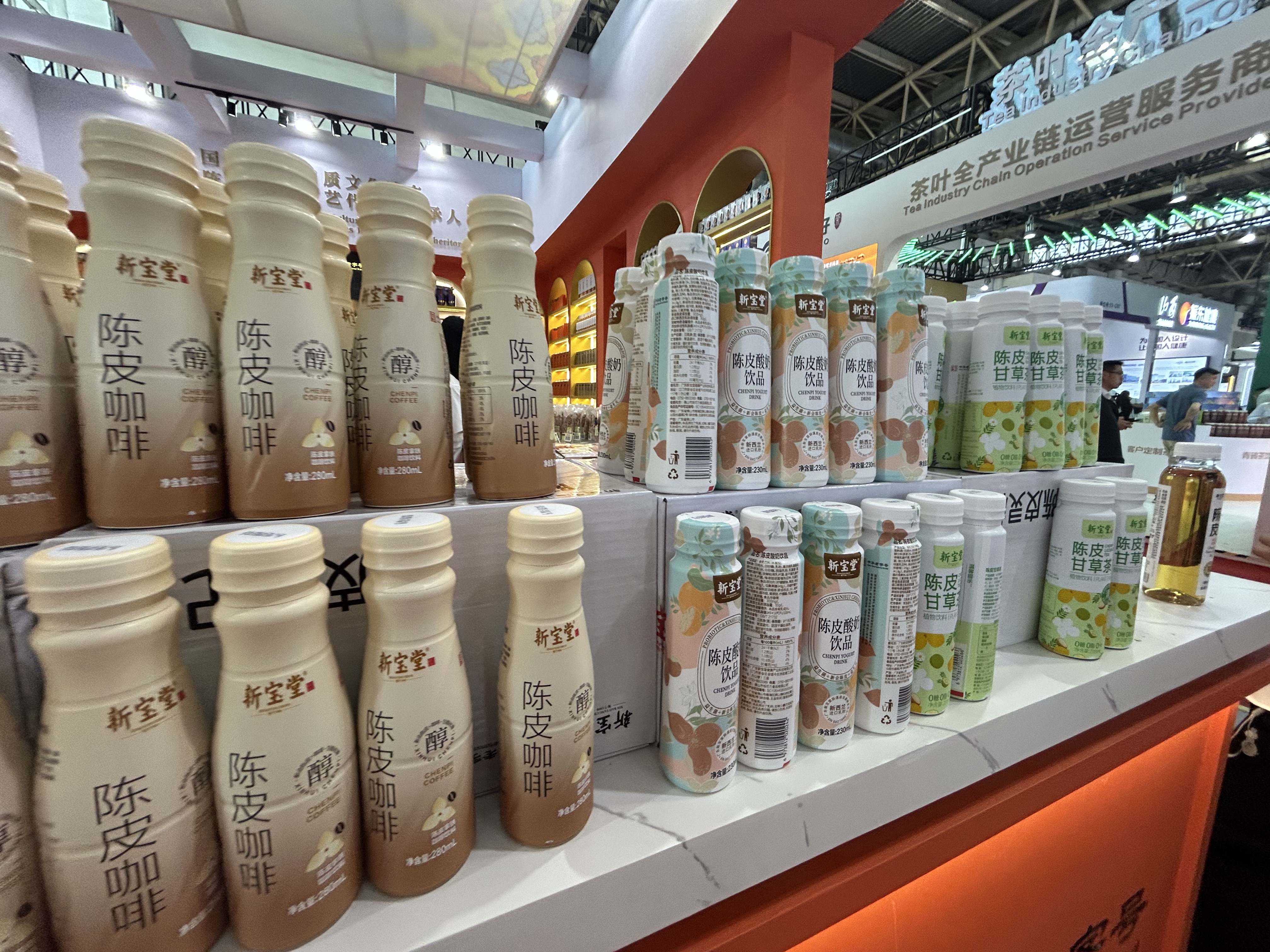
Core Insights - The tea industry in China is experiencing a transformation driven by health-conscious trends and the younger demographic, with the market expected to exceed 530.96 billion yuan by 2028 [2][5] - Traditional tea culture is evolving, with companies shifting from simple cultivation and wholesale to a full industry chain approach, focusing on product development and deep processing [3][4] Industry Trends - The demand for ready-to-drink tea beverages and innovative products like tea-flavored ice cream and beer is on the rise, reflecting a shift in consumer preferences [1][20] - The competition in the tea market has intensified, leading to issues like overproduction and product homogenization, prompting companies to innovate [5][6] Company Strategies - Companies like Hubei Tea Group are expanding their operations to include product research and development, creating a variety of tea derivatives and establishing marketing channels both domestically and internationally [7][8] - New Bao Tang, a century-old brand, has developed a complete industry chain around Chenpi (dried tangerine peel), integrating cultivation, processing, and retail [9][14] Market Opportunities - The rise of health-oriented tea products is creating new opportunities for tea and herbal medicine companies, with many now serving as suppliers for ready-to-drink brands [16][22] - The increasing popularity of health drinks has led to a significant rise in the number of related enterprises, with a reported 6.1 times increase in registrations for health tea companies compared to the previous year [22] Consumer Preferences - The integration of traditional tea with modern health concepts is appealing to consumers, as evidenced by the popularity of products like herbal teas and functional beverages [24][27] - Companies are recognizing the need to diversify their product offerings to meet the evolving demands of consumers, moving towards functional and personalized tea products [27][29]

抖音否认做外卖,业务暂停内测,小程序下架
21世纪经济报道· 2025-07-19 00:54
Core Viewpoint - ByteDance's entry into the takeaway market with its AI product "Tan Fan" is under scrutiny, as Douyin (TikTok's Chinese counterpart) focuses on in-store services and has no plans to build its own takeaway service [1]. Group 1: Douyin's Takeaway Business Adjustments - Douyin's takeaway business has undergone multiple adjustments, ultimately choosing "Sui Xin Tuan" as its breakthrough point [3]. - As of June 30, 2023, merchant entry into the "Sui Xin Tuan" business has shifted from self-application to targeted invitations, emphasizing "quality merchants" as the core entry requirement [3]. - The "Sui Xin Tuan" business primarily targets chain brand merchants and covers various categories such as beverages, Western fast food, pastries, and Chinese cuisine [3][4]. Group 2: Business Performance and Market Challenges - In 2023, Douyin's annual GMV target for its takeaway business was drastically reduced from 100 billion to 5 billion [7]. - The takeaway business has faced challenges, including a low retention rate due to a low-entry strategy that resulted in inconsistent merchant quality [6]. - Analysts suggest that Douyin's success in the competitive takeaway market will depend on its ability to balance content flow and fulfillment efficiency, with a short-term focus on capturing the mid-to-high-end market [7]. Group 3: Competitive Landscape - The takeaway market is experiencing a redefined competitive landscape, with significant promotional activities from platforms like Meituan and Taobao [11][12]. - Recent advertising campaigns have targeted competitors directly, indicating an intensifying battle for market share in the takeaway sector [10][11].

稳中有进 向新向好——上半年全省经济发展怎么看
He Nan Ri Bao· 2025-07-18 23:35
Economic Performance Overview - The province's GDP reached 31,683.80 billion yuan in the first half of the year, with a year-on-year growth of 5.7%, surpassing the national average by 0.4 percentage points [3] - Major economic indicators showed a positive trend, with the province's economic growth rate higher than the national average in the first quarter [3][4] Investment Highlights - In the second quarter, 348 major projects were launched with a total investment of 2,273.2 billion yuan, significantly boosting demand and resource flow [4] - Investment in projects worth over 100 million yuan increased by 9.3% year-on-year, contributing 5.9 percentage points to overall investment growth [4] Export Performance - The province's foreign trade import and export volume reached 4,125.3 billion yuan in the first half of the year, marking a year-on-year increase of 26.2% [4] - Local enterprises adapted to external challenges, such as the U.S. tariff war, by exploring new markets and maintaining order stability [4] Consumer Market Dynamics - The total retail sales of consumer goods in the province amounted to 14,201.55 billion yuan, with a year-on-year growth of 7.2%, outperforming the national average by 2.2 percentage points [5] - Online retail sales reached 2,441.08 billion yuan, growing by 16.3% year-on-year, exceeding the national growth rate by 7.8 percentage points [7] Industrial Innovation and Transformation - The province is witnessing a robust integration of technological and industrial innovation, with significant growth in strategic emerging industries and high-tech manufacturing [6] - The added value of strategic emerging industries and high-tech manufacturing increased by 10.7% and 14.9% year-on-year, respectively [6] Policy and Economic Strategy - The provincial government has implemented targeted policies to stabilize the economy, focusing on consumption, investment, and foreign trade [8] - A total of 28 policy measures were introduced to stimulate economic growth in the first quarter, followed by 24 measures in the second quarter [8] Future Outlook - Despite external uncertainties and internal structural adjustment pressures, the province aims to maintain economic stability and confidence through continuous and effective policy measures [9]

林里、柠季门店总数超 3500 家,柠檬茶为什么越开越多?| 声动早咖啡
声动活泼· 2025-07-18 10:35
Core Viewpoint - The rapid expansion of lemon tea brands across China is driven by changing consumer preferences, effective marketing strategies, and the health trend favoring lemon tea over traditional sugary drinks [1][2][6]. Market Expansion - The number of lemon tea stores has surged, with brands like Linli and Ningji surpassing 1800 and 1700 locations respectively by May 2024, and even signing contracts for 15 overseas stores [1]. - In 2021, the number of dedicated lemon tea stores increased from over 3000 in 2020 to more than 6000, with a 400% year-on-year sales growth [1][2]. Cultural Influence - Lemon tea's popularity is rooted in its historical context, influenced by British afternoon tea culture in Hong Kong during the 1950s, and its suitability as a refreshing drink in Guangdong's humid climate [2][3]. Brand Strategies - Vitasoy played a significant role in popularizing lemon tea by launching ready-to-drink lemon tea in 1979 and increasing marketing efforts in mainland China starting in 2016 [3][4]. - The brand's sales reached approximately 3 billion yuan in 2020, accounting for about 75% of its mainland revenue [3]. Health Trends - The rise of health-conscious consumers has favored lemon tea, with nearly two-thirds of consumers perceiving it as healthier than milk tea [6]. - The demand for acidic flavors to balance oily diets is expected to further boost lemon tea's market share [6]. Supply Chain Dynamics - The price of lemons has increased from around 10 yuan per kilogram to over 14 yuan due to reduced production in major growing areas like Anju County [1][7]. - Brands like Linli and Ningji use different lemon varieties to optimize flavor and product diversity, with Linli owning its lemon orchards to mitigate supply chain risks [8]. Competitive Landscape - The lemon tea market has a low entry barrier, leading to intense competition among brands, necessitating differentiation through marketing and store design [9]. - Seasonal sales fluctuations pose challenges, with winter sales often dropping to half of summer sales, highlighting the need for brands to expand into northern markets [12]. Consumer Engagement - Innovative marketing strategies, such as unique store designs and engaging promotions, have become essential for attracting consumers in a crowded market [9].

对话淡马锡吴亦兵:超配中国资产的坚定信心与投资策略
2 1 Shi Ji Jing Ji Bao Dao· 2025-07-18 09:33
Core Insights - Temasek aims to build a resilient investment portfolio that can navigate through economic cycles, emphasizing long-term returns over short-term performance [1][2] - The company's net asset value reached SGD 434 billion, an increase of SGD 45 billion from the previous fiscal year, with a one-year total shareholder return of 11.8% [1] - Temasek's investment strategy has evolved alongside the Chinese market, focusing on sectors like energy transition and life sciences [1][2] Investment Strategy - Temasek's investment portfolio is divided into three main segments: Singapore-based assets (41%), global direct investments (36%), and cooperative investment projects (23%) [3][4] - The Singapore-based assets include well-known companies such as Singapore Airlines and DBS Bank, providing stable long-term returns [3] - Global direct investments align with structural trends like digitalization, sustainability, and new consumption, allowing Temasek to navigate different economic cycles [4] Early-Stage Investments - Temasek continues to invest in early-stage companies but maintains a limit, with early investments not exceeding 6% of the global portfolio [5][6] - The company focuses on supporting successful companies through multiple funding rounds, exemplified by its ongoing investment in Innovent Biologics [5][6] Focus on China - Temasek's exposure to Chinese assets is 18%, slightly down from 19% in the previous fiscal year, but the net asset value in China increased by approximately SGD 4 billion [6][7] - The company emphasizes innovation as a key investment theme, noting the shift in China's competitive advantages from manufacturing to engineering and R&D [6][7] New Consumption Trends - Temasek observes a significant shift in the perception of Chinese brands, moving from low-cost to premium branding, as seen with companies like Pop Mart and LABUBU [9][10] - The emergence of brands that offer emotional value and aesthetic appeal indicates a new era for Chinese consumer products, with potential for global market success [9][10] Stablecoin Insights - Temasek recognizes the early-stage development of stablecoins and their potential in enhancing payment efficiency and reducing cross-border transaction costs [11] - The company is monitoring the regulatory landscape surrounding stablecoins, emphasizing the importance of regulatory alignment for long-term viability [11]
港股IPO火热,哪家投行最忙?
3 6 Ke· 2025-07-18 09:02
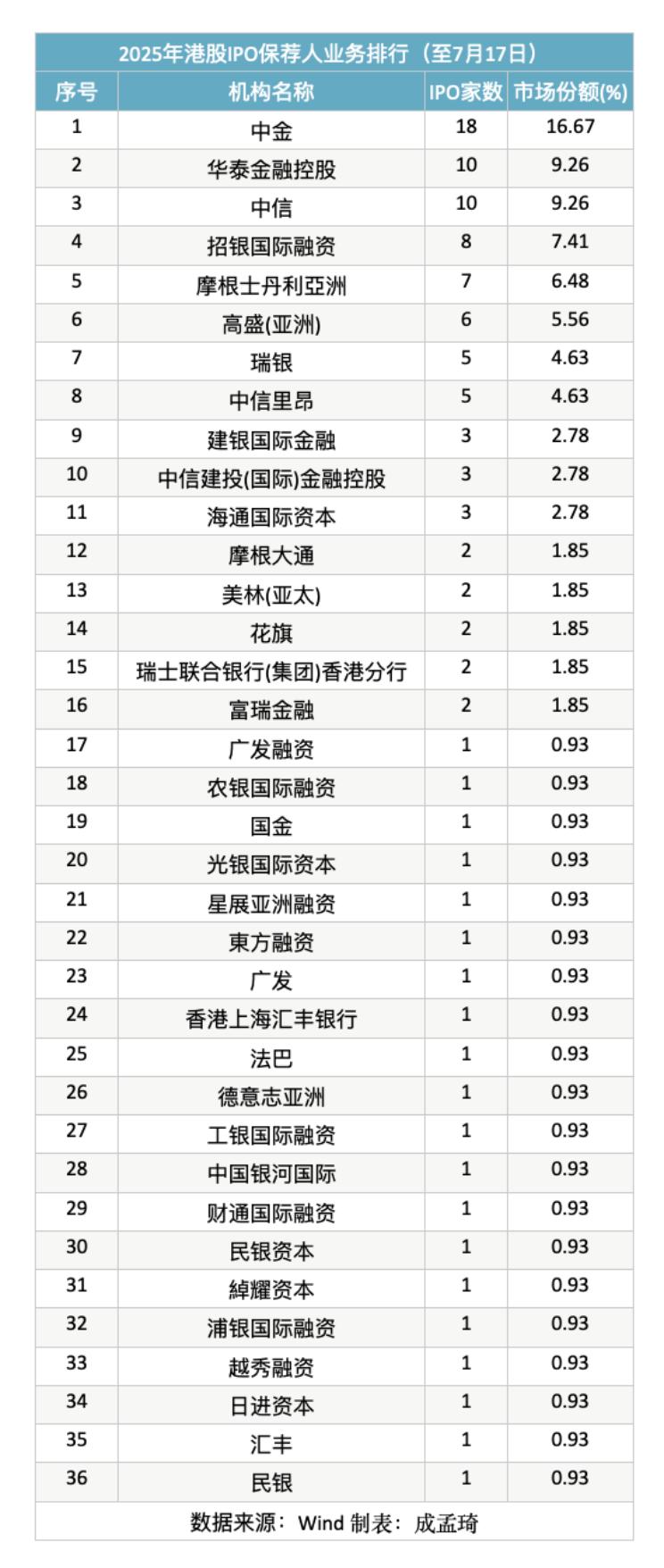
Group 1 - The Hong Kong IPO market has seen a significant surge, with a record number of listings and a total fundraising amount of 1,067 million HKD in the first half of 2025, nearly eight times that of the same period last year [1][2] - Five companies, including Peak Technology and Blue Sky Technology, listed on the Hong Kong Stock Exchange on the same day, marking a historic moment with six gongs ringing simultaneously [1] - The number of IPOs in May and June accounted for 58.14% of the total listings in the first half of 2025, indicating a concentrated period of activity [1] Group 2 - Eight new stocks raised over 2 billion HKD, while 17 raised over 1 billion HKD, with the top five fundraising companies being CATL, Hengrui Medicine, Haitian Flavoring, Sanhua Intelligent Control, and Mixue Ice City [2] - As of July 17, 2025, the Hong Kong market recorded 51 IPOs and a total fundraising amount of 1,134 million HKD, surpassing the total for the entire year of 2024 and increasing by 217% compared to the same period last year [2] Group 3 - The revival of the Hong Kong IPO market has led to increased activity among investment banks, with a notable rise in the number of companies seeking to go public [3] - As of July 17, 2025, there are 232 companies in the queue to apply for H-share listings, indicating strong interest in the market [3] - The competition between domestic and foreign investment banks has intensified, with domestic banks gaining an advantage due to their understanding of local enterprises and improved international service capabilities [5] Group 4 - The Hong Kong IPO market has regained its position as the largest globally, driven by a surge in A+H listings, which have become a dominant trend [4][10] - A total of 50 A+H companies have submitted IPO applications in the first half of 2025, with several major firms already listed [10] - Predictions indicate that 90 to 100 companies are expected to raise between 200 billion to 220 billion HKD in 2025, with the second half typically being a peak period for IPOs [11] Group 5 - The top investment banks in the Hong Kong IPO market as of July 17, 2025, include CICC with 18 IPOs (16.67% market share), followed by Huatai Financial Holdings and CITIC with 10 IPOs each (9.26% market share) [6][8] - The market shows a clear "Matthew effect," where larger projects are predominantly led by top-tier investment banks, while many smaller banks have only participated in a single IPO [8] Group 6 - The A+H listing model is expected to drive significant fundraising, with estimates suggesting an 85% increase in total fundraising from A+H listings compared to the first half of 2024 [12] - The technology, biomedicine, and consumer sectors are anticipated to lead the IPO market in the second half of 2025, although an increase in supply may raise the failure rate to 35% [12]





帮主郑重:50万亿消费大爆发!服务消费飙至46%,三招布局消费升级红利
Sou Hu Cai Jing· 2025-07-18 04:24
Group 1 - The core viewpoint is that China's retail sales are projected to reach 50 trillion yuan, driven by a significant shift towards service consumption, which now accounts for 46.1% of total consumption [1][3] - The average annual growth rate of retail sales over the past four years has been stable at 5.5%, with consumption contributing approximately 60% to GDP [1][3] - Service retail sales have surged by 7.5% year-on-year in the first half of the year, outpacing the growth of goods retail [3][4] Group 2 - The rural consumption market is growing faster than urban areas, with a 4.5% growth rate in rural consumption, 0.9 percentage points higher than urban areas [3][4] - The government has introduced 48 new policies to boost service consumption, indicating ongoing support for expanding domestic demand [3][4] - Essential consumption remains stable, with food and daily necessities showing consistent growth, while discretionary spending is more volatile but has seen significant increases in certain sectors like home appliances [4][5] Group 3 - Companies in the service consumption chain, such as those in tourism and entertainment, are expected to benefit significantly from the ongoing consumption upgrade [4][5] - The focus on county-level markets is crucial, as companies that can dominate these areas will have a competitive edge in the evolving consumption landscape [5] - Brands that resonate with national sentiment and cultural identity, such as Li Ning and Luckin Coffee, are positioned to capture the emotional spending of younger consumers [5]

8点1氪:特朗普称想让可口可乐配方改回蔗糖;宗庆后未在香港汇丰银行为三子女设立信托;蜜雪冰城旗下幸运咖下半年主战场转向一二线城市
36氪· 2025-07-18 00:03
Group 1 - President Trump is in discussions with Coca-Cola to revert the sweetener in its U.S. cola formula back to cane sugar, which he claims is a "better" choice [1][2] - Coca-Cola stated that any changes to the formula will only apply to the U.S. market and not to China, and they will soon announce details about "innovative products" [2][3] - Currently, Coca-Cola uses corn syrup as the sweetener in its U.S. products, and it remains unclear if they will modify the existing formula or introduce new products [2] Group 2 - The founder of Wahaha, Zong Qinghou, has not established a trust for his three children at HSBC in Hong Kong, despite previous rumors [4][5] - A lawsuit filed in Hong Kong did not mention any trust-related information, and the core content of the lawsuit included a transfer of $1.085 million from an HSBC account without specifying its origin [3][5] Group 3 - Lucky Coffee, a subsidiary of Mixue Ice Cream, aims to reach 10,000 stores by 2025, with nearly 7,000 stores currently, focusing on first and second-tier cities for expansion [4][5] - The average product price at Lucky Coffee is between 6-8 yuan, and they plan to strengthen their presence in urban commercial streets [4][5] - Lucky Coffee's expansion strategy has shifted from lower-tier markets to more competitive urban areas, with a goal of achieving a 150% growth rate if targets are met [4] Group 4 - The beverage brand Dayao has been acquired by KKR, with the deal for 85% of its shares now moving forward after the public notice period [6] - Following the acquisition, Dayao plans to focus on national and potentially international expansion while maintaining a stable management team [6] Group 5 - The Chinese government has discovered a new rare earth mineral named "Ned Yellow River Mineral," which has been approved for naming by the International Mineralogical Association [11] - This new mineral is characterized by a unique enrichment of neodymium, which is in high demand for applications in electric vehicles, wind power, and electronics [11]




餐饮价格战加剧,恒天然调整相关业务丨消费参考
2 1 Shi Ji Jing Ji Bao Dao· 2025-07-17 23:45
Group 1 - Fonterra's Greater China region is undergoing a restructuring, merging its consumer brand team with its food service team to optimize operations and enhance synergies [1] - In the Chinese market, Fonterra's food service business significantly outperforms its consumer brand business, with food service revenue of NZD 2.377 billion (approximately RMB 10.133 billion) in FY2024, compared to consumer products revenue of NZD 394 million (approximately RMB 1.68 billion) [1] - The food service business is considered Fonterra's profit driver, generating a tax profit of NZD 299 million (approximately RMB 1.275 billion) in FY2024, while the consumer products segment reported a tax loss of NZD 15 million (approximately RMB 63.945 million) [1] Group 2 - Fonterra is facing intense competitive pressure, particularly from domestic brands like Miaokelando, which reported a 14% year-on-year revenue growth in its food service series, reaching RMB 1.31 billion in 2024 [2][3] - The ongoing price war in the food service sector is exerting downward pressure on prices, affecting Fonterra's profit margins in its food service business, which has already seen a decline in gross margin [4] - The adjustments being made by Fonterra may be just the beginning in response to market changes and competitive dynamics [5]
电商,变了!
Sou Hu Cai Jing· 2025-07-17 11:28
Group 1: Instant Retail Market Dynamics - The instant retail market in China is experiencing a "subsidy war," with major players like Alibaba, Meituan, and JD.com investing billions in subsidies to attract consumers [3][4] - JD.com has launched its "Double Hundred Plan," committing over 10 billion yuan to support brands achieving significant sales milestones [3] - The market is projected to grow from 650 billion yuan in 2023 to 2 trillion yuan by 2030, expanding beyond food delivery to include daily necessities and other high-frequency categories [4] Group 2: Traditional E-commerce Transformation - Traditional e-commerce is shifting from price competition to an efficiency revolution, focusing on operational efficiency and user experience [5][6] - Tmall has changed its traffic distribution mechanism to favor quality over low prices, promoting a more sustainable competitive environment [5] - JD.com is leveraging AI technology to enhance efficiency, aiming to reduce costs and improve profitability for both consumers and merchants [6] Group 3: Ecosystem Collaboration - Major platforms are integrating resources to create cross-business and cross-scenario collaborative networks, enhancing user engagement and profitability [6][7] - Alibaba is merging its various services to create a closed-loop system that boosts user activity and diversifies revenue streams [7] - Regulatory bodies are increasing oversight in the e-commerce sector to ensure fair competition and protect consumer rights [7][8]