
嘉能可

Search documents
低库存现实和需求?弱预期交织,有?延续震荡
Zhong Xin Qi Huo· 2025-06-24 07:30
Group 1: Report Industry Investment Rating - Copper: Oscillating [4] - Alumina: Oscillating weakly in the medium to long term, with short - term opportunities for positive spreads or cautious short - selling [5] - Aluminum: Short - term unilateral trading depends on inventory accumulation and geopolitical trends; medium - to long - term trading with a bearish bias [6] - Aluminum Alloy: Short - term spot is weak in the off - season, while the medium - to long - term has an upward expectation [8] - Zinc: Oscillating weakly [11] - Lead: Oscillating [12] - Nickel: Oscillating weakly in the short term, with a strategy of short - selling on rebounds in the medium - to long term [15] - Stainless Steel: Oscillating in the short term [22] - Tin: Oscillating [23] Group 2: Core Viewpoints - The reality of low inventories and the expectation of weakening demand in the non - ferrous metals industry are intertwined, leading to continued oscillations. In the short - to medium - term, focus on structural opportunities, and cautiously consider short - term long positions in copper, aluminum, and tin. In the medium - to long - term, there is uncertainty in the demand prospects of base metals, and short - selling opportunities on rallies can be considered for some oversupplied or expected - to - be - oversupplied varieties [1] Group 3: Summary by Directory Copper - Information: The Fed maintained the federal funds rate, Antofagasta initiated mid - year negotiations, copper production increased, and copper inventories decreased significantly. The spot had a certain premium, and嘉能可 purchased Russian copper. Trump raised tariffs on steel and aluminum imports [4] - Logic: Overseas economies may continue to weaken. Supply risks persist due to low processing fees, and demand is weakening in the off - season, but low inventories support copper prices [4] - Outlook: Copper prices may oscillate at a high level in the short term [4] Alumina - Information: Spot prices declined, warehouse receipts decreased, and an electrolytic aluminum plant in Xinjiang conducted a tender [4][5] - Logic: In the short - to medium - term, there is no shortage of ore, and the market is affected by various events. The market has gradually digested the news, and further upward movement requires an expansion of production cuts [5] - Outlook: Medium - to long - term oscillations are weak, and short - term positive spreads or cautious short - selling can be considered [5] Aluminum - Information: Aluminum prices and inventory data changed, Iran threatened to close the Strait of Hormuz, and the US increased tariffs on household appliances [6] - Logic: The possible closure of the Strait of Hormuz by Iran has an impact on the regional balance, but the possibility and long - term ability are uncertain. Domestic inventory accumulation is increasing, and consumption may be under pressure in the second half of the year [6] - Outlook: Short - term trading depends on inventory and geopolitics, and medium - to long - term trading has a bearish bias [6] Aluminum Alloy - Information: Aluminum alloy prices and related data changed, and there were policies for new energy vehicle promotions and payment term commitments from car companies [7][10] - Logic: The off - season pressure on the automotive industry is high, but electrolytic aluminum prices drive the upward movement of waste aluminum and ADC12. In the medium - to long - term, ADC12 demand is expected to recover seasonally [7][8] - Outlook: Short - term spot is weak, and medium - to long - term has an upward expectation [8] Zinc - Information: Spot premiums, inventory changes, and Kipushi's production plan were reported [11] - Logic: Macro uncertainties exist, zinc ore supply is loosening, and demand is weakening in the off - season. Inventory accumulation is emerging, and the price support is weakening [11] - Outlook: Zinc prices are expected to oscillate weakly, with a downward trend in the medium - to long - term [11] Lead - Information: Lead prices, inventory, and related data changed, and there were news about lead smelter maintenance and market supply and demand [12] - Logic: The cost support is stable, the supply is decreasing due to smelter maintenance and environmental inspections, and the demand is gradually emerging from the off - season, but the market is in a state of low supply and demand [12][13] - Outlook: Lead prices are expected to oscillate [12] Nickel - Information: Nickel inventories increased, and there were news about mining cooperation, investment, and policy in the nickel industry [15] - Logic: The market is dominated by sentiment, the industrial fundamentals are weakening marginally, and the supply is in excess, with high inventory pressure [15][19] - Outlook: Short - term wide - range oscillations, and short - selling on rebounds in the medium - to long - term [15] Stainless Steel - Information: Stainless steel futures warehouse receipts, spot premiums, production data, and raw material prices changed [22] - Logic: Nickel and chromium prices are falling, and the supply and demand situation is complex. The inventory has a certain accumulation, but the structural oversupply pressure is limited [22] - Outlook: Short - term range oscillations, and attention should be paid to inventory and cost changes [22] Tin - Information: Tin warehouse receipts, inventory, and spot prices changed [23] - Logic: There is no obvious driving force currently. The supply in the main production areas has stabilized, and the domestic ore supply is tight, but the upward elasticity of prices is limited [23] - Outlook: Tin prices are expected to oscillate [23]
商品期货早班车-20250624
Zhao Shang Qi Huo· 2025-06-24 03:33
1. Report Industry Investment Ratings No relevant content provided. 2. Core Views of the Report The report provides market analysis and trading strategies for various commodities including basic metals, agricultural products, and energy chemicals. It evaluates the market performance, fundamentals, and offers corresponding trading suggestions for each commodity based on supply - demand dynamics, macro - economic factors, and industry - specific events. 3. Summary by Commodity Category Basic Metals Copper - Market performance: Copper prices oscillated strongly yesterday [1]. - Fundamentals: Trump announced a cease - fire between Israel and Iran, causing a sharp drop in crude oil prices. US PMI data exceeded expectations while European PMI data was weak. The supply of copper ore remained tight, and Glencore stated that the mountain ISA smelter was difficult to continue operating. Demand showed some resilience, with premiums for flat - water copper in East and South China at 70 yuan and 20 yuan respectively, and the London structure at a 392 - dollar back [1]. - Trading strategy: Maintain the idea of buying on dips [1]. Aluminum - Market performance: The closing price of the electrolytic aluminum 2508 contract showed no significant change from the previous trading day, closing at 20,365 yuan/ton. The domestic 0 - 3 month spread was 435 yuan/ton, and the LME price was 2,559 dollars/ton [1]. - Fundamentals: On the supply side, electrolytic aluminum plants maintained high - load production, and the operating capacity increased slightly. On the demand side, the operating rate of aluminum products decreased slightly [1]. - Trading strategy: LME has forced traders holding near - month contract positions exceeding available inventory to reduce their positions to limit spot liquidity risk. Aluminum ingots have seen inventory accumulation (15,000 tons) for the first time since June. It is necessary to observe whether the inventory accumulation is continuous, and aluminum prices may come under pressure to decline. It is recommended to wait and see [1]. Alumina - Market performance: The closing price of the alumina 2509 contract showed no significant change from the previous trading day, closing at 2,906 yuan/ton. The domestic 0 - 3 month spread was 288 yuan/ton. On June 20, India had a transaction of 30,000 tons at a price of 366 dollars/ton (the previous transaction was also at 366 dollars/ton) [1]. - Fundamentals: On the supply side, new production capacity continued to be released, and the operating capacity increased. On the demand side, electrolytic aluminum plants maintained high - load production, and the operating capacity was stable [1]. - Trading strategy: The alumina futures price encountered resistance when rising. In the medium term, the pressure of production capacity release and inventory accumulation persists, and the price may continue to operate at a low level [1]. Industrial Silicon - Market performance: On Monday, the market opened low and then oscillated. The main 09 contract closed at 7,420 yuan/ton, up 30 yuan/ton from the previous trading day. The position decreased by 2,437 lots to 303,119 lots. Today, the warehouse receipt volume decreased by 439 lots to 54,184 lots [1]. - Fundamentals: Last week, spot prices stopped falling. On the supply side, there was no significant contraction, and the number of open furnaces increased by 5. Weekly inventory decreased slightly for two consecutive weeks, and after the market decline, the visible inventory of warehouse receipts turned into invisible inventory. On the demand side, the production of polysilicon in June may increase slightly compared to May, and there are plans for复产 this week. The production of organic silicon was relatively stable, and the decline in industrial chain prices widened. The downstream demand for aluminum alloys entered the off - season, and the operating rate was relatively stable [1]. - Trading strategy: If the futures price continues to rise, it may face hedging pressure, and the rebound of the market may be limited. Before there is an effective reduction in actual supply during the flood season, maintain a bearish view. It is expected that the market will oscillate at a low level. Consider shorting lightly after a rebound. Pay attention to the on - site sentiment at the Leshan industry conference [1]. Polysilicon - Market performance: On Monday, the market opened low and then oscillated. The main 08 contract closed at 30,615 yuan/ton, down 605 yuan/ton from the previous trading day. The position increased by 10,054 lots to 78,183 lots. The 11 contract closed at 30,030 yuan/ton. Today, the warehouse receipt volume remained unchanged at 2,600 lots (7,800 tons) [1]. - Fundamentals: On the supply side, the weekly production changed little, and the industry inventory decreased slightly. There are still expectations of复产 in the future, and the market is pessimistic about the joint production cuts by leading enterprises. On the demand side, the silicon wafer production schedule data has recovered, which is related to the production scheduling of some enterprises' previous orders in the third quarter due to limited quotas. The expected production schedule for the third quarter is still declining quarter - on - quarter. According to the balance sheet, inventory will start to accumulate in July [1]. - Trading strategy: The industry's复产 plan exceeded expectations. In the short term, it is recommended to go short on the 07 contract on rallies. Pay attention to the industry's production cut plan [2]. Agricultural Products Soybean Meal - Market performance: Overnight, CBOT soybeans declined, affected by favorable weather in the production area and the sharp drop in crude oil prices [2]. - Fundamentals: On the supply side, the supply from South America was abundant in the near term, and the growth of US soybeans was normal in the long term. On the demand side, South America was the main influence in the short term, US soybean exports were seasonally weak, but the US biodiesel policy was beneficial to the demand for soybean crushing [2]. - Trading strategy: In the short term, US soybeans will oscillate strongly; in China, although there will be a large arrival of soybeans later, demand will also remain high. The domestic market will follow the international cost side [2]. Corn - Market performance: The corn 2509 contract corrected, and the spot price of corn declined slightly [2]. - Fundamentals: This year, the supply - demand situation has tightened marginally, and the grain rights have shifted to channels, increasing the bargaining power of channels. The expected import volume of substitutes will decrease significantly, which is beneficial to the demand for domestic corn. The wheat support - price purchase has boosted the wheat price, which will also drive up the corn price. The spot price is expected to oscillate strongly [2]. - Trading strategy: With the reduction of remaining grain and the wheat support - price purchase, the futures price is expected to oscillate strongly [2]. Palm Oil - Market performance: Malaysian palm oil rose yesterday [2]. - Fundamentals: On the supply side, the production area is in the seasonal production - increasing period, and Malaysia's production in May increased by 5% month - on - month. On the demand side, the exports from the production area improved month - on - month. ITS showed that exports,from June 1 - 20 increased by 14% month - on - month [2]. - Trading strategy: In the short term, the volatility of palm oil will increase, affected by the large fluctuations in crude oil and other factors. The trading difficulty has increased. Pay attention to crude oil and biodiesel policies [2]. Eggs - Market performance: The egg 2508 contract performed strongly, and the spot price was stable [2]. - Fundamentals: Due to breeding losses, the culling of old hens is expected to decrease temporarily. Supply remains high, and the hot and humid weather is not conducive to egg storage, but low prices stimulate demand. With strong supply and weak demand and cost support, the futures and spot prices are expected to oscillate [2]. - Trading strategy: With sufficient supply and cost support, the futures price is expected to oscillate [2]. Pigs - Market performance: The pig 2509 contract performed strongly, and the spot price of pigs rose [2]. - Fundamentals: Large - scale farms have been continuously reducing the weight of pigs recently, and the pressure to sell at the end of the month has decreased. Small - scale farmers, on the contrary, continue to hold back pigs to gain weight. At the end of the month, the supply from the breeding side will decrease, and the entry of second - fattening will support the price. The pig price is expected to be strong in the short term. In the medium term, the supply will continue to increase, and the center of the pig price will gradually decline. Pay attention to the slaughter rhythm of enterprises and the trend of second - fattening [2]. - Trading strategy: With reduced supply at the end of the month, the futures price is expected to oscillate strongly [2]. Energy Chemicals PVC - Market performance: The V09 contract closed at 4,897, down 0.3% [3]. - Fundamentals: PVC was driven up by the rise in crude oil prices and then retreated. On the supply side, the plants of Wanhua, Bohua, etc. are gradually being put into production, and the supply growth rate is expected to reach about 5%. The upstream operating rate is 80%, and maintenance has gradually ended. Social inventory has been continuously decreasing. On June 19, the new sample of PVC social inventory was 569,300 tons, a decrease of 0.74% month - on - month and 37.97% year - on - year. India has postponed the BIS anti - dumping investigation until December, which is beneficial to exports. The carbide price is 2,400 yuan, and it is expected to decline in the future. The spot price has stopped rising, with 4,800 yuan in East China and 4,870 yuan in Inner Mongolia [4]. - Trading strategy: It is recommended to gradually close short positions and wait and see. Since there is no driving force for a rebound, consider selling call options above 4,950 [4]. PTA - Market performance: The CFR China price of PX is 899 dollars/ton, equivalent to 7,430 yuan/ton in RMB at the current exchange rate. The spot price of PTA in East China is 5,260 yuan/ton, and the spot basis is 264 yuan/ton [4]. - Fundamentals: On the cost side of PX, domestic production still has maintenance plans for plants such as Zhejiang Petrochemical and Shandong Weilian, and the load increase is limited. Overseas, a 400,000 - ton plant of South Korea's GS has restarted, a 500,000 - ton plant of Japan's Eneos has unexpectedly shut down, plants in Iran and Israel have shut down, the restart of a Saudi plant has been postponed, and Vietnam's NSRP has reduced production. It is expected that imports will remain at a low level. For PTA, Hengli Dalian and Fuhai Chuang are implementing maintenance plans, Yisheng New Materials has briefly reduced production, and Jiaxing Petrochemical's 1.5 - million - ton plant has restarted. Overall, the supply has decreased, but the medium - and long - term supply pressure remains large. The polyester load remains around 92%, the comprehensive inventory is at a medium - level in history, and the profit of polyester products has been greatly compressed. Continuously pay attention to the implementation of production cuts. The load of downstream texturing and weaving machines has decreased overall and is at a medium - level in history. After the peripheral factors drove the market last Friday, there was concentrated replenishment at the terminal; since the weekend, downstream enterprises have mainly been digesting their stocks, with only rigid demand following up. As of now, the downstream raw material inventory is mainly 10 - 15 days, with sporadic high - inventory reaching about 1 month. Overall, both PX and PTA are in a de - stocking pattern [4]. - Trading strategy: Continue to hold long positions in PX. PTA has tight short - term liquidity but large medium - and long - term surplus pressure. Maintain the view of shorting the processing margin on rallies [4]. Glass - Market performance: The FG09 contract closed at 1,007, up 0.1% [4]. - Fundamentals: The glass trading volume has been mixed, and the average price has been stable. Downstream demand is gradually improving. On the supply side, 4 production lines will resume production in July, and the supply growth rate is expected to increase by 1.2% month - on - month. The daily melting volume of glass is 156,000 tons, a decrease of 8.8% year - on - year. Inventory has unexpectedly accumulated. On June 19, the upstream inventory was 69,887,000 heavy boxes, an increase of 0.29% month - on - month and 16.82% year - on - year. The order days of downstream deep - processing enterprises are 9.8 days, the operating rate is about 48%, which is lower than in previous years. In terms of valuation, losses have increased, with a large loss of 195 yuan for the natural - gas route, a profit of about 85 yuan for the coal - gas route, and a loss of 105 yuan for the petroleum - coke route. The spot prices are 1,120 yuan in North China, 1,020 yuan in Central China, 1,230 yuan in East China, and 1,280 yuan in South China [4]. - Trading strategy: The downward trend of glass prices is hard to reverse. It is recommended to sell call options above 1,250 [4]. MEG - Market performance: The spot price of MEG in East China is 4,597 yuan/ton, and the spot basis is 78 yuan/ton [4]. - Fundamentals: Plants are restarting in a concentrated manner, increasing the supply. Pay attention to the implementation of Zhejiang Petrochemical's maintenance plan at the end of the month. Overseas, plants in Canada, Saudi Arabia, and Malaysia have restarted, increasing the import supply. The inventory at East China ports is around 620,000 tons, at a historically low level. The polyester load remains around 92%, the comprehensive inventory is at a medium - level in history, and the profit of polyester products has been greatly compressed. Continuously pay attention to the implementation of production cuts. The load of downstream texturing and weaving machines has decreased overall and is at a medium - level in history. As of now, the downstream raw material inventory is mainly 10 - 15 days, with sporadic high - inventory reaching about 1 month. Overall, the supply - demand situation of MEG has weakened [4]. - Trading strategy: With the easing of the geopolitical situation, it is recommended to take short positions [4]. Soda Ash - Market performance: The SA09 contract closed at 1,173, down 0.3% [4]. - Fundamentals: The supply - demand of soda ash is in a weak balance, and the supply is gradually recovering. On the supply side, the Lianyungang Soda plant has reached full production, and the upstream operating rate of soda ash is 86%. Summer maintenance has gradually ended, and Qinghai Fatou Soda and Xuzhou Fengcheng Soda have maintenance plans this month. Inventory has accumulated at a high level. On June 23, the upstream inventory was 1.7559 million tons, an increase of 29,200 tons from last Thursday, a rise of 1.69%. The number of days of pending orders for upstream manufacturers is 11 days. The inventory at delivery warehouses is 311,000 tons, a decrease of 20,000 tons month - on - month. On the downstream demand side, the daily melting volume of photovoltaic glass is 98,000 tons, the inventory days are 30.5 days, and the photovoltaic glass production line of China National Building Materials Yixing has blocked the kiln mouth. The soda ash price has changed little, with the delivered price around 1,250 yuan, the futures - spot quotation in Shahe at 09 contract + 20, and the factory - pickup price in Inner Mongolia at 09 contract - 160 [4][5]. - Trading strategy: The supply - demand of soda ash is weak on both sides, and it will oscillate at the bottom. Consider selling out - of - the - money call options above 1,400 for soda ash options [5].
全球关键矿产市场亟待实现供需平衡与供应多元化
Zhong Guo Chan Ye Jing Ji Xin Xi Wang· 2025-06-23 22:18
2024年,全球关键矿产需求有所增长,其中锂需求增长近30%,保持了2023年的强劲增势,超过21世纪 前十年10%的年增长率。此外,镍、钴、石墨和稀土需求增长了6%~8%;铜需求增长了3%。 然而,关键矿产供应增长超过了需求增长。由于筹备时间较短、投资量增加,2020年后的采矿活动增长 率明显高于21世纪前十年,其中多数增长来自老牌产矿国,如刚果民主共和国的钴、印尼的镍、我国的 天然石墨和锂等。但在锂供应增长过程中,阿根廷和津巴布韦等新兴产矿国也占了较大份额。此外,就 精炼材料而言,在我国和印尼等主要生产国加工能力充足的支持下,产量增速超过了原材料供应增速。 受供大于求影响,2024年用于制作电池的矿产价格表现低迷。锂价格2023年以来下跌了80%以上;石墨 和钴价格2024年下降了20%,镍价格下降了10%。而锰价格则是个例外,由于澳大利亚和加蓬的供应中 断,加上需求增长,2024年下半年明显上涨。铝、铜和锌等基本金属价格2024年出现反弹,并将在2025 年继续上涨,原因是主要产区减产和需求前景改善。 此外,由于资源质量下降、筹备时间延长、资本密集度提高,以及新项目开发的复杂性增加,基本金属 开采量增速 ...
“中国是跨国企业的‘投资沃土’”——第六届跨国公司领导人青岛峰会热议中国市场机遇
Ren Min Ri Bao· 2025-06-23 21:39
"感受到中国所展现出的创新活力" 韩国希杰集团已多次参加峰会。该集团会长孙京植说,跨国公司领导人青岛峰会已成功举办6届,通过 持续的开放对话机制,促进了跨国公司与中国市场之间的互惠共赢与可持续发展,成为跨国公司了解中 国、投资中国的重要平台。中国通过推进高水平对外开放,积极应对世界经济的不确定性,将为全球经 济稳定与发展注入强大动力。 日本瑞穗金融集团董事长今井诚司第二次参加峰会。他说,国际局势深刻变化,全球市场面临单边主 义、保护主义冲击。中国坚定不移推进市场化改革和国际化进程,致力于打造世界一流的营商环境,为 跨国企业投资发展提供了广阔的空间。 深交老朋友,广交新朋友。本届峰会得到跨国公司的积极响应:首次参会的"新面孔"达131人、占总数 的23%,越南、埃及等9个国家企业首次参会,报名参会的新兴市场企业占比超过50%,峰会的"朋友 圈"越来越大。 首次参会的埃及众议院副议长、克利奥帕特拉集团主席穆罕默德·阿布·埃奈因表示,埃中两国在高质量 共建"一带一路"框架下开展了卓有成效的合作,进一步拓展了经贸往来、产业融合及人文交流的空 间。"峰会展示了跨国合作的新机遇,我们期待与中国企业开展深入合作,共同打造具 ...
刚果金钴出口禁令再延3个月,钴价有望突破前高
Changjiang Securities· 2025-06-22 23:30
丨证券研究报告丨 行业研究丨行业周报丨金属、非金属与采矿 [Table_Title] 刚果金钴出口禁令再延 3 个月,钴价有望突 破前高 报告要点 [Table_Summary] 钴方面,刚果金宣布延长钴出口禁令 3 个月,钴价将迎来二轮上涨,并有望突破前高。相较于 2 月底禁令发布后更多来自于情绪修复的钴价上涨,考虑到下半年将面临原料到港的真空期, 且后续刚果金政策不定,本轮现货矛盾或更为突出,有部分下游开始出现由于原料短缺而带来 的产能利用率下降。本轮钴价上行有望突破前高并看涨至 30 万/吨。内外对冲下,工业金属维 稳。联储降息预期增强对冲国内经济预期转弱:一方面,美国零售、新屋销售等数据走弱,强 化联储降息预期,美债由此走弱利好大宗商品,另一方面,国内经济数据回落弱化需求展望, 压制工业金属价格,二者对冲下,工业金属商品本周整体维稳。 分析师及联系人 [Table_Author] SFC:BQT626 SFC:BUT918 王鹤涛 肖勇 叶如祯 王筱茜 肖百桓 SAC:S0490512070002 SAC:S0490516080003 SAC:S0490517070008 SAC:S049051908 ...
钴行业专题:供需失衡背景下,刚果(金)政策调整主导钴价
Guoxin Securities· 2025-06-22 03:23
Investment Rating - The report maintains an "Outperform" rating for the cobalt industry [1] Core Insights - The global cobalt supply chain is highly dependent on the Democratic Republic of the Congo (DRC), which accounts for over 50% of global cobalt reserves and over 70% of production. In 2024, DRC's cobalt production is expected to reach approximately 220,000 metric tons, a year-on-year increase of about 25%, representing 76.4% of global market share [4][30] - Indonesia's nickel-cobalt projects are reshaping the industry landscape, with MHP production expected to grow significantly, leading to a projected cobalt output of 28,000 metric tons in 2024, accounting for about 10% of global production [4][42] - The lithium battery sector is the main driver of global cobalt consumption, with a projected consumption of 222,000 metric tons in 2024, a year-on-year increase of approximately 14%. The electric vehicle sector is expected to consume about 95,000 metric tons, a 21% increase [4][42] - The DRC's policy adjustments in response to supply-demand imbalances have led to fluctuations in cobalt prices, with domestic prices expected to rebound above 250,000 yuan per ton in 2024 [4] Summary by Sections Supply and Demand Dynamics - The DRC's cobalt production is projected to grow significantly due to the performance of major mining companies like Luoyang Molybdenum, which is expected to produce approximately 114,200 metric tons of cobalt in 2024, a 106% increase year-on-year [4][30] - The DRC's decision to suspend cobalt raw material exports for four months aims to address oversupply issues, which is expected to impact global cobalt supply by over 100,000 metric tons [4] Industry Structure - The cobalt industry is characterized by a concentration of resources, with major players including Luoyang Molybdenum, Glencore, and others controlling significant portions of the market [4][16] - Indonesia's MHP production is rapidly increasing, with a projected output of 323,000 metric tons of nickel in 2024, which will also enhance cobalt production [4][42] Market Trends - The report highlights a recovery in global demand for consumer electronics, with smartphone shipments expected to reach 1.24 billion units in 2024, marking a 6.4% increase [4] - The DRC's cobalt price adjustments and export policies are expected to influence market dynamics significantly, with long-term implications for pricing power in the cobalt market [4]

第六届跨国公司领导人青岛峰会签约40个重点项目,总金额59.3亿美元
Da Zhong Ri Bao· 2025-06-21 01:08
Core Points - The sixth Multinational Corporation Leaders Qingdao Summit signed 40 key projects with a total amount of $5.93 billion, covering industries such as high-end equipment, new energy materials, and next-generation information technology [2][7] Group 1: Summit Overview - The summit took place from June 18 to 20, focusing on the theme "Multinational Corporations and China - Linking the World for Win-Win Cooperation" [2] - A record 570 leaders from 465 multinational companies across 43 countries and regions attended the summit, including 26 global CEOs and 56 global vice presidents from Fortune 500 companies [3] Group 2: New Trends and Opportunities - The summit highlighted the "first-release economy," where consumers are increasingly willing to pay for unique experiences and products [5] - A new "First-Release Show" was established to provide a global platform for multinational companies to launch new products and technologies [5] Group 3: Investment Projects - The 40 signed projects involved investment from countries including the USA, UK, Germany, Japan, South Korea, Australia, Singapore, and Malaysia, focusing on high-end chemicals, high-end equipment, new energy materials, and modern financial services [7] - AstraZeneca announced a total investment of $750 million for a new inhalation aerosol production base in Qingdao, set to be a "zero-carbon factory" by 2028 [7] Group 4: International Cooperation - Haier Group signed a deal to build a home appliance industrial park in Algeria, showcasing the summit's role in promoting international collaboration [7] - The summit invited Xinjiang as a guest province and facilitated cooperation activities with 21 provincial business departments and 128 enterprises [8]
共绘开放合作新图景,青岛举行国际城市合伙人对话会
Xin Lang Cai Jing· 2025-06-20 10:50
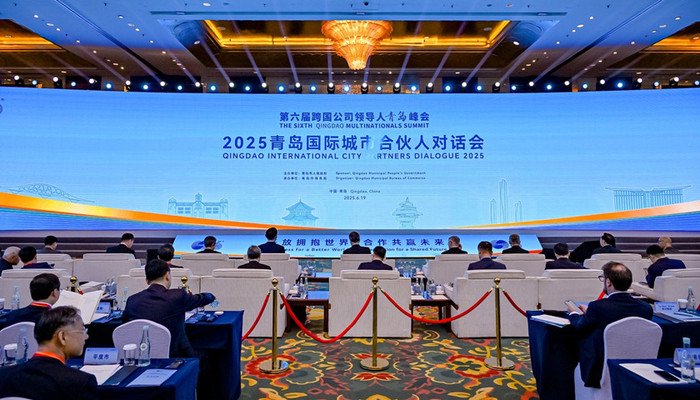
文|徐雅琳 链接世界,合作共赢。 6月19日,由山东省人民政府、商务部主办第六届跨国公司领导人青岛峰会的重要板块——2025青岛国 际城市合伙人对话会在香格里拉大酒店举行。对话会以"开放拥抱世界 合作共赢未来"为主题,日本瑞 穗、英国阿斯利康、瑞典阿特拉斯·科普柯、德国安迈铝业、爱尔兰埃森哲、美国卡夫亨氏等跨国公司 领导人、商协会代表、知名专家学者与青岛市参会代表在内的400余名嘉宾齐聚一堂,围绕新经济格局 下加强产供链合作,促进全球经贸互通与跨国资本流动,以及在青岛投资合作展望等话题展开交流,共 叙友谊、共谋发展、共话未来。 山东省委常委、青岛市委书记曾赞荣出席对话会并作主旨演讲,青岛市委副书记、市长任刚主持。青岛 市人大常委会主任梅建华,青岛市政协主席孟庆斌,商务部驻青岛特派办特派员孙继文,山东省商务厅 厅长王磊,青岛市委副书记张惠出席。日本、韩国、泰国驻青岛总领事,青岛市领导王波、宋明杰、张 元升、高健参加了对话会。 高效的行政支持,叠加与政府长期稳定的合作生态, 如同瑞典阿特拉斯·科普柯集团所验证的企业过去 十年显著增长——依托本地强大的供应链和人才库,其青岛工厂不仅成为综合性生产基地,青岛制造基 地 ...


中国期货每日简报-20250620
Zhong Xin Qi Huo· 2025-06-20 03:37
1. Report Industry Investment Rating - No relevant content provided 2. Core Viewpoints - On June 19, equity index futures declined while 30 - Y CGB futures rose; energy & chemical futures increased, while metal futures declined [2][10][12] - The MOFCOM stated that it will continuously accelerate review of rare earths export license applications in accordance with laws and regulations [1][3][35] 3. Summary by Directory 3.1 China Futures 3.1.1 Overview - On June 19, equity index futures declined, 30 - Y CGB futures rose, energy & chemical futures increased, and metal futures declined. The top three gainers were Chinese jujube (up 4.9% with 29.6% month - on - month open interest increase), crude oil (up 4.7% with 8.4% month - on - month open interest increase), and LSFO (up 2.7% with 0.5% month - on - month open interest decrease). The top three decliners were SCFIS(Europe) (down 4.0% with 0.4% month - on - month open interest decrease), poly - silicon (down 2.5% with 9.3% month - on - month open interest decrease), and silver (down 1.9% with 13.1% month - on - month open interest decrease) [10][11][12] 3.1.2 Daily Rise - Crude Oil - On June 19, crude oil increased by 4.7% to 570.9 yuan/barrel. Geopolitical uncertainties put oil prices in a high - risk phase, expected to be volatile. API data showed a significant draw in U.S. crude oil inventories last week, but gasoline inventories declined more modestly. The IEA monthly report revised down annual demand growth forecast and raised supply expectations. Short - term Middle East geopolitical concerns dominate oil price fluctuations. Attacks on energy infrastructure have occurred but haven't materially affected production or transportation. If geopolitical tensions ease, premiums may decline rapidly, but supply disruption expectations are hard to falsify, leading to more volatile oil prices [15][16][17] 3.1.3 Daily Drop 3.1.3.1 Copper - On June 19, copper decreased by 0.4% to 78310 yuan/ton. Supply constraints and low inventories support the bottom of copper prices, and it may show high - level volatility in the short term. U.S. manufacturing activity contracted for the third consecutive month in May, with overseas economic weakening risks. Copper concentrate and blister copper processing fees are low, and raw material supplies are tight. Domestic and overseas smelters have cut production. As the consumption off - season approaches, downstream replenishment willingness has weakened, and domestic social inventories have started to rebound, limiting price upside. The U.S. may increase copper tariffs, causing the COMEX copper price to rise again [22][23][24] 3.1.3.2 Gold - On June 19, gold decreased by 0.5% to 781.24 yuan/gram. The Fed kept rates unchanged in June, indicating two rate cuts this year. It lowered growth forecasts and raised inflation projections, validating stagflation risks. After the meeting, gold had a slight late - session decline but maintained an overall volatile trend. The Israel - Palestine conflict continues but with no significant intensity escalation, and the safe - haven sentiment driving gold is gradually weakening. Since June, gold's correction magnitude has narrowed, and its price center has moved upward, maintaining a long - term bullish trend, with silver following a relatively strong volatile pattern [29][30][31] 3.2 China News 3.2.1 Macro News - The MOFCOM stated that China is fully prepared for CPTPP accession and will actively align with high - standard international economic and trade rules, steadily expanding institutional opening - up. It also said that it will continuously accelerate the review of rare earths export license applications in accordance with laws and regulations and strengthen communication on export controls with relevant countries [35] 3.2.2 Industry News - As of June 19, the total dividend amount of public funds this year exceeded 107.66 billion yuan, a 47% increase year - on - year. At the 2025 Lujiazui Forum, the HKEX CEO said there are over 160 companies queuing for IPO in Hong Kong, and the mainland and Hong Kong exchanges should develop in a dislocation manner to jointly promote the construction of a multi - level capital market system [36][37]
低库存现实和需求走弱预期交织,有色延续震荡
Zhong Xin Qi Huo· 2025-06-20 02:58
Report Industry Investment Rating - The report does not explicitly provide an overall industry investment rating. However, for individual metals, the ratings are as follows: - Copper: Mid - term outlook is "oscillation" [6] - Alumina: Mid - long term outlook is "oscillation on the weak side" [8] - Aluminum: Short - term outlook is "strong oscillation", mid - long term consumption may face pressure [9] - Aluminum alloy: Short - term outlook is "spot is weak in the off - season, the market follows aluminum and is strong", mid - long term outlook is that "spot ADC12 and ADC12 - A00 are expected to rebound" [12] - Zinc: Outlook is "oscillation on the weak side" [13] - Lead: Outlook is "oscillation" [17] - Nickel: Short - term outlook is "wide - range oscillation", mid - long term can "short on rebounds" [23] - Stainless steel: Short - term outlook is "range oscillation" [25] - Tin: Outlook is "oscillation" [27] Report's Core View - The reality of low inventory and the expectation of weakening demand are intertwined, and the non - ferrous metals market will continue to oscillate. In the short and medium term, the weak US dollar, low LME inventory, and weakening demand are intertwined. Attention should be paid to structural opportunities, and short - term long opportunities for copper, aluminum, and tin can be cautiously considered. In the long term, the demand prospects of basic metals are still uncertain, and opportunities to short on rallies for some varieties with supply surplus or expected surplus can be considered [1] Summary by Relevant Catalogs 1.行情观点 Copper - **View**: The Fed maintains the interest rate unchanged, and copper prices oscillate. - **Analysis**: US May labor market data is better than expected; global copper mining giant Antofagasta starts mid - year negotiations; China's electrolytic copper production increases; spot premiums decline; copper inventory decreases; Glencore buys Russian copper; Trump raises tariffs on steel and aluminum imports. - **Logic**: Overseas economy may continue to weaken. Supply is tight due to falling processing fees and smelter maintenance. Demand weakens in the off - season, and there is a risk of tariff increase on copper. - **Outlook**: Copper supply constraints remain, and low inventory supports prices. Copper may oscillate at a high level in the short term [6] Alumina - **View**: The number of warehouse receipts is at a low level, and the monthly spread of the alumina futures market widens. - **Analysis**: Spot prices decline; shipping freight increases; warehouse receipts decrease. - **Logic**: In the short and medium term, there is no shortage of ore, but warehouse receipt depletion is obvious. In the long term, events have limited impact without further fermentation. - **Outlook**: Mid - long term outlook is oscillation on the weak side. Short - term positive spreads or shorting can be considered after the far - month contract rises further [7][8] Aluminum - **View**: Low inventory and high premiums lead to high - level oscillation of aluminum prices. - **Analysis**: Spot prices decline; inventory decreases; geopolitical events occur; new tariff policies are introduced. - **Logic**: Short - term geopolitical and squeezing risks push up prices. Mid - long term consumption may face pressure. - **Outlook**: Short - term prices are strongly oscillating, and mid - long term consumption may be under pressure. Short - term positive spreads can be considered, and mid - long term shorting on rallies is recommended [9][10] Aluminum Alloy - **View**: The transaction prices of scrap aluminum and spot increase, and the aluminum alloy futures market rises. - **Analysis**: Spot prices decline; relevant policies are introduced; car companies make payment commitments. - **Logic**: Short - term pressure in the off - season is high, but low inventory of electrolytic aluminum drives prices up. Mid - long term demand is expected to recover seasonally. - **Outlook**: Short - term spot is weak in the off - season, and the market follows aluminum and is strong. Mid - long term spot ADC12 and ADC12 - A00 are expected to rebound [10][12] Zinc - **View**: Inventory continues to accumulate, and zinc prices oscillate on the weak side. - **Analysis**: Spot premiums are different in different regions; inventory increases; a mine's production plan is announced. - **Logic**: Macro uncertainty exists. Supply is loose, and demand is in the off - season. Inventory accumulates, and prices may decline further. - **Outlook**: Zinc prices are expected to oscillate on the weak side [12][13] Lead - **View**: Cost support is stable, and lead prices oscillate. - **Analysis**: Scrap battery prices rise; lead ingot prices increase; inventory changes; some enterprises are in maintenance or production reduction. - **Logic**: Spot premiums narrow slightly; supply tightens; demand is in the off - season but with some positive factors. - **Outlook**: Lead prices are expected to oscillate [13][14][17] Nickel - **View**: Supply and demand are under pressure, and nickel prices are weak in the short term. - **Analysis**: LME and domestic nickel inventories change; relevant investment and cooperation projects are announced. - **Logic**: Market sentiment dominates the market. Industry fundamentals weaken marginally. Inventory accumulates, and prices are under pressure. - **Outlook**: Short - term wide - range oscillation, mid - long term shorting on rebounds [17][23] Stainless Steel - **View**: Nickel iron prices continue to decline, and the stainless steel futures market oscillates. - **Analysis**: Futures warehouse receipts decrease; spot premiums exist; production data changes. - **Logic**: Nickel iron and chrome iron prices decline, and steel mills are under pressure. Supply and demand may weaken, and inventory accumulates slightly. - **Outlook**: Short - term range oscillation [24][25] Tin - **View**: There is no obvious driving force, and tin prices oscillate. - **Analysis**: Warehouse receipts and inventory increase; spot prices rise; high prices suppress restocking. - **Logic**: Supply disturbances in the main production areas subside. Without obvious driving forces, prices oscillate. Supply is tight, but upward elasticity is limited. - **Outlook**: Tin prices are expected to oscillate [25][27] 2.行情监测 - The report does not provide specific content for this part, so it is skipped.