
PPI回升

Search documents
如何看待近期“HALO”交易?
ZHONGTAI SECURITIES· 2026-03-02 05:09
证券研究报告 信用业务周报 如何看待近期"HALO"交易? 2026年3月2日 中泰证券研究所 分析师:徐驰 执业证书编号:S0740519080003 分析师:张文宇 执业证书编号:S0740520120003 请务必阅读正文之后的信息披露和重要声明 【市场回顾】 图表:市场表现回顾 数据来源:Wind,中泰证券研究所 2 【市场观察】春节后科技主线行情或将如何演绎? 3 ➢ A股节后首周市场整体情绪明显回暖,中证1000与中证500指数周内涨幅均超过4%,算力产业链、电 力、商业航天、资源品顺周期板块轮番活跃,人民币汇率走强亦形成支撑。但"AI吞噬应用"叙事 主导之下,A股软件及恒生科技等板块受到显著冲击,全球HALO交易策略成为外资主导方向,A股同 步共振。 ➢ 一、科技与资源品共振:驱动逻辑是什么? ➢ 上周科技与资源的双线行情,本质上是同一套市场逻辑的"一体两面"——前者对应"AI带动算力 与电力需求扩张、国产替代加速"的产业景气逻辑,后者对应"PPI回升、反内卷政策落地、全球资 源再定价"的周期修复逻辑。 ➢ 1)资源品方面,美伊局势升温推动国际油价假期累涨逾5%,叠加国内PPI环比持续回升与供给 ...
固定收益策略报告:“主线逻辑”的边际变化-20260201
SINOLINK SECURITIES· 2026-02-01 13:29
Report Industry Investment Rating - Not provided in the content Core Viewpoints - After the January long - short game, the market has seen some new changes. The PPI recovery speed may be faster than the previous neutral expectation, government bond supply is front - loaded with longer terms, and the expectation of broad monetary policy has further weakened. The bond market may face medium - term pressure, but there may be short - term trading opportunities with limited space [7][11][15][25][31] Summary by Related Catalogs Interest Rate and Bond Market in January - Interest rate showed a first - up - then - down trend in January. In the first two weeks, the 10 - year Treasury bond rate rose to around 1.9% due to factors such as supply concerns, dampened interest rate cut expectations, the seesaw effect of rising equities, and inflation concerns from strong commodities. In the middle and late January, with sufficient central bank liquidity injection and other factors, the market had a recovery window [2][7] - The bond market remained relatively resilient in the last week of January. The 7 - day reverse repurchase net investment was 5.805 billion yuan. The 7 - day funding rate rose significantly. The yields of both ends of the curve rose while the middle part declined. The 10 - year Treasury bond yield fell 2bp to 1.81%. The duration of public - offering funds continued to rise [32][33][37] PPI and Inflation - In January, prices accelerated upward with a wider coverage, and the change was transmitted from raw materials to the end - products. The month - on - month increase of PPI in January may be between 0.15% and 0.25%, and the year - on - year may be in the range of - 1.53% to - 1.43%, with the year - on - year decline expected to narrow faster. The PPI may return to zero earlier than the previous neutral prediction [3][11] Government Bond Supply - In January, the overall net financing of government bonds was significantly higher than the seasonal level, showing the characteristic of front - loaded supply. The local bond issuance was skewed towards the medium - and long - term, with the issuance scale of 10 - year and 30 - year bonds increasing. The supply pressure will still be relatively high from February to March [4][15][24] Expectation of Broad Monetary Policy - Since the beginning of the year, the market's expectation of broad monetary policy has gradually cooled, and the overall level has further weakened compared with the end of last year. Although there may be opportunities for short - term game of easing expectations, the overall space for total easing is limited this year [5][25][27] Local Bond Issuance - In the last week of January, local bond issuance increased, and the issuance scale this year has been significantly higher than that of the same period last year. The weighted average issuance term of local bonds has generally increased slightly compared with the same period last year, and the issuance scale of 10 - year and 30 - year local bonds has almost doubled [54][57] - In the week from January 24th to January 30th, the issuance scale of new special bonds and ordinary refinancing bonds increased month - on - month. The weighted average issuance term increased slightly by 1 year to 17 years, and the issuance spread decreased by 1bp month - on - month [43][45][51] - The actual issuance progress of local bonds in January was 103% of the plan. The expected issuance scale of local bonds from February 2nd to 6th is 57.97 billion yuan [59][60]
东海证券晨会纪要-20260112
Donghai Securities· 2026-01-12 03:40
Group 1 - The report highlights a positive trend in the Producer Price Index (PPI), which narrowed its year-on-year decline to -1.9% in December 2025, with a month-on-month increase of 0.2%, marking three consecutive months of positive growth [8][14]. - The chemical industry is expected to benefit from a favorable cycle, driven by the exit of high-cost petrochemical capacities in Europe and Japan, and a slowdown in new domestic petrochemical capacities, particularly in the chemical fiber and propylene chains [8][20]. - The report recommends focusing on leading companies in the petrochemical and non-ferrous metal industries, as well as sectors like AI applications, computing power, and commercial aerospace for investment opportunities [8][20]. Group 2 - The December 2025 Consumer Price Index (CPI) showed a year-on-year increase of 0.8%, up from 0.7% in November, indicating a positive trend in inflation [11][12]. - The core CPI remained stable at 1.2% year-on-year, with significant contributions from household appliances and communication tools, reflecting a recovery in consumer demand [12][13]. - The report anticipates that both CPI and PPI will continue to rise in 2026, which may drive nominal GDP growth [11][12]. Group 3 - Chery Automobile has undergone significant transformation since its establishment in 1997, focusing on technology development, strategic restructuring, and a comprehensive shift towards new energy and intelligent vehicles [16][20]. - The company achieved a record export volume of 1.145 million vehicles in 2024, surpassing SAIC Motor, with overseas revenue accounting for 37.4% of total income [17][20]. - Chery's new energy vehicle segment is expected to grow rapidly, with a dual strategy of hybrid and pure electric vehicles, positioning the company for significant market expansion [18][20]. Group 4 - Juxing Technology (002444) is projected to achieve a net profit of between 2.419 billion and 2.764 billion yuan in 2025, reflecting a year-on-year growth of 5% to 20% [21][24]. - The company has successfully navigated external challenges, such as changes in U.S. tariff policies, by implementing a flexible "nomadic factory plan" and enhancing product innovation [22][24]. - The electric tool business has seen a remarkable growth of 56.03% year-on-year in the first half of 2025, indicating strong potential for future growth [23][24].
资产配置周报:PPI回升与化工周期推动向好-20260111
Donghai Securities· 2026-01-11 15:06
Group 1 - The report highlights a recovery in PPI and a positive outlook for the chemical cycle, with December 2025 PPI showing a year-on-year decline narrowing to -1.9% and a month-on-month increase of 0.2%, marking three consecutive months of positive growth [8][9][10] - The report emphasizes the correlation between chemical profitability and factors such as crude oil prices and PPI, noting that historical chemical market trends benefited from demand-driven oil price increases [8][9] - The report expresses optimism for leading chemical companies due to the exit of high-cost petrochemical capacities in Europe and Japan, a slowdown in new domestic petrochemical capacities, and the cost reductions from scale effects and internal synergies [8][9] Group 2 - The domestic equity market showed a preference for growth sectors over cyclical, financial, and consumer sectors, with an average daily trading volume of 28,287 billion yuan, up from 21,111 billion yuan [11][17] - Among the 30 industries tracked, the comprehensive sector (+14.55%), defense industry (+13.63%), and media (+13.10%) saw significant gains, while only the banking sector experienced a decline of -1.90% [11][17] - The report recommends focusing on the petrochemical and non-ferrous metal industry chains, as well as technology sectors such as AI applications, computing power, and commercial aerospace for asset allocation [8][9]
全面复盘:史上5轮PPI回升的股债表现【国盛宏观熊园团队】
Xin Lang Cai Jing· 2025-12-26 14:58
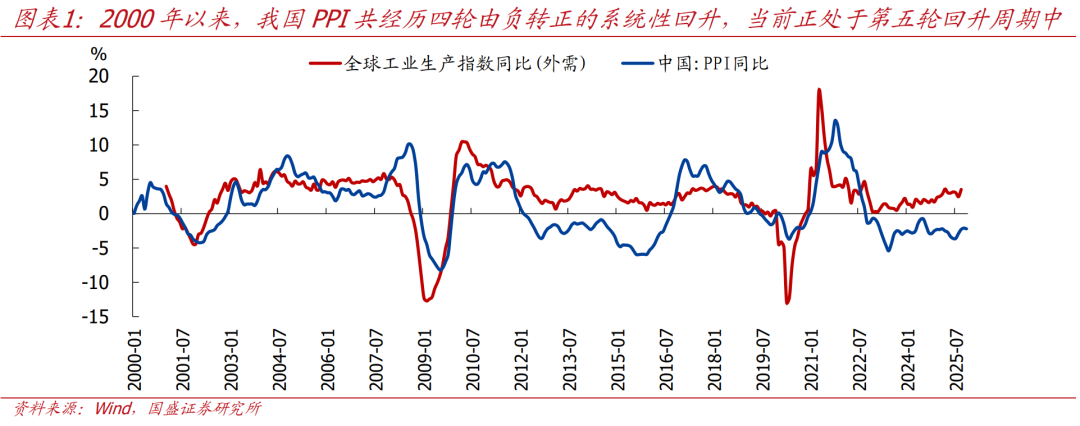
Core Viewpoint - The article discusses the recovery trend of China's Producer Price Index (PPI) since July 2025, predicting a narrowing year-on-year decline in PPI for 2026, with the next six months likely being the fastest recovery period. Historical analysis of past PPI recovery phases is used to identify potential investment opportunities in the stock and bond markets for 2026 [2][3]. Group 1: Historical PPI Recovery Phases - Since 2000, there have been five rounds of PPI recovery in China, with the current phase being the fifth. The PPI has transitioned from negative to positive during these periods, with significant economic events influencing these changes [15][22]. - The first round (2002-2004) saw PPI rise from -4.2% to 8.4%, driven by global economic recovery and domestic urbanization [4][16]. - The second round (2009-2010) experienced a rise from -8.2% to 7.1%, supported by the global financial crisis response and domestic stimulus measures [5][17]. - The third round (2015-2017) saw PPI increase from -5.9% to 7.8%, influenced by supply-side reforms and monetary policies [6][19]. - The fourth round (2020-2021) had PPI rise from -3.7% to 13.5%, primarily due to supply-side factors and global commodity price increases [7][20]. - The current phase (2025-present) has seen PPI recover from -3.6% to -2.2%, with expectations for further recovery in 2026 [8][21]. Group 2: Stock Market Performance During PPI Recovery - Historical analysis indicates that during the first phase of PPI recovery, A-shares typically show an upward trend, with small-cap growth stocks outperforming [3][6]. - In the second phase, as PPI rises from its bottom to positive territory, the stock market experiences a more balanced performance across growth, consumption, and cyclical sectors, with notable performances in electronics, communication, and consumer goods [3][8]. - The third phase, when PPI turns positive, often leads to high-level market fluctuations, with value stocks gaining an advantage over growth stocks [3][7]. Group 3: Bond Market Dynamics - The bond market's response to PPI recovery is influenced by various factors, including growth expectations and liquidity conditions, rather than solely by inflation [10][11]. - Historical data shows that during PPI recovery phases, the 10-year government bond yield may face upward pressure, but this is not always synchronized with PPI movements [10][11]. - A stable liquidity environment and lack of sustained demand improvement can prevent significant upward trends in bond yields, even during periods of PPI recovery [11][12]. Group 4: Outlook for 2026 - The PPI is expected to narrow its year-on-year decline in 2026, with the next six months likely being the fastest recovery period, driven by policies aimed at stabilizing coal and steel prices, as well as rising demand for lithium and copper [12][13]. - The stock market is anticipated to have upward potential, with growth, consumption, and cyclical sectors all presenting investment opportunities, particularly in undervalued sectors such as food and beverage, home appliances, and non-ferrous metals [12][13]. - The bond market is expected to remain in a state of fluctuation, with a continued focus on monetary easing, although significant adjustments in bond yields are not anticipated [13].

【申万宏源策略】讨论人民币升值、PPI回升和外资流入展望
申万宏源证券上海北京西路营业部· 2025-12-26 02:28
Core Viewpoint - The article discusses the outlook for RMB appreciation, PPI recovery, and foreign capital inflow, highlighting the potential positive impacts on the economy and investment landscape [2] Group 1: RMB Appreciation - The article indicates that the RMB is expected to appreciate due to various economic factors, which could enhance the purchasing power of consumers and businesses [2] - It notes that a stronger RMB may lead to increased imports and reduced export competitiveness, impacting trade balances [2] Group 2: PPI Recovery - The Producer Price Index (PPI) is projected to recover, suggesting a potential increase in manufacturing profitability and overall economic growth [2] - The recovery in PPI is seen as a positive signal for industrial sectors, indicating improved demand and pricing power [2] Group 3: Foreign Capital Inflow - The article highlights an anticipated increase in foreign capital inflow, driven by favorable economic conditions and investment opportunities in China [2] - It suggests that this inflow could support domestic markets and enhance liquidity, benefiting various sectors [2]

明年PPI回升幅度取决于需求侧配合以及“反内卷”政策落地成效|宏观晚6点
Xin Lang Cai Jing· 2025-12-25 10:11
Group 1 - The National Development and Reform Commission (NDRC) has outlined key investment directions for infrastructure during the 14th Five-Year Plan, focusing on transportation and energy sectors [1] - In the transportation sector, the NDRC emphasizes the high-quality construction of strategic corridors along coastal, border, and river areas, as well as enhancing the transportation network including railways, highways, waterways, and civil aviation [1] - The NDRC aims to address transportation shortcomings in the western and border regions, promote infrastructure updates, and implement digital transformation to create a resilient and diversified international transport corridor system [1] Group 2 - The Ministry of Commerce responded to the U.S. decision to impose Section 301 tariffs on certain Chinese semiconductor products, currently set at 0% and expected to increase after 18 months [1] - The spokesperson for the Ministry of Commerce stated that China has formally lodged strong representations to the U.S. through the China-U.S. economic and trade consultation mechanism [1] - China firmly opposes the U.S. conclusions from the Section 301 investigation and the imposition of tariffs on Chinese semiconductor products [1]
向阳花开,乘势而上——2026年A股年度策略
2025-12-15 01:55
Summary of Key Points from the Conference Call Industry Overview - The report focuses on the A-share market and macroeconomic trends in China for 2026, highlighting the expected recovery of the Producer Price Index (PPI) and its implications for corporate profitability and market performance [1][2][4]. Core Insights and Arguments - **2025 Market Performance**: The market was primarily driven by liquidity, with the Wind All A Index rising by 25%. Valuation improvements contributed 20%, while profit support was only 5%. Key drivers included state support, insurance capital inflows, and the migration of household deposits [1][3]. - **2026 PPI Expectations**: A significant recovery in PPI is anticipated, with a neutral forecast suggesting it may reach around -0.7 by the end of the year. This recovery is expected to align with the profit growth rate and return on equity (ROE) of non-financial enterprises, which is projected to be around 10% [1][5][4]. - **Market Space and ERP**: In a weak recovery scenario for PPI, the equity risk premium (ERP) for the CSI 300 Index could drop to negative one standard deviation, suggesting a potential index increase of about 10%, from approximately 4,000 points to around 4,500 points [1][6]. - **Liquidity Sources**: Micro-level liquidity is heavily reliant on foreign capital and the migration of household deposits. The return of foreign capital is limited, necessitating a focus on attracting domestic funds through bank wealth management products and declining yields [1][7]. - **Role of Brokerage Firms**: Brokerage firms are crucial for guiding retail investor participation in the market. Historical data indicates that rapid increases in brokerage stocks often correlate with higher net inflows from retail investors. A resurgence in brokerage stocks is expected in Q1 2026 [1][9][10]. - **Q1 2026 Outlook**: The first quarter of 2026 is viewed as the most certain window for investment, with anticipated policy support, optimistic economic expectations, and liquidity easing. Key events, such as the visit of a U.S. official and the full rollout of the "15th Five-Year Plan," are expected to boost market sentiment [1][11][12]. - **Second Half of 2026**: The second half may see a verification phase for economic data and corporate earnings, with potential uncertainties arising from U.S. midterm elections impacting risk appetite. The market is expected to remain volatile [1][13]. Additional Important Insights - **Spring Rally Timing**: The spring rally is expected to start earlier than usual, potentially from late 2025 to early 2026, driven by liquidity shifts and early signs of market enthusiasm [1][14]. - **Sector Focus for 2026**: Key sectors to watch include software, media (especially gaming), robotics, innovative pharmaceuticals, and energy storage, with a focus on growth styles [1][16]. - **Investment Strategies**: The chemical industry is highlighted as a key area for investment, particularly in the context of rising external demand and AI materials. The report suggests that the chemical sector has a high probability of outperforming during the early stages of PPI recovery [1][21]. - **Brokerage Sector Performance**: The brokerage sector is expected to perform well in Q1 2026, with a potential rally that could attract retail investment and push indices higher [1][23]. - **Overall Market Outlook for 2026**: The overall market outlook for 2026 is positive, with expectations of reaching 4,500 points if PPI recovers, household deposits migrate, and brokerage stocks rally. Recommended sectors include industrial metals, energy storage, and domestic computing capabilities [1][24].
2026年A股年度策略:向阳花开,乘势而上
Guohai Securities· 2025-12-14 10:23
Group 1 - The core viewpoint of the report emphasizes the recovery of PPI as a significant macroeconomic theme for 2026, which is expected to strengthen corporate profitability and provide solid fundamental support compared to 2025 [7][19][20] - The report predicts that the net profit growth rate for the non-financial sector of the entire A-share market is expected to exceed 10% in 2026, driven by the recovery of PPI [20][22] - The report highlights that the recovery slope of PPI will depend on the degree of fiscal expansion, with a steeper recovery indicating stronger market performance [26][32] Group 2 - The report identifies key industry configurations for 2026, including sectors benefiting from U.S. interest rate cuts, external demand, AI, price increases, and an active capital market [8][19] - Specific sectors such as industrial metals, electric grid equipment, energy storage, battery materials, and certain chemicals are expected to benefit from increased external demand and U.S. capital expenditure expansion [8][19] - The report suggests that the technology sector, particularly in AI and robotics, will continue to see high demand and potential growth, with a focus on software, media, and innovative pharmaceuticals [8][19][40] Group 3 - The report anticipates that the first half of 2026 will present a favorable time window for growth performance, driven by domestic policy initiatives and external interest rate cuts [7][44] - The potential for a "spring rally" is highlighted, with expectations that it may occur earlier than usual due to clearer interest rate cut expectations and favorable market conditions [7][49] - The report emphasizes the importance of monitoring the pace of resident deposit migration and foreign capital inflow as critical variables influencing market dynamics [7][36][41]
股指期货周报:震荡整理,韧性显现-20251208
Cai Da Qi Huo· 2025-12-08 05:13
Report Summary 1. Report Industry Investment Rating No investment rating information is provided in the report. 2. Core Viewpoints - The market is currently in a weak - balance stage, and after the accumulation of positive signals and the display of market resilience, a market repair process is expected to occur [6]. - The 12 - month Politburo meeting and the Central Economic Work Conference are expected to set a positive tone for policies in 2026 and boost market risk appetite [6]. - The US labor market pressure remains unresolved, and the Fed may need to cut interest rates in December [6]. 3. Summary by Related Contents Market Performance - Last week, the four stock - index futures showed a narrow - range upward oscillation trend, with relatively large increases in CSI 300 and CSI 500. All main contracts remained in the futures discount mode, with the basis of IH at - 10.14, IF at - 4.61, IC at - 14.64, and IM at - 22.69 [4]. - The A - share market showed a narrow - range oscillation last week, with prominent hot - topic sectors. The prices of non - ferrous metal futures and stocks reached new highs, and the listing of a domestic chip company on Friday drove up the communication computing power sector, but the high valuation of new listings may have a negative impact on the computing power sector later [4]. - On Friday, there were multiple hot sectors such as communication computing power, commercial space, non - ferrous metals, insurance and securities, and new energy. With limited increase in overall market trading volume, funds actively attacked multiple sectors without causing obvious weakness in other sectors [4]. Comprehensive Analysis - Macroscopically, the upward trend of PPI is relatively clear, while the market's optimistic expectations for policies need verification [5]. - Overseas, the pressure on the US labor market remains, and the deteriorating labor market is the main contradiction in the Fed's monetary policy, making a December interest - rate cut necessary [6].