以旧换新政策

Search documents
换新政策激活天水消费新活力
Xin Lang Cai Jing· 2026-01-19 03:42
Core Viewpoint - The implementation of the 2026 consumer goods trade-in subsidy policy in Gansu Province is expected to significantly boost consumer spending in key sectors such as automobiles, home appliances, and digital products, thereby injecting strong momentum into the local market [1][2]. Group 1: Subsidy Policy Details - The subsidy policy covers three main categories of consumer goods: automobiles, home appliances, and digital products [1]. - For automobiles, the maximum subsidy for scrapping old vehicles to purchase new energy vehicles is 20,000 yuan, while for fuel vehicles, it is 15,000 yuan. The subsidy for trade-in purchases of new energy vehicles is up to 15,000 yuan, and for fuel vehicles, it is 13,000 yuan [1]. - The home appliance trade-in subsidy includes six categories, such as refrigerators, washing machines, televisions, air conditioners, computers, and water heaters, all of which must meet energy efficiency or water efficiency standards [1]. - The digital product subsidy applies to smartphones, tablets, smartwatches, and smart glasses, with a single item price limit of 6,000 yuan [1]. Group 2: Market Response - Following the launch of the subsidy policy, local automobile dealerships have reported an increase in customer inquiries about trade-in options, with foot traffic remaining stable compared to the previous year [2]. - Consumers are showing a strong interest in upgrading their vehicles, with many taking advantage of the subsidies and additional dealer promotions [2]. - Home appliance and digital product retailers are experiencing heightened activity, with government subsidy promotions attracting many customers, particularly for energy-efficient products [2]. Group 3: Implementation and Accessibility - The city has completed the collection of businesses eligible for the trade-in program to ensure consumers can easily access the benefits [3]. - The subsidy application process is streamlined and can be completed online through the "Gankuaiban" app or via WeChat and Alipay mini-programs [3]. - The local commerce bureau will continue to promote the policy, provide support to businesses, and ensure accurate distribution of subsidy funds to maximize the benefits for consumers and stimulate healthy market growth [3].
周观点 | 2025Q4前瞻:以旧换新政策延续 板块表现分化【国联民生汽车 崔琰团队】
汽车琰究· 2026-01-18 15:41
Market Performance - The automotive sector outperformed the market this week, with the A-share automotive sector rising by 0.5%, ranking 12th among Shenwan sub-industries, compared to the CSI 300 which fell by 0.9% [3] - Within the sub-sectors, automotive services and automotive parts increased by 4.5% and 1.8% respectively, while commercial passenger vehicles, commercial freight vehicles, motorcycles, and passenger cars saw declines of -1.1%, -1.3%, -1.7%, and -1.9% respectively [3] Investment Recommendations - The core investment recommendations for this month include Geely Automobile, Xpeng Motors, BYD, Berteli, Top Group, New Spring Co., and Chunjun Power [4] 2025Q4 Outlook - Total wholesale sales of passenger vehicles are expected to be 8.748 million units in 2025Q4, a year-on-year decrease of 1.3% but a quarter-on-quarter increase of 13.8% [5] - In the new energy sector, wholesale sales of new energy passenger vehicles are projected to reach 4.46 million units, a year-on-year increase of 3.1% and a quarter-on-quarter increase of 10.9% [5] - Price competition is expected to ease, with discounts stabilizing and profitability improving [5] - Companies expected to perform well year-on-year in 2025Q4 include Seres, Xiaomi Motors, NIO, Leap Motor, and Geely [5] Components Sector - Revenue in the components sector is expected to be driven by strong performances from Xiaomi, Geely, and BYD, while costs are anticipated to decrease due to lower raw material prices and shipping costs [36] - The average global shipping cost in 2025Q4 is projected to be $3,484, a year-on-year decrease of 2.6% [38] - The performance of the components sector is expected to diverge significantly based on customer structure, with companies like Top Group and Hu Guang expected to perform well [41] Heavy Trucks - The heavy truck sector is expected to see continued recovery in demand, with wholesale sales projected at 231,000 units in 2025Q4, a year-on-year increase of 34.7% [42] - The market competition is expected to remain stable, with companies like FAW Group and Beiqi Foton gaining market share [43] Motorcycles - The wholesale sales of large-displacement motorcycles (over 250cc) are expected to be 191,000 units in 2025Q4, a year-on-year increase of 4.3% but a quarter-on-quarter decrease of 26.3% [60] - Domestic sales are projected to be 69,000 units, a year-on-year decrease of 5.2% [60] - Export sales are expected to reach 122,000 units, a year-on-year increase of 10.5% [60] Policy Impact - The continuation of the vehicle replacement policy is expected to stimulate demand, with subsidies for scrapping old vehicles remaining in place [33][64] - The new subsidy policy for 2026 will shift to a percentage of the vehicle price, which is expected to improve the structure of subsidized models [65][70]

新一轮国补落地首周带动消费4.5亿元 消费市场“焕新”提速
Yang Guang Wang· 2026-01-17 09:48
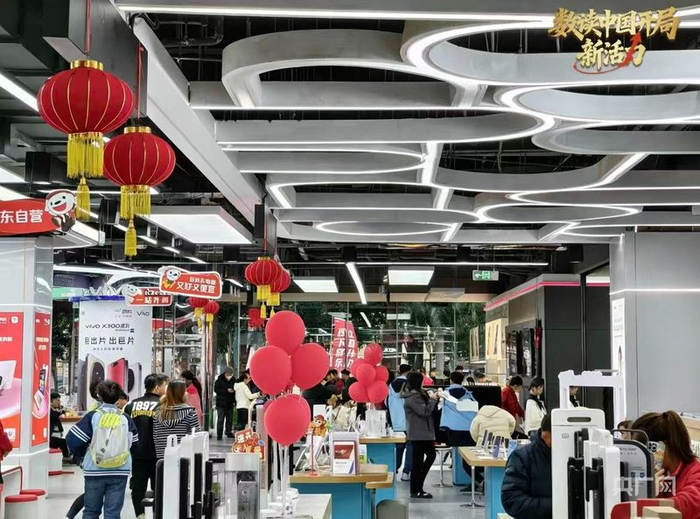
Core Insights - The new round of appliance trade-in policy in Guangxi has shown significant results in its first week, with 114,000 subsidies issued and a total subsidy amount of 64.99 million yuan, directly boosting appliance and digital product sales by 450 million yuan [1][4] Group 1: Policy Impact - The policy has led to a notable increase in the sales of energy-efficient appliances, with 80% of sales in a major store being of first-class energy efficiency products, reflecting a 56.18% month-on-month growth [4] - The implementation of the trade-in policy has resulted in a 46.8% year-on-year increase in sales of green smart appliances, with first-class energy efficiency products accounting for 62% of total subsidy applications [4][5] Group 2: Consumer Behavior - Consumers are increasingly prioritizing energy efficiency and smart features over price, indicating a shift in purchasing behavior towards quality [4][5] - The demographic of consumers engaging in the trade-in program is diverse, with 50% of subsidy applications for digital products coming from the 25-35 age group, and older consumers also showing significant interest in smart and health-oriented products [6] Group 3: Service Enhancements - Retailers are enhancing service offerings to ensure consumers can easily access policy benefits, including dedicated support for subsidy applications and integrated old product recycling services [7] - The online and offline service model has expanded, with 27% of subsidy applications coming from online channels, facilitating a seamless process for consumers [7] Group 4: Economic Implications - The trade-in policy is viewed as a practical measure to stabilize growth and promote consumption, while also serving as a long-term strategy for industrial upgrading and green development [9]
热点思考|新年第一会,谁在抢跑?(申万宏观·赵伟团队)
赵伟宏观探索· 2026-01-16 16:05
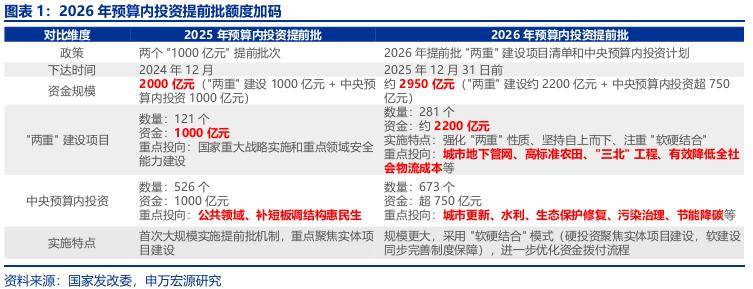
Core Viewpoint - The article analyzes the early meetings held by various regions after the New Year, focusing on their different priorities for the year ahead and the potential economic space in early 2026, providing insights for tracking and assessment [1]. Group 1: Central Government Initiatives - The central government has increased investment ahead of schedule, with the National Development and Reform Commission issuing a list of early construction projects for 2026, totaling 295 billion yuan, an increase of 95 billion yuan compared to 2025 [2][9]. - The "two heavy" projects will receive 220 billion yuan, focusing on urban underground pipelines and high-standard farmland, while central budget investments exceed 75 billion yuan, targeting urban renewal and water conservancy [2][9]. - The "old-for-new" policy has been refined, with the first batch of 62.5 billion yuan in special long-term bonds issued to support this initiative, with changes in subsidy structures for automobiles and home appliances [3][12]. Group 2: Local Government Responses - Many regions have moved their "New Year First Meetings" to after New Year's Day, emphasizing early initiation of key work for the year, contrasting with 2025 when most meetings were held after the Spring Festival [4][16]. - Regions like Shanghai and Fujian focus on optimizing the business environment and boosting confidence in the private economy, with specific measures to eliminate market entry barriers and address overdue payments [19][20]. - Core cities such as Hubei, Nanjing, and Suzhou are concentrating on cultivating new productivity, while Zhejiang and Henan are focusing on stabilizing investment to support growth [21][46]. Group 3: Economic Potential and Tracking Indicators - The postponement of the Spring Festival by 19 days in 2026 creates a pattern of "heavy production and investment in January, heavy consumption in February," aligning with the central government's emphasis on early economic stability [5][22]. - Since 2019, the proportion of actual GDP in the first quarter has increased annually by 0.1 percentage points, highlighting the importance of early economic performance [26]. - Local government debt issuance plans indicate a potential increase of approximately 340 billion yuan in January 2026 compared to the previous year, with 257.78 billion yuan planned for issuance [35][41].
开局“十五五”丨扩消费、稳外贸、促开放 多策并举赋能经济高质量发展
Yang Shi Xin Wen· 2026-01-16 09:04
Core Viewpoint - The article emphasizes the importance of boosting consumption and expanding the supply of quality consumer goods and services in China, as outlined in the "14th Five-Year Plan" [1] Group 1: Domestic Consumption Growth - In the first 11 months of 2025, China's total retail sales of consumer goods increased by 4.0% year-on-year, with an expected annual total surpassing 50 trillion yuan [2] - Service retail growth outpaced goods retail by 1.3 percentage points, indicating strong vitality and potential in the service sector [2] - The focus for this year includes key areas such as transportation, housekeeping, performances, and sports events to cultivate new growth points in service consumption [2][3] - The government plans to enhance policies supporting service consumption and organize events like "Service Consumption Season" and "Chinese Cuisine Festival" to promote local service brands [2] Group 2: Trade Innovation and Balance - China's foreign trade is expected to exceed 45 trillion yuan in 2025, with a growth rate of 3.8%, maintaining its position as the world's largest goods trader for nine consecutive years [4] - The government aims to stabilize foreign trade by promoting goods, services, and digital trade amidst external uncertainties [4][5] - Initiatives will include expanding imports through targeted procurement and enhancing the influence of the "Export China" brand [5] Group 3: High-Level Opening Up - The government is committed to expanding high-level openness and cooperation, particularly in sectors like telecommunications and biotechnology [7] - Measures will be taken to implement zero-tariff policies for all diplomatic countries in Africa and to enhance the Hainan Free Trade Port's policies [7][8] - The focus will also be on cross-border supply chain management and promoting cooperation in green development and digital economy [8]
新年第一会,谁在抢跑?
Sou Hu Cai Jing· 2026-01-16 07:57
来源:申万宏观·赵伟团队 文| 赵伟、贾东旭、侯倩楠 联系人| 贾东旭 元旦后,多地密集召开"新年第一会",擘画全年重点工作,地区侧重有何不同,2026年初经济潜在空间几何,如何跟踪研判?本文分析,可供 参考。 一、热点思考:新年第一会,谁在抢跑? (一)中央如何靠前发力,筑牢年初经济稳定基础?政府投资前置加码,以旧换新政策续接 政府投资前置加码,国家发改委已下达2026年提前批"两重"建设项目清单及中央预算内投资,合计2950亿元。相较2025年提前批,本次新增950 亿元,其中"两重"项目资金保障力度加大,规模达2200亿元,重点投向城市地下管网、高标准农田等领域;中央预算内投资超750亿元,重点覆 盖城市更新、水利等领域。资金前置部署,或助力一季度投资"止跌回稳"。 以旧换新政策续接更精准,国家发改委、财政部提前10天(较2025年初)下达首批625亿元超长期特别国债资金支持该政策。汽车改定额补贴为 比例补贴,新增2019年前注册新能源车的报废要求;家电精简至6类1级能效补贴,比例降至15%(单件上限1500元);数码新增智能眼镜补 贴。全国统一领域标准不变,地方可自主确定配套领域政策。 动能培育持续赋 ...
热点思考|新年第一会,谁在抢跑?(申万宏观·赵伟团队)
申万宏源宏观· 2026-01-16 07:04
Core Viewpoint - The article discusses the early meetings held by various regions after New Year's Day to outline key work for the year, highlighting differences in regional focus and potential economic space in early 2026 [1]. Group 1: Central Government Initiatives - The central government has increased investment ahead of schedule, with the National Development and Reform Commission issuing a list of early construction projects for 2026, totaling 295 billion yuan, an increase of 95 billion yuan compared to 2025 [2][9]. - The "two heavy" projects will receive 220 billion yuan, focusing on urban underground pipelines and high-standard farmland, while central budget investments exceed 75 billion yuan, targeting urban renewal and water conservancy [2][9]. - The "old-for-new" policy has been refined, with the first batch of 62.5 billion yuan in special bonds issued 10 days earlier than in 2025, supporting consumer goods replacement [2][12]. Group 2: Local Government Responses - Many regions have moved their "New Year First Meetings" to after New Year's Day, emphasizing early initiation of key work for the year, contrasting with 2025 when most meetings were held after the Spring Festival [4][16]. - Regions like Shanghai and Fujian focus on optimizing the business environment and boosting confidence in the private economy, with specific measures to eliminate market entry barriers and address overdue payments [4][19]. - Core cities such as Hubei, Nanjing, and Suzhou are concentrating on cultivating new productivity, while Zhejiang and Henan are focusing on stabilizing investment to support growth [4][19]. Group 3: Economic Potential and Tracking Indicators - The postponement of the Spring Festival by 19 days in 2026 creates a pattern of "heavy production and investment in January, heavy consumption in February," aligning with the central government's emphasis on early economic work [5][22]. - Since 2019, the proportion of actual GDP in the first quarter has increased by an average of 0.1 percentage points annually, indicating the importance of early economic performance [5][26]. - The fiscal front is accelerating, with local government debt issuance in January expected to increase by approximately 340 billion yuan compared to the previous year, with 24 provinces planning to issue 257.78 billion yuan in new debt [7][35].
北京:提振消费 扩大投资 以旧换新政策优化实施机制
Xin Lang Cai Jing· 2026-01-16 04:41
格隆汇1月16日|"北京文旅"还将再升级。"本市将梳理客流、票务、交通等实用信息,与各大平台合 作,发布推广一批'官方精选+实际体验'的精品攻略,欢迎境外和全国游客来京旅游。"市发改委综合处 处长王育玲说。对于市民关心的"以旧换新",今年本市将主动对接国家新一轮以旧换新政策举措,优化 实施机制,持续推动汽车、家电等大宗商品消费增长。开年时刻历来是扩大投资的关键时间点。市发改 委投资处处长王丹丽透露,一季度,本市将坚持投资于物和投资于人紧密结合,加快建设和储备重大项 目,做好各类要素保障,持续扩大有效投资。按照计划,1月底前本市将发布全年供地计划,力争一季 度集中供应一批优质地块,春节前下达40%的市政府固定资产项目建设资金,2月底前发行首批地方政 府专项债券。1月底前还将形成城市更新储备项目和攻坚项目清单,推动建筑指标统筹、功能混合和复 合利用、优化土地续期和房屋租期等创新政策集成落地。 ...
横店东磁:2026年“两新”政策优化助力磁材板块提质增效
Sou Hu Cai Jing· 2026-01-16 00:56
投资者提问:请问贵公司在2026年国家以旧换新的补贴,是否可以延续获益? 横店东磁回复:您好,国家发改委和财政部对2026年"两新"政策的支持范围、补贴标准和实施机制都有 了进一步的优化,这将有利于提升家电和消费电子领域的产销,从而带动磁性材料在诸多应用领域的需 求提升,预期助力公司磁材板块提质增效。感谢关注! 证券之星消息,横店东磁(002056)01月16日在投资者关系平台上答复投资者关心的问题。 以上内容为证券之星据公开信息整理,由AI算法生成(网信算备310104345710301240019号),不构成 投资建议。 ...

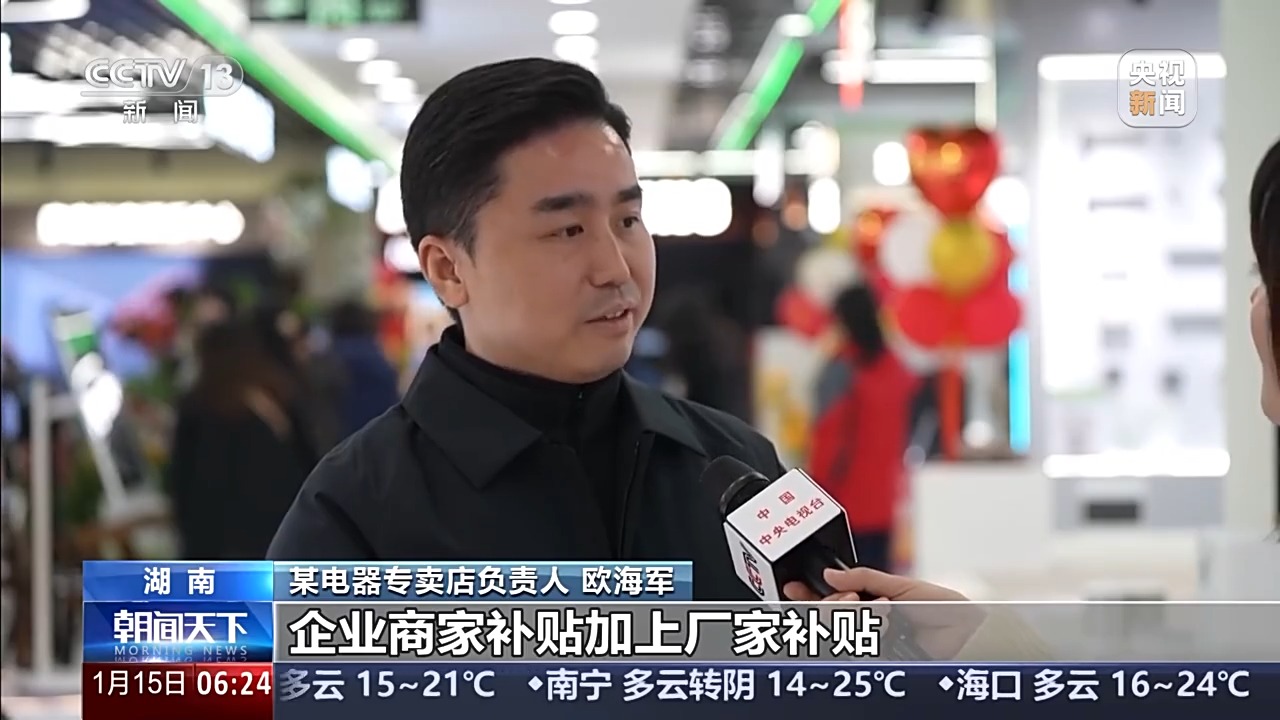
视频丨“国补”叠加商家优惠 消费市场迎新年“开门红”
Yang Shi Xin Wen Ke Hu Duan· 2026-01-15 10:30
Group 1 - The new round of consumer goods trade-in policy has led to a surge in the consumption market in regions like Hunan and Shanxi, marking a strong start to the new year [1] - In a large appliance store in Changsha, Hunan, many consumers are inquiring about the "national subsidy" policy, with some stores offering additional discounts on top of government subsidies [3] - A store manager reported that with combined subsidies from businesses and manufacturers, consumers can enjoy up to 45% in discounts, resulting in a sales increase of over 30% year-on-year since January 1 [5] Group 2 - Hunan's trade-in policy this year has expanded the scope of subsidized products from "digital products" to include "digital and smart products," covering items such as smartphones, tablets, smartwatches, smart glasses, and smart home products [7] - In Shanxi, the consumption market is also thriving, with staff assisting consumers in redeeming "national subsidy" vouchers at an appliance store [9] - Shanxi's government subsidies are distributed weekly through the "Yunshanfu" platform, using a "voucher first, discount at purchase" method, with a subsidy standard of 15% off the final price after all discounts, limited to one item per category per consumer [11]