
反内卷政策

Search documents
十年期国债收益率重上1.8%,国债买卖年内会重启吗
Hua Xia Shi Bao· 2025-09-12 04:12
Group 1: Bond Market Dynamics - Recent rise in government bond yields, with 10-year yields surpassing 1.8% and 30-year yields exceeding 2.1%, correlating with the strength of the A-share market, indicating a "stock-bond seesaw effect" [1] - The increase in yields is attributed to a shift in investor risk appetite, as regulatory policies aimed at reducing competition may lead to rising prices, diminishing the investment value of bonds [1] - The market is currently experiencing pressure on bond yields due to the potential resumption of government bond trading, which was previously halted by the central bank [4] Group 2: Inflation and Economic Indicators - August CPI showed a significant decline, entering negative territory with a year-on-year decrease of 0.4%, primarily driven by weak food prices, which fell by 4.3% [1][2] - Core CPI, however, rose by 0.9% year-on-year, marking the highest level in 18 months, indicating some resilience in core consumer prices [2] - PPI also showed a year-on-year decline of 2.9%, but this was an improvement from the previous value of -3.6%, suggesting some stabilization in producer prices [2] Group 3: Policy Implications - The central bank emphasizes the importance of promoting reasonable price recovery as a key consideration in monetary policy, with measures in place to control production in traditional industries [3] - Ongoing economic challenges include weak real estate sales and insufficient consumer demand, which limit the effectiveness of policy measures aimed at stabilizing prices [3] - The central bank's potential purchase of government bonds in the secondary market could support the struggling real estate market and consumer spending, countering the negative impact of rising yields on the stock market [5]
IEA?报上调全球原油供应增量,原油带领油化?偏弱震荡
Zhong Xin Qi Huo· 2025-09-12 03:05
Report Industry Investment Rating - The report does not explicitly mention an overall industry investment rating. However, based on the individual product outlooks, the general sentiment is "oscillating weakly" for the chemical industry [4]. Core Viewpoints - The IEA monthly report raised the global crude oil supply increment for 2025 from 2.5 million barrels per day to 2.7 million barrels per day, and EIA and IEA reports both reaffirmed the market's surplus pattern. The U.S. petroleum total inventory increased by 15 million barrels weekly, and the surplus inventory is spreading to developed economies [2]. - The chemical industry follows raw material fluctuations. The demand peak season characteristics are not obvious. The overall operating rate of the agricultural film industry downstream of plastics is still at a low level, and the polyester and styrene downstream industries have mixed performance in terms of operating rate and inventory [3]. - Investors should approach the chemical industry with an oscillating weakly mindset and wait for the implementation of specific policies to address over - competition in China's petrochemical industry [4]. Summary by Related Catalogs 1. Market Views Crude Oil - **Viewpoint**: Supply pressure persists, and geopolitical risks should be monitored. The OPEC monthly report showed a significant increase in OPEC+ production in August, and the IEA monthly report strengthened the global crude oil surplus expectation. The oil price is expected to oscillate weakly, with geopolitical factors causing short - term disturbances [8]. Asphalt - **Viewpoint**: The resistance level of 3,500 for asphalt futures prices is gradually established. The supply tension has been significantly alleviated, and the demand is still not optimistic. The absolute price of asphalt is overvalued, and the monthly spread is expected to decline with the increase of warehouse receipts [9]. High - Sulfur Fuel Oil - **Viewpoint**: Fuel oil follows the decline of crude oil. The increase in OPEC+ production, the deterioration of the U.S. employment data, and the decline in fuel oil demand expectations have led to a weakening of high - sulfur fuel oil. Geopolitical upgrades may cause short - term price fluctuations [10]. Low - Sulfur Fuel Oil - **Viewpoint**: Low - sulfur fuel oil follows the decline of crude oil. It faces a trend of increasing supply and decreasing demand, with a low valuation and is expected to follow crude oil fluctuations [11]. Methanol - **Viewpoint**: Olefins still have a drag, and methanol futures prices oscillate. There is a contradiction between the inland and port inventories. Considering the high probability of overseas shutdown in the far - month, there may be opportunities for long - position in the far - month [26]. Urea - **Viewpoint**: Under the loose supply - demand fundamentals, the futures market runs weakly and stably. The market is waiting for new positive factors [27]. Ethylene Glycol (EG) - **Viewpoint**: Multiple new plants will be launched around October, which pressures market sentiment. The price is expected to oscillate within a range [18]. PX - **Viewpoint**: It oscillates following raw materials and the macro - environment. The price oscillates narrowly, and the fundamentals have limited contradictions [12]. PTA - **Viewpoint**: The sales volume lacks continuous growth, and the enthusiasm for raw material inventory is insufficient. The supply is slightly increasing, and the downstream polyester sales have turned cold again [13]. Short - Fiber - **Viewpoint**: The demand has not improved significantly, and there is a slight inventory build - up. The cost support is limited, and the downstream demand has not met expectations [20]. Bottle Chip - **Viewpoint**: There is limited driving force, and it follows passively. The upstream raw materials oscillate, and the supply - demand drive is weak [22]. PP - **Viewpoint**: As the oil price declines, PP oscillates and falls back. It has reached a low point in June, with support at the previous low. The supply side still has an incremental trend, and the demand is slowly increasing [30]. Propylene (PL) - **Viewpoint**: PL follows PP's short - term fluctuations. The inventory of propylene enterprises is low, and the short - term macro - end may fluctuate [32]. Plastic (LLDPE) - **Viewpoint**: As the oil price weakens, plastic oscillates and declines. The oil price is under pressure, and the domestic measures to address over - capacity have limited substantial support. The downstream start - up is slow, and the supply side still has pressure [29]. Pure Benzene - **Viewpoint**: The port will return to inventory build - up, and the pure benzene price oscillates weakly. The supply surplus risk is increasing, and the market is trading on the expected import increment in October and inventory build - up [14]. Styrene - **Viewpoint**: The decline has暂缓, and the market oscillates. It has rebounded after a decline, but the medium - term outlook is still bearish. There is still significant inventory pressure in September - October [17]. PVC - **Viewpoint**: Weak reality and strong expectation, PVC oscillates. The macro - policy has not been implemented, and the micro - fundamentals are under pressure, but the valuation is not high [34]. Caustic Soda - **Viewpoint**: The spot price has reached a short - term peak, and the futures market is cautiously weak. The short - term fundamental pressure is increasing, but the decline space is limited considering the far - month alumina production expectation [34]. 2. Variety Data Monitoring Energy Chemical Daily Indicator Monitoring - **Inter - Period Spread**: Different varieties have different inter - period spread values and changes, such as Brent's M1 - M2 spread being 0.35 with a change of 0.02, and PX's 1 - 5 month spread being 12 with a change of 10 [36]. - **Basis and Warehouse Receipts**: Each variety has its own basis and warehouse receipt situation, for example, the basis of asphalt is 77 with a change of - 13, and the number of warehouse receipts is 64,460 [37]. - **Inter - Variety Spread**: There are various inter - variety spread values and changes, like the 1 - month PP - 3MA spread being - 222 with a change of 51 [38]. Chemical Basis and Spread Monitoring - The report mentions the monitoring of multiple varieties such as methanol, urea, styrene, etc., but specific data details are not fully presented in the provided text [39][52][64].
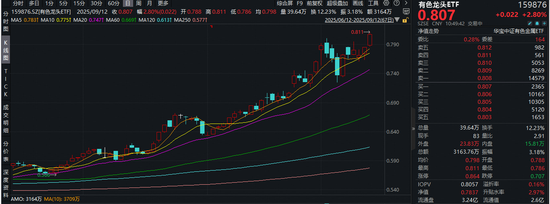
有色金属领涨两市!多重利好驱动,北方铜业等4股涨停,有色龙头ETF(159876)拉升3%刷新阶段高点!
Xin Lang Ji Jin· 2025-09-12 03:02
Group 1 - The non-ferrous metal sector is leading the market, with the non-ferrous metal ETF (159876) rising over 3.1% during trading, reaching a peak and achieving a transaction volume exceeding 310 million yuan [1] - Key stocks such as Yunnan Copper, Northern Copper, and others have hit the daily limit, while Jiangxi Copper and Yun Aluminum have increased by over 7% [1] Group 2 - In the first half of 2025, China's economy is expected to recover beyond expectations, with GDP growth reaching 5.3%, benefiting the non-ferrous metal industry [3] - The non-ferrous metal sector has experienced a strong bullish trend this year, driven by multiple favorable factors, including expectations of interest rate cuts by the Federal Reserve [3][4] - The "anti-involution" policy and large-scale infrastructure projects are creating significant demand for non-ferrous metals [3][4] Group 3 - The supply-demand dynamics are improving, with stricter regulations on rare earth mining and smelting, leading to a perception of increasing scarcity [4] - Rapid development in green industries such as new energy and electric vehicles is driving strong demand for metals like copper, aluminum, lithium, and rare earths [4] - Predictions indicate that the demand for key metals in new energy will increase sixfold by 2040 compared to 2020, with electric vehicle metal demand expected to grow at least 30 times [4] Group 4 - The current economic policies are expected to stimulate a new round of supply-side reforms, similar to the impact seen in 2015, which could lead to a recovery in the non-ferrous metal sector [4][6] - The non-ferrous metal sector is positioned to benefit from both monetary easing due to Federal Reserve rate cuts and domestic policies aimed at optimizing production factors [6] Group 5 - The non-ferrous metal sector is characterized by strategic metals like rare earths benefiting from global competition, while lithium and cobalt are influenced by the "anti-involution" logic [7] - The supply-demand balance for industrial metals like copper and aluminum is tight due to limited supply growth and emerging industry demand [7] - The non-ferrous metal ETF and its linked funds provide a diversified investment option, reducing risks associated with investing in single metal industries [7]


国泰君安期货商品研究晨报:能源化工-20250912
Guo Tai Jun An Qi Huo· 2025-09-12 02:25
1. Report Industry Investment Ratings No specific industry investment ratings are provided in the report. 2. Core Views of the Report - The report provides daily research and analysis on various energy - chemical futures, including trends, fundamentals, and trading strategies for each product [2]. - The performance of different products varies, with some in a state of shock, some showing a downward trend, and others with potential investment opportunities in spread trading [2]. 3. Summary by Related Catalogs 3.1 PX, PTA, MEG - **PX**: Oil prices are falling, and valuations are dropping again. It is recommended to take a long - short spread position between the November and January contracts. The PXN compression space may be limited, and attention should be paid to the strategy of going long on PX and short on Brent [4][12]. - **PTA**: Cost support is weak. It is advisable to take a long - short spread position between the November and January contracts. The PTA processing fee is difficult to expand, and attention should be paid to the compression of the PTA01/05 processing fee [5][12]. - **MEG**: The market is concerned about the new capacity of Yulong Petrochemical. It is recommended to take a short - long spread position between the January and May contracts. The spot price is in a weak shock state [5][13]. 3.2 Rubber - Rubber is in a wide - range shock state. The trading volume has increased, and the position of the top 20 members' net short has decreased [14][15]. 3.3 Synthetic Rubber - In the short term, it is under shock pressure, and in the medium term, it oscillates within the fundamental valuation range. Although the fundamentals face pressure, there are some positive expectations [20][23]. 3.4 Asphalt - Crude oil prices have fallen, and many regions are accelerating inventory reduction. The overall trend is neutral [24]. 3.5 LLDPE - In the medium term, it is in a shock market. Although demand is improving, the "Golden September" demand peak has not been fully realized, and the market is in a state of shock [39][40]. 3.6 PP - In the short term, it is in a shock state, and in the medium term, there is still pressure. Supply pressure will increase in the future, but short - selling at low levels should be cautious [43][44]. 3.7 Caustic Soda - It is not advisable to chase short positions. Currently, the market is in a wide - range shock, and the driving force for price increases is insufficient [47][48]. 3.8 Pulp - Pulp is in an oscillating operation state. The futures market is affected by the chemical sector, and the demand side is weak, while the international market provides cost support [52][56]. 3.9 Glass - The price of glass original sheets is stable. The market price is slightly weaker, with supply pressure increasing and demand improvement insufficient [57][58]. 3.10 Methanol - Methanol is in an oscillating operation state. The port inventory is accumulating, and the price is under pressure from the supply side, but there is also support from positive expectations and policies [60][63]. 3.11 Urea - Urea is in a weak shock state. In the short term, it is under shock pressure, and in the medium term, the trend is still weak. Export growth may not be able to make up for the weak domestic demand [65][68]. 3.12 Styrene - Styrene is bearish in the medium term. The cost center has moved down, and the short - term downward space has opened up [69][70]. 3.13 Soda Ash - The spot market for soda ash has changed little. The market is weakly stable, and prices are expected to be weakly sorted in the short term [71]. 3.14 LPG and Propylene - **LPG**: Affected by the expectation of oversupply, the night - session oil price has declined [73]. - **Propylene**: Supply and demand are tight, and spot transactions are rising [74]. 3.15 PVC - PVC is in a low - level shock state. The market has a high - production and high - inventory structure, and the export growth rate may slow down [83][85]. 3.16 Fuel Oil and Low - Sulfur Fuel Oil - **Fuel Oil**: The night - session price has weakened significantly, and the price center continues to decline [87]. - **Low - Sulfur Fuel Oil**: It follows the decline of crude oil, and the spread between high - and low - sulfur in the foreign spot market fluctuates narrowly [87]. 3.17 Container Shipping Index (European Line) - The container shipping index (European line) is under pressure. Freight rates are showing a downward trend [89].
广发期货有色日报-20250912
Guang Fa Qi Huo· 2025-09-12 01:49
1. Report Industry Investment Ratings No industry investment ratings are provided in the reports. 2. Core Views Copper - Macroscopically, a September interest rate cut is likely, but its impact on copper prices depends on the reason and background. The "stagflation - like" environment in the US restricts the rate - cut space. In the short - term, the rate - cut expectation boosts the financial attribute of copper, but the upside is limited. - Fundamentally, it shows a state of "weak reality + stable expectation". The copper demand may weaken marginally in the second half of the year, but the supply elasticity is insufficient. With the arrival of the peak season, the demand will improve marginally. Without a clear US recession expectation, copper prices will at least remain volatile, and a new upward cycle requires the resonance of commodity and financial attributes. The main contract is expected to range from 79,500 to 81,500 yuan/ton [1]. Aluminum - For alumina, the market shows a pattern of "high supply, high inventory, and weak demand". Although the short - term import of bauxite is tight, the new production capacity is continuously put into operation, and the demand from electrolytic aluminum is limited. The price is under pressure, but the downside is limited as it approaches the cost zone. It is expected to oscillate between 2,900 and 3,200 yuan/ton. - For aluminum, the macro - environment provides support, and the fundamentals are improving marginally. However, the price increase is restricted by the 20,900 - 21,000 yuan/ton range. It is expected to oscillate around the actual peak - season demand, with the main contract ranging from 20,600 to 21,200 yuan/ton [3]. Aluminum Alloy - Macroscopically, the Fed's rate - cut expectation boosts the sentiment of bulk commodities. The cost support is strong due to the tight supply of scrap aluminum. The supply is affected by uncertain tax policies, and the demand is slightly warming but needs verification. The inventory is still accumulating, and the import resources are limited. The ADC12 price is expected to remain high and volatile, with the main contract ranging from 20,200 to 20,800 yuan/ton [4]. Zinc - The US inflation data improves the rate - cut expectation and boosts zinc prices. The supply side is in an upward cycle of production resumption, and the smelting profit is repaired. The demand side is about to enter the peak season, and the global inventory is low. In the short - term, zinc prices may be driven by the macro - environment, but the upside is limited. It is expected to oscillate, with the main contract ranging from 21,500 to 23,000 yuan/ton [7]. Tin - The supply of tin ore remains tight, and the processing fees are low. The actual ore output from Myanmar is expected to be postponed to the fourth quarter. The demand is weak, and the traditional consumption decline cannot be offset by the growth in emerging fields. The spot market is divided. Tin prices are expected to remain high and volatile, with the operating range from 265,000 to 285,000 yuan/ton [9]. Nickel - The macro - environment is generally stable, and the cost provides some support. There is no obvious short - term supply - demand contradiction, but the de - stocking pace slows down. The medium - term supply is expected to be loose, restricting the upside. The price is expected to adjust within a range, with the main contract ranging from 118,000 to 126,000 yuan/ton [11]. Stainless Steel - The macro - environment is positive, with the Fed's rate - cut expectation rising and domestic policies being supportive. The raw material prices are firm, but the stainless - steel profit is in deficit, which will suppress nickel - iron. The supply is under pressure as the September production schedule is expected to increase. The demand improvement has not been significantly reflected, and the inventory reduction is slow. The price is expected to oscillate within a range, with the main contract ranging from 12,600 to 13,400 yuan/ton [13]. Lithium Carbonate - The futures market oscillates and strengthens in the afternoon with the improvement of the macro - sentiment. The fundamentals are in a tight balance. The supply is increasing slightly, and the demand is expected to increase in the peak season. The whole - chain de - stocking is accelerating. The price is expected to oscillate and consolidate, with the main contract ranging from 70,000 to 72,000 yuan/ton [15][16]. 3. Summary by Directory Copper - **Price and Basis**: SMM 1 electrolytic copper price rose to 80,175 yuan/ton, with a daily increase of 0.54%. The spot premium and other price - related indicators also changed. The refined - scrap price difference increased by 11.80% [1]. - **Monthly Spread**: The 2509 - 2510 spread increased by 40 yuan/ton [1]. - **Fundamental Data**: In August, the electrolytic copper production was 117.15 million tons, a month - on - month decrease of 0.24%. The import volume in July decreased by 1.20%. The domestic mainstream port copper concentrate inventory decreased by 3.14% week - on - week [1]. Aluminum - **Price and Spread**: SMM A00 aluminum price rose to 20,860 yuan/ton, with a daily increase of 0.53%. The alumina prices in different regions showed slight declines [3]. - **Monthly Spread**: The 2509 - 2510 spread increased by 5 yuan/ton [3]. - **Fundamental Data**: In August, the alumina production was 773.82 million tons, a month - on - month increase of 1.15%. The electrolytic aluminum production increased by 0.30%. The social inventory of electrolytic aluminum decreased by 0.16% week - on - week [3]. Aluminum Alloy - **Price and Spread**: SMM aluminum alloy ADC12 price rose to 20,960 yuan/ton, with a daily increase of 0.48%. The refined - scrap price differences in different regions increased [4]. - **Monthly Spread**: The 2511 - 2512 spread decreased by 45 yuan/ton [4]. - **Fundamental Data**: In July, the regenerative aluminum alloy ingot production decreased by 1.60%. The primary aluminum alloy ingot production increased by 1.88%. The regenerative aluminum alloy inventory increased by 33.83% week - on - week [4]. Zinc - **Price and Spread**: SMM 0 zinc ingot price rose to 22,180 yuan/ton, with a daily increase of 0.41%. The import loss increased [7]. - **Monthly Spread**: The 2509 - 2510 spread increased by 10 yuan/ton [7]. - **Fundamental Data**: In August, the refined zinc production was 62.62 million tons, a month - on - month increase of 3.88%. The import volume in July decreased by 50.35%. The galvanizing start - up rate increased by 5.98% week - on - week [7]. Tin - **Spot Price and Basis**: SMM 1 tin price rose to 271,100 yuan/ton, with a daily increase of 0.37%. The LME 0 - 3 premium decreased by 55.74% [9]. - **Monthly Spread**: The 2509 - 2510 spread decreased by 680 yuan/ton [9]. - **Fundamental Data**: In July, the tin ore import decreased by 13.71%. The SMM refined tin production increased by 15.42%. The SHEF inventory increased by 2.74% week - on - week [9]. Nickel - **Price and Basis**: SMM 1 electrolytic nickel price was 121,450 yuan/ton, a daily decrease of 0.08%. The production cost of different nickel - related products changed [11]. - **Monthly Spread**: The 2510 - 2511 spread decreased by 30 yuan/ton [11]. - **Supply - Demand and Inventory**: The Chinese refined nickel product output increased by 1.26% month - on - month. The SHFE inventory decreased by 1.87% week - on - week [11]. Stainless Steel - **Price and Spread**: The 304/2B stainless - steel price remained stable. The futures - spot price difference increased by 11.11% [13]. - **Monthly Spread**: The 2510 - 2511 spread increased by 15 yuan/ton [13]. - **Fundamental Data**: The Chinese 300 - series stainless - steel crude - steel production decreased by 3.83% month - on - month. The 300 - series social inventory decreased by 2.10% week - on - week [13]. Lithium Carbonate - **Price and Basis**: SMM battery - grade lithium carbonate price decreased to 72,850 yuan/ton, a daily decrease of 0.82%. The lithium - related raw material prices also declined [15]. - **Monthly Spread**: The 2509 - 2511 spread increased by 440 yuan/ton [15]. - **Fundamental Data**: In August, the lithium carbonate production was 85,240 tons, a month - on - month increase of 4.55%. The demand increased by 8.25%. The total inventory decreased by 3.75% [15].
广发早知道:汇总版-20250912
Guang Fa Qi Huo· 2025-09-12 01:33
1. Report Industry Investment Ratings No relevant investment ratings for the entire industries are provided in the report. 2. Core Views of the Report The overall market shows a complex and diverse situation across different sectors. In the financial derivatives market, stock index futures rose with strong performance from the technology and finance sectors, while the bond market was affected by factors such as capital supply and demand, and the performance of different - term bonds was divided. In the commodity market, the performance of various commodities was also different. For example, copper prices were affected by macro - economic factors and supply - demand fundamentals; the shipping index futures continued to decline due to weakening spot prices. In the agricultural product market, factors such as supply expectations and demand changes influenced the prices of various products. In the energy and chemical market, factors like supply and demand forecasts and macro - economic conditions affected the price trends of products such as crude oil and urea. 3. Summary by Relevant Catalogs Financial Derivatives Financial Futures - **Stock Index Futures**: On Thursday, A - share major indexes opened lower and then rose. The Shanghai Composite Index rose 1.65%, and the Shenzhen Component Index rose 3.36%. The four major stock index futures contracts all rose with the index, and the basis of the September contracts was quickly repaired. The domestic policy promotes the opening of the digital trade field, and overseas, the Bank of Japan plans to reduce its ETF holdings. The A - share market may enter a high - level shock pattern after a large increase, and it is recommended to sell near - month put options at the support level to collect premiums [2][3][4]. - **Treasury Bond Futures**: Treasury bond futures closed with a mixed performance, with long - term bonds weak and short - term bonds strong. The central bank's net investment improved the capital supply, but the impact of the increase in bond fund redemption fees and the strong stock market still suppressed long - term bonds. It is recommended that investors wait and see, pay attention to the capital supply and the release of economic data [5][6]. Precious Metals - **Gold and Silver**: The European Central Bank maintained interest rates unchanged, and the US employment market weakened. Gold showed a sideways consolidation trend, while silver strengthened. The Fed's expected policy path and geopolitical risks affected the price of precious metals. It is recommended to buy gold at low prices cautiously or sell out - of - the - money gold options. For silver, it is recommended to conduct band operations in the 40 - 42 US dollars range and sell out - of - the - money options at high volatility [7][9][10]. Container Shipping Futures (EC) - **Spot and Index**: The spot quotes of major shipping companies continued to decline slowly. As of September 8, the SCFIS European line index decreased by 11.68% month - on - month. - **Fundamentals and Logic**: The global container shipping capacity increased, and the spot price decline put downward pressure on the futures. It is expected that the spot price will continue to decline slowly, and the futures price may also decline. It is recommended to short the October contract unilaterally or conduct a spread arbitrage between the December and October contracts [12][13]. Commodity Futures Non - ferrous Metals - **Copper**: The US core CPI met expectations, and the expectation of interest rate cuts increased. The spot price of copper rose slightly, and the consumption recovery was slow. The supply of copper concentrate was tight, and the production of refined copper was expected to decline. The copper price was affected by macro - economic factors and the supply - demand relationship. It is expected to be in a sideways - to - strong trend, with the main contract reference range of 79,500 - 81,500 yuan/ton [14][15][17]. - **Alumina**: The spot price of alumina decreased slightly, and the market was in a pattern of high supply, high inventory, and weak demand. The futures price was expected to be in a sideways - to - weak trend, with the main contract reference range of 2900 - 3200 yuan/ton. It is recommended to pay attention to policy changes in Guinea and cost - profit changes [18][20]. - **Aluminum**: The spot price of aluminum rose, and the supply was at a high level while the demand showed marginal improvement. The aluminum price was supported by the macro - environment and the expectation of the peak season, but there was still pressure in the 20,900 - 21,000 yuan/ton range. It is expected to fluctuate around the actual demand in the peak season, with the main contract reference range of 20,600 - 21,200 yuan/ton [21][23]. - **Aluminum Alloy**: The spot price of aluminum alloy rose slightly. The cost was strongly supported, but the demand recovery was limited, and the inventory was in the process of accumulation. It is expected to continue to fluctuate at a high level in the short term, with the main contract reference range of 20,000 - 20,600 yuan/ton [24][26][27]. - **Zinc**: The spot price of zinc rose, and the supply was expected to be loose. The demand was approaching the peak season, and the inventory was at a relatively low level. The zinc price was expected to fluctuate, with the main contract reference range of 21,500 - 23,000 yuan/ton [27][30]. - **Tin**: The spot price of tin rose, and the supply was tight. The demand was weak, and the market was in a tight - balance pattern of "weak supply and weak demand". It is expected that the tin price will fluctuate at a high level, with the reference range of 265,000 - 285,000 yuan/ton [31][32][33]. - **Nickel**: The spot price of nickel was stable, and the supply was at a high level. The demand was relatively stable, and the inventory was at a high level overseas and increased slightly domestically. It is expected that the nickel price will adjust within a range, with the main contract reference range of 118,000 - 126,000 yuan/ton [33][34][35]. - **Stainless Steel**: The spot price of stainless steel was stable, and the cost was supported, but the demand was weak. The supply was expected to increase, and the inventory was slowly decreasing. It is expected that the stainless - steel price will fluctuate within a range, with the main contract reference range of 12,600 - 13,400 yuan/ton [37][38][39]. - **Lithium Carbonate**: The spot price of lithium carbonate decreased slightly, and the supply increased slightly. The demand was optimistic, and the inventory decreased. The lithium - carbonate price was expected to fluctuate and consolidate, with the main contract reference range of 70,000 - 72,000 yuan/ton [40][42][43]. Ferrous Metals - **Steel**: The spot price of steel was weak, and the cost of iron ore increased while the cost of coking coal decreased. The supply was at a high level, and the demand decreased seasonally. The inventory increased, and the steel price was expected to be weak. It is recommended to wait and see [44][45][46]. - **Iron Ore**: The spot price of iron ore decreased slightly, and the futures price was in a downward trend. The global shipment volume decreased, and the port inventory increased slightly. The demand from steel mills increased, and the iron - ore price was expected to be in a balanced - to - tight pattern, with the reference range of 780 - 830 yuan/ton. It is recommended to go long on the 2601 contract at low prices and conduct a spread arbitrage of long iron ore and short coking coal [48][49]. - **Coking Coal**: The spot price of coking coal was in a weak - sideways trend, and the futures price rebounded. The supply of coking coal increased, and the demand from steel mills and coking plants increased. The inventory decreased, and the coking - coal price was expected to decline in September. It is recommended to short the 2601 contract at high prices and conduct a spread arbitrage of long iron ore and short coking coal [50][52][53]. - **Coke**: The first - round price cut of coke was implemented, and the futures price rebounded. The supply of coke increased, and the demand was supported. The inventory increased, and the coke price was expected to have 2 - 3 rounds of price cuts. It is recommended to short the 2601 contract at high prices and conduct a spread arbitrage of long iron ore and short coke [54][55][56]. Agricultural Products - **Meal Products**: The domestic spot price of soybean meal fluctuated, and the trading volume decreased. The market expected the US soybean yield to be high, but the domestic cost was supported. The price of meal products was expected to have a limited downward space, and the cost support was strong in the fourth quarter [57][58][59]. - **Live Pigs**: The spot price of live pigs fluctuated, and the breeding profit decreased. The supply of live pigs was expected to increase, and the demand recovery was uncertain. The price of live pigs was expected to have limited downward space in the short term, but there was still a risk of decline in the future [60][61]. - **Corn**: The spot price of corn fluctuated, and the inventory decreased. The new - season corn was about to be listed, and the supply was expected to increase. The demand was weak, and the corn price was expected to be weak in the medium term. It is recommended to be cautious when shorting [62][63]. - **Sugar**: The international sugar price was under pressure, and the domestic sugar price was in a sideways trend. The supply of Brazilian sugar was large, and the sugar - alcohol ratio was expected to have limited upward space. The domestic demand was mainly for Mid - Autumn Festival stocking, and the sugar price was expected to be in a sideways trend. It is recommended to maintain a bearish view [65]. - **Cotton**: The US cotton was in a bottom - grinding stage, and the domestic cotton demand had no obvious increase. The new - cotton purchase drive was not clear, and the domestic cotton price was expected to fluctuate in the short term and be under pressure after the new - cotton listing [66]. - **Eggs**: The spot price of eggs rebounded slightly, but the supply pressure was still large. The inventory of laying hens was at a high level, and the demand might weaken in the second half of the week. The egg price was expected to have a limited upward space in early September and maintain a bearish view [68][69]. - **Oils and Fats**: The price of palm oil was affected by the decline in production data and the weak export. The price of soybean oil was affected by the increase in the CBOT soybean oil price and the sufficient supply. The price of palm oil was expected to test the support level, and the price of soybean oil was expected to fluctuate in a narrow range [70][71]. - **Jujubes**: The spot price of jujubes was stable, and the market supply was small. The jujube production was expected to decrease, but the double - festival stocking effect was not obvious. The jujube price was expected to fluctuate in the short term, and it is recommended to pay attention to the weather and festival effects [72][73]. - **Apples**: The early - Fuji apples were on the market, and the market was differentiated. The price of high - quality apples was stable at a high level, while the price of ordinary apples was determined by quality. The red - general apples in Shandong were still coloring, and the large - scale trading was yet to come [74][75]. Energy and Chemicals - **Crude Oil**: The international oil price declined due to concerns about long - term supply surplus and weak US demand. The supply of Russian crude oil increased, and the IEA predicted a large supply surplus in 2026. The oil price was expected to be weak in the short term. It is recommended to take a bearish view unilaterally and wait for opportunities to expand options volatility [75][76][78]. - **Urea**: The domestic spot price of urea decreased, and the supply increased while the demand was in the off - season. The inventory increased, and the international price declined. The urea price was expected to be weak, and it is recommended to wait and see, paying attention to the support level of 1630 - 1650 yuan/ton [79][80][82]. - **PX**: The spot price of PX was stable, and the supply was expected to increase while the demand was expected to be relatively stable. The PX price was expected to fluctuate in the range of 6600 - 6900 yuan/ton [83][84]. - **PTA**: The spot price of PTA was in a sideways trend, and the supply was expected to be tight in September but weak in the medium term. The demand was expected to increase slightly, and the PTA price was expected to fluctuate in the range of 4600 - 4800 yuan/ton. It is recommended to conduct a rolling reverse - spread arbitrage between TA1 and TA5 [85][86]. - **Short - Fiber**: The short - fiber price followed the raw materials, and the supply was at a high level. The demand was expected to increase slightly, but the new orders were insufficient. The short - fiber price was expected to follow the raw materials, and the processing fee was expected to fluctuate in the range of 800 - 1100 yuan/ton [87]. - **Bottle - Chip**: The bottle - chip price followed the cost, and the supply and demand were expected to decrease in September. The inventory was expected to increase, and the processing fee had limited upward space. It is recommended to follow the PTA strategy, and the main - contract processing fee is expected to fluctuate in the range of 350 - 500 yuan/ton [88][89]. - **Ethylene Glycol**: The ethylene - glycol price was in a downward trend, and the supply was expected to increase in the fourth quarter. The demand was expected to decrease after the peak season. It is recommended to pay attention to the EG1 - 5 reverse - spread arbitrage opportunity [91]. - **Caustic Soda**: The caustic - soda market was stable, and the supply was expected to decline next week. The demand from alumina plants was expected to weaken. The caustic - soda price was expected to be stable in the short term, and it is recommended to pay attention to the alumina - plant procurement rhythm and device fluctuations [92][93]. - **PVC**: The PVC price was stable, and the supply was expected to increase. The demand was weak, and the PVC price was expected to continue to be in a weak - sideways trend [94][95]. - **Pure Benzene**: The pure - benzene price had limited upward drive, and the supply was expected to be relatively loose. The demand from downstream products was weak. The pure - benzene price was expected to follow the styrene price and fluctuate at a low level [96]. - **Styrene**: The styrene price was in a low - level sideways trend, and the supply was expected to decrease in the future. The demand from downstream products increased slightly. The styrene price was expected to have a low - level support, and it is recommended to go long at a low level and expand the spread between EB11 and BZ11 [97][98]. Special Commodities - **Natural Rubber**: The natural - rubber price fluctuated at a high level, and the cost was supported. The demand was expected to increase, but the increase in production capacity might be limited. The natural - rubber price was expected to fluctuate in the range of 15,000 - 16,500 yuan/ton. It is recommended to wait and see [106][107][108]. - **Polysilicon**: The polysilicon price increased, and the supply was expected to decline slightly in September. The demand was at a low level, and the inventory decreased slightly. The polysilicon price was affected by policy expectations, and it is recommended to wait and see [108][109][110]. - **Industrial Silicon**: The industrial - silicon price increased, and the supply was expected to increase in September. The demand was relatively stable, and the inventory decreased slightly. The industrial - silicon price was expected to have a cost - side support, and it is recommended to try to go long at a low price, with the main price fluctuation range of 8000 - 9500 yuan/ton [110][111][113]. - **Soda Ash and Glass**: The soda - ash price was in a narrow - range sideways trend, and the supply was at a high level while the demand was in a rigid - demand pattern. The glass price was affected by production - line news, and the inventory decreased. The soda - ash price is recommended to be shorted on the rebound, and the glass price is recommended to wait and see [114][115][116].
本刊由金信期货研究院撰写:金信期货日刊-20250912
Jin Xin Qi Huo· 2025-09-12 01:17
Group 1: Report Overview - Report date: September 12, 2025 [1] - Report issuer: GOLDTRUST FUTURES CO., LTD [2] Group 2: Hotspot Focus - Coking Coal - Price movement: On September 11, 2025, coking coal futures closed up 26.0 yuan, a 2.33% increase, at 1141 yuan [2] - Fundamental situation: Tighter safety inspections in Shanxi may limit production release, but steel mill profits have limited recovery, hot metal production is at a medium - low level, coke demand is insufficient, and coking plants have high inventories and low procurement willingness [2] - News situation: Coal mine supply disruptions may last until around National Day, downstream procurement of coking coal and coke has slowed, and speculative demand has weakened. Overall, carbon element supply is still abundant, with an expected recovery in downstream hot metal [3] - Investment suggestion: Coking coal and coke prices are greatly disturbed by the "anti - involution" policy expectations, with high volatility. Seize the opportunity of an oscillating upward trend [3] Group 3: Technical Analysis - Stock Index Futures - Market situation: Consumption policies continue to take effect, with the core CPI up 0.9% year - on - year in August. Six departments are jointly rectifying the "black public relations" and "口水战" chaos in the auto industry. The A - share market opened slightly lower and then rose rapidly, closing with a large positive line [7][8] - Investment suggestion: It is expected that the market will continue to oscillate upward in the short term [7] Group 4: Technical Analysis - Gold - Market situation: The US non - farm payrolls data in August still fell short of expectations, increasing the probability of a Fed rate cut in September, which is positive for gold. The weekly adjustment is relatively sufficient [12] - Investment suggestion: Gold prices are expected to continue rising in the short term [12] Group 5: Technical Analysis - Iron Ore - Market situation: Supply shipments are stable. Steel mills are showing signs of resuming production, and hot metal is expected to remain at a high level. As the National Day approaches in the middle and late months, steel mills may start restocking [16] - Investment suggestion: Restocking may support raw materials. Technically, it is still in a high - level wide - range oscillation range, and pay attention to the breakthrough situation [15] Group 6: Technical Analysis - Glass - Market situation: Daily melting is basically stable, factory inventories continue to accumulate, and the recovery of downstream deep - processing orders is insufficient. Pay attention to restocking as the peak season approaches [20] - Investment suggestion: Technically, it had a narrow - range consolidation today. It can be viewed with a low - buying strategy [19] Group 7: Technical Analysis - Palm Oil - Market situation: The oil market has had a large cumulative increase recently. With rising inventory pressure and lack of demand support, the motivation for further chasing up has declined, and the pressure for profit - taking has increased [23] - Investment suggestion: Treat it with an oscillating downward view [23] Group 8: Technical Analysis - Pulp - Market situation: Pulp prices in Shandong remained stable today. Port inventories started to decline slightly and are at a medium - high level. There are expectations of a boost before the Mid - Autumn Festival peak season, but no improvement has been seen yet [26] - Investment suggestion: Maintain the view of low - level oscillation and suggest short - term long positions [26]
时报观察|债市延续震荡格局 投资者应保持定力
证券时报· 2025-09-12 00:30
近期国债市场出现一轮下跌行情,国债期货主力合约11日盘中再创近6个月以来新低,且30年 期国债期货加权指数距离年内新低仅一步之遥。同时,10年期国债活跃券收益率已升至1.8%以 上,Shibor利率品种集体上行。 这一波调整,从7月初至今,10年期国债活跃券收益率从1.63%上涨到最高1.83%,两个月时间上涨20个基 点,幅度不低,且1.80%是一个重要关口。这让债券投资者原来不如预期的收益率变得更加岌岌可危,担忧情 绪蔓延。 截至9月11日,中证综合债券指数(全部债券)今年以来累计收益仅为0.33%。刚刚过去的8月份,被动指数 型债券基金、中长期纯债型基金的平均净值均告负。 与以往债市调整不同,此次债市调整存在两大主因。一是股票市场持续走牛,赚钱效应不断释放,显著推升了 投资者的风险偏好,部分原本配置债券的资金随之流向权益市场,对债市形成直接分流压力;二是"反内卷"相 关政策逐步落地,政策预期持续升温,间接带动市场通胀预期抬头,进一步削弱了债券资产的配置吸引力。 往后看,本轮权益市场的风险偏好升温可能仍将继续,破除"内卷"已成为当前和未来一段时间的政策重心。在 这一政策预期下,沪深两市成交额连续76个交易 ...

天风证券晨会集萃-20250912
Tianfeng Securities· 2025-09-11 23:44
Group 1 - The report highlights the impact of the "Federal Reserve independence shock" on the U.S. economy, emphasizing direct and indirect interference with the Fed's operations [3] - It suggests that the traditional economic tools to suppress inflation may be compromised, potentially leading to a "re-inflation" scenario in the U.S. economy [3] - The report indicates that the dollar's status as a reserve currency and the credibility of U.S. institutions may be affected, with commodity markets, especially precious metals, likely benefiting from global investment diversification trends [3] Group 2 - The report discusses the August inflation data, noting a negative CPI of -0.4% and a narrowing PPI decline of -2.9%, indicating a divergence in inflation trends [5][25] - It points out that the core CPI has shown resilience, with a continuous increase over four months, reflecting a mild recovery in domestic demand [5][25] - The report emphasizes that the negative inflation implies a passive rise in real interest rates, which may prompt the central bank to lower financing costs for the real economy [5][25] Group 3 - The report on Hangzhou Oxygen Plant (杭氧股份) indicates a steady performance in H1 2025, with revenue of 73.27 billion and a net profit of 4.79 billion, reflecting a year-on-year growth of 8.92% and 9.61% respectively [19][40] - It highlights the industrial gas segment's revenue growth of 14% and a gross margin of 21.18%, suggesting a potential bottom reversal in the industrial gas market [19][41] - The equipment segment shows promising results, with a significant increase in orders for petrochemical equipment, indicating successful overseas expansion [19][42] Group 4 - The report on Youyou Green Energy (优优绿能) emphasizes the company's focus on high-power charging modules, projecting revenues of 13.5 billion, 16.2 billion, and 19.5 billion for 2025-2027, with a net profit forecast of 2.0 billion, 3.0 billion, and 4.1 billion respectively [11][35] - It notes the strong overseas market performance, with a gross margin of 50.2% for international sales, significantly higher than domestic margins [11][33] - The report highlights the company's commitment to R&D, with a focus on product innovation and a high R&D expense ratio compared to sales and management costs [11][34] Group 5 - The report on Longxin General (隆鑫通用) indicates a robust performance in H1 2025, with revenue of 97.52 billion and a net profit of 10.74 billion, marking a year-on-year increase of 27.21% and 82.26% respectively [12][36] - It highlights the successful overseas expansion of the "Wuji" brand, with significant growth in sales and a strong marketing presence across various platforms [12][37] - The report projects an upward revision of profit forecasts for 2025-2027, estimating net profits of 19.06 billion, 23.07 billion, and 27.13 billion, reflecting the company's strong growth trajectory [12][39]



债市延续震荡格局 投资者应保持定力
Sou Hu Cai Jing· 2025-09-11 22:10
Group 1 - The recent decline in the national bond market has led to the main contract of bond futures hitting a six-month low, with the 30-year bond futures weighted index nearing its yearly low [1] - The yield on the 10-year active bond has risen above 1.8%, increasing from 1.63% to a peak of 1.83% over two months, marking a 20 basis points rise [1] - The cumulative yield of the China Securities Comprehensive Bond Index for the year is only 0.33%, with passive index bond funds and medium-to-long-term pure bond funds showing negative average net values in August [1] Group 2 - The current adjustment in the bond market is driven by two main factors: the continuous bull run in the stock market, which has increased investor risk appetite, and the implementation of anti-involution policies that have raised inflation expectations [1] - The equity market's rising risk appetite is expected to continue, with the Shanghai and Shenzhen stock exchanges seeing over 10 trillion yuan in trading volume for 76 consecutive trading days [2] - Despite the bullish expectations, the real economy still requires further improvement, with weak demand in real estate and exports limiting the upward pressure on prices [2]