
风险偏好

Search documents
经济回升信号还不明显,为何风险偏好回升明显?红利反弹是暂时的吗?
Sou Hu Cai Jing· 2025-10-31 05:31
Group 1 - The current market exhibits seemingly contradictory phenomena: weak economic data but a rebound in risk appetite and dividends, raising questions about the sustainability of this trend [1] - Historical downturns with internal industry cycles have limited overall impact, but when combined with balance sheet contractions, the effects can be more severe and prolonged [1] - Recent targeted policies, including large-scale debt restructuring and fiscal measures to stabilize consumption and capital markets, have helped mitigate potential "balance sheet recession" risks [1] Group 2 - Investors recognize that the worst periods are being supported by policy measures, leading to a decrease in systemic risk and a recovery in risk appetite, indicating a new trend rather than a temporary rebound [2] - The appeal of dividend assets during economic downturns as safe havens is shifting, with a re-evaluation of stable high-dividend assets driven by both risk reduction and value reassessment [2] - Current policies aimed at economic recovery and cash flow stabilization enhance the sustainability of cash flows behind dividend-paying companies [2]
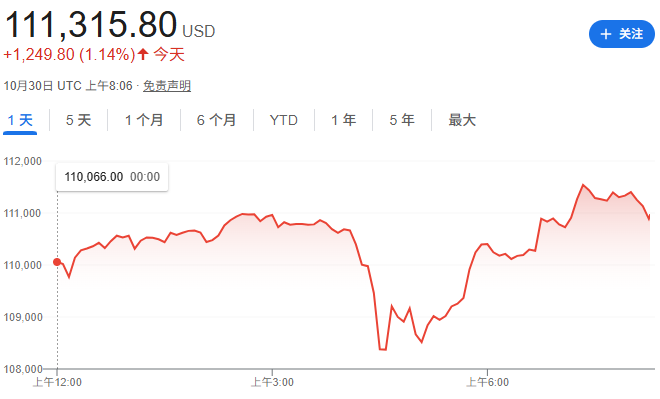
鲍威尔鹰派发言重挫比特币:一度失守10.8万美元后艰难收复11万
智通财经网· 2025-10-30 08:27
Core Viewpoint - Bitcoin experienced a decline following hawkish comments from Federal Reserve Chairman Jerome Powell, dropping 3.1% to below $108,000, before recovering slightly to trade around $111,315 [1][3]. Group 1: Federal Reserve Impact - The Federal Reserve announced a 0.25 percentage point cut in the benchmark interest rate to 3.75%-4%, marking the second consecutive rate cut, but Powell cautioned against assuming further cuts in the future [3]. - Following Powell's remarks, the probability of a 25 basis point cut in December dropped from nearly 100% to about 60% [3]. - Powell's comments triggered risk-off sentiment in the market, impacting Bitcoin's performance despite some gains in tech stocks [3]. Group 2: Market Dynamics - Bitcoin's decline accelerated after the U.S.-China summit, although selling pressure eased quickly, indicating mixed market reactions [3]. - The overall cryptocurrency market remains bearish, with Bitcoin's decline for the week at 4%, reflecting uncertainty about liquidity conditions and risk appetite [4]. - Despite the bearish trend, there are signs of recovering optimism, as the long-to-short ratio for Bitcoin has risen above 2.0, and open interest increased from $34 billion to $35 billion, suggesting traders are increasing leveraged positions in anticipation of a rebound [4]. Group 3: Technical Analysis - Technically, the 4-hour and daily RSI readings remain in bearish territory, indicating that corrections may not be fully over [4]. - For Bitcoin to sustain a recovery, it must break through the resistance cluster formed by the 20, 50, and 100 EMA around $112,000, which could shift short-term sentiment to bullish [4]. - Conversely, if momentum weakens again, the next downside target would be last week's low of $106,600, while a successful rebound could see prices return to $116,000 or even $118,000 with increased buying support [4][5].

富格林:套路虚假抨击曝光 联储决议指引金价走向
Sou Hu Cai Jing· 2025-10-29 07:25
Group 1: Gold Market Dynamics - The price of spot gold experienced significant volatility, reaching a low of $3,886.51, the lowest level since October 6, due to optimistic sentiments surrounding US-China trade negotiations, which diminished gold's appeal as a safe-haven asset [1][4] - On October 28, spot gold fell to a three-week low, dropping 0.73% to close at $3,952.71 per ounce, influenced by improved trade outlooks [1][4] - The recent progress in US-China trade talks, including a framework agreement on soybean purchases and a pause on rare earth export controls, has led to a decrease in gold prices as investors preferred to sell gold [4][6] Group 2: Inflation and Federal Reserve Policy - The US Consumer Price Index (CPI) for September rose by 3% year-on-year, indicating that inflation remains above target levels, providing room for "moderate rate cuts" [3] - Market expectations for a 25 basis point rate cut in October and another in December have been largely priced in, limiting direct support for gold prices [3] - The Federal Reserve's internal divisions regarding the pace of rate cuts and the potential impact of political pressure from President Trump on interest rates are key factors influencing market sentiment [3] Group 3: Geopolitical Factors - The recent escalation of conflict in Gaza, following Israel's military actions against Hamas, has added to geopolitical tensions, which traditionally support gold prices [5][6] - Despite the current pressures on gold prices, long-term factors such as geopolitical risks, inflation expectations, and monetary policy uncertainties continue to support gold's attractiveness [8] Group 4: Technical Analysis and Market Sentiment - The recent drop in gold prices below $4,000 triggered technical sell-offs, with significant stop-loss orders being activated, leading to rapid declines [8] - If gold can reclaim and maintain the $4,000 level, it would signal a strong bullish trend; otherwise, continued trading below this level may indicate a short-term top has formed [8] - Investors are advised to monitor the Federal Reserve's upcoming rate decision and the outcomes of the US-China summit for potential market direction [8]

Commodity wrap: gold, crude tumble on easing trade tensions; copper near record highs
Invezz· 2025-10-28 13:20
Group 1 - Gold prices continued to decline as easing trade tensions increased investor risk appetite, negatively impacting the demand for gold [1] - Oil prices fell by over 1%, marking a third consecutive day of decline, indicating a potential shift in market dynamics [1]

金荣中国:现货黄金仍有承压表现,目前暂交投于4009美元附近
Sou Hu Cai Jing· 2025-10-28 09:11
Fundamental Analysis - Gold prices experienced a significant drop, reaching a low of $3971.38 per ounce on October 27, marking a 3.2% decline for the day, closing at $3981.80 [1] - The decline in gold prices is attributed to reduced safe-haven demand due to easing U.S.-China trade tensions and complex expectations regarding the Federal Reserve's interest rate decisions and global economic outlook [1][3] - The U.S. dollar index fell by 0.11% to 98.84 on October 27, but gold prices did not benefit from this weakness, indicating a more pronounced decline in safe-haven demand [1] - The U.S. 10-year Treasury yield rose slightly to 3.997%, reflecting increased risk appetite among investors following positive developments in U.S.-China trade negotiations [3] - A framework agreement was reached between U.S. and Chinese negotiators, which includes provisions for China to purchase U.S. soybeans and a pause on rare earth export controls [3] - U.S. Treasury Secretary Mnuchin confirmed a preliminary consensus on suspending higher tariffs, boosting market confidence and leading to record highs in major U.S. stock indices [4] - The market anticipates a 98% probability of a 25 basis point rate cut by the Federal Reserve, which has already been priced in, limiting its direct support for gold prices [4][5] - Despite short-term pressures on gold prices, long-term factors such as geopolitical risks, inflation expectations, and monetary policy uncertainties continue to support gold's appeal [5] Technical Analysis - On the daily chart, gold prices closed with a bearish candle, indicating potential continued downward pressure, with a recent low of $3970 suggesting a test of the $3900 level may occur [8] - Short-term price movements have shown a negative trend after retreating from a high of $4380, with recent lows around $3970 indicating a possible stabilization [8] Trading Strategy - Short positions are recommended near $4080 with a stop loss at $4095 and targets set at $4035 and $4005 [9] - Long positions are suggested near $3985 with a stop loss at $3970 and targets at $4030 and $4080 [9]

美联储降息之后中国央行为何“按兵不动”?
Sou Hu Cai Jing· 2025-10-28 08:26
Core Viewpoint - The Federal Reserve has initiated a rate cut cycle, reducing the federal funds rate target range by 25 basis points to 4.00%-4.25%, which may influence the People's Bank of China (PBOC) to consider similar actions in the context of China's economic conditions and expectations for lower interest rates [1][2]. Group 1: Economic Context - China's total social financing reached 433.66 trillion yuan, increasing the demand for a rate cut among economic entities and individuals [1]. - The PBOC has maintained the Loan Prime Rate (LPR) stable at 3.00% for one year and 3.50% for five years, with no adjustments for four consecutive months since May [1][2]. Group 2: Banking Sector Challenges - The net interest margin (NIM) of the banking sector has been under pressure, dropping to 0.947% in Q1 2025, the lowest in history, while the non-performing loan ratio exceeded 1% [2]. - The ability of banks to cover risk costs has diminished, with the NIM's coverage of non-performing loans falling from 120.2% in 2021 to 94.7% in Q1 2025 [2]. Group 3: Monetary Policy Constraints - The PBOC's decision to hold rates steady is influenced by the dual pressures of declining asset yields and intensified competition on the liability side, leading to a significant reduction in risk appetite within the financial system [3]. - Recent market interest rate trends and fiscal policy execution have created technical constraints on the PBOC's ability to lower rates, with long-term rates rising and indicating tighter liquidity expectations [4]. Group 4: Capital Flows and Exchange Rate Pressures - The inverted yield curve between Chinese and U.S. bonds has raised concerns about capital outflows, with estimates suggesting a net outflow of $100-120 billion in the first half of 2025 [5]. - The PBOC faces pressure to maintain exchange rate stability, as further rate cuts could exacerbate capital outflow risks and weaken the yuan [5][6]. Group 5: Future Policy Considerations - The PBOC is likely to consider a rate cut in late October, potentially aligning with the outcomes of the upcoming 20th Central Committee meeting, which may signal new economic policy directions [7]. - The need to achieve the annual economic growth target of around 5% and to stimulate domestic demand and stabilize the real estate market will add pressure for future monetary easing [6][7].
广发早知道:汇总版-20251028
Guang Fa Qi Huo· 2025-10-28 01:56
Report Industry Investment Rating No relevant information provided. Core Viewpoints of the Report The report analyzes the market conditions of various financial and commodity futures, including financial derivatives (financial futures, precious metals), shipping indices, and multiple commodity futures (non - ferrous metals, black metals, agricultural products, energy chemicals, etc.). It provides insights into market trends, influencing factors, and offers corresponding operation suggestions based on the analysis of each sector. Summary by Directory Financial Derivatives Financial Futures - **Stock Index Futures**: The macro sentiment improved, and stock indices rose across the board. A - shares opened higher and increased in volume. The four major stock index futures rose with the index, and the basis premium narrowed. The market was boosted by domestic economic data and Sino - US trade talks. It is recommended to try light - selling put options at support levels or construct bullish call spreads [2][3][4]. - **Treasury Futures**: The expectation of loose monetary policy strengthened, and the futures were expected to rise. Although the futures closed down, the speech at the Financial Street Forum released a signal of loose money. It is expected that the futures will open higher, and it is recommended to go long on dips and pay attention to the cash - and - carry arbitrage strategy [5][6][7]. Precious Metals - **Gold and Silver**: The risk - aversion sentiment subsided, and the market awaited the Fed's decision. The prices of gold and silver fell. In the short term, the market may be volatile, but in the long term, precious metals are expected to have a bull market. It is recommended to buy gold at low prices below $4000 [8][9]. Shipping Index - **Container Shipping Index (European Line)**: The futures market was volatile and declined, mainly affected by the reduction of quotations by MSC. However, the SCFIS European line index continued to rise, so a cautious bullish attitude is maintained. It is recommended to go long on the December contract on dips [12][13]. Commodity Futures Non - Ferrous Metals - **Copper**: Sino - US reached a preliminary consensus, and copper prices reached a new high. The macro environment and supply - demand fundamentals supported the price increase. It is recommended to focus on the support at around 86,000 yuan [13][14][17]. - **Alumina**: The spot trading activity increased, but the short - term oversupply situation was difficult to change. The supply was abundant, while the demand was weak. It is expected that the price will be under pressure, and the main contract will fluctuate between 2,750 - 2,950 yuan [17][18][19]. - **Aluminum**: The price was strong, and the spot discount widened. The macro environment was mixed, and the fundamentals were in a tight balance. It is expected that the price will remain in a strong and volatile range of 20,800 - 21,400 yuan [20][21]. - **Aluminum Alloy**: The price followed aluminum and was volatile and strong. The cost support was obvious, and the supply - demand was in a tight balance. It is recommended that the main contract operate in the range of 20,300 - 20,900 yuan [22][23]. - **Zinc**: The price rose slightly due to the squeeze on LME zinc and macro - level benefits. The supply was loose but the subsequent increase might be limited, and the demand was stable. It is expected to be in a range of 21,800 - 22,800 yuan [24][25][27]. - **Tin**: Supported by strong fundamentals, the price was strong. The supply was tight, and the demand was weak. It is recommended to wait and see, and the price is expected to be in a wide - range fluctuation [27][29][30]. - **Nickel**: The price was volatile, and the fundamentals were weak during the policy window period. The production was high, the demand was average, and the inventory was increasing. It is expected to fluctuate in the range of 120,000 - 128,000 yuan [30][31][32]. - **Stainless Steel**: The price was mainly volatile, and the fundamentals were weak. The raw material cost support was weakening, the supply was increasing, and the demand was not significantly boosted. It is expected to operate in the range of 12,500 - 13,000 yuan [34][35][36]. - **Lithium Carbonate**: The price was strong, and the strong demand was gradually realized. The supply - demand gap was expanding in the peak season. It is expected to run strongly, and the main contract is recommended to operate in the range of 80,000 - 84,000 yuan [37][38][41]. Black Metals - **Steel**: The apparent demand for steel recovered, and the price rose with coking coal. The cost was supported, the supply was affected by environmental protection, the demand was expected to be supported by policies, and the inventory decreased. It is recommended to hold long positions and pay attention to the previous high pressure [42][43][44]. - **Iron Ore**: The price rebounded. The supply and demand situation was complex, with the decline in arrivals and the increase in inventory. It is recommended to go long on the 2601 contract on dips and engage in the 1 - 5 positive spread arbitrage [45][46]. - **Coking Coal**: The price of coking coal was strong, and the downstream replenishment demand recovered. The supply decreased, and the demand had replenishment needs. It is recommended to go long on the 2601 contract on the short - term and engage in the long - coking - coal and short - coke arbitrage [47][48][49]. - **Coke**: The second - round price increase was proposed. The cost was supported, the supply decreased, the demand was weak, and the inventory was moderately reduced. It is recommended to go long on the 2601 contract on dips and engage in the long - coking - coal and short - coke arbitrage [50][51][52]. Agricultural Products - **Meal Products**: Sino - US relations improved, and near - month soybeans had cost support. The price of domestic soybean meal decreased slightly, and the cost of imported soybeans was supported. It is expected that the domestic soybean meal will be on a strong trend [53][54][55]. - **Pigs**: The secondary fattening boosted the price of pigs. The spot price rose, and the market demand improved. However, there will be an increase in the number of pigs to be slaughtered in November and December. It is recommended to exit the arbitrage position and re - enter after the spot price stabilizes [56][57]. - **Corn**: The supply pressure remained, and the price was weak and volatile. The supply was abundant, the demand was mainly for rigid needs, and the price was affected by the selling rhythm of farmers and policy support [58][59].
爱华中文官网: 美国主要指数扩大了涨势 美元指数走软
Sou Hu Cai Jing· 2025-10-27 08:12
Core Insights - The U.S. stock market has shown an upward trend, driven by a slight easing in inflation concerns and strong earnings from major companies [3][5][11] Market Drivers - Inflation has slightly slowed, with the U.S. Consumer Price Index (CPI) year-over-year at 3.0%, below the expected 3.1%, raising hopes that the Federal Reserve may pause its rate hikes [3][11] - Strong earnings from several large-cap stocks have further supported market optimism [3] - WTI crude oil prices remain stable above $61 per barrel, maintaining a positive sentiment in the energy sector without reigniting inflation fears [3][11] Volatility and Yield - The VIX index has decreased by 5.38%, indicating a reduction in risk aversion among investors [4][15] - The 10-year Treasury yield is stable at 4.043%, reflecting a balance between stock and bond liquidity [6] Top Stock Movers - Ford has seen a significant increase of 11.92% due to strong electric vehicle sales and optimistic guidance [8] - Western Union's stock rose by 10.07% driven by robust remittance volumes [9] - Coinbase experienced a 9.57% increase attributed to rising cryptocurrency inflows [10] Commodity Insights - WTI crude oil is priced at $61.50 per barrel, stabilizing after a recent surge driven by sanctions [13] - Gold is trading at $4,137.80 per ounce, supported by weak inflation data and stable dollar conditions [13] Other Key Areas - The Federal Reserve is expected to clarify its interest rate path following recent CPI data, with several officials scheduled to speak this week [16] - Earnings reports from major tech companies may test market sentiment resilience [16] - Month-end liquidity flows could cause short-term distortions in the market [16]

通胀高企强化日本央行加息预期
Jin Tou Wang· 2025-10-27 07:27
Group 1 - The Japanese yen has depreciated against the US dollar for seven consecutive days, reaching a two-week low, with the latest USD/JPY rate at 153.0100, up 0.10% [1] - Japan's service industry inflation rose again in September, with the Producer Price Index accelerating from 2.7% in August to 3.0%, reinforcing expectations for a potential interest rate hike by the Bank of Japan (BoJ) [1] - The new Japanese Prime Minister, Fumio Kishida, is seen as a successor to former Prime Minister Shinzo Abe's economic policies, raising concerns about Japan's fiscal health and limiting aggressive bullish bets on the yen [1] Group 2 - Investors are cautious ahead of key meetings from the Federal Reserve (Fed) and BoJ, with short-term focus on resistance at 153.25 and support at 152.65 [2] - From a technical perspective, a sustained buy above the 153.25-153.30 range could trigger further bullish momentum for USD/JPY, potentially targeting levels up to 155.00 [3] - Immediate support is noted at the 152.65 level, with a potential drop below this level leading to further declines towards 152.00 and possibly 151.10-151.00 [3]
Gold’s Pause is Bitcoin’s Pulse as Risk Appetite Returns Ahead of the Fed Week
Yahoo Finance· 2025-10-26 14:00
Gold’s record-breaking run took a breather this week, snapping an eight-week winning streak as traders took profits ahead of the Federal Reserve’s October policy decision. The retreat has eased safe-haven demand and, for the first time in weeks, tilted some attention back toward risk assets including bitcoin (BTC). Spot gold fell more than 6% from its all-time high above $4,380/oz touched on Monday, settling near $4,120 by the weekend. The pullback was driven by profit-taking, heavy exchange-traded fund ...