
货币政策

Search documents
2025年社融规模增量超35万亿元,12月末M2同比增长8.5%
Sou Hu Cai Jing· 2026-01-15 07:21
Core Insights - The central bank reported that the total social financing scale increased by 3.34 trillion yuan year-on-year, reaching 35.6 trillion yuan in 2025 [2][3] Monetary Policy and Financing - The broad money supply (M2) reached 340.29 trillion yuan at the end of December 2025, reflecting an 8.5% year-on-year growth [1][3] - The total social financing stock at the end of 2025 was 442.12 trillion yuan, with a year-on-year increase of 8.3% [1][2] - The balance of RMB loans to the real economy was 268.4 trillion yuan, growing by 6.3% year-on-year [1][2] Loan and Deposit Trends - RMB loans to the real economy increased by 15.91 trillion yuan, although this was a decrease of 1.13 trillion yuan compared to the previous year [3][6] - Total RMB deposits increased by 26.41 trillion yuan in 2025, with household deposits rising by 14.64 trillion yuan [4][6] - Foreign currency deposits reached 1.07 trillion USD at the end of December, marking a 25% year-on-year increase [5] Government and Corporate Financing - Government bonds saw a net financing of 13.84 trillion yuan, which is an increase of 2.54 trillion yuan year-on-year [3] - Corporate bonds had a net financing of 2.39 trillion yuan, up by 482.5 billion yuan compared to the previous year [3] Currency and Interest Rates - The average weighted interest rate for interbank RMB market lending was 1.36% in December, lower than both the previous month and the same month last year [7] - The total transaction volume in the interbank RMB market reached 2180.31 trillion yuan for the year, with a daily average transaction of 8.79 trillion yuan [7] Foreign Exchange Reserves - The national foreign exchange reserves stood at 3.36 trillion USD at the end of December 2025 [8] Cross-Border Transactions - The total amount of cross-border RMB settlements under the current account reached 17.86 trillion yuan in 2025 [9]
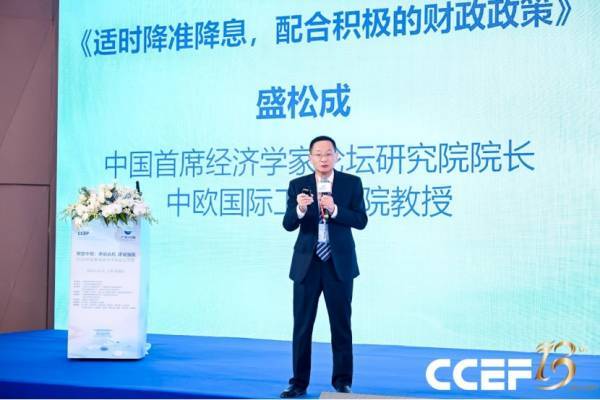
盛松成:为什么说现在降准比降息更重要?
Sou Hu Cai Jing· 2026-01-15 05:54
Core Viewpoint - The main theme of the speech is the necessity of timely reductions in reserve requirements and interest rates, complemented by proactive fiscal policies [1][3]. Group 1: Monetary Policy - The likelihood of a "small step" approach in monetary policy is high, as it requires a cautious attitude in the face of complex uncertainties [3]. - The transmission mechanism of monetary policy is complex and involves a longer path, with the central bank unable to precisely control each link in the chain [4]. - The central bank's toolbox for monetary policy is becoming increasingly rich, with various liquidity support tools and market operations being utilized to stabilize short-term market fluctuations [4][5]. Group 2: Reserve Requirement vs. Interest Rate - Reducing reserve requirements (RRR) is preferred over lowering interest rates, as RRR increases the funds available to commercial banks, aligning better with proactive fiscal policies [5][6]. - The majority of government bonds and local government debts are held by commercial banks, making RRR a more effective tool for ensuring efficient coordination between fiscal and monetary policies [5][6]. - Since 2016, the statutory reserve requirement ratio has been adjusted 23 times, all of which have been reductions, indicating a focus on liquidity release [7]. Group 3: Interest Rate Dynamics - There is still some room for interest rate reductions, but the foundation for sustained large-scale cuts is lacking due to low interest elasticity in consumption and investment [8][9]. - The current low inflation levels provide a basis for interest rate cuts, with CPI growth at 0.2% in 2024 and PPI experiencing negative growth for 39 consecutive months [9]. - The central bank's structural monetary policy tools are designed to optimize credit structure and support sectors like technology innovation and real estate, with a significant amount of funding allocated to these areas [9][10]. Group 4: Economic Outlook - The expectation is for a gradual reduction in reserve requirements and interest rates over the next two years, with the core goal being to guide the economy towards stability and improvement [10]. - The current economic situation is approaching a cyclical bottom, with prospects for gradual recovery, emphasizing the need for fiscal policy to take the lead while monetary policy supports this effort [10].

【新华解读】2025年四季度全球央行货币政策观察:全球央行分道扬镳 日本央行加息搅动全球政策格局
Sou Hu Cai Jing· 2026-01-15 05:05
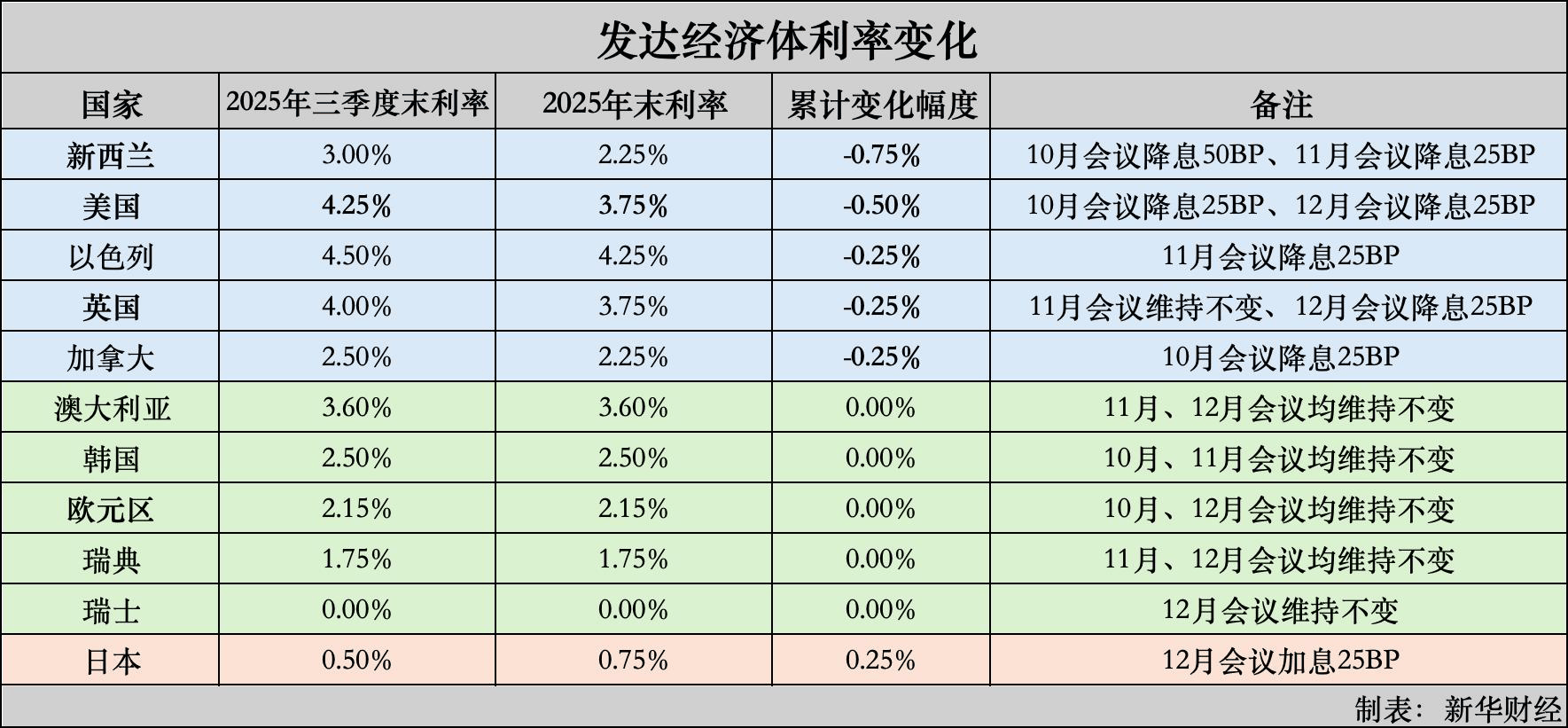
Core Viewpoint - The global monetary policy landscape is increasingly divergent, with major central banks adopting different stances on interest rates as they navigate economic stability, inflation, and employment concerns. The Federal Reserve and New Zealand are expected to implement significant rate cuts, while the Bank of England and the European Central Bank are likely to proceed cautiously or maintain current rates [1][12]. Group 1: Developed Economies Interest Rate Changes - As of the end of 2025, New Zealand's interest rate decreased from 3.00% to 2.25%, a reduction of 0.75% [3] - The U.S. Federal Reserve lowered its rate from 4.25% to 3.75%, a decrease of 0.50% [3] - The Bank of England reduced its rate to 3.75%, marking a cumulative decline of 0.25% [5] - The European Central Bank maintained its rates at 2.15%, showing no change [3][6] - Japan's central bank raised its rate from 0.50% to 0.75%, an increase of 0.25%, becoming the only major central bank to hike rates during this period [2][4] Group 2: Emerging Markets Interest Rate Changes - Turkey's central bank cut its rate from 40.50% to 38.00%, a reduction of 2.50% [8] - Russia's rate decreased from 17.00% to 16.00%, a drop of 1.00% [8] - Mexico's rate was lowered from 7.50% to 7.00%, a decrease of 0.50% [10] - South Africa and India both reduced their rates by 25 basis points, bringing them to 6.75% and 5.25%, respectively [9] - Several emerging market central banks, including Brazil and Indonesia, opted to keep their rates unchanged [10][11] Group 3: Future Monetary Policy Outlook - In the first quarter of 2026, the Federal Reserve may slow its rate-cutting pace after several reductions, influenced by fiscal expansion policies [12][13] - The European Central Bank is expected to maintain a neutral stance, with no immediate plans for rate changes [12][14] - The Bank of England's future rate decisions will be cautious, reflecting internal disagreements on the appropriate level of interest rates [14] - Emerging market central banks are likely to adopt varied strategies based on their unique inflation and growth conditions, with some, like Mexico and Turkey, potentially considering further rate cuts [12][14]
韩国央行行长罕见量化加息幅度 称稳汇率或需加息200–300基点
Xin Hua Cai Jing· 2026-01-15 05:04
新华财经北京1月15日电韩国央行行长李昌镛15日就货币政策与外汇市场形势发表系列讲话,明确指 出:若试图通过政策利率手段稳定外汇市场,"利率必须上调约200至300个基点",即从当前2.50%升至 4.5%–5.5%区间。 针对房地产市场,李昌镛重申:"不认为仅靠更高的利率就能平息房价上涨",暗示需依赖财政与监管等 非货币政策工具应对楼市风险。 在外汇干预方面,李昌镛透露,国民年金公团(NPS)近期已配合外汇当局开展对冲操作以稳定市场, 并感谢福利部协同合作。但他亦警告,散户投资者海外股票购买再度增加,叠加"韩国有很多人愿意借 出美元,但很少有人愿意出售"的结构性问题,加剧了本币贬值压力。 此外,李昌镛表示,若外汇市场持续不稳定,"韩国央行不会同意每年向美国流出200亿美元的投资资 金",并称政府将于当日稍晚就美韩贸易协议及外汇市场发布联合声明。他呼吁采取"临时措施与长期解 决方案并重"的策略应对汇率波动,并强调"有必要改变市场对韩元将进一步贬值的预期"。 (文章来源:新华财经) 李昌镛的此番表态凸显韩元持续贬值对货币政策构成的潜在压力。 李昌镛强调,近期韩元兑美元汇率一度跌至1470,虽"远未反映韩国经济基 ...
央行释放新信号!本月第二次大手笔操作→
Xin Lang Cai Jing· 2026-01-15 03:58
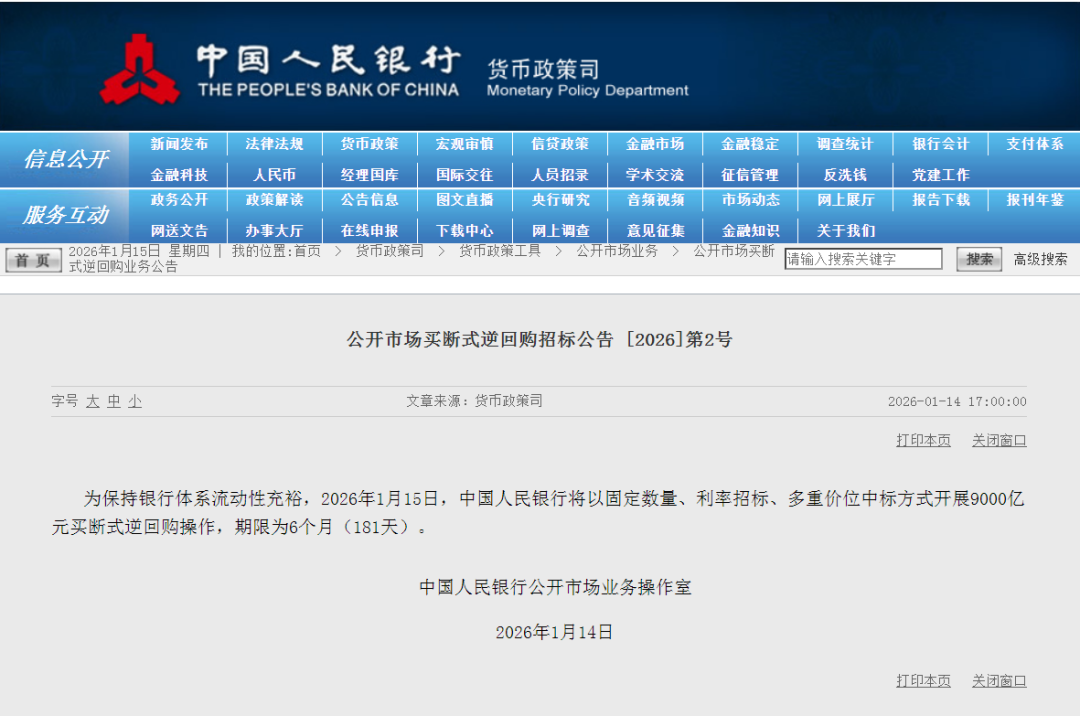
Core Viewpoint - The People's Bank of China (PBOC) is continuing its policy of maintaining ample liquidity in the banking system through a series of reverse repo operations, with a significant operation of 900 billion yuan scheduled for January 15, 2026 [1][4]. Group 1: Reverse Repo Operations - On January 14, 2026, the PBOC announced a 900 billion yuan reverse repo operation with a term of 6 months, utilizing a fixed quantity, interest rate bidding, and multiple price levels [1]. - This operation marks the second reverse repo conducted by the PBOC in January, following an earlier operation of 1.1 trillion yuan for a 3-month term on January 8, 2026 [4]. - The PBOC has been increasing the amount of 6-month reverse repos for five consecutive months, indicating a sustained effort to inject medium-term liquidity into the market [4]. Group 2: Market Liquidity and Economic Context - The overall liquidity in January has remained stable, although there was a slight tightening mid-month due to the maturity of 6-month reverse repos and government bond issuance pressures [4]. - Analysts suggest that the PBOC's actions are aimed at ensuring liquidity around the reserve requirement payment date of January 15, which is a critical time for banks [4]. - The PBOC's operations are seen as a reflection of its commitment to a moderately accommodative monetary policy for 2026, supporting government bond issuance and encouraging financial institutions to increase credit supply [4][5]. Group 3: Future Monetary Policy Outlook - The PBOC is expected to continue using various monetary policy tools, including reverse repos and Medium-term Lending Facility (MLF), to maintain liquidity and support economic growth [5]. - The central bank's recent work meeting emphasized the need for flexible and efficient use of monetary policy tools to ensure liquidity remains ample and financing conditions are relatively loose [5][6]. - The monetary policy in 2026 aims to balance multiple objectives, including promoting economic growth and risk prevention, while supporting stability in employment, businesses, markets, and expectations [6].
韩国央行行长直言韩元疲软与基本面脱节
Sou Hu Cai Jing· 2026-01-15 03:46
Core Viewpoint - The Bank of Korea, led by Governor Lee Chang-yong, is actively addressing the recent volatility of the Korean won and is implementing measures to stabilize the foreign exchange market amid depreciation pressures [1] Group 1: Currency Policy and Measures - The Bank of Korea has collaborated with the Ministry of Welfare and the National Pension Service (NPS) to conduct foreign exchange hedging operations to stabilize the foreign exchange market [1] - If the foreign exchange market remains unstable, the central bank will not agree to an annual outflow of $20 billion in investment funds to the United States [1] - The government is expected to make a statement later regarding the U.S. trade agreement and the foreign exchange market [1] Group 2: Economic Context and Implications - The recent depreciation of the won is primarily influenced by geopolitical risks and an increase in residents' overseas investments, which has intensified capital outflow pressures [1] - Despite the depreciation, Lee emphasized that the weakness of the won does not reflect the fundamental aspects of the Korean economy, which currently has ample dollar reserves [1] - The weakening won may lead to inflationary pressures, potentially prompting an interest rate hike of about 200 to 300 basis points if the policy rate is to stabilize the foreign exchange market [1]
富格林:合规准则谨慎交易欺诈侵蚀
Sou Hu Cai Jing· 2026-01-15 03:34
美联储——①卡什卡利:川普的威胁实际是货币政策问题,一月份没有降息的必要。②保尔森:今年晚 些时候小幅降息可能较为合适。③褐皮书:有八个地区的整体经济活动以小幅至温和的速度增长,三个 地区报告无变化,一个地区报告温和下降。④博斯蒂克称控制通胀的挑战尚未取得胜利,需继续采取限 制性政策。⑤米兰批评外国央行决策者为鲍威尔辩护不恰当。 数据——美国11月PPI环比略微上涨;零售销售增长超出预期。去年三季度录得2023年第二季度以来最 小贸易逆差。 金银比自2012年3月以来首次跌破50大关。 1月15日 资讯分享 周三,从地缘政治热点以及川普对美联储的攻击,都促使投资者寻找避险资产。现货黄金盘中逼近4640 美元,再创历史新高,最终收涨0.92%,报4628.14美元/盎司;现货白银最终收涨7.2%,报93.17美元/盎 司。 川普暗示可能暂缓对伊朗行动,油价随即短线暴跌4%。但一则关于德黑兰可能发生爆炸的新闻使美、 布两油在纽约尾盘短线拉升1.2美元。WTI原油最终收涨1.13%,报61.79美元/桶;布伦特原油最终收涨 1.17%,报66.35美元/桶。 ...
氧化铝现货成交重心仍在下滑
Hua Tai Qi Huo· 2026-01-15 03:12
Group 1: Report Investment Ratings - Unilateral: Aluminum: Neutral; Alumina: Cautiously bearish; Aluminum alloy: Neutral. Arbitrage: Neutral [9] Group 2: Core Views - The high-level fluctuations of Shanghai aluminum prices have increased, starting to suppress consumption. Although it is the off-season for consumption, the current inventory accumulation speed is fast, and it is difficult to transmit prices downward in the short term. However, the macro situation remains the long - term driving force for price increases, while short - term large fluctuations due to capital disturbances need to be watched out for [6] - The procurement price of alumina in the spot market is still slightly declining. The cost of bauxite is under pressure, the supply is in excess, the social inventory is increasing, and there is little support for the absolute price to rise [7][8] Group 3: Key Data Summary Aluminum Spot - East China A00 aluminum price is 24,670 yuan/ton, up 370 yuan/ton from the previous trading day; the spot premium is - 80 yuan/ton, down 20 yuan/ton from the previous trading day. Central China A00 aluminum price is 24,510 yuan/ton, and the spot premium is - 240 yuan/ton, down 20 yuan/ton from the previous trading day. Foshan A00 aluminum price is 24,690 yuan/ton, up 380 yuan/ton from the previous trading day; the aluminum spot premium is - 60 yuan/ton, down 15 yuan/ton from the previous trading day [1] Aluminum Futures - On January 14, 2026, the main contract of Shanghai aluminum opened at 24,500 yuan/ton, closed at 24,595 yuan/ton, down 15 yuan/ton from the previous trading day, with a maximum price of 25,005 yuan/ton and a minimum price of 24,465 yuan/ton. The trading volume was 777,707 lots, and the open interest was 368,960 lots [2] Inventory - As of January 14, 2026, the domestic social inventory of electrolytic aluminum ingots was 730,000 tons, up 16,000 tons from the previous period; the warrant inventory was 133,565 tons, up 32,803 tons from the previous trading day; the LME aluminum inventory was 492,000 tons, down 2,000 tons from the previous trading day [2] Alumina Spot Price - On January 14, 2026, the SMM alumina price in Shanxi was 2,625 yuan/ton, in Shandong was 2,575 yuan/ton, in Henan was 2,655 yuan/ton, in Guangxi was 2,735 yuan/ton, in Guizhou was 2,775 yuan/ton, and the FOB price of Australian alumina was 310 US dollars/ton [2] Alumina Futures - On January 14, 2026, the main contract of alumina opened at 2,780 yuan/ton, closed at 2,800 yuan/ton, down 8 yuan/ton from the previous trading day's closing price, a change of - 0.28%, with a maximum price of 2,827 yuan/ton and a minimum price of 2,770 yuan/ton. The trading volume was 691,294 lots, and the open interest was 518,021 lots [2] Aluminum Alloy Price - On January 14, 2026, the purchase price of Baotai civil raw aluminum was 18,000 yuan/ton, and the purchase price of mechanical raw aluminum was 18,300 yuan/ton, with no change from the previous day. The Baotai quotation for ADC12 was 23,700 yuan/ton, up 100 yuan/ton from the previous day [3] Aluminum Alloy Inventory - The social inventory of aluminum alloy was 68,200 tons, and the in - plant inventory was 64,500 tons [4] Aluminum Alloy Cost and Profit - The theoretical total cost was 22,988 yuan/ton, and the theoretical profit was 312 yuan/ton [5]
韩国央行维持利率不变 房价与汇率成政策焦点
Xin Hua Cai Jing· 2026-01-15 03:05
Group 1 - The Bank of Korea decided to maintain the benchmark interest rate at 2.50%, aligning with market expectations, and emphasized the need to balance economic recovery support with financial stability risks [1] - The central bank's statement removed previous language indicating a willingness to lower rates, signaling a more cautious policy stance [1] - The recent depreciation of the Korean won against the US dollar was attributed to factors such as a weakening yen, rising geopolitical risks, and increased overseas investment by residents, although the central bank believes this does not reflect the underlying economic fundamentals [1] Group 2 - The Bank of Korea projects that GDP growth in the fourth quarter will be below 0.2%, but the strong semiconductor industry is expected to support economic growth, with export conditions remaining favorable [2] - The central bank warned of ongoing housing price risks in Seoul and surrounding areas, stating that high interest rates are not an effective tool to curb housing prices and that structural measures are needed [2] - The monetary policy committee showed divided opinions, with five members favoring maintaining rates in the short term, while one member suggested that the possibility of rate cuts within three months should remain open [2] Group 3 - The Bank of Korea announced an extension of a special loan program for small and medium-sized enterprises for an additional six months, until the end of July 2026, to alleviate financing pressures [3]
利差与技术锚定 瑞士法郎震荡格局难破
Jin Tou Wang· 2026-01-15 02:43
Group 1 - The Swiss franc is experiencing a narrow trading range against the US dollar, currently around 0.8014, with a downward trend since the beginning of the year, having recently dropped to a short-term low of 0.7970, a daily decline of 0.55% [1] - The Swiss National Bank (SNB) has maintained a 0% policy interest rate and reiterated its commitment to actively participate in the foreign exchange market, indicating that the current expansionary monetary policy conditions are appropriate [1][2] - The stability of the Swiss franc against the euro is attributed to the SNB's foreign exchange interventions and zero interest rate policy, with the euro to Swiss franc exchange rate currently at 0.9287, down from 0.9395 at the beginning of the year [1] Group 2 - The current monetary policy's stimulus effects are fully transmitted, with credit growth and money supply data reflecting the policy's impact, which supports mid-term price stability [2] - The SNB's reluctance to reintroduce negative interest rates is due to significant side effects on pension systems, reinforcing expectations of policy stability [2] - The "loose US, stable Swiss" policy framework has narrowed the interest rate differential between the US and Switzerland, driving the decline of the USD/CHF exchange rate [2] Group 3 - Technical analysis indicates that the USD/CHF exchange rate is in a short-term consolidation phase, with key support at the previous low of 0.7970 and resistance around 0.8020-0.8030 [3] - Recent trading volumes for the USD/CHF pair remain low, indicating a lack of clear market direction and a need for a breakout at key levels to confirm future trends [3] - The EUR/CHF exchange rate is expected to maintain a range between 1.08 and 1.09, showing no clear breakout signals in the short term [3]