
通胀

Search documents
美国国会预算办公室:美联储或再小幅降息以稳就业 随后长期按兵不动
智通财经网· 2026-01-08 22:25
CBO预计,目前处于3.5%至3.75%区间的短期利率,到今年第四季度将降至约3.4%,并在此水平附近维 持至2028年。这意味着,美联储在完成有限的政策调整后,或将进入较长时间的观望期。 智通财经APP获悉,美国国会预算办公室(CBO)周四发布最新经济展望称,美联储可能还会小幅下调利 率,以"应对劳动力市场的下行风险",但在此之后将暂停进一步宽松。报告指出,在关税上调以及特朗 普政府减税政策刺激需求的背景下,通胀预计将在未来数年持续高于美联储2%的目标水平。 经济增长方面,CBO预计美国今年经济增速将加快至2.2%,但在2027年至2028年期间,平均增速将回 落至1.8%。报告指出,人工智能推动的生产率提升以及减税政策带来的企业投资增加,将在一定程度 上抵消移民减少导致劳动力增速放缓的负面影响。 在宏观数据方面,CBO预测,美国失业率将在今年底升至4.6%,随后逐步回落,并于2028年降至 4.4%。以美联储偏好的指标衡量,通胀率预计今年降至2.7%,到2028年进一步回落至2.1%,但在相当 一段时间内仍高于政策目标。 总体来看,CBO的判断较美联储官员自身的预测略显悲观。美联储政策制定者在去年12月中 ...
美联储理事米兰:预计2026年降息约150个基点,可增加100万个就业岗位
Sou Hu Cai Jing· 2026-01-08 13:40
Core Viewpoint - Current policy interest rates are considered "clearly above neutral levels" according to Federal Reserve Governor Milan, who also anticipates a cumulative interest rate cut of approximately 150 basis points by 2026 [1] Group 1: Monetary Policy Insights - Milan emphasizes that it is "hard to believe" that current policy rates are neutral, indicating a preference for lower interest rates [1] - He advocates for the potential of the U.S. economy to expand employment without triggering inflation, suggesting that around one million jobs could be added without causing inflationary pressures [1] Group 2: Economic Indicators - The ADP Research report shows that private sector employment in the U.S. increased by 41,000 in December, which fell short of market expectations [1] - The upcoming non-farm payroll data from the U.S. Labor Department is anticipated, with economists predicting a slight decrease in the unemployment rate to 4.5% for December [1]
美国经济:强劲服务业支撑经济韧性
Zhao Yin Guo Ji· 2026-01-08 11:18
Group 1: Economic Indicators - The ISM Services PMI rose from 52.6 in November to 54.4 in December, exceeding market expectations of 52.2, marking 10 consecutive months of expansion[2] - The Services PMI corresponds to an annualized GDP growth rate of 1.9%[2] - The Manufacturing PMI decreased from 48.2 in November to 47.9 in December, below the market expectation of 48.4, indicating continued contraction[2] Group 2: Employment and Inflation - The Employment Index in the Services sector increased from 48.9 to 52, indicating a rebound in the job market for the first time since the implementation of tariffs[2] - The Prices Index in the Services sector decreased from 65.4 to 64.3, returning to pre-tariff levels while still indicating rapid expansion[2] - Inflation is expected to decline slightly in the short term due to falling oil prices and slowing rent increases, but may rise again in the second half of the year[1] Group 3: Market Outlook - The U.S. economy is projected to maintain a robust growth rate of 4.3% in Q3, driven by strong consumer spending and a rebound in net exports[2] - The Federal Reserve is anticipated to cut interest rates by 25 basis points in June, adjusting the target federal funds rate from 3.5%-3.75% at the end of 2025 to 3.25%-3.50% by the end of 2026[1] - Risk asset prices may experience volatility as expectations for tighter dollar liquidity increase in the latter half of the year[1]
机构:2026年铜或将极易受到股市上涨的影响
Ge Long Hui· 2026-01-08 07:35
Core Viewpoint - The rising copper prices in 2025 are a source of optimism for traders, but the copper market in 2026 may be significantly influenced by stock market performance, potentially leading to adverse outcomes for industrial metals [1] Price Trends - In early 2025, copper prices were approximately $4 per pound, with fluctuations that saw prices exceed $5.25 before dropping below $4.50, ultimately closing the year around $5.7 [1] - The potential for copper prices to remain above $6 in 2026 is contingent on the resilience of the stock market, with a normal correction risk pointing towards $4.50 [1]
美元疲软前景或将持续,美联储独立性隐忧挥之不去
Sou Hu Cai Jing· 2026-01-08 07:34
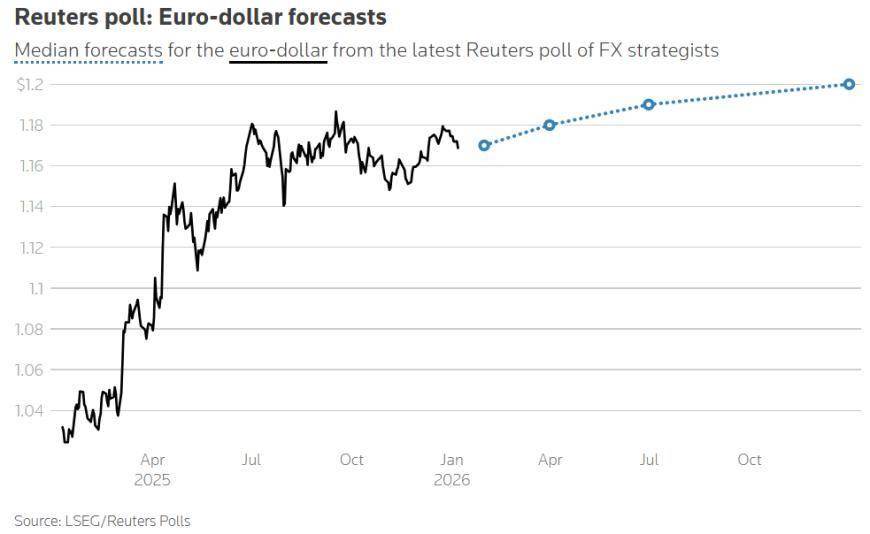
Core Viewpoint - Forex strategists maintain a bearish outlook on the US dollar heading into 2026, driven by concerns over the Federal Reserve's independence and expectations of interest rate cuts, predicting a slight depreciation of the dollar by year-end [1] Group 1: Dollar Performance and Predictions - The dollar fell nearly 10% against a basket of major currencies last year, marking its weakest performance since 2017 [1] - A Reuters survey indicates that the mainstream view among forex forecasters remains unchanged, with expectations for the euro to rise approximately 1% each quarter, reaching 1.19 against the dollar by mid-year and 1.20 by year-end [2] Group 2: Federal Reserve and Monetary Policy - Concerns about the labor market's weakness have led the Federal Reserve to cut the federal funds rate three times since September, currently targeting a range of 3.50%-3.75%, with one more rate cut anticipated this year [5] - The Fed has signaled a pause in rate cuts to assess subsequent data, highlighting divisions among officials regarding inflation and employment concerns [5] Group 3: Market Sentiment and Positioning - Nearly 90% of currency traders surveyed expect to maintain or increase their net short positions on the dollar by the end of January [6] - The interest rate futures market reflects expectations for at least two rate cuts by the Fed this year, with potential for further easing if political influences affect policy decisions [7]

澳联储释放“耐心”信号:淡化短期数据波动 高通胀下对利率持谨慎立场
Zhi Tong Cai Jing· 2026-01-08 06:00
Core Viewpoint - The Reserve Bank of Australia (RBA) is adopting a patient and cautious approach towards future interest rate adjustments, focusing on long-term inflation trends rather than reacting to individual data points [1][2] Group 1: Inflation Assessment - RBA's Deputy Governor Andrew Hagger indicated that inflation above 3% is still considered too high, and the bank will wait for the comprehensive quarterly inflation report on January 28 to make a complete assessment of consumer prices [1] - Recent data showed a slowdown in Australia's November inflation, but overall and core inflation rates remain above the RBA's target range of 2%-3% [1] Group 2: Market Reactions - Following Hagger's comments, traders reduced the probability of a rate hike in May from full pricing to 80%, leading to an increase in three-year government bond prices and a decrease in yields [1] - Market interpretation suggests that the RBA's stance has not significantly changed, indicating a longer period of maintaining interest rates rather than an imminent need for rate hikes [1] Group 3: Economic Context - The RBA has maintained the benchmark interest rate at 3.60% since the last rate cut in August, shifting focus to address new inflation pressures amid a tight labor market and weak productivity growth [1] - Recent monetary policy meeting minutes revealed discussions on conditions that might necessitate a rate hike, but any actions will depend on subsequent data [2] - The RBA acknowledges that the full effects of the 75 basis points of easing implemented from February to August have not yet fully materialized [2]
光大期货金融期货日报-20260108
Guang Da Qi Huo· 2026-01-08 02:42
Report Industry Investment Rating - No investment rating for the industry is provided in the report. Core Viewpoints - **Stock Index Futures**: The A-share market fluctuated after a rise and fall yesterday. The style was divided, with sectors such as electronics and power equipment rising, and sectors such as petroleum and petrochemicals and non-bank finance correcting. The capital sentiment remained high. The A500ETF received significant subscriptions, and the net short positions of the Top5 member units in IF increased significantly recently. It is expected that the stock index will continue to fluctuate within the shock center formed since October. The spring rally may not be as strong as in previous years [1]. - **Treasury Bond Futures**: On Wednesday, treasury bond futures closed down. The central bank conducted reverse repurchase operations, resulting in a net withdrawal of funds. The reasonable and sufficient liquidity in the capital market is the biggest support for the bond market, but economic stability, rising inflation, and cautious interest rate cuts pose certain constraints. It is expected that the bond market will remain in a range-bound pattern in the short term [1][2]. Summary by Directory 1. Research Views - **Stock Index Futures**: The A-share market fluctuated after a rise and fall yesterday. The Wind All A index rose 0.19% with a trading volume of 2.88 trillion yuan. The CSI 1000 index rose 0.53%, the CSI 500 index rose 0.78%, the SSE 50 index fell 0.43%, and the SSE 300 index fell 0.29%. The A500ETF received significant subscriptions, and the net short positions of the Top5 member units in IF increased significantly recently. The stock index is expected to continue to fluctuate within the shock center formed since October. The spring rally may not be as strong as in previous years [1]. - **Treasury Bond Futures**: On Wednesday, treasury bond futures closed down. The 30-year main contract fell 0.44%, the 10-year main contract fell 0.08%, the 5-year main contract fell 0.06%, and the 2-year main contract fell 0.03%. The central bank conducted 286 billion yuan of 7-day reverse repurchase operations, resulting in a net withdrawal of funds. The reasonable and sufficient liquidity in the capital market is the biggest support for the bond market, but economic stability, rising inflation, and cautious interest rate cuts pose certain constraints. It is expected that the bond market will remain in a range-bound pattern in the short term [1][2]. 2. Daily Price Changes - **Stock Index Futures**: From December 31, 2025, to January 5, 2026, IH rose 2.44%, IF rose 2.11%, IC rose 3.17%, and IM rose 2.73%. The SSE 50 index rose 2.26%, the SSE 300 index rose 1.90%, the CSI 500 index rose 2.49%, and the CSI 1000 index rose 2.09% [3]. - **Treasury Bond Futures**: From December 31, 2025, to January 5, 2026, TS fell 0.04%, TF fell 0.055%, T remained unchanged, and TL remained unchanged [3]. 3. Market News - On January 7, the Chinese Foreign Ministry spokesperson Mao Ning stated that the US government's demand to obtain 50 million barrels of oil from Venezuela violates international law and infringes on Venezuela's sovereignty. China's legitimate rights and interests in Venezuela must be protected [4]. 4. Chart Analysis - **Stock Index Futures**: The report provides charts showing the trends of IH, IF, IM, and IC main contracts, as well as the basis trends of IH, IF, IC, and IM [5][6][7]. - **Treasury Bond Futures**: The report provides charts showing the trends of treasury bond futures main contracts, treasury bond yields, basis, inter - period spreads, cross - variety spreads, and capital interest rates [12][13][14]. - **Exchange Rates**: The report provides charts showing the central parity rates of the US dollar and euro against the RMB, forward exchange rates, the US dollar index, and exchange rates between major currencies [21][22][23].
日度策略参考-20260108
Guo Mao Qi Huo· 2026-01-08 02:26
Report Industry Investment Rating No specific industry investment ratings were provided in the report. Core Viewpoints of the Report - A-share market is expected to continue its upward trend in the short term and may rise further in 2026 compared to 2025, supported by macro policies, inflation, capital market reforms, and the role of Central Huijin [1]. - The bond market is favored by asset shortages and weak economic conditions, but the central bank has recently warned of interest rate risks [1]. - Metal prices are influenced by factors such as supply disruptions, macro sentiment, and cost changes. Some metals are expected to have upward trends, while others may experience volatility or are subject to supply concerns [1]. - Energy and chemical product prices are affected by factors such as geopolitical conflicts, supply and demand, and cost support. Some products are expected to have upward trends, while others may experience volatility [1]. - Agricultural product prices are influenced by factors such as seasonal changes, policy support, and supply and demand. Some products are expected to have upward trends, while others may experience volatility [1]. Summary by Category A-shares - A-share market has continuous trading volume increase. Short-term, the index is expected to remain strong. In 2026, the index may continue to rise on the basis of 2025, supported by macro policies, inflation, capital market reforms, and Central Huijin [1]. Bonds - Asset shortages and weak economic conditions are favorable for bond futures, but the central bank has recently warned of interest rate risks. Attention should be paid to the Bank of Japan's interest rate decision [1]. Metals - Copper: Supply disruptions and improved macro sentiment have led to a rise in copper prices, and the upward trend is expected to continue [1]. - Aluminum: Domestic electrolytic aluminum has accumulated inventory, but macro sentiment is positive, and global aluminum ingot supply is expected to tighten, leading to a strong aluminum price [1]. - Alumina: Supply has significant release potential, putting pressure on prices. However, the current price is close to the cost line, and the price is expected to oscillate [1]. - Zinc: Fundamentals have improved, and the cost center has shifted upward. With positive macro sentiment, zinc prices have risen, but the upside space is limited due to fundamental pressure [1]. - Nickel: Supply concerns have led to a significant increase in nickel prices and an increase in positions. The short-term price may be strongly oscillating, but high risks and volatility are present at high price levels. Attention should be paid to Indonesian policies and macro sentiment [1]. Industrial and Energy Chemicals - Polycrystalline silicon: Northwest production has increased, while southwest production has decreased. December production schedules for polycrystalline silicon and organic silicon have declined [1]. - Carbonate lithium: It is the traditional peak season for new energy vehicles, with strong energy storage demand and increased supply from restarts. Prices have risen rapidly in the short term [1]. - Rebar and hot-rolled coil: Futures-spot arbitrage positions can be rolled for profit-taking. The price valuation is not high, and short-selling is not recommended [1]. - Iron ore: Near-term contracts are restricted by production cuts, but the commodity sentiment is positive, and there is still an upward opportunity for far-term contracts [1]. - Silicone and ferrosilicon: There is a combination of weak reality and strong expectations. In the short term, expectations dominate, and energy consumption control and anti-involution may disrupt supply [1]. - Soda ash: The market sentiment has improved, and the supply and demand are supportive. The price is low and expected to be strong in the short term [1]. - Coking coal and coke: If the "capacity reduction" expectation continues to ferment and there is pre-holiday restocking of spot goods, there may still be room for price increases, but the actual increase is difficult to judge, and volatility increases after a significant rise [1]. Agricultural Products - Palm oil: The December MPOB data is expected to be bearish, but the price is expected to reverse under themes such as seasonal production cuts, the B50 policy, and US biofuels. Short-term rebounds due to macro sentiment should be watched out for [1]. - Soybean oil: The fundamentals are strong, and it is recommended to be overweight in the oil market. Consider the spread between soybean oil and palm oil [1]. - Cotton: There is support but no driving force in the short term. Future attention should be paid to the central government's No. 1 document in the first quarter of next year, planting area intentions, weather during the planting period, and peak season demand [1]. - Sugar: There is a global surplus and increased domestic supply. The short side consensus is strong. If the price continues to fall, there is strong cost support, but there is a lack of continuous driving force in the short term [1]. - Corn: With the release of reserve and imported grains, the supply has increased. The spot price is expected to be firm in the short term, and the futures price will oscillate within a range [1]. - Pulp: The 05 contract is expected to oscillate between 5400 - 5700 yuan/ton due to the tug-of-war between "strong supply" and "weak demand" [1]. - Logs: The spot price has shown signs of bottoming out and rebounding, and the downward space for the futures price is limited. However, the January overseas quotation has slightly declined, and there is a lack of upward driving factors. The price is expected to oscillate between 760 - 790 yuan/m³ [1]. Energy and Chemicals - Crude oil: OPEC+ has suspended production increases until the end of 2026. The uncertainty of the Russia-Ukraine peace agreement and US sanctions on Venezuelan oil exports have an impact [1]. - Fuel oil: Follows the trend of crude oil in the short term, with no prominent supply-demand contradictions [1]. - Asphalt: The "14th Five-Year Plan" rush demand is likely to be disproven, and the supply of Ma Rui crude oil is sufficient. The profit margin is high [1]. - Natural rubber: The raw material cost provides strong support, the futures-spot price difference has rebounded significantly, and the midstream inventory has increased substantially [1]. - BR rubber: The upward momentum has slowed down, the spot price has led the recovery of the basis, and the processing profit has narrowed. There are positive factors for future domestic butadiene exports [1]. - PTA: The PX market has experienced a sharp rise, and the PTA market is expected to remain tight in 2026. Domestic PTA maintains high production, and the gasoline spread provides support for aromatics [1]. - Ethylene glycol: Two MEG plants in Taiwan, China, plan to shut down next month. The price has rebounded rapidly due to supply-side news, and the downstream demand is slightly better than expected [1]. - Styrene: The Asian market is stable, with suppliers reluctant to cut prices due to losses and buyers pressing for lower prices due to weak downstream demand. The market is in a weak balance, and the upward momentum depends on overseas markets [1]. - Urea: The export sentiment has eased, and the upside space is limited due to insufficient domestic demand. There is support from anti-involution and the cost side [1]. - PE: There is a risk of rising crude oil prices due to geopolitical conflicts. The supply pressure is high, and the market expectation is weak due to planned production increases in 2026 [1]. - PP: The supply pressure is high, and the downstream improvement is less than expected. The cost is supported by high propylene monomer and crude oil prices [1]. - PVC: The global production is expected to be low in 2026, but the current supply pressure is rising. The demand is weak, and the implementation of differential electricity prices in the northwest may force the clearance of PVC production capacity [1]. - LPG: The January CP has risen unexpectedly, and the import cost provides strong support. Geopolitical conflicts have increased the risk premium. The inventory accumulation trend has slowed down, and the domestic port inventory is decreasing. The long-term demand for LPG is expected to increase [1]. Aviation - It is expected to peak in mid-January. Airlines are still cautious about trial resumptions [1].
突发回落!瑞郎失守关键位 政策避险成推手
Jin Tou Wang· 2026-01-08 02:25
瑞士作为传统避险经济体,瑞郎的避险属性在当前全球市场环境中得到凸显。近期全球地缘政治局势复 杂多变,中东冲突持续升级,欧洲经济复苏乏力,市场避险情绪有所升温,资金流向瑞郎等避险资产, 间接推动美元兑瑞郎下行。此外,瑞士银行业盈利能力改善,外汇储备规模稳定,进一步增强了瑞郎的 基本面支撑。 技术分析 从技术图形上来看,美元兑瑞郎日线级别呈现震荡下行趋势,当前汇价失守MA5均线支撑,短期空头 趋势占优。RSI指标当前读数为41,处于中性偏空区间,尚未进入超卖区域,下跌动能仍有延续空间; 小时级别MACD图显示绿色动能柱温和放大,死叉信号持续,短期回调压力未减。支撑位方面,关注 0.8720一线(近期震荡区间下沿)及0.8700整数关口,若下方失守则可能测试0.8680附近的38.2%斐波那契 回撤位;阻力位先看0.8760附近(MA10均线位置),若上方突破则可能向0.8780一线发起冲击。 展望后市,美元兑瑞郎短期大概率维持震荡回落态势,后续需重点关注三大变量:一是美联储1月议息 会议政策指引,若释放更明确的宽松信号,可能加速美元回调;二是瑞士央行官员讲话及通胀数据,若 通胀持续低于目标,可能提前降息预期,削弱 ...
1月资产配置月报:宏观友好,金属乐观-20260108
Zhong Xin Qi Huo· 2026-01-08 01:38
Report Industry Investment Rating - The report does not explicitly mention an overall industry investment rating. However, it provides specific investment recommendations for different asset classes in January [9][12][69]. Report's Core View - After the Fed's rate cut in December, the market shifted its focus to re - pricing the subsequent policy path and liquidity. The domestic policy expectations in China are positive. In January, it is recommended to balance the allocation and seize structural opportunities. Long - term overweight is suggested for equities and non - ferrous metals, while precious metals should be treated with caution regarding volatility and can be re - weighted after volatility stabilizes [2][3][69]. Summary According to Relevant Catalogs 1. December Review of Major Assets - The macro theme of global major assets in December shifted from a single monetary policy expectation to structural pricing and capital transaction - driven scenarios under risk appetite recovery. Asset performance showed divergence [15]. - In the equity market, A - shares performed well, with small and medium - sized stocks and growth styles outperforming large - cap indices. Overseas, US equity indices were nearly flat [16]. - In the bond market, government bonds and US Treasuries performed weakly, with yields rising [17]. - In the foreign exchange market, the US dollar index weakened, the RMB was relatively strong, and the Japanese yen declined after the Bank of Japan's rate hike [18]. - In the commodity market, precious metals and new energy metals performed significantly better, base metals rose but with weaker gains, ferrous metals were generally weak, energy and chemicals were weak, and agricultural products had mixed performance [19]. 2. Macro Environment Outlook 2.1 Overseas Macro - The global PMI in November slightly declined to 50.5, but remained in the expansion range [23]. - US economic data from October - November showed weakening inflation, an increase in the unemployment rate, and stable consumption. The Fed cut interest rates by 25 basis points in December, with a dovish tone [24][28][29]. - Attention should be paid to the nomination of the new Fed chair. Different candidates have different policy stances, which may cause market fluctuations. The US bond market shows a "bear steepening" feature, and the US dollar is under pressure [30]. - The European Central Bank maintained the interest rate unchanged in December and raised GDP forecasts. Japan's rate hike was not radical, and short - term liquidity may tighten slightly, but the expectation of overseas easing in 2026 remains [33]. - Non - US developed markets are stable, and emerging markets had a generally positive economic sentiment in November [34][35]. 2.2 Chinese Domestic Macro - In December, domestic macro indicators were stable. Important meetings set tasks for the "15th Five - Year Plan", raising market expectations for additional policies in the first half of 2026 [36]. - The economic structure showed differentiation, with real estate and infrastructure investment remaining weak, manufacturing PMI rising to the expansion zone, consumption being stable and slightly weak, and exports contributing significantly to the economy [37]. - Social financing slightly exceeded expectations, M1 data rebound did not change the trend of activating funds, PPI was on an upward trend, and core CPI unexpectedly recovered, indicating an improvement in inflation in 2026 [37][38]. 3. Outlook for Major Assets 3.1 Equity indices - In January, policy easing expectations are likely to be the main narrative in the equity market. Domestic equities may trade in a volatile but generally stronger trend. Fiscal policy may front - load in 2026, and monetary policy may ease marginally in the first half of the year, providing a window for increasing equity index allocation [41]. 3.2 Commodities - **Precious Metals**: In January, precious metals will enter a critical phase of speculation on the Fed's monetary policy path. Gold and silver are likely to maintain a volatile upward trend under the dual fiscal and monetary easing macro - backdrop. Attention should be paid to the US fiscal deficit and the Fed's policy path changes [44]. - **Non - Ferrous Metals**: The macro environment is favorable, and upstream raw materials are tight, with supply disruption concerns. Although actual demand is weak, non - ferrous metals are expected to maintain a generally volatile but stronger trend, especially in the medium - to - long - term with supply remaining tight [49]. - **Ferrous Metals**: In January, ferrous metals are expected to trade in a range - bound manner. In the medium - to - long - term, "anti - involution" policies and export control measures may reshape the supply - demand balance and improve industry profits [54]. - **Energy & Chemicals**: In January, the crude oil sector will verify OPEC+ production cut compliance. Oil prices may oscillate in a low range. Geopolitics and supply - side factors will affect prices. In the medium - to - long - term, the global oversupply assumption remains, but prices below $60 may trigger support measures [57][59]. 3.3 Bonds - Treasury bond movements in January may continue to be range - bound, with short - end performance relatively better than long - end. In the long - term, bonds have limited upside potential as inflation expectations may put pressure on medium - and long - duration bond yields [64].