
宏观经济

Search documents
原油月报:等待地缘高点-20260104
Wu Kuang Qi Huo· 2026-01-04 13:10
Report Summary 1. Investment Rating The report does not provide an investment rating for the industry. 2. Core Viewpoints - In early 2026, geopolitical issues in Latin America resurfaced, potentially causing minor impacts on crude oil prices. The narrowing oscillation of crude oil prices in December 2025 is expected to continue. [15] - The US Energy Department released previously postponed data, showing a seasonal decline in refinery operations but still stronger than in previous periods, and a slight increase in Cushing inventories. Russian exports have recovered after falling from their peak in September. [15] - At the macro - political level, the final value of the US GDP in the third quarter of 2025 exceeded expectations, and the combination of a "strong economy + interest - rate cut cycle" continued. Politically, the US military raided and captured Maduro, but domestic oil and gas facilities were not damaged. In Yemen, conflicts between Saudi - and UAE - supported factions have raised concerns about their relationship, but it is unlikely to affect OPEC+ production coordination. [15] - Given that most of the inventory is at sea and concentrated in the Asia - Pacific region, the upward potential of oil prices due to geopolitical situations is limited. However, the valuations of heavy oil and asphalt will significantly benefit. It is recommended to go long on the cracking spreads of heavy oil and asphalt during the window when the sea - borne inventory is not fully released. [15][17] 3. Section Summaries 3.1 Monthly Assessment & Strategy Recommendation - **Market Review**: In December 2025, crude oil prices showed a narrowing oscillation. At the beginning of 2026, geopolitical issues in Latin America flared up again, which may have a minor impact on crude oil prices. [15] - **Supply - Demand Changes**: US refinery operations declined seasonally but were still stronger than before, and Cushing inventories increased slightly. Russian exports recovered after the September peak. [15] - **Macro - Political Situation**: The US GDP in Q3 2025 exceeded expectations, and the "strong economy + interest - rate cut cycle" persisted. Geopolitical events included the capture of Maduro and conflicts in Yemen, but OPEC+ production coordination is expected to remain stable. [15] - **Viewpoint Summary**: Limited upward potential for oil prices due to sea - borne inventory, but heavy oil and asphalt valuations will benefit. Long heavy oil and asphalt cracking spreads during the inventory release window. [15][17] 3.2 Macro & Geopolitical - **Short - Term High - Frequency Macro Indicators**: The report presents relationships between indicators such as the US ISM manufacturing PMI, the Citigroup G10 economic surprise index, the US 10 - year inflation expectation, and the US long - short - term spread with WTI oil prices. [48] - **Medium - Term Macro Forecast Indicators**: It includes the euro - area investment confidence index, the US investment confidence index, US GDP growth rate forecasts, and global major country GDP growth rate forecasts. [55][56] - **Geopolitical Indicators**: The Middle - East geopolitical risk index and the high - frequency export statistics of sensitive oil - producing countries (Iran, Libya, Venezuela, and Russia) are shown, along with their relationships with WTI oil prices. [63] 3.3 Oil Product Spreads - **Forward Curve**: It shows the WTI crude oil forward curve, the near - far structure of various crude oils, the WTI M1/M4 monthly spread, and the WTI M1 price. [67] - **Inter - regional Spreads**: Spreads such as Brent/WTI, Brent/Dubai, INE/WTI, and MRBN/WTI are presented. [71][73] - **Product Spreads**: It includes the LGO diesel forward curve, the near - far structure of refined products, and spreads like RB/HO and LGO/RB. [79] - **Cracking Spreads**: Cracking spreads of gasoline, diesel, high - sulfur fuel oil, and low - sulfur fuel oil in Singapore, Europe, and the US are analyzed. [85][88][91] 3.4 Crude Oil Supply - **OPEC & OPEC+ Supply**: It details the results of OPEC's past meetings, the production and quota situations of OPEC and OPEC+ countries, and the supply and export forecasts of OPEC 12 member countries and major OPEC+ members. [97][99][103] - **US Supply**: The US government has made various policies regarding oil, such as budget cuts for the SPR, potential sanctions adjustments, and plans to increase local production. The report also shows data on US oil wells, rigs, production, and exports. [128][130][132] - **Other Supply**: It includes the production forecasts of countries like Canada, Norway, and Brazil, as well as China's crude oil production. [137] 3.5 Crude Oil Demand - **US Demand**: It covers direct demand from refineries (including crude oil input, refinery capacity utilization, and parking capacity) and imports/exports, as well as derived demand for gasoline, diesel, fuel oil, aviation kerosene, and refined product imports/exports. Micro - demand indicators such as bank car loans, railway traffic, and aviation security passenger flow are also presented. [144][147][150] - **Chinese Demand**: It includes direct demand (crude oil input, imports, and refinery operations) and derived demand for gasoline, diesel, and refined product exports. Micro - demand indicators such as new - energy vehicle penetration and population migration are also shown. [166][172][174] - **European Demand**: It includes direct demand from refineries (refinery operations, crude oil input, and profits) and imports, as well as derived demand for refined products. [185][187][190] - **Indian Demand**: It shows India's crude oil input, refinery operating rate, imports, and demand forecasts. [195] - **Other Demand**: It includes the average daily speeds of different types of oil tankers and oil - transportation quality models. [199][203] 3.6 Crude Oil Inventory - **US Inventory**: It includes commercial crude oil inventories, Cushing inventories, and inventories of gasoline, diesel, fuel oil, and aviation kerosene, as well as their available - days data. [209][211][213] - **Chinese Inventory**: It includes crude oil port inventories and inventories of gasoline and diesel, as well as their production - sales ratios. [218][221][224] - **European Inventory**: It includes ARA inventories and inventories of 16 European countries for various refined products and crude oil. [229][234][237] - **Singapore Inventory**: It shows inventories of gasoline, diesel, fuel oil, and total refined products. [241] - **Fujairah Inventory**: It includes inventories of gasoline, diesel, fuel oil, and total refined products at the port. [246] - **Maritime Inventory**: It includes floating storage of refined products (gasoline, diesel, fuel oil, and kerosene), heavy and light oils, and crude oil, as well as the relationship between VLCC and Suezmax floating storage and WTI oil prices. [251][255][259] 3.7 Meteorological Disasters - It presents storm models in the US Gulf of Mexico and the Middle - East straits, as well as wildfire probability models in Canada and rainstorm & thunderstorm data in the US Gulf of Mexico. [264][270] 3.8 Alternative Data - It includes data on crude oil maritime in - transit supply, oil - transportation demand models, shipping fees in the Arabian Sea, and the probability of the Strait of Hormuz being blocked according to media polls, along with their relationships with WTI oil prices. [276]
宏观和大类资产配置周报:寻找美元的替代品-20260104
Bank of China Securities· 2026-01-04 07:44
Macro Economic Overview - The report indicates a downward trend in the Shanghai Composite Index, which fell by 0.59% this week, while the CSI 300 index futures decreased by 0.06% [1][11] - The report highlights a mixed performance in commodity futures, with coking coal futures down by 0.76% and iron ore futures up by 2.00% [1][11] - The yield on ten-year government bonds increased by 1 basis point to 1.85%, while active ten-year government bond futures dropped by 0.36% [1][11] Asset Allocation Recommendations - The recommended order for asset allocation is equities > commodities > bonds > currency, reflecting a positive outlook on A-shares and stable bond yields [2][4] - The report suggests that the U.S. dollar's safe-haven status is weakening, prompting international capital to seek alternatives, with RMB assets being a top choice due to their stability and growth potential [2][4] - The report anticipates that commodity prices will be influenced by supply pressures in oil and demand dynamics in cyclical goods, while agricultural products will be affected by supply factors [2][4] Key Economic Indicators - The manufacturing PMI for December was reported at 50.1, indicating a slight expansion, while the non-manufacturing PMI was at 50.2, returning to the expansion zone [18] - The report notes that the upcoming National People's Congress will convene on March 4, 2026, which may influence economic policies [18][19] Market Performance Insights - The report details a significant decline in the real estate market, with a notable drop in transaction volumes for new homes in major cities, indicating potential market stabilization due to recent policy changes [36][41] - The automotive sector is experiencing a downturn, with wholesale and retail sales of passenger vehicles showing negative growth for four consecutive weeks [36][41] Bond Market Analysis - The yield on ten-year government bonds has risen to 1.85%, with a noted increase in the yield of ten-year policy bank bonds to 2.00% [46] - The report highlights a significant rise in yields for low-rated credit bonds, indicating a shift in market sentiment [46]
12月PMI超预期回暖,产需两端明显回升
Hua Xia Shi Bao· 2025-12-31 16:39
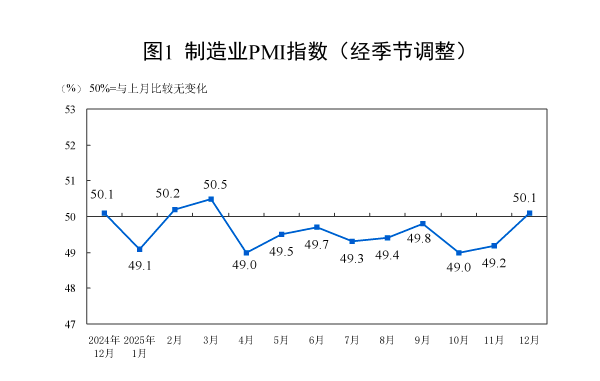
Core Viewpoint - The manufacturing PMI has returned to the expansion zone for the first time since April, indicating a recovery in economic sentiment, driven by stable growth policies and resilient exports [2][4]. Group 1: Manufacturing Sector - The manufacturing PMI for December is reported at 50.1%, marking a significant increase and indicating expansion [2]. - The production index stands at 51.7%, up 1.7 percentage points from the previous month, reflecting accelerated production activities and improved market confidence [4]. - The new orders index has risen to 50.8%, indicating a recovery in market demand, particularly in sectors like food processing and textiles [5]. - Large enterprises' PMI has also returned to the expansion zone at 50.8%, up 1.5 percentage points from last month [5]. Group 2: Non-Manufacturing Sector - The non-manufacturing PMI is reported at 50.2%, showing improvement in the service sector, although the service PMI remains slightly below the expansion threshold at 49.7% [8]. - The construction sector has shown notable recovery, with the construction PMI rising to 52.8%, marking a return to expansion after five months [8]. - The business activity expectation index for the service sector is at 56.4%, indicating increased confidence among service enterprises regarding future market developments [8]. Group 3: Economic Policies and Outlook - The government is expected to implement more proactive macroeconomic policies, with a focus on balancing fiscal expansion and sustainable growth [3]. - The production and business activity expectation index has risen to 55.5%, reflecting enhanced confidence among manufacturing enterprises [7]. - The overall economic environment is supported by favorable external trade conditions and a strong global AI investment trend, contributing positively to exports [6].


广发宏观:高频数据下的12月经济:数量篇
GF SECURITIES· 2025-12-31 14:44
[Table_Page] 宏观经济研究报告 2025 年 12 月 31 日 证券研究报告 [Table_Title] 广发宏观 高频数据下的 12 月经济:数量篇 | 分析师: [Tabl | 郭磊 | 分析师: | 贺骁束 | | --- | --- | --- | --- | | e_Author] | SAC 执证号:S0260516070002 | | SAC 执证号:S0260517030003 | | | SFC CE.no: BNY419 | | | | | 021-38003572 | | 021-38003589 | | | guolei@gf.com.cn | | hexiaoshu@gf.com.cn | | | 请注意,贺骁束并非香港证券及期货事务监察委员会的注册持牌人,不可在香港从事受监管活动。 | | | [Table_Summary] 报告摘要: 用电量增速淡季偏弱,叠加暖冬影响,中电联口径截至 12 月 25 日,纳入统计的发电集团燃煤电厂本月累计发 电量同比下降 8.5%,较 11 月同比的-7.2%进一步有所走低。工业开工率同样呈淡季特征,叠加基数偏高,除 下游汽车全钢胎 ...

12月高频数据跟踪
LIANCHU SECURITIES· 2025-12-31 09:54
Production Side - In December, the operating rates for blast furnaces and electric furnaces were 78.88% and 60.10%, respectively, both lower than the previous month[3] - The rebar operating rate was 38.03%, and the grinding machine operating rate was 31.72%, both showing a decline from last month[3] - The average operating rates for PVC and PTA were 78.73% and 73.75%, respectively, indicating a general decrease in chemical product operating rates[3] - The inventory levels for asphalt, rebar, cold-rolled, hot-rolled, and float glass showed a decrease, with respective month-on-month growth rates of -3.77%, -10.26%, -4.73%, -6.82%[3] Demand Side - The average transaction area for commercial housing in 30 cities increased by 22.48% month-on-month but decreased by 31.93% year-on-year[4] - The average transaction area for land in 100 cities increased by 93.96% month-on-month, with a year-on-year decrease of 4.50%[4] - The average daily sales of passenger cars were 61,883 units, reflecting a month-on-month decline of 20.18% and a year-on-year decline of 26.34%[4] - The average box office revenue for movies was 675 million yuan, down 7.67% month-on-month but up 45.47% year-on-year[4] Price Side - The wholesale price index for agricultural products increased by 3.32% month-on-month and 6.94% year-on-year, with notable increases in vegetable and fruit prices[5] - The price of gasoline and diesel saw year-on-year declines of 6.82% and 5.20%, respectively[6] - The price of copper and aluminum increased by 5.28% and 1.26% month-on-month, with year-on-year increases of 21.31% and 7.28%[6]
为什么我国2025年12月PMI开始扩张?|宏观经济
清华金融评论· 2025-12-31 09:29
Core Viewpoint - The manufacturing Purchasing Managers' Index (PMI) rose to 50.1% in December 2025, indicating a return to the expansion zone after eight months, driven by policy support, increased external demand, and a later Spring Festival in 2026 [2][3]. Group 1: Policy Support and Investment Recovery - Policy measures have effectively promoted investment stabilization, with the central economic work conference emphasizing the need to "promote investment stabilization and stimulate private investment vitality" [2][3]. - The National Development and Reform Commission announced a plan for early 2026 construction projects and a central budget investment plan totaling approximately 295 billion yuan [2][3]. - The production index increased to 51.7% and the new orders index rose to 50.8%, indicating a rebound in production and orders due to fiscal support [3]. Group 2: External Demand and Export Orders - The new export orders index increased by 1.4 percentage points to 49%, reflecting a significant rise in export orders driven by strong external demand [4]. - Global monetary easing and fiscal stimulus have bolstered external demand, with manufacturing PMIs in France and the UK rising to expansion zones, and the US PMI remaining above 52% since August [4]. - Container throughput increased by 7.2% year-on-year in December, indicating a positive trend in export activities [4]. Group 3: Impact of the Spring Festival Timing - The later timing of the 2026 Spring Festival (February 17) resulted in less disruption to December's physical workload compared to previous years [5]. - The production index in December rose by 1.7 percentage points, contrasting with the historical trend of decline in December production indices [5]. Group 4: Price Trends and Inventory Adjustments - The PMI output price index rose by 0.7 percentage points to 48.9%, indicating a recovery in output prices, although they remain in a contraction zone [5]. - The inventory index saw an increase, with procurement volume, raw material inventory, and finished goods inventory rising due to increased production and orders [6]. - Various industries, including electrical machinery and pharmaceuticals, showed signs of inventory replenishment, although the sustainability of this trend requires further data support [6].
制造业PMI时隔8个月重回扩张区间 市场预期向好
Di Yi Cai Jing· 2025-12-31 04:51
国家统计局12月31日发布的数据显示,12月份制造业采购经理指数(PMI)为50.1%,比上月上升0.9个 百分点,在连续8个月运行在50%以下后升至扩张区间。 12月制造业生产经营活动预期指数为55.5%,较上月上升2.4个百分点,创2024年4月以来的新高。 中国物流与采购联合会特约分析师张立群认为,12月份PMI指数出现较明显回升,表明市场预期进一步 向好。同时也要看到,市场引导的需求收缩力度仍大,企业产品销售面对的困难仍多。 张立群表示,要通过力度足够的政府公共产品投资有效带动企业订单增长,带动企业和社会投资增长, 带动就业和居民消费,使扩大内需、扭转市场需求收缩的系统性努力尽快见到明显成效。进而持续改善 市场预期,推动中国经济尽快进入需求持续回暖带动的持续回升向好轨道。 中型企业也趋稳运行,中型企业PMI为49.8%,较上月上升0.9个百分点,创年内次高点,其中生产指数 较上月上升1.2个百分点至接近52%的水平,新订单指数较上月上升2.1个百分点至接近50%的水平,显 示中型企业需求持稳运行,生产加快扩张。小型企业PMI为48.6%,比上月下降0.5个百分点,低于临界 点。 文韬表示,当前市场需求 ...
中信期货晨报:国内商品期市收盘涨跌互现,贵金属跌幅居前-20251231
Zhong Xin Qi Huo· 2025-12-31 01:12
投资咨询业务资格:证监许可【2012】669号 国内商品期市收盘涨跌互现,贵金属跌幅居前 ——中信期货晨报20251231 中信期货研究所 王含章 从业资格号F03121254 投资咨询号Z0022985 重要提示:本报告非期货交易咨询业务项下服务,其中的观点和信息仅作参考之用,不构成对任何人的投资建议。 我司不会因为关注、收到或阅读本报告内容而视相关人员为客户;市场有风险,投资需谨慎。 金融市场涨跌幅 国内主要商品涨跌幅 | | | 热门行业涨跌幅 | | | | | | 硅铁 | 5750 | 1.30% | 1.38% | 6.68% -8.09% | 2.42% | | --- | --- | --- | --- | --- | --- | --- | --- | --- | --- | --- | --- | --- | --- | | 指数 | 行业 | 现价 日度涨跌幅 | 周度涨跌幅 | 月度涨跌幅 | 季度涨跌幅 | 今年涨跌幅 | | 锰硅 | 5942 | 1.36% | 1.75% | 5.80% -2.43% | 2.84% | | | 石油石化 | 3429 2.67% | 4.0 ...
宏观经济专题:建筑开工有所回升
KAIYUAN SECURITIES· 2025-12-30 12:44
Group 1: Construction and Industrial Production - Recent construction starts have shown a seasonal recovery, with residential construction performing better than infrastructure projects[2] - Industrial production remains at a historically high level, although some sectors, such as high furnace and coking, have weakened[2] - Cement supply for infrastructure projects has decreased month-on-month, with a larger year-on-year decline, while residential cement usage has seen a smaller month-on-month change and a narrowing year-on-year decline[2] Group 2: Demand and Sales Trends - Overall demand in construction remains weak, with rebar, wire rod, and building materials at historical lows[3] - Passenger vehicle sales continue to show negative growth year-on-year, while online sales of major home appliances have weakened further[3] - The average transaction area of new homes in 30 major cities increased by 44% compared to the previous two weeks, but still reflects a year-on-year decline of 18% and 27% compared to 2023 and 2024, respectively[6] Group 3: Commodity Prices - Copper, aluminum, and gold prices have reached new historical highs, driven by the expansion of dollar liquidity and industrial activity related to AI investments[4] - Domestic industrial product prices are experiencing a strong upward trend, with the South China industrial product index showing resilience[5] - Recent fluctuations in commodity prices indicate a potential risk of volatility exceeding expectations[77] Group 4: Export and Economic Indicators - Export growth for the period leading up to December 28 is projected to be between 2% and 4%, with a model indicating a 4.2% year-on-year increase[68] - The central bank has implemented a net withdrawal of 119.3 billion yuan through reverse repos, indicating a tightening of liquidity[70]
【宏观与债市周报】工业企业利润增速回落,国债收益率分化,全国财政工作会议召开
Xin Lang Cai Jing· 2025-12-30 11:04
(来源:远东资信) 摘要 宏观经济方面,1-11月份,规模以上工业企业利润同比增长0.1%,增速较前十个月放缓1.8个百分点, 自8月以来累计增速连续四个月保持增长。国家统计局对2024年GDP数据进行最终核实,2024年GDP现 价总量为1348066亿元,比初步核算数减少1018亿元;按不变价格计算,比上年增长5.0%,与初步核算 数持平。从全球来看,12月26日,10年期美债收益率较周初下行3BP至4.14%,有效联邦基金利率为 3.64%,较前期持平。2025年11月,美国经季节调整的非农就业人数增加6.4万人,10月非农就业人数减 少10.5万人,9月非农就业人数从增加11.9万人下修至增加10.8万人,8月非农就业人数从减少0.4万人下 修至减少2.6万人,合计下修3.3万人。11月失业率升至4.6%,为2021年10月以来最高值。欧元区基准利 率维持2.15%,日本基准利率维持0.75%。 债券市场方面,从无风险收益率来看,上周10年期国债收益率维持在1.84%左右,2年期国债收益率整 体有所下行。12月26日,10年期国债到期收益率较周初持平为1.8376%,2年期国债到期收益率较周初 下行3 ...