
出口增速

Search documents
贸易摩擦再起,如何影响出口?——9月外贸数据解读【陈兴团队•财通宏观】
陈兴宏观研究· 2025-10-13 11:20
Core Viewpoint - China's export growth rate in September recorded an increase of 8.3% year-on-year, driven by a low base from the previous year, despite a decline in the two-year average growth rate and a month-on-month growth rate below the median of the past five years [2][3] Export Analysis - The increase in export growth is primarily attributed to the low base effect from last year and improved cooperation with emerging markets such as Latin America and Africa, which has supported exports to these regions [3][7] - Exports to Latin America and Africa saw significant increases, with growth rates of 15.1% and 56.6% respectively, while exports to the US decreased by 27% [7] - The contribution of quantity to export growth has slightly weakened, while price factors have shifted from being a drag to a positive contributor [5][10] Import Analysis - China's import growth rate in September was 7.4%, a significant increase of 6.1 percentage points from August, driven by rising demand for production materials and energy [12] - Imports from the EU increased by 9.5%, benefiting from deepening trade relations between China and Europe, while imports from the US decreased by 16.1% [12][15] - All categories of imports showed varying degrees of increase, with notable growth in industrial raw materials and energy products [15] Trade Balance - The trade surplus in September narrowed to $90.45 billion, but net exports continue to support the economy [17] - Future trade dynamics may be influenced by the expiration of the US-China tariff agreement, with potential concessions from both sides regarding tariffs on rare earths and soybeans [17]



物价的三个变化——9月经济数据前瞻
一瑜中的· 2025-10-08 23:48
Core Viewpoint - The article highlights three significant changes in the economic landscape for September, focusing on manufacturing investment growth, price indicators, and the current state of demand, suggesting a need for policy adjustments to stimulate demand [2]. GDP - The GDP growth rate for the third quarter is expected to be around 4.8%, with a cumulative growth rate of approximately 5.1% for the first three quarters [4][11]. - Key downward factors include a decline in industrial production, construction, real estate, and wholesale retail sectors, with retail sales growth expected to drop to around 3.2% in September [4][12]. Prices - The Consumer Price Index (CPI) is projected to show a month-on-month increase of about 0.2% and a year-on-year decrease of around -0.2% in September [5][13]. - The Producer Price Index (PPI) is expected to decrease by approximately -0.2% month-on-month but improve from -2.9% to -2.5% year-on-year [5][14]. Production - Industrial production growth is anticipated to be around 6.0% in September, with strong performance in the manufacturing sector driven by increased production and external demand [15]. Foreign Trade - Exports are expected to grow by about 6% year-on-year in September, supported by low base effects and resilient non-U.S. demand [16]. - Imports are projected to increase by around 1%, influenced by rising commodity prices and stable export performance [17]. Fixed Asset Investment - Cumulative fixed asset investment growth is expected to decline to around -0.2% for the first nine months, with manufacturing investment growth dropping to 4.0% and real estate investment falling to -13.2% [18]. Real Estate Sales - Real estate sales are projected to have a growth rate of approximately 0% in September, with recent policy adjustments in major cities potentially leading to a slight recovery in sales [7][19]. Retail Sales - Retail sales growth is expected to be around 3.2% in September, influenced by high base effects and changes in consumer behavior [21][22]. Financial Indicators - New social financing is estimated at 3 trillion yuan in September, with a year-on-year decrease of 610 billion yuan, while M2 growth is projected at around 8.4% [8][23].

大摩邢自强最新研判:出口消费承压下市场仍活跃,杠杆可控 + 资金入市成核心底气
Zhi Tong Cai Jing· 2025-08-22 16:57
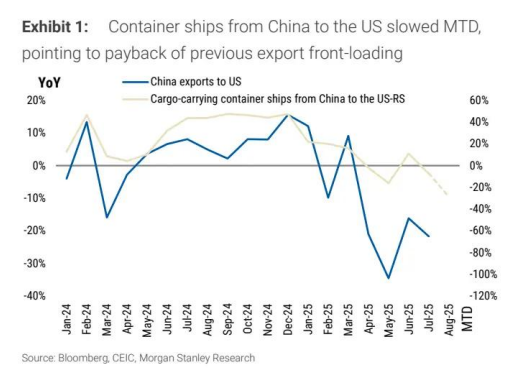
Economic Growth Observation - The economic growth in China is expected to slow down, with Morgan Stanley predicting a year-on-year growth rate of approximately 4.5% for the third quarter [2] - Export growth is anticipated to decline from 7.2% in July to 5%-6% in August due to high base effects and a pullback in pre-emptive demand [2] - Domestic consumption remains weak, particularly in the automotive and home appliance sectors, despite the central government allocating around 600 billion yuan in subsidies [4] - The real estate market's ongoing decline is contributing to a "negative wealth effect," further dampening consumer confidence [5] - Infrastructure investment has seen a slight rebound, but its sustainability is questioned due to a decrease in net financing from government bonds [6][7] Market Sentiment - Despite the economic slowdown, market sentiment in the A-share market remains resilient, supported by ample liquidity and proactive policy measures [11] - The financial environment is characterized by a shift towards capital markets, with significant inflows into offshore Chinese stocks, estimated at 15-17 trillion yuan in the first half of 2025 [13] - There is a notable shift in residents' asset allocation from savings to capital markets, as indicated by a decrease in household deposits and an increase in non-bank financial institution deposits [15] Policy Response - The Chinese government is addressing core challenges, termed the "3Ds" (de-leveraging, insufficient demand, structural transformation), with targeted policy measures [18] - Recent government meetings have emphasized the continuity of cyclical policies and the acceleration of consumer support measures to bolster domestic demand [18] Central Bank Stance - The central bank's recent monetary policy report indicates a focus on the quality of liquidity management rather than simply injecting liquidity into the market [19] - The central bank has reduced the scale of net liquidity injections since June, reflecting a recognition of the current level of liquidity [19] Leverage Levels - Current leverage levels in the market are deemed reasonable, with the margin trading balance exceeding 2 trillion yuan (approximately 290 billion USD) but remaining below historical peaks [22] - The proportion of margin trading balance to free float market value is about 4.8%, slightly below the 10-year average of 4.9% [22] - There is a low risk of immediate policy intervention regarding market leverage, although vigilance is advised if leverage indicators rise significantly [26]

东吴证券:中国出口增速或持续超市场预期
Sou Hu Cai Jing· 2025-08-19 05:25
Group 1 - The market previously worried that with the weakening momentum of "export grabbing," China's exports might face significant downward pressure in the second half of the year, with a risk of a substantial decline in the fourth quarter. The expected annual export growth rate was only around 3%. However, it is believed that due to the resilient economic growth in emerging markets like ASEAN and Africa, as well as improvements in China-Europe trade amid uncertainties in US tariffs, China's exports are likely to continue exceeding expectations in the second half of the year. The projected export growth rates for Q3 and Q4 are 5.9% and 1.0%, respectively, leading to an expected annual growth rate of 4.6%, which is about 1.6 percentage points higher than market expectations, potentially boosting GDP growth by approximately 0.3 percentage points [1][12][14] - The high growth of exports to emerging markets is not solely driven by "export grabbing." The new tariff framework has seen limited adjustments in major transshipment regions, including ASEAN, with most rates still lower than the tariffs imposed on China. Additionally, the actual demand from emerging markets has been a significant driver of high export growth. The manufacturing PMI of emerging markets (excluding China) has consistently been above that of developed countries, indicating stronger demand in regions like ASEAN and Africa [2][12][10] - The uncertainty surrounding US tariffs may continue to support improvements in China-Europe trade. The high growth of exports to the EU this year is partly due to the easing of trade relations between China and the EU amid US-EU trade frictions. Despite existing differences in various economic and trade issues, the EU is unlikely to worsen its economic ties with China, allowing for continued resilience in exports to the EU in the second half of the year [3][13] Group 2 - The US's dual approach of loose monetary and fiscal policies is expected to maintain external demand resilience next year. The market anticipates that the Federal Reserve may lower interest rates by 150 basis points to around 3% by the end of next year, with a consensus on the continuation of the easing cycle. The new Federal Reserve chair, nominated by Trump, may implement even looser policies in the second half of 2026, further stimulating total demand in the US economy [4][14] - The "Great Beautiful Act" is projected to have a significant positive impact on the US economy over the next 1-3 years. The act is expected to increase US economic output by 1.21% over the next 30 years compared to previous baseline expectations. The act's implementation is characterized by an initial phase of fiscal expansion followed by monetary tightening, which will positively affect the output gap in the US economy during the early years [5][17]

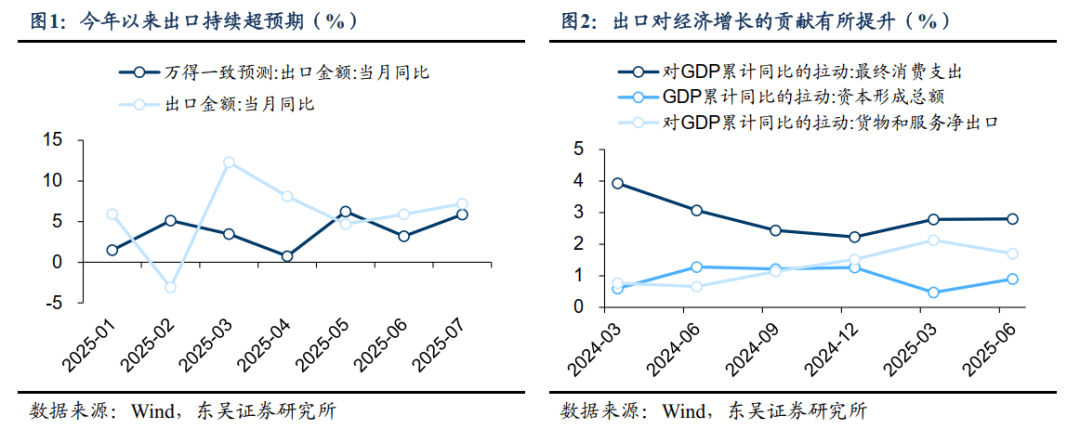
中国出口增速或持续超市场预期
Soochow Securities· 2025-08-18 04:55
Export Growth Outlook - China's export growth is expected to exceed market expectations in the second half of 2025, with projected growth rates of 5.9% and 1.0% for Q3 and Q4 respectively, leading to an annual growth rate of 4.6%, which is 1.6 percentage points higher than market expectations[1] - The contribution of net exports to GDP is projected to be approximately 0.3 percentage points higher than expected due to the stronger export performance[1] Emerging Markets Impact - High export growth to emerging markets like ASEAN and Africa is driven not only by "export grabbing" but also by actual demand from these regions, as indicated by their manufacturing PMI remaining above the growth threshold[2] - For the first seven months of 2025, China's exports to ASEAN, Africa, and the EU increased by 13.6%, 24.4%, and 7.3% respectively, reflecting a diversification in export markets[3] Trade Relations and Tariff Uncertainty - The uncertainty surrounding US-EU tariffs is likely to support improved trade relations between China and the EU, with expectations of sustained export resilience to the EU in the second half of the year[3] - The new tariff framework has limited impacts on re-export trade, as most adjustments remain below the current tariffs imposed on China[2] US Economic Policy Influence - The US is expected to maintain a loose monetary policy, with projections of a 150 basis point rate cut to around 3% by the end of 2026, which will support external demand for Chinese exports[4] - The "Great Beautiful Act" is projected to increase US economic output by 1.21% over the next 30 years, with significant positive impacts on GDP growth in the years 2026-2028[4] Risks and Considerations - There are risks associated with the uncertainty of US tariff policies, which could affect China's export outlook[4] - High-frequency data should be interpreted cautiously, as they need to be aligned with leading indicators like the PMI new orders index to avoid prediction errors[4]
格林大华期货早盘提示-20250814
Ge Lin Qi Huo· 2025-08-14 01:06
Report Industry Investment Rating - The short - term investment rating of treasury bond futures is "oscillation" [1] Report's Core View - On Wednesday, treasury bond futures rebounded after opening lower and stopped falling in the short - term. The short - term treasury bond futures may oscillate. Traders are advised to conduct band operations [1][2] Summary According to Related Content Market Performance - On Wednesday, most of the main contracts of treasury bond futures opened lower and fluctuated upward throughout the day. The 30 - year treasury bond futures main contract TL2509 rose 0.10%, the 10 - year T2509 rose 0.02%, the 5 - year TF2509 rose 0.05%, and the 2 - year TS2509 rose 0.03% [1] - On Wednesday, the Wande All - A stock index rose unilaterally in the morning and fluctuated horizontally in the afternoon. Treasury bond futures did not show a seesaw effect with the stock index. After two consecutive days of corrections on Monday and Tuesday, treasury bond futures opened lower and then rebounded [2] Important Information Open Market - On Wednesday, the central bank conducted 118.5 billion yuan of 7 - day reverse repurchase operations, with 138.5 billion yuan of reverse repurchases maturing on the same day, resulting in a net withdrawal of 20 billion yuan [1] Money Market - On Wednesday, the overnight interest rate in the inter - bank money market was basically flat compared with the previous trading day. The weighted average of DR001 throughout the day was 1.32%, the same as the previous trading day; the weighted average of DR007 throughout the day was 1.45%, compared with 1.44% in the previous trading day [1] Cash Bond Market - On Wednesday, the closing yields of inter - bank treasury bonds fluctuated narrowly compared with the previous trading day. The yield to maturity of 2 - year treasury bonds decreased by 1.00 BP to 1.40%, the 5 - year decreased by 0.46 BP to 1.56%, the 10 - year decreased by 0.09 BP to 1.73%, and the 30 - year increased by 0.30 BP to 2.02% [1] Social Financing and Credit Data in July - The social financing scale increased by 1.16 trillion yuan, with a market expectation of 1.41 trillion yuan, 389.3 billion yuan more than the same period last year. The net financing of government bonds increased by 1.244 trillion yuan, 555.9 billion yuan more year - on - year; the RMB loans issued to the real economy decreased by 426.3 billion yuan, 345.5 billion yuan more year - on - year; the net financing of corporate bonds was 279.1 billion yuan, 75.5 billion yuan more year - on - year; the undiscounted bank acceptance bills decreased by 163.9 billion yuan, 56.4 billion yuan more year - on - year. The RMB loans in the credit caliber decreased by 50 billion yuan, with a market expectation of a 15 - billion - yuan decrease, 310 billion yuan more year - on - year [1] - Corporate medium - and long - term loans decreased by 260 billion yuan, 390 billion yuan more than the same period last year; corporate short - term loans decreased by 550 billion yuan, the same as the decrease in the same period last year; corporate bill financing increased by 871.1 billion yuan, 312.5 billion yuan more than the same period last year. Resident short - term loans decreased by 382.7 billion yuan, 167.1 billion yuan more than the same period last year; resident medium - and long - term loans decreased by 110 billion yuan, 120 billion yuan more than the same period last year [1] - At the end of July, the balance of broad - money (M2) was 329.94 trillion yuan, a year - on - year increase of 8.8%, with a market expectation of 8.3% and 8.3% at the end of June. The balance of narrow - money (M1) was 111.06 trillion yuan, a year - on - year increase of 5.6%, with a market expectation of 5.3% and a year - on - year increase of 4.6% in June [1] Other Economic Data - China's exports denominated in US dollars increased by 7.2% year - on - year in July, better than the market forecast of 5.8% and the previous value of 5.9%. It is expected that China's export growth rate will probably decline in the future [2] - China's CPI was flat year - on - year in July, slightly exceeding the market expectation of a 0.1% decrease; the PPI decreased by 3.6% year - on - year, lower than the market expectation of a 3.4% decrease. The overall price level continued to hover at a low level [2] - On August 12, it was announced that China and the US would suspend the implementation of a 24% tariff for 90 days from August 12, 2025, which is beneficial for stabilizing bilateral trade and market confidence [2] Trading Strategy - Traders are advised to conduct band operations [2]
中信证券:我国企业出海的三大新趋势将对出口增速形成支撑
Xin Lang Cai Jing· 2025-08-13 00:20
Core Viewpoint - The report from CITIC Securities highlights the increasing demand for Chinese companies to expand overseas due to slowing domestic economic growth and ongoing trade frictions since 2015 [1] Group 1: Trends in Overseas Expansion - Chinese companies are transitioning from the 1.0 phase of overseas expansion, characterized by methods such as re-export trade, changing export destinations, relocating production capacity, and upgrading technology, to a 2.0 phase that emphasizes resilience and efficiency in response to heightened tariffs [1] - The new trends in overseas expansion include the normalization of re-export trade and diversification of regional layouts, which are essential strategies for companies to cope with tariffs [1] Group 2: Technological Advancements and Market Opportunities - High-tech products with rapidly increasing domestic production rates may create sufficient price advantages to mitigate tariff impacts, while traditional products can explore domestic gradient transfer and technology improvements to reduce costs and enhance efficiency [1] - There is a focus on actively expanding export markets in Belt and Road Initiative countries as part of the new strategies for overseas expansion [1] Group 3: Macroeconomic Impact - The three new trends in overseas expansion are expected to support export growth, with an estimated combined contribution of 3-5 percentage points to export momentum [1] - The report anticipates that China's exports may achieve a positive growth rate of 2.5% in the second half of the year [1]

宏观经济周报:美欧降息预期分化,中国出口保持强韧-20250808
BOHAI SECURITIES· 2025-08-08 13:40
Group 1: Macroeconomic Trends - US non-farm employment data for July fell short of expectations, with significant downward revisions for May and June, indicating a weakening job market[2] - The unemployment rate is rising, influenced by immigration policies that lower labor participation rates[2] - Forward-looking indicators such as manufacturing and non-manufacturing PMI employment components have reached recent lows, reflecting overall economic weakness[2] Group 2: Monetary Policy Expectations - The divergence in interest rate expectations between the US and Europe is notable, with US officials expressing concerns about the labor market while maintaining a neutral stance overall[5] - European inflation data shows July CPI growth near central bank targets, reinforcing confidence in keeping policy rates unchanged[5] Group 3: China's Economic Performance - China's export growth has exceeded expectations, supported by low base effects and stable demand from non-US countries, while exports to the US have weakened due to diminishing tariff relief effects[5] - Domestic demand remains uncertain, with imports primarily driven by integrated circuits and high-tech products, while the improvement in bulk commodity imports is largely price-driven[5] Group 4: Policy Developments - Recent government policies, such as the implementation of childcare subsidies and the promotion of free preschool education, aim to alleviate financial pressures on low- and middle-income families and support long-term population development[5] Group 5: Commodity Price Movements - Prices for non-ferrous metals have generally increased, while oil prices have declined, reflecting broader market dynamics[4]
中信证券;7月出口增速继续超预期,下半年出口增速有望录得2.5%左右的正增长
Di Yi Cai Jing· 2025-08-08 00:55
Core Viewpoint - CITIC Securities believes that the export growth in July continued to exceed expectations, with rapid growth in exports to ASEAN and Africa effectively offsetting the decline in demand from the United States [1] Export Analysis - In terms of export product structure, the semiconductor industry chain, automotive industry chain, and raw materials industry significantly contributed to export growth in July [1] - The contribution of labor-intensive products to overall exports has turned negative [1] Import Analysis - In July, the import growth rate rebounded, with a notable increase in the decline of imports from the United States, while the import quantity growth of most bulk commodities increased compared to previous values [1] Outlook - Looking ahead to the second half of the year, although direct exports to the U.S. and re-export trade will be affected by tariff disturbances, accelerated capacity transfer, technological product innovation, and diversified trade layouts are expected to mitigate some downward pressure on export growth [1] - The export growth rate is anticipated to achieve a positive growth of around 2.5% in the second half of the year [1]
中信证券: 7月出口增速继续超预期
Zheng Quan Shi Bao Wang· 2025-08-08 00:42
Core Viewpoint - In July, China's export growth continued to exceed expectations, with rapid growth in exports to ASEAN and Africa effectively offsetting the decline in demand from the United States [1] Export Analysis - The semiconductor industry chain, automotive industry chain, and raw materials industry significantly contributed to export growth in July, while labor-intensive products shifted from a positive to a negative contribution to overall exports [1] Import Analysis - In July, import growth rebounded, with a notable increase in the decline of imports from the United States, while the import growth rate of most bulk commodities increased compared to previous values [1] Outlook - Despite the impact of tariffs on direct exports to the U.S. and transshipment trade, accelerated capacity transfer, technological product innovation, and diversified trade layouts are expected to mitigate some downward pressure on export growth, with an anticipated positive growth rate of around 2.5% for exports in the second half of the year [1]