宽货币预期

Search documents
存单利率迎下行拐点
Sou Hu Cai Jing· 2025-11-02 04:16
Core Viewpoint - The liquidity in the financial market remains stable at the beginning of October, with a comfortable funding environment, although there are slight fluctuations towards the end of the month due to tax periods and cross-month factors [1][3][4]. Funding Environment - The average overnight rate (R001) and the 7-day rate (R007) for October were 1.38% and 1.50%, respectively, marking the lowest levels of the year [1]. - The net issuance of government bonds in October was 528.1 billion yuan, the lowest for the year, contributing to a stable funding price [1][26]. - The funding rates experienced slight increases at the end of the month due to tax period pressures, but the central bank's actions helped to stabilize the rates [1][9]. Interbank Lending - The average daily lending volume from banks decreased to 3.80 trillion yuan in the last week of October, down from 4.25 trillion yuan in the previous weeks, primarily due to large banks reducing their lending [3]. - Despite a decrease in lending willingness, the issuance price of certificates of deposit (CDs) fell, indicating a potential turning point in CD pricing [3][4]. Monetary Policy - The central bank's actions, including the resumption of government bond trading, are expected to inject medium to long-term funds into the banking system, stabilizing banks' liability expectations [4][13]. - The central bank's net injection of liquidity through reverse repos and MLF (Medium-term Lending Facility) indicates a continued supportive monetary policy stance [13][15]. Government Bonds - The net issuance of government bonds in October was significantly below expectations, with a total of 528.1 billion yuan, leading to a forecasted increase in issuance for November [26][29]. - The expected net issuance for November is approximately 1.23 trillion yuan, reflecting a seasonal increase in government bond supply [26]. Interbank Certificates of Deposit - The weighted issuance rate of interbank CDs decreased to 1.64% in the last week of October, indicating a downward trend in funding costs [32]. - The net financing from interbank CDs was 153.6 billion yuan, with a total issuance of 734.4 billion yuan during the same period [34]. Bill Market - The bill rates saw a significant decline, with the 1-month bill rate dropping to 0.01%, reflecting weak credit demand in October [19][20]. - Major banks shifted from net buying to net selling in the bill market, indicating a potential decrease in credit activity [19][22].


国债期货:国债买卖重启预期支撑 中短端利率明显下行
Jin Tou Wang· 2025-10-30 02:13
Market Performance - The majority of government bond futures closed higher, with the 30-year main contract down 0.27%, while the 10-year, 5-year, and 2-year main contracts rose by 0.13%, 0.16%, and 0.10% respectively [1] - The yields on major interbank bonds mostly declined, with mid-to-short term bonds performing well. The yield on the 10-year policy bank bond "25国开15" increased by 1.05 basis points to 1.8910%, while the 10-year government bond "25附息国债16" saw a slight rise of 0.10 basis points to 1.8140% [1] Funding Conditions - The central bank announced a 7-day reverse repurchase operation of 557.7 billion yuan at a fixed rate of 1.40% on October 29, with a net injection of 419.5 billion yuan for the day [2] - The interbank market liquidity has turned loose, with the weighted average rate for repos falling, particularly the overnight repo rate dropping over 6 basis points to 1.40% [2] Operational Suggestions - The bond market is experiencing a divergence in trends, with short-term bonds supported by expectations of renewed central bank bond purchases, while long-term bonds are pressured by U.S.-China trade relations and rising risk appetite [3] - There is potential for short-term fluctuations in the bond market, but a recovery in market sentiment may present trading opportunities if there are event shocks leading to market adjustments [3]
备兑增厚思路应对
Zhong Xin Qi Huo· 2025-10-23 00:43
Group 1: Report Industry Investment Ratings - No information about the report industry investment ratings is provided in the content. Group 2: Report's Core Views - The stock index futures market showed a volume - shrinking adjustment with overall resilience. After two consecutive days of gains, the market took a rest on Wednesday. The Wind All - A Index slightly declined by 0.38%. Defensive sectors like oil and gas and banks led the rise, while military and agricultural products led the decline. The A - share trading volume dropped to 1.69 trillion yuan, and the total position of stock index futures decreased by over 30,000 lots. The market is in a state of limited upside and downside, and it is advisable to hold a dumbbell - shaped structure and then shift to a growth - oriented allocation structure when the situation changes [1][7]. - The stock index options market witnessed a simultaneous decline in volume and volatility. The trading volume of the options market was 7815 million yuan, a 20.39% decrease from the previous day. The market liquidity declined, especially for small - and medium - cap varieties. The implied volatility index decreased by 0.51% on average. It is recommended to use covered call strategies to increase returns and also consider holding short straddles [2][7]. - The treasury bond futures market should focus on policy signal releases. The bond market showed a volatile performance. The expectation of loose monetary policy continued to boost the bullish sentiment in the bond market, and the central bank continued to conduct net injections in the open market, with a net injection of 94.7 billion yuan on the day. In the fourth quarter, there is a possibility of the implementation of quantitative tools such as reserve requirement ratio cuts and interest rate cuts, but the timing may be late. In the short term, caution is still needed, and attention should be paid to policy signals after the Fourth Plenary Session [2][7][9]. Group 3: Summaries According to Relevant Catalogs Market Views - **Stock Index Futures**: The current situation is a volume - shrinking adjustment with overall resilience. The basis, spread, and total position of IF, IH, IC, and IM contracts have changed. The operation suggestion is to hold dividend ETF + IM [7]. - **Stock Index Options**: The volume and volatility have declined simultaneously, and covered call strategies can be used to deal with the situation. The trading volume of the options market decreased, the risk preference retracted, and the implied volatility continued to decline. The suggestions are covered call and short straddle strategies [7]. - **Treasury Bond Futures**: Attention should be paid to policy signal releases. The trading volume, position, spread, and basis of T, TF, TS, and TL contracts have changed. The central bank conducted 138.2 billion yuan of 7 - day reverse repurchases, with 43.5 billion yuan of reverse repurchases maturing. The operation suggestions include trend strategies (volatility), hedging strategies (pay attention to short - hedging at low basis levels), basis strategies (pay attention to basis widening), and curve strategies (the curve may remain steep) [7][9]. Economic Calendar - The economic data of China and the US for the week are presented, including China's October LPR, September fixed - asset investment, industrial added - value, social consumer goods retail sales, and the third - quarter GDP, as well as the US's September non - farm payrolls change [10]. Important Information and News Tracking - **Mergers and Acquisitions**: Shenzhen has launched an action plan for high - quality development of mergers and acquisitions from 2025 - 2027, aiming to improve the quality of listed companies, increase the total market value of listed companies, and promote the development of the mergers and acquisitions market [11]. - **Interest Rates**: In September 2025, the average interest rates of bank time deposits for different terms are provided, such as 0.944% for 3 - month deposits [11]. - **Huawei**: On October 22, Huawei released the HarmonyOS 6 special version, including the Harmony Galaxy Interconnection architecture with a transmission rate of 160MB/s, and enhanced functions such as "touch - to - share" [12]. - **US Government Shutdown**: The US government shutdown has entered the 22nd day, becoming the second - longest shutdown in history. The shutdown is likely to last until November [12]. Derivatives Market Monitoring - Information about the monitoring of stock index futures, stock index options, and treasury bond futures markets is mentioned, but specific data details are not provided in the given content [13][17][29].
股市偏好回升
Zhong Xin Qi Huo· 2025-10-22 01:54
1. Report Industry Investment Rating No relevant content provided. 2. Core Viewpoints of the Report - The stock market preference is rising. The stock index futures are led by technology stocks, the implied volatility of stock index options continues to decline, and the bond market of treasury bond futures strengthens due to the increasing expectation of loose monetary policy [1]. - Before the release of the 15th Five - Year Plan suggestions, a bullish view is maintained. Technology and anti - involution may become the consensus directions, and there may be opportunities in elastic sectors recently. After the release of the 15th Five - Year Plan suggestions, focus on tracking the market trading volume [8]. - The bond market is affected by the change in tariff war expectations and the increasing expectation of loose monetary policy. The stock - bond跷跷板 effect may weaken [2][9]. 3. Summary According to Relevant Catalogs 3.1 Market Views 3.1.1 Stock Index Futures - The equity market continued its upward trend, with technology stocks leading for the second consecutive day. The Sci - Tec 50 and ChiNext Index both rose by around 3%. The market trading volume increased to around 1.9 trillion, and the number of daily limit stocks reached 90. It is recommended to focus on the dumbbell configuration. After the release of the 15th Five - Year Plan suggestions, track the market trading volume [8]. 3.1.2 Stock Index Options - The trading volume of each option variety increased slightly by 1.47%, maintaining a liquidity level below 10 billion. The implied volatility of each option variety decreased by an average of 1.61%. It is recommended to continue to hold the covered call strategy [9]. 3.1.3 Treasury Bond Futures - Treasury bond futures rose across the board. The T, TF, TS, and TL main contracts rose by 0.05%, 0.05%, 0.04%, and 0.16% respectively. The bond market was affected by the change in tariff war expectations and the increasing expectation of loose monetary policy. It is recommended to adopt different strategies for trends, hedging, basis, and yield curve [9][10]. 3.2 Economic Calendar - On October 20, 2025, China released a series of economic data, including the one - year and five - year loan prime rates (LPR), September's urban fixed - asset investment annual rate, industrial added value annual rate, total retail sales of consumer goods annual rate, and the third - quarter GDP annual rate. The US also released the forecast for the September non - farm payrolls change [11]. 3.3 Important Information and News Tracking - On October 20, the Ministry of Commerce held a policy interpretation round - table meeting for foreign - funded enterprises. The central bank will accelerate legislation in key and emerging fields. Guangdong Province issued an action plan for AI to empower the high - quality development of the manufacturing industry. Japanese central bank officials believe there is no need to raise the benchmark interest rate next week [12][13]. 3.4 Derivatives Market Monitoring - The report includes data on stock index futures, stock index options, and treasury bond futures, but specific data details are not fully presented in the provided content. Only the headings for data collection are given [14][18][30].
资产配置日报:“霜”降-20251021
HUAXI Securities· 2025-10-21 15:21
Market Overview - The equity market experienced a significant rebound on October 21, with the total A-share index rising by 1.62% and a trading volume of 1.89 trillion yuan, an increase of 141.4 billion yuan compared to the previous day [1][2] - The Hang Seng Index and Hang Seng Tech Index rose by 0.65% and 1.26% respectively, with net inflows from southbound funds amounting to 1.171 billion HKD [1] Driving Factors - The market's rise was driven by three main factors: a reiteration of "stabilizing the market" in a publication by the Learning Times, increasing expectations for Trump's visit to China, and positive earnings reports from companies like CATL, which saw a 41.2% year-on-year increase in net profit for Q3 [1][2][3] Market Sentiment - The market sentiment improved significantly compared to the previous day, indicating a recovery in risk appetite, as evidenced by the increase in trading volume and the performance of related sectors [2] - The concentration of trading volume rose to 44%, nearing the historical warning line of 45%, while the proportion of stocks with prices above their 95% historical percentile reached 16.5%, suggesting potential volatility in the ongoing thematic market [2] Hong Kong Market Insights - The Hong Kong stock market has rebounded over two consecutive days, recovering from a significant drop on October 17. The technology sector, particularly the Hang Seng Tech Index, is seen as undervalued after recent declines [3] - Short-term positives include expectations of improved US-China relations, while uncertainties remain regarding the impact of a strengthening US dollar on the Hong Kong market [3] Bond Market Dynamics - The bond market also showed signs of recovery, with yields on medium to long-term government bonds declining by over 1 basis point. The 10-year and 30-year government bond yields fell to 1.76% and 2.07% respectively [3][4] - The core factor driving the bond market's shift from volatility to rapid recovery is the expectation of a loose monetary policy, with the central bank conducting a 159.5 billion yuan reverse repurchase operation [5] Commodity Market Trends - The domestic commodity market showed a cooling sentiment, with precious metals stabilizing after a recent pullback. Gold and silver prices rose by 2.02% and 0.20% respectively, while industrial metals exhibited flat performance [7] - The "anti-involution" theme-related commodities faced declines, particularly coking coal and coke, which dropped by 3.49% and 2.73% respectively, reflecting weak fundamentals [8] Investment Strategy - The report suggests actively participating in thematic market trends while being cautious of structural risks. Key indicators to monitor include trading concentration and the proportion of high-priced stocks [2] - The potential for a rebound in the technology sector in Hong Kong is highlighted, with the current market conditions presenting a favorable entry point for long-term investments in AI and related industries [3]
美债收益率下行空间仍在,关注美国9月CPI数据
Sou Hu Cai Jing· 2025-10-21 12:28
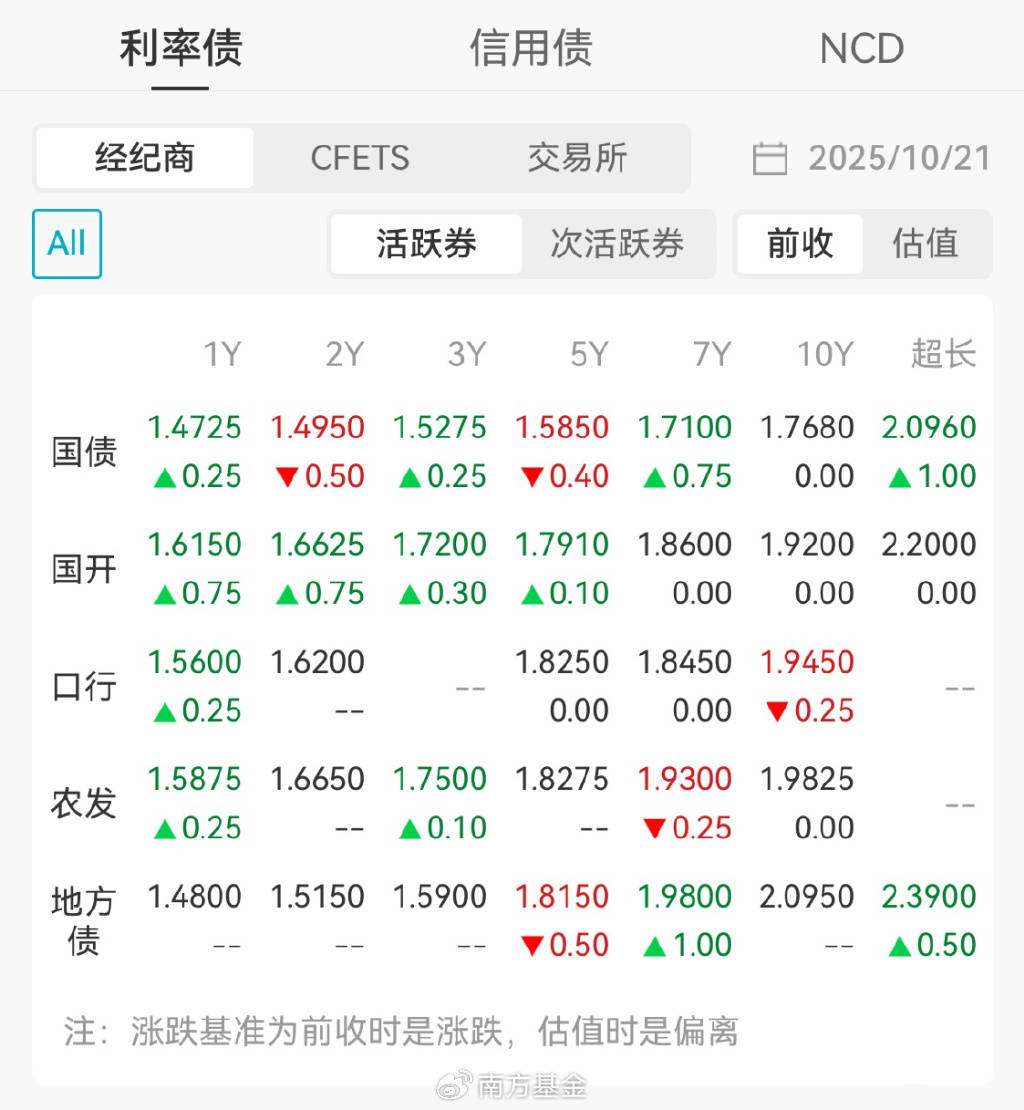
Market Overview - The bond market is experiencing slight fluctuations with mixed performance, as the 10-year and 30-year government bonds yield 1.77% and 2.1% respectively [1] - Government bond futures are down across the board, with the 30-year main contract falling by 0.33% and the 10-year main contract decreasing by 0.17% [1] Liquidity Situation - The central bank has conducted a reverse repurchase operation of 100 billion, resulting in a net liquidity recovery of 68.5 billion after accounting for 91 billion in maturing amounts [2] - The liquidity remains stable and accommodative, with overnight and 7-day funding rates at 1.3% and 1.44% respectively [2] Reverse Repo Details - Recent reverse repo operations include: - 7-day reverse repo on October 20 with an issuance of 189 billion and maturity of 116 billion [4] - 7-day reverse repo on October 21 with an issuance of 159.5 billion and maturity of 91 billion [4] Bond Market Outlook - In the short term, the bond market pricing is not primarily driven by fundamentals, as new fund sales regulations have yet to be implemented and expectations for loose monetary policy remain insufficient [3] - The 10-year government bond yield is likely to fluctuate within the range of 1.7% to 1.8% [3] U.S. Treasury Focus - The key focus for U.S. Treasuries this week is the September CPI data; if inflation remains moderate, it could strengthen the expectation for a rate cut by the Federal Reserve in October, potentially leading to further declines in Treasury yields [5] - However, there are two risk factors to consider: a marginal easing in U.S.-China trade tensions may reduce market risk aversion, and regional bank credit issues in the U.S. could impact the market in the short term [5] - A balanced allocation between domestic stocks and bonds is recommended, along with diversification across countries for stable asset management [5]
贵金属2025年四季度展望:再创新高,强势延续
Nan Hua Qi Huo· 2025-09-30 11:37
Report Industry Investment Rating No relevant information provided. Core Viewpoints of the Report - The upward cycle of gold is not over, and any adjustment in gold prices should be seen as a buying opportunity on dips. The long - term trend of gold is anchored to its monetary attribute, and with the decline of the US dollar currency system, global central banks will increase their gold allocation and reduce their US dollar allocation. [2][120] - In the fourth quarter, central bank gold purchases will act as a support, and investment demand will be the driving force. Investment demand will shift from uncertain hedging transactions to interest - rate cut transactions on the monetary policy side. The target price of London gold in Q4 2025 will move up to the $4000/ounce area, with support at $3600/ounce, and the domestic price will be in the range of 820 - 900 yuan/gram. [2][121] - Silver trends generally follow gold, but there are differences in fundamentals and volatility. The expected operating range of London silver in the fourth quarter is $42 - 50/ounce, and the domestic price is 10000 - 12000 yuan/kilogram. A strategy of buying on dips is recommended. [3][121] Summary According to the Table of Contents 1. Precious Metals Market Review - In 2025, the domestic and foreign precious metals markets continued the bull market in 2024, with strong upward momentum and the relative strength of gold and silver switching. The foreign market outperformed the domestic market, mainly due to the appreciation of the RMB. [9] - In the third quarter, the precious metals market had both synchronization and differentiation. Gold started to break through upwards in late August, silver followed gold's upward movement in late August after a period of adjustment, and platinum's price moved up following gold and silver after a large - scale fluctuation in July. [9] - As of September 19, 2025, all precious metals showed significant price increases compared to the end of 2024, with COMEX silver having the highest increase of 48.05%, and the gold - to - silver ratio decreased by 3.75%. [19] 2. Cross - Market Price Difference Fluctuations Caused by Concerns over US Tariff Policies - From late last year to the first quarter of this year, concerns about the US imposing gold import tariffs led to large - scale arbitrage trading, pushing up the price difference between COMEX gold and London gold. Similar arbitrage transactions have occurred multiple times since November 2024. [23] - In the third quarter of this year, a similar story of cross - market price differences in precious metals repeated. In July, the premium of COMEX futures over London spot in the gold, silver, platinum, and palladium markets widened rapidly due to concerns that the US might extend copper import tariff measures to precious metals. [26] 3. Broad Monetary Expectations Boost Precious Metals Valuation and Investment Demand 3.1 Q3 Real Interest Rate Decline Boosts Gold Valuation - In August, the enhanced expectation of the Fed's interest - rate cut pushed down the 10 - year US Treasury real interest rate, thereby boosting the valuation of gold. Although the non - farm payroll report in early August was far below expectations, the lack of a clear signal from the Fed and the time interval between FOMC meetings limited the increase in precious metals prices. [33] - During the period of increasing interest - rate cut expectations, the US dollar index remained resilient, with a limited depreciation range. Except for the Swedish krona, the other five major currencies depreciated against the US dollar in Q3 2025, with the Japanese yen having the largest depreciation. [35] 3.2 The Fed's Monetary Easing Expectation is the Main Cause of the Decline in Real Interest Rates - The mid - to long - term decline in the real interest rate of US Treasury bonds is mainly driven by the Fed's interest - rate cut and easing expectations. At the September FOMC meeting, the Fed cut interest rates by 25 basis points as expected. Market expectations indicate that the Fed will cut interest rates 1.728 times by the end of this year and 4.317 times by the end of 2026. [41] - The dot - plot of the September FOMC meeting shows that most Fed officials expect the Fed to cut interest rates twice this year and once each in 2026 and 2027. Compared with June, the expected number of interest - rate cuts has increased due to the Fed's shift towards the employment side in balancing inflation and employment. [45] - The Fed's September economic forecast shows an upward revision of the GDP growth rate forecast for 2025 - 2027, a downward revision of the unemployment rate forecast for 2026 and 2027, and an upward revision of the PCE forecast, reflecting the Fed officials' increased concern about inflation and reduced concern about the economy. [49] 3.3 The Fed's Broad Monetary Policy Still Has Room for Strengthening - In the fourth quarter, the US dollar index and the 10 - year US Treasury real interest rate are expected to decline further, which will continue to boost the valuation of precious metals. The Fed's interest - rate cut and possible suspension of balance - sheet reduction are likely to be further strengthened due to increased economic downward pressure in the US and the expected increase in the number of Fed officials favorable to Trump. [51] - The US economy may face greater downward pressure in the fourth quarter and 2026, as evidenced by the cooling of the employment market and the negative impact of trade tariffs on the economy. The Fed's independence is being challenged through institutional and personnel interventions, and there is also the issue of fiscal coercion. [53][63] - Since 2025, global gold investment demand has increased significantly, but there was a net outflow in May. The uncertainty brought about by Trump's policies has increased the demand for gold investment and allocation, but the "90 - day suspension period" of the "reciprocal tariff" policy and the cooling of uncertainty have led to a partial withdrawal of investment demand. [73][75] 4. Central Bank Gold Purchases as a Support - Central bank gold purchases have shown a slowdown this year. From the perspective of the fourth quarter and 2026, central bank gold purchases will act as a support rather than the core driving force for price increases. Central banks are expected to continue to support the gold market, with a concave - shaped demand curve that is more sensitive to price declines. [81] - Long - term, the relationship between central bank gold purchases and gold prices is asymmetric. Central banks are more likely to increase purchases when prices fall, and the inhibitory effect on price increases is weaker than the boosting effect on price increases when prices fall. [82] - As of July, the Polish central bank was the largest gold purchaser in 2025, but its gold purchases slowed down in the second half of the year. Many central banks, including those of Azerbaijan, Kazakhstan, China, and Turkey, maintained a good demand for gold. [89] - According to a survey by the World Gold Council, most central banks expect to increase their gold reserves and reduce their US dollar reserves in the next five years. In the next 12 months, 95% of central banks expect the global central bank's gold reserves to continue to increase. [90][91][98] 5. Precious Metals Market Outlook 5.1 Q4 2025 Outlook: Reaching New Highs and Maintaining Strength - In terms of influencing factors, the decline in the US dollar index and the US Treasury real interest rate has boosted the valuation of precious metals. The rise in the precious metals market in the first half of the year was mainly due to hedging demand and interest - rate cut expectations. Central bank gold purchases provided support, and market supply - demand imbalances in the first quarter also contributed to the rise. Gold entered a consolidation phase from late April to mid - August and broke through after late August. [119] - The demand for silver is weaker than that for gold. Industrial silver demand has stagnated, and the underdeveloped investment channels in the domestic market have limited investment demand. However, the deviation of the gold - to - silver ratio and the small market size of silver have created trading opportunities. [120] - The long - term upward cycle of gold is not over, and any price adjustment should be seen as a buying opportunity. In the fourth quarter, investment demand will shift, and the price of London gold is expected to reach the $4000/ounce area, with support at $3600/ounce. The expected operating range of London silver in the fourth quarter is $42 - 50/ounce. [2][3][121]

短线暂偏震荡,中期逐渐转多
Dong Zheng Qi Huo· 2025-09-21 11:44
Industry Investment Rating - The short - term trend of treasury bonds is rated as "volatile", and the medium - term trend is expected to turn bullish gradually [1][3][13][14][15] Core Viewpoints - This week (09.15 - 09.21), treasury bond futures fluctuated, first rising and then falling. Looking ahead to next week, the market is still a mix of bullish and bearish factors, with the bond market mainly in a volatile state. In the short term, it is advisable to adopt a volatile mindset and not chase the upward trend. In the medium - term, as the fundamental factors are favorable for the bond market, the bond market in Q4 is expected to gradually strengthen [2][3][12][13][14][15] Summary by Directory 1. One - week Review and Views 1.1 This Week's Trend Review: Treasury Bond Futures Fluctuated - From 09.15 to 09.21, treasury bond futures first rose and then fell, showing an overall volatile trend. As of September 19th, the settlement prices of the main contracts of 2 - year, 5 - year, 10 - year, and 30 - year treasury bond futures were 102.358, 105.630, 107.755, and 114.880 yuan respectively, with changes of - 0.006, + 0.050, + 0.075, and - 0.280 yuan compared to last weekend [2][12] 1.2 Next Week's View: Short - term Volatility with a Gradual Turn to Bullish in the Medium - term - Next week, the market will be a mix of bullish and bearish factors, and the bond market will mainly fluctuate. In the long run, the fundamental factors are the main driving force for the bond market, and the bond market in Q4 is expected to strengthen. Strategies include: short - term volatile thinking, not chasing the upward trend; laying out medium - term long positions at low prices according to market sentiment; closing short - hedging strategies after the market returns to fundamentals; and moderately paying attention to the strategy of steepening the yield curve [3][13][14][15][16][17][18] 2. Weekly Observation of Interest - rate Bonds 2.1 Primary Market - This week, 85 interest - rate bonds were issued, with a total issuance volume of 664.539 billion yuan and a net financing amount of 466.425 billion yuan. The net financing amount of local government bonds decreased, while that of inter - bank certificates of deposit increased [20][23][24] 2.2 Secondary Market - Treasury bond yields generally increased. As of September 19th, the yields of 2 - year, 5 - year, 10 - year, and 30 - year treasury bonds were 1.49%, 1.62%, 1.88%, and 2.20% respectively, with changes of + 5.41, + 0.39, + 1.38, and + 1.75 basis points compared to last weekend. The spreads of 10Y - 1Y, 10Y - 5Y, and 30Y - 10Y all widened [28][29] 3. Treasury Bond Futures 3.1 Price, Trading Volume, and Open Interest - As of September 19th, the settlement prices of the main contracts of 2 - year, 5 - year, 10 - year, and 30 - year treasury bond futures were 102.358, 105.630, 107.755, and 114.880 yuan respectively. The trading volumes of 2 - year, 5 - year, 10 - year, and 30 - year treasury bond futures this week were 37,145, 77,933, 123,679, and 159,719 lots respectively, with changes of + 2,940, + 6,401, + 20,560, and - 16,964 lots compared to last weekend. The open interests were 76,364, 145,436, 244,571, and 167,280 lots respectively, with changes of + 3,818, + 1,953, + 16,013, and + 14,208 lots compared to last weekend [37][40] 3.2 Basis and IRR - This week, the opportunities for cash - and - carry arbitrage were not obvious. The basis of futures generally fluctuated within a narrow range, and the IRR of the CTD bonds of each main contract was between 1.3% - 1.4% [44] 3.3 Inter - delivery and Inter - product Spreads - As of September 19th, the inter - delivery spreads of the 2512 - 2603 contracts of 2 - year, 5 - year, 10 - year, and 30 - year treasury bond futures were + 0.066, + 0.120, + 0.335, and + 0.310 yuan respectively, with changes of - 0.008, - 0.010, + 0.005, and - 0.010 yuan compared to last weekend [47][48] 4. Weekly Observation of the Funding Situation - This week, the central bank's open - market operations had a net injection of 119.23 billion yuan. As of September 19th, R007, DR007, SHIBOR overnight, and SHIBOR 1 - week were 1.52%, 1.51%, 1.46%, and 1.49% respectively, with changes of + 3.29, + 2.64, + 9.40, and + 2.80 basis points compared to last weekend. The average daily trading volume of inter - bank pledged repurchase was 7.16 trillion yuan, 0.33 trillion yuan less than last week [53][55][57] 5. Weekly Overseas Observation - The US dollar index fluctuated within a narrow range, and the yield of 10 - year US Treasury bonds increased. As of September 19th, the US dollar index rose 0.03% to 97.6519 compared to last weekend's close, and the yield of 10 - year US Treasury bonds was 4.14%, up 8 basis points from last weekend. The spread between Chinese and US 10 - year Treasury bonds was inverted by 226.3 basis points [63] 6. Weekly Observation of High - frequency Inflation Data - This week, industrial product prices all rose, while agricultural product prices showed mixed trends. As of September 19th, the South China Industrial Product Index, Metal Index, and Energy and Chemical Index were 3,630.65, 6,411.66, and 1,664.67 points respectively, with changes of + 34.64, + 8.68, and + 23.30 points compared to last weekend. The prices of pork, 28 key vegetables, and 7 key fruits were 19.48, 4.98, and 6.85 yuan/kg respectively, with changes of - 0.40, - 0.09, and + 0.10 yuan/kg compared to last weekend [66] 7. Investment Recommendations - Adopt a volatile mindset in the short term, and lay out medium - term long positions according to market sentiment [67]
国债期货:资金继续收敛债市情绪仍弱 期债延续下行
Jin Tou Wang· 2025-09-11 02:11
Market Performance - The futures market saw a decline in government bond futures, with the 30-year main contract dropping by 0.86% to 114.760, marking a new closing low since March 19 [1] - The 10-year main contract fell by 0.27% to 107.490, while the 5-year and 2-year contracts decreased by 0.15% and 0.04% respectively [1] - The yield on major interbank bonds increased, particularly for mid to long-term bonds, with the 10-year government bond yield rising nearly 4 basis points [1] Funding Conditions - The central bank conducted a 7-day reverse repurchase operation on September 10, with a fixed rate of 1.40% and a total of 304 billion yuan, resulting in a net injection of 749 billion yuan for the day [2] - The overnight repurchase weighted rate for deposit institutions slightly increased, remaining above 1.42%, while non-bank institutions saw rates for pledged certificates and credit bonds rise close to 1.50% [2] - Despite the central bank's shift to net injections, liquidity remains tight due to factors like maturing certificates and government bond issuances [2] Operational Suggestions - The recent increase in redemption fees for bond funds has contributed to a weak sentiment in the bond market, which may remain sensitive to negative news in the short term [3] - Investors are advised to observe funding trends and await clearer positive signals from the central bank, particularly after the release of August economic data [3] - The bond market sentiment is currently weak, with the 10-year government bond yield not stabilizing at 1.8%, suggesting potential further declines in bond prices [3]
9月,债市重塑“独立人格”
Xin Lang Cai Jing· 2025-09-02 11:50
Group 1 - The core viewpoint of the articles indicates that the bond market in August has been primarily influenced by the stock market, leading to a "look at stocks to trade bonds" strategy, which has become the only trading rule in the bond market [2][10][9] - In August, the yields on 10-year and 30-year government bonds reached a peak of 1.79% and 2.06% respectively, reflecting a significant upward trend despite a generally loose funding environment [9][10][2] - The bond market's traditional pricing mechanisms have failed, as the expectations for a return to a stable stock market have been repeatedly invalidated [10][2] Group 2 - Institutional behavior is identified as a significant risk factor for the bond market in the upcoming quarter, with banks under pressure to realize profits due to declining financial investment returns [3][18][21] - The average decline in financial investment returns for state-owned banks and joint-stock banks in the first half of 2025 was 30 basis points and 28 basis points respectively, indicating a heightened urgency to cash in on profits [18][21] - The behavior of banks, including a trend of "selling long and buying short," suggests a cautious approach to bond investments as they seek to adjust their balance sheets [21][18] Group 3 - The funding environment is expected to be tight at the beginning of September but may ease later in the month, with historical trends indicating a rise in funding rates post-August [4][31][33] - The central bank's commitment to maintaining a stable funding environment is evident, with significant short-term injections to fill funding gaps during tax periods [33][31] - The anticipated net issuance of government bonds in September is projected to be around 1.3 trillion yuan, which is expected to have a limited impact on the funding environment [31][33] Group 4 - The fundamental economic indicators for July showed a downward trend in inflation, credit, consumption, investment, and real estate, which the bond market has largely ignored [5][38][41] - The upcoming release of August data may reinforce the downward trend in key economic indicators, potentially leading to increased expectations for loose monetary policy [5][38] - The real estate market continues to face challenges, with significant declines in second-hand housing prices in major cities, indicating weak demand [41][38] Group 5 - The bond market's ability to regain its "independent personality" hinges on three key factors: the stock market's return to a volatile state, the release of economic data, and the clearing of negative institutional behaviors [6][45][49] - The current market conditions suggest that while the stock market may experience fluctuations, it is premature to conclude that the upward trend has ended, necessitating a defensive stance in the bond market [49][45] - The bond market is expected to undergo a three-phase process in September: an observation period, a negotiation period, and a bargain-hunting period, with strategies focusing on leveraging and maintaining a neutral duration [57][58]