反内卷政策

Search documents
20cm速递|创业板医药ETF国泰(159377)飘红,创新药技术主线受关注
Mei Ri Jing Ji Xin Wen· 2025-12-22 06:32
Core Viewpoint - The global competitiveness of Chinese innovative pharmaceutical companies is continuously improving, with a focus on innovation in treatment areas and technology platforms [1] Group 1: Treatment Areas - The commercial health insurance premium scale has significant growth potential and is expected to become a new source of medical payment [1] - Fast-growing treatment areas include cutting-edge technologies such as GLP-1, ADC, and bispecific antibodies [1] - In addition to existing popular fields like oncology and immunology, potential treatment areas to watch include metabolic diseases (e.g., weight loss), chronic diseases (e.g., hypertension, hyperlipidemia), and central nervous system disorders (e.g., Alzheimer's, Parkinson's) [1] Group 2: Technology Platforms - Potential technology platforms to focus on include small nucleic acid drugs, radioactive drugs (RDC), and CAR-T therapies [1] Group 3: Medical Device Industry - The medical device industry is currently under pressure due to policy impacts, but the fundamentals are expected to improve with the ongoing implementation of anti-involution policies, clearing of centralized procurement, and innovation upgrades by companies along with international business expansion [1] Group 4: Investment Products - The Guotai Innovation Pharmaceutical ETF (159377) tracks the Innovation Pharmaceutical Index (399275), which has a daily price fluctuation limit of 20% [1] - This index focuses on the innovative biopharmaceutical sector, selecting listed company securities involved in biopharmaceuticals, chemical pharmaceuticals, and medical services to reflect the overall performance of pharmaceutical companies with high R&D investment and innovation capabilities, leaning towards high-tech and growth styles [1]

需求稳中偏弱,供给弹性增强
Guo Mao Qi Huo· 2025-12-22 04:24
1. Report Industry Investment Rating - The investment view is bearish on glass (FG) and soda ash (SA) [1] 2. Core View of the Report - In 2025, the demand for glass and soda ash was weak, and the supply was high, leading to a continuous decline in prices and a compression of industrial profits. In 2026, the weak demand will continue to suppress the upward drive of prices, but the supply elasticity will increase significantly under the influence of profit compression and policies. The fundamentals of glass and soda ash will remain loose, and prices may be more affected by supply changes [3][85][86] 3. Summary by Relevant Catalogs 3.1 Market Review 3.1.1 Glass - In 2025, glass prices were under pressure and continued to decline. The annual average price of 5mm glass in the Shahe area was about 1,100 yuan, a year - on - year decrease of 21.4%. The price fluctuations were mainly divided into three stages: continuous decline from the beginning of the year to the end of June, a rise and then a fall in the third quarter, and a continued decline under pressure in the fourth quarter. The futures price showed a contango structure, and the basis and inter - month spreads had obvious characteristics. The glass factory's profit was under pressure and fluctuated at a low level [4][7][14] 3.1.2 Soda Ash - In 2025, the supply of soda ash was strong and the demand was weak, and the price center of gravity continued to move down. The annual average price of heavy soda ash in the Shahe area was about 1,286 yuan, a decrease of 32.2% compared with 2024. The price fluctuations mainly went through four stages: a slight rise before and after the Spring Festival, a sharp decline in the second quarter, a rise and then a fall in the third quarter, and a continued decline and a new low in the fourth quarter. The basis and spreads fluctuated slightly, and the annual structure was in backwardation. The alkali factory's profit was under pressure and decreased [24][28][32] 3.2 Glass Fundamental Analysis 3.2.1 Supply Analysis - In 2025, the glass supply was mainly stable, with a slight increase followed by a decline. The production profit was under pressure, and the industry clearing was slow. In 2026, the glass factory's production profit will continue to be under pressure, and the industry may accelerate the clearing. The daily melting volume and start - up rate are expected to decline, but the reduction may still be insufficient [42][43] 3.2.2 Demand Analysis - In 2025, the glass demand was weak, with a slight improvement in stages. Real estate demand continued to decline, while manufacturing demand was resilient. In 2026, the overall demand will remain weakly stable, with real estate demand still under pressure and manufacturing demand maintaining a certain degree of support. The inventory is expected to remain at a high level and fluctuate [53][54][62] 3.3 Soda Ash Fundamental Analysis 3.3.1 Supply Analysis - In 2025, the soda ash supply was at a high level, and the new production capacity was put into operation. In 2026, the production capacity expansion will slow down, and the production capacity will start to clear in the medium and long term. The supply elasticity of alkali factories is relatively strong, and the price will continue to fluctuate greatly due to supply disturbances [64] 3.3.2 Demand Analysis - In 2025, the demand for soda ash was weakly stable, with a downward trend. The demand from float glass and photovoltaic glass was weak, while the demand for light soda ash was relatively good. In 2026, the demand for soda ash will still be an important driving factor. The demand from float glass and photovoltaic glass is expected to weaken, but the overall demand still has strong resilience [74][75][84] 3.4 Summary and Outlook - In 2025, the downstream demand for glass and soda ash was weak, and the supply was high, resulting in an imbalance in fundamentals and a continuous decline in prices. In 2026, the weak demand will continue to suppress the upward space of glass and soda ash prices, and the industrial profits will continue to be under pressure. The prices may be more affected by supply changes, and the overall fluctuation range is limited [85][86]
中泰期货晨会纪要-20251222
Zhong Tai Qi Huo· 2025-12-22 02:26
Report Industry Investment Rating No relevant content provided. Core Views of the Report The report provides trend judgments and investment suggestions for various futures products based on fundamental and quantitative indicators, and summarizes macro - financial news and market conditions of different industries. It analyzes the supply - demand relationship, price trends, and influencing factors of each product, and gives corresponding trading strategies [2][7][9][14]. Summary by Related Catalogs 1. Fundamental - based Trend Judgment - **Trend空头**: Carbonate lithium [2] - **Oscillating偏空**: Synthetic rubber, lead, etc. [2] - **Oscillating**: Ethylene glycol, zinc, etc. [2] - **Oscillating偏多**: Pulp, short - fiber, etc. [2] 2. Quantitative Indicator - based Trend Judgment - **偏空**: Zhengzhou cotton, PTA, etc. [7] - **Oscillating**: Rebar, plastic, etc. [7] - **偏多**: Rapeseed oil, rapeseed meal, etc. [7] 3. Macro - news - **Regulatory actions**: The National Internet Information Office and the China Securities Regulatory Commission have cracked down on false information in the capital market, and punished accounts spreading rumors and illegally recommending stocks [9]. - **Stock market**: Pingtan Development's stock price fluctuated greatly on December 19th [9]. - **International central bank policies**: The Bank of Japan raised interest rates by 25 basis points to 0.75%, and the yield of 10 - year Japanese government bonds reached a 26 - year high [9]. - **Domestic policies**: The State Council Executive Meeting arranged the implementation of the decisions of the Central Economic Work Conference, and the China Banking and Insurance Regulatory Commission issued a draft regulation on the asset - liability management of insurance companies [10]. - **Corporate news**: ByteDance is expected to achieve a record profit of $50 billion in 2025, with its annual revenue expected to increase by over 20%. It is also promoting cooperation with hardware manufacturers on AI mobile phones [10]. 4. Macro - finance - **Stock index futures**: Pay attention to the continuity and structure of liquidity repair. If realized, the index may strengthen. A - shares are oscillating higher, and it is necessary to pay attention to the economic data from January to February next year and the rhythm of macro - policy implementation [14]. - **Treasury bond futures**: Short - and medium - term bonds may oscillate strongly, but the odds are more important than the direction. The probability of the central bank cutting interest rates next week is relatively low [15]. 5. Black Industry - **Coking coal and coke**: The prices of coking coal and coke may oscillate and rise in the short term, but the potential negative feedback risk still restricts the price increase. The supply of coking coal is expected to shrink, and the downstream replenishment is slow [17]. - **Ferroalloys**: It is recommended to close out previous long positions and pay attention to short - selling opportunities in the short term. The fundamental logic of manganese silicon remains unchanged [18]. 6. Non - ferrous Metals and New Materials - **Zinc**: After the macro - positive factors fade, the price is expected to oscillate lower. It is recommended to hold short positions. The short - term market will focus on overseas macro and domestic supply changes [22]. - **Lead**: It is recommended to continue holding previous short positions. The production of electrolytic lead may decline slightly this week [23]. - **Carbonate lithium**: The short - term demand is weakening, and there may be a short - term correction, but it will rise in the long - term and operate in a wide - range oscillation [24]. - **Industrial silicon and polysilicon**: Industrial silicon may have some valuation repair opportunities, and polysilicon is expected to be strong under the anti - involution policy. Pay attention to low - buying opportunities on dips [25][26]. 7. Agricultural Products - **Cotton**: The short - term supply is loose, but the long - term supply is expected to shrink. The price of Zhengzhou cotton is expected to oscillate strongly in the short term [28]. - **Sugar**: The domestic sugar supply - demand situation is still bearish. It is recommended to wait and see, and be cautious when short - selling at low prices [30]. - **Eggs**: The spot price may rise before the Spring Festival, but the increase may be limited. The contracts after the Spring Festival are under pressure, and the far - month contracts are supported by the expectation of a decline in inventory [32]. - **Apples**: The futures price may oscillate. The sales in the production and sales areas are slow, and the price of high - quality goods is firm [34]. - **Corn**: Pay attention to the spot price changes in the production area. It is recommended to short - sell the far - month contracts at high prices or look for reverse - spread opportunities [35]. - **Red dates**: Pay close attention to the market performance during the peak consumption season, and currently maintain an oscillating view [36]. - **Pigs**: The supply is strong and the demand is weak. It is recommended to short - sell the near - month contracts at high prices [38]. 8. Energy and Chemical Industry - **Crude oil**: The short - term market focuses on geopolitical factors, but the supply surplus is still the main trading line [39]. - **Fuel oil**: The price will follow the oil price, and the short - term focus is on geopolitical impacts [40]. - **Plastic**: Polyolefins are expected to oscillate weakly due to large supply pressure and weak downstream demand [41]. - **Rubber**: It is recommended to stop profiting on the ru - nr spread strategy in the short term and try short - buying on dips [42]. - **Synthetic rubber**: Short - sell at high prices in the short term, and be cautious when chasing short positions on sharp drops [43]. - **Methanol**: The short - term may have some support, and the far - month contracts can be considered for a slightly long - biased allocation after the inventory is smoothly reduced [44]. - **Caustic soda**: Avoid going long on the near - month contracts, and hold long positions on the main contract dynamically [45]. - **Asphalt**: The price fluctuation is expected to increase, and the focus is on the price bottom after the winter storage game [46]. - **Polyester industry chain**: Consider going long on dips, and pay attention to the positive spread opportunities of PX and PTA 5 - 9 contracts [47]. - **Liquefied petroleum gas**: The price may oscillate, with support but limited upward momentum [48]. - **Pulp**: Do not chase long positions in the short term. Consider going long on dips if the spot price is stable [49]. - **Log**: The fundamentals are expected to maintain a weak supply - demand balance, and the price may oscillate [49]. - **Urea**: Maintain an oscillating view and wait to observe the start of the spot market after the end of environmental protection restrictions [51].
新世纪期货交易提示(2025-12-22)-20251222
Xin Shi Ji Qi Huo· 2025-12-22 01:56
Report Industry Investment Ratings - Iron ore: Oscillating [2] - Coking coal and coke: Oscillating [2] - Rolled steel and rebar: Oscillating [2] - Glass: Oscillating [2] - Soda ash: Oscillating [2] - CSI 500 Index Futures/Options: Rebounding [3] - CSI 1000 Index Futures/Options: Rebounding [3] - 2 - year Treasury bonds: Oscillating [3] - 5 - year Treasury bonds: Oscillating [3] - 10 - year Treasury bonds: Consolidating [3] - Gold: Oscillating with a bullish bias [3] - Silver: Oscillating with a bullish bias [3] - Logs: Rebounding from the bottom [4] - Pulp: Oscillating [4] - Offset paper: Weakly oscillating [4] - Soybean oil: Oscillating with a bearish bias [7] - Palm oil: Oscillating with a bearish bias [7] - Rapeseed oil: Oscillating with a bearish bias [7] - Soybean meal: Oscillating with a bearish bias [7] - Rapeseed meal: Oscillating with a bearish bias [7] - Soybean No. 2: Oscillating with a bearish bias [7] - Soybean No. 1: Oscillating with a bearish bias [7] - Live pigs: Bullish - biased [8] - Rubber: Oscillating [8] - PX: Widely oscillating [9] - PTA: Widely oscillating [9] - MEG: Oscillating [9] - PR: On the sidelines [9] - PF: On the sidelines [9] Core Views - The iron ore market is characterized by "loose supply, low demand, and port inventory accumulation" in 2026, and the implementation of the steel export license management system is a definite negative for raw materials [2]. - The coking coal and coke market is supported by capacity inspections, safety supervision, and anti - involution policies, but the steel export policy has shifted market expectations from supply - side policy benefits to demand - side negatives [2]. - The steel market has seen a rebound due to improved sentiment and short - term fundamentals, but the implementation of the steel export license management system requires a downward adjustment of export expectations and attention to production control policies [2]. - The glass market has a supply - demand contradiction due to weakening demand and insufficient supply contraction, and attention should be paid to macro and production line cold - repair situations [2]. - The financial market is in short - term shock adjustment, with the mid - term trend continuing and the high - tech industry growing. The gold price is affected by central bank gold purchases, geopolitical risks, and Fed interest rate policies [3]. - The log market has weakening supply pressure and non - weak demand in the off - season, and the price is expected to rebound from the bottom but with weak driving force [4]. - The pulp market has a loose supply - demand pattern, and the price is expected to oscillate [4]. - The double - offset paper market has supply pressure and general social orders, and the price is expected to weakly oscillate [4]. - The oil and fat market has uncertain demand prospects, high inventory pressure, and abundant supply, and is expected to oscillate with a bearish bias [7]. - The meal market has a relatively loose supply, and the price is expected to oscillate with a bearish bias due to factors such as the weakness of US soybeans and the expected high yield in South America [7]. - The live pig market has stable supply and increased downstream consumption demand, and the weekly average price is expected to increase slightly [8]. - The rubber market has supply affected by weather and demand with limited support, and the price is expected to oscillate [8]. - The polyester market has different trends for each product, with prices mainly affected by cost, supply - demand, and inventory factors [9]. Summary by Related Catalogs Black Industry - **Iron ore**: The global mine supply will increase significantly in 2026, while the current iron - making demand is weak, and the steel export policy is negative. Short - term rebounds can be used to enter short positions [2]. - **Coking coal and coke**: Supported by policies, but the steel export policy has a negative impact on demand. Short - term, the price may be affected by the disappearance of export orders, and the long - term anti - involution policy provides some support [2]. - **Rolled steel and rebar**: The market sentiment has been boosted, and the short - term fundamentals are good. However, the steel export policy requires attention to production control and export expectations [2]. - **Glass**: The supply - demand contradiction is prominent due to weak demand and insufficient supply contraction. The price is expected to oscillate at the bottom and may rebound due to sentiment [2]. Financial - **Stock index futures/options**: The market is affected by policy arrangements and regulatory changes. Different stock indexes have different trends, with some rebounding and some oscillating [3]. - **Treasury bonds**: The yield of 10 - year Treasury bonds is flat, and the market is in a state of consolidation with a slight rebound [3]. - **Precious metals**: The gold - pricing mechanism is changing, and factors such as central bank gold purchases, geopolitical risks, and Fed interest rate policies affect the price, which is expected to oscillate with a bullish bias [3][5]. Light Industry - **Logs**: The supply pressure is weakening, and the demand is non - weak in the off - season. The price is expected to rebound from the bottom, but the driving force is not strong [4]. - **Pulp**: The supply - demand pattern is loose, with cost support and weak demand. The price is expected to oscillate [4]. - **Double - offset paper**: The supply pressure exists, and the social orders are general. The price is expected to weakly oscillate [4]. Oilseeds and Oils - **Oils and fats**: The demand prospects are uncertain, the inventory is high, and the supply is abundant. The price is expected to oscillate with a bearish bias, and attention should be paid to weather and production - sales changes [7]. - **Meals**: The supply is relatively loose, affected by the weakness of US soybeans and the expected high yield in South America. The price is expected to oscillate with a bearish bias [7]. Agricultural Products - **Live pigs**: The supply is stable, the downstream consumption demand has increased slightly, and the weekly average price is expected to increase slightly [8]. Soft Commodities - **Rubber**: The supply is affected by weather, the demand support is limited, and the inventory is in a seasonal accumulation period. The price is expected to oscillate [8]. Polyester - **PX**: Geopolitical factors increase supply risks, and the price is affected by oil prices. The demand from downstream polyester can support it for the time being [9]. - **PTA**: The cost end is affected by oil price fluctuations, and the short - term supply - demand is improved but will deteriorate in the future. The price follows the cost end [9]. - **MEG**: There is a long - term inventory accumulation pressure, and the short - term price oscillates with an upward suppression [9]. - **PR**: The cost support is strong, but the terminal demand restricts the price increase [9]. - **PF**: The cost is strong, but the demand is expected to shrink after New Year's Day, and the processing fee may be compressed [9].
回顾反内卷政策,2026年钢铁分级管理怎么走?
Changjiang Securities· 2025-12-21 23:30
丨证券研究报告丨 行业研究丨行业周报丨钢铁 [Table_Title] 回顾反内卷政策,2026 年钢铁分级管理怎么走? 报告要点 [Table_Summary] 回顾 2025 年,反内卷无疑是钢铁行业最受关注的交易主线。作为低价内卷的典型行业,也是 过往供改的重点行业,市场期待随着反内卷的渐进深化,钢铁的供给侧具有出清的预期。尽管 2025 年暂未看到反内卷的具体举措落地,但通过对重点政策的系统性梳理,可以清晰地理出 "分级管理、扶优劣汰"的调控思路。随着 2026 年政策抓手和配套政策的进一步完善,行业 有望迎来供给侧出清的机遇。考虑到近年来产量压减政策的延续性和"扶优劣汰"的思路,不 规范企业或具有更大的产量压减幅度,从而具有市场化出清的预期。 分析师及联系人 [Table_Author] 王鹤涛 赵超 易轰 吕士诚 SAC:S0490512070002 SAC:S0490519030001 SAC:S0490520080012 SAC:S0490525080005 SFC:BQT626 SFC:BUY139 SFC:BUZ394 请阅读最后评级说明和重要声明 %% %% %% %% research ...
氨纶或迎格局重塑,欧盟对华轮胎反倾销暂不采取措施,不改企业出海优势
Shenwan Hongyuan Securities· 2025-12-21 12:13
Investment Rating - The report maintains an "Optimistic" rating for the chemical industry [3][4]. Core Insights - The chemical industry is expected to experience a restructuring in the spandex sector, with a potential upward trend in market conditions. The EU has decided not to impose anti-dumping measures on Chinese tires, which does not alter the competitive advantages for companies expanding overseas [3][4]. - The report highlights the macroeconomic conditions affecting the chemical sector, including stable oil prices, easing pressures in the coal market, and potential reductions in natural gas import costs due to increased export facility construction in the U.S. [3][4]. - The report suggests focusing on specific companies within the spandex, tire, and agricultural chemical sectors, indicating a positive outlook for companies like Huafeng Chemical, Xinxiang Chemical Fiber, and SaiLun Tire [3][4]. Summary by Sections Chemical Macro Judgment - Oil supply is tightening due to OPEC+ production delays and peak shale oil output, while demand is stabilizing with global economic improvements. Brent oil prices are expected to remain in the range of $55-70 per barrel [3][4]. - Coal prices are anticipated to stabilize at a low level, and natural gas costs may decrease as the U.S. accelerates its export infrastructure [3][4]. Spandex Industry Outlook - The spandex industry is currently operating at an 84% utilization rate, with a significant price gap remaining at historical lows. The report anticipates a recovery in market conditions as outdated capacities are phased out [3][4]. - Companies to watch include Huafeng Chemical, Xinxiang Chemical Fiber, and Taihe New Materials [3][4]. Tire Industry Insights - The EU's decision to delay anti-dumping measures on Chinese tires is seen as a positive for companies like Sailun Tire and Zhongce Rubber, as it allows for safer procurement from Southeast Asia or overseas bases [3][4]. - The report emphasizes the importance of global supply chain strategies in light of changing trade barriers [3][4]. Investment Recommendations - The report recommends a diversified investment approach across various chemical sectors, including textiles, agricultural chemicals, and export-oriented products, highlighting specific companies for potential investment [3][4]. - Key materials for growth are identified, including semiconductor materials and OLED panel materials, with specific companies suggested for each category [3][4].


六大私募展望2026:股市仍有较好机会,成长与价值风格趋于均衡
Xin Lang Cai Jing· 2025-12-21 10:52
炒股就看金麒麟分析师研报,权威,专业,及时,全面,助您挖掘潜力主题机会! 来源:中国基金报 2025年,市场超预期回暖,A股、港股结构性行情显著,投资者对即将到来的2026年充满期待。新的一 年经济前景如何?市场行情如何演绎? 中国基金报记者采访了复胜资产董事长兼投资总监陆航、相聚资本总经理梁辉、康曼德资本董事长丁 楹、华安合鑫董事长袁巍、深圳红筹投资总经理兼投资总监邹奕和同犇投资总经理童驯等六位私募投资 人士。 受访人士表示,在盈利和业绩驱动下,2026年中国股市仍有较好的机会,A股与港股有望保持上行态 势,风格上成长与价值将趋于均衡;看好AI产业链,以及周期、消费和制造业的投资机会。 2025年结构性行情超出预期 中国基金报:2025年的市场与年初预期有哪些不同? 童驯:今年A股市场呈现显著的结构性行情,科创板、创业板及主板表现均超出年初时的预期。行业分 化特征鲜明,有色金属、通信、电子等板块表现亮眼。核心驱动源于双重逻辑:一是供求关系收紧叠加 美联储降息周期开启,贵金属(金、银)、小金属(钨、锑、钴)及工业金属(铜、铝)价格大幅上 涨,直接推动有色金属板块估值与业绩双升;二是AI产业技术进展持续超预期, ...
六大私募展望2026:股市仍有较好机会,成长与价值风格趋于均衡
中国基金报· 2025-12-21 10:46
Core Viewpoint - The Chinese stock market is expected to have good opportunities in 2026, with A-shares and H-shares likely to maintain an upward trend, and a balance between growth and value styles is anticipated [3][10]. Group 1: Market Performance in 2025 - The market in 2025 showed significant structural performance, with sectors like non-ferrous metals, communication, and electronics performing well due to tightening supply-demand relationships and advancements in AI technology [5][6]. - The A-share and H-share markets exceeded initial expectations, with actual returns surpassing 20%, driven by a recovery in valuations and a strong performance in technology and small-cap stocks [6][7]. Group 2: Economic Outlook for 2026 - The domestic GDP is expected to maintain stable growth, supported by a resilient export outlook and ongoing fiscal and monetary policies [10][11]. - The stock market in 2026 will shift from valuation recovery to being driven by earnings and performance, with opportunities in technology, cyclical, consumer, and manufacturing sectors [10][12]. Group 3: Investment Opportunities - Key investment opportunities for 2026 include the AI industry chain, advanced manufacturing with real technological barriers, and traditional industry leaders with strong balance sheets and cash flows [14][15]. - The focus will be on sectors benefiting from policy support and industry optimization, particularly in technology innovation and traditional industries undergoing upgrades [14][15]. Group 4: Market Dynamics and Stock Selection - The differentiation between "old economy" and "new economy" stocks is expected to narrow, with both types of stocks showing potential for balanced performance [18][19]. - The market is transitioning from a narrative-driven approach to one focused on fundamental performance, emphasizing the importance of earnings realization in stock selection [20][21]. Group 5: Cautionary Notes - Investors should be wary of stocks that lack earnings support and those that have shown signs of bubble formation, focusing instead on undervalued quality companies [22][23].


告别低通胀、AI接力新需求叙事,改革红利提振消费率......十大券商一文展望2026中国经济
Hua Er Jie Jian Wen· 2025-12-21 01:13
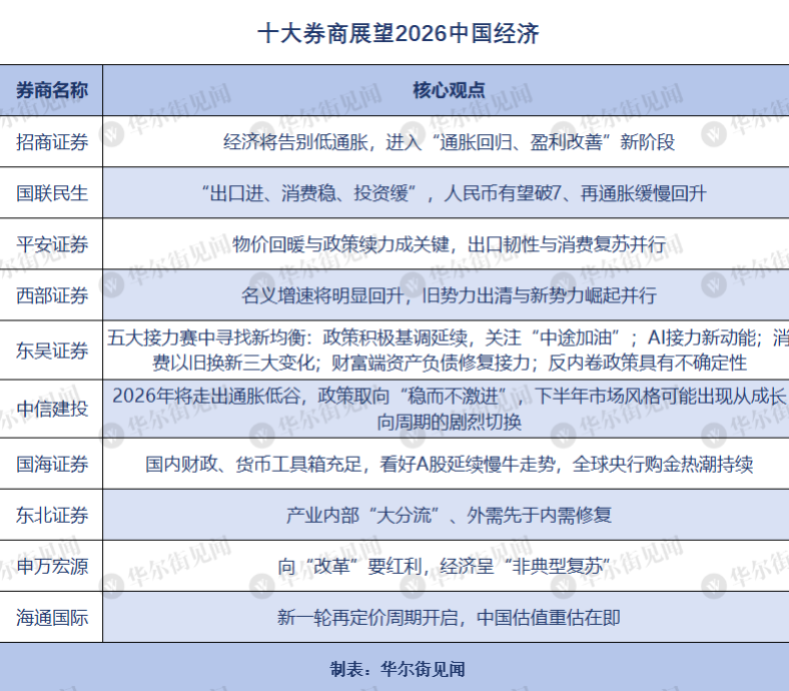
Core Viewpoint - The year 2026 is projected to be a turning point for China's economy, moving away from low inflation and establishing a "new equilibrium" as per the consensus among major securities firms [1]. Group 1: Macroeconomic Growth and Price Recovery - Major securities firms, including China Merchants, Ping An, and West Securities, agree that the Chinese economy will emerge from the low inflation phase, with expectations of nominal GDP growth recovery driven by price factor improvements [1][5]. - The "anti-involution" policy is expected to limit supply, combined with the pig cycle bottoming out and PPI turning positive, which will be key in improving corporate profitability and nominal GDP [1][5][6]. Group 2: Structural Transition and New Growth Drivers - 2026 is seen as a critical juncture for the transition between old and new growth drivers, with real estate investment entering a bottoming phase while AI, data center energy demand, and high-end manufacturing are expected to become substantial growth engines [1][5][21]. - The consensus is that the economy will experience a "new-old relay" with significant changes in investment structures, particularly in manufacturing and real estate [1][21]. Group 3: Demand-Side Drivers - There is a divergence in views regarding demand-side drivers; some firms like Minsheng and Northeast Securities believe external demand will outperform internal demand, while others like West Securities and Shenwan Hongyuan predict a shift towards internal demand dominance [1][5][21]. Group 4: Asset Allocation and Market Style Predictions - Opinions on asset allocation and market style are highly varied, with Haitong International being the most optimistic, predicting a 40% increase in the Shanghai Composite Index based on "value re-evaluation" logic [2][50]. - China Merchants Securities anticipates a shift from "policy-driven" to "profit-driven" market dynamics, while others suggest a more balanced focus on both growth and cyclical opportunities [2][21]. Group 5: Key Predictions from Securities Firms - China Merchants Securities predicts a recovery in corporate profits and a shift in policy focus towards enhancing development quality, with manufacturing investment expected to grow by 5% and real estate investment's decline narrowing to -8% [5][10]. - Ping An Securities emphasizes the importance of price recovery, forecasting CPI to rise to 0.6% and PPI to narrow its decline significantly [16][18]. - West Securities expects nominal GDP growth to accelerate, driven by inflation recovery and the emergence of new growth forces [21][23]. Group 6: External Environment and Trade Dynamics - The external environment is expected to improve, with strong export performance contributing significantly to GDP growth, projected to be around 40%-50% from actual export growth [11][44]. - The report from Northeast Securities highlights that external demand will recover before internal demand, with exports expected to grow by approximately 7% [44][45].





解锁2025中国经济关键密码
Sou Hu Cai Jing· 2025-12-20 14:10
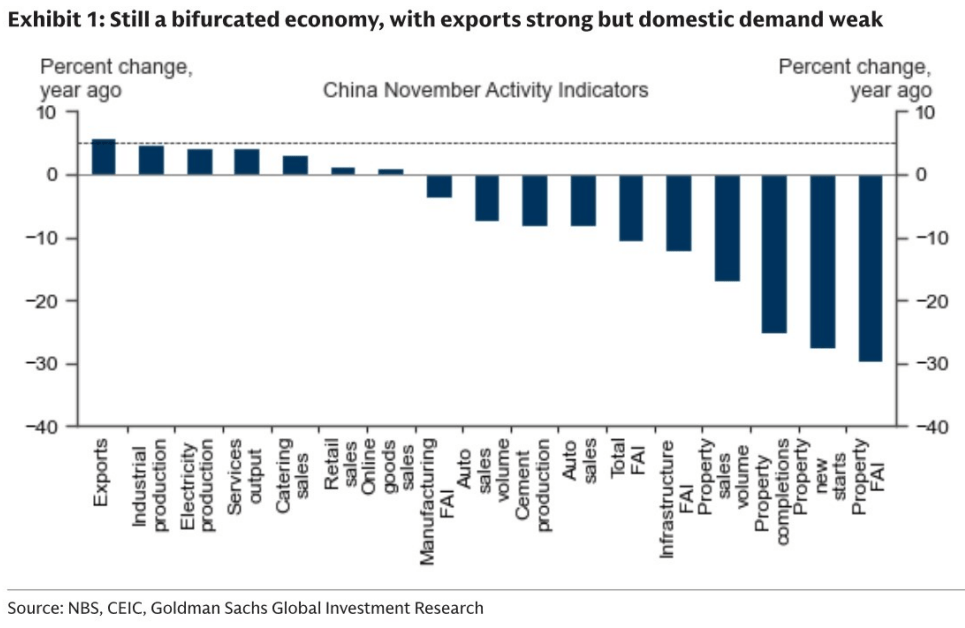
Group 1 - The core viewpoint is that China's economy in 2025 is characterized by a divergence, with strong export performance and weak domestic demand, contributing approximately half of the actual GDP growth despite increased tariffs from the US [5] - China's exports to the US have decreased by 20%-30%, but exports to other emerging markets have seen significant growth, indicating a diversification of China's export markets [10][7] - The actual effective exchange rate of the Renminbi has decreased by 20%, enhancing China's export competitiveness [13] Group 2 - China's goods trade surplus has exceeded $1 trillion for the first time in 2025, driven by structural growth in high-tech manufacturing exports [15] - The construction cycle has entered its fifth year, with new construction and sales indicators down by 50%-80% compared to the peaks of 2020-2021, indicating a lack of short-term recovery [21] - Employment pressure is high, with the unemployment rate reaching a new high of 18.9% in August 2025, reflecting the strain on the labor market amid weak domestic demand [26] Group 3 - The effectiveness of consumption stimulus policies is diminishing, with households showing a preference for saving rather than spending, leading to nearly 60 trillion RMB in "excess savings" [30][35] - The re-inflation process is slow due to a lack of strong demand-side stimulus, with supply-demand imbalances persisting despite government efforts [39] - Macro policies in China were notably loose in the first half of 2025, including accelerated government bond issuance and interest rate cuts, but the pace of easing slowed in the second half due to strong export performance [44] Group 4 - China ranks first globally in patent applications, accounting for 26% of the total, reflecting strong momentum in technology research and innovation [49] - The stock market performance shows a divergence between the technology sector, which is performing well, particularly in AI-related indices, and the real estate sector, which is underperforming [52] - The strategic focus of China's 15th Five-Year Plan (2026-2030) will be on technology, security, and livelihood, aiming to expand domestic demand and promote high-quality growth while facing challenges in transitioning growth drivers and enhancing consumer confidence [54]