
股债跷跷板效应

Search documents
信用利差周报2025年第28期:“股债跷跷板”效应下债市回调,政治局会议影响几何?-20250812
Zhong Cheng Xin Guo Ji· 2025-08-12 11:03
Report Industry Investment Rating - Not provided in the document Core Viewpoints - In the context of the "stock-bond seesaw" effect, the bond market adjusted due to the stock market's rise. However, the bond market still has support from fundamentals and capital, and the yield center may remain low. The Politburo meeting's policies may boost stock market activity, causing short-term disturbances to the bond market [4][11][12] - The Central Bank and the Ministry of Agriculture and Rural Affairs issued a document encouraging the issuance of rural revitalization bonds, which may lead to the expansion of such bonds [5][14][15] - Industrial enterprise profits declined in the first half of the year, with industrial product prices dragging down revenue and profits, while "volume" remained an important support factor for profit recovery [6][17] Summary by Directory Market Hotspots - **Stock-Bond Seesaw Effect and Bond Market Adjustment**: The stock market rose significantly last week, with the Shanghai Composite Index breaking through 3600 points, triggering the "stock-bond seesaw" effect. The bond market adjusted, with most major bond market indices falling and bond yields rising. The 10-year Treasury yield reached 1.73%. The Politburo meeting's policies may increase stock market activity, causing short-term disturbances to the bond market, but the bond market still has support [4][11][12] - **Policy Encouragement for Rural Revitalization Bonds**: The Central Bank and the Ministry of Agriculture and Rural Affairs jointly issued a document encouraging the issuance of rural revitalization bonds. This policy aims to provide comprehensive financial support for rural revitalization, and rural revitalization bonds may expand in the future [5][14][15] Macroeconomic Data - Industrial enterprise profits declined by 1.8% year-on-year from January to June, with the decline widening compared to the previous period. In June, the profit decline narrowed, indicating marginal improvement but overall weakness. Industrial product prices continued to drag down profits, while industrial production was supported by factors such as the "export rush" effect and the "618" shopping festival [6][17] Money Market - The central bank's net capital injection decreased last week, leading to a marginal tightening of liquidity. Most interbank repurchase rates rose, except for a slight decline in the DR1m rate. The spread between the 3-month and 1-year Shibor widened [20] Primary Market of Credit Bonds - The issuance scale of credit bonds increased last week, reaching 3243.17 billion yuan, an increase of 418.72 billion yuan from the previous period. Different bond types showed varying trends, with ultra-short-term financing bonds and corporate bonds increasing significantly. The infrastructure investment and financing industry had a net outflow of financing, while most industries in the industrial bond sector had a net inflow. The issuance cost of credit bonds mostly increased [23][25][31] Secondary Market of Credit Bonds - The trading volume in the secondary bond market increased last week, with the daily average trading volume reaching 19682.03 billion yuan. Bond yields generally rose, with interest rate bonds and credit bonds both showing significant increases. Most credit spreads widened, while rating spreads showed mixed trends with small changes [33][36][40]
债市周观察:股市上涨对债市仍有压制,十年期国债重回1.7以上
Great Wall Securities· 2025-08-12 02:45
Report Industry Investment Rating - No information provided on the industry investment rating [1][2] Core Viewpoints - The short - term fluctuations caused by current policies are constrained within the interest rate central framework, and the bond market will return to the fundamentals in the medium term after short - term negative shocks [2][19] - In the context of continued loose funding, the bond market is expected to maintain an oscillation range of 1.65% - 1.75%. A decline below 1.65% or a new low requires a substantial domestic interest rate cut, so whether the Fed cuts interest rates in September is an important variable [2][19] Summary by Directory 1. Interest Rate Bond Last Week's Data Review - **Funding Rates**: DR001 remained at around 1.31% with a 1BP weekly fluctuation; R001 was around 1.35% and closed at 1.34% on August 8th with a 1BP weekly fluctuation. DR007 fell 2BP from 1.45% on August 4th to 1.43% on August 8th; FR007 dropped from 1.48% to 1.46% with a 2BP weekly decline [7] - **Open Market Operations**: The central bank's reverse - repurchase injection volume shrank to 1126.7 billion yuan, with a total maturity of 1660 billion yuan, resulting in a net capital injection of - 536.5 billion yuan [7] - **Sino - US Market Interest Rates**: The inversion of the 10 - year bond yield spread between China and the US slightly increased. The 6 - month SOFR rate in the US dropped from 4.10% on August 4th to 4.06% on August 8th, while the 6 - month SHIBOR rate in China remained stable at 1.61%. As of August 8th, the 6 - month interest rate spread was - 245BP with a slightly reduced inversion. The 2 - year and 10 - year bond yield spreads were - 236BP and - 258BP respectively, with a slightly increased inversion in the short - and long - term spreads [13] - **Term Spreads**: The term spreads of Chinese bonds and US bonds both slightly expanded. The 10 - 2 year spread of Chinese bonds increased from 28BP to 29BP; the 10 - 2 year spread of US bonds expanded by 1BP to 51BP [15] - **Interest Rate Term Structure**: The yield curve of Chinese bonds shifted downward by about 2BP - 3BP; the yield curve of US bonds flattened, with most maturities rising except for the 3 - month maturity, and the mid - term callback was relatively large [15] 2. Narrowing of CPI and PPI Month - on - Month Declines - **CPI**: In July, the year - on - year CPI was flat, down 0.1 percentage points from the previous month. The food item of CPI was - 1.6% year - on - year, down 1.3 percentage points from the previous month, while the non - food item was 0.3% year - on - year, up 0.3 percentage points from the previous month. The core CPI increased by 0.8% year - on - year, with the growth rate expanding for three consecutive months. The month - on - month CPI rose from - 0.1% to 0.4%, the highest since February this year. Service consumption, driven by the summer tourism season, had a significant month - on - month increase [20][21] - **PPI**: In July, the year - on - year decline of PPI remained at 3.6%, and the month - on - month decline narrowed by 0.2 percentage points to - 0.2%, the first narrowing since March this year. The narrowing of PPI month - on - month mainly relied on the recovery of producer goods ex - factory prices. The month - on - month decline in prices of multiple industries narrowed, which was consistent with the increase in commodity prices [28] 3. Key Bond Market Events Last Week - **US Employment Data and Fed Rate - Cut Probability**: The US non - farm payrolls in July increased by 73,000, lower than the expected 110,000, and the unemployment rate was 4.2%. The poor employment data increased the probability of a Fed rate cut in September [30] - **Bond Market Underwriting Regulations**: On August 7th, a notice on strengthening self - discipline management of bond underwriting quotes in the inter - bank bond market was issued, stating that lead underwriters should not bid for bond projects with underwriting fees below cost [32]
【债市观察】央行买断式逆回购注入中期流动性 首批恢复征税地方债平稳发行
Xin Hua Cai Jing· 2025-08-11 06:00
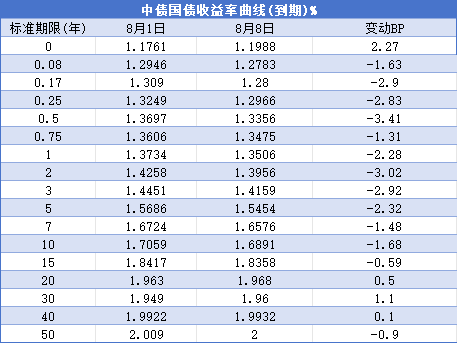
Core Viewpoint - The bond market experienced fluctuations with a slight decline in yields, influenced by the recovery of the equity market and the central bank's liquidity measures. The 10-year government bond yield fell by 1.68 basis points to 1.69% over the week [1][4]. Market Overview - The bond market saw a total issuance of 61 bonds amounting to 806.51 billion yuan, including 4.6855 billion yuan in government bonds and 1.725 billion yuan in policy bank bonds [7]. - The central bank conducted a buyout reverse repurchase operation of 700 billion yuan to maintain liquidity, resulting in a net injection of 163.5 billion yuan into the market [13][14]. Yield Changes - The yield curve for government bonds showed varied changes from August 1 to August 8, with the 10-year yield decreasing by 1.68 basis points to 1.6891% [2][3]. - The 30-year and 10-year futures contracts rose by 0.19% and 0.18%, respectively, indicating a bullish sentiment in the futures market [6]. International Market Context - The U.S. Treasury market showed signs of weakness, with yields rising by 6-8 basis points, reflecting a decrease in demand for newly issued bonds [8][9]. - The market anticipates three rate cuts by the Federal Reserve by the end of the year, with an 88.9% probability for a 25 basis point cut in September [11]. Institutional Insights - Analysts suggest that the recent issuance of local government bonds exceeded expectations, indicating a supportive stance from the central bank and a pursuit of yield by institutions [17][18]. - The bond market is expected to remain in a range-bound trading pattern, with specific attention to the 10-year government bond yield around 1.7% [17][18].

债市早报:7月CPI环比由降转涨,PPI环比降幅收窄;资金面平稳偏松,债市偏强震荡
Sou Hu Cai Jing· 2025-08-11 02:49
【内容摘要】8月8日,资金面延续平稳偏松态势;债市整体偏强震荡;转债市场继续小幅上涨,转债个 券多数上涨;各期限美债收益率普遍上行,主要欧洲经济体10年期国债收益率普遍上行。 一、债市要闻 (一)国内要闻 【7月CPI环比由降转涨,PPI环比降幅收窄】8月9日,国家统计局发布数据显示,7月CPI环比由降转 涨,上涨0.4%,同比持平;扣除食品和能源价格的核心CPI同比上涨0.8%,涨幅连续3个月扩大;PPI环 比下降0.2%,国内市场竞争秩序持续优化,环比降幅比6月收窄0.2个百分点,同比下降3.6%,降幅与6 月持平。7月CPI环比上涨主要受服务和工业消费品价格上涨带动,当月服务价格环比上涨0.6%,影响 CPI环比上涨约0.26个百分点,成为带动CPI环比增速"转正"的重要因素,工业消费品价格环比上涨 0.5%,涨幅比6月扩大0.4个百分点,影响CPI环比上涨约0.17个百分点。 【7月中小企业发展指数为89.0,与上月持平】根据中国中小企业协会8月10日发布的数据,7月中国中 小企业发展指数为89.0,与上月持平。具体来看,分项指数2升2平4降。7月资金指数和投入指数较上月 分别上升了0.2和0.1点, ...
这一指标再到2万亿,见顶还是新起点?| 周度量化观察
申万宏源证券上海北京西路营业部· 2025-08-11 01:54
Market Overview - A-shares and Hong Kong stocks rose together this week, with A-shares slightly outperforming, reaching a financing balance of nearly 2 trillion, a new high for this round [2] - The average daily trading volume in the A-share market fell to 111.2 billion, indicating a significant decline in trading activity [2] - The market showed a divergence in performance, with sectors like defense, non-ferrous metals, and machinery leading gains, while pharmaceuticals, computers, and retail sectors lagged [2][22] Bond Market - The bond market experienced a balanced and slightly loose funding environment, with both government and credit bonds strengthening [2][28] - The expectation for pure bond fund returns is positive, supported by a favorable monetary policy environment due to the anticipated interest rate cuts by the Federal Reserve [2][28] - The bond market is expected to remain volatile in the short term, with a focus on coupon strategies [7] Commodity Market - Gold prices rose significantly this week, with COMEX gold briefly breaking previous highs, supported by dovish comments from the Federal Reserve and a weaker dollar [2][8] - The long-term bullish logic for gold remains intact, with recommendations to accumulate on dips, although short-term risks of price weakness exist if highs are not sustained [8][33] Overseas Market - U.S. stocks showed a recovery after a decline, with the latest non-farm payroll data falling short of expectations, increasing the likelihood of a rate cut by the Federal Reserve [3][9] - The European stock market rose overall, influenced by geopolitical discussions between U.S. and Russian leaders [3] - The current environment suggests a focus on diversified asset allocation in overseas markets, balancing equity investments across regions and styles [9] Stock Market Performance - The stock market saw significant weekly gains, with the CSI 1000 index and other broad indices showing notable increases [11] - The trading volume in the two markets decreased compared to the previous week, with the CSI 1000 component stocks seeing an increase in trading volume share [14][15] - The volatility of major indices like the CSI 300 and CSI 500 increased, although they remain below their historical averages [19][20] Sector Performance - In the sector performance, defense, non-ferrous metals, and machinery sectors showed strong weekly gains of +5.93%, +5.78%, and +5.37% respectively [22][24] - Conversely, the pharmaceutical and computer sectors experienced declines, indicating a mixed performance across different industries [22][24]

上周“反内卷”预期降温,美联储9月降息预期提升
Sou Hu Cai Jing· 2025-08-08 14:55
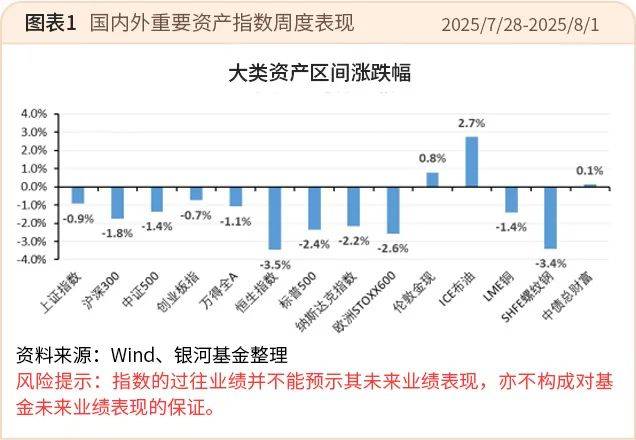
Market Overview - The AI industry chain demand expectations were boosted by related order factors, but the political bureau meeting's policy statements were moderate, leading to a pullback in market risk appetite [1] - A-shares showed a high open but low close, with the market facing pressure around the 3600-point level; growth style outperformed value style, and small-cap stocks performed slightly better than large-cap stocks [1][8] - The Shanghai Composite Index rose by 0.9%, while the CSI 300 fell by 1.8%, the ChiNext Index dropped by 0.7%, and the Wind All A Index decreased by 1.1% [1] Bond Market - Bond yields fell due to the stock-bond seesaw effect, with the 10-year government bond yield down by 2 basis points to 1.71% and the 30-year yield also down by 2 basis points to 1.95% [2] - The one-year government bond yield decreased by 1 basis point to 1.37%, while the one-year AA+ credit spread fell by 1 basis point [2] International Market - The U.S. and other countries reached trade agreements, and the Federal Reserve maintained its policy, leading to a significant rebound in the dollar index and adjustments in European and U.S. stock markets [3] - The S&P 500 fell by 2.4%, the Nasdaq dropped by 2.2%, and the European STOXX 600 decreased by 2.6%; Brent crude oil rose by 2.7% while LME copper fell by 1.4% [3] A-share Sector Performance - Among the sectors, telecommunications (3.14%), pharmaceuticals (2.73%), media (1.11%), and defense (0.66%) performed the strongest, while non-ferrous metals (-4.69%), coal (-4.56%), building materials (-3.32%), and transportation (-3.28%) were relatively weak [6] - The growth and consumer sectors showed resilience, while cyclical and stable sectors were affected by various factors [6][8] Recent Important Events - The Political Bureau meeting on July 30 acknowledged the economic recovery but shifted focus from "extraordinary counter-cyclical adjustments" to "maintaining policy continuity and stability" [9] - The emphasis is now on accelerating government bond issuance and improving fund utilization efficiency, indicating a shift towards more precise and effective financial policies [9] Federal Reserve Meeting - The Federal Reserve maintained its interest rate target range at 4.25%-4.5%, with increasing internal dissent regarding potential rate cuts [10] - The possibility of a rate cut in September has risen significantly due to recent employment data revisions and trade negotiations [11] Public Fund Weekly Issuance - A total of 28 public funds were established last week, accumulating 12.8 billion units, with a continued focus on equity funds [14] - The issuance structure has shifted from being dominated by bond funds to a more balanced approach [14]
跷跷板效应显现 部分债基遭遇大额赎回
Shang Hai Zheng Quan Bao· 2025-08-08 07:06
Group 1 - The core viewpoint is that the bond market is experiencing significant pressure due to a "see-saw effect" with the equity market, leading to negative returns for bond funds and increased large redemptions [1][2][3] - As of July 25, the average return of pure bond funds in July is -0.11%, with less than 35% of products achieving positive returns, indicating widespread underperformance [2] - The recent large redemptions in bond funds are attributed to crowded trading in the bond market since June and a recovery in market risk appetite, but the fundamental factors affecting the bond market are unlikely to reverse [1][4] Group 2 - The equity market's recovery is identified as a primary driver of the bond market's pressure, with rising yields impacting the net value of fixed-income funds [3] - On July 24, 12 equity funds were launched with a total issuance scale exceeding 11 billion, contrasting with the struggles faced by bond funds [3] - Institutions maintain a positive outlook on the equity market, citing strong liquidity and optimistic sentiment, while the bond market is expected to find a new equilibrium amid adjustments [4][3] Group 3 - Concerns about a sustained redemption wave in bond funds are mitigated by the fact that recent redemptions are mainly precautionary measures from asset management institutions, without triggering a negative feedback loop [4] - The current bond market situation is characterized by high duration and leverage, making it sensitive to expectations of fundamental recovery and rising commodity prices [3][4] - Short-term opportunities in the bond market may be limited, with increased volatility expected as previous low-volatility conditions are disrupted [5]

债市“冲击波” 基金公司打出应对“组合拳”
Zhong Guo Zheng Quan Bao· 2025-08-08 07:06
Core Viewpoint - The bond fund industry is currently facing a significant redemption wave, with a notable increase in fund outflows following a sharp market correction on July 24, leading to the largest single-day redemption scale since last year's "9.24" event [1][2]. Group 1: Redemption Trends - On July 24, the bond market experienced a substantial correction, resulting in a record single-day redemption for public bond funds, with cumulative net selling of bonds exceeding 120 billion yuan over three consecutive trading days [1][2]. - Since July 21, the net subscription index for public bond funds has remained negative, reaching -29.2 on July 24, indicating a significant outflow of funds [2]. - In July, over 40 bond funds had to adjust their net asset value precision due to large redemptions, a significant increase compared to previous months [2]. Group 2: Market Dynamics - The "see-saw" effect between stocks and bonds is intensifying, with funds flowing from bond markets into equity markets as stock and commodity markets show strong performance [1][4]. - The low yield environment for bond funds has diminished their attractiveness, leading to increased risk appetite among investors and subsequent outflows from bond funds [4][5]. - As of July 28, only 140 out of 4,252 bond funds had returns exceeding 2% this year, with over 72% of pure bond funds yielding less than 1% [4]. Group 3: Fund Manager Responses - Fund managers are proactively managing redemption pressures by reducing bond holdings' leverage and duration to mitigate the impact of market fluctuations on fund net values [6]. - Communication with institutional investors is emphasized to encourage staggered redemptions, thereby minimizing the overall impact [6]. - Many bond funds are utilizing dividend distributions to retain investors, with 924 pure bond funds announcing dividends since June, compared to 848 in the same period last year [6]. Group 4: Future Outlook - The current redemption wave is expected to be shorter and less intense compared to previous instances, with the scale of net selling and related product pullbacks remaining within manageable limits [7]. - Some institutions are beginning to buy into bond funds amid the market correction, suggesting a balanced flow of funds rather than a one-sided outflow [7].
股指期货:续持多单
Zhong Xin Qi Huo· 2025-08-08 05:06
1. Report Industry Investment Ratings No specific report industry investment ratings are provided in the content. 2. Core Views of the Report - The overall market risk preference remains high. For stock index futures, it is recommended to continue holding long positions; for stock index options, it is advisable to appropriately reduce the directional exposure of small - cap stocks in the short term; for treasury bond futures, the bond market sentiment is relatively warm [1][2][3]. 3. Summary by Relevant Catalogs 3.1 Market Views 3.1.1 Stock Index Futures - **View**: Continue to hold long positions. The basis of IF, IH, IC, and IM current - month contracts are - 8.47 points, - 1.51 points, - 38.14 points, and - 34.15 points respectively, with a month - on - month change of - 2.38 points, 0.31 points, - 7.57 points, and - 7.24 points. The spreads between current - month and next - month contracts are 13.6 points, - 1.0 point, 73.0 points, and 78.0 points, with a month - on - month change of 3.2 points, - 0.4 point, 9.4 points, and 6.2 points. The total open interest changes are 7431 lots, 2077 lots, 3443 lots, and 4114 lots. The upward trend of the market has not changed. In August, the tone is still positive due to factors such as strong capital inflow, low probability of mid - report disappointment, and the weakening US dollar index. It is recommended to continue holding IM long positions [8]. 3.1.2 Stock Index Options - **View**: Appropriately reduce the directional exposure of small - cap stocks in the short term. The underlying market showed mixed trends and was in a volatile state. The trading volume of the options market was 6 billion and 60 million yuan, a 16.85% increase from the previous day. The sentiment indicators remained similar to the previous day, with the MO skew reaching a half - year high, indicating continued defensive sentiment in the small - cap segment. Volatility increased in small - cap and ChiNext stocks. It is recommended to continue the medium - term covered call strategy and reduce the short - term directional exposure of small - cap stocks [2][9]. 3.1.3 Treasury Bond Futures - **View**: The bond market sentiment is warm. Most treasury bond futures closed higher, with the 30 - year, 10 - year, and 5 - year main contracts rising by 0.03%, 0.05%, and 0.05% respectively, and the 2 - year main contract remaining flat. The yields of major inter - bank interest - rate bonds generally declined. Although the central bank conducted a net withdrawal of 12.25 billion yuan in the open market, the capital market remained loose. The central bank's 70 - billion - yuan 3 - month outright reverse repurchase operation is beneficial to the bond market. However, the high market risk preference and potential factors such as the increase in long - term bond supply in the third quarter and the introduction of growth - stabilizing policies may have an impact on the bond market. Different strategies are proposed for different trading purposes [3][10][11]. 3.2 Economic Calendar - The economic calendar includes data such as the US factory orders in June, the US ISM non - manufacturing PMI in July, China's trade balance in July, the UK central bank's benchmark interest rate in August, the US initial jobless claims in the week ending August 2nd, and China's M2 money supply annual rate in July [12]. 3.3 Important Information and News Tracking - **Export**: In the first seven months, ASEAN was China's largest trading partner, with a total trade value of 4.29 trillion yuan, a 9.4% increase. The EU was the second - largest trading partner, with a total trade value of 3.35 trillion yuan, a 3.9% increase. The US was the third - largest trading partner, with a total trade value of 2.42 trillion yuan, an 11.1% decrease. China's total imports and exports to the Belt and Road Initiative countries increased by 5.5% [13]. - **Retail and Commerce**: The Shanghai SASAC launched a campaign for the rejuvenation of local state - owned time - honored brands, aiming to promote brand development through various measures such as open cooperation, improving market - oriented operation mechanisms, and attracting professional talents [13]. - **Power**: Shandong Province issued a reform plan for the market - based on - grid electricity price of new energy, stating that the on - grid electricity of new energy projects such as wind and solar power will enter the power market, and the on - grid electricity price will be determined through market transactions [14]. - **Education**: The state - wide policy of exempting preschool education fees for all children in the senior class of kindergartens is expected to benefit about 12 million people this autumn [14]. 3.4 Derivatives Market Monitoring - The content only lists the categories of stock index futures data, stock index options data, and treasury bond futures data, but no specific data is provided [15][19][31].
如何定量测算“股债跷跷板”的影响
2025-08-07 15:04
Summary of Key Points from Conference Call Industry or Company Involved - The discussion revolves around the relationship between the equity market, specifically the 中证 500 Index, and the bond market, particularly the 10-year government bond yield. Core Insights and Arguments - There exists a "seesaw effect" between the stock market and the bond market, where the 中证 500 Index and the 10-year government bond yield are positively correlated. Specifically, for every 100-point increase in the 中证 500 Index, the 10-year bond yield rises by approximately 0.9 basis points [1][2][5]. - The Bernanke three-factor model effectively decomposes the yield of the 10-year government bond, achieving an R-squared value of 0.85 when fitted to data since 2016. This model uses the 7-day reverse repo rate as a proxy for short-term rates, current CPI for inflation expectations, and the difference between social financing and M2 to represent economic conditions [1][4][7]. - The relationship between the 中证 500 Index and the 10-year bond yield shows a leading effect, indicating that an increase in the stock index can lead to a rise in bond yields in the following month [2][11]. - The bond market has already absorbed the impact of the recent rise in the equity market, with an increase of about 4-5 basis points in the bond yield since mid-June [14]. - If the equity market rises by an additional 5%, it could exert an extra pressure of about 3 basis points on the bond market, pushing yields to a range of 1.70% to 1.75%. A further 10% increase in the equity market could raise yields by approximately 6 basis points, resulting in a range of 1.75% to 1.80% [2][14]. Other Important but Possibly Overlooked Content - Different equity indices have varying degrees of influence on the 10-year bond yield. The 中证 1,000 and 中证 2000 indices show weaker correlation with the bond market compared to larger indices like the 上证综指 and 深证成指 [8][9]. - The structural integrity of the model is affected by the inclusion of large-cap indices, which can disrupt the original model's structure, particularly the impact of social financing minus M2 [9]. - The current market environment has led to a notable increase in the correlation between the 中证 500 Index and the 10-year bond yield, a phenomenon not seen in the past decade. This is attributed to stable fundamental and monetary conditions [15].