债市

Search documents
【笔记20250609— 债市重新关注弱现实】
债券笔记· 2025-06-09 12:39
回踩入场,最怕的就是真反转;突破入场,最怕的就是假突破。 在顺大势下,这些担心的"真反 转"和"假突破",都已经变为小概率事件。我们不能为小概率事件缩手缩脚,而要为大概率系统严格执 行。 | | | | 银行间资金 | | (2025.06.09) | | | | | --- | --- | --- | --- | --- | --- | --- | --- | --- | | 回购代码 | 加权利率 | 变化 | 利率走势 | 量高利率 | 变化 | 成义中 (亿 | 变化量 | 成交量占 | | | (%) | (bp) | (近30天) | (%) | (bp) | 元) | (亿元) | 比 (%) | | R001 | 1.42 | 8 | 11/2 | 2. 00 | 115 | 67710. 16 | 213. 67 | 91.51 | | R007 | 1.54 | -1 | Non/ 1 | 2. 05 | 0 | 5248. 91 | -894. 45 | 7.09 | | R014 | 1.59 | -1 | 1 /VI | 2. 00 | 218 | 759. 37 | 115. 90 ...

利率债周报:债市延续暖势,收益率曲线陡峭化下移-20250609
Dong Fang Jin Cheng· 2025-06-09 10:01
债市延续暖势,收益率曲线陡峭化下移 ——利率债周报(2025.6.2-2025.6.8) 作者 东方金诚 研究发展部 关注东方金诚公众号 获取更多研究报告 核心观点 ⚫ 上周债市延续暖势,收益率曲线陡峭化下移。上周(6 月 2 日当 周)海外关税政策不确定性延续,为债市提供支撑。同时,尽 管大量同业存单陆续到期,但央行首次提前公告买断式逆回购 操作,加之首次披露月度各项工具流动性投放情况,释放加强 预期管理信号,市场资金宽松预期进一步强化,对债市产生利 多影响。在此背景下,上周长债收益率整体下行。短端利率方 面,月初资金面均衡偏松,带动债市短端利率下行,且下行幅 度大于长端,收益率曲线趋于陡峭化。 本周(6 月 9 日当周)债市料延续偏强震荡。从基本面来看, 本周将陆续公布5月通胀、贸易以及金融数据。其中,5月CPI 和 PPI 同比仍处负值区间,反应居民消费信心不足,内需整体 疲弱,同时,受海外关税政策反复影响,外需整体走弱, 5 月 出口增速有所放缓,基本面对债市影响将偏利多。从资金面来 看,尽管本周逆回购与存单到期规模较大,但央行提前开展 1 万亿买断式逆回购操作予以对冲,释放"呵护"信号,资金面 有望 ...
债市正在起变化
HUAXI Securities· 2025-06-08 12:57
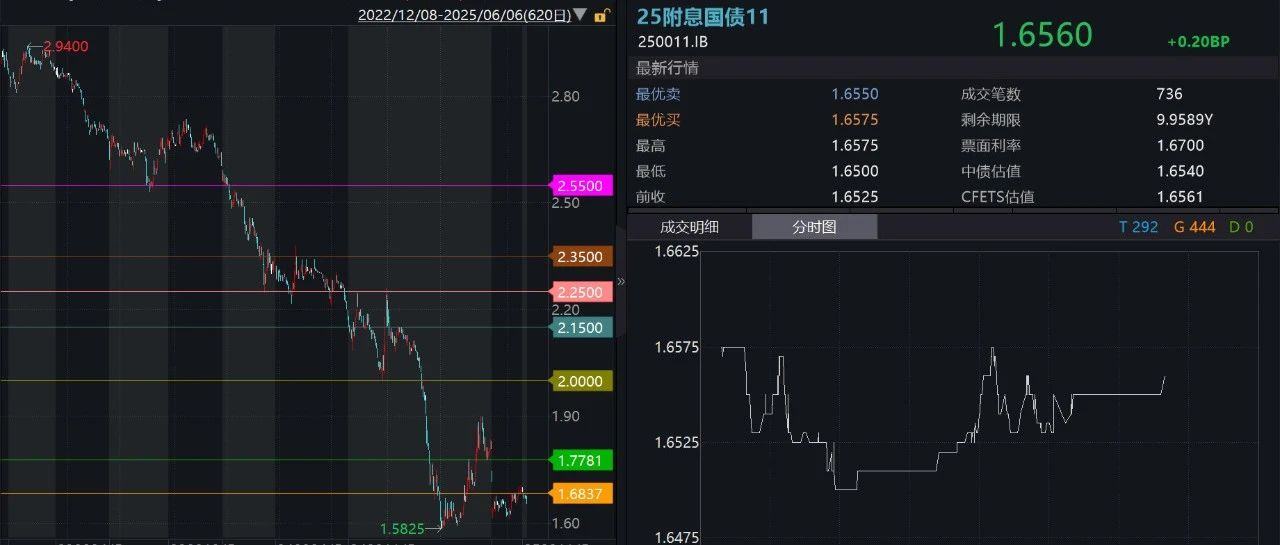
1. Report Industry Investment Rating No information provided regarding the industry investment rating. 2. Core Viewpoints of the Report - In the past week, despite the volatile news, the bond market remained stable with bullish sentiment prevailing. On June 5th, the bond market yields declined instead of rising, pricing in the positive factors of central bank support [1][21]. - The central bank's early renewal of RMB 1 trillion in outright repurchase operations is a signal of support, which may reduce the possibility of a significant tightening of liquidity during the quarter - end [2][21]. - Institutional behavior has received two positive factors: large - banks' continuous allocation of short - term bonds in the secondary market may be a signal of the central bank restarting bond purchases; the improvement in long - term life insurance premiums may increase the insurance sector's allocation of ultra - long bonds [3]. - The outcome of the new round of Sino - US negotiations in the coming week is a variable. An optimistic outcome may lead to a short - term rise in long - term interest rates but is beneficial to the bond market in the medium term, while a neutral outcome may see the bond market continue to be influenced by central bank support, with limited downward space for long - term interest rates [32]. - In June, with few foreseeable negative factors, short - term bond prices have risen significantly, and long - term interest rates may break out of the narrow - range oscillation. Investors can consider trading duration products for excess returns [33]. 3. Summary by Relevant Catalog 3.1 Bond Market Bullish Sentiment Dominates - From June 3rd - 6th, after the Dragon Boat Festival, the bond market emerged from a narrow - range oscillation and showed a downward trend. Yields of long - term and short - term treasury bonds decreased, with the 10 - year treasury bond active bond (250011) falling to 1.65% (- 2bp) and the 1 - year treasury bond active bond (250008) falling to 1.41% (- 5bp) [10]. 3.2 Bond Market May Be on the Rise - The central bank's early renewal of RMB 1 trillion in 3 - month outright repurchase operations, with the announcement form changed and the time advanced, is to enhance information transparency and ease market concerns about quarter - end pressure. There are still reserve operations in the second half of the month [2][21]. - The positive impact of central bank support is first reflected in the certificate of deposit (CD) market. After the central bank's announcement, the pressure on banks to issue CDs has eased, but there may still be issuance pressure in the next 1 - 2 weeks [22]. - In terms of institutional behavior, large banks have continuously allocated short - term bonds in the secondary market, which may be a signal of the central bank restarting bond purchases. In addition, the improvement in long - term life insurance premiums may increase the allocation of ultra - long bonds by the insurance sector [3][23][28]. 3.3 In the First Week of June, the Wealth Management Scale Continued to Shrink 3.3.1 Weekly Scale: A Slight Decline of RMB 1.79 Billion - At the end of May (May 26th - 30th), the wealth management scale decreased by RMB 186.6 billion due to the balance - sheet return pressure, with the daily - open products bearing the main decline. In May, the scale increased by RMB 193.4 billion, reaching a record high, but the growth rate was slightly slower than in previous years [37]. - In the first week of June (June 3rd - 6th), the wealth management scale unexpectedly decreased by RMB 1.79 billion to RMB 31.51 trillion. Historically, the scale usually increases in the first week of June [38]. 3.3.2 Wealth Management Risks: Net Value Stabilized and Negative Yields Decreased - The net value of wealth management products stabilized and rebounded, driving down the negative yield. The negative yield of products in the past week decreased by 4.90pct to 1.51%, and the negative yield in the past three months decreased by 0.66pct to 0.96% [43]. - The overall proportion of wealth management products breaking the net value decreased by 0.2pct to 0.7%, while the proportion of products with unmet performance targets increased by 0.5pct to 18.2% [52]. 3.4 Leverage Ratio: Large Banks' Lending Continued to Recover, and Inter - bank Leverage Increased - In the first week of June (June 3rd - 6th), with the central bank's support, the inter - bank funds became looser. The average price of funds decreased, and the average trading volume of inter - bank pledged repurchase increased from RMB 6.5 trillion to RMB 7.5 trillion, with the average overnight ratio rising from 83.33% to 87.48% [61]. - The leverage ratio of non - bank institutions slightly decreased, the inter - bank leverage ratio continued to rise from 107.18% to 107.36%, and the exchange leverage ratio slightly decreased [63]. 3.5 Funds Continued to Extend Duration - From June 3rd - 6th, bond funds further extended their duration. The median duration of interest - rate medium - and long - term bond funds increased from 4.32 years to 4.68 years, and that of credit medium - and long - term bond funds increased from 2.09 years to 2.22 years. The duration of short - term and medium - short - term bond funds also extended [71][75]. 3.6 Treasury Bond Issuance Accelerated - From June 9th - 13th, the planned issuance scale of government bonds was RMB 722.8 billion, mainly due to the accelerated issuance of treasury bonds, which increased by RMB 168.8 billion to RMB 615 billion compared with the previous week, while the local bond issuance scale remained basically unchanged at RMB 107.8 billion [79]. - Regarding local bonds, as of June 6th, the issuance progress of replacement bonds was 84.18%, and the issuance of new local special bonds was RMB 1647.9 billion, accounting for 37% of the RMB 4.4 trillion quota. From January 1st - June 13th, the cumulative net issuance of local bonds was RMB 3714.8 billion, an increase of RMB 2144.5 billion year - on - year [80][81]. - Regarding treasury bonds, from January 1st - June 13th, the cumulative net issuance was RMB 3371 billion, an increase of RMB 1854.3 billion year - on - year, with a remaining quota of RMB 3289 billion [84]. - Regarding policy - financial bonds, from January 1st - June 9th, the cumulative net issuance was RMB 827.4 billion, an increase of RMB 299.3 billion year - on - year [85].
半年末债市的三个关注点
HTSC· 2025-06-08 12:32
证券研究报告 固收 半年末债市的三个关注点 华泰研究 2025 年 6 月 08 日│中国内地 利率周报 报告核心观点 上周央行通过政策工具释放呵护信号,叠加大行积极增持短端利率债,市场 做多情绪回暖,终结了 5 月底的震荡下跌走势,短端利率下行带动长端利率 走低,曲线陡峭化。展望半年末时点,关税与基本面演绎、资金面及银行等 机构行为值得关注。预计短期中美关税谈判小幅抬升风险偏好,基本面对债 市仍有支撑;资金面冲击幅度有限,仍需提防资金分层与时点冲击;大行持 续买短债或助推曲线走陡,半年末银行兑现 OCI 浮盈券或无需过度担忧。 整体上,债市多空力量相对均衡,或难打破震荡格局,建议适度博弈曲线陡 峭化等。本周关注中美关税谈判、5 月通胀数据、贸易数据、金融数据。 关注点一:从关税谈判进展到基本面高频数据 特朗普就任以来,市场对中美关税预期波动剧烈。去年底与今年四月初,市 场情绪相对悲观,二月则过度乐观,当前市场情绪相对乐观,但整体已较为 钝化。展望未来,尽管特朗普关税政策充满不确定性,但其背后逻辑逐渐清 晰,市场反应将更趋钝化。上周两国领导人通话,关税谈判进入第二阶段, 期待本周关税谈判有积极进展,风险偏好略 ...
固定收益定期:利率为何能突破前低
GOLDEN SUN SECURITIES· 2025-06-08 11:03
1. Report Industry Investment Rating No relevant content provided. 2. Core View of the Report - Interest rates are expected to reach new lows, with a new downward trend possibly starting from mid - to late June. The report believes that the 10 - year treasury bond could reach 1.4% - 1.5% within the year [5][18]. 3. Summary by Related Content Bond Market Performance This Week - The bond market fluctuated strongly this week, with most interest rates across different tenors declining. At the beginning of the month, funds became looser, with the R001 rate dropping to around 1.45% and the R007 rate to around 1.55%. The 10 - year and 30 - year treasury bond rates decreased by 1.7bps and 2.0bps to 1.65% and 1.88% respectively. The 1 - year AAA certificate of deposit rate fell 2.3bps to 1.68%, and the 3 - year and 5 - year AAA - secondary capital bond rates dropped 3.2bps and 1.9bps [1][8]. Alleviation of Market Concerns - Market concerns about the bond market have eased. Big banks have limited pressure to sell bonds, and there is no obvious need to realize floating profits at the end of the quarter. Although a large number of certificates of deposit will mature in the coming weeks, due to the limited liability pressure of banks, they are still lending a large amount of funds, and the certificate of deposit rates remain low. The central bank's repurchase operation at the beginning of the month also helps stabilize market expectations [1][8]. Factors Driving Interest Rate Decline - The main driver of interest rate decline is the decrease in the real - economy return rate. The weakening trend of prices in the next few months is expected to lead to a reduction in the financing cost that the real economy can accept. Empirical data shows a high correlation between industrial enterprises' EBIT/ total assets and the weighted average loan interest rate. The recent weakening of industrial product prices indicates a possible decline in corporate profitability in the next few months, which means the corporate - acceptable financing cost may continue to fall [2][9]. Manifestation of Interest Rate Decline - The decline in broad - spectrum interest rates is reflected in both the decrease in liability costs and the narrowing of net interest margins. The liability cost decline is evident in various financial institutions, with the yields of deposits, money market funds, wealth management products, and insurance products showing a downward trend. For example, the 1 - year and 5 - year deposit rates of Industrial and Commercial Bank of China have decreased by 50bps and 70bps respectively since the end of 2023, and were further reduced by 15bps and 25bps in May this year. The 7 - day average interest rate of Yu'E Bao has dropped below 1.2%, hitting a record low [3][12][13]. - Financial institutions' earnings are also on a downward trend. The net interest margin of banks has been decreasing over the past few years, dropping from 1.91% at the end of 2022 to 1.43% in the first quarter of this year, a decrease of 9bps compared to the end of last year, and it may continue to decline. Insurance's fee - difference loss may also be shrinking, and the management fees of various fixed - income asset management institutions may be under continuous pressure [4][15]. Short - term Driving Variables - In addition to the fundamental - driven decline in broad - spectrum interest rates, changes in asset supply and demand and the central bank's liquidity support will be the main short - term variables driving interest rates to break previous lows. The supply of government bonds will slow down in the next few months, while the supply of funds will remain abundant. The central bank has increased its support for liquidity, conducting repurchase operations in early June to maintain capital stability. The bond market may once again experience a situation where demand exceeds supply, and the asset shortage may reappear [4][17][18].
策略周报:稳中求进,静待成长良机-20250608
HWABAO SECURITIES· 2025-06-08 05:11
Group 1 - The report emphasizes a cautious approach in the current market environment, suggesting a focus on defensive sectors such as banking due to ongoing tariff negotiations and economic pressures [3][10][12] - It highlights the potential for bond yields to reach new lows, recommending patience in positioning for left-side opportunities, particularly when the 10-year government bond yield approaches 1.7% after a 10 basis point rate cut [3][12] - The report notes a significant recovery in the domestic stock market, driven by short-term high-elasticity targets, with small-cap stocks becoming the core focus for capital [10][12] Group 2 - The report outlines key events impacting the market, including the U.S. tariff increase on steel and aluminum, and the People's Bank of China's liquidity support measures [9][10] - It tracks market performance indicators, noting a rise in average daily trading volume to 12,088.54 billion yuan, indicating increased trading activity and investor interest [22] - The report anticipates continued recovery in U.S. markets, driven by stable earnings from tech giants and a favorable environment during the tariff policy window [13]
债券市场专题研究:近期焦煤上涨对债市是否有影响?
ZHESHANG SECURITIES· 2025-06-06 05:19
Group 1: Report Industry Investment Rating - No industry investment rating was provided in the report [1][2] Group 2: Core Viewpoints of the Report - The recent strength in the black commodity futures prices is mainly a news-driven rebound in both technical and fundamental aspects, not a trend reversal, so its impact on the bond market is limited [1][2][32] - The focus of the bond market should be on factors such as the capital situation, central bank operations, and the progress of Sino-US negotiations [2][32] Group 3: Summary by Relevant Catalog How to Understand the Abnormal Rise of Coking Coal? - **Technical Analysis of Coking Coal**: From the weekly K-line perspective, the current trend of the coking coal main contract remains bearish. Although the bullish force has increased this week, it is not enough to confirm a trend reversal. From the daily K-line perspective, the further upward momentum of the coking coal main contract may be exhausted, and more driving factors are needed for long positions [10][11] - **Fundamental Analysis of Coking Coal**: Coking coal has a relatively serious overcapacity problem, with short-term demand still weakening and the supply-demand pattern not significantly improved. The sharp rise on June 4th was mainly due to news about Mongolia's potential coal export tax, but there has been no official decision. The supply and demand of coking coal both weakened in April, and high-frequency data in May showed weakening demand and potential inventory pressure [13][15] - **Analysis of Rebar and Iron Ore**: Rebar and iron ore futures main contracts also rose on June 4th, but the increases were significantly less than that of coking coal. Technically, their trends are also bearish, with weaker rebound signals than the coking coal main contract. Fundamentally, the supply and demand of rebar have not improved significantly, and its price is in a downward channel. The supply-demand pattern of iron ore has weakened month-on-month, and its price is also in a medium-term downward trend [17][18][24]
国投期货市场主流观点汇-20250605
Guo Tou Qi Huo· 2025-06-05 11:26
Report Overview - The report aims to objectively reflect the research views of futures and securities companies on various commodity varieties, track hot varieties, analyze market investment sentiment, and summarize investment driving logic. It is for internal company use only and does not constitute personal investment advice [1]. Market Data Commodities - **Palm oil**: Closed at 8060.00 with a weekly increase of 0.67% [2]. - **Live pigs**: Closed at 13605.00 with a weekly increase of 0.67% [2]. - **Soybean meal**: Closed at 2968.00 with a weekly increase of 0.54% [2]. - **Corn**: Closed at 2336.00 with a weekly increase of 0.39% [2]. - **Copper**: Closed at 77600.00 with a weekly decrease of 0.24% [2]. - **PTA**: Closed at 4700.00 with a weekly decrease of 0.34% [2]. - **Aluminum**: Closed at 20070.00 with a weekly decrease of 0.42% [2]. - **Silver**: Closed at 8218.00 with a weekly decrease of 0.54% [2]. - **Methanol**: Closed at 2208.00 with a weekly decrease of 0.63% [2]. - **Gold**: Closed at 771.80 with a weekly decrease of 1.06% [2]. - **Crude oil**: Closed at 447.90 with a weekly decrease of 1.08% [2]. - **Ethylene glycol**: Closed at 4349.00 with a weekly decrease of 1.23% [2]. - **Glass**: Closed at 982.00 with a weekly decrease of 1.80% [2]. - **PVC**: Closed at 4764.00 with a weekly decrease of 1.85% [2]. - **Iron ore**: Closed at 702.00 with a weekly decrease of 2.23% [2]. - **Rebar**: Closed at 2961.00 with a weekly decrease of 2.79% [2]. - **Coke**: Closed at 1308.00 with a weekly decrease of 5.42% [2]. A-shares - **CSI 500**: Closed at 5671.07 with a weekly increase of 0.32% [2]. - **CSI 300**: Closed at 3840.23 with a weekly decrease of 1.08% [2]. - **SSE 50**: Closed at 2678.70 with a weekly decrease of 1.22% [2]. Overseas Stocks - **Nikkei 225**: Closed at 37965.10 with a weekly increase of 2.17% [2]. - **Nasdaq Composite**: Closed at 19113.77 with a weekly increase of 2.01% [2]. - **S&P 500**: Closed at 5911.69 with a weekly increase of 1.88% [2]. - **FTSE 100**: Closed at 8772.38 with a weekly increase of 0.62% [2]. - **CAC 40**: Closed at 7751.89 with a weekly increase of 0.23% [2]. - **Hang Seng Index**: Closed at 23289.77 with a weekly decrease of 1.32% [2]. Bonds - **5-year Chinese Treasury bond**: Closed at 1.58 with a weekly increase of 2.36% [2]. - **2-year Chinese Treasury bond**: Closed at 1.50 with a weekly increase of 1.35% [2]. - **10-year Chinese Treasury bond**: Closed at 1.70 with a weekly decrease of 1.33% [2]. Foreign Exchange - **US Dollar Index**: Closed at 99.44 with a weekly increase of 0.32% [2]. - **US Dollar central parity rate**: Closed at 7.18 with a weekly decrease of 0.10% [2]. - **EUR/USD**: Closed at 1.13 with a weekly decrease of 0.14% [2]. Commodity Views Macro-financial Sector Stock Index Futures - **Strategy view**: Among 9 institutions, 1 is bullish, 0 is bearish, and 8 expect a sideways trend [3]. - **Bullish logic**: May PMI data shows significant improvement in corporate export orders; ETF shares tracking the CSI 300 index increased by 600 million this week; The Premier emphasized increasing policy support to expand consumption; Market sentiment for real estate and fiscal policies is expected to further recover [3]. - **Bearish logic**: May construction and service sector PMI is not high; A-share average daily trading volume decreased by 79.4 billion yuan week-on-week; Weak domestic demand affects profit expectations; Trump's false social media posts on China trade increase tariff uncertainty [3]. Treasury Bond Futures - **Strategy view**: Among 7 institutions, 3 are bullish, 0 is bearish, and 4 expect a sideways trend [3]. - **Bullish logic**: Setbacks in China-US economic and trade negotiations support the bond market; Manufacturing PMI remains below the boom-bust line; Weak stock market momentum benefits the bond market; Supply-demand disturbances in the bond market weaken after partial issuance [3]. - **Bearish logic**: Industrial enterprise profit growth rebounds; High-speed profit growth in new kinetic energy industries; Banks and insurance companies have limited capacity to absorb bond supply; Market concerns about rising certificate of deposit rates persist [3]. Energy Sector Crude Oil - **Strategy view**: Among 9 institutions, 1 is bullish, 2 are bearish, and 6 expect a sideways trend [4]. - **Bullish logic**: Saudi Arabia's production increase falls short of expectations; Low oil prices hinder US shale oil supply growth; The Northern Hemisphere enters the peak season for refined oil; Chinese refineries plan to end maintenance in June [4]. - **Bearish logic**: OPEC+ is expected to continue increasing production in July; A large amount of US Treasury bonds will mature in June; Trump reignites China-US trade disputes; Global economic weakness and trade frictions drag down oil demand [4]. Agricultural Products Sector Cotton - **Strategy view**: Among 8 institutions, 0 is bullish, 2 are bearish, and 6 expect a sideways trend [4]. - **Bullish logic**: Xinjiang cotton commercial inventory is depleting faster; Import window is mostly closed; India's cotton production decreases year-on-year; US cotton sowing progress lags behind [4]. - **Bearish logic**: The domestic textile industry enters the off-season; Textile enterprises' operating rates decline; Finished product inventories increase; Post-Dragon Boat Festival temperature rise benefits new cotton growth; US cotton-growing areas have good weather [4]. Non-ferrous Metals Sector Copper - **Strategy view**: Among 7 institutions, 2 are bullish, 2 are bearish, and 3 expect a sideways trend [5]. - **Bullish logic**: Global copper mine supply is disrupted; LME copper inventory is falling; Domestic social inventory is low; Strong demand from power grid and new energy industries [5]. - **Bearish logic**: US steel tariff hikes raise stagflation expectations; Weak domestic commodity market sentiment; Widening scrap-copper price difference; Poor cable orders [5]. Chemical Sector Soda Ash - **Strategy view**: Among 7 institutions, 0 is bullish, 4 are bearish, and 3 expect a sideways trend [5]. - **Bullish logic**: Maintenance peaks in July and August may ease supply pressure; Strong export performance; Stable light soda ash demand [5]. - **Bearish logic**: Weak glass demand affects the soda ash market; End of the PV installation rush; Low downstream purchasing enthusiasm; High production and inventory levels limit price increases [5]. Precious Metals Sector Gold - **Strategy view**: Among 7 institutions, 4 are bullish, 0 is bearish, and 3 expect a sideways trend [6]. - **Bullish logic**: US steel and aluminum tariff hikes increase uncertainty; Central bank gold purchases and safe-haven demand support prices; SPDR Gold ETF holdings increase; Long-term logic of gold as a hedge against credit currency risk [6]. - **Bearish logic**: US economic data shows resilience; The Fed's May meeting was hawkish; US stocks showed no significant reaction to tariff hikes; Market sensitivity to Trump's policies may decline [6]. Black Metals Sector Iron Ore - **Strategy view**: Among 9 institutions, 0 is bullish, 3 are bearish, and 6 expect a sideways trend [6]. - **Bullish logic**: Steel mills maintain profits; Port iron ore inventory decreases; Steel mills' imported ore inventory is low; Global iron ore shipments decline [6]. - **Bearish logic**: Trump plans to double steel and aluminum import tariffs; Mainstream ore shipments recover; Daily pig iron production decreases; Daily port throughput decreases; Weak domestic real estate market [6].
国债期货日报:2025年6月消息只是触发剂-20250604
Nan Hua Qi Huo· 2025-06-04 13:38
Report Industry Investment Rating - No clear industry investment rating is provided in the report. Core View of the Report - The view is to hold positions firmly. Although the reasons for the bond market's rise today seem unconvincing and further observation is needed, the current interest rate level and capital center are still favorable for allocation funds, and long - position holders should hold their chips [1][3] Summary by Related Catalogs 1. Disk Review - Treasury bond futures opened higher and then declined in the morning, fluctuated narrowly in the afternoon, and rallied across the board at the close. The capital interest rate remained low, with the overnight DR closing below 1.4%. The open market had a net withdrawal of 600 million yuan, and liquidity remained abundant [1] 2. Intraday News - The Ministry of Finance and the Ministry of Housing and Urban - Rural Development organized the 2025 evaluation of central - fiscal support for urban renewal actions. 20 cities are proposed to be supported, including Beijing, Tianjin, Tangshan, etc. [2] 3. Market Judgment - The bond market trading has been relatively dull recently. After the adjustment of deposit interest rates, the bulls lack sufficient upward momentum. Neither data releases nor capital levels can truly constitute negative factors. In this uncertain environment, short - term factors such as CD price increases and the seesaw effect of risk assets have an amplified impact on the market. The reasons for the bond market's rise today seem unconvincing, and further observation is needed [3] 4. Data Overview - **Contract Prices and Changes**: TS2509 rose 0.04 to 102.392, TF2509 rose 0.05 to 106.01, T2509 rose 0.06 to 108.73, and TL2509 rose 0.05 to 119.5 [4] - **Contract Positions and Changes**: TS contract positions decreased by 1185 to 119,964 hands, TF contract positions increased by 1800 to 164,943 hands, T contract positions increased by 4148 to 194,988 hands, and TL contract positions increased by 1114 to 114,724 hands [4] - **Basis and Changes**: TS basis (CTD) rose 0.0086 to - 0.0741, TF basis (CTD) rose 0.0091 to - 0.0175, T basis (CTD) rose 0.0683 to 0.023, and TL basis (CTD) fell 0.0567 to 0.4113 [4] - **Transaction Volume and Changes**: TS main contract trading volume decreased by 6072 to 31,202 hands, TF main contract trading volume decreased by 1213 to 46,001 hands, T main contract trading volume increased by 12841 to 55,709 hands, and TL main contract trading volume increased by 9425 to 70,260 hands [4] - **DR Interest Rates and Changes**: DR001 fell 0.0686 to 1.4136%, DR007 fell 0.1149 to 1.5496%, and DR014 fell 0.1392 to 1.5844% [4] - **DR Transaction Amounts and Changes**: DR001 transaction amount increased by 7904.9392 billion yuan to 24,426.9455 billion yuan, DR007 transaction amount increased by 254.423 billion yuan to 1075.1885 billion yuan, and DR014 transaction amount increased by 36.574 billion yuan to 122.9315 billion yuan [4]
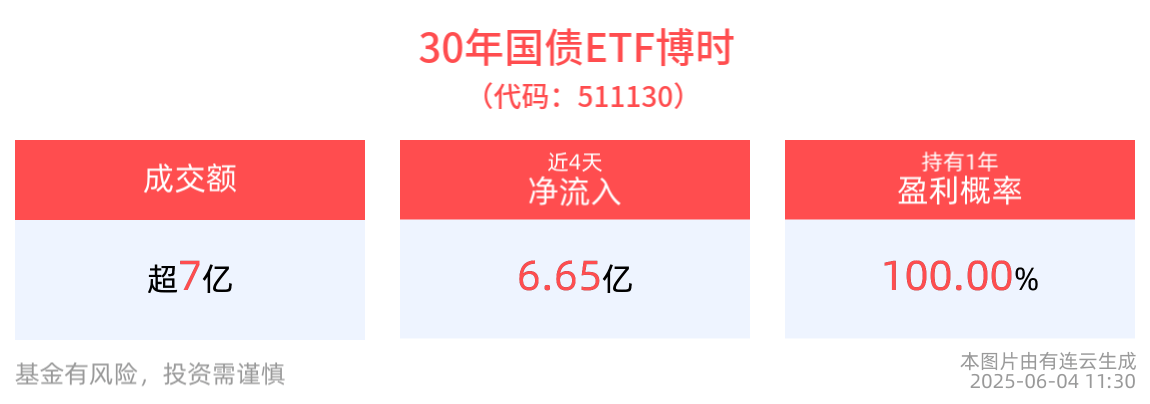
机构:本周债市料延续偏强震荡,30年国债ETF博时(511130)早盘成交额超7亿元
Sou Hu Cai Jing· 2025-06-04 04:10
30年国债ETF博时(511130)多空胶着,最新报价110.95元。流动性方面,30年国债ETF博时盘中换手9.89%,成交7.56亿元。拉长时间看,截至6月3日,30年 国债ETF博时近1月日均成交23.01亿元。 2025年6月4日,国债期货午盘多数下跌。30年期主力合约跌0.09%报119.340元,10年期主力合约跌0.03%报108.635元,5年期主力合约跌0.02%报105.940元, 2年期主力合约涨0.01%报102.366元。 截至6月3日,30年国债ETF博时近1年净值上涨14.44%,指数债券型基金排名3/389,居于前0.77%。从收益能力看,截至2025年6月3日,30年国债ETF博时自 成立以来,最高单月回报为5.35%,最长连涨月数为4个月,最长连涨涨幅为10.58%,涨跌月数比为9/5,上涨月份平均收益率为2.20%,月盈利百分比为 64.29%,月盈利概率为70.00%,历史持有1年盈利概率为100.00%。截至2025年6月3日,30年国债ETF博时近6个月超越基准年化收益为0.29%。 回撤方面,截至2025年6月3日,30年国债ETF博时成立以来最大回撤6.89%, ...