
流动性

Search documents
每日债市速递 | 央行将再次呵护流动性
Wind万得· 2026-02-12 22:59
(*数据来源:Wind-央行动态PBOC) (IMM) (*数据来源:Wind-国际货币资金情绪指数、资金综合屏) 3. 同业存单 全国和主要股份制银行一年期同业存单最新成交在 1.59% 附近,较上日小幅下行。 // 债市综述 // 1. 公开市场操作 央行公告称, 2 月 12 日以固定利率、数量招标方式开展了 1665 亿元 7 天期逆回购操作,操作利率 1.40% ,投标量 1665 亿元,中标量 1665 亿元。同时,以固定数量、利率招标、多重价位中标方式开 展了 4000 亿元 14 天期逆回购操作。 Wind 数据显示,当日 1185 亿元逆回购到期,据此计算,单日净 投放 4480 亿元。 2. 资金面 银行间市场资金面稍有改善,不过资金价格仍坚挺, DR001 加权平均利率小幅下行并徘徊于 1.36% 附 近。匿名点击( X-repo )系统上,隔夜报价在 1.35% ,供给好于上日。非银机构以信用债为抵押融入 隔夜以及跨节资金,报价坚挺在 1.65% 附近。 海外方面,最新美国隔夜融资担保利率为 3.65% 。 (*数据来源:Wind-同业存单-发行结果) 4. 银行间主要利率债收益率 | ...


央行今日将开展1万亿元买断式逆回购操作
Xin Lang Cai Jing· 2026-02-12 18:30
Group 1 - The People's Bank of China (PBOC) announced a 1 trillion yuan reverse repo operation with a fixed amount and interest rate, set to take place on February 13, with a term of 6 months (182 days) [1] - In February, the PBOC has conducted a total of 1.8 trillion yuan in reverse repo operations, with a net injection of 600 billion yuan after accounting for 1.2 trillion yuan in maturing operations [1] - The increase in net reverse repo operations in February is aimed at countering potential liquidity tightening, especially with the upcoming Spring Festival and government bond issuances [1] Group 2 - Citic Securities noted that the demand for cash during the Spring Festival is a major factor affecting liquidity in February, with expectations of a phase of tightening at the end of the month [2] - The PBOC is expected to use various tools, including medium-term lending facilities (MLF) and structural tools, to inject medium-term liquidity into the market [2] - Analysts predict that the PBOC will continue to utilize reverse repos and MLF to maintain liquidity and support financial institutions amid pressure on net interest margins [2]

10000亿元!央行宣布,明作
Zhong Guo Ji Jin Bao· 2026-02-12 12:08
Core Viewpoint - The People's Bank of China (PBOC) will conduct a 1 trillion yuan reverse repurchase operation on February 13, 2026, to maintain ample liquidity in the banking system, marking the sixth consecutive month of increased reverse repo operations [1] Group 1: Reverse Repo Operations - The PBOC will implement a fixed amount, interest rate bidding, and multi-price bidding method for a 1 trillion yuan reverse repurchase operation with a term of 6 months (182 days) [1] - In February, there is a total of 600 billion yuan in net reverse repo injections, which is an increase of 300 billion yuan compared to the previous month, indicating a continued effort to inject medium-term liquidity into the market for nine consecutive months [1] Group 2: Market Analysis - The chief economist of Zhaolian, Dong Ximiao, noted that February is a month with concentrated bank credit issuance, and increased cash withdrawals before the Spring Festival have raised liquidity demand in the market [1] - The chief macro analyst at Dongfang Jincheng, Wang Qing, anticipates that the PBOC may continue to use both reverse repos and Medium-term Lending Facility (MLF) tools to inject liquidity into the market [1] Group 3: Future Outlook - The increase in net reverse repo injections in February suggests a reduced likelihood of a reserve requirement ratio (RRR) cut in the near term [1] - Both analysts agree that while large-scale liquidity injections decrease the urgency for a comprehensive RRR cut, it remains an important option in the PBOC's toolkit, with the current weighted average reserve requirement ratio at 6.3% indicating some room for cuts [1]
金价走软,因美国数据削弱美联储降息押注
Sou Hu Cai Jing· 2026-02-12 09:01
欧洲市场早盘,金价走软,纽约黄金期货价格维持在每盎司5,100美元下方,因强于预期的美国就业人 数数据和失业率下降,降低了市场对美联储近期降息的预期。盛宝银行的分析师表示:"市场对未来经 济数据的重新关注表明,在近期波动性飙升后市场出现一定程度的正常化,而中国即将到来的春节假期 可能会进一步抑制风险偏好和流动性。"黄金期货下跌0.3%,至每盎司5,082.50美元;白银下跌0.9%, 至每盎司83.16美元。美元指数持平于96.88。 来源:滚动播报 ...
降息缩表并行,“沃什冲击”如何影响资本市场
Di Yi Cai Jing· 2026-02-11 06:27
Core Viewpoint - The nomination of Kevin Warsh as the next Federal Reserve Chairman by President Trump signals a significant shift in the Fed's communication style and its approach to interest rate cuts, potentially altering market expectations and reactions to monetary policy changes [1][2]. Group 1: Warsh's Monetary Policy Approach - Warsh is characterized as a "disciplinarian" who prioritizes the long-term consequences of financial conditions and the institutional costs of balance sheet expansion, showing a natural aversion to the normalization of unconventional tools like quantitative easing (QE) [2][3]. - He believes that the threshold for initiating QE will be significantly raised in response to general economic fluctuations, as he views QE as distorting asset prices and exacerbating wealth inequality [2][3]. - Warsh emphasizes that while interest rate cuts may be necessary, they do not equate to excessive monetary easing, suggesting that current rates could be 50-100 basis points above the neutral rate, which is around 3% [2][3]. Group 2: Impact of Balance Sheet Reduction - Warsh advocates for using balance sheet reduction to create room for interest rate cuts, arguing that inflation stems from fiscal deficit expansion and excessive monetary issuance rather than an overheated labor market [3][4]. - His approach suggests that the Fed's intervention threshold will be raised during market turbulence, contrasting with the current trend of the Fed acting as a market backstop [3][4]. - The transition to a framework focused on price adjustment rather than quantity support could lead to increased volatility in money markets, as banks will need to manage liquidity more actively without relying on the Fed's unlimited supply [6][7]. Group 3: Political Considerations and Market Reactions - Trump's choice of Warsh reflects a desire for a candidate who is loyal and willing to cut rates while also being credible enough to navigate Senate confirmation and maintain market confidence [8][9]. - Warsh's "hawkish reputation" is seen as a competitive advantage, as it reassures the market that any future rate cuts will be based on monetary discipline rather than political compromise [9][10]. - The upcoming midterm elections in 2026 create a political imperative for Warsh to align his actions with the administration's goals, particularly in managing inflation and living costs for voters [10][14]. Group 4: Future Market Implications - The midterm elections are expected to serve as a natural dividing line for policy pacing, with Warsh likely to adopt a gradual approach to reforms post-election, regardless of the election outcome [15][16]. - The Fed's communication style is anticipated to shift, with less frequent guidance and a reduction in the predictability of rate cuts, leading to increased market volatility and uncertainty [16][18]. - Overall, while the narrative of a weak dollar remains intact, the focus on fundamental performance in the stock market may increase, with a notable return to value sectors as high valuations and leverage are scrutinized [18].
2025年四季度货币政策执行报告解读:从“先手棋”到“组合拳”
Huafu Securities· 2026-02-11 03:22
Monetary Policy Insights - By the end of 2025, the loan interest rate decreased by 10 basis points to 3.15%, with general loan rates falling by 12 basis points to 3.55%[2][10] - The central bank's excess reserve ratio rose to 1.5% by the end of 2025, up 0.1 percentage points from September and 0.4 percentage points year-on-year[2][10] Fiscal and Monetary Coordination - The report emphasizes the coordination between monetary and fiscal policies, highlighting three main modes of collaboration: supporting government bond issuance, using "re-lending + fiscal subsidies," and risk-sharing mechanisms[3][12] - The government is expected to be the main driver of leverage in 2026, with limited room for significant rate cuts due to the need to maintain low financing costs[3][12] Liquidity and Financial Structure - The central bank aims to merge asset management products with bank deposits to better observe liquidity, indicating that changes in deposit structure do not significantly affect total liquidity[4][13] - The growth rate of combined household and corporate deposits aligns closely with M2 growth, showing no significant volatility in overall liquidity[4][13] Economic Outlook and Policy Focus - The central bank expresses concerns over economic conditions, including trade barriers and inflation risks, while emphasizing the need for macro policy consistency and flexibility in counter-cyclical adjustments for 2026[5][15] - Future monetary policy will focus on expanding domestic demand and optimizing supply, with an emphasis on service consumption and new productive capacities[5][15] Risk Considerations - Potential risks include unexpected policy changes, slower-than-expected economic recovery, and the possibility of historical economic patterns not holding true in the current context[6][19][20]
从“先手棋”到“组合拳”——2025年四季度货币政策执行报告解读【陈兴团队·华福宏观】
陈兴宏观研究· 2026-02-11 02:09
Core Viewpoint - The report highlights the ongoing decline in loan interest rates, with the central bank projecting a decrease to 3.15% by the end of 2025, supported by various monetary policy tools [2] Group 1: Loan Interest Rates and Monetary Policy - Loan interest rates are expected to decrease, with general loan rates falling by 12 basis points to 3.55% and mortgage rates remaining stable at 3.06% [2] - The central bank's actions, including reserve requirement ratio cuts and interest rate reductions, are aimed at enhancing liquidity, with excess reserve ratios projected to rise to 1.5% by the end of 2025 [2] Group 2: Coordination of Monetary and Fiscal Policies - The report discusses the shift from a proactive monetary policy to a synchronized approach with fiscal policy, emphasizing three modes of collaboration: supporting government bond issuance, coordinating credit supply and demand, and sharing risk costs [5] - The government is expected to remain the main driver of leverage in 2026, with limited room for significant policy rate reductions [5] Group 3: Observations on Liquidity and Financial Structure - The central bank suggests merging asset management products with bank deposits to better assess liquidity, indicating that changes in deposit structures do not significantly affect overall liquidity [6] - The report aims to correct market misinterpretations regarding deposit fluctuations, thereby minimizing their impact on bond market trends [6] Group 4: Economic Outlook and Policy Consistency - Concerns about the economic situation persist, with challenges such as weak domestic demand and external trade barriers highlighted [9] - The focus of monetary policy will be on expanding domestic demand and optimizing supply, with an emphasis on structural credit support and green finance [9]

——2025年四季度货币政策执行报告解读:从先手棋到组合拳
Huafu Securities· 2026-02-11 01:51
Group 1: Monetary Policy Insights - By the end of 2025, the loan interest rate from financial institutions decreased by 10 basis points to 3.15% compared to Q3 2025[3] - The general loan interest rate fell by 12 basis points to 3.55%, while the bill and mortgage rates remained stable at 1.14% and 3.06% respectively[3] - The central bank's excess reserve ratio rose to 1.5% by the end of 2025, up 0.1 percentage points from September and 0.4 percentage points year-on-year[3] Group 2: Fiscal and Monetary Coordination - The report emphasizes the coordination between fiscal and monetary policies to support domestic demand, with the government expected to be the main driver of leverage in 2026[4] - The central bank has shifted from a proactive monetary policy to a synchronized approach with fiscal measures, indicating a change in the sequence of policy implementation[4] - The government utilized a limit of 500 billion yuan in local bond reserves in October 2025, prompting the central bank to restart government bond trading[4] Group 3: Liquidity and Financial Structure - The central bank proposed merging asset management products with bank deposits to better observe liquidity in the financial system, indicating a structural change rather than a total liquidity reduction[5] - The growth rate of combined household and corporate deposits is closely aligned with M2 growth, showing no significant volatility in overall liquidity[5] - The central bank aims to shift focus from quantity targets to a price-based model for economic influence through interest rate adjustments[5] Group 4: Economic Outlook and Risks - The central bank expresses heightened concerns about economic conditions, citing challenges such as trade barriers and inflation risks, alongside domestic supply-demand imbalances[6] - Future monetary policy will emphasize macro policy consistency, with a flexible and precise counter-cyclical adjustment expected in 2026[6] - Risks include potential policy changes, slower-than-expected economic recovery, and the possibility of historical experiences becoming less applicable[6]
中金:港股市场指数空间受限 坚守AI与周期主线 短期关注零售、消费与科技硬件
智通财经网· 2026-02-11 01:12
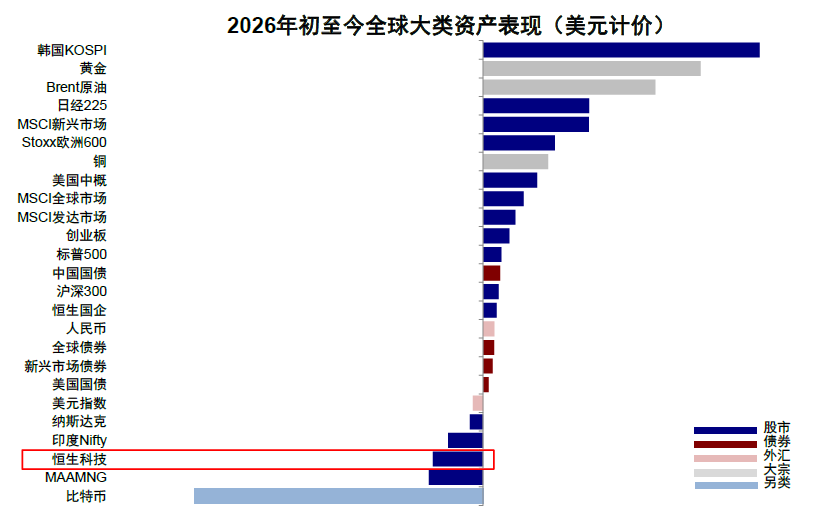
Core Viewpoint - Since the beginning of 2026, the Hong Kong stock market has underperformed, particularly the Hang Seng Tech Index, which has been the worst performer among core assets [1][2]. Market Performance - The Hang Seng Index has shown a decline of 3% since February, while the Hang Seng Tech Index has dropped by 6.5%, reaching a new low since July of the previous year, with a nearly 20% pullback from its October peak [2][3]. - The A-share market experienced a strong start with 17 consecutive days of gains after New Year's, contrasting with the weaker performance of the Hong Kong market [1][2]. Market Dynamics - Concerns over tightening liquidity and a weak macroeconomic environment have contributed to the recent pullback in the Hong Kong market [3][13]. - The market's performance is influenced by three dimensions: the credit cycle, industry trends, and liquidity, which amplify volatility [13][21]. Investment Strategy - The investment strategy should focus on sectors aligned with credit expansion, particularly in AI technology and cyclical industries, while also considering essential retail and new consumption sectors for short-term opportunities [39][45]. - The report suggests that the overall market index has limited upside potential, with a benchmark range of 28,000 to 29,000 points for the Hang Seng Index [13][14]. Sector Analysis - The report highlights that the technology sector, particularly AI, and new consumption are critical for supporting the Hong Kong market's valuation elasticity [19][30]. - The performance of the Hong Kong market is closely tied to external liquidity conditions, with significant sensitivity to U.S. Federal Reserve policies [21][27]. Future Outlook - The outlook for the Hong Kong market will depend on the evolution of the credit cycle, industry trends, and liquidity conditions, which will dictate the market's ability to recover [13][14]. - The report anticipates a potential earnings growth of 3-4% for the Hong Kong market, driven by sentiment recovery in key sectors [27][28].
Q4货政报告,七点变化
HUAXI Securities· 2026-02-11 00:50
证券研究报告|宏观点评报告 [Table_Date] 2026 年 02 月 11 日 [Table_Title] Q4 货政报告,七点变化 2 月 10 日,人民银行发布 2025 年四季度货币政策执行报告(以下简称四季度报告),关注以下几点: 第一,政策基调:删除三稳表述,要求促进经济稳定增长、物价合理回升。三季度报告中的"稳增长、稳 就业、稳预期"在四季度报告中删除,背景是 2025 年 5%增长目标顺利完成,而 2026 年一季度地方债发行前 置、信贷开门红等因素带动,经济增速有望在去年四季度基础上回升。更重要地,考虑到 2026 是十五五开局之 年,政策也要更加注重中长期,因而"不断巩固拓展经济稳中向好势头",取代了单纯的"稳增长"。具体到货币 政策方面,四季度报告延续了 2025 年 12 月中央经济工作会议的表述,"把促进经济稳定增长、物价合理回升作 为货币政策的重要考量",以及"引导金融机构加力支持扩大内需"。物价合理回升在三季度报告中也有提及,但 四季度报告将其放在更靠前的位置,可见重视程度上升。扩内需是十五五时期的核心战略任务,专栏一也分析了 货币和财政政策协同支持扩内需的三种方式,以及 ...