
春季躁动

Search documents
节前债稳,节后股暖?
Hua Er Jie Jian Wen· 2026-02-03 13:27
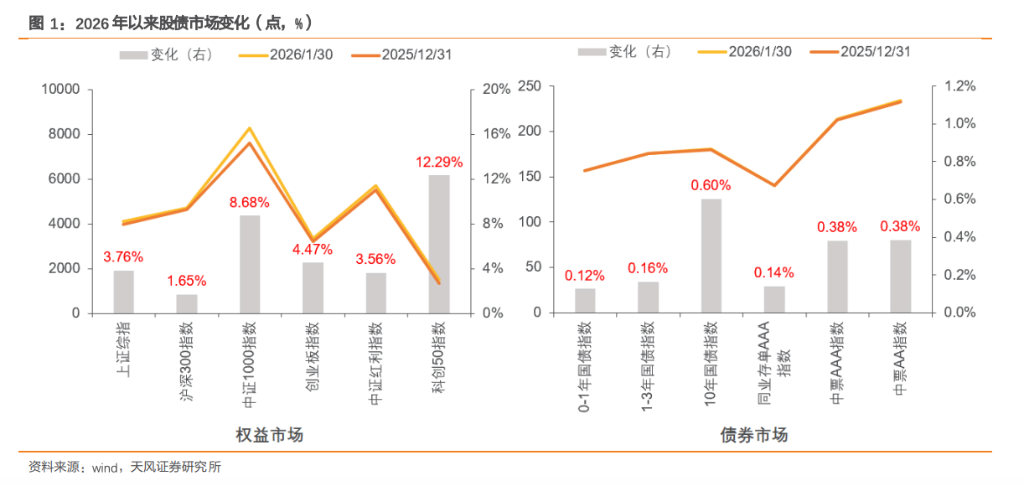
Core Viewpoint - The market performance at the beginning of 2026 is breaking traditional historical patterns, with significant divergence between stocks and bonds observed in the Chinese capital market [1]. Market Environment - The A-share market is expected to experience a "spring rally" after the Spring Festival, with a shift from a defensive large-cap style to a growth-oriented small-cap style [1][5]. - The bond market has shown a "V-shaped" recovery after initial pressure, with a structural interest rate cut of 0.25% by the central bank in January, leading to a stabilization in market sentiment [3][12]. Historical Patterns - Historical data from 2015 to 2025 indicates a clear seasonal pattern in the A-share market, with a 63.64% probability of the CSI 300 index rising in the 30 days before the Spring Festival, while the probability for the CSI 1000 index is only 27.27% [5][6]. - Post-Spring Festival, the CSI 300 index has a 72.73% probability of rising, with an average increase of 3.15%, while the CSI 1000 index shows an 81.82% probability and an average increase of 8.71% [5][6]. Bond Market Dynamics - The bond market typically shows strength in the 30 days before the Spring Festival due to increased liquidity and strong demand from institutional investors, with a historical average decline of 5.73 basis points in the 1-year bond yield [7][11]. - After the Spring Festival, the bond market may face upward pressure on yields due to changes in policy expectations and increased supply, with an average increase of 1.03 basis points in the 10-year bond yield [7][11]. 2026 Outlook - The foundation for the "spring rally" is expected to be stronger this year due to favorable policy expectations, global liquidity conditions, and a trend of residents allocating more assets to equity markets [12]. - Consumer demand is anticipated to be released earlier than in previous years due to an extended holiday, with expectations for increased spending on travel and consumption [12]. - The bond market is likely to experience a range-bound trading pattern, with reduced necessity for further rate cuts following the January reduction [12]. Potential Changes in Patterns - The traditional "strong bonds, weak stocks" model before the Spring Festival may be disrupted this year, with both markets potentially showing support and increased competition [13]. - The typical post-Spring Festival shift to small-cap growth may be weakened, as large-cap growth could perform well alongside high-dividend assets, leading to a mixed market style rather than a clear transition [13][14].

公司产品为HDI、IC载板等高阶产品的必备制程,并已深入参与服务器液冷散热系统
摩尔投研精选· 2026-02-03 10:39
Core Viewpoint - The current spring market rally is not yet over, despite recent pullbacks in A-shares, with the index returning to around 4000 points. The analysis suggests that the market is likely to continue its upward trend due to ongoing economic recovery and supportive policies [1]. Market Analysis - Historical data indicates that the average duration of spring rallies since 2010 is 39 days, with a maximum increase of 15.8%. The current rally has lasted 31 days with a gain of 9.8%, suggesting potential for further upward movement [2]. - The analysis maintains the view that the spring rally is entering a phase of "volume contraction and price increase," with a stronger focus on quality growth factors [3]. Sector Focus - The following sectors are highlighted for their performance expectations: 1. Cyclical sectors: Focus on tight supply in non-ferrous metals, chemicals, building materials, steel, and machinery [3]. 2. Non-bank financials: Emphasis on insurance companies benefiting from short-term premium growth and mid-term investment income enhancement [3]. 3. Technology sectors with solid fundamentals: Attention on themes such as satellite navigation, commercial aerospace, memory storage, optical modules, and circuit boards, which show clear trends in earnings growth [3].

中信、华泰、国泰等十大券商高目标个股曝光!62股被赋予50%上行预期!
私募排排网· 2026-02-03 10:00
Core Viewpoint - The A-share market is expected to enter a slow bull phase in 2025, with major indices significantly rising. As the annual report preview window approaches in early 2026, institutional investors are likely to focus on stocks with long-term growth potential and valuation revaluation space [2][3]. Group 1: Target Price Insights from Citic Securities - Citic Securities has identified 12 stocks with a target price increase of over 50%, indicating a recovery in market confidence. The focus is on sectors that can articulate a logical recovery narrative, particularly in consumer and real estate chains [2][3]. - Among the stocks covered, the highest target price increase is for Baili Tianheng, with a target price of 1322 CNY compared to a closing price of 269.69 CNY, representing a potential upside of 390.19% [3][4]. Group 2: Target Price Insights from Huatai Securities - Huatai Securities has identified 15 stocks with a target price increase of over 50%, focusing on sectors with sustainable recovery capabilities, particularly in price increase chains, high-end manufacturing, and AI [5][6]. - The highest target price increase is for Tianci Materials, with a target price of 80.5 CNY compared to a closing price of 40.04 CNY, indicating a potential upside of 101.05% [6]. Group 3: Target Price Insights from Guotai Junan - Guotai Junan has identified 13 stocks with a target price increase of over 50%, with China Railway leading at a target price of 9.07 CNY against a closing price of 5.37 CNY, representing a potential upside of 68.90% [8][9]. - The firm emphasizes the long-term potential of the "transformation bull" market, supported by improved regulatory governance and economic transformation [8]. Group 4: Target Price Insights from GF Securities - GF Securities has identified three stocks with significant target price increases, including Pudong Development Bank with a target price of 15.65 CNY compared to a closing price of 10.06 CNY, indicating a potential upside of 55.57% [10][11]. - The firm anticipates a strong seasonal market effect during the spring, particularly around the Chinese New Year [10]. Group 5: Target Price Insights from Guotai Securities - Guotai Securities has identified three stocks with target price increases over 50%, including Betta Pharmaceuticals with a target price of 71.95 CNY against a closing price of 45.70 CNY, representing a potential upside of 57.44% [13][15]. - The firm highlights the importance of technology and overseas expansion as key drivers for future growth [13]. Group 6: Target Price Insights from Dongwu Securities - Dongwu Securities has identified three stocks with the highest target price increases, including Tianci Materials with a target price of 79.20 CNY compared to a closing price of 40.40 CNY, indicating a potential upside of 97.80% [19][20]. - The firm expects a strong performance in the market as it transitions towards technology and cyclical sectors [19]. Group 7: Target Price Insights from Guojin Securities - Guojin Securities has identified China Pacific Insurance as the only stock with a target price increase over 50%, with a target price of 73.18 CNY against a closing price of 44.36 CNY, representing a potential upside of 64.97% [16][18]. - The firm believes that the insurance sector is entering a new cycle of growth driven by both volume and price increases [16].





港股通互联网ETF基金(520910)跌幅持续收窄,机构称“春季躁动”驱动下或存在阶段性修复机会
Sou Hu Cai Jing· 2026-02-03 06:32
Group 1 - The Hong Kong stock market showed mixed performance on February 3, with the Hang Seng Index rising by 0.2%, while the Hang Seng Tech Index and the National Enterprises Index fell by 1.32% and 0.22% respectively [1] - The decline in tech stocks was attributed to investor concerns over potential increases in value-added tax (VAT) for internet service companies, following a VAT hike for Chinese telecom stocks [1] - Institutions believe that the concerns regarding tax increases for internet companies are exaggerated and lack solid evidence, noting that any tax hikes would contradict current policies aimed at promoting consumption [1] Group 2 - GF Securities indicated that the global dollar cycle is at a peak and is now in a decline phase, while the RMB has transitioned from depreciation to a mild appreciation, creating a favorable revaluation window for Chinese equity assets [2] - The report suggests embedding currency logic into asset allocation, focusing on "core manufacturing assets + beneficiaries of appreciation" in A-shares, and prioritizing sectors sensitive to import costs and high-quality liquid stocks in Hong Kong [2] - The Hong Kong Stock Connect Internet ETF (520910) tracks the CSI Hong Kong Stock Connect Internet Index, focusing on leading internet companies such as Alibaba, Tencent, Meituan, and Kuaishou, which are expected to benefit from AI penetration [2]

资产配置快评:金银巨震,大类资产风波又起——总量创辩第121期
Huachuang Securities· 2026-02-03 03:52
Economic Structure Insights - The "golden crossover" of new and old economies indicates that by 2025, the new economy's GDP share will rise to 20%, surpassing the old economy's 19.7%[11] - By 2026, residents' financial assets are expected to exceed the total value of urban residential properties for the first time, indicating a shift in wealth structure[12] Spending Intentions - Combined spending intentions of residents, government, and overseas sectors are projected to stabilize in 2024 and show a first increase in 2025, driven by strong export performance and increased fiscal counter-cyclical adjustments[13] Market Dynamics - Recent market volatility is attributed to sharp fluctuations in gold and silver prices, with A-share indices experiencing a significant drop of 0.96% on January 30, 2026, primarily due to external factors[15] - The probability of a significant market pullback post-volatility is considered low, as domestic economic recovery is ongoing and supportive policies remain in place[16] Debt Market Outlook - The bond market is experiencing a correction of pessimistic expectations, with a notable recovery in the long-end segment, driven by improved risk appetite and stable funding conditions[20] - The issuance pace of local government bonds is slower than expected, alleviating supply pressure in the bond market[21] Federal Reserve Policy - The Federal Reserve maintained the federal funds rate at 3.5%-3.75% in January 2026, signaling a shift to a "wait-and-see" approach regarding future rate cuts[25] - The Fed's recent statements reflect a more positive outlook on economic growth, with a focus on normalizing monetary policy rather than further rate cuts in the near term[26]
甲骨文拟募资百亿美元加码云基建,港股科技30ETF(513160)盘中涨超1%,连续3日获净流入累超2亿元
2 1 Shi Ji Jing Ji Bao Dao· 2026-02-03 01:55
Group 1 - The Hong Kong stock market opened higher on February 3, with the Hang Seng Stock Connect China Technology Index (HSSCT.HK) rising by 1.1% [1] - Notable gainers in the index included Huahong Semiconductor, which increased by nearly 4%, and Gao Wei Electronics, which rose over 3% [1] - The Hong Kong Technology 30 ETF (513160) saw an intraday increase of 1.57%, with a trading volume exceeding 27 million yuan, making it the top performer in its category [1] Group 2 - Oracle has initiated a USD bond issuance plan, aiming to raise a total of USD 45 billion to 50 billion to expand its cloud infrastructure capabilities [2] - The bond transaction is expected to range between USD 20 billion and 25 billion, with the issuance potentially divided into up to eight parts, with maturities from 3 to 40 years [2] - Recent performance in the Hong Kong stock market is attributed to overseas liquidity dynamics and a pause in interest rate cuts by the Federal Reserve, with expectations for a "spring rally" in the technology sector driven by sentiment and AI industry growth [2]

国泰君安期货所长早读-20260203
Guo Tai Jun An Qi Huo· 2026-02-03 01:44
Report Industry Investment Rating The document does not provide an overall industry investment rating. Core Viewpoints of the Report - The latest released US ISM Manufacturing PMI in January soared from the previous month's 47.9 to 52.6, far exceeding the expected 48.5, indicating a substantial expansion in the US manufacturing sector [7][8]. - The sharp decline in precious metals and non - ferrous metals was mainly due to concerns over the overseas AI bubble and the unexpected adjustment of the Fed's replacement candidates. However, there may still be buying opportunities at relatively safe low - points, especially for copper in the long - term [9][11]. - The short - term outlook for stock index futures is expected to stabilize and recover. The end of the "Spring Rally" was affected by policy adjustments and external risks, but there is still a possibility of a second - wave rally [13]. Summary by Relevant Categories 1. Metals Gold and Silver - Yesterday, gold, silver, platinum, and palladium accelerated their decline. The sharp drop was mainly triggered by the fall of US stocks, extreme trading convergence in precious metals, and the potential hawkish stance of the new Fed Chairman. In the short - term, it is recommended to consider option strategies mainly based on selling options, and the internal - external spread of silver may converge. The support level for gold is lowered to $4275 per ounce, and for silver, it remains at $70 per ounce [9][10]. Copper - The price of copper was weak due to pessimistic sentiment. The US manufacturing expansion and production changes in major copper - producing regions such as Zambia, Chile, and Canada affected the market. The copper trend strength was neutral [24][25][26]. Zinc - Zinc was in a range - bound oscillation. News such as the delay of the US employment report and the potential Fed Chairman's plan to shrink the balance sheet influenced the market. The zinc trend strength was neutral [27][28][29]. Lead - The decrease in LME lead inventory limited the price decline. Positive US manufacturing data and the delay of the US employment report were important news. The lead trend strength was neutral [30][31]. Tin - Tin was in a phase of decline and consolidation. The price of tin dropped significantly, and there were various macro and industry news such as Iran - US negotiations. The tin trend strength was bearish [33][34][35]. Aluminum - Aluminum was waiting for market repair. Alumina had a slight rebound, and cast aluminum alloy followed the trend of electrolytic aluminum. There were various data changes in the aluminum market, and relevant news such as Iran - US nuclear negotiations and India - US trade agreements affected the market. The aluminum trend strength was bullish, while alumina and aluminum alloy were neutral [37][38]. Platinum and Palladium - Platinum was slightly recovering in the oscillation, and palladium had strong resilience but was still in low - level oscillation. The market was affected by factors such as the delay of the US employment report and the expansion of the US manufacturing sector. The trend strength of both was neutral [39][40][43]. Nickel and Stainless Steel - The marginal influence on nickel was dominated by macro sentiment, with a game between fundamentals and speculative positions. For stainless steel, there were frequent maintenance and production cuts in February, and nickel - iron was expected to support the price. The trend strength of both was neutral [46][47][52]. 2. Energy - related Coal - **Coking Coal and Coke**: Both were in high - level oscillations. The coking coal market had issues such as a high auction non - sale rate, and the price of both was affected by factors like the adjustment of the CCI metallurgical coal index [74][75]. - **Steam Coal**: The supply - demand was in a weak balance, and the coal price before the Spring Festival was expected to be stable. The market was affected by factors such as port inventory changes and potential production cuts in Indonesia [79][80]. 3. Chemicals PX, PTA, and MEG - PX followed the sharp decline of oil prices and was in an interval - oscillation market. PTA was also in an interval - oscillation market with a bearish view on the monthly spread. MEG was in a unilateral interval - oscillation market with large supply pressure. The market was affected by factors such as the restart of domestic and overseas devices, changes in the supply - demand of PTA and MEG, and the decline of the overall commodity market [85][90][91]. Rubber and Synthetic Rubber - Rubber was in a weak - oscillation trend. The inventory in Qingdao increased, and the production and sales of tires were affected by the approaching Spring Festival. Synthetic rubber was in a high - level decline, influenced by factors such as the reduction of geopolitical conflicts and the approaching boundary of valuation indicators [93][96][98]. LLDPE and PP - LLDPE had a narrowing import profit, limited offers, and weakened oil price support. PP was greatly affected by cost, and its profit might be repaired. The market was affected by factors such as the decline of raw material prices, changes in supply and demand, and the profit of production devices [99][100][103]. Caustic Soda - Caustic soda was supported by cost, and the future expectation was strong. Although the high - inventory situation made the spot market weak before the Spring Festival, the market's expectation of future supply reduction was strong. The trend strength was bullish [105][107][110]. Pulp - Pulp was in a wide - range oscillation. The market demand was weak, and the high - inventory and weak - demand contradiction restricted the market trend. The trend strength was neutral [111][113][114]. Glass - The price of glass raw sheets was stable. The market demand was limited, and attention should be paid to the winter - storage policy of manufacturers in high - inventory areas. The trend strength was neutral [116][117]. Methanol - Methanol was oscillating with support. The macro - sentiment was weak, but the international energy price provided support. The supply - demand pattern was weak in the short - term, and the inventory was high. The trend strength was neutral [119][121][122]. Urea - Urea was in short - term horizontal consolidation. The macro - sentiment was weak, and there was a small - scale state reserve release. The fundamental pressure and support levels were clear. The trend strength was neutral [124][125][126]. Styrene - Styrene was in a relatively strong oscillation. The market was in a high - production and high - inventory pattern, and the future supply - demand situation and the restart of parking devices should be noted. The trend strength was neutral [127][128]. Soda Ash - The spot market of soda ash changed little. The supply was high, and the demand was weak. The price was expected to be weakly stable and oscillating. The trend strength was neutral [130][132]. LPG and Propylene - LPG was strongly affected by short - term geopolitical factors, and the fundamental driving force was downward. Propylene's upward driving force was weakening, and attention should be paid to cost - end disturbances. The market was affected by factors such as price changes, device maintenance plans, and changes in shipping volume. The trend strength of both was neutral [134][138][139]. PVC - PVC had a strong sentiment, but the fundamentals did not improve significantly. Although there were some supporting factors in the short - term, the high - production and high - inventory structure was difficult to change, and attention should be paid to the future supply reduction situation. The trend strength was neutral [142][143][144]. Fuel Oil and Low - Sulfur Fuel Oil - Fuel oil had a sharp decline and continued in a high - volatility state. Low - sulfur fuel oil mainly followed the decline, and the price difference between high - and low - sulfur fuels in the overseas spot market continued to shrink. The trend strength of both was bearish [147]. 4. Others Logs - Logs had a slight upward exploration. The price and trading volume of log contracts changed, and the market was affected by factors such as the manufacturing PMI. The trend strength was bullish [81][83][84]. Shipping Index (European Line) - The shipping index (European line) was in an oscillating market. The market was affected by factors such as the weakening of commodity sentiment, the easing of the geopolitical situation, and changes in shipping capacity. Different contracts had different strategies. The trend strength was neutral [149][160][162]. Short - fiber and Bottle - grade Resin - Both short - fiber and bottle - grade resin were in short - term oscillations after the release of emotional risks. The market was affected by factors such as price changes of upstream polyester raw materials and production and sales of products. The trend strength of both was neutral [165][166]. Offset Printing Paper - For offset printing paper, it was recommended to hold short positions and conduct a 3 - 4 reverse spread. The price in the spot market was stable, and the trading atmosphere was weak. The trend strength was bearish [168][169][170]. Pure Benzene - Pure benzene was in a relatively strong oscillation. The inventory in some ports decreased, and the price changed. The trend strength was neutral [173][174][175]. Fats and Oils - Palm oil was affected by the ebb of macro - sentiment and the attenuation of geopolitical influence, and soybean oil was in high - level oscillation adjustment. The market was affected by factors such as the decline of international crude oil prices, the expected high yield of South American soybeans, and relevant policies in Indonesia. The trend strength of both was neutral [177][178][179]. Soybean Meal and Soybean - Soybean meal oscillated following the sentiment of the commodity market, and the state - reserve auction of soybeans had a positive impact. The market was affected by factors such as the decline of international crude oil prices and the expected high yield of Brazilian soybeans. The trend strength of both was neutral [183][185]. Corn - The decline range of corn was limited. The price in the spot market changed, and the futures price was affected by the overall market situation. The trend strength was neutral [186][187][188]. Sugar - Sugar was in a weak operation. The global sugar supply - demand situation changed, and attention should be paid to policies such as China's import of syrup and premixed powder. The trend strength was bearish [189][190][191]. Cotton - Cotton was expected to maintain an oscillating trend. The spot trading of cotton was average, the price of cotton yarn was stable, and the ICE cotton futures declined. The trend strength was bullish [193][194][197]. Eggs - The spot price of eggs weakened. The prices of futures and spot contracts changed, and the market was affected by factors such as the prices of feed and related products. The trend strength was bearish [199][200]. Hogs - The pre - festival price increase of hogs was less than expected, and the pressure increased. The prices of spot and futures contracts changed, and the trend strength was bearish [202][203][204]. Peanuts - Peanuts were in a weak - oscillating state. The spot price was stable, and the futures price and trading volume changed. The trend strength was neutral [206][207][208].
公募基金指数跟踪周报(2026.01.26-2026.01.30):全球流动性巨震,盈利修复值得期待-20260202
HWABAO SECURITIES· 2026-02-02 12:04
Report Investment Rating - No specific investment rating for the industry is provided in the report Core Viewpoints - Last week (2026.01.26 - 2026.01.30), the A - share market was volatile and differentiated, with high trading volume, extreme differentiation, and rapid rotation. The market's driving logic shifted from macro - cycle trading to micro - performance verification, and it's advisable to focus on mid - stream industries with profitability repair and ROE improvement [2][3][11][12][13] - The bond market was volatile last week, and the current environment is favorable for the bond market. The 10 - year Treasury yield is expected to gradually decline towards 1.80%. In the context of increased volatility in the equity market, the relative value of bond coupon allocation has increased [4][14] - The China Securities Regulatory Commission released a draft for public comments on amending the information disclosure rules for public funds, aiming to guide the industry to focus on the concepts of "long - term investment and value investment" [5][17] Weekly Market Observation 1.1 Equity Market Review and Observation - Last week, the Shanghai - Shenzhen 300 rose 0.1%, the CSI 500 fell 2.6%, and the ChiNext fell 0.1%. The market was characterized by extreme differentiation and rapid rotation under high trading volume, with more stocks falling than rising [2][11] - Market funds were in a fierce game between inflation trading and the technology growth theme. "Price trends" were the guiding principle in the first half of the week, and later, policies and performance became the main drivers of style switching. The annual performance forecast disclosure was a key factor for individual stock trends [3][12] - The market's driving logic shifted from macro - cycle trading to micro - performance verification. Funds tended to seek more balanced and performance - supported allocations, and it's recommended to focus on mid - stream industries [13] 1.2 Pan - Fixed - Income Market Review and Observation - Last week, the bond market was volatile. The 1 - year Treasury yield rose 1.80BP to 1.30%, the 10 - year yield declined 1.86BP to 1.81%, and the 30 - year yield rose 0.19BP to 2.29%. The 10 - year yield is expected to gradually decline towards 1.80% [4][14] - The current environment is favorable for the bond market. The central bank maintains stable liquidity, and the cautious economic growth targets in many places ease the market's expectations of strong fiscal stimulus. The bond market sentiment is gradually improving [4][14] - Last week, the U.S. Treasury yield curve steepened. The 1 - year yield declined 5BP to 3.48%, the 2 - year yield declined 8BP to 3.52%, and the 10 - year yield rose 2BP to 4.26%. The appointment of Kevin Warsh as the Fed Chairman affected the U.S. Treasury yield curve [15] - The CSI REITs Total Return Index rose 0.47% last week, with municipal environmental protection and highways leading the gains. Ten new public REITs made progress in the primary market [15] 1.3 Public Fund Market Dynamics - On January 30, 2026, the China Securities Regulatory Commission released a draft for public comments on amending the information disclosure rules for public funds. The new rules require adding the medium - to - long - term performance of the past 7 and 10 years, no longer disclosing the past 1 - month performance, and adding disclosure requirements such as fair trading, employee fund - holding, and trading unit leasing [5][17] Fund Index Performance Tracking 2.1 Equity Strategy Theme - Based Index - **Active Stock Fund Selection**: The index selects 15 funds each period, with equal - weight allocation. The core positions select active equity funds based on performance competitiveness and style stability, and balance the style according to the CSI Equity - Oriented Fund Index. The performance benchmark is the CSI Equity - Oriented Fund Index [21][22] 2.2 Investment Style - Based Index - **Value Stock Fund Selection**: It selects 10 funds of deep - value, quality - value, and balanced - value styles. The performance benchmark is the CSI 800 Value Index [25] - **Balanced Stock Fund Selection**: It selects 10 relatively balanced and value - growth style funds. The performance benchmark is the CSI 800 [25][26] - **Growth Stock Fund Selection**: It selects 10 funds of active - growth, quality - growth, and balanced - growth styles. The performance benchmark is the 800 Growth Index [29] 2.3 Industry Theme - Based Index - **Pharmaceutical Stock Fund Selection**: It selects 15 funds with an average purity of no less than 60% in the pharmaceutical industry. The performance benchmark is the pharmaceutical theme fund index [32][33] - **Consumer Stock Fund Selection**: It selects 10 funds with an average purity of no less than 50% in the consumer industry. The performance benchmark is the consumer theme fund index [33][34] - **Technology Stock Fund Selection**: It selects 10 funds with an average purity of no less than 60% in the technology industry. The performance benchmark is the technology theme fund index [37] - **High - End Manufacturing Stock Fund Selection**: It selects 10 funds with an average purity of no less than 50% in the high - end manufacturing industry. The performance benchmark is the high - end manufacturing theme fund index [42][43] - **Cyclical Stock Fund Selection**: It selects 5 funds with an average purity of no less than 50% in the cyclical industry. The performance benchmark is the cyclical theme fund index [45][46] 2.4 Money - Market Enhancement Index - **Money - Market Enhancement Strategy**: The index aims for liquidity management, pursues a curve that exceeds money - market funds and is smoothly upward. It mainly allocates money - market funds and inter - bank certificate of deposit index funds. The performance benchmark is the CSI Money - Market Fund Index [48] 2.5 Pure Bond Index - **Short - Term Bond Fund Selection**: It selects 5 funds with stable long - term returns, strict drawdown control, and significant absolute - return ability. The performance benchmark is 50% * Short - Term Pure Bond Fund Index + 50% * Ordinary Money - Market Fund Index [52] - **Medium - and Long - Term Bond Fund Selection**: It selects 5 medium - and long - term pure bond funds with both return and drawdown control, and adjusts the duration and the ratio of credit bond and interest - rate bond funds according to the market [54] 2.6 Fixed - Income + Index - **Low - Volatility Fixed - Income + Selection**: The equity center is 10%. It selects 10 funds with an equity center of less than 15%. The performance benchmark is 10% CSI 800 Index+90% ChinaBond New Composite Full - Price Index [57] - **Medium - Volatility Fixed - Income + Selection**: The equity center is 20%. It selects 5 funds with an equity center between 15% - 25%. The performance benchmark is 20% CSI 800 Index+80% ChinaBond New Composite Full - Price Index [60] - **High - Volatility Fixed - Income + Selection**: The equity center is 30%. It selects 5 funds with an equity center between 25% - 35%. The performance benchmark is 30% CSI 800 Index+70% ChinaBond New Composite Full - Price Index [63] 2.7 Other Pan - Fixed - Income Index - **Convertible Bond Fund Selection**: It selects 5 convertible bond funds based on an evaluation system from multiple dimensions. The sample space requires a high proportion of convertible bond investment [66] - **QDII Bond Fund Selection**: It selects 6 QDII bond funds with stable returns and good risk control based on credit and duration [69] - **REITs Fund Selection**: It selects 10 REITs funds with stable operation, reasonable valuation, and certain elasticity based on the underlying asset type [70]
金鹰基金:外围扰动引发市场情绪回落 短期震荡为后续主线重聚提供条件
Xin Lang Cai Jing· 2026-02-02 09:41
Market Overview - All three major indices closed lower, with the Shanghai Composite Index down 2.48% to 4015 points and the ChiNext Index down 2.46%. The Hang Seng Index also saw a significant decline, closing down 2.92% [1][8] - Trading volume in the two markets decreased, remaining around 2.6 trillion [1][8] - Among the 31 primary industries, all except food and beverage and banking sectors experienced declines, with 4647 out of over 5300 stocks falling, indicating poor profitability [1][8] External Factors - The precious metals market experienced a sharp decline, impacting market sentiment and contributing to the A-share market's pullback. This was influenced by the nomination of Kevin Warsh as the next Federal Reserve Chairman, who advocates for a "balance sheet reduction + interest rate cut" policy [2][9] - Following Warsh's announcement, the US dollar index rose while gold and silver prices plummeted, with silver dropping 26%, marking its largest historical decline, and gold falling 9%, the worst single-day performance in nearly a decade [2][9] Internal Dynamics - Since mid-December, the index has risen rapidly due to improved liquidity and risk appetite, moving from around 3800 points to near 4200 points. This led to structural opportunities and accelerated sector rotation [3][10] - As uncertainty increased, market sensitivity heightened, prompting a shift from "increasing positions" to "realizing profits and reducing exposure," resulting in a net outflow of funds and overall market pressure [3][11] Future Outlook - The market is expected to focus on signs of economic recovery and the unfolding of the spring market, with a potential "second wave" of spring activity anticipated in February [4][11] - Historical data suggests a higher success rate for A-shares in February, particularly for small-cap growth stocks, which typically perform well in the week leading up to the Spring Festival [4][11] Sector Allocation - A balanced approach is recommended to navigate rapid rotations, with a focus on technology sectors supported by performance, such as AI applications, overseas computing power, storage, and wind energy storage [5][12] - For value investments, attention should be given to upstream commodities, which may benefit from geopolitical adjustments and potential mid-term recovery in manufacturing and real estate sectors [6][12]
如何理解近期金银历史性的行情?
Huafu Securities· 2026-02-02 07:46
策 略 研 究 华福证券 2026 年 02 月 02 日 如何理解近期金银历史性的行情? 团队成员 投资要点: 本周(1/26-1/30)市场震荡整理,全 A 收跌-1.59%。从指数情况看, 中证红利、上证 50 领涨,中证 500、科创 50 领跌。从风格情况看,周期、 金融地产领涨,医药医疗、先进制造领跌。本周 31 个申万行业涨少跌多, 石油石化、通信、煤炭领涨,汽车、电力设备、国防军工领跌。 策 略 定 期 报 告 市场观察:股债收益差上升,行业轮动强度下降。(1)市场估值:股 债收益差上升至 0.4%,小于+1 标准差。估值分化系数有所下降。(2)市 场情绪:市场情绪调整,行业轮动强度下降。市场大盘风格占优,微盘股 指数跑赢市场,主题热度主要聚集在黄金珠宝、光模块(CPO)、光通信。(3) 市场结构:市场量能环比上升,煤炭、钢铁、石油石化多头个股占比居前, 计算机、电子、机械设备内部或存在α机会。(4)市场资金:本周陆股通 周内日平均成交金额较上周上升 507 亿元,本周陆股通周内日平均成交笔 数较上周上升 206 万笔。本周陆股通成交额排名前三的标的为宁德时代、 中际旭创、紫金矿业,近 5 日 ...