内需

Search documents
跨年的经济
Sou Hu Cai Jing· 2025-12-07 14:35
Group 1 - The ongoing debate about whether AI technology is becoming "bubble-like" continues, but investment is gradually penetrating upstream electricity and downstream applications, with increased fiscal budgets in the US, Europe, Japan, and South Korea for the coming year [1] - The Federal Reserve's interest rate cut cycle continues, while inflation expectations remain at historically high levels; the short-term weakness of the US dollar is accompanied by expectations of RMB appreciation [1] - High-frequency data indicates a potential short-term rebound in China's exports [1] Group 2 - The proportion of residents expecting a decline in housing prices has risen to a high level, indicating that the response to real estate risks has entered a new phase [1] - Under strict control of hidden debts, debt reduction and repayment continue, which corresponds to the ongoing weakness in infrastructure investment since the second half of the year [1] - Personal income tax has increased compared to trend values due to standardized tax administration, while cross-year consumption may still face pressure [1] Group 3 - Prices related to "anti-involution" categories have experienced a rebound in the third quarter but have since retreated, with the central tendency remaining higher than before; industrial production indicators are showing a month-on-month slowdown [1] - Vegetable prices have risen above seasonal levels due to weather disturbances, and combined with a low base, the CPI is expected to see a short-term rebound [1] - However, the resonance of pork and oil prices is expected to ease in early next year, leading to a further decline in prices [1] Group 4 - Historical economic "New Year openings" often correspond to prior year-end fiscal spending, with recent fiscal strength and continued pressure on local land transfer income indicating moderate economic growth at the beginning of next year [2] - The effectiveness of subsidy policies in promoting consumption in the service sector remains to be explored, while credit demand remains at historically low levels [2] - The management of liquidity through government bond trading is becoming more diversified, although interest rate tools remain cautious [2]
国泰海通|宏观:决胜于“价”——2026年宏观年度展望
国泰海通证券研究· 2025-12-05 10:48
Group 1 - The medium to long-term outlook indicates that China's economy has significant growth potential, with macroeconomic stability expected by 2025, but structural differentiation will be evident, necessitating policy interventions to address weak domestic demand by 2026 [1] - Asset restructuring is crucial, with inflation expectations playing a vital role in wealth management for residents [2] - Global economic and monetary system restructuring is leading to changes in the pricing framework for assets such as gold, the US dollar, and US Treasury bonds [3]


内需“双引擎”扩容提质 增长新动能释放新潜力——2025年终经济观察
Zheng Quan Shi Bao Wang· 2025-12-04 23:26
Group 1 - The core viewpoint emphasizes that the dual engines of consumption and investment are crucial for maintaining stable economic growth in the face of external uncertainties, with potential for further release of domestic demand through enhanced policies [1][6] Group 2 - Service consumption is expanding and improving, with retail sales of consumer goods increasing by 4.3% year-on-year and service retail sales growing by 5.3% in the first ten months of the year [2] - The "old-for-new" consumption policy has significantly boosted sales, generating over 2.5 trillion yuan in sales and benefiting more than 360 million people [2] - The share of service consumption in residents' expenditure is increasing, reaching 46.8% in the first three quarters of this year, indicating a shift in consumer behavior towards services [2][3] Group 3 - Investment structure is optimizing, with fixed asset investment excluding real estate growing by 1.7% year-on-year, and manufacturing investment increasing by 2.7% [4] - Despite a slowdown in overall investment growth, high-tech industries such as information services and aerospace are experiencing rapid investment growth [4] - The impact of fiscal policies, including special bonds and long-term loans, is expected to support investment growth, particularly in infrastructure, although the effects may take time to materialize [5][8] Group 4 - The potential for domestic demand is expected to continue being released, with consumption capacity and structure upgrading, providing broad growth opportunities [7] - The implementation of major strategies outlined in the 14th Five-Year Plan is anticipated to drive investment growth stabilization [7] - Supportive fiscal policies, including the use of special long-term bonds for consumption upgrades, are expected to enhance the effectiveness of consumption policies [8]
内需“双引擎”扩容提质 增长新动能释放新潜力
Zheng Quan Shi Bao· 2025-12-04 17:54
Core Viewpoint - The article emphasizes the importance of domestic demand as a dual engine of consumption and investment in driving China's economic growth, particularly in the context of the 14th Five-Year Plan and the uncertain external environment [1][6]. Group 1: Consumption Trends - Service consumption is expanding and improving, with retail sales of consumer goods increasing by 4.3% year-on-year and service retail sales growing by 5.3% in the first ten months of the year [2]. - The "old-for-new" consumption policy has significantly boosted sales, generating over 2.5 trillion yuan in sales and benefiting more than 360 million people [2]. - The proportion of per capita service consumption expenditure is projected to reach 46.1% in 2024, with a further increase to 46.8% in the first three quarters of this year, indicating a shift towards service consumption as a key growth driver [2]. Group 2: Investment Structure - Fixed asset investment, excluding real estate, grew by 1.7% year-on-year in the first ten months, with manufacturing investment increasing by 2.7% [4]. - High-tech industries, particularly in information services and aerospace, are experiencing rapid investment growth, while overall investment growth is slowing [4]. - The impact of fiscal policies, such as special bonds and long-term loans, is expected to support investment growth, although the immediate effects may not be realized until early next year [5][8]. Group 3: Policy Support - The People's Bank of China has established a 500 billion yuan service consumption and pension refinancing facility, indicating a shift in macro policy focus towards service consumption [3]. - The government is implementing various policies to enhance service consumption, including subsidies and support for sectors like elderly care and cultural tourism [3]. - The upcoming 15th Five-Year Plan aims to significantly increase the role of domestic demand in economic growth, with a focus on improving consumption rates [6][7].
工业克苏鲁,中国想从世界买什么?
虎嗅APP· 2025-12-03 10:22
Core Viewpoint - The article discusses the implications of China's self-sufficiency in manufacturing and its reluctance to engage in international trade, raising questions about the future of global trade dynamics and the concept of "Industrial Cthulhu" [4][8]. Group 1: Trade Dynamics - The author highlights that during a recent trip to mainland China, the prevailing sentiment was a lack of interest in imports, as China is capable of producing everything it needs more efficiently and at lower costs [7]. - The article questions the existence of trade if the largest seller, China, is not interested in buying from others, suggesting a potential shift in global trade paradigms [8]. - The author notes that the current trade surplus for China reached $3.3 trillion by the end of October, indicating a significant imbalance in trade relationships [16]. Group 2: Industrial Innovation - The article emphasizes China's rapid advancements in various sectors, including electric vehicles, photovoltaics, and AI, showcasing its transition from a manufacturing hub to an innovation leader [12]. - It mentions that the cost of hardware for autonomous vehicles in China is less than one-third of that in the U.S., highlighting China's competitive edge in technology [12]. - The article also points out that Western pharmaceutical companies are increasingly investing in Chinese firms, recognizing their potential in innovative drug development [12]. Group 3: Economic Challenges - The author discusses the risks associated with China's high trade surplus, including the potential for increased financial risk and inefficiency in overseas dollar assets [16]. - The article suggests that China's reliance on its status as the "world's factory" may hinder the internationalization of the renminbi, as the country imports less and maintains a singular channel for offshore assets [17]. - It raises concerns about the long-term sustainability of China's economic model, which may lead to a vicious cycle of trade imbalances and reduced global competitiveness [16][17]. Group 4: Future Considerations - The article proposes a shift in narrative from a zero-sum game in trade to a collaborative approach, suggesting that countries should work together and share benefits rather than compete solely on buying and selling [18]. - It emphasizes the need for a new framework that transforms the "world factory" concept into a "world workshop + world testing ground," which could foster innovation and cooperation [18].
大国五年|澎湃内需,铸就发展主锚
Xin Hua Wang· 2025-12-03 08:55
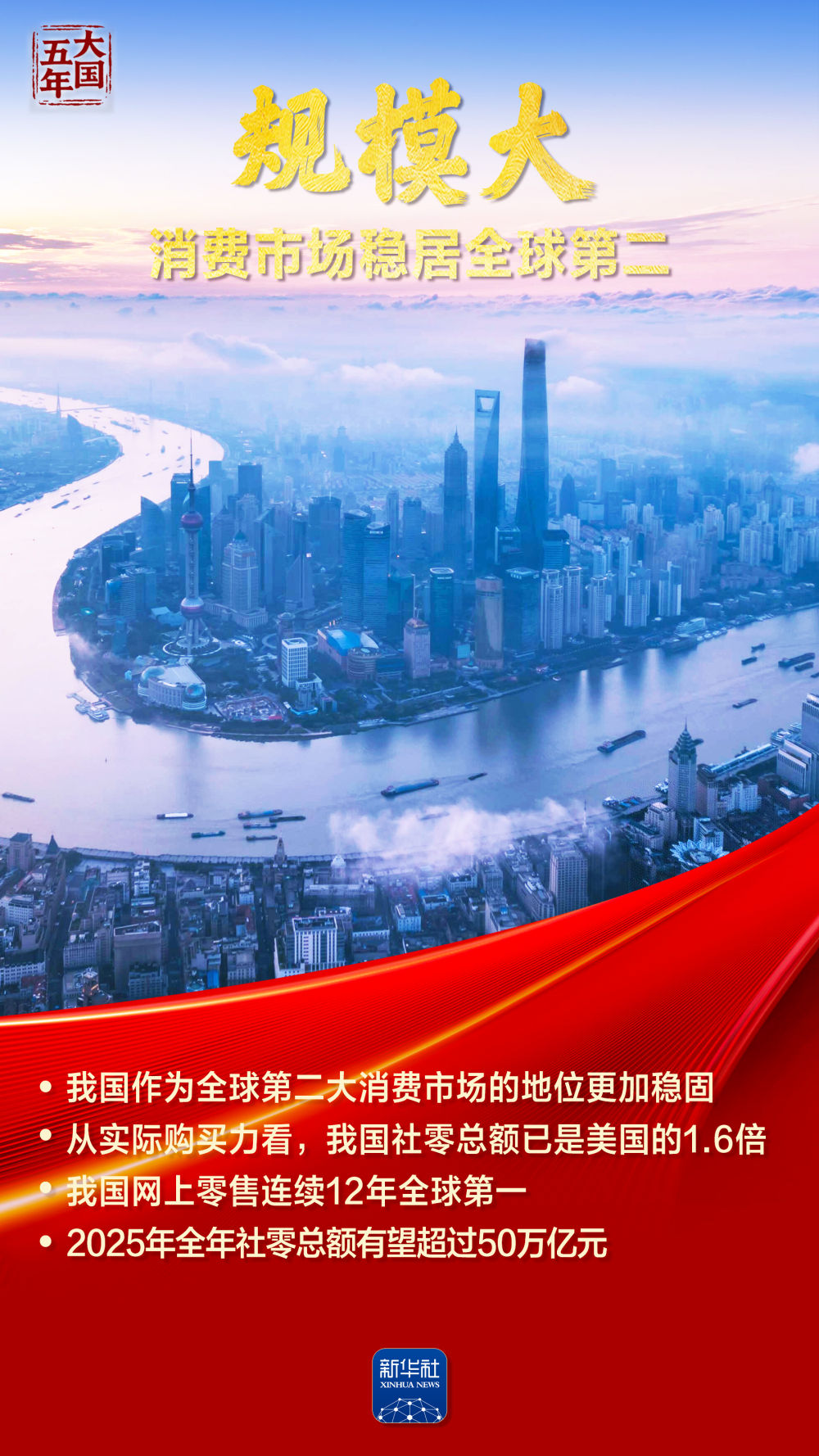
Core Insights - Domestic demand is a key driver of China's economic growth, contributing an average of 86.4% to economic growth during the "14th Five-Year Plan" period, with consumption accounting for approximately 60% of this growth [1][5][20] Group 1: Consumer Market Dynamics - China's total retail sales of consumer goods reached 50 trillion yuan, establishing it as the world's second-largest consumer market [1] - The average annual growth rate of retail sales is projected to be 5.5%, increasing from 39.1 trillion yuan in 2020 to 48.3 trillion yuan in 2024 [5] - Online retail sales in China have maintained the global leading position for 12 consecutive years [3] Group 2: Sectoral Growth and Innovations - The sales volume in sectors such as automobiles and home appliances ranks first globally [5] - The value added by the wholesale and retail industry is expected to reach 13.8 trillion yuan in 2024, marking a 40% increase compared to the end of the "13th Five-Year Plan" [5] - The integration of culture, tourism, and commerce is driving innovation in "one-stop" services, with domestic products gaining popularity both domestically and internationally [11] Group 3: Logistics and Infrastructure - The proportion of social logistics costs to GDP has decreased from 14.7% five years ago to 14.1% [13] - Over 95% of administrative villages can now access direct express delivery services [13] - The total volume of cold storage facilities in the country has reached 25.3 million cubic meters, with 495,000 refrigerated vehicles [14] Group 4: International Trade and Investment - Cumulative imports of consumer goods from 2021 to 2024 are expected to reach 7.4 trillion yuan [16] - The total expenditure of inbound tourists in 2024 is projected to be 94.2 billion USD, reflecting a 77.8% increase [16] - The actual use of foreign capital during the "14th Five-Year Plan" period reached 70.87 billion USD, with a significant increase in newly established foreign enterprises [22]
产需修复持续性有待观察——11月PMI点评
Changjiang Securities· 2025-12-01 23:30
1. Report Industry Investment Rating No relevant content provided. 2. Core View of the Report In November 2025, the manufacturing PMI showed a marginal improvement with synchronized recovery in production and demand and accelerated destocking, but the asymmetric recovery of raw material and finished product prices may still restrict corporate profit repair, and the sustainability of external demand contribution remains to be verified. The decline in service - sector sentiment indicates that the resilience of domestic demand also needs to be observed. The bond market has adjusted, and the impact of PMI data is expected to be limited. It is recommended to allocate 10 - year Treasury bonds with a taxable coupon yield above 1.8% when there are adjustments [2]. 3. Summary by Related Catalogs Manufacturing PMI - **Overall situation**: In November 2025, the manufacturing PMI was 49.2%, up 0.2 pct from the previous month, still seasonally weak but with marginal improvement. Production, procurement, and import indices on the supply - side increased, and new order and backlog order indices on the demand - side rose. Inventory destocking accelerated, and some predictive indicators showed improved supply - demand relationships [5][9]. - **External demand contribution**: The new export order index rose 1.7 pct to 47.6%, and the new export order indices of four major manufacturing industries and large, medium, and small enterprises all increased. However, the asymmetric recovery of raw material and finished product prices may pressure corporate profit repair [9]. - **Enterprise size and industry differences**: Small and medium - sized enterprises' sentiment improved, especially small enterprises which rose 2 pct to a nearly 6 - month high of 49.1%, while large enterprises' sentiment declined 0.6 pct to 49.3%. High - tech manufacturing with a high proportion of small and medium - sized enterprises remained in expansion, while the sentiment of equipment and consumer goods manufacturing declined, and their production sides may be stronger than the demand sides [9]. Non - manufacturing PMI - **Overall situation**: The non - manufacturing business activity index was 49.5% in November 2025, down 0.6 pct from the previous month, the first time below the boom - bust line since 2023. The service - sector sentiment was dragged down by factors such as the fading holiday effect, while the construction industry's sentiment improved [5][9]. - **Sub - item structure**: The inventory and new order indices of non - manufacturing declined, while the new export order index rose. The sales price and input price indices increased for two consecutive months. In the service sector, the financial industry and some new - energy industries showed good performance. The construction industry's business activity index increased, possibly boosted by financial activities and policy support [9]. Investment Suggestion The bond market has adjusted, and the impact of PMI data is expected to be limited. It is recommended to allocate 10 - year Treasury bonds with a taxable coupon yield above 1.8% when there are adjustments [2][9].
2025年10月财政数据点评:财政支出收紧有何深意?
Minsheng Securities· 2025-11-18 11:59
Revenue Insights - From January to October 2025, the national general public budget revenue reached 18.65 trillion yuan, a year-on-year increase of 0.8%, with a growth rate improvement of 0.3 percentage points compared to January to September[1] - In October, the general public budget revenue recorded a year-on-year growth of 3.2%, up from 2.6% in September, driven primarily by tax revenue which grew by 8.6%[1][2] - Personal income tax showed a remarkable year-on-year growth of 27.3%, significantly higher than the previous value of 16.7%, making it a core driver of tax revenue growth[2] Expenditure Trends - General public budget expenditure from January to October 2025 totaled 22.58 trillion yuan, reflecting a year-on-year increase of 2%[1] - In October, public budget expenditure decreased by 9.8%, marking the first negative growth of the year, attributed to earlier fiscal spending in the first half of the year and constraints from the annual deficit requirements[3] - Infrastructure spending saw a significant decline of 26.7%, indicating reduced support for traditional fiscal investment methods[5] Tax Revenue Dynamics - Non-tax revenue experienced a sharp decline of 33.0%, indicating an ongoing improvement in the quality of fiscal revenue[1] - Export tax rebates fell by 14.8%, suggesting a potential weakening in external demand, consistent with the downward trend in October's export growth[2] - The growth rate of securities transaction stamp duty normalized to 17.5%, down from a previous 342.4%, indicating a return to typical market conditions[2] Fiscal Policy Implications - The tightening of fiscal expenditure in October may necessitate an increase in the deficit ratio next year to support economic continuity, especially with the upcoming "14th Five-Year Plan"[3] - Local government land transfer revenue dropped by 27.3%, a significant increase in decline compared to the previous month's -1.0%, impacting government fund expenditures which fell by 38.2%[5]
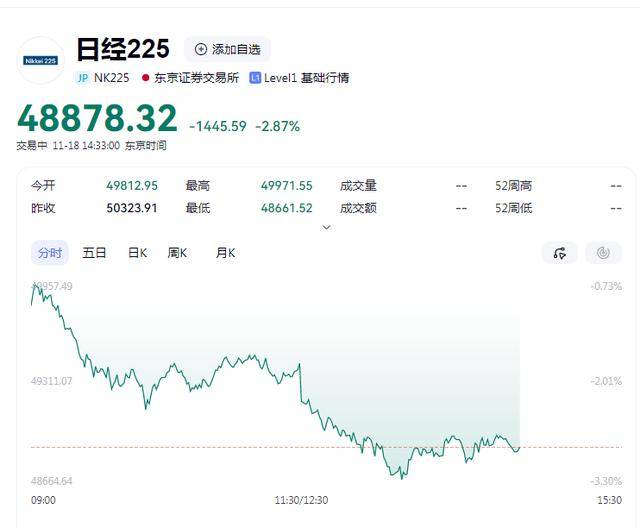
日本GDP再现负增长
Sou Hu Cai Jing· 2025-11-18 07:46
日本内阁府17日公布,日本三季度实际国内生产总值(GDP)按年率计算下降1.8%,自2024年第一季 度以来再次出现负增长。分析人士指出,受困于内需与外需的双重压力,以及对华关系持续紧张,日本 经济正滑向更为复杂的境地。 数据显示,日本今年三季度实际GDP(剔除物价变动因素)比上一季度下降0.4%。日媒分析指出,国 内需求疲软和出口低迷是导致GDP下滑的主要原因。 自5月以来,受美国关税影响,日本出口连续4个月萎缩。尽管日美双方于7月份达成协议,将"对等关 税"税率设定为15%,但历史高位的关税水平仍然抑制了制造业的发展,对其出口依赖型经济构成严重 冲击。受此影响,三季度货物及服务贸易出口大幅下降,环比下降1.2%,拖累GDP增速0.2个百分点。 进口因内需疲软环比下降0.1%。 与此同时,内需方面,占日本经济总量过半的私人消费增速也显著放缓,增速从第二季度的0.4%放缓 至0.1%,这再次表明,由于生活成本高企导致实际工资停滞不前,日本家庭仍在削减可自由支配的支 出。 截至发稿,日经225指数跌破49000点关口,日内跌超1300点。 来源:经济日报 日本内阁府此前发布中期经济预测报告称,考虑到美国关税政策 ...