反内卷

Search documents
航空机场2025年12月数据点评:国内线表现明显优于24年,国际线供给略有过剩
Dongxing Securities· 2026-01-16 11:59
Investment Rating - The industry investment rating is "Positive" for the transportation sector, indicating an expectation of performance that exceeds the market benchmark by more than 5% [6]. Core Insights - Domestic routes show significant improvement compared to 2024, with a 4.2% year-on-year increase in capacity and a 2.4 percentage point increase in passenger load factor [2][34]. - International routes are experiencing a short-term oversupply, with a 12.8% year-on-year increase in capacity but only a 1.0 percentage point increase in load factor, indicating weaker-than-expected demand [3][52]. - The cancellation of Japanese flights has a more pronounced impact on airports than on airlines, as airport revenues are closely tied to passenger volume and flight operations [4][66]. - The introduction of the "Self-Discipline Convention for Air Passenger Transport" in August 2025 is seen as a foundational step towards reducing market competition pressures and improving profitability in the industry [5]. Summary by Sections Domestic Routes - In December 2025, listed companies increased domestic route capacity by approximately 4.2% year-on-year and 1.9% month-on-month, reflecting a gradual recovery in supply-demand dynamics compared to the previous year [2][14]. - The overall passenger load factor for domestic routes improved by about 2.4 percentage points year-on-year, although it saw a seasonal decline of 1.0 percentage point compared to November [34][41]. International Routes - For international routes, capacity increased by approximately 12.8% year-on-year and 9.3% month-on-month in December 2025, but the load factor only increased by 1.0 percentage point year-on-year, with a significant month-on-month decline of 3.1 percentage points [3][52]. - The low year-on-year increase in load factor is attributed to a low base in 2024, and the demand for international routes is not meeting expectations, leading to oversupply [12][57]. Airport Sector - Major airports such as Shanghai, Beijing, Baiyun, and Shenzhen saw international passenger throughput growth of 4%, 9%, 22%, and 9% respectively in December, but the growth rates were significantly lower than in November due to the cancellation of Japanese flights [4][66]. - The impact of flight cancellations on airport revenues is more significant than on airlines, as airport income is based on passenger volume and flight operations [4][66].
积跬步至千里,小雪实盘2025年度报告
雪球· 2026-01-16 08:34
Market Overview - The central bank, financial regulatory authority, and securities commission jointly launched a package of financial policies on September 24, 2024, injecting confidence into the capital market. As of December 31, 2025, the Shanghai Composite Index had risen by 18.41% for the year, while the ChiNext Index and the STAR 50 Index increased by 49.57% and 35.92%, respectively. The Shanghai Composite Index reached 4000 points for the first time in nearly a decade as of October 29 [1][3]. Economic Indicators - In 2025, the Chinese price index showed a trend of "moderate recovery in CPI and narrowing decline in PPI." The central bank's annual meeting in January 2026 emphasized promoting high-quality economic development and reasonable price recovery as key considerations for monetary policy [3][5]. Investment Performance - The investment strategy followed a three-part allocation model, with 60% in equities, 30% in bonds, and 10% in commodities, achieving a return of 19.60% for 2025. The maximum drawdown was 7.52%, with an annualized volatility of 9.87%. The Sharpe ratio was 1.99, indicating a favorable risk-return profile compared to the Shanghai Composite Index's 1.5 and the Nasdaq 100's below 1 [8][10]. Asset Allocation - The three-part allocation strategy aimed to optimize risk-adjusted returns by selecting quality assets that benefit from different economic environments. This approach allowed the portfolio to navigate through various market cycles effectively [11][13]. Market Dynamics - The investment strategy included a focus on A-share market opportunities, particularly in sectors like new energy, semiconductors, and innovative pharmaceuticals, which were seen as core assets with both profit and valuation growth potential. The strategy also involved reducing exposure to U.S. equity funds in favor of A and H shares [17][18]. Fund Selection - The equity fund selection combined index-based strategies with high-quality active management. For instance, the fund allocated to the CSI 300 and the Nasdaq 100, while also incorporating actively managed funds that excelled in sectors like new consumption and innovative pharmaceuticals [20][21]. Risk Management - The bond allocation served primarily to hedge against equity volatility, with a notable focus on U.S. Treasuries, which provided attractive yields amid a low-interest-rate environment. The strategy also included a small allocation to commodity funds, particularly gold, which performed well in 2025 [21][22]. Investor Behavior - A significant 92% of investors who adhered to the three-part allocation strategy achieved positive returns, demonstrating the effectiveness of disciplined investment practices. The data indicated that longer holding periods correlated with higher profitability [24][25]. Conclusion - The article reflects on the investment landscape as of early 2026, highlighting the importance of maintaining a balanced approach to asset allocation while being mindful of market risks. The company aims to continue delivering value to investors through its strategic insights and disciplined investment framework [29].


建材行业双周报(2026/01/02-2026/01/15):“稳地产”信号持续释放,建材供给侧“优化”进一步推进-20260116
Dongguan Securities· 2026-01-16 08:32
Investment Rating - The industry investment rating is "Market Weight" [51] Core Insights - The construction materials industry is experiencing a continuous release of "stabilizing real estate" signals, with further optimization of supply-side measures [2][42] - Cement production is strictly regulated according to approved capacity, with over 280 clinker production lines replaced by the end of 2025, resulting in an annual capacity reduction of 150 million tons [3][42] - The glass fiber industry is undergoing a structural recovery driven by "anti-involution" policies, with demand shifting from traditional construction materials to high-growth emerging fields [44] Summary by Sections Industry Overview - The construction materials sector has shown a 3.37% increase over the past two weeks, outperforming the CSI 300 index by 0.75 percentage points [11] - The cement market is facing a decline in production and prices due to reduced demand from real estate and infrastructure [3][21] Cement - The average price of cement is currently 316 RMB/ton, down 2 RMB from the previous week, with regional variations in demand affecting prices [21] - The cement industry is expected to see demand supported by major infrastructure projects and urban renewal in 2026, despite ongoing price fluctuations [3][43] Glass and Glass Fiber - The average price of float glass in December 2025 was 1121.29 RMB/ton, reflecting a month-on-month decrease of 8.14% and a year-on-year decrease of 18.0% [44] - The glass fiber sector is benefiting from high demand in advanced applications such as AI servers and 5G communications, with a focus on upgrading production technologies [44] Consumer Building Materials - The Ministry of Commerce and other departments have issued a notice promoting green consumption, which is expected to drive growth in the renovation and urban renewal sectors [45] - Leading companies are enhancing their market share through brand advantages and service improvements, focusing on retail and overseas expansion [45] Recommended Stocks - The report suggests focusing on companies with strong fundamentals and high dividend yields, including Shangfeng Cement (000672), Tapai Group (002233), and Huaxin Cement (600801) [43][46]


15天3起“反垄断”,说明了什么?
经济观察报· 2026-01-16 07:30
Core Viewpoint - The article emphasizes that antitrust regulations in China are entering a "strong regulatory" phase, with recent actions indicating that there is no room for complacency among companies regarding antitrust compliance [2][5]. Group 1: Recent Regulatory Actions - In January, the State Administration for Market Regulation (SAMR) has conducted three significant antitrust investigations targeting the food delivery industry, the polysilicon alliance, and Ctrip, all aimed at reinforcing antitrust measures [2][3]. - The discussions with the polysilicon industry highlighted that agreements on production capacity, utilization rates, sales volumes, and pricing are prohibited, signaling a strict stance against collusion [3][4]. Group 2: Misconceptions About Antitrust - Many companies hold a false sense of security regarding antitrust laws, believing that the current "anti-involution" policies might allow for some leniency in monopolistic practices, which is a dangerous misconception [2][4]. - The article argues that the belief in "winner-takes-all" in the internet sector leads to a misunderstanding of market competition, as companies think that size alone can protect them from antitrust scrutiny [4][5]. Group 3: Importance of Antitrust Regulations - Antitrust laws are described as the foundational rules of a market economy, ensuring market vitality and innovation through external constraints [5]. - The article stresses that a well-structured market economy is essential for addressing "anti-involution" and fostering technological advancement and economic growth [5].

15天3起“反垄断”,说明了什么?
Jing Ji Guan Cha Wang· 2026-01-16 07:01
Core Viewpoint - The Chinese government is intensifying its antitrust regulations, signaling a shift towards a "strong regulatory" period in response to market monopolies and unfair competition [2][5]. Group 1: Antitrust Actions - The State Administration for Market Regulation (SAMR) has conducted three significant interventions in January, targeting the food delivery industry, polysilicon alliances, and travel platforms like Trip.com, all aimed at reinforcing antitrust measures [2]. - Recent discussions with the China Silicon Corporation and leading polysilicon companies emphasized that agreements on production capacity, utilization rates, sales volumes, and pricing are prohibited, highlighting that "anti-involution" cannot be used as an excuse for monopolistic practices [3]. Group 2: Market Competition Dynamics - The belief that larger scale equates to immunity from antitrust scrutiny is prevalent, especially in the internet sector, where companies operate under the "winner takes all" mentality [3][4]. - Local governments sometimes interfere in market competition to protect local economies, leading to de facto market segmentation or regional monopolies, which complicates regulatory enforcement [4]. Group 3: Importance of Antitrust Regulations - Antitrust laws are fundamental to maintaining market order and ensuring competition, which is essential for market vitality and innovation [4]. - The recent surge in antitrust investigations across various sectors indicates that there is no room for complacency regarding compliance with antitrust regulations [5].

日度策略参考-20260116
Guo Mao Qi Huo· 2026-01-16 06:01
1. Report Industry Investment Ratings - No clear overall industry investment ratings are provided in the report. However, specific ratings for some individual industries are as follows: - Industrial silicon is rated "bearish" [1] -沪胶 is rated "bullish" [1] 2. Core Views of the Report - The stock index is expected to continue rising after a period of shock adjustment. The bond market is favored by the asset shortage and weak economy, but short - term interest rate risks are prompted by the central bank. The prices of various commodities show different trends due to factors such as macro - policies, supply - demand relationships, and geopolitical situations [1] 3. Summary by Related Catalogs Macro - financial - **Stock index**: After the policy of lowering the margin trading leverage, the market speculative sentiment declined. The central bank's measures of lowering interest rates and increasing loan quotas are expected to further loosen the capital side. The stock index is expected to continue rising after shock adjustment [1] - **Treasury bonds**: The asset shortage and weak economy are beneficial for bond futures, but the central bank's short - term interest rate risk prompt and the Japanese central bank's interest rate decision need attention [1] Non - ferrous metals - **Copper**: The downstream demand is relatively pressured. With the cooling of market sentiment, copper prices have fallen from high levels and are currently in a volatile trend [1] - **Aluminum**: Due to limited industrial drivers and weakening macro - sentiment, aluminum prices have fallen from high levels and are expected to fluctuate [1] - **Alumina**: The alumina production capacity has a large release space, and the industrial side exerts downward pressure on prices. However, the current price is close to the cost line, so it is expected to fluctuate [1] - **Zinc**: The cost center of zinc fundamentals is stabilizing, but there is inventory pressure. Although zinc prices have made up for losses due to good macro - sentiment recently, the upside space is cautiously viewed [1] - **Nickel**: The 2026 RKAB target of Indonesian nickel mines is about 260 million wet tons, but the supply shortage pattern is difficult to change. Nickel prices are expected to be strongly volatile in the short term, and attention should be paid to Indonesian policies, macro - sentiment, and futures positions [1] - **Stainless steel**: The price has risen sharply due to the supply shortage of nickel ore. The price of raw material nickel - iron has been rising, the social inventory of stainless steel has slightly decreased, and steel mills' production in January has increased. The stainless steel futures are expected to be strongly volatile [1] - **Tin**: Due to good macro - sentiment and continuous supply disturbances, tin prices have continued to rise. The exchange's margin - increasing action on the 15th has had a short - term impact on tin prices [1] Precious metals and new energy - **Precious metals**: With the easing of geopolitical tensions and Trump's decision to postpone the tariff on key minerals, the upward momentum of precious metal prices has slowed down. Gold and silver prices are expected to fluctuate widely at high levels in the short term. Platinum and palladium prices are expected to fluctuate widely in the short term. In the long term, due to the supply - demand gap of platinum and the relatively loose supply of palladium, platinum can be allocated at a low price or a [long - platinum, short - palladium] arbitrage strategy can be adopted [1] - **Lithium carbonate**: It is in the traditional peak season of new energy vehicles, with strong demand for energy storage and increased supply from restarts. It is expected to be strongly volatile, but the spot market is weak, and the upward momentum is insufficient [1] Black metals - **Rebar and hot - rolled coil**: High output and high inventory suppress the price increase space. The transmission from futures price increases to the spot market is not smooth. Unilateral long positions should be closed and observed, and cash - and - carry arbitrage positions can be participated in [1] - **Iron ore**: There is obvious upward pressure, and it is not recommended to chase long positions at the current position [1] - **Coking coal and coke**: If the "capacity - reduction" expectation continues to ferment and there is pre - holiday stockpiling in the spot market, coking coal may still have room to rise. However, since the "capacity - reduction" expectation mainly comes from online rumors, the actual upward space is difficult to judge, and the volatility increases after a sharp rise [1] - **Glass and soda ash**: The short - term market sentiment has warmed up, and supply and demand are supportive. However, in the medium term, supply and demand will continue to be in surplus, and prices will be under pressure. Soda ash mainly follows the trend of glass, and its supply - demand situation is more relaxed in the medium term, so the price is under pressure [1] Agricultural products - **Palm oil**: The rumor that Indonesia will not implement B50 has put pressure on the market. It is expected to enter a shock - consolidation phase in the short term, waiting for positive driving factors such as Indian stockpiling and inventory reduction in the producing areas [1] - **Soybean oil**: It has a strong fundamental situation, and it is recommended to allocate more in the oil market. Consider a long - soybean - oil, short - palm - oil spread strategy [1] - **Rapeseed oil**: The expectation of improved Sino - Canadian trade and the Australian commercial crushing are expected to improve the tight domestic supply situation. Coupled with the global rapeseed harvest in the new season, the fundamentals of rapeseed oil are relatively weak in the oil market [1] - **Cotton**: There is support from the new - crop purchase price, and the downstream has rigid replenishment demand. However, there is currently no clear driving factor. Future attention should be paid to the central government's No.1 Document in the first quarter of next year, planting intentions, weather during the planting period, and the peak - season demand in March and April [1] - **Sugar**: The global sugar market has a surplus, and the domestic new - crop supply has increased. There is a strong consensus on short positions. If the futures price continues to fall, there will be strong cost support below, but there is a lack of continuous fundamental drivers in the short term [1] - **Corn**: The grain - selling progress has slowed down but is still faster than the same period last year. The port inventory is low, and there is a certain pre - holiday replenishment demand from the middle and lower reaches. The spot price is still firm in the short term, and the futures price is expected to fluctuate at a high level [1] - **Soybeans**: The USDA report is bearish. The expected harvest pressure in South America is gradually reflected in the Brazilian CNF premium. The domestic futures market is expected to be weakly volatile. In the first quarter, the concentrated ownership of imported soybeans may lead to structural problems, which may support the pre - holiday spot price, but the domestic auction policy is uncertain [1] Energy and chemicals - **Crude oil**: OPEC+ has suspended production increases until the end of 2026, the uncertainty of the Russia - Ukraine peace agreement, and US sanctions on Venezuelan oil exports have an impact on the market [1] - **Fuel oil**: It follows the trend of crude oil in the short term. The probability of the "14th Five - Year Plan" rush - work demand is falsified, and the supply of Venezuelan crude oil is not short [1] - **Asphalt**: The raw material cost provides strong support, the futures - spot price difference has rebounded significantly, and the mid - stream inventory has increased significantly [1] - **BR rubber**: The futures position has declined, the new warehouse receipts have increased, and the short - term upward momentum has slowed down. The spot price has led the recovery of the basis, and attention should be paid to the upward momentum above 12,000. The processing profit of butadiene rubber has narrowed, and the overseas cracking device capacity has been cleared, which is beneficial for the long - term domestic butadiene export [1] - **PTA**: The PX market has experienced a sharp rise, which is not due to fundamental changes. The PX fundamentals are supported, and the market is expected to be tight in 2026. Domestic PTA maintains high - level operation, and the high gasoline spread supports aromatics [1] - **Ethylene glycol**: Two MEG plants in Taiwan, China, with a total capacity of 720,000 tons/year, plan to shut down next month. Ethylene glycol has rebounded rapidly due to supply - side news. The current polyester downstream operating rate is maintained above 90%, and the demand performance slightly exceeds expectations [1] - **Styrene**: The Asian styrene market is generally stable. Suppliers are reluctant to lower prices due to continuous losses, while buyers insist on pressing prices due to weak downstream polymer demand and profit compression. Although the downstream demand is weak, the domestic market has a strong bullish sentiment due to export support. The market is in a weak - equilibrium state, and the short - term upward momentum depends on the overseas market [1] - **Hydrogen**: The upward space is limited due to weak domestic demand, but there is support from anti - involution and the cost side [1] - **PE**: The supply pressure is relatively large due to high operating load and less maintenance. The downstream improvement is less than expected, and the price has returned to a reasonable range. Geopolitical conflicts may lead to a rise in crude oil prices [1] - **PVC**: There is less global production in 2026, and the future expectation is optimistic. The cancellation of export tax rebates may lead to a rush - export phenomenon. The implementation of differential electricity prices in the northwest region may force the elimination of PVC production capacity [1] - **LPG**: The January CP has risen unexpectedly, providing strong support for the import cost. The escalation of the Middle East geopolitical conflict has increased the short - term risk premium. The EIA weekly C3 inventory accumulation trend has slowed down and is expected to turn into inventory reduction, and the domestic port inventory has also decreased. Domestic PDH maintains high - level operation but is deeply in deficit [1] Others - **Container shipping**: It is expected to reach the peak in mid - January. Airlines are still cautious about trial resumption of flights. The pre - holiday replenishment demand still exists [1] - **Paper pulp**: Affected by the decline of the commodity macro - market, paper pulp has fallen but has not broken through the shock range. The short - term commodity sentiment fluctuates greatly, and it is recommended to observe cautiously [1] - **Log**: The spot price of logs has shown signs of bottom - rebounding recently, and the further decline space of the futures price is limited. However, the January overseas offer has still declined slightly, and the log futures and spot markets lack upward driving factors, and it is expected to fluctuate in the range of 760 - 790 yuan/m³ [1] - **Live pigs**: The spot price has gradually stabilized recently. Supported by demand and with the unsold slaughter weight, the production capacity still needs to be further released [1]
【广发宏观钟林楠】货币弹性下降,定价矛盾切换:2026年流动性环境展望
郭磊宏观茶座· 2026-01-16 05:35
Group 1 - The monetary policy in 2025 is expected to be moderately loose, with lower rates of cuts compared to 2023-2024, primarily focused in the second quarter due to external shocks and a combination of resilient exports, proactive fiscal policy, and industrial highlights enhancing growth resilience [1][11][12] - Structural tools have formed a framework to support key areas such as consumption and real estate, with a focus on optimization in 2026, including streamlining the number of tools and expanding counterparties to include non-bank institutions [15][16] - The policy framework is shifting towards interest rate regulation, with a focus on narrowing the width of the short-term interest rate corridor, which currently has a width exceeding 200 basis points [2][18][19] Group 2 - Narrowing the interest rate corridor is expected to stabilize liquidity expectations and reduce short-term interest rate volatility, which is crucial for improving the interest rate transmission mechanism [20][21] - The narrow liquidity in 2025 is projected to gradually loosen after the first quarter, with potential tightening risks due to credit exceeding acceptable levels and unexpected exchange rate fluctuations [23][24] - The systemic convergence of narrow liquidity fluctuations since 2016 is attributed to increased exchange rate marketization and changes in intermediary targets, leading to a more stable monetary supply [26][27] Group 3 - In 2025, the growth of M1 is expected to increase by 3.6 percentage points, driven mainly by fiscal expansion and overseas net income, although the micro-level activation of funds remains limited [32][33] - The growth of M2 is projected to rise by 0.7 percentage points in 2025, supported by fiscal expansion and a decrease in bond issuance, but may slow down in 2026 due to uncertainties in the banking sector [42][43] - The total amount of remaining liquidity is expected to increase by approximately 0.7 trillion yuan in 2025, primarily flowing into private equity funds and fixed-income assets, but significant expansion in 2026 is unlikely [45][48][49]

“反内卷”优化供给,有机硅、PTA等子行业迎修复机遇,聚焦石化ETF(159731)配置价值
Mei Ri Jing Ji Xin Wen· 2026-01-16 05:14
Group 1 - The core viewpoint of the article highlights the performance of the Petrochemical ETF (159731), which has seen a decline of 0.52% as of January 16, with notable gains from stocks like Bluestar Technology, Tongcheng New Materials, and Jinfat Technology [1] - The Petrochemical ETF has experienced net inflows for 8 out of the last 10 trading days, totaling 176 million yuan, with its latest share count reaching 449 million and a total scale of 431 million yuan, both marking new highs since its inception [1] - According to Industrial Securities, the "anti-involution" trend is optimizing supply order, and certain sub-industries are expected to recover, particularly in organic silicon, PTA, polyester filament, caprolactam, spandex, soda ash, PVC, glyphosate, and urea [1] Group 2 - Several sub-industries within the chemical sector, such as organic silicon, PTA, and caprolactam, are gradually initiating industry self-discipline to seek profit recovery, with expectations for improved performance following price control and production reduction measures [1] - Other sub-industries experiencing price and margin fluctuations at the bottom are also anticipated to see profit improvements driven by potential industry self-discipline and supply-demand recovery [1] - The Petrochemical ETF and its linked funds closely track the CSI Petrochemical Industry Index, with the basic chemical industry accounting for 59.23% and the oil and petrochemical industry for 32.60%, indicating a potential upward trend in industry prosperity due to the "anti-involution" catalyst [1]
2026,预见|周期篇——价值重估:紧扣“反内卷”下的中国制造龙头
Xin Lang Cai Jing· 2026-01-16 04:05
Core Viewpoint - The year 2026 marks the beginning of a new phase for China's manufacturing sector, driven by a shift from demand-driven growth to supply-side optimization, necessitating a reevaluation of company valuations and investment strategies [2][18]. Group 1: Non-Ferrous Metals - Investment in non-ferrous metals is traditionally tied to macroeconomic variables like the Federal Reserve's interest rates, but different metals are now operating on their own "industrial clocks," presenting differentiated alpha opportunities [3][13]. - Aluminum is viewed as an energy-intensive asset with a supply constraint due to global energy structure changes and domestic production limits, while demand from green sectors like electric vehicles and photovoltaics supports long-term growth [3][13]. - Copper's long-term demand story is well-known, but current supply vulnerabilities due to declining ore grades and insufficient capital expenditure may tighten the supply-demand balance, making investments in leading companies with quality resources and cost advantages attractive [3][13]. Group 2: Chemical Industry - The chemical industry reflects a clear picture of China's supply-side reform, with policies aimed at eliminating outdated capacity to shift the focus from quantity to quality [5][15]. - The core investment dilemma has shifted from "where is the demand" to "who will clear the supply," with two main investment lines emerging for 2026: focusing on companies with cost advantages and investing in sectors where high-cost capacities are exiting the market [6][16]. - The "survivor takes all" approach is catalyzed by the "anti-involution" trend, leading to significant increases in industry concentration across various segments, such as spandex and polyester [7][16]. Group 3: Methodology - Capturing investment opportunities requires a matching investment framework, focusing on the essence of "upward revisions of corporate profit expectations" through three paths: investing in clear industry structures, reverse positioning at price bottoms, and identifying advanced capacities that will lead to profit leaps [8][17]. - The methodology emphasizes transforming deep industry knowledge into pricing power that exceeds market consensus, requiring fund managers to act as both researchers and industry observers [8][17]. Group 4: Conclusion - The year 2026 may signify a new era for China's cyclical manufacturing, with a shift in driving forces from demand to supply optimization, necessitating a reconstruction of valuation systems for related listed companies [18]. - Investors are encouraged to explore companies transitioning from "cyclical stocks" to "cyclical growth stocks" and "pattern dividend stocks," focusing on proactive value discovery rather than reactive responses to cyclical fluctuations [18].
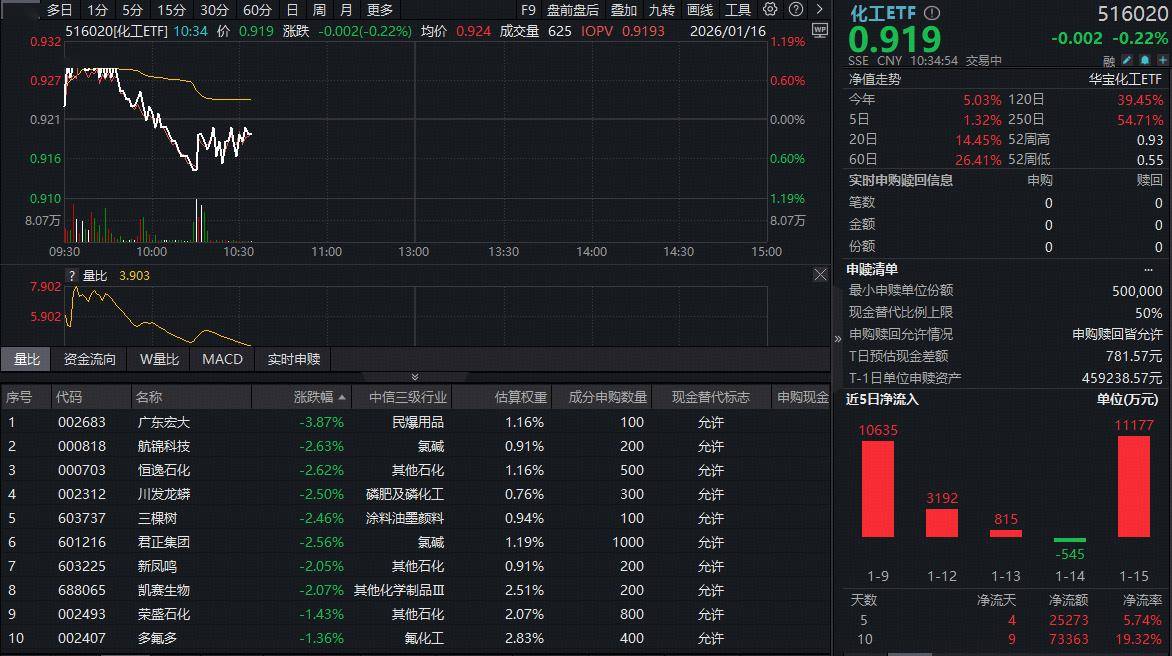
ETF盘中资讯|化工板块迎盘整!政策利好密集释放,机构:化工盈利有望触底回升
Sou Hu Cai Jing· 2026-01-16 03:07
Group 1 - The chemical sector is experiencing fluctuations, with the Chemical ETF (516020) showing a slight decline of 0.22% as of the latest update [1] - Key stocks in the sector, including Guangdong Hongda, Hanjin Technology, Hengyi Petrochemical, and Chuanfa Longmang, have seen significant declines, with Guangdong Hongda dropping over 3% [1][2] - Recent regulatory developments in the basic chemical industry include the approval of the "Safety Law of Hazardous Chemicals," effective from May 1, 2026, marking a new phase in national safety management [1] Group 2 - Shanghai Securities indicates a recovery in the chemical industry, with expectations of a supply-side slowdown and a new inventory replenishment cycle [3] - Huafu Securities notes that the chemical industry is at a new equilibrium point, with policies reshaping the competitive landscape and new production technologies driving growth [3] - The Chemical ETF (516020) is highlighted as an efficient way to invest in the sector, with nearly 50% of its holdings in large-cap stocks and the remainder in key segments like phosphate and fluorine chemicals [3]