反内卷

Search documents
民航继续整治过低票价,继续重视油运布局
GOLDEN SUN SECURITIES· 2026-01-11 05:23
Investment Rating - The report maintains an "Overweight" rating for the transportation industry [4] Core Insights - The civil aviation sector is expected to continue addressing "involutionary competition" while focusing on "expanding domestic demand" and "countering involution," indicating a positive long-term outlook for the aviation sector [2][11] - The shipping market is experiencing a recovery in VLCC freight rates due to geopolitical risks, with some shipowners becoming optimistic about future market conditions [2][12] - The logistics sector shows promising growth in express delivery, particularly in overseas markets, with significant increases in package volumes reported [3][15] Summary by Sections Weekly Insights and Market Review - The transportation sector index rose by 0.23% from January 5 to January 9, 2026, underperforming the Shanghai Composite Index by 3.59 percentage points [1][17] - The top-performing segments included highway freight, public transport, and warehousing logistics, with increases of 4.90%, 2.34%, and 2.16% respectively [1][17] Aviation - The civil aviation sector is seeing a recovery in demand, with a focus on maintaining low growth in capacity supply and improving airline profitability as ticket prices stabilize [11] - Key stocks to watch include China Eastern Airlines, China Southern Airlines, and Spring Airlines [11] Shipping and Ports - VLCC freight rates have begun to rise, with the CT1 route rate reaching $54,455 per day as of January 9, 2026 [2][12] - The dry bulk shipping market is facing downward pressure, with the BDI index at 1,688 points as of January 9, 2026 [13][14] Logistics - The express delivery sector is expected to grow, with a focus on overseas expansion and the impact of e-commerce growth on delivery volumes [3][15] - The report highlights the performance of Jitu Express, which saw a 73.6% increase in package volume in Southeast Asia for Q4 2025 [15][16]
拆解车企2026新年致辞:反内卷、求质量成为集体共识
经济观察报· 2026-01-11 04:40
Core Viewpoint - The automotive industry is collectively reflecting on the past years of intense competition, termed "involution," and is advocating for a shift towards a more sustainable competitive landscape that emphasizes technology, quality, brand, and user experience rather than just cost and price [2]. Group 1: Involution and Industry Reflection - The automotive industry consensus in 2025 recognizes that endless low-price competition erodes profits and stifles innovation, leading to a narrow path that does not foster long-term competitiveness [2]. - Major automotive leaders, including those from FAW Group and BAIC Group, have publicly denounced "involution" and emphasized the need for fair competition and healthy industry development [2]. - Geely's chairman highlighted a pivotal moment in 2007 when the company decided to abandon low-price competition, marking a significant turning point in its development [2]. Group 2: Safety as a Priority - Safety has emerged as a critical topic in the automotive industry, especially following several high-profile electric vehicle accidents in 2025 [4]. - Companies like Chery and GAC have established stringent safety standards that exceed national regulations, with GAC introducing a comprehensive safety guarantee policy [4]. - Geely has expanded its safety focus to include data, software, and ecological safety, reflecting a broader understanding of safety beyond just physical vehicle safety [4]. Group 3: Openness and Collaboration - The automotive industry is shifting from a competitive mindset to one of collaboration across the supply chain, with companies forming partnerships with tech firms and other sectors [6][7]. - SAIC Group has articulated a strategy of "equal rights-driven advancement," listing numerous partners across various technological fields, indicating a move towards a more integrated ecosystem [6]. - Chery's initiative to collaborate with top global universities aims to create a platform for continuous innovation, moving beyond mere technology acquisition [7]. Group 4: Smart and Electric Transformation - The consensus among automotive companies is that electrification is a baseline requirement, while smart technology will determine competitive positioning in the industry [9]. - Companies like BYD and NIO are making significant investments in smart technology, with NIO announcing the production of advanced driving chips and operating systems [9]. - The evolution of vehicles into "mobile smart terminals" signifies a fundamental shift in the automotive value proposition, integrating technology and business models [9]. Group 5: Global Expansion - The export of Chinese automobiles has become a crucial factor for future success, with companies like BYD and Dongfeng accelerating their global strategies [12][13]. - The shift from mere product export to a comprehensive value chain export strategy is evident, as companies aim to establish sustainable competitive advantages in international markets [12]. - Chery's global strategy emphasizes becoming an integral part of local markets, highlighting the importance of localized operations and community engagement [13].


美团、淘宝闪购、京东外卖,集体表态
Sou Hu Cai Jing· 2026-01-11 03:12
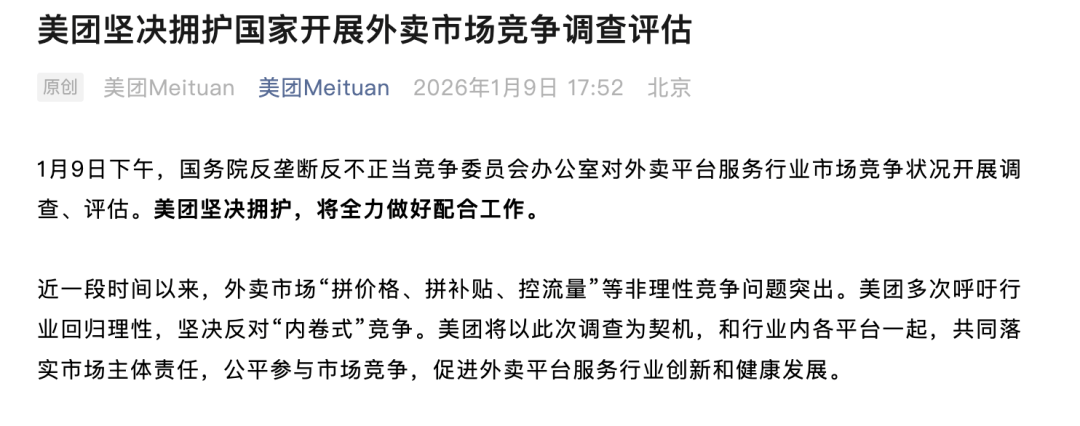
Core Viewpoint - The State Council's Anti-Monopoly and Anti-Unfair Competition Committee announced an investigation into the competitive status of the food delivery platform service industry, with major players like Meituan, Taobao Flash, and JD Delivery expressing their willingness to cooperate [1][3][5]. Group 1: Industry Response - Meituan highlighted the prevalence of irrational competition characterized by price wars, subsidies, and traffic control, urging the industry to return to rational competition and opposing "involution" [1]. - Taobao Flash emphasized the importance of fair competition as a core principle of market economy, committing to compliance with relevant laws and regulations while supporting the investigation [3]. - JD Delivery expressed strong support for the investigation, advocating for the maintenance of fair competition and the protection of consumer and operator rights, while promoting high-quality development through supply chain innovation [5][6]. Group 2: Commitment to Healthy Development - Meituan aims to use the investigation as an opportunity to collaborate with other platforms to fulfill market responsibilities and foster innovation and healthy development in the food delivery service industry [1]. - Taobao Flash reiterated its commitment to providing diverse and high-quality services in collaboration with merchants and partners, contributing to a fair and orderly market environment [3]. - JD Delivery plans to resist harmful competition and focus on quality delivery services, enhancing its offerings for consumers, merchants, and delivery personnel [5][6].

GGII:2026年电池行业十大预测(上)
高工锂电· 2026-01-10 12:19
Core Viewpoint - The lithium battery industry is transitioning from an emotion-driven phase to a rational value-return cycle starting in 2026, following a strong recovery after a deep correction in 2025 [3][4]. Group 1: Industry Trends - In 2026, the lithium battery market in China is expected to see a shipment volume exceeding 2.3 TWh, with a year-on-year growth of nearly 30%. The energy storage battery shipments are projected to surpass 850 GWh, with a growth rate exceeding 35% [7]. - The demand for energy storage is driven by independent market growth and supportive policies, leading to an increase in internal rate of return (IRR) for energy storage stations, generally reaching 6-12% [7]. - The export of new energy vehicles is anticipated to approach 4 million units in 2026, representing a year-on-year growth of over 50% [9]. Group 2: Supply and Demand Dynamics - The supply-demand tension in the lithium battery industry is expected to persist in 2026, with top enterprises maintaining high order volumes and production schedules [10]. - The "anti-involution" policy is leading to a rational expansion of production capacity, with a projected increase in bidding orders by over 30% in 2026, although new capacities will primarily come online in 2027-2028 [11]. - Key material segments are dominated by leading companies, with a shortage of capacity in areas such as lithium iron phosphate and high-end anode products, exacerbating the tight balance in the industry [11]. Group 3: Capacity Expansion and Market Growth - The lithium battery industry is expected to add over 700 GWh of new capacity in 2026, primarily concentrated among top companies like CATL and BYD, which will drive the equipment market demand to exceed 65 billion yuan [13][14]. - The expansion of production capacity will directly contribute to a significant increase in the lithium battery equipment market, with strong demand for coating, stacking, and formation equipment [14]. Group 4: Price Trends - The lithium battery supply chain is projected to experience a simultaneous increase in volume and price, with battery-grade lithium carbonate prices expected to stabilize above 120,000 yuan/ton, potentially reaching peaks above 150,000 yuan/ton [16]. - The price of copper foil is anticipated to exceed 120,000 yuan/ton, driven by rising copper prices and a tightening supply-demand situation for high-end copper foil [16]. - The price of electrolyte is expected to increase by 10-20% in 2026 due to tight supply conditions for upstream materials [18]. Group 5: Collaboration Between Large and Small Enterprises - The number of small and medium-sized enterprises engaging in contract manufacturing is expected to increase significantly in 2026, particularly in the fields of battery cells, phosphate, and anode materials [20]. - A competitive landscape is emerging where leading companies are vying for contract manufacturing resources due to their insufficient production capacity and expansion constraints [20].
回升的迹象增多—2025年物价回顾与2026年展望【国盛宏观熊园团队】
Xin Lang Cai Jing· 2026-01-10 09:09
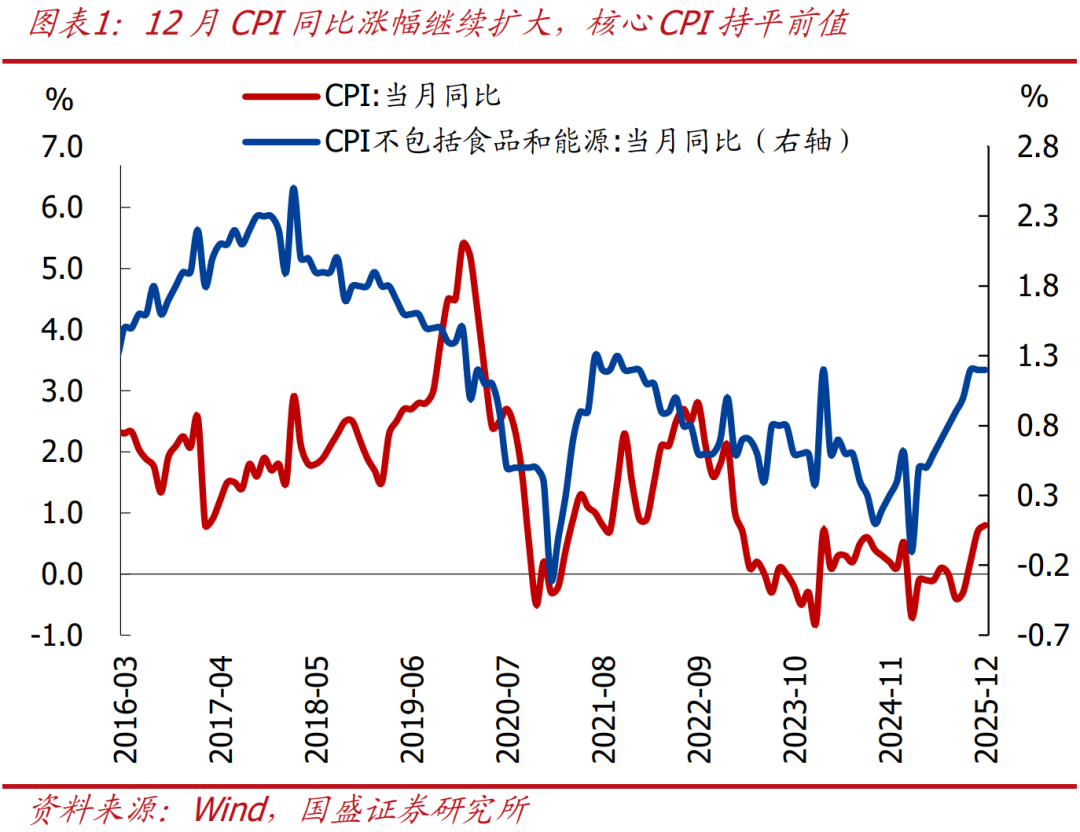
Core Insights - The Consumer Price Index (CPI) for December 2025 is projected to increase by 0.8% year-on-year, while the Producer Price Index (PPI) is expected to decline by 2.6% year-on-year, indicating a mixed economic outlook for 2025 [1][2][3] CPI Analysis - CPI has shown a continuous recovery for four months, reaching a new high since March 2023, with core CPI remaining above 1% for the same duration [1][2] - In December, the CPI increased by 0.1 percentage points to 0.8%, driven by rising food and core consumer goods prices, while energy prices remained weak [6][7] - The annual CPI for 2025 is expected to average around 0%, the lowest level since 2009, primarily due to weak food and energy prices [3][4] PPI Analysis - The PPI for December is projected at -1.9%, with a narrowing decline compared to the previous month, and a month-on-month increase of 0.2% [3][12] - The annual PPI for 2025 is expected to average -2.6%, the second-lowest since 2016, influenced by weak demand and excess capacity in various sectors [4][5] - Key drivers for PPI include the recovery in the non-ferrous metals sector and the impact of "anti-involution" policies, while the oil and petrochemical sectors continue to exert downward pressure [12][13] 2026 Outlook - For 2026, CPI is forecasted to slightly increase to 0.7%, supported by policies such as "old-for-new" exchanges and rising gold prices, while PPI is expected to stabilize at -0.4% [5][6] - Factors influencing the 2026 outlook include potential price increases in coal, steel, and lithium due to demand from energy storage and AI-related sectors [6][12]
国盛证券:2026年物价仍将延续2025年下半年以来的回升趋势
Xin Lang Cai Jing· 2026-01-10 06:06
Core Insights - The report from Guosheng Securities indicates that the Consumer Price Index (CPI) is expected to remain flat in 2025 compared to the previous year, while the Producer Price Index (PPI) is projected to decline by 2.6% [1] Group 1: CPI Trends - CPI has rebounded for four consecutive months, reaching the highest level since March 2023, with core CPI maintaining above 1% for the same duration [1] - Prices of core goods such as household appliances and gold jewelry continue to show strength [1] Group 2: PPI Trends - PPI has increased for three consecutive months, with an expanding growth rate, driven primarily by the non-involution sector and the metals industry [1] - The oil and petrochemical industry chain prices continue to decline [1] Group 3: Future Projections - For 2026, the report anticipates a continuation of the price recovery trend observed in the latter half of 2025, influenced by factors such as the "old-for-new" policy, narrowing rental declines, and rising gold and service prices [1] - Core CPI is expected to remain strong, with a projected year-on-year central tendency of around 0.7%, influenced by gold jewelry prices contributing approximately 0.3% to the CPI if the London gold price averages $4,500 per ounce in 2026 [1] - PPI is projected to have a year-on-year central tendency of around -0.4%, supported by rising prices in coal, steel, lithium carbonate, and copper due to demand from non-involution, energy storage, and AI-related sectors [1]

国盛证券:2026 年物价仍将延续 2025 年下半年以来的回升趋势
Xin Lang Cai Jing· 2026-01-10 05:53
Core Insights - The report from Guosheng Securities indicates that the Consumer Price Index (CPI) in 2025 is expected to remain flat compared to the previous year, while the Producer Price Index (PPI) is projected to decline by 2.6% [1] Group 1: CPI Analysis - CPI has shown a continuous recovery for four months, reaching a new high since March 2023, with core CPI maintaining above 1% for the same duration [1] - Prices of core goods such as household appliances and gold jewelry continue to exhibit strength [1] Group 2: PPI Analysis - PPI has increased for three consecutive months, with an expanding growth rate, primarily driven by the non-ferrous and "anti-involution" industries [1] - Prices in the oil and petrochemical industry chain continue to decline [1] Group 3: 2026 Outlook - For 2026, the report anticipates a continuation of the price recovery trend observed in the latter half of 2025, influenced by recent commodity price movements and the "replacement basket" effect [1] - Core CPI is expected to remain strong, with a projected year-on-year central tendency of around 0.7%, driven by policies such as trade-in programs, narrowing rental declines, and rising gold and service prices [1] - Assuming the central price of London gold is $4,500 per ounce, gold jewelry is expected to contribute approximately 0.3% to the CPI in 2026 [1] - PPI is projected to have a year-on-year central tendency of around -0.4%, supported by demand in coal, steel, lithium carbonate, and copper due to "anti-involution," energy storage needs, and AI-related demand [1]
扩内需政策效果显现,2025年12月CPI超预期增长
Hua Xia Shi Bao· 2026-01-10 04:12
Group 1 - The core consumer demand is increasing, leading to a rise in the Consumer Price Index (CPI) for December, which increased by 0.2% month-on-month and 0.8% year-on-year, exceeding market expectations [2][3] - The core CPI, excluding food and energy, rose by 1.2% year-on-year, indicating stable domestic demand [2][4] - The Producer Price Index (PPI) showed a month-on-month increase of 0.2% and a year-on-year decrease of 1.9%, with the decline narrowing due to improved supply-demand structures [5][6] Group 2 - Prices of communication tools, maternal and infant products, entertainment durable goods, and household appliances increased by 1.4% to 3.0% month-on-month, reflecting the effectiveness of consumption-boosting policies [3][4] - Food prices rose by 1.1% year-on-year, contributing significantly to the CPI increase, while pork prices decreased by 1.7% due to sufficient supply [4][5] - The prices of durable goods showed overall improvement, with household appliances rising by 1.4% month-on-month, marking a historical high [4][5] Group 3 - The energy prices decreased by 0.5%, with gasoline prices falling by 1.2% due to international oil price fluctuations [4][5] - The prices in the coal mining and washing industry and coal processing rose by 1.3% and 0.8% respectively, continuing a five-month upward trend [5][6] - New production capacities in digital economy-related industries are driving price increases, with significant rises in prices for external storage devices (15.3%) and biomass liquid fuels (9.0%) [6]

中信证券:2026年化工板块投资价值有望持续提升
Di Yi Cai Jing· 2026-01-10 04:06
Core Viewpoint - The profitability of chemical companies is expected to gradually bottom out and recover, driven by a backdrop of weakening industry capital expenditure and the domestic push against "involution" [1] Group 1: Investment Opportunities - Focus on high-energy-consuming products such as calcium carbide, caustic soda, and yellow phosphorus, which may become effective tools against "involution" [1] - Attention to segments where self-discipline is steadily advancing and initial results of the "involution" countermeasures are visible [1] - Certain products have fallen below or are close to the industry cash cost line, with leading companies having significant cost advantages [1] - Chemical products with strong demand or new demand drivers that have the potential for sustained price increases [1] - Chemical products related to new materials and new applications [1]

多晶硅巨头遭约谈,光伏反内卷转向市场化
Zhong Guo Jing Ying Bao· 2026-01-10 02:21
Core Viewpoint - The recent meeting with the State Administration for Market Regulation highlighted concerns about potential monopolistic practices in the polysilicon industry, prompting calls for regulatory compliance and market-driven solutions to address excessive competition and price manipulation [1][2][4]. Industry Overview - On January 6, 2026, the State Administration for Market Regulation held discussions with major polysilicon companies, including Tongwei Co., GCL-Poly Energy, Daqo New Energy, and Xinte Energy, regarding reported monopolistic risks and corrective measures [1][2]. - Following the meeting, stock prices for these companies fell significantly, with declines of 3.83%, 7.89%, 6.1%, and 7.81% respectively by January 9 [1]. Regulatory Actions - The meeting's minutes indicated that since July 2025, there have been reports of companies using self-regulation as a pretext to raise polysilicon prices, leading to the establishment of a platform company aimed at capacity integration [2]. - The regulatory body emphasized that companies should not agree on production capacity, sales prices, or engage in market division, and must avoid any form of communication regarding pricing and production volumes [2]. Market Dynamics - The establishment of the platform company, Beijing Guanghe Qiancheng Technology Co., was intended to address the issue of excessive competition in the polysilicon sector through a dual-track model of "debt acquisition + flexible capacity utilization" [2]. - Analysts noted that the recent discussions have shifted market expectations towards anti-monopoly measures, leading to a withdrawal of funds from the polysilicon market and a potential breakdown of previously established price alliances [1][5]. Future Outlook - The polysilicon industry is currently facing significant challenges due to supply-demand imbalances and widespread losses among companies, necessitating a swift resolution to foster healthy development [4]. - Future pricing trends for polysilicon may be influenced by the recent regulatory actions, with expectations of price adjustments as market dynamics evolve [5].