
供给侧改革

Search documents
小摩:推动中国股票下一轮上涨的三大因素!超配互联网和消费
Zhi Tong Cai Jing· 2025-07-04 11:44
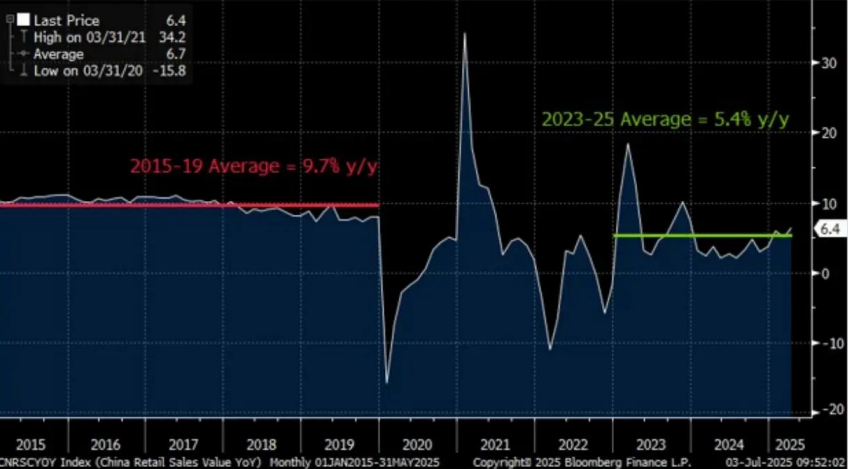
Group 1: Core Insights - The MSCI China Index has increased by 32% over the past year and is currently at a price-to-earnings ratio of 11.5, close to its 20-year average of 11.9, raising questions about the sustainability of this growth [1] - JPMorgan identifies three key factors supporting a positive outlook for the Chinese market: initial recovery in consumption, addressing overcapacity issues, and high equity risk premium due to significantly lower interest rates [1] Group 2: Consumption Recovery - The recovery of Chinese consumption is a critical theme for the second half of 2025, with retail sales growth averaging 5.4% since 2023, down from pre-COVID levels of 9-10%, but showing signs of rebound [2] - Improving consumption will help balance supply and demand, alleviate deflationary pressures, and enhance corporate pricing power and profitability [2] - Key areas to focus on for sustained retail sales growth include expanding policy support, emphasizing consumer services, and stabilizing the real estate market, which has negatively impacted GDP by 2-2.5% annually over the past four years [2] Group 3: Addressing Overcapacity - The Chinese government is focusing on reducing overcapacity, particularly in the context of real estate control and technology access restrictions from the U.S., aiming for greater self-sufficiency in the industrial chain [7] - There is anticipation for meaningful supply-side reforms, with a focus on sectors such as automotive, materials, industrials, and technology [7] - Stocks that may benefit from industry consolidation include BYD, CATL, Chalco, Putailai, and Nippon Paint [7] Group 4: Capital Costs and Equity Risk Premium - Despite the MSCI China Index's mean reversion, the equity risk premium remains high, attributed to a significant decline in government bond yields, indicating that the Chinese stock market is still undervalued [9] - Interest rates are expected to remain low, with a forecasted 10 basis point cut by the end of 2025, currently at 1.64% for 10-year government bonds [9] - The current earnings yield of the Chinese stock market is 9%, suggesting an implied equity risk premium exceeding 7%, which is historically high compared to the U.S. [9][10]

策略点评报告:助力”中枢”抬升
Bank of China Securities· 2025-07-04 11:32
Group 1: Policy Signals and Market Reactions - The recent signals regarding the orderly exit of backward production capacity emerged before the July 1 meeting of the Central Financial Committee, with some product prices stabilizing in June[3] - The Central Financial Committee emphasized the need to promote the orderly exit of backward production capacity, marking a shift from industry self-discipline to top-level policy[3] - Despite the policy signals, related industry stock performances remained subdued until the July 1 meeting, indicating a delayed market reaction[21] Group 2: Market Characteristics and Trends - The current market is expected to exhibit "pulse-like" trends due to unclear demand-side signals, contrasting with the 2016 supply-side reform that saw simultaneous demand boosts[22] - The segmentation of industries will likely show significant differentiation between "old industries" (e.g., steel, coal, cement) and "new industries" (e.g., new energy vehicles, lithium batteries)[22] - Focus should be on new industries with external demand, which may offer higher profit elasticity under similar supply-side adjustments[22] Group 3: Economic Implications and Risks - The stabilization of related industries will significantly aid macroeconomic structural adjustments and improve price factors, contributing to the overall elevation of the A-share market[23] - Risks include the potential underperformance of the orderly exit of backward production capacity, unexpected macroeconomic fluctuations, and unforeseen tariff disputes[28]

工信部重磅发声:依法依规、综合治理光伏行业低价无序竞争
Cai Jing Wang· 2025-07-04 08:36
开源证券在研报中指出,当前光伏行业多环节产品价格已跌破现金成本线,深化供给侧改革诉求迫切。 在此背景下,头部光伏玻璃企业计划自7月开始集体减产,头部硅料企业正主动推进多晶硅产能整合, 企业行为契合政策导向,推动行业供需结构改善。 实际上,自去年以来,主管部门、行业协会等密集发声,释放光伏产业"反内卷"信号。 2024年10月14日,中国光伏行业协会联合16家光伏头部企业召开"防止恶性竞争"座谈会,达成共识强化 行业自律;2025年2月25日,市场监管总局召开部分企业公平竞争座谈会,天合光能、晶澳科技 (002459)、隆基绿能(601012)等7家企业有关负责人围绕整治"内卷式"竞争进行深入交流。 近期,国内多个制造业领域掀起"反内卷"行动,光伏产业链企业也计划减产。 7月3日,中国有色金属工业协会硅业分会发文称,7月开始,主要硅片厂商计划降低开工率4成左右。因 此,在政策陆续落地和硅片企业减产挺价情形下,硅片价格有触底企稳动力。 据工信部网站,7月3日,工业和信息化部党组书记、部长李乐成主持召开第十五次制造业企业座谈会, 聚焦加快推动光伏产业高质量发展,听取光伏行业企业及行业协会情况介绍和意见建议。 会上, ...


日度策略参考-20250704
Guo Mao Qi Huo· 2025-07-04 08:10
Report Industry Investment Ratings - **Bullish**: Silver, industrial silicon, palm oil, soybean oil, rapeseed oil [1] - **Bearish**: Alumina, zinc, tin, log, LPG [1][2] - **Neutral (Oscillating)**: Stock index, bond futures, gold, copper, nickel, stainless steel, rebar, hot-rolled coil, iron ore, ferrosilicon, manganese silicon, coking coal, coke, cotton, corn, soybeans, pulp, live pigs, crude oil, fuel oil, asphalt, BR rubber, PTA, ethylene glycol, short fiber, styrene, PVC, VCM, shipping freight rates [1][2] Core Viewpoints - In the short term, the market trading volume is gradually shrinking, and there are few positive factors at home and abroad. The stock index faces resistance in breaking through upward and may show an oscillating pattern. The bond futures are favored by the asset shortage and weak economy, but the central bank's short-term warning on interest rate risks suppresses the upward space. The strong non-farm payrolls in June dampened the expectation of interest rate cuts, which may suppress the price of gold, but the high uncertainty of tariff policies and tax reform bills supports the price of gold. The macro and commodity attributes still support the price of silver, which may be strong in the short term [1]. - The unexpected non-farm payrolls in the United States dampened the expectation of interest rate cuts. The copper price may oscillate due to the overseas squeeze risk. The aluminum price has a risk of decline due to the cooling expectation of the Fed's interest rate cuts and the high price suppressing downstream demand. The price of alumina and zinc may be weak. The nickel price has rebounded in the short term, but the upward space is limited, and the medium- and long-term excess of primary nickel still exerts pressure. The stainless steel has rebounded in the short term, but the sustainability remains to be observed. The price of tin has a risk of decline due to the weakening of the macro sentiment and the limited production expectation in the glass and photovoltaic industries [1]. - The industrial silicon is favored by the production cut of large factories in Xinjiang, the marginal increase in the demand for polysilicon, and the high market sentiment. The polysilicon is expected to have a supply-side reform in the photovoltaic market and high market sentiment. The supply of lithium carbonate has not decreased, the downstream replenishment is mainly by traders, and the factory procurement is not active. The rebar, hot-rolled coil, and iron ore may oscillate due to the short-term production restriction of some steel mills. The price of ferrosilicon and manganese silicon is under pressure due to the weakening of supply and demand. The coking coal and coke may oscillate, and the industry customers can take advantage of the premium to establish futures-spot positive hedging positions [1]. - The palm oil, soybean oil, and rapeseed oil are favored by the latest US tax bill from the demand side, and the short-term view is bullish. The domestic cotton price is expected to maintain an oscillating and weakening trend due to the entry of the domestic cotton spinning industry into the consumption off-season and the accumulation of downstream finished product inventory. The sugar production in Brazil in the 2025/26 season is expected to reach a record high, and the production may exceed expectations if the crude oil continues to be weak. The corn price may oscillate, and the C01 contract is recommended to be shorted on rallies. The soybean price may oscillate, and it is recommended to wait and see. The pulp price is currently undervalued with macro positives. The log price is weak. The live pig futures may be stable due to the weak impact of the current slaughter on the spot price [1]. - The crude oil and fuel oil may oscillate due to the cooling of the Middle East geopolitical situation, the possible continuation of the OPEC+ production increase operation, and the support of the current consumption peak season in Europe and the United States. The asphalt price may decline slowly due to the cost drag, the possible increase in the consumption tax rebate in Shandong, and the slow recovery of demand. The BR rubber price is expected to be weak in the short term. The PTA price is becoming more abundant in the spot market, and the polyester replenishment willingness is not high due to the profit compression. The ethylene glycol price is expected to oscillate due to the large arrival volume in the later period and the impact of the concentrated procurement of polyester production and sales [1]. - The short fiber price may oscillate due to the small number of registered warehouse receipts and the close follow-up of costs. The styrene price may oscillate due to the increase in the device load and the weakening of the basis. The PVC price may oscillate strongly due to the positive impact of the anti-involution policy on the spot, the end of the maintenance, the commissioning of new devices, and the arrival of the seasonal off-season for downstream demand. The VCM price may oscillate due to the end of the maintenance, the decline of the spot price to a low level, the decline of liquid chlorine eroding the comprehensive profit, and the small number of current warehouse receipts. The LPG price has a downward space in the short term due to the seasonal off-season of combustion and chemical demand and the narrow spread between industrial and civil use [2]. - The shipping freight rate on the European route is expected to peak in the first half of July and show an arc-shaped top in July and August, with the peak time advancing. The subsequent weeks will have sufficient shipping capacity deployment [2]. Summary by Industry Segments Macro Finance - **Stock Index**: Faces resistance in breaking through upward and may show an oscillating pattern due to the shrinking trading volume and few positive factors at home and abroad. Follow-up attention should be paid to the guidance of macro incremental information on the direction of the stock index [1]. - **Bond Futures**: Favored by the asset shortage and weak economy, but the central bank's short-term warning on interest rate risks suppresses the upward space [1]. - **Gold**: The strong non-farm payrolls in June dampened the expectation of interest rate cuts, which may suppress the price, but the high uncertainty of tariff policies and tax reform bills supports the price [1]. - **Silver**: The macro and commodity attributes still support the price, which may be strong in the short term [1]. Non-Ferrous Metals - **Copper**: May oscillate due to the overseas squeeze risk and the unexpected non-farm payrolls in the United States dampening the expectation of interest rate cuts [1]. - **Aluminum**: Has a risk of decline due to the cooling expectation of the Fed's interest rate cuts and the high price suppressing downstream demand [1]. - **Alumina**: The price may be weak due to the unexpected non-farm payrolls in the United States dampening the expectation of interest rate cuts [1]. - **Zinc**: Has a risk of decline due to the unexpected non-farm payrolls in the United States and the continuous inventory accumulation [1]. - **Nickel**: Has rebounded in the short term, but the upward space is limited, and the medium- and long-term excess of primary nickel still exerts pressure. Short-term interval operation is recommended, and follow-up attention should be paid to the improvement of demand [1]. - **Stainless Steel**: Has rebounded in the short term, but the sustainability remains to be observed. Short-term operation is recommended, and follow-up attention should be paid to the raw material changes and the steel mill production schedule [1]. - **Tin**: Has a risk of decline due to the weakening of the macro sentiment and the limited production expectation in the glass and photovoltaic industries [1]. - **Industrial Silicon**: Favored by the production cut of large factories in Xinjiang, the marginal increase in the demand for polysilicon, and the high market sentiment [1]. - **Polysilicon**: Expected to have a supply-side reform in the photovoltaic market and high market sentiment [1]. - **Lithium Carbonate**: The supply has not decreased, the downstream replenishment is mainly by traders, and the factory procurement is not active [1]. Black Metals - **Rebar**: May oscillate due to the short-term production restriction of some steel mills. Temporary waiting and observation are recommended [1]. - **Hot-Rolled Coil**: May oscillate due to the short-term production restriction of some steel mills. Temporary waiting and observation are recommended [1]. - **Iron Ore**: The upward space is suppressed by the production restriction of steel mills, but the high short-term demand provides support [1]. - **Ferrosilicon**: The price is under pressure due to the weakening of supply and demand. The production decreases under the pressure of profit, and the demand weakens marginally [1]. - **Manganese Silicon**: The price is under pressure due to the short-term increase in production, the weakening of demand, and the insufficient cost support [1]. - **Coking Coal**: May oscillate, and the industry customers can take advantage of the premium to establish futures-spot positive hedging positions. The short-term trading level cannot be falsified, so the short positions on the futures market can be temporarily avoided [1]. - **Coke**: Similar to coking coal, focus on the opportunity of futures premium for selling hedging [1]. Agricultural Products - **Palm Oil, Soybean Oil, Rapeseed Oil**: Favored by the latest US tax bill from the demand side, the short-term view is bullish. Follow-up attention should be paid to the hearing on the 8th and the supply and demand reports from the producing areas [1]. - **Cotton**: The domestic cotton price is expected to maintain an oscillating and weakening trend due to the entry of the domestic cotton spinning industry into the consumption off-season and the accumulation of downstream finished product inventory. Follow-up attention should be paid to the progress of the US economic recession and the Sino-US tariff war [1]. - **Sugar**: The sugar production in Brazil in the 2025/26 season is expected to reach a record high, and the production may exceed expectations if the crude oil continues to be weak. Follow-up attention should be paid to the impact of the crude oil price on the sugar production ratio in Brazil's new crushing season [1]. - **Corn**: The short-term import of corn and the release of brown rice have impacted the market, but the impact is within the market expectation. The old crop of corn has a tightening supply and demand expectation, and the decline of the futures price is expected to be limited. The C01 contract is recommended to be shorted on rallies [1]. - **Soybeans**: May oscillate due to the strong US soybeans under the expectation of Sino-US trade negotiations and the slight decline of the Brazilian premium. The domestic oil mills have a phenomenon of urging提货, and the basis is weak. Short-term attention should be paid to the progress of Sino-US trade negotiations, and waiting and observation are recommended [1]. - **Pulp**: The outer quotation has decreased, the shipping volume has increased, the domestic demand is weak, and the current valuation is low, with macro positives [1]. - **Log**: The current season is the off-season, and the supply decreases limitedly even when the outer price rises. The view is weak [1]. - **Live Pigs**: The inventory is expected to be abundant on the futures market, and the futures price is at a large discount to the spot price. The short-term spot price is less affected by the slaughter, but the overall decline is limited, so the futures price remains stable [1]. Energy and Chemicals - **Crude Oil**: May oscillate due to the cooling of the Middle East geopolitical situation, the possible continuation of the OPEC+ production increase operation, and the support of the current consumption peak season in Europe and the United States [1]. - **Fuel,Oil**: Similar to crude oil, may oscillate due to the cooling of the Middle East geopolitical situation, the possible continuation of the OPEC+ production increase operation, and the support of the current consumption peak season in Europe and the United States [1]. - **Asphalt**: The price may decline slowly due to the cost drag, the possible increase in the consumption tax rebate in Shandong, and the slow recovery of demand [1]. - **BR Rubber**: The price is expected to be weak in the short term due to the limited support from the raw material end, the pressure on the synthetic rubber fundamentals, the high basis, and the follow-up of the butadiene price. Follow-up attention should be paid to the price adjustment of butadiene and the spot price of cis-polybutadiene rubber, as well as the de-stocking progress of synthetic rubber [1]. - **PTA**: The price is becoming more abundant in the spot market, and the polyester replenishment willingness is not high due to the profit compression. The polyester downstream load remains at 90% despite the expectation of load reduction, and the bottle chips and short fibers will enter the maintenance cycle in July [1]. - **Ethylene Glycol**: The price is expected to oscillate due to the large arrival volume in the later period and the impact of the concentrated procurement of polyester production and sales. The macro sentiment has improved, and the chemical industry has followed the downward trend of the crude oil price [1]. - **Short Fiber**: May oscillate due to the small number of registered warehouse receipts and the close follow-up of costs. The short fiber factory has a maintenance plan [2]. - **Styrene**: May oscillate due to the increase in the device load and the weakening of the basis. The market speculative demand has weakened, and the pure benzene price has rebounded slightly [2]. - **PVC**: May oscillate strongly due to the positive impact of the anti-involution policy on the spot, the end of the maintenance, the commissioning of new devices, and the arrival of the seasonal off-season for downstream demand [2]. - **VCM**: May oscillate due to the end of the maintenance, the decline of the spot price to a low level, the decline of liquid chlorine eroding the comprehensive profit, and the small number of current warehouse receipts. Follow-up attention should be paid to the change of liquid chlorine [2]. - **LPG**: Has a downward space in the short term due to the seasonal off-season of combustion and chemical demand, the narrow spread between industrial and civil use, and the slow decline of the spot price [2]. Others - **Shipping Freight Rate on the European Route**: Expected to peak in the first half of July and show an arc-shaped top in July and August, with the peak time advancing. The subsequent weeks will have sufficient shipping capacity deployment [2].
供给侧改革2.0启动,钢铁指数人气回升!相关ETF布局正当时?
Sou Hu Cai Jing· 2025-07-04 07:47
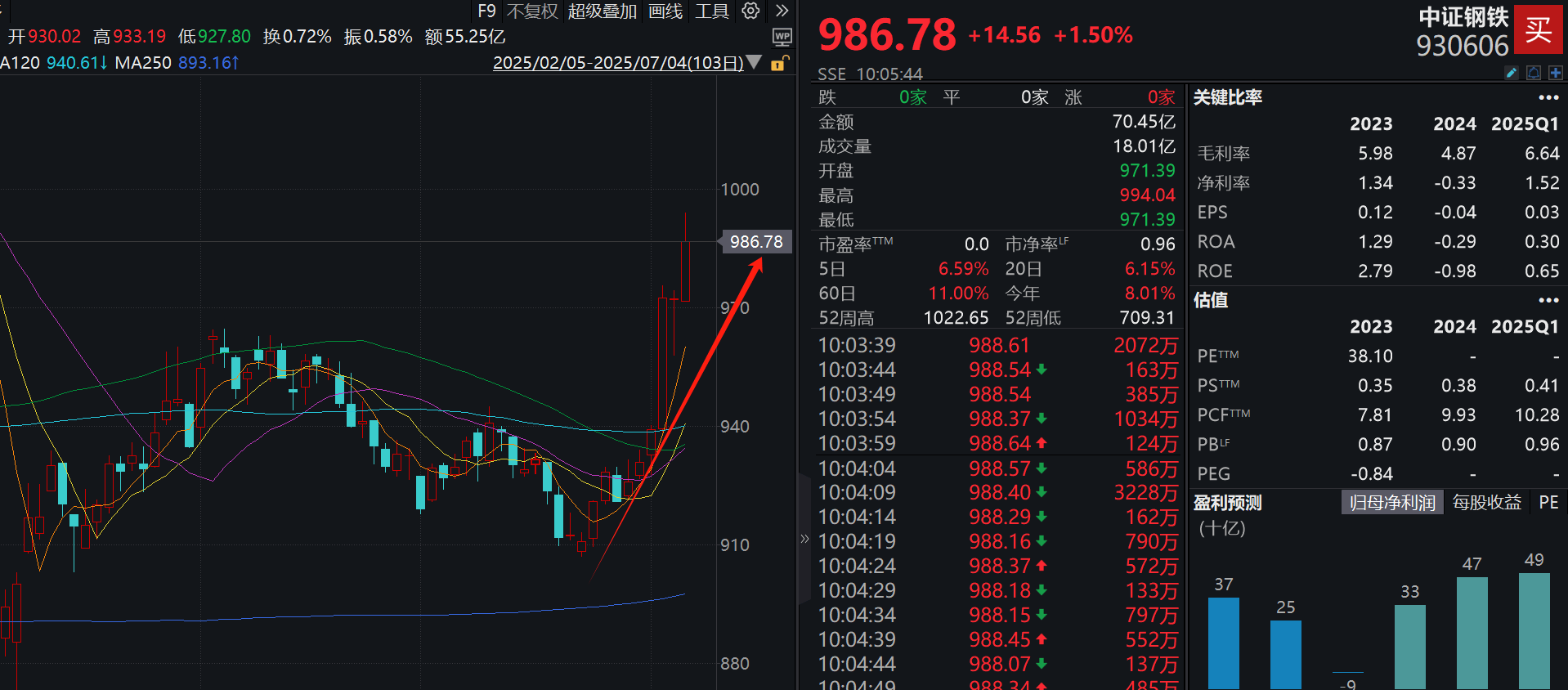
Group 1 - The core viewpoint of the article emphasizes the significance of the supply-side reform 2.0, which aims to eliminate backward production capacity and effectively address chaotic competition in the industry [1] - The supply-side reform initiated in 2015 led to substantial price increases in commodities, with rebar futures soaring from 843 yuan/ton to 3147 yuan/ton, a 273% increase, and coking coal prices rising from 203 yuan to 719 yuan, a 3.5-fold increase [1] - The recent performance of the steel industry, particularly the China Steel Index, has mirrored past trends, with a notable increase of over 3.5% in a single day, indicating a potential revival similar to the previous supply-side reform [1][4] Group 2 - The current supply-side reform is characterized by unprecedented policy strength, focusing on eliminating low-price competition and orderly phasing out of backward production capacity, suggesting a potential for significant market recovery [6] - The valuation of steel stocks should consider the cyclical nature of the industry, with many steel companies currently valued below their replacement cost by 0.35 times, indicating a sufficient margin of safety [6] - The comparison between the China Steel Index and the National Steel Industry Index shows a high degree of overlap, with both indices focusing on the steel industry, although the China Steel Index includes some coal companies [7] Group 3 - The performance of funds tracking the China Steel Index and the National Steel Industry Index has been similar, with differences in returns being minimal, generally within 0.1% [12] - Specific funds, such as the Guolian National Steel A and Penghua National Steel Industry A, have shown significant returns of 8.10% and 7.66% respectively, outperforming the CSI 300 index [14] - The article suggests that as the economy develops, steel consumption will stabilize, with a shift from rebar consumption in construction to sheet metal consumption in manufacturing, indicating a potential improvement in profitability for the steel sector [14]


黑色金属数据日报-20250704
Guo Mao Qi Huo· 2025-07-04 07:36
盖色金属数据日报 7000 1000 6000 800 5000 600 4000 400 3000 2000 1000 -200 螺纹基差(石轴) = 价格:螺纹钢:HRB400 20mm:上 - 期货收盘价(活跃合约):螺纹钢 8000 800 600 6000 400 200 2000 -200 60-6700 10-570 as 2008 2008 2008 200 | 热卷基差(右轴) = 价格:热轧板卷:Q235B:4. 75r 期货收盘价(活跃合约):热轧卷板 1000 -500 焦煤基差(右轴) 5000 800 【钢材】续涨动能尚可,周数据好转也添了一点油 4000 600 周四黑色板块依然算是坚挺,盘面延续增仓反弹,期盘续涨动能尚可;钢联周度数据显示淡季累库幅度和需求掉的节奏都没 3000 有失速,暂时托住了市场的信心。"反内卷"的导火线带来资金的跟随,期现正套以及前期反套被空单可能会带来短期现货 400 成交及投机需求的放量,观察持续性;我们更倾向于若短期未看到实质性政策出台,则对利润的利好影响及成材价格的独自 2000 利好并不能持续太久。值得关注的是,黑色板块品种的基差近期持续收缩, ...
广发期货《黑色》日报-20250704
Guang Fa Qi Huo· 2025-07-04 07:07
免责声明 知识图强, 求实奉献, 客户至上, 合作共赢 t to 关注微信公众 | 产业期现日报 | | | | | | | --- | --- | --- | --- | --- | --- | | 投资咨询业务资格:证监许可 【2011】1292号 | | | | 徐艺丹 Z0020017 | | | 铁矿石相关价格及价差 | | | | | | | 品种 | 现值 | 前值 | 涨跌 | 米咲帽 | 单位 | | 仓单成本:卡粉 | 731.9 | 724.2 | 7.7 | 1.1% | | | 仓单成本:PB粉 | 764.5 | 753.5 | 11.0 | 1.5% | | | 仓单成本:巴混粉 | 775.0 | 764.2 | 10.8 | 1.4% | | | 仓单成本:金布巴粉 | 756.2 | 745.4 | 10.8 | 1.4% | | | 09合约基差:卡粉 | 48.3 | 44.7 | 3.6 | 8.0% | | | 09合约基差:PB粉 | 31.5 | 74.0 | -42.5 | -57.4% | 元/吨 | | 09合约基差:巴混粉 | 42.0 | 84.7 | ...
供给侧产能调整,?猪期货反弹
Zhong Xin Qi Huo· 2025-07-04 07:03
1. Report Industry Investment Ratings - Oils and Fats: Oscillating with a bullish bias [4] - Protein Meal: Oscillating [4] - Corn and Starch: Oscillating [4] - Live Pigs: Oscillating with a bullish bias [5] - Natural Rubber: Oscillating [6] - Synthetic Rubber: Oscillating [9] - Cotton: Oscillating [10] - Sugar: Oscillating [11] - Pulp: Oscillating with a bearish bias [12] - Logs: Oscillating with a bearish bias [13] 2. Core Viewpoints of the Report - The report analyzes the market conditions of multiple agricultural products. In the short - term, the prices of live pigs and oils and fats may show a bullish trend, while protein meal, corn, and other products will oscillate. In the long - term, the supply of live pigs may face pressure, and the sugar market may decline due to expected supply increases [2][4][5]. 3. Summaries According to Relevant Catalogs 3.1 Market Views 3.1.1 Oils and Fats - Yesterday, the market oscillated and showed differentiation. The market should continue to monitor changes in the US biodiesel policy. Due to technical buying and optimistic demand expectations for soybean oil in the US biofuel industry, US soybeans rose on Wednesday, and domestic oils oscillated and showed differentiation yesterday, with palm oil being relatively strong. In the future, oils may continue to oscillate with a bullish bias, but the sustainability of the upward trend should be noted [4]. 3.1.2 Protein Meal - The price rose first and then fell, continuing to oscillate. Internationally, the US "Big and Beautiful" Act was passed, and US soybeans rebounded from the lower limit of the range. Domestically, soybean meal inventories continued to accumulate, and supply pressure may lead to a weakening of spot prices. In the long - term, protein meal may be supported by cost and oscillate in the short - term [4]. 3.1.3 Corn and Starch - The futures market remained weak, and the spot market stabilized. The current fundamentals of the corn market are affected by factors such as rainfall, changes in supply rhythm, and wheat substitution. The short - term trend is oscillating [4][5]. 3.1.4 Live Pigs - Affected by the expected supply - side reform in the industry, the live pig futures market rebounded. In the short - term, pig prices have temporarily changed from weak to strong, but in the long - term, there is still supply pressure [2][5]. 3.1.5 Natural Rubber - Rubber prices continued to fluctuate with commodities. The current fundamentals of natural rubber are relatively stable, with limited price changes, and the market is waiting for new variables [6][8]. 3.1.6 Synthetic Rubber - The weak raw materials dragged the market down. The current fundamentals of synthetic rubber are not significant, and the market mainly follows the fluctuations of natural rubber and overall commodities. The market may continue to decline, and attention should be paid to the previous low support [9]. 3.1.7 Cotton - Low inventory supports cotton prices. Although there are expectations of increased production in the new season, the current low inventory structure is expected to be beneficial to cotton prices, and the short - term price may be relatively resistant to decline [10]. 3.1.8 Sugar - The external market continued to weaken, and the domestic - foreign price difference widened. Domestically, there is an expectation of concentrated arrivals of imported sugar, and the sugar price is expected to be under pressure [11]. 3.1.9 Pulp - The futures market continued to rebound, but the spot market did not follow. The supply - demand situation of pulp is weak, and the futures market is expected to oscillate with a bearish bias [12]. 3.1.10 Logs - The fundamentals changed little, and the market oscillated. The log market is in a traditional off - season, and the medium - term supply - demand pattern is expected to be weak on both sides [13]. 3.2 Variety Data Monitoring - The report lists the data monitoring of multiple varieties, including the prices of live pigs, oils and fats, cotton, etc., but does not provide detailed analysis in this part [16][47][66][105][118][133][152]. 3.3 Rating Standards - The report provides rating standards such as "bullish", "oscillating with a bullish bias", "oscillating", "oscillating with a bearish bias", and "bearish", and the time period is the next 2 - 12 weeks [165].
新世纪期货交易提示(2025-7-4)-20250704
Xin Shi Ji Qi Huo· 2025-07-04 06:57
Report Industry Investment Ratings - Iron Ore: Rebound [2] - Coking Coal and Coke: Oscillation [2] - Rolled Steel and Rebar: Rebound [2] - Glass: Rebound [2] - Soda Ash: Oscillation [2] - Shanghai Composite 50: Rebound [2] - CSI 300: Oscillation [2] - CSI 500: Uptrend [4] - CSI 1000: Uptrend [4] - 2 - year Treasury Bond: Oscillation [4] - 5 - year Treasury Bond: Oscillation [4] - 10 - year Treasury Bond: Rebound [4] - Gold: High - level Oscillation [4] - Silver: High - level Oscillation [4] - Pulp: Oscillation [6] - Logs: Oscillation [6] - Soybean Oil: High - level Oscillation [6] - Palm Oil: High - level Oscillation [6] - Rapeseed Oil: High - level Oscillation [6] - Soybean Meal: Oscillation with a Bearish Bias [6] - Rapeseed Meal: Oscillation with a Bearish Bias [6] - No. 2 Soybeans: Oscillation with a Bearish Bias [6] - No. 1 Soybeans: Oscillation with a Bearish Bias [6] - Live Pigs: Rebound [8] - Rubber: Rebound [10] - PX: Wait - and - See [10] - PTA: Try Shorting at Highs [10] - MEG: Try Shorting at Highs [10] - PR: Wait - and - See [10] - PF: Wait - and - See [10] Core Viewpoints - The iron ore market shows a pattern of gradually increasing supply, relatively low demand, and an entry into the inventory accumulation stage. In the short term, due to emotional disturbances, it's recommended to exit previous short positions and wait and see. For coking coal and coke, with potential supply increases and uncertain demand, attention should be paid to the trends of hot metal and supply. The steel products market has a complex supply - demand situation, with short - term rebounds affected by policies and seasonal factors. The glass market lacks substantial positive factors, and its demand is difficult to recover significantly. The financial market is affected by factors such as policy support for infrastructure projects, economic data, and interest rate policies, with different trends for various stock indices and bonds. The precious metals market, especially gold, is influenced by central bank purchases, geopolitical risks, and interest rate policies, maintaining a high - level oscillation. The light industry and agricultural products markets have their own supply - demand characteristics and price trends, such as the pulp market being in a situation of weak supply and demand, the live pig market expected to rise, and the rubber market having a wide - range oscillation [2][4][6][8][10]. Summaries by Categories Black Industry - **Iron Ore**: Recently, the iron ore futures price has risen due to emotional factors. Although the global shipping volume and arrival volume have both declined this period, they are still at relatively high levels in recent years. There is an expectation of increased shipping volume later, and the arrival pressure may increase. During the industrial off - season, the output of five major steel products has increased, and the hot metal output is strong. The port inventory is still decreasing. In the long - term, the supply - demand surplus pattern remains unchanged. It's recommended to exit previous short positions and wait and see [2]. - **Coking Coal and Coke**: Affected by supply - side reform news and Tangshan production restrictions, the prices of black products have risen, and raw materials have followed. There are rumors of some coke enterprises and coal mines resuming production, and the supply is expected to increase. The steel mills are suppressing coke prices, the profit of coke enterprises has shrunk, and the inventory pressure has increased. Attention should be paid to the trends of hot metal and supply [2]. - **Rolled Steel and Rebar**: Due to rumors of production reduction policies in Tangshan and supply - side reform news, the futures price has rebounded. In the off - season, the building materials demand has slightly increased, the output of five major steel products has continued to rise, and the total steel inventory is flat. However, the total demand is difficult to show an inverse - seasonal performance [2]. - **Glass**: There is no substantial positive factor in the glass fundamentals. The speculative sentiment in the Shahe area has been reignited. To achieve seasonal inventory reduction, the daily melting volume needs to be reduced below 154,000 tons. With the arrival of the rainy season, the demand is expected to weaken, and the total inventory is at a relatively high level in the past two years. In the long - term, the glass demand is difficult to recover significantly [2]. Financial Industry - **Stock Index Futures/Options**: On the previous trading day, the CSI 300 index rose by 0.62%, the Shanghai Composite 50 index rose by 0.07%, the CSI 500 index rose by 0.50%, and the CSI 1000 index rose by 0.53%. Funds flowed into the electronic components and pharmaceutical sectors and out of the coal and energy equipment sectors. With policy support for infrastructure projects and the issuance of special bonds, infrastructure investment is expected to accelerate. It's recommended to hold long positions in stock indices [2][4]. - **Treasury Bonds**: The central bank carried out reverse repurchase operations, and there was a large - scale net withdrawal of funds on that day. The market interest rate was consolidating, and the bond prices rebounded slightly. It's recommended to hold long positions in bonds lightly [4]. - **Gold and Silver**: In the context of high - interest rates and globalization restructuring, the pricing mechanism of gold is shifting. Central bank purchases are the key factor, and gold's various attributes are affected by different factors such as debt problems, interest rates, and geopolitical risks. Gold is expected to maintain a high - level oscillation [4]. Light Industry - **Pulp**: The cost price has decreased, and the support for pulp prices has weakened. The papermaking industry's profitability is low, and the demand is in the off - season. The pulp market is in a situation of weak supply and demand, and the price is expected to oscillate [6]. - **Logs**: The daily shipment volume of logs at ports has increased, and the futures first - delivery has boosted market activity. The supply pressure is expected to increase with the increase in arrival volume, but the supply - demand contradiction is not prominent. Attention should be paid to the impact of the first - delivery on prices [6]. Agricultural Products - **Oils and Fats**: The palm oil inventory in Malaysia has increased for three consecutive months. With the reduction of export tariffs, the export momentum is expected to continue. The demand for soybean oil and its upstream raw materials is expected to increase. However, due to factors such as high inventory and weak demand, the prices of three major oils are expected to oscillate at a high level [6]. - **Meal Products**: The soybean planting area in the US has decreased slightly, and the weather in the US soybean - producing areas has improved. With the high - yield of South American soybeans and large - scale imports in China, the soybean meal market is expected to oscillate with a bearish bias [6]. - **Live Pigs**: The supply side shows strong price - holding sentiment in the northern region, and the pig price is expected to continue rising. In the southern region, the supply is expected to be tight in July. The average trading weight of live pigs has decreased, and the slaughter enterprise's purchase strategy has changed. The pig price is expected to continue rising [8]. Soft Commodities and Polyester - **Rubber**: On the supply side, the raw material supply is tight due to rainfall in major rubber - producing areas. On the demand side, the capacity utilization rate of the tire industry has a structural rise. The inventory situation is complex, and the rubber price is expected to maintain a wide - range oscillation [10]. - **PX, PTA, MEG, PR, PF**: PX prices follow oil prices, with a short - term tight supply - demand pattern. PTA's supply - demand is expected to weaken in the medium - term, and its price follows cost fluctuations. MEG's supply - demand is strong in the near - term and weak in the long - term. PR and PF markets have their own supply - demand and price characteristics, with different trading outlooks [10].
《能源化工》日报-20250704
Guang Fa Qi Huo· 2025-07-04 06:51
1. Report Industry Investment Ratings No relevant content provided. 2. Core Views of the Report PVC and Caustic Soda - The policy signal of supply - side optimization brings positive long - term expectations for the supply - demand contradiction of PVC, but the short - term supply - demand contradiction remains prominent. The export volume may decline in the third quarter, and the anti - dumping tax decision in mid - July will affect future exports. The PVC inventory is lower than the same period in 23 - 24, and the pressure is limited. The short - term disk is strong, but the upward space should be viewed with caution [6]. - For caustic soda, the supply - side optimization expectation boosts market sentiment, and the price rebounds. The supply - demand contradiction is limited, but high profits stimulate high production. The downstream non - aluminum market is in the off - season, and the alumina purchase price adjustment has limited support for the caustic soda price. After the stimulus news, there is low - price speculative demand. It is recommended to wait and see [6]. Methanol The port's inventory accumulation, Iranian device restart, and MTO device shutdown increase the port's inventory pressure and weaken the basis. The inland market is weak due to high production and the off - season of demand, but the increase in maintenance plans in July eases the supply pressure. Overall, the upward and downward space of methanol is limited, and interval operation is recommended [10]. LLDPE and PP PP and PE are in a state of supply contraction, with increasing PP maintenance losses and low PE import expectations, driving inventory reduction. The weighted valuation has been repaired, and the July balance sheet shows a de - stocking expectation, but there is still overall pressure. In the short - term, attention can be paid to the support brought by de - stocking. For PP, it is recommended to short when the price rebounds to the 7200 - 7300 range [13]. Urea The urea disk is mainly driven by macro - policies. The anti - involution policy stimulates the commodity market, and the export collection and device maintenance support the price. However, weak industrial demand and unclear export quotas limit the upward space. It is necessary to track policy details, agricultural demand progress, and device maintenance dynamics. The disk needs export and downstream demand support to continue to rise [19]. Crude Oil Oil prices are oscillating weakly due to concerns about trade negotiations and OPEC+ supply decisions. The increase in US crude oil inventory further exacerbates supply pressure. The future trend depends on the OPEC+ meeting and trade negotiation results. It is recommended to wait and see, with resistance levels for WTI at [66, 67], Brent at [68, 69], and SC at [510, 520] [77]. Styrene The pure benzene market rebounds weakly, supported by crude oil and affected by the possible resumption of US ethane exports to China. High imports and production suppress the pure benzene price. The styrene market in East China is stable, with a strong basis before the end - of - month paper delivery. High - price transactions are limited. In the medium - term, high profits may lead to over - supply, and attention can be paid to short - selling opportunities [73]. Polyester Industry Chain - PX: The supply - demand is tight in the short - term, but with the PXN repair, some device maintenance may be postponed. The PX drive is limited, and it is expected to oscillate at a high level in the short - term, with the PX09 oscillating in the 6600 - 6900 range [81]. - PTA: The supply - demand is expected to weaken in July, and the basis has weakened. The absolute price is under pressure but supported by raw materials. It is recommended to short at the upper limit of the 4600 - 4900 range and conduct a rolling reverse spread for TA9 - 1 [81]. - Ethylene Glycol: The supply is increasing, and the supply - demand is turning to be loose. The short - term price is expected to oscillate. It is recommended to conduct a reverse spread for EG9 - 1 at high prices [81]. - Short - fiber: The supply - demand is weak. The absolute price is supported by raw materials, and the processing fee has been repaired to a limited extent. PF should be operated similarly to PTA, and the processing fee can be expanded at a low level [81]. - Bottle - chip: The supply - demand is expected to improve. The processing fee is bottoming out, and the absolute price follows the cost. It is recommended to operate PR similarly to PTA, conduct a positive spread for PR8 - 9 at low prices, and expand the processing fee at the lower limit of the 350 - 600 yuan/ton range [81]. 3. Summaries According to Relevant Catalogs PVC and Caustic Soda - **Price Changes**: The price of East China calcium - carbide - based PVC increased by 0.4% on July 3 compared to July 2, while the price of East China ethylene - based PVC remained unchanged. The export profit of PVC increased by 147.2% from June 19 to June 26. The FOB price of caustic soda in East China decreased by 2.4% from June 19 to June 26, but the export profit increased by 61.3% [2][3]. - **Supply**: The caustic soda industry's operating rate increased by 1.2% from June 20 to June 27, and the PVC total operating rate increased by 0.1%. The profit of externally purchased calcium - carbide - based PVC increased by 2.2%, while the northwest integrated profit decreased by 20.5% [4]. - **Demand**: The operating rate of the alumina industry increased by 0.5% from June 20 to June 27, while the operating rates of the viscose staple fiber and printing and dyeing industries decreased [5]. The operating rates of PVC downstream products such as pipes and profiles decreased, and the pre - sales volume decreased by 2.9% [6]. - **Inventory**: The inventory of liquid caustic soda in East China factories and Shandong decreased, while the PVC upstream factory inventory decreased by 1.6%, and the total social inventory increased by 1.9% [6]. Methanol - **Price and Spread**: The closing prices of MA2601 and MA2509 increased on July 3 compared to July 2, with increases of 0.66% and 0.42% respectively. The MA91 spread decreased by 20.00%, and the Taicang basis decreased by 32.79% [10]. - **Inventory**: The methanol enterprise inventory, port inventory, and social inventory all increased, with increases of 3.14%, 0.47%, and 1.37% respectively [10]. - **Operating Rate**: The upstream domestic enterprise operating rate decreased by 3.19%, the downstream external - purchase MTO device operating rate increased by 1.28%, and the formaldehyde operating rate decreased by 1.95% [10]. LLDPE and PP - **Price and Spread**: The closing prices of L2601 remained unchanged, L2509 decreased by 0.05%, PP2601 increased by 0.18%, and PP2509 increased by 0.03% on July 3 compared to July 2. The L2509 - 2601 spread decreased by 15.38%, and the PP2509 - 2601 spread decreased by 25.00% [13]. - **Inventory**: The PE enterprise inventory decreased by 2.19%, the social inventory increased by 9.12%, the PP enterprise inventory decreased by 2.55%, and the PP trader inventory increased by 10.81% [13]. - **Operating Rate**: The PE device operating rate increased by 3.95%, the downstream weighted operating rate decreased by 0.24%, the PP device operating rate decreased by 0.4%, and the PP powder operating rate decreased by 1.3% [13]. Urea - **Price and Spread**: The futures prices of different contracts showed different changes on July 3 compared to July 2. The 01 - 05 contract spread decreased by 16.67%, the 05 - 09 contract spread increased by 17.24%, and the 09 - 01 contract spread decreased by 7.32% [15][16]. - **Inventory**: The domestic urea factory inventory decreased by 7.06%, and the port inventory increased by 14.70% on a weekly basis [19]. - **Production**: The domestic urea daily production remained unchanged, and the weekly production remained unchanged. The device maintenance loss increased by 12.53% on a weekly basis [19]. Crude Oil - **Price and Spread**: On July 4, Brent crude oil decreased by 0.45%, WTI increased by 0.19%, and SC increased by 0.66%. The Brent - WTI spread decreased by 7.22%, and the EFS decreased by 1.46% [77]. - **Product Price and Spread**: The prices of NYM RBOB and ICE Gasoil changed slightly, and the spreads of different contracts also showed different changes [77]. - **Crack Spread**: The crack spreads of various refined oils decreased to different degrees on July 4 compared to July 3 [77]. Styrene - **Upstream Price**: On July 3, Brent crude oil decreased by 0.4%, CFR Japan naphtha increased by 0.9%, and the prices of CFR Northeast Asia ethylene and CFR Korea pure benzene increased slightly [71]. - **Spot and Futures Price**: The East China spot price of styrene decreased by 0.1%, EB2508 increased by 0.5%, and EB2509 increased by 0.4%. The basis decreased by 14.4%, and the monthly spread increased by 6.2% [71]. - **Overseas Price and Import Profit**: The CFR China price of styrene increased by 0.7%, and the import profit decreased by 96.3% [72]. - **Operating Rate and Profit**: The domestic pure benzene comprehensive operating rate decreased by 2.9%, the styrene operating rate increased by 1.4%, and the profits of different products showed different changes [73]. - **Inventory**: The inventories of pure benzene, styrene, PS, EPS, and ABS all increased to different degrees [73]. Polyester Industry Chain - **Upstream Price**: On July 3, Brent crude oil decreased by 0.4%, CFR Japan naphtha increased by 0.9%, and the prices of CFR Northeast Asia ethylene and CFR China PX changed slightly [81]. - **Product Price and Cash Flow**: The prices of various polyester products such as POY, FDY, and DTY decreased to different degrees, and the cash flows also changed [81]. - **Operating Rate**: The operating rates of Asian PX, Chinese PX, PTA, MEG, and polyester products all decreased to different degrees [81]. - **Inventory and Arrival Expectation**: The MEG port inventory decreased by 12.4%, and the arrival expectation increased by 141.9% [81].